
Dry Cat Pet Food Market Size and Share
Market Overview
| Study Period | 2026 - 2031 |
|---|---|
| Market Size (2026) | USD 20.71 Million |
| Market Size (2031) | USD 28.42 Million |
| Growth Rate (2026 - 2031) | 6.89 % |
| Fastest Growing Market | Africa |
| Largest Market | North America |
| Market Concentration | Medium |
Major Players *Disclaimer: Major Players sorted in no particular order Image © Mordor Intelligence. Reuse requires attribution under CC BY 4.0. | |
Dry Cat Pet Food Market Analysis by Mordor Intelligence
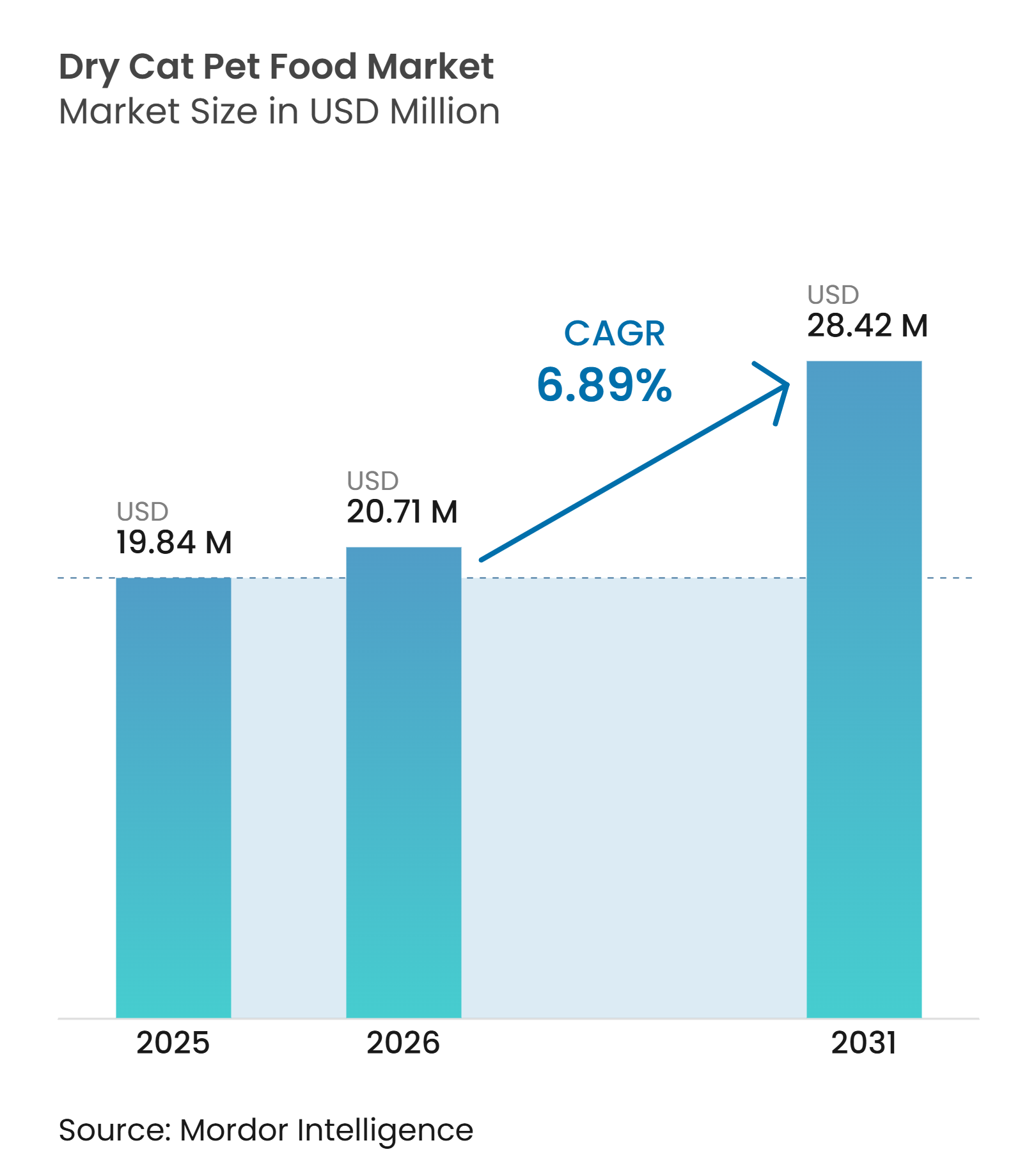
The Dry Cat Pet Food Market size is projected to expand from USD 19.84 million in 2025 and USD 20.71 million in 2026 to USD 28.42 million by 2031, registering a CAGR of 6.89% between 2026 and 2031. The dry cat food market is supported by rising cat ownership in urban homes, where ease of storage, feeding convenience, and reduced waste make dry food a practical daily choice. Premium buying behavior is also driving value growth, as more cat owners are moving toward functional recipes, higher-quality ingredients, and targeted health formulas that address urinary, digestive, and senior care needs. The dry cat food market is also benefiting from repeat online purchases, as subscription delivery reduces reorder friction and provides brands with a stable path to retention and personalized product suggestions. At the same time, manufacturers with larger procurement scales and stronger compliance systems are better placed to manage elevated protein costs and multi-year labeling changes, reinforcing the position of established companies. Capacity additions, premium portfolio extension, and early investment in personalized feeding tools are creating room for growth while also raising the operating threshold for smaller brands in the dry cat pet food market.
Key Report Takeaways
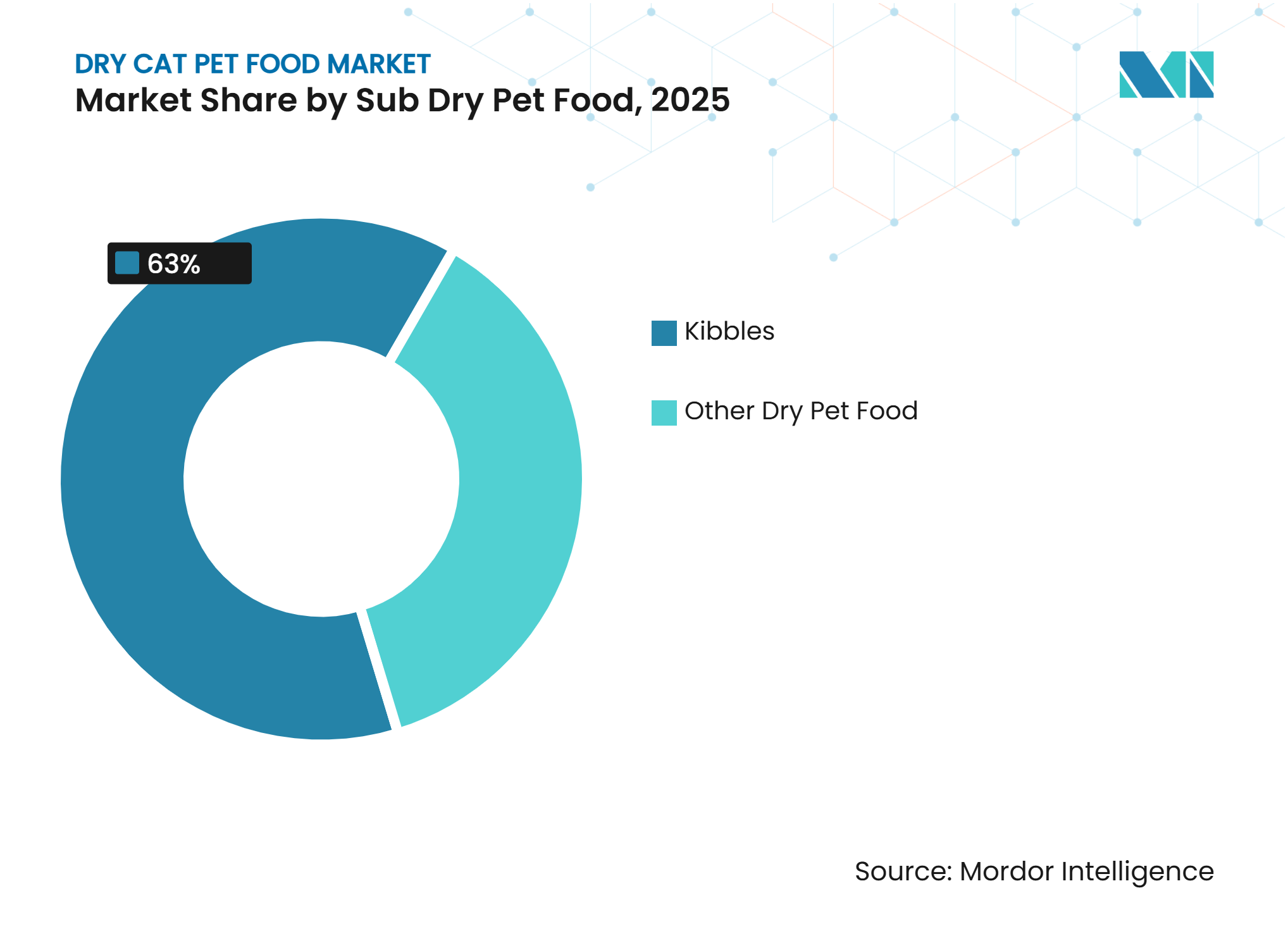
By sub dry pet food, kibbles were the largest segment with a 63.0% share in 2025, while the fastest segment CAGR was not provided in the user-supplied draft.
By ingredient type, protein ingredients were the largest segment with a 38.7% share in 2025, but the fastest segment CAGR was not provided in the user-supplied draft.
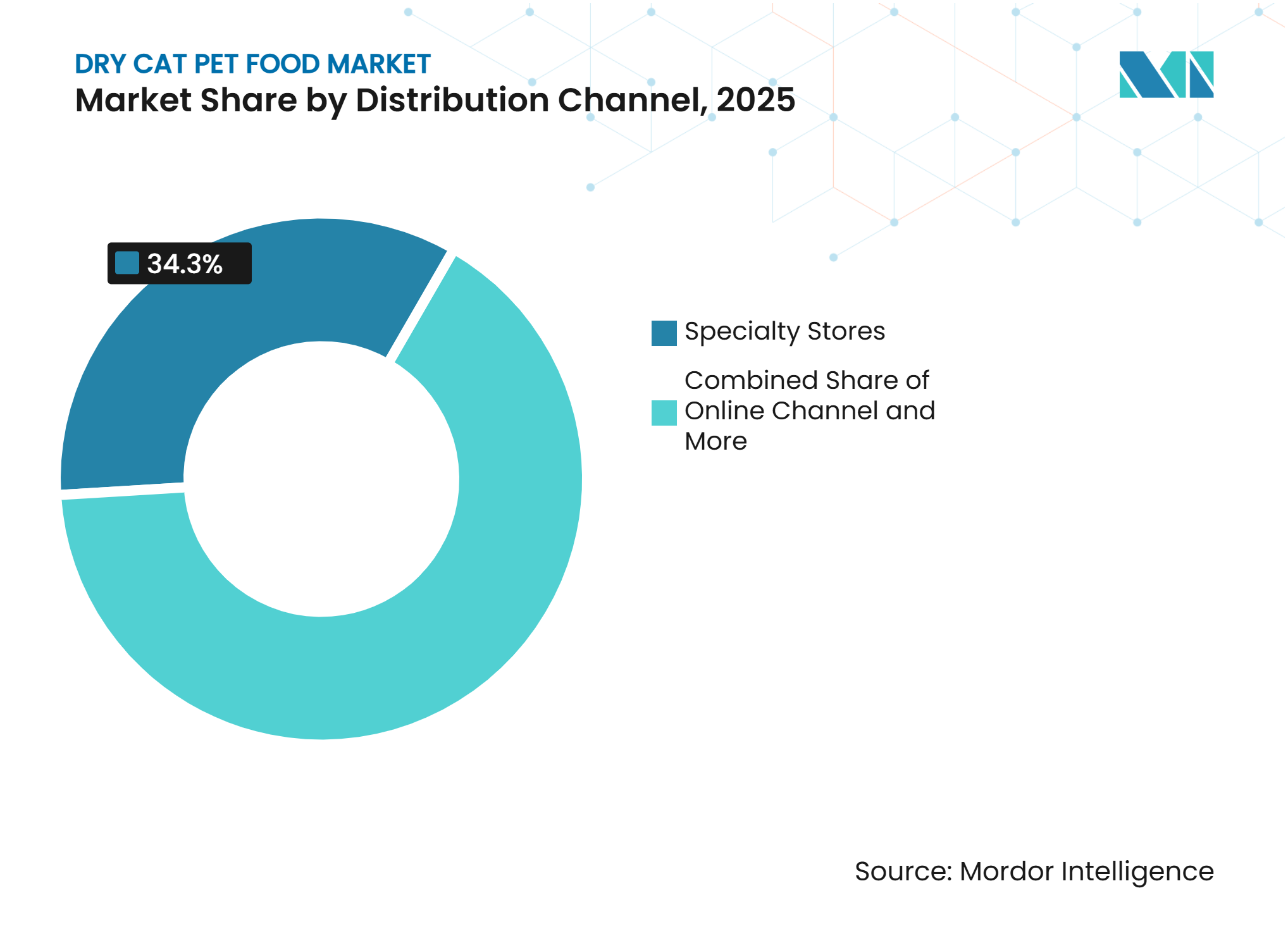
By distribution channel, specialty stores were the largest segment, accounting for 34.3% of the dry cat pet food market share in 2025, while the online channel was the fastest-growing segment and is projected to expand at an 8.8% CAGR through 2031.
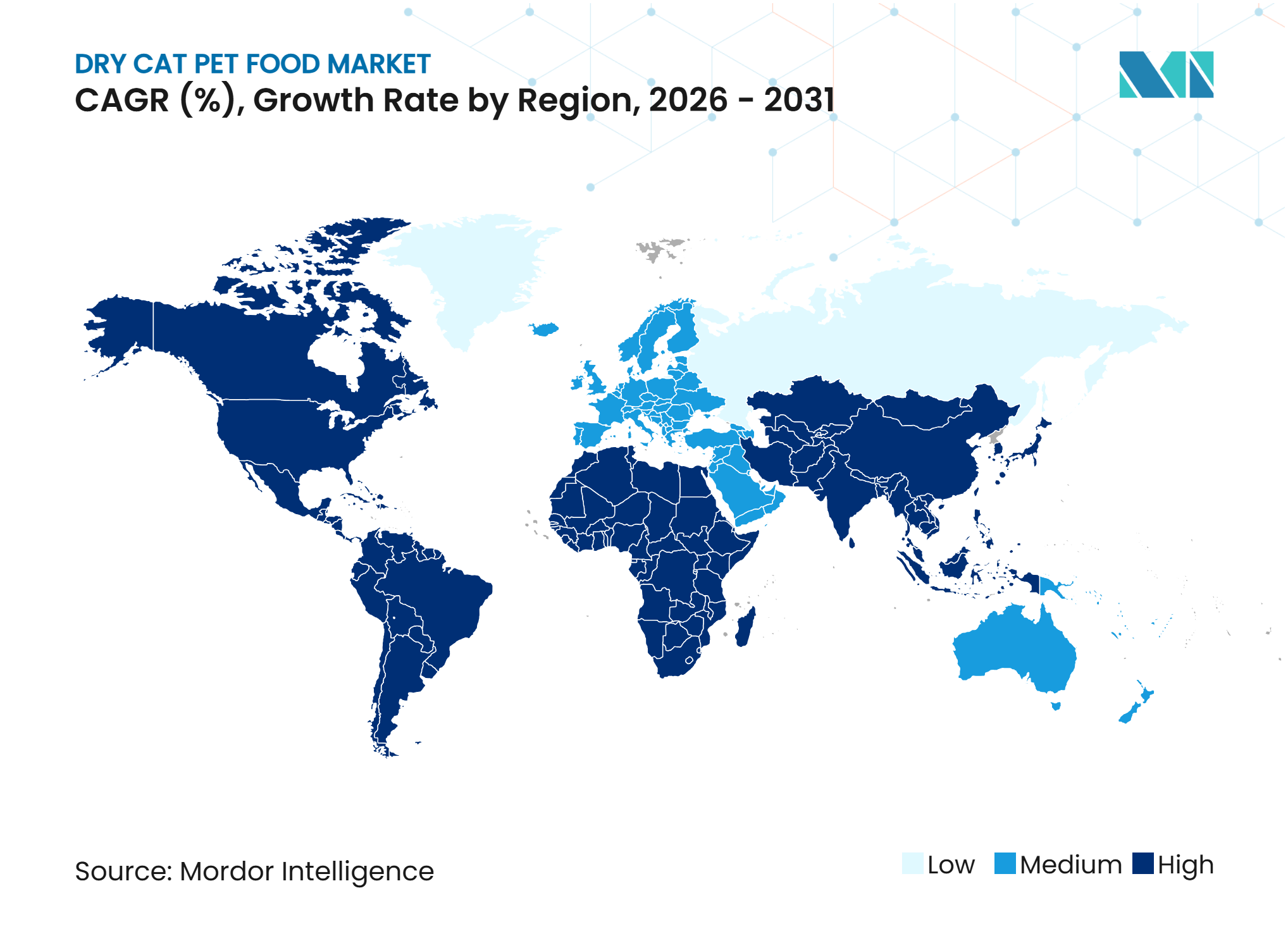
By geography, North America was the largest segment, accounting for 39.9% of the dry cat pet food market size in 2025, while Africa was the fastest-growing segment, projected to expand at an 8.6% CAGR through 2031.
Note: Market size and forecast figures in this report are generated using Mordor Intelligence’s proprietary estimation framework, updated with the latest available data and insights as of January 2026.
Market Trends and Insights
Drivers Impact Analysis of Dry Cat Pet Food Market*
| Driver | (~) % Impact on CAGR Forecast | Geographic Relevance | Impact Timeline |
|---|---|---|---|
| Rising cat ownership in urban single-person and senior households | +1.5% | Global, strongest in North America and Asia-Pacific | Medium term (2-4 years) |
| Dry food affordability and long shelf life | +1.2% | Global, strongest in South America and Africa | Short term (≤ 2 years) |
| E-commerce reordering and subscription penetration | +1.0% | North America, Europe, and Asia-Pacific | Medium term (2-4 years) |
| Premiumization of functional dry kibble | +1.3% | North America and Europe, with spillover to Asia-Pacific | Medium term (2-4 years) |
| Insect and single-cell protein reformulation | +0.6% | Europe and North America | Long term (≥ 4 years) |
| Ai-guided personalized feline nutrition | +0.4% | North America, Japan, and Northern Europe | Long term (≥ 4 years) |
| Source: Mordor Intelligence | |||
Rising Cat Ownership in Urban Single-Person and Senior Households
The dry cat pet food market is gaining steady support from the expansion of single-person and senior households that favor cats over more demanding companion animals. The American Pet Products Association reported that cat ownership in the United States rose in 2024, reaching 49 million households, and homes with 3 or more cats increased. These homes usually value easy storage, clean feeding, and flexible portion control, which makes dry food better suited to daily routines than wet food that spoils faster. This pattern also supports higher-value products because older cat populations and multi-cat homes are more likely to buy dental care, kidney care, and joint support products. The same urban living pattern is supporting the dry cat pet food market across Asia-Pacific, where cats fit smaller homes and busier schedules more easily than larger pets.
Dry Food Affordability and Long Shelf Life
The dry cat pet food market continues to benefit from the cost efficiency of kibble, especially in regions where household budgets remain tight. Dry food carries an ambient shelf life of 12 to 18 months, which removes cold chain dependence and helps retailers distribute products more widely in South America, Africa, and parts of the Middle East. The Pet Food Institute and IFEEDER reported that upcycled ingredients entered measured pet food manufacturing in 2024, with over 1 million metric tons used in cat food, showing that cost and ingredient efficiency are improving at the production level[1]. This makes dry food the practical volume base of the category, because consumers often shift within price tiers before moving away from the format itself. Retailers also benefit because dry products reduce spoilage risk and make inventory handling easier across the dry cat pet food market.
E-Commerce Reordering and Subscription Penetration
The dry cat pet food market is seeing stronger channel support from digital ordering and subscription replenishment. The Pet Food Institute stated that online channels now account for 40% of pet food sales in the United States, and dry cat food is among the most suitable categories for recurring delivery because feeding routines are predictable. Subscription models reduce shopping friction and lower switching rates, which gives brands more stable repeat demand and better visibility into future sales. They also generate direct consumption data on reorder timing, bag size, and health-related product migration, which helps brands refine assortment more quickly than store-only competitors. This leaves meaningful room for the dry cat pet food market to keep expanding online in regions where digital payments and delivery networks are still developing.
Premiumization of Functional Dry Kibble
The dry cat pet food market is gaining value as functional kibble narrows the perceived gap between ordinary dry food and more premium feeding formats. In October 2024, the United States Food and Drug Administration issued Guidance for Industry No. 284, which provides manufacturers with a validated relative supersaturation method to support urinary tract health claims in adult maintenance cat food. This raises the commercial appeal of premium dry products tied to urinary health, renal support, and other senior cat needs that can command stronger pricing. Brands that add freeze-dried inclusions, probiotics, or targeted mineral balance are therefore pushing the dry cat pet food market upward in both price realization and product differentiation.
Restraints Impact Analysis of Dry Cat Pet Food Market*
| Restraint | (~) % Impact on CAGR Forecast | Geographic Relevance | Impact Timeline |
|---|---|---|---|
| Volatile meat and fish meal input costs | -1.3% | Global, strongest in Asia-Pacific and Europe | Short term (≤ 2 years) |
| Tight labeling and food safety compliance burden | -0.8% | North America and the European Union | Medium term (2-4 years) |
| Premium price sensitivity in inflationary cycles | -1.0% | Global, strongest in South America and Africa | Short term (≤ 2 years) |
| Carbon footprint scrutiny on animal protein formulations | -0.6% | Europe and North America | Long term (≥ 4 years) |
| Source: Mordor Intelligence | |||
Volatile Meat And Fish Meal Input Costs
The dry cat pet food market remains exposed to protein cost volatility because cat diets depend heavily on animal-based and fish-derived ingredients. The Pet Food Institute and IFEEDER noted that marine ingredients were the most valuable ingredient category by weight in United States cat food manufacturing in 2024, underscoring how sensitive this category is to movements in fishery and protein costs. The Producer Price Index for meats, poultry, and fish has remained elevated since 2024, suggesting a firmer cost floor rather than a short-lived spike[2]. User-supplied material also showed taurine price fluctuations of 15% to 25% year on year, which adds another pressure point because most feline formulas require supplementation. This environment favors larger companies with stronger buying power and longer procurement contracts, which can squeeze smaller operators across the dry cat pet food market.
Tight Labeling And Food Safety Compliance Burden
The dry cat pet food market faces a longer compliance cycle because labeling standards are changing across many product lines at once. The Association of American Feed Control Officials published its Pet Food Label Modernization framework in the 2024 Official Publication, and full compliance is required by 2030. The same regulatory period also includes more detailed work on ingredient statements, nutritional panels, and supporting documentation, which increases redesign and verification costs for companies with broad portfolios. The October 2024 expiration of the memorandum of understanding between the United States Food and Drug Administration and the Association of American Feed Control Officials also left added uncertainty around novel ingredient pathways in the user-supplied draft. While these changes can eventually support clearer communication, they raise the operating burden in the dry cat pet food market during the transition period.
*Our forecasts treat driver/restraint impacts as directional, not additive. The impact forecasts reflect baseline growth, mix effects, and variable interactions.
Dry Cat Pet Food Market Segment Analysis
By Sub Dry Pet Food:
Kibbles Anchor Volume While Premium Variants Drive ValueKibbles were the largest segment and accounted for 63.0% of dry cat pet food market size in 2025. Their lead comes from easy storage, broad price coverage, and a formulation base that can support everyday maintenance recipes as well as veterinary and therapeutic diets. This makes kibbles the central volume engine of the dry cat pet food market, especially in homes that want convenience and less spoilage risk. The J.M. Smucker Company stated in user supplied material that its Meow Mix Gravy Bursts line ranked as the top dry cat food innovation launch in the 2025 measured retail period, which shows how product upgrades can still move household penetration within a mature format. Other dry pet food formats, including biscuits and pellet blends, remain smaller because they are used more for variety or targeted functions than for complete daily feeding.
Within kibbles, a clear split is now emerging between mainstream value products and premium variants with higher per unit realization. The dry cat pet food industry is seeing stronger competition in freeze dried raw blends, cold pressed recipes, and breed specific formulas that push the format above its older commodity image. General Mills, Inc. launched Edgard and Cooper in the United States in July 2025 through PetSmart, using fresh ingredient positioning to extend its premium reach in dry food. This places pressure on middle tier kibble, because it now faces upgraded premium offers above and stronger private label pressure below. As a result, the dry cat pet food market is becoming more polarized in value capture even though kibble remains the largest product format by volume.



By Ingredient Type:
Protein Ingredients Drive Feline Nutrition StandardsProtein ingredients were the largest segment with 38.7% share in 2025. Their lead reflects the biological needs of cats, which require amino acids such as taurine and arginine from dietary protein sources. Poultry meal, fish meal, and meat byproducts remain the foundation of many formulas, but clean-label preferences are opening the door to hybrid systems that combine animal inputs with pea or potato protein. The Pet Food Institute and IFEEDER also recorded more than 1 million metric tons of upcycled ingredients in cat food in 2024, suggesting that sourcing innovation is beginning to serve both efficiency and sustainability goals. Cereals and cereal derivatives still matter because they support extrusion structure and affordable calorie delivery, even though their role is more limited in premium grain-free positioning.
The others category remains smaller by weight, but it has an outsized effect on palatability, micronutrient balance, and health claim support. That means formulation expertise is becoming more important than simple ingredient sourcing in parts of the dry cat pet food market. Europe has moved earlier on alternative proteins under the European Union's novel food and feed framework, which gives manufacturers in that region a clearer path to commercial launches of insect-based products than some competitors elsewhere. This timing gap could support technology licensing or selective acquisitions if larger companies want to close capability gaps more quickly. The dry cat food industry is therefore shifting toward a more specialized ingredient model, where regulatory readiness and formulation know-how can matter as much as raw-material access.
By Distribution Channel:
Specialty Stores Lead Share While Online Ordering Expands FastestSpecialty stores were the largest channel with 34.3% share in 2025, while the online channel recorded the fastest growth with an 8.8% CAGR through 2031, making it the most dynamic route in the dry cat pet food market size outlook. Specialty stores hold their position because trained staff, curated assortments, and loyalty programs help shoppers trade up into premium and functional products. In June 2026, Open Farm and PetSmart expanded access to premium pet nutrition across nearly 1,700 North American stores, which strengthens the role of specialty retail in recommendation-led purchases. Supermarkets and hypermarkets still account for significant volume because they remain convenient for routine shopping, but their growth is slower as premium buyers shift to more specialized channels. Convenience stores and other channels stay limited because dry cat food is bulky and often bought in planned rather than impulse purchases.
The online channel is expanding faster because subscriptions remove reorder friction and support tailored product discovery. That makes digital platforms increasingly important to the dry cat pet food market, especially for premium formulas that depend on repeat use and higher trust. E-commerce players also have more direct access to shopper data, which helps them adjust their product mix and pricing more quickly than physical retailers. At the same time, specialty chains are investing more in loyalty programs and digital integration to protect their customer base from online switching. The result is a channel structure in which store-led advice and digital replenishment increasingly work side by side rather than as separate models.

Geography Analysis
North America was the largest region, accounting for 39.9% of the dry cat pet food market share in 2025. The region benefits from a large ownership base, because the American Pet Products Association reported that 49 million households in the United States owned at least 1 cat by the end of 2024, after a 23% increase during the year. Mature specialty retail, deeper online adoption, and broad premium brand architecture keep North America at the center of value creation in the dry cat pet food market. Nestlé S.A. has opened its USD 550 million Batavia, Ohio, facility in May 2026, which produces dry cat and dog food for Purina Pro Plan, Purina ONE, and Dog Chow, and signals continued confidence in regional demand.
Europe remains an important center for premium and regulatory standards in the dry cat pet food market. The region has stronger early movement on insect derived ingredient approvals and labeling alignment, which raises compliance demands but also creates barriers that can protect early movers. Asia-Pacific shows wider internal variation, with Japan representing a mature premium environment and China offering larger volume expansion potential. Unicharm Corporation commenced full operations at a new pet food manufacturing plant in China in September 2025, which reduced transport distances and lead times compared with its earlier import-led model. In Australia, Mars, Incorporated opened its AUD 112.5 million (USD 73 million) Wodonga facility in June 2026, expanding local pet food manufacturing capacity through automated production.
Africa was the fastest-growing region and is projected to expand at an 8.6% CAGR through 2031, putting it at the forefront of growth in the dry cat pet food market by geography. Urbanization, rising household incomes, and the format advantage of ambient storage support wider distribution in markets with less developed cold chain infrastructure. South America is also moving from a lower-penetration base toward a more competitive environment as multinationals deepen their manufacturing reach and increase category investment. The Middle East remains more import-dependent, but higher urban disposable incomes and improving retail infrastructure are supporting steady demand for dry cat food across the main Gulf markets. These patterns show that the dry cat pet food market is still driven by mature value pools in North America and Europe, while faster incremental expansion comes from Africa and selected emerging markets.
Competitive Landscape
Market Concentration
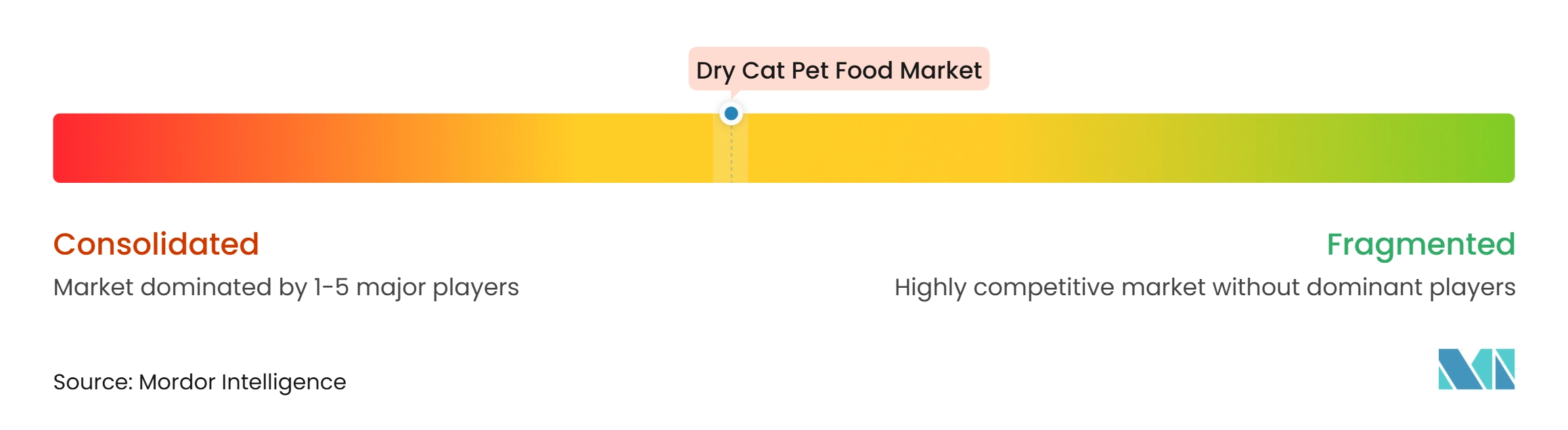
The dry cat pet food market shows moderate concentration in 2025, with large multinational companies holding a strong position across economy, mainstream, therapeutic, and premium price bands. Nestlé S.A. (Purina), Mars, Incorporated, General Mills, Inc., The J.M. Smucker Company, and Colgate-Palmolive Company benefit from scale in procurement, manufacturing, and channel access, while regional specialists remain relevant where local sourcing and retailer relationships are harder to replicate quickly. This structure keeps the dry cat food market competitive, but it still favors companies that can absorb ingredient volatility, navigate regulatory transitions, and support higher promotional and innovation spending. Smaller players can still win in niche spaces such as allergy management, premium kibble, and personalized nutrition, but they face a higher operating threshold than before. The current shape of competition is therefore broad enough to avoid tight dominance, yet concentrated enough to reward scale and execution.
Capacity expansion has become one of the clearest strategic signals in the dry cat pet food market. Nestlé S.A. opened its USD 550 million Batavia facility in Ohio in May 2026, while Mars, Incorporated opened its USD 450 million Royal Canin facility in Lewisburg, Ohio, in May 2025[3]. General Mills, Inc. also extended its premium platform through the United States launch of Edgard and Cooper in July 2025, demonstrating how brand elevation and portfolio extension work alongside plant investment. Nasta Pet Food acquired FirstMate Pet Foods in February 2026, creating a 54,000 metric ton dry pet food platform in North America and strengthening challenger scale in ultra premium products.
Another area of competition is moving beyond physical distribution into formulation and data capability. Functional products tied to urinary care, digestion, and senior cat health are expanding as clinical positioning becomes more important to brand value. The October 2024 urinary tract health guidance from the United States Food and Drug Administration supports more structured claim development for adult maintenance cat food, helping larger companies move faster with validated premium offerings. At the same time, alternative proteins and artificial intelligence-supported feeding tools are opening new ground where faster brands can still stand out before the category becomes more standardized. The dry cat pet food market is therefore likely to remain moderately consolidated, with leadership shaped by scale, compliance-readiness, product science, and selective digital capability rather than by price alone.
Dry Cat Pet Food Industry Leaders
-
Mars, Incorporated
-
Colgate-Palmolive Company
-
General Mills, Inc.
-
The J.M. Smucker Company
-
Nestle S.A. (Purina)
- *Disclaimer: Major Players sorted in no particular order
Dry Cat Pet Food Market Companies Covered in this Report
- Nestle S.A. (Purina)
- Mars, Incorporated
- Colgate-Palmolive Company
- General Mills, Inc.
- The J.M. Smucker Company
- Wellness Pet Company, Inc.
- Unicharm Corporation
- Affinity Petcare, S.A.
- Diamond Pet Foods, Inc.
- Deuerer GmbH
- Sunshine Mills, Inc.
- heristo aktiengesellschaft
- Agroindustrias Baires S.A.
- Central Garden and Pet Company
- Simmons Foods, Inc.
Recent Industry Developments in Dry Cat Pet Food Market
- May 2026: Nestlé S.A. (Purina) announced the grand opening of its USD 550 million Batavia, Ohio, facility, the company's first ground-up factory construction since 1975 and one of Nestlé's largest manufacturing investments in Purina to date. The 1.2-million-square-foot plant produces dry cat and dog food for Purina Pro Plan, Purina ONE, and Dog Chow, with current staffing of over 340 associates projcted to grow to over 500.
- February 2026: Nasta Pet Food acquired FirstMate Pet Foods and its parent company Taplow Ventures Ltd in British Columbia, Canada, establishing a combined dry pet food manufacturing capacity of 54,000 metric tons annually in North America. The combined entity is projected to generate EUR 200 million (USD 220 million) in consolidated revenue in 2026.
- December 2025: Unicharm Corporation launched Gin no Spoon Nippon Select Ajiwai Crunch, a premium dry cat treat using domestically sourced ingredients from Japanese regional provenance designations. The launch reflects Unicharm Corporation's provenance-based premium positioning strategy in Japan's mature functional feline nutrition market.
Global Dry Cat Pet Food Market Report Scope
Cat foods are usually intended to provide complete and balanced nutrition for cats but are primarily used as functional products. A dry, biscuit, or kibble diet is a processed pet food diet. The Dry Cat Food Market is segmented by Product Type, Ingredient Type, Distribution Channel, and Geography. Product Types are further segmented into Kibble and Other Dry Pet Food. The Ingredient Types are further segmented into Protein, Cereal and Cereal Derivatives, and Other Ingredient Types. The Distribution Channels are further segmented into Specialized Pet Stores, Supermarkets/Hypermarkets, Online Channels, and Other Distribution Channels. The report is further segmented by Geography into North America, Europe, Asia-Pacific, South America, and the Middle East & Africa. The report offers the market size for all the above segments in terms of value (USD).
Segmentation Overview
| Kibbles |
| Other Dry Pet Food |
| Protein | Animal-Derived |
| Plant-Derived | |
| Cereals and Cereal Derivatives | |
| Others |
| Convenience Stores |
| Online Channel |
| Specialty Stores |
| Supermarkets/Hypermarkets |
| Other Channels |
| North America | United States |
| Canada | |
| Mexico | |
| Rest of North America | |
| South America | Brazil |
| Argentina | |
| Rest of South America | |
| Europe | Germany |
| United Kingdom | |
| France | |
| Italy | |
| Spain | |
| Russia | |
| Rest of Europe | |
| Asia-Pacific | China |
| India | |
| Japan | |
| South Korea | |
| Australia and New Zealand | |
| Rest of Asia-Pacific | |
| Middle East | Saudi Arabia |
| United Arab Emirates | |
| Rest of Middle East | |
| Africa | South Africa |
| Egypt | |
| Rest of Africa |
| Sub Dry Pet Food | Kibbles | |
| Other Dry Pet Food | ||
| Ingredient Type | Protein | Animal-Derived |
| Plant-Derived | ||
| Cereals and Cereal Derivatives | ||
| Others | ||
| Distribution Channel | Convenience Stores | |
| Online Channel | ||
| Specialty Stores | ||
| Supermarkets/Hypermarkets | ||
| Other Channels | ||
| Geography | North America | United States |
| Canada | ||
| Mexico | ||
| Rest of North America | ||
| South America | Brazil | |
| Argentina | ||
| Rest of South America | ||
| Europe | Germany | |
| United Kingdom | ||
| France | ||
| Italy | ||
| Spain | ||
| Russia | ||
| Rest of Europe | ||
| Asia-Pacific | China | |
| India | ||
| Japan | ||
| South Korea | ||
| Australia and New Zealand | ||
| Rest of Asia-Pacific | ||
| Middle East | Saudi Arabia | |
| United Arab Emirates | ||
| Rest of Middle East | ||
| Africa | South Africa | |
| Egypt | ||
| Rest of Africa | ||
Key Questions Answered in the Report
What is the 2031 value outlook for dry cat pet food?
The category is projected to reach USD 28.42 billion by 2031, rising from USD 20.71 billion in 2026 at a 6.89% CAGR.
Which product format leads sales for cats?
Kibbles are the largest format, holding 63.0% share in 2025 because they offer convenience, long shelf life, and broad price coverage.
Which sales channel is expanding the fastest for cat kibble purchases?
The online channel is the fastest growing route, with an 8.8% CAGR through 2031, supported by subscriptions and repeat ordering.
Which region leads global demand for dry cat food?
North America is the largest region with 39.9% share in 2025, backed by a large cat owning population and strong premium retail infrastructure.
Which region is projected to grow the fastest through 2031?
Africa is projected to record the fastest regional growth at an 8.6% CAGR, helped by urbanization and the storage advantages of dry food.
What are the main risks affecting producers in this category?
The main pressures are elevated animal protein costs, labeling and compliance changes, premium price sensitivity in inflationary periods, and rising scrutiny of ingredient carbon footprints.