
Downdraft Range Hoods Market Size and Share
Market Overview
| Study Period | 2019 - 2031 |
|---|---|
| Market Size (2026) | USD 2.38 Billion |
| Market Size (2031) | USD 3.21 Billion |
| Growth Rate (2026 - 2031) | 6.17 % |
| Fastest Growing Market | Asia Pacific |
| Largest Market | North America |
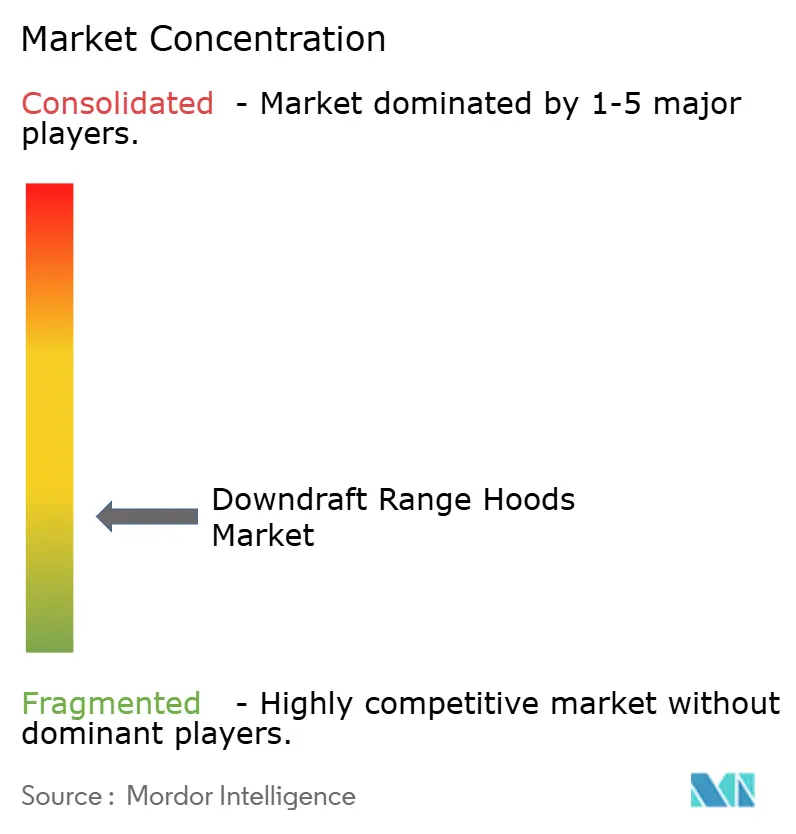
| Market Concentration | Low |
Major Players *Disclaimer: Major Players sorted in no particular order Image © Mordor Intelligence. Reuse requires attribution under CC BY 4.0. | |
Downdraft Range Hoods Market Analysis by Mordor Intelligence
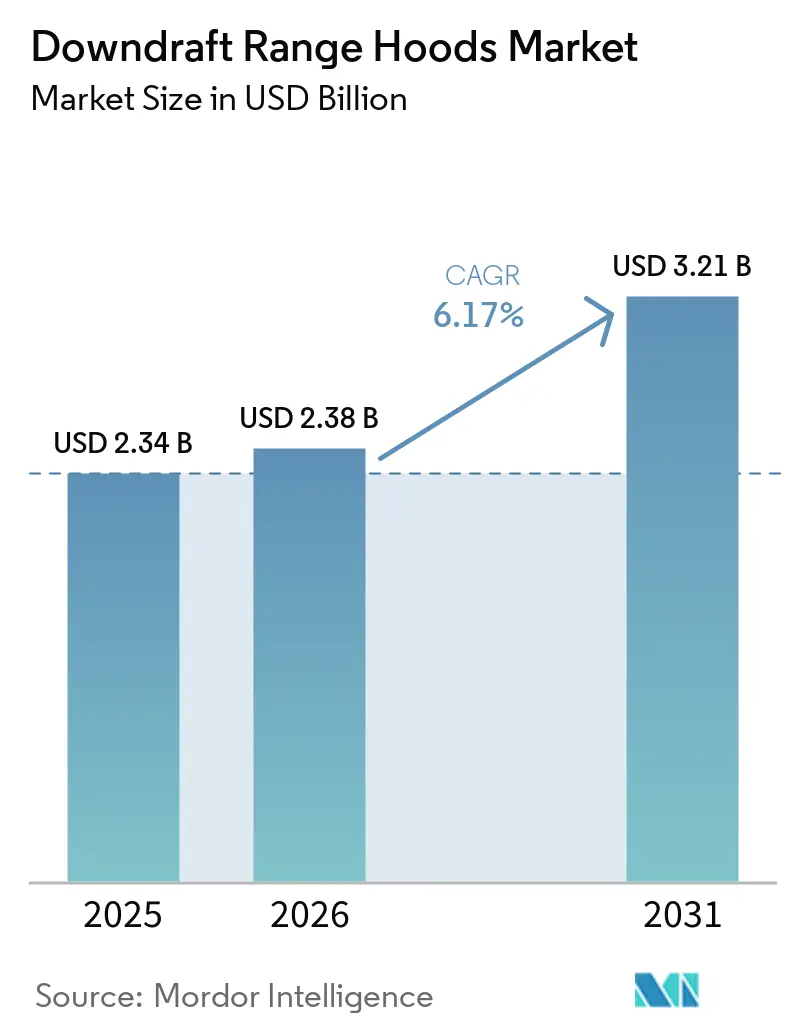
The downdraft range hoods market size is expected to grow from USD 2.34 billion in 2025 to USD 2.38 billion in 2026 and is forecast to reach USD 3.21 billion by 2031 at 6.17% CAGR over 2026-2031. Within the broader built-in kitchen ecosystem, the downdraft range hood market is advancing steadily as it meets code-compliant ventilation needs where overhead hoods are impractical, especially in island and peninsula layouts. Demand is concentrated on open-plan renovations in North America and Western Europe, where designers prioritize sightlines and flexible lighting while maintaining capture at source. Code tightening around indoor air quality, exemplified by California’s Title 24 makeup-air trigger at 400 CFM, reinforces adoption of solutions that can meet capture requirements while minimizing disruption to architectural plans [1]California Energy Commission, “Building Energy Efficiency Standards Title 24,” California Energy Commission, energy.ca.gov . Hospitality operators renovating open kitchens continue to specify discreet systems that align with guest-facing formats and commercial ventilation codes, which sustains the category’s relevance across premium projects. The downdraft range hoods market also benefits from incremental advances in motors, filtration, and acoustics that reduce noise at the cook’s head height and improve near-source capture without compromising aesthetics.
Key Report Takeaways
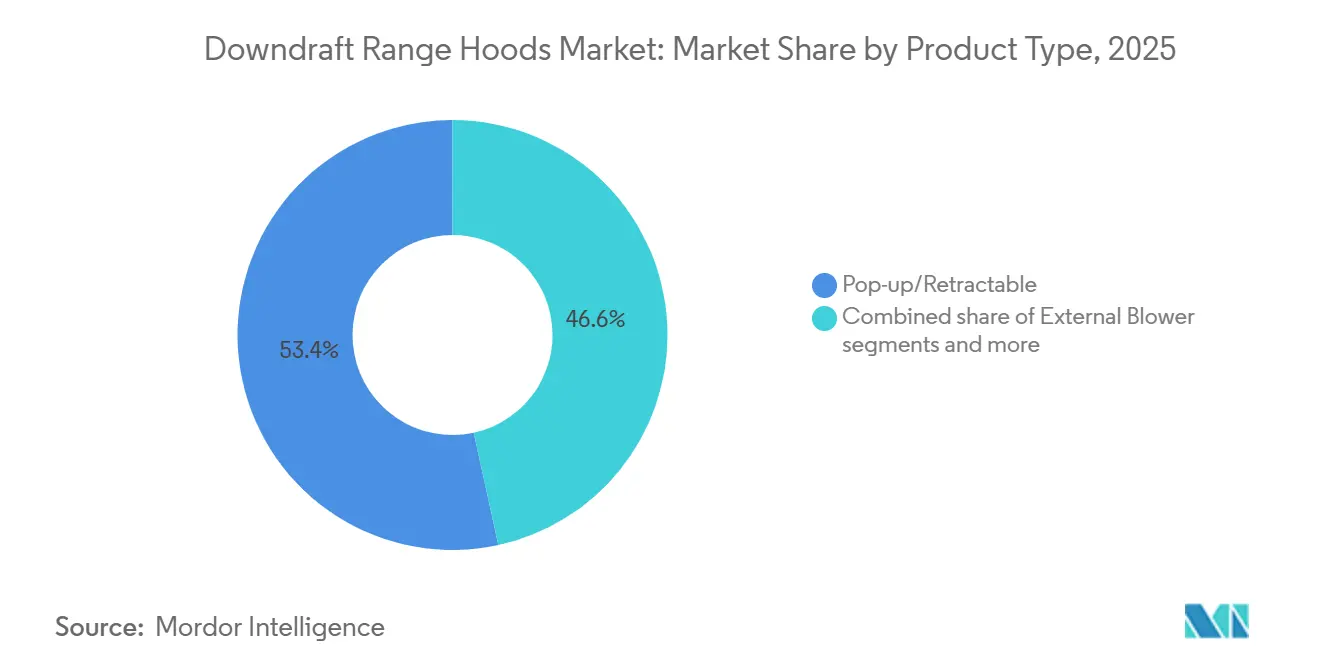
- By product type, pop-up or retractable models led with 53.42% revenue share in 2025 in the downdraft range hoods market, while the same category is projected to deliver a 6.72% CAGR through 2031.
- By venting type, ducted configurations accounted for 64.31% in 2025 in the downdraft range hoods market, whereas ductless or recirculating systems are forecast to expand at a 7.24% CAGR through 2031.
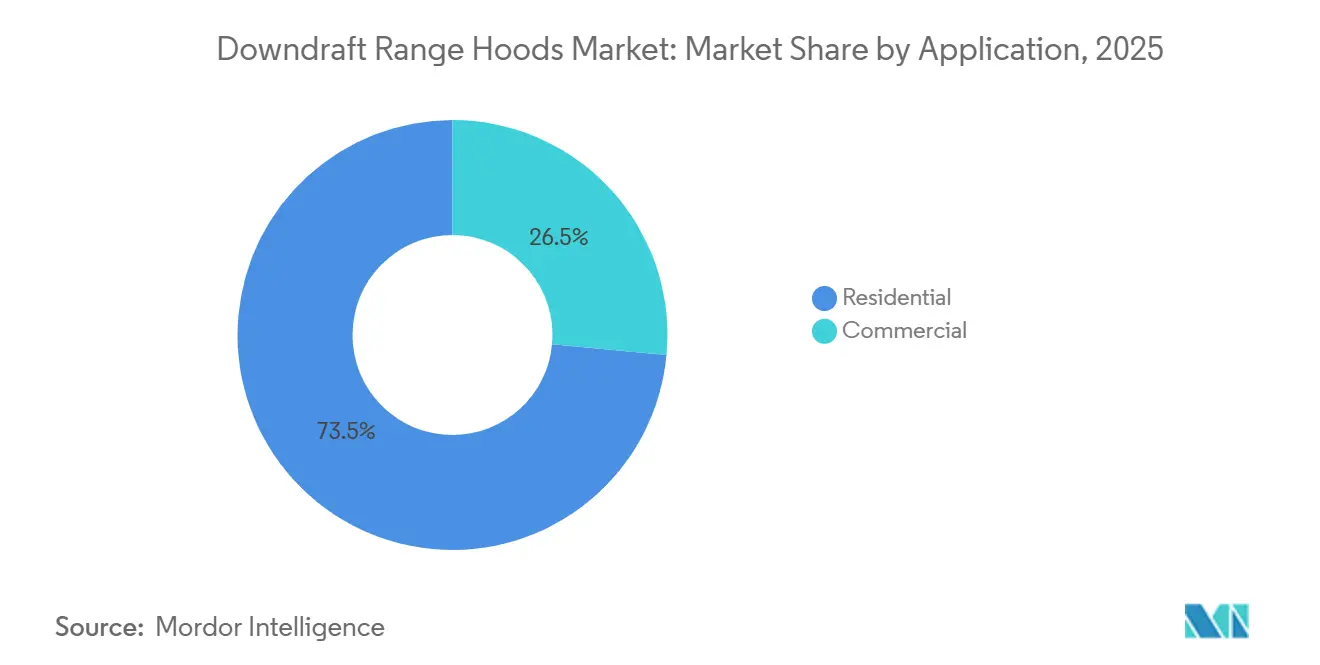
- By application, residential installations accounted for 73.52% in 2025 in the downdraft range hood market, and commercial deployments are advancing at a 7.87% CAGR through 2031.
- By distribution channel, B2C or indirect routes held 67.72% in 2025 in the downdraft range hoods market, with B2B or direct sales projected to grow at 7.13% CAGR to 2031.
- By geography, North America accounted for 39.91% in 2025 in the downdraft range hood market, while Asia-Pacific is projected to be the fastest-growing region at a 7.36% CAGR through 2031.
Note: Market size and forecast figures in this report are generated using Mordor Intelligence’s proprietary estimation framework, updated with the latest available data and insights as of January 2026.
Global Downdraft Range Hoods Market Trends and Insights
Drivers Impact Analysis*
| Driver | (~) % Impact on CAGR Forecast | Geographic Relevance | Impact Timeline |
|---|---|---|---|
| Open-kitchen remodeling and premium built-in adoption are accelerating downdraft uptake | +1.2% | North America & European Union | Medium term (2-4 years) |
| Shift to induction and integrated venting hobs in the European Union and premium segments | +0.9% | European Union core, spill-over to North America premium | Medium term (2-4 years) |
| Indoor air quality focus and code compliance are pushing for effective capture at source | +1.5% | Global, with early gains in California, Germany, United Kingdom | Short term (≤ 2 years) |
| E-commerce and D2C enabling configuration and reach for premium downdrafts | +0.7% | Global | Short term (≤ 2 years) |
| Hospitality refurb cycles specifying discreet island ventilation | +0.8% | Asia-Pacific core, Middle East, North America secondary | Medium term (2-4 years) |
| Motor, filtration, and acoustic advances enabling quieter, higher-capture flush downdrafts | +1.1% | Global | Long term (≥ 4 years) |
| Source: Mordor Intelligence | |||
Open-Kitchen Remodeling and Premium Built-In Adoption Accelerating Downdraft Uptake
Kitchen designers and homeowners have continued to favor islands and peninsulas, which raises the appeal of concealed ventilation that preserves sightlines in open-plan spaces. In 2026, appliance makers report steady uptake of integrated extractor formats, confirming that the downdraft range hoods market benefits from layout-driven renovation choices rather than broad replacement cycles alone. The downdraft range hoods market fits remodels where soffits conflict with lighting plans and where vent paths for overhead hoods would be costly or impractical. Jurisdictions that have adopted stringent ventilation rules reinforce configurations that capture at source, which supports solutions that sit close to the cooking surface. On the commercial side, open-kitchen restaurants and boutique hotels continue to adopt discreet extraction to protect the guest experience while aligning with code, which sustains premium demand for integrated downdraft platforms. These factors collectively keep the downdraft range hoods market positioned as a strategic niche within premium kitchen renovations.
Shift to Induction and Integrated Venting Hobs in the European Union and Premium Segments
Electrification and premium induction formats are changing ventilation architecture by reducing vertical plumes and enabling near-source capture with integrated extractor hobs. Leading European designs now bundle sensors that modulate extraction based on vapor density, narrowing performance gaps with traditional hoods while keeping decibel levels suitable for open-plan living. European Union energy label reforms have also tightened expectations around grease filtration and efficiency, indirectly favoring well-engineered downdraft systems that achieve high separation close to heat sources [2]European Commission, “Energy Labeling Framework for Range Hoods,” EUR-Lex, eur-lex.europa.eu . North American brands have responded by partnering with European innovators to accelerate integrated induction-downdraft portfolios, thereby strengthening high-end design-led kitchen choices. As these capabilities spread through premium tiers, the downdraft range hoods market gains credibility among architects and builders who once defaulted to overhead canopies. The segment’s integration story now centers on performance parity with superior noise control rather than concealment alone, improving the category’s value proposition.
Indoor Air Quality Focus and Code Compliance Pushing Effective Capture at Source
Regulatory shifts continue to reshape specification decisions, most visibly through California’s Title 24 makeup-air trigger at 400 CFM, which prompts builders and homeowners to assess ventilation choices more rigorously at the design stage. ASHRAE 62.2’s provisions for minimum exhaust and capture efficiency alternatives further orient specifiers toward at-source solutions that can meet effectiveness targets without escalating airflow to uncomfortable noise or energy levels. Guidance on indoor pollutants has also raised awareness of cooking-related exposures, which pushes decision-makers toward systems that capture directly at the hob. In European commercial kitchens, grease filtration expectations are strict, and designs that achieve high fat separation near the cooktop can reduce maintenance frequency compared with ceiling-mounted alternatives. Hospitality deployments that pair downdrafts with energy-saving controls have demonstrated material operating reductions while maintaining compliance, which supports broader consideration in premium front-of-house formats. These regulations and results keep the downdraft range hoods market relevant to projects seeking both air quality assurance and operational efficiency.
Motor, Filtration and Acoustic Advances Enabling Quieter, Higher-Capture Flush Downdrafts
Component innovation helps the downdraft range hoods market improve real-world usability in open-plan homes where sound pressure at head height matters. BLDC motors feature prominently in premium models, lowering energy consumption and cutting noise compared with older AC designs. Flagship platforms show how optimized fan geometry, insulated housings, and smart modulation keep dB levels comfortable for social spaces. Filtration has advanced as well, with regenerable carbon modules and plasma-based systems extending service intervals and improving odor removal for recirculating use cases where exterior ducting is not feasible. Regulatory pathways that account for capture efficiency give designers flexibility to meet performance targets without oversizing airflow, aligning with integrated downdraft configurations that sit closer to the source. These gains combine to enhance the appeal of integrated systems in premium renovations, sustaining momentum for the market for downdraft range hoods.
Restraints Impact Analysis*
| Restraint | (~) % Impact on CAGR Forecast | Geographic Relevance | Impact Timeline |
|---|---|---|---|
| Capture-efficiency limits vs. updraft for high-heat/tall pots | -0.8% | Global | Medium term (2-4 years) |
| Install complexity and cabinetry/plinth constraints (especially retrofits) | -1.1% | North America & European Union | Short term (≤ 2 years) |
| Makeup-air code thresholds (>400 CFM) are raising the total install cost | -1.3% | North America, early European Union adoption | Short term (≤ 2 years) |
| Fragmented channels and counterfeit price pressure in select markets | -0.6% | Asia-Pacific, Latin America | Long term (≥ 4 years) |
| Source: Mordor Intelligence | |||
Capture-Efficiency Limits vs. Updraft for High-Heat/Tall Pots
Near-source extraction performs best when vapors form close to the intake, which means tall pots and high-heat techniques can exceed the effective capture zone for many downdraft designs. Performance is more consistent for shallow pans and searing tasks, while tall stockpots and high-moisture boiling can allow steam to rise beyond the draw path before being contained. Brands position integrated downdrafts as optimized for modern cooking styles and island layouts, rather than as one-for-one substitutes for large overhead canopies in every task. Commercial standards for hoods over heavy-duty equipment remain stringent, which reinforces the role of canopy systems for charbroiling and similar applications [3]National Fire Protection Association, “NFPA 96 Ventilation Control and Fire Protection of Commercial Cooking Operations,” NFPA, nfpa.org . Regulatory frameworks that acknowledge capture efficiency provide flexibility, but they do not eliminate the physics of buoyancy in challenging use cases. These realities confine the downdraft range hoods market mostly to moderate-duty cooking or to premium integrated platforms where layout advantages outweigh task-specific limits.
Makeup-Air Code Thresholds (>400 CFM) Raising Total Install Cost
Codes in many United States jurisdictions require makeup air for kitchen exhaust above a defined airflow threshold, which introduces additional components and an expanded installation scope that can increase project cost and complexity. California guidance further ties mechanical makeup air to energy modeling and synchrony with hood operation, which favors early planning and integrated mechanical designs. Where climates are cold, tempering the makeup air to preserve comfort also elevates power draw, which can offset efficiency gains from improved motors. Manufacturers offer accessories and control strategies to keep systems compliant and comfortable, but many retrofit projects face additional permitting and coordination steps that extend timelines. These requirements can push some projects to select lower-CFM settings or to default to traditional overhead hoods when budgets are tight. The downdraft range hoods market remains resilient despite these hurdles, though growth is fastest in new builds and premium renovations where mechanical coordination is planned from the outset.
*Our forecasts treat driver/restraint impacts as directional, not additive. The impact forecasts reflect baseline growth, mix effects, and variable interactions.
Segment Analysis
By Product Type: Pop-Up or Retractable Models Command Share Through Concealment and Noise Control
Pop-up or retractable designs captured 53.42% of the downdraft range hoods market share in 2025 as homeowners paid for a clean countertop look that retracts when cooking ends. Premium entries continue to reduce noise and automate extraction, strengthening the category’s appeal in open-plan homes. Flagship German and United States platforms couple precise airflow control with low dB levels suitable for social spaces, making them a default choice when designers want invisible ventilation. Brands also add app-linked controls and auto-sensing features that adapt fan speed to vapor density, translating into fewer manual adjustments during meal prep [4]Bosch Home, “Series 8 Induction with Integrated Ventilation,” Bosch Home, bosch-home.com . Model refreshes reflect this trajectory, with integrated induction-downdraft cooktops debuting in North America in 2025 to positive reviews and design awards. These attributes keep retractable units at the center of layout-driven renovations and sustain momentum for the downdraft range hoods market. Reliability concerns about lift mechanisms have eased as sealed actuators and improved grease management have become standard in newer designs from established manufacturers. As buyers focus on usability and acoustic comfort, pop-up solutions hold their price premium relative to fixed alternatives.
Fixed or flush-mounted downdrafts serve commercial operators and minimalist residential programs that want permanent, low-profile capture without moving parts. Outside-blower options help achieve very low in-kitchen noise by relocating motors to basements or exterior walls, where decibel impact is minimal for the cook. Where budgets and space allow, these configurations deliver strong performance with reduced head-height sound pressure. Manufacturers also emphasize grease separation near the source through optimized baffle geometry, which improves filtration effectiveness while lowering maintenance. Across both fixed and retractable formats, gains in BLDC motor efficiency and refined air channels reinforce the downdraft range hoods market’s position in high-end kitchen planning. As integrated induction remains ascendant, the segment is likely to retain its share lead due to a blend of concealment, comfort, and compatibility with premium cooktops.



By Venting Type: Ductless Systems Accelerate as Regenerable Carbon and Plasma Filtration Mature
Ducted solutions-maintained category leadership in 2025 due to proven odor removal and code fit for grease-laden vapors, yet ductless or recirculating designs are growing faster as filtration improves, and high-rise retrofits limit exterior penetration options. Regenerable carbon cartridges dramatically extend service life compared to traditional disposables, lowering the total cost of ownership in urban apartments and heritage settings where ducting to the outside is restricted. Plasma-based odor removal adds another option by breaking down contaminants without frequent filter changes, which narrows the practical gap with ducted exhaust for many everyday tasks. Standards continue to draw lines between residential recirculation and commercial Type I cooking, however, so projects with grease-heavy equipment still default to ducted systems with proven capture and discharge protocols. The downdraft range hoods market reflects these tradeoffs, with ductless growth centered on premium multifamily and condo renovations that cannot alter exterior envelopes.
Ducted configurations remain preferred in single-family homes and many commercial settings where exterior venting, makeup air strategies, and demand-control features can be coordinated at the design phase. For those projects, low-noise duct routing and remote blowers provide performance without compromising living-space ambiance. Recirculating systems thrive where codes or structures preclude ducting, and advances in regenerable media and plasma modules enhance their utility for everyday cooking. As buyers and specifiers balance maintenance, odor targets, noise, and compliance, both venting types maintain clear roles. The result is a venting mix that enables the downdraft range hoods market to serve both premium renovations and high-density housing with credible options. Ductless models will likely see continued share gains where advanced filtration and indoor-air goals align with strict building envelopes.
By Application: Commercial Formats Outpace Residential on Open-Kitchen and Front-of-House Use
Residential installations accounted for 73.52% in 2025, while commercial deployments are advancing at a 7.87% CAGR, bringing the downdraft range hood market size to 2031. The commercial uptick concentrates in open-kitchen restaurants and boutique hotels that want theater-style cooking without overhead canopies obstructing sightlines. Those environments reward integrated extraction that keeps noise and grease under control near the source, a fit reinforced by project case studies showing lower energy use when fan speed is modulated in real time. Marine and premium RV builds extend the logic, where constrained headroom and safety rules favor flush capture that preserves clearance pathways. Residential growth remains steady as island layouts proliferate and as technology reduces noise to conversation-friendly levels. The downdraft range hood market, therefore, benefits from a dual-source demand profile spanning premium homes and guest-facing hospitality venues.
Commercial kitchens have specific compliance requirements, such as equipment listing and surface finish standards, which have driven certified downdraft options tailored to HoReCa settings. Demand-control ventilation acceptance by codes and insurers also aligns well with near-source sensing architectures, strengthening the case for integrated platforms in energy-sensitive properties. In homes, homeowners who want minimalist design without sacrificing indoor air quality gravitate to integrated induction-downdraft hobs that align performance with clean lines. This convergence of design preference and code-led performance keeps both applications active contributors to the downdraft range hoods market.
By Distribution Channel: B2B Direct Scales Faster from a Lower Base as Buyers Seek Configuration Support
B2C or indirect routes held 67.72% in 2025 on the strength of showroom-led project management for complex installations, while B2B or direct channels are growing faster as builders, hospitality operators, and premium homeowners configure systems with manufacturers. Buyers value dimensioning tools, duct calculators, and integrated service coordination when planning downdraft systems, and direct platforms are investing in those workflows to reduce post-sale adjustments. Manufacturers also scale white-glove support for projects that need electrical, HVAC, and countertop trades aligned from design through commissioning. In parallel, certified installers and integrators remain essential where makeup air and control synchrony are required for code compliance. The downdraft range hoods market reflects this channel balance, with showrooms managing complexity for many homeowners while direct programs expand configuration options for commercial and custom residential buyers.
Pure-play direct sellers in the ventilation value chain continue to educate buyers on airflow, filtration, noise, and compliance tradeoffs, and this content-driven approach can shorten decision cycles for premium projects. As integrated downdraft platforms spread across premium cooktops, manufacturers with robust direct tooling and post-sale service are positioned to gain reach without sacrificing experience. Showrooms play a critical role by bundling on-site measurement, stonework, and installer coordination into a single point of accountability. The channel mix, rather than converging to a single dominant route, is evolving toward a hybrid that leverages both trusted local project managers and manufacturer-owned digital configuration. This hybrid path supports steady gains for the downdraft range hoods market across geographies and project types.
Geography Analysis
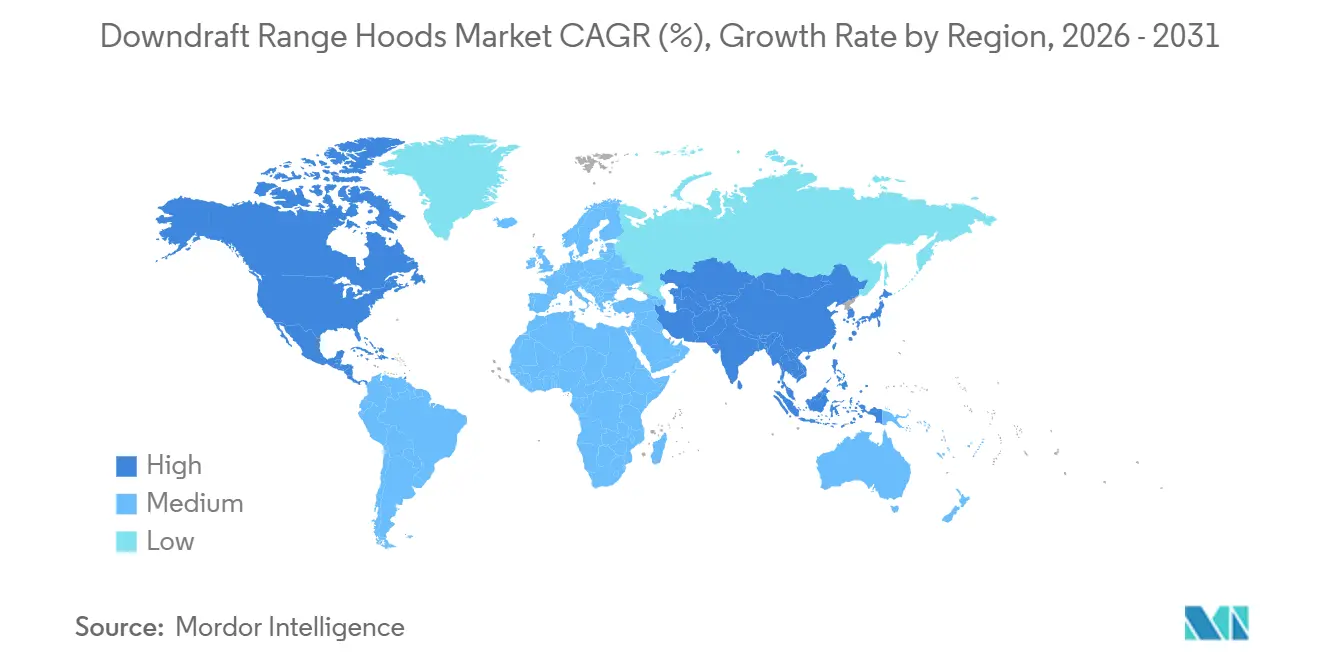
North America led with 39.91% in 2025 as open-plan renovations and strict ventilation codes shaped specification choices in both new builds and remodels. California’s Title 24 makeup-air trigger at 400 CFM has encouraged early-stage planning and integration with whole-house systems, a pattern that improves project outcomes for premium downdraft installations. The International Residential Code’s makeup-air provisions also reinforce careful airflow selection and control synchrony, which favors well-engineered systems and certified installers. As homeowners prioritize design continuity and low-noise performance, the downdraft range hood market in North America balances layout-driven demand with task-specific limitations, which still favor canopies for heavy-duty cooking. Canada’s code and climate differences influence adoption patterns within the region, and builders coordinate solutions that meet comfort and compliance without over-sizing extraction. With renovation intensity high and island layouts common, the downdraft range hoods market remains a key option in premium residential upgrades across the United States and Canada.
Europe continues to lead technology innovation, with integrated extractor hobs spreading across premium tiers and with energy labeling frameworks shaping filtration expectations. Acoustic optimization, BLDC motor integration, and regenerative filtration are now table stakes in top-end platforms, which raise buyer expectations for design-led kitchens. In 2026, appliance makers report that extractor hood sales in Europe have tilted toward hobs with integrated extraction, a signal that the downdraft range hoods market is a durable segment rather than a passing trend. Country-level preferences vary, and compact urban kitchens still often favor wall-mounted solutions, yet new-build island layouts and minimalist aesthetics keep integrated downdrafts in the consideration set. As premium consumers weigh storage, aesthetics, and performance, the downdraft range hoods market advances on the strength of product maturity and regulatory alignment across major European Union markets.
Asia-Pacific is projected to grow fastest at a 7.36% CAGR through 2031, propelled by premium residential adoption in select urban centers and hospitality investments showcasing open-kitchen formats. In 2026, multinational brands have stepped up investment and regional coordination to serve premium demand, including expanding product lines and connected features that resonate with technology-forward buyers. Australia’s standards exclude residential makeup air from the scope, which simplifies downdraft integration in homes compared to many United States jurisdictions. As codes accept demand-control ventilation in commercial settings, front-of-house concepts in Asia-Pacific hotels and restaurants continue to explore integrated downdraft, where equipment and menu profiles align with moderate-duty cooking. With urban high-rises and premium condos adding constraints on exterior penetrations, advanced recirculating filtration supports growth in select subsegments. This mix keeps the downdraft range hoods market positioned for above-average regional gains through 2031.

Competitive Landscape
Competition remains fragmented across regions, with strong local preferences and service ecosystems shaping brand reach. European innovation has influenced global roadmaps, and North American portfolios have incorporated integrated induction-downdraft cooktops through partnerships that accelerate premium offerings. Appliance makers that deliver low noise at head height, credible grease separation near the source, and smart modulation continue to differentiate in premium segments. Procurement decisions in commercial settings weigh certifications and compliance, which limits the field to listed and tested platforms for Type I equipment. These dynamics collectively support a steady share for incumbents with deep engineering pipelines and reliable after-sales networks.
Several manufacturers executed notable strategic moves that shape capacity and focus. JennAir launched its first BORA-partnered induction downdraft in early 2025, signaling a premium-tier refresh and alignment with European integrated design trends. BSH highlighted an ongoing shift toward integrated extractor hobs while elevating investment in AI-supported cooking ecosystems that are set to cascade into ventilation portfolios. Elica expanded its manufacturing footprint by acquiring a stake in Steel S.r.l., while also exiting a legacy joint venture in India to reallocate capital to higher-margin integrated platforms.
Demand-control ventilation acceptance by codes and insurers continues to influence front-of-house restaurant and hotel projects, where real-time modulation complements near-source sensing architectures. In parallel, direct-to-consumer specialists and manufacturer-owned direct channels have grown configuration support that helps buyers navigate ducting, filtration, and makeup-air planning for integrated systems. The most durable competitive advantages remain engineering depth, installer ecosystems, and certified compliance across commercial and residential codes. As these forces play out, brands with proven ultra-quiet operation, regenerable filtration, and integrated controls are best positioned to sustain premium share in the downdraft range hoods market.
Downdraft Range Hoods Industry Leaders
BSH Home Appliances
Sub-Zero Group
Elica S.p.A.
Whirlpool Corporation
BORA Vertrieb & Service
- *Disclaimer: Major Players sorted in no particular order

Recent Industry Developments
- October 2025: Wiggo introduced a BLDC-based cooker hood with 36 dB operation, illustrating the shift toward quieter motors and smoother speed control.
- February 2025: JennAir, a Whirlpool brand, launched a 36-inch induction downdraft cooktop developed with BORA, featuring Flex-Choice zones and low-noise fans, and received top design awards at KBIS 2025.


Global Downdraft Range Hoods Market Report Scope
Integrating the ventilation system directly into the cooking surface, a downdraft range or cooktop eliminates the need for an overhead vent. These systems capture smoke, steam, grease particles, and odors right at the cooking surface, pulling them down and out of the kitchen before they can escape into the air. Another form of downdraft ventilation, a retractable unit often referred to as a downdraft range hood, rises from near the cooking surface when in use.
The Global Downdraft Range Hoods Market segments by Product Type (Pop-up/Retractable, Fixed/Flush-mounted, External Blower, Internal Blower), Venting Type (Ducted, Ductless/Recirculating), Application (Residential, Commercial including HoReCa, Marine, RV, Others), Distribution Channel (B2B/Direct Sales, B2C/Indirect Sales with Offline and Online sub-channels), and Geography (North America, South America, Asia-Pacific, Europe, Middle East and Africa). Market Forecasts are Provided in Terms of Value (USD).
| Pop-up/Retractable |
| Fixed/Flush-mounted |
| External Blower |
| Internal Blower |
| Ducted |
| Ductless / Recirculating |
| Residential |
| Commercial (HoReCa, Marine, RV, Others) |
| B2B/Direct Sales | |
| B2C/Indirect Sales | Offline (Kitchen Showrooms, Big-Box Retail) |
| Online (e-Commerce, D2C) |
| North America | Canada |
| United States | |
| Mexico | |
| South America | Brazil |
| Peru | |
| Chile | |
| Argentina | |
| Rest of South America | |
| Asia-Pacific | India |
| China | |
| Japan | |
| Australia | |
| South Korea | |
| South East Asia (Singapore, Malaysia, Thailand, Indonesia, Vietnam, and Philippines) | |
| Rest of Asia-Pacific | |
| Europe | United Kingdom |
| Germany | |
| France | |
| Spain | |
| Italy | |
| BENELUX (Belgium, Netherlands, and Luxembourg) | |
| NORDICS (Denmark, Finland, Iceland, Norway, and Sweden) | |
| Rest of Europe | |
| Middle East and Africa | United Arab Emirates |
| Saudi Arabia | |
| South Africa | |
| Nigeria | |
| Rest of Middle East and Africa |
| By Product Type | Pop-up/Retractable | |
| Fixed/Flush-mounted | ||
| External Blower | ||
| Internal Blower | ||
| By Venting Type | Ducted | |
| Ductless / Recirculating | ||
| By Application | Residential | |
| Commercial (HoReCa, Marine, RV, Others) | ||
| By Distribution Channel | B2B/Direct Sales | |
| B2C/Indirect Sales | Offline (Kitchen Showrooms, Big-Box Retail) | |
| Online (e-Commerce, D2C) | ||
| By Geography | North America | Canada |
| United States | ||
| Mexico | ||
| South America | Brazil | |
| Peru | ||
| Chile | ||
| Argentina | ||
| Rest of South America | ||
| Asia-Pacific | India | |
| China | ||
| Japan | ||
| Australia | ||
| South Korea | ||
| South East Asia (Singapore, Malaysia, Thailand, Indonesia, Vietnam, and Philippines) | ||
| Rest of Asia-Pacific | ||
| Europe | United Kingdom | |
| Germany | ||
| France | ||
| Spain | ||
| Italy | ||
| BENELUX (Belgium, Netherlands, and Luxembourg) | ||
| NORDICS (Denmark, Finland, Iceland, Norway, and Sweden) | ||
| Rest of Europe | ||
| Middle East and Africa | United Arab Emirates | |
| Saudi Arabia | ||
| South Africa | ||
| Nigeria | ||
| Rest of Middle East and Africa | ||


Key Questions Answered in the Report
What is the current size and growth outlook for the downdraft range hoods market to 2031?
The downdraft range hoods market size was USD 2.34 billion in 2025 and is projected to reach USD 3.21 billion by 2031 at a 6.17% CAGR over 2026-2031.
Which regions lead, and which are growing the fastest in downdraft range hoods?
North America led with 39.91% in 2025, while Asia-Pacific is projected to be the fastest-growing region at a 7.36% CAGR through 2031.
What product and venting formats are gaining the most traction in downdraft solutions?
Pop-up or retractable designs led with 53.42% in 2025, and ductless or recirculating systems are the fastest-growing venting type at a 7.24% CAGR, supported by advances like regenerable carbon and plasma filtration.
How do evolving codes affect the specification of downdraft range hoods?
California’s Title 24 triggers makeup air at 400 CFM, and ASHRAE 62.2 sets minimum exhaust and capture efficiency alternatives, which drives early planning and favors near-source capture and demand-control strategies.
Where are commercial downdraft applications expanding the fastest?
Front-of-house hospitality projects and premium hotels are adopting discreet integrated systems paired with demand-control ventilation to meet code and reduce operating load, which supports faster growth on the commercial side.
What technology advances most improve user experience in downdraft installations?
BLDC motors, optimized fan geometry, low-noise housings, and long-life regenerable or plasma filtration are improving comfort, lowering maintenance, and enabling credible recirculation where exterior venting is limited.
Page last updated on:


 Your data is secure and never sold or shared.


