
Domain-Specific Language Models Market Size and Share
Market Overview
| Study Period | 2020 - 2031 |
|---|---|
| Market Size (2026) | USD 4.78 Billion |
| Market Size (2031) | USD 18.25 Billion |
| Growth Rate (2026 - 2031) | 30.73 % |
| Fastest Growing Market | Asia-Pacific |
| Largest Market | North America |
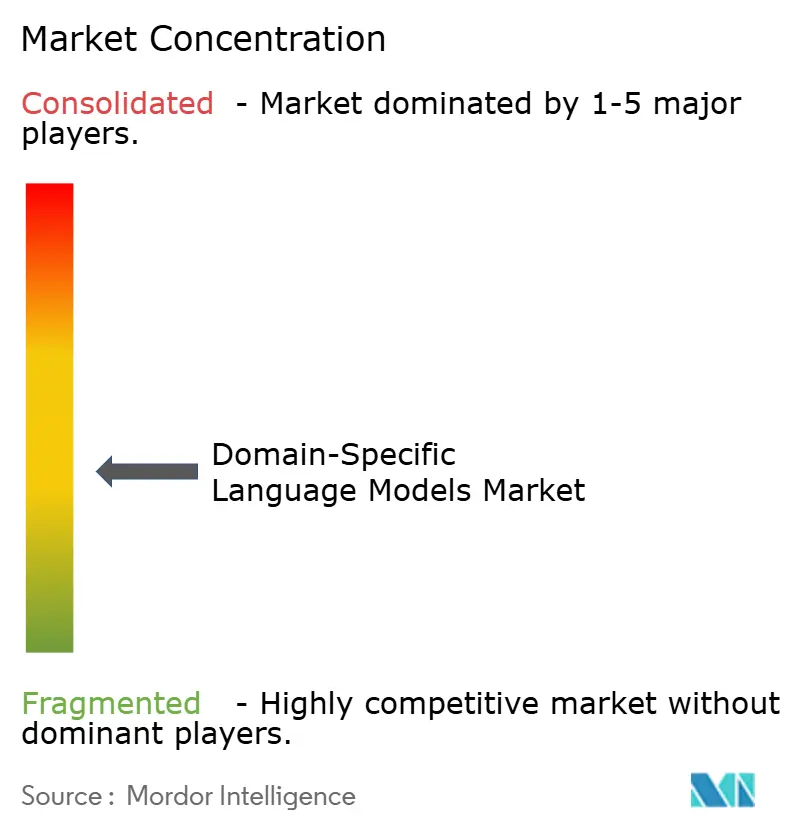
| Market Concentration | Medium |
Major Players *Disclaimer: Major Players sorted in no particular order Image © Mordor Intelligence. Reuse requires attribution under CC BY 4.0. | |
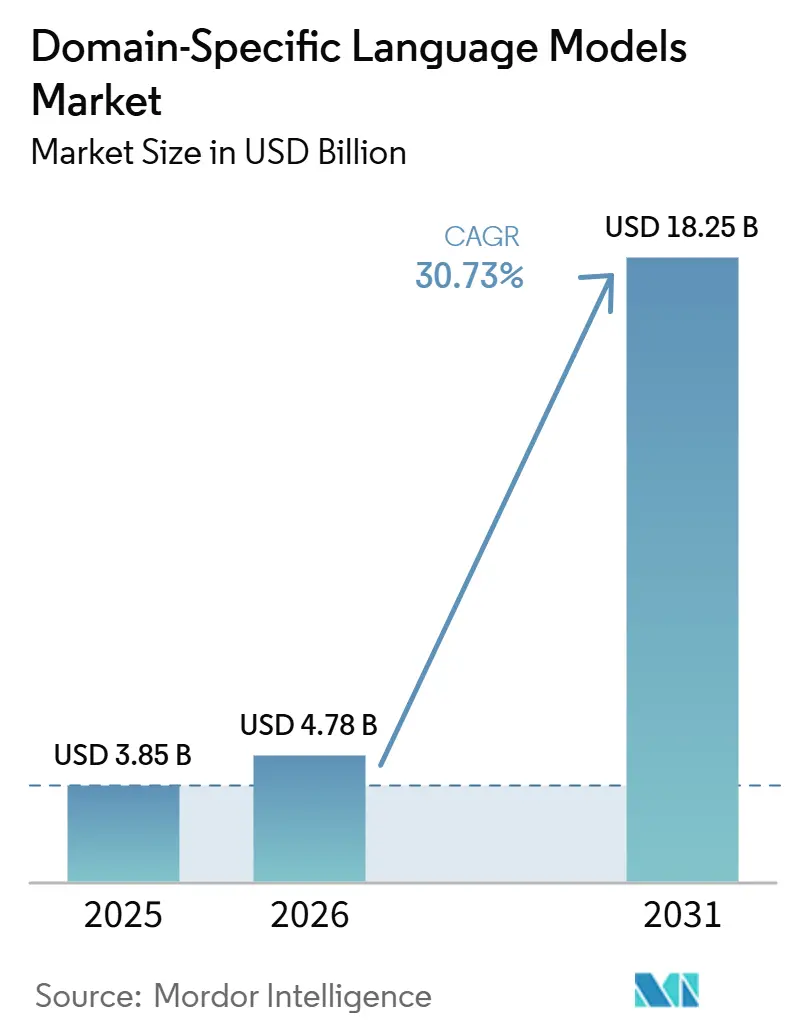
Domain-Specific Language Models Market Analysis by Mordor Intelligence
The Domain-Specific Language Models Market size was valued at USD 3.85 billion in 2025 and is estimated to grow from USD 4.78 billion in 2026 to reach USD 18.25 billion by 2031, at a CAGR of 30.73% during the forecast period (2026-2031). The market is moving forward as enterprises shift from general-purpose models to systems tuned for narrow, high-stakes tasks where accuracy, traceability, and lower inference cost matter more than model scale. Procurement criteria are also changing because regulated buyers now place greater weight on controlled training data, explainable outputs, and infrastructure choices that align with internal governance requirements. Smaller, fine-tuned models are becoming more attractive because they improve task fit while reducing the cost burden tied to broad frontier models. Competitive activity is split between hyperscalers with broad infrastructure reach and domain-focused specialists with harder-to-replicate data assets. Even with ongoing concerns around hallucinations and limited technical talent, the domain-specific language models market continues to benefit from steady enterprise adoption and sovereign AI programs that support long-term deployment demand.
Key Report Takeaways
- By offering, frameworks held 57.74% of the revenue share in the domain-specific language models market in 2025, while services are projected to expand at 29.12% CAGR through 2031.
- By deployment, cloud held 81.12% of the revenue share in the domain-specific language models market in 2025, while on-premise is projected to expand at 29.89% CAGR through 2031.
- By application, customer service automation accounted for 22.32% of the revenue share in the domain-specific language models market in 2025, while the code generation and review segment is projected to expand at 30.14% CAGR through 2031.
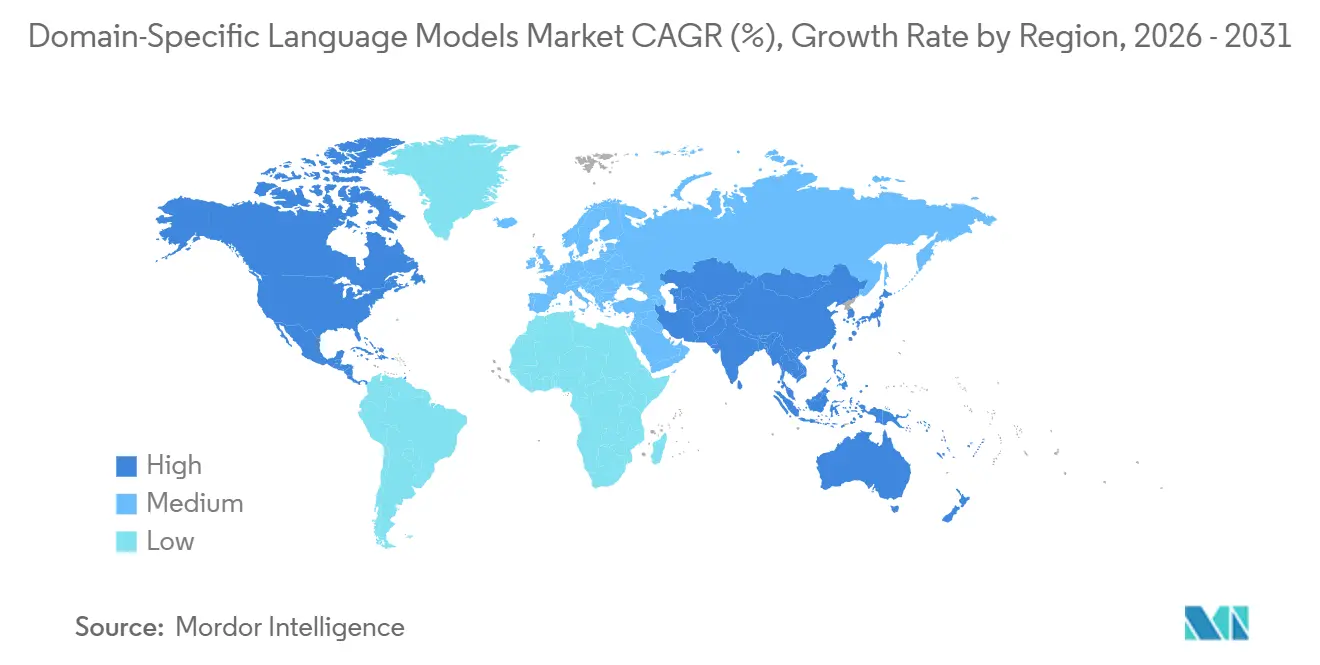
- By geography, North America held 41.55% of the revenue share in the domain-specific language models market in 2025, while Asia-Pacific is projected to expand at 30.98% CAGR through 2031.
Note: Market size and forecast figures in this report are generated using Mordor Intelligence’s proprietary estimation framework, updated with the latest available data and insights as of January 2026.
Market Trends and Insights
Drivers Impact Analysis of Domain-Specific Language Models Market*
| Driver | (~) % Impact on CAGR Forecast | Geographic Relevance | Impact Timeline |
|---|---|---|---|
| Enterprise Demand for Domain-Tuned Accuracy | +7.5% | Global | Short term (≤ 2 years) |
| Regulatory Pressure for Model Traceability and Controlled Outputs | +5.5% | Europe, North America, Asia-Pacific | Medium term (2-4 years) |
| Rising Retrieval-Augmented Fine-Tuning in Regulated Workflows | +5.0% | North America, Europe | Medium term (2-4 years) |
| Cost Compression Through Smaller, Specialized Models | +4.5% | Global | Short term (≤ 2 years) |
| Sovereign AI Procurement and Local Data Residency Mandates | +3.5% | Europe, Asia-Pacific, Middle East and Africa | Medium term (2-4 years) |
| Vertical SaaS Embedding of Domain-Specific Models | +3.0% | North America, Europe | Medium term (2-4 years) |
| Source: Mordor Intelligence | |||
Enterprise Demand For Domain-Tuned Accuracy Converts Pilots to Production
Enterprise adoption in the domain-specific language models market accelerated in 2025 as deployments moved out of pilot mode and into production across financial services, healthcare, and legal work. The performance gap is clearer in tightly defined workflows where accuracy must hold under regulatory review, and domain-specific terminology cannot be handled loosely. As more enterprises standardize their frameworks, datasets, and evaluation routines in 2026, early production deployments are creating switching costs that support longer customer retention in the domain-specific language models market.
Regulatory Pressure For Model Traceability Reshapes AI Procurement Criteria
Regulatory pressure is driving traceability to become a required purchase condition in the domain-specific language models market, especially in financial services, healthcare, and other supervised environments. Buyers now place more value on controlled datasets, auditable outputs, and training documentation because these features reduce the effort needed for internal review and external compliance checks. Research presented at IEEE IJCNN 2025 found that domain-tuned models outperformed GPT-4 and Mistral-7B in documentation compliance checks, supporting the case for specialized architectures for regulated tasks. Aveni’s FinLLM suite also illustrates how vendors are aligning products with financial regulatory expectations, including those tied to the FCA, PRA, and the EU AI Act.[1]Aveni Labs, “Aligning LLMs to Financial Services, The Technical Procedures Behind Aveni’s FinLLM,” Aveni Labs, labs.aveni.ai This is changing procurement in the domain-specific language models market because qualification now depends less on broad model popularity and more on evidence that outputs can be controlled, documented, and reviewed. Vendors that can show those features up front are better positioned to win new enterprise programs in the domain-specific language models market.
Rising Retrieval-Augmented Fine-Tuning Extends Domain Precision In Regulated Workflows
Retrieval-augmented fine-tuning is becoming a preferred setup in the domain-specific language models market for organizations that need precision and source-grounded responses in regulated workflows. This approach combines narrow model alignment with live access to approved documents, which helps enterprises connect generated answers to internal or regulatory source material. In the domain-specific language models market, retrieval-augmented architectures are therefore gaining traction where legal, healthcare, financial, and public-sector users need current answers backed by documents they can inspect. Organizations that adopt this structure early can build more resilient workflows as regulations and internal rules continue to change.
Cost Compression Through Smaller, Specialized Models Changes The Build-Versus-Buy Calculus
Cost is now pushing adoption rather than slowing it in the domain-specific language models market. NVIDIA reported that running a small, fine-tuned model can be 10 to 30 times cheaper than running a frontier-scale model on similar workloads, depending on the architecture and query profile.[2]NVIDIA Developer Blog, “How Small Language Models Are Key to Scalable Agentic AI,” NVIDIA, developer.nvidia.com That change matters because many enterprise teams had delayed deployments when broad-frontier inference costs made continuous production use hard to justify. Salesforce AI Research also highlighted the move toward compact, enterprise-ready models with xGen-small, designed for long context handling and a more predictable cost-to-serve profile.[3]Salesforce AI Research, “xGen-small, Enterprise-Ready Small Language Models,” Salesforce, salesforce.com As a result, the domain-specific language models market is seeing more buyers treat specialized model deployment as an operating decision rather than a research experiment. This shift favors vendors that can deliver reliable performance at lower serving costs across repeated business workflows.
Restraints Impact Analysis of Domain-Specific Language Models Market*
| Restraint | (~) % Impact on CAGR Forecast | Geographic Relevance | Impact Timeline |
|---|---|---|---|
| High-Quality Domain Data Acquisition Cost | -2.5% | Global | Short term (≤ 2 years) |
| Evaluation Difficulty and Hallucination Risk in Mission-Critical Use | -2.0% | Global, Healthcare, Finance, Legal | Short term (≤ 2 years) |
| Restricted Talent Pool for Domain Fine-Tuning and Model Ops | -1.5% | Global | Medium term (2-4 years) |
| Fragmented Compliance Across Borders | -1.0% | Global, Multi-jurisdiction operators | Long term (≥ 4 years) |
| Source: Mordor Intelligence | |||
High-Quality Domain Data Acquisition Cost Pressures Development Timelines
Access to high-quality domain data remains a major restraint in the domain-specific language models market, as privacy, confidentiality, and legal-use restrictions limit what can be collected and reused. Healthcare providers cannot freely pool patient records, financial institutions face strict confidentiality duties, and legal firms hold privileged matter files that are difficult to repurpose for model training. Nomura Research Institute addressed this challenge in insurance compliance work by using synthetic data, as real conversational material was difficult to collect within privacy constraints. Even so, synthetic data still requires subject-matter expertise, strong validation rules, and careful review before it can support production-grade tuning. This raises costs and lead times for smaller organizations in the domain-specific language models market that lack mature data engineering teams or access to compliant data pipelines. The result is a market where larger enterprises and infrastructure-adjacent providers can move faster than firms with similar needs but weaker internal resources.
Evaluation Difficulty and Hallucination Risk Limit Adoption in Mission-Critical Applications
Hallucination risk continues to slow wider deployment in the domain-specific language models market, where one incorrect output can trigger safety, legal, or compliance issues. A 2025 study in Nature Communications Medicine found that LLMs used in adversarial clinical decision support settings were highly vulnerable to hallucination attacks, which highlighted patient safety concerns in medical use. Research from the National University of Singapore also found that state-of-the-art LLMs exhibited intrinsic hallucination patterns when working with financial tables from annual reports, leading to some structural errors that are hard to detect during normal review. These problems are harder to manage because many organizations still lack benchmark datasets and enough expert reviewers to test task-specific output quality at scale. In the domain-specific language models market, this forces buyers to add manual validation layers before launch, thereby increasing deployment time and operating costs. Until evaluation methods improve, high-stakes workflows will continue to adopt the technology more carefully than lower-risk use cases.
*Our forecasts treat driver/restraint impacts as directional, not additive. The impact forecasts reflect baseline growth, mix effects, and variable interactions.
Domain-Specific Language Models Market Segment Analysis
By Offering:
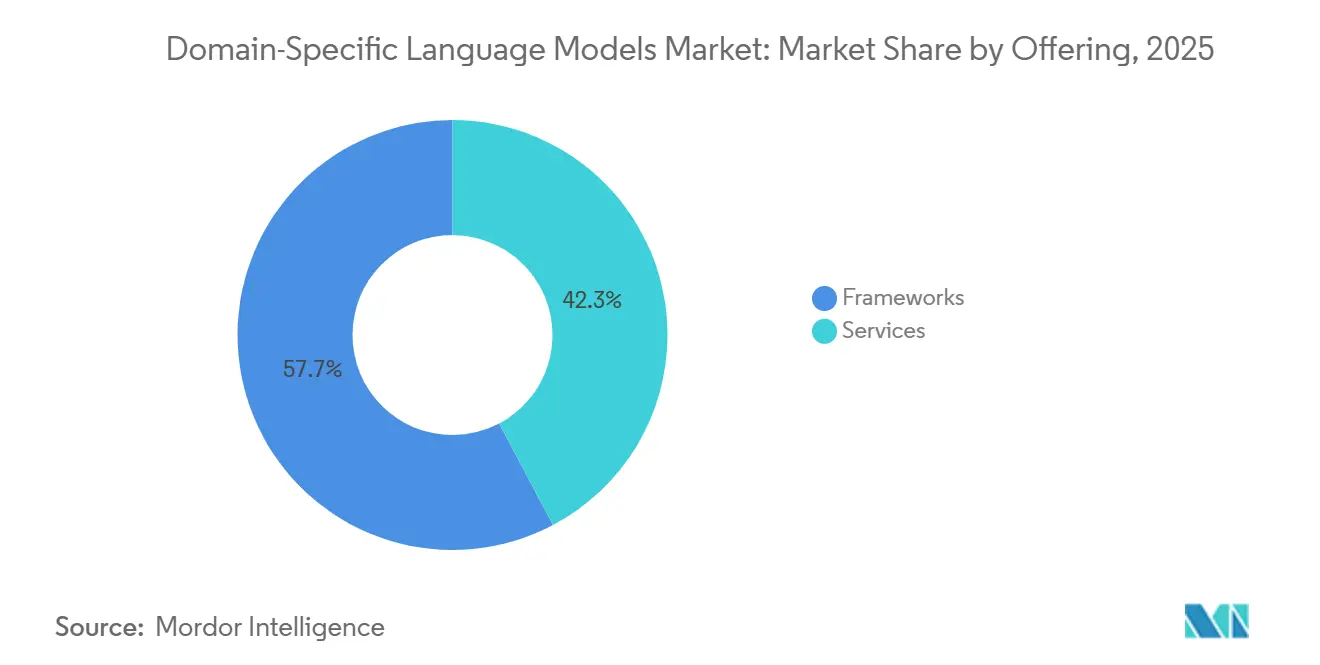
Frameworks Lead Scale While Services Gain Deployment DepthFrameworks held a 57.74% share of the domain-specific language models market in 2025, reflecting the fact that most enterprise programs still start with the core scaffolding needed to build, tune, evaluate, and govern models. Within that base, general-purpose language model frameworks often serve as the starting layer, while domain-specific frameworks play a higher-value role by integrating proprietary corpora, task-specific structures, and specialized evaluation logic. That distinction matters in the domain-specific language models market because value shifts upward once enterprises need repeatable performance in regulated, business-specific tasks rather than simple experimentation. Framework vendors that accumulate controlled training assets, annotation methods, and internal benchmarks tend to build stronger switching barriers over time in the domain-specific language models market.
Services are projected to expand at 29.12% CAGR through 2031 in the domain-specific language models market as buyers seek practical deployment support rather than isolated model access. Consulting and systems integration remain important because most enterprises still need help connecting domain models to internal processes, data estates, review layers, and policy controls. Fine-tuning and customization form the highest-value service layer because organizations want model behavior aligned with internal vocabulary, regulatory language, and output formats that already define how work gets done. Managed inference and hosting are also gaining importance as more enterprises require infrastructure choices that keep weights, prompts, and logs inside approved environments. This makes the services side of the domain-specific language models industry especially relevant for firms that want to deploy to production without building a full in-house model operations stack.


By Deployment:
Cloud Leads Installed Base While On-Premise Gains From Sovereignty RulesCloud held an 81.12% share in 2025, making it the dominant operating model in the domain-specific language models market for enterprises seeking speed, scale, and managed infrastructure. Early adopters favored cloud because it reduced setup burden, enabled faster model iteration, and provided access to integrated fine-tuning and deployment tools from large platform vendors. That scale advantage becomes self-reinforcing because higher cloud inference volumes improve benchmarking, version control, and safety monitoring across more customer environments. Google strengthened this position in 2026 with the Gemini Enterprise Agent Platform, which brought model selection, agent building, and governance tooling together into a single environment. In the domain-specific language models market, cloud remains the default path for data-sensitive workloads, where deployment speed matters more than infrastructure control.
On-premise is projected to expand at 29.89% CAGR through 2031, making it the fastest-growing deployment model in the domain-specific language models market. Growth is supported by data sovereignty rules, internal security policies, and regulated workflows that prohibit moving sensitive records to external infrastructure. NTT updated tsuzumi 2 in May 2026 with optimizations for on-premises and private cloud environments handling sensitive information, demonstrating how vendors are tailoring products for controlled enterprise settings. As deployment widens in healthcare, finance, government, and other supervised sectors, the domain-specific language models market is likely to see a larger addressable base for self-hosted and private cloud inference. This trend does not diminish cloud leadership, but it does give on-premises options a stronger, more durable role in regulated buying cycles.
By Application:
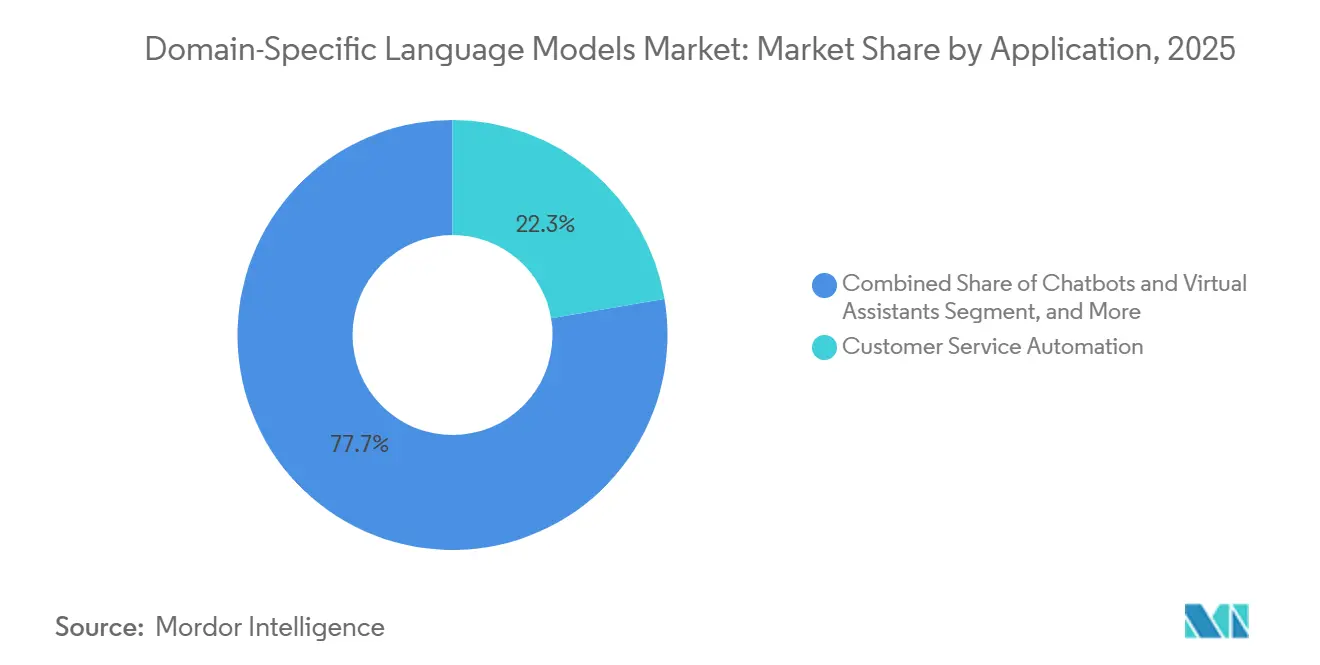
Customer Service Automation Leads While Code Generation And Review Expands FastestCustomer service automation accounted for 22.32% of the domain-specific language models market in 2025, making it the largest application area in the current demand mix. Enterprises are using these systems to handle high-volume interactions where responses must stay accurate, policy-compliant, and aligned with brand standards across regulated sectors. Baseten described a fine-tuned 32-billion-parameter deployment for insurance queries under FCA oversight, delivering 2.88-second response times and outperforming closed-source alternatives in compliance accuracy. The application also benefits from repeated customer interactions that help enterprises refine prompts, review flows, and domain-specific answer patterns over time.
Code generation and review are projected to expand at 30.14% CAGR through 2031, making it the fastest-growing application in the domain-specific language models market. Demand is rising because enterprise coding assistants perform better when they are trained on proprietary codebases, internal API references, and organization-specific engineering standards. Microsoft introduced MAI-Code-1-Flash in June 2026 for GitHub Copilot Business and Enterprise, signaling a stronger push toward purpose-built coding models for repetitive development tasks. Beyond coding and support, the domain-specific language models market continues to see significant demand for chatbots, virtual assistants, content generation, and translation. Language translation and localization remain especially relevant in multilingual regions where broad general-purpose multilingual systems poorly serve technical and regulatory vocabulary.

Geography Analysis
North America Domain-Specific Language Models Market
North America held a 41.55% share in 2025, making it the largest regional market for domain-specific language models. The region benefits from a mature buyer base in financial services, healthcare, legal technology, and enterprise software, along with deep hyperscaler infrastructure and a broad pool of AI startups. These conditions make North America the most established environment for production deployment because enterprises can access tooling, compute, compliance services, and integration partners in one place. The region also remains important in the domain-specific language models market because many large buyers already have cloud contracts, security governance teams, and internal data programs that shorten deployment time. That combination supports steady scaling even as some workloads shift toward more controlled private and on-premises setups.
APAC Domain-Specific Language Models Market
Asia-Pacific is projected to expand at 30.98% CAGR through 2031, making it the fastest-growing region in the domain-specific language models market. Growth is tied to sovereign AI efforts, strong local-language demand, and enterprise use cases that require better adaptation than many off-the-shelf Western models can provide. NTT’s May 2026 update to tsuzumi 2 showed continued product investment in Japanese business document handling and in deployment modes suited to sensitive enterprise environments. Stockmark also released a document titled "AI foundation" in April 2026, optimized for practical deployment and reflecting active local development around enterprise document workflows. In China, CNPC’s Kunlun domain model had been deployed across 152 application scenarios by May 2026, spanning oil and gas exploration, refinery operations, and capital finance, with multilingual support across 7 languages. These developments show that the domain-specific language models market in Asia-Pacific is being shaped by sector-specific use cases and language requirements rather than by imported generic tooling alone.
EMEA and South America Domain-Specific Language Models Market
Europe, South America, the Middle East, and Africa form the next layer of demand in the domain-specific language models market, though each follows a different adoption path. Europe is being shaped by AI compliance obligations and data residency needs, which are encouraging investment in sovereign infrastructure and more controlled enterprise deployment choices. Deutsche Telekom stated in March 2026 that its T-Systems Industrial AI Cloud was operating 10,000 GPUs to train the SOOFI sovereign LLM, underscoring the scale of regional infrastructure commitments. Cohere and Aleph Alpha also announced a merger in April 2026 to build a sovereign AI platform for enterprises and governments with strict data control requirements. The Middle East and Africa are seeing early institutional adoption of sovereign AI and Arabic-language deployments, while South America is earlier in its cycle, with Brazil leading initial activity in financial services and agri-tech. Together, these regions broaden the domain-specific language models market beyond the early core and show that regulation, language, and compute access are shaping regional trajectories in different ways.

Competitive Landscape
The domain-specific language models market has a split structure with a concentrated upper tier of hyperscalers and large model providers, and a broader specialist layer built around vertical workflows and proprietary data. Microsoft, Google, Amazon Web Services, and IBM benefit from existing enterprise relationships, cloud contracts, and established governance tools, which often make them the first vendors considered in large deployments. At the same time, specialists compete where domain fit matters more than scale alone, especially in workflows that depend on proprietary corpora, internal review steps, and close alignment with expert practice. This gives the domain-specific language models market a mixed competitive profile where infrastructure breadth matters at the top, but task-specific depth still creates room for focused entrants. The result is active competition across platforms, orchestration tools, deployment models, and governance layers rather than in model parameters alone.
Strategic moves in 2026 show that vendors are trying to strengthen their position in the domain-specific language models market by gaining ecosystem control and aligning with compliance standards. Google expanded its enterprise toolchain with the Gemini Enterprise Agent Platform, which unified model selection, agent development, and governance within a single managed environment. Cohere and Aleph Alpha are moving to create a sovereign AI platform for enterprises and governments that need greater direct control over model deployment and data handling. Salesforce and Databricks also advanced their Governed Business Context integration so AI agents could use structured governance metadata from Unity Catalog inside Salesforce Agentforce prompts. Each of these moves points to the same pattern in the domain-specific language models market, where providers want to own more of the workflow, governance, and deployment stack around the model.
Competitive differentiation is therefore moving toward retrieval-backed accuracy, policy-aware orchestration, model evaluation, and infrastructure choices that reflect data residency rules. IBM’s emphasis on traceable training data provenance for its Granite series aligns with this direction, as documented model lineage is becoming increasingly valuable in regulated procurement. GitHub and Microsoft also reinforced their position in coding workflows by making purpose-built coding models and coding agents available to enterprise Copilot users in 2026. White-space opportunities remain strongest in energy, manufacturing quality control, pharmaceutical regulatory affairs, and multilingual government services, where domain depth still matters more than broad platform scale. That keeps the domain-specific language models market open to new specialists, even though the upper tier remains anchored by large vendors with wider distribution and infrastructure advantages.
Domain-Specific Language Models Industry Leaders
OpenAI, LLC
Microsoft Corporation
Google LLC
Amazon Web Services, Inc.
Anthropic PBC
- *Disclaimer: Major Players sorted in no particular order
Domain-Specific Language Models Market Companies Covered in this Report
- OpenAI, LLC
- Microsoft Corporation
- Google LLC
- Amazon Web Services, Inc.
- Anthropic PBC
- Meta Platforms, Inc.
- IBM Corporation
- NVIDIA Corporation
- Alibaba Cloud (Alibaba Group Holding Limited)
- Baidu, Inc.
- Tencent Holdings Limited
- Huawei Technologies Co., Ltd.
- Cohere Inc.
- AI21 Labs Ltd.
- Mistral AI SAS
- Databricks, Inc.
- Writer, Inc.
- Abridge AI, Inc.
- Harvey AI, Inc.
- Salesforce, Inc.

Recent Industry Developments in Domain-Specific Language Models Market
- June 2026: Anthropic PBC's Claude Opus 4.6 became generally available in Microsoft Foundry on NVIDIA GB300 Blackwell Ultra GPUs, enabling enterprises to deploy domain-specific AI agents with a 1-million-token context window. The integration targeted domains where extended context and instruction-following precision were operationally critical, including legal, healthcare, and financial services.
- June 2026: Microsoft Corporation's MAI-Code-1-Flash, a purpose-built domain coding model, became generally available for GitHub Copilot Business and Enterprise users. The model was optimized for high-volume, iterative agentic coding workflows and was purpose-built for GitHub's enterprise developer environment.
- May 2026: Mistral AI SAS's Mistral Medium 3.5 joined Microsoft Copilot Studio's enterprise agent model lineup, with worldwide availability and support for data-residency-sensitive deployments across regulated European industries.


Global Domain-Specific Language Models Market Report Scope
The Domain-Specific Language Models Market comprises the development, deployment, and commercialization of language models optimized for specific industries, domains, or enterprise use cases, along with the frameworks and services required to build, customize, and operate these specialized AI models. Market revenue is generated through the licensing and subscription of language model frameworks, cloud-based and on-premise deployments, API and inference usage fees, and professional services, including consulting, systems integration, model fine-tuning, managed inference, and hosting, supporting applications such as chatbots, code generation, content creation, customer service automation, language translation, and other domain-specific AI workloads.
The Domain-Specific Language Models Market Report is Segmented by Offering (Frameworks and Services), Deployment (Cloud and On-Premise), Application (Chatbots and Virtual Assistants, Code Generation and Review, Content and Media Generation, Customer Service Automation, Language Translation and Localization, and Other Applications), and Geography (North America, South America, Europe, Asia-Pacific, Middle East and Africa). The Market Forecasts are in Terms of Value (USD).
| Frameworks (Including General-Purpose and Domain-Specific Language Model Frameworks) |
| Services (Including Consulting and Systems Integration, Fine-Tuning and Customization, Managed Inference and Hosting) |
| Cloud |
| On-Premise |
| Chatbots and Virtual Assistants |
| Code Generation and Review |
| Content and Media Generation |
| Customer Service Automation |
| Language Translation and Localization |
| Other Applications |
| North America | United States | |
| Canada | ||
| South America | Brazil | |
| Rest of South America | ||
| Europe | Germany | |
| United Kingdom | ||
| France | ||
| Italy | ||
| Spain | ||
| Rest of Europe | ||
| Asia-Pacific | China | |
| India | ||
| Japan | ||
| South Korea | ||
| Australia | ||
| Rest of Asia-Pacific | ||
| Middle East and Africa | Middle East | United Arab Emirates |
| Saudi Arabia | ||
| Turkey | ||
| Rest of Middle East | ||
| Africa | South Africa | |
| Rest of Africa | ||
| By offering | Frameworks (Including General-Purpose and Domain-Specific Language Model Frameworks) | ||
| Services (Including Consulting and Systems Integration, Fine-Tuning and Customization, Managed Inference and Hosting) | |||
| By Deployment | Cloud | ||
| On-Premise | |||
| By Application | Chatbots and Virtual Assistants | ||
| Code Generation and Review | |||
| Content and Media Generation | |||
| Customer Service Automation | |||
| Language Translation and Localization | |||
| Other Applications | |||
| By Geography | North America | United States | |
| Canada | |||
| South America | Brazil | ||
| Rest of South America | |||
| Europe | Germany | ||
| United Kingdom | |||
| France | |||
| Italy | |||
| Spain | |||
| Rest of Europe | |||
| Asia-Pacific | China | ||
| India | |||
| Japan | |||
| South Korea | |||
| Australia | |||
| Rest of Asia-Pacific | |||
| Middle East and Africa | Middle East | United Arab Emirates | |
| Saudi Arabia | |||
| Turkey | |||
| Rest of Middle East | |||
| Africa | South Africa | ||
| Rest of Africa | |||


Key Questions Answered in the Report
What is the current size and outlook of the domain-specific language models market?
The domain-specific language models market stood at USD 3.85 billion in 2025, reached USD 4.78 billion in 2026, and is forecast to reach USD 18.25 billion by 2031 at a 30.73% CAGR.
Which offering segment currently leads revenue generation?
Frameworks led the revenue mix with a 57.74% share in 2025 because most enterprise deployments still begin with the core layer used for tuning, governance, and model control.
Why is on-premise deployment expanding so quickly?
On-premise is projected to grow at 29.89% CAGR through 2031 because regulated buyers increasingly need stronger control over sensitive data, inference logs, and model weights.
What is the largest application area today?
Customer service automation was the largest application in 2025 with a 22.32% share, supported by demand for accurate, policy-compliant responses in high-volume enterprise interactions.
Which region is growing the fastest?
Asia-Pacific is projected to expand at 30.98% CAGR through 2031, supported by sovereign AI programs, local-language demand, and sector-focused enterprise deployments.
What is shaping competition among vendors?
Competition is being shaped by infrastructure reach, proprietary domain data, retrieval-backed accuracy, governance tooling, and the ability to support cloud as well as controlled on-premise environments.
Page last updated on:





