
Digital Workplace In Retail Market Size and Share
Market Overview
| Study Period | 2020 - 2031 |
|---|---|
| Market Size (2026) | USD 8.69 Billion |
| Market Size (2031) | USD 20.34 Billion |
| Growth Rate (2026 - 2031) | 18.53 % |
| Fastest Growing Market | Asia-Pacific |
| Largest Market | North America |
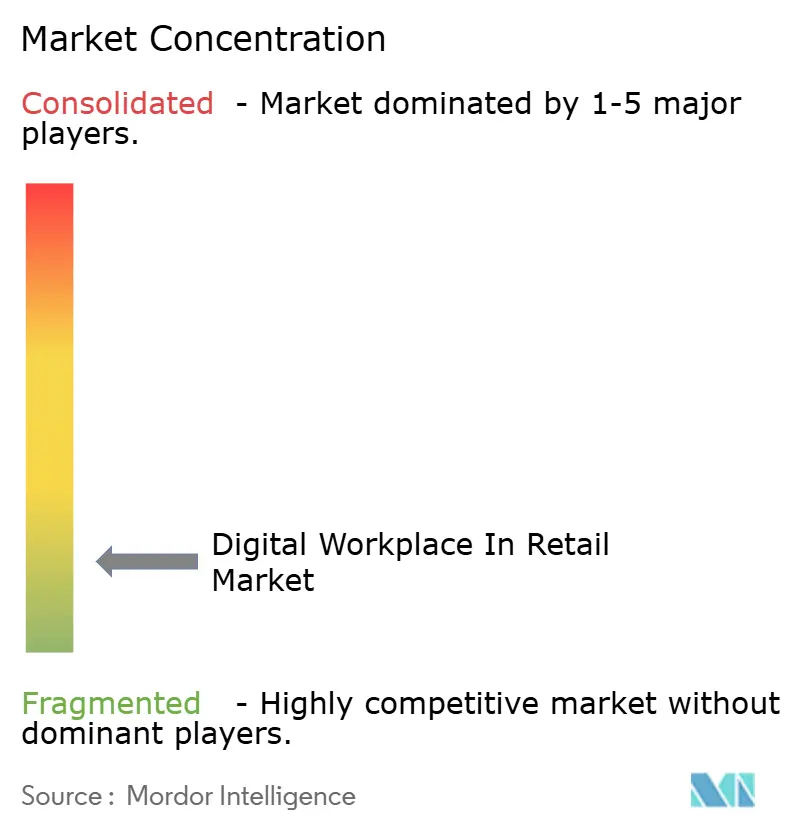
| Market Concentration | Low |
Major Players *Disclaimer: Major Players sorted in no particular order Image © Mordor Intelligence. Reuse requires attribution under CC BY 4.0. | |
Digital Workplace In Retail Market Analysis by Mordor Intelligence
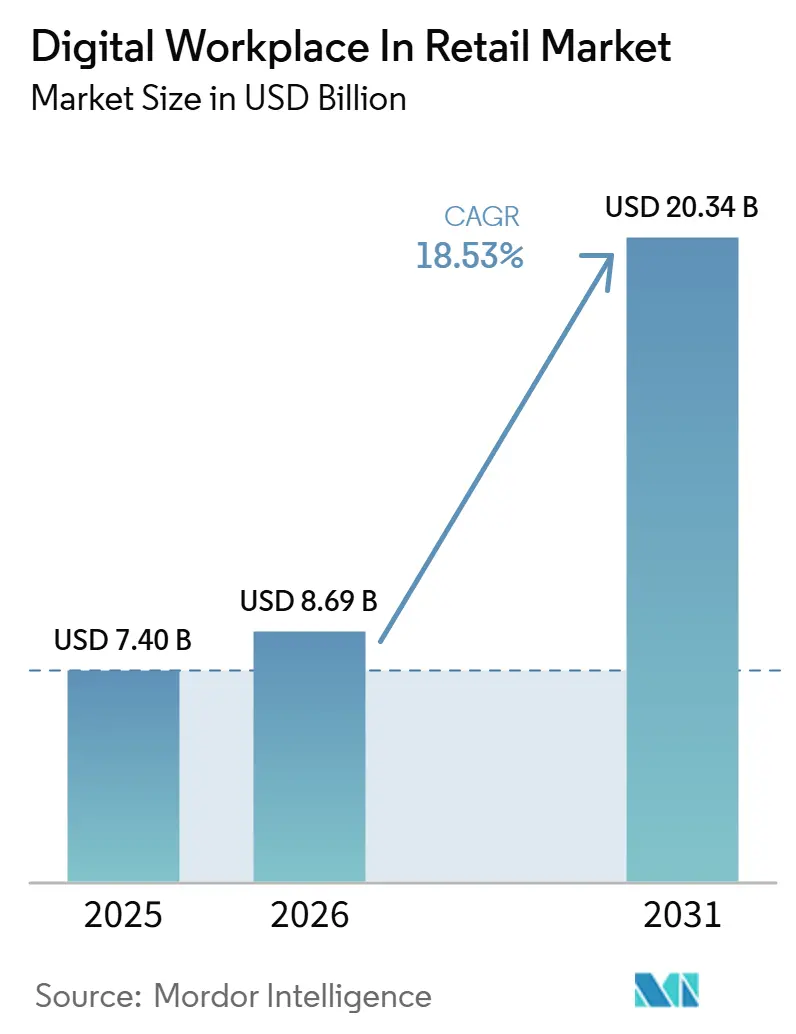
The digital workplace in retail market size is projected to be USD 7.4 billion in 2025, USD 8.69 billion in 2026, and reach USD 20.34 billion by 2031, growing at a CAGR of 18.53% from 2026 to 2031. The digital workplace in retail market is expanding because retailers now need one operating layer that connects headquarters, store managers, and associates in real time across stores, pickup points, and fulfillment tasks. As omnichannel activity has increased, the workload on store teams has become more complex, which is pushing retailers to adopt platforms that combine communication, task management, workflow support, and knowledge access in one interface. The digital workplace in retail market is also benefiting from a stronger focus on frontline productivity because retailers are linking faster execution on the store floor to service quality, order handling, and day-to-day consistency across large networks. Competitive activity is increasing as enterprise software vendors, communications providers, and retail-focused platform companies all move deeper into AI-enabled frontline execution. Adoption is still shaped by security controls, integration needs, and store-level change management, but the digital workplace in retail market continues to create room for vendors that can show measurable gains in workforce efficiency and execution quality.
Key Report Takeaways
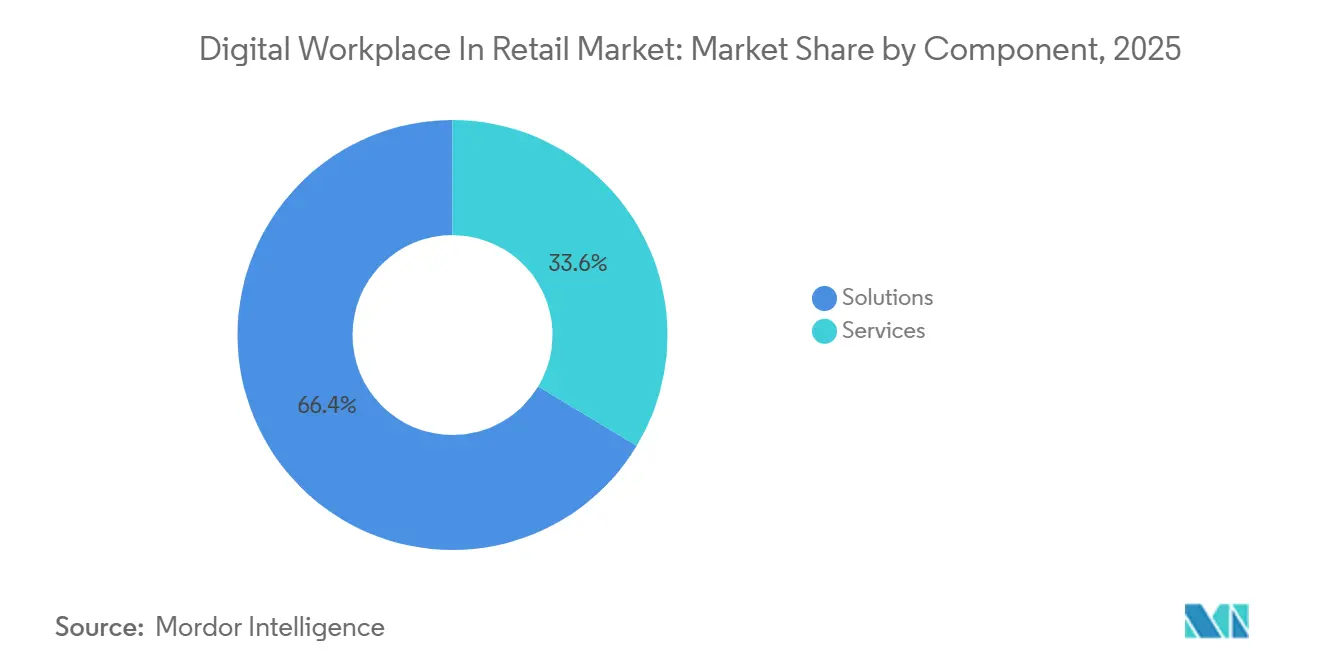
- By component, solutions held 66.38% share of the digital workplace in retail market in 2025 and are projected to expand at an 18.93% CAGR through 2031 in the digital workplace in retail market.
- By deployment mode, cloud held 63.91% share of the digital workplace in retail market in 2025 and is projected to expand at a 19.09% CAGR through 2031.
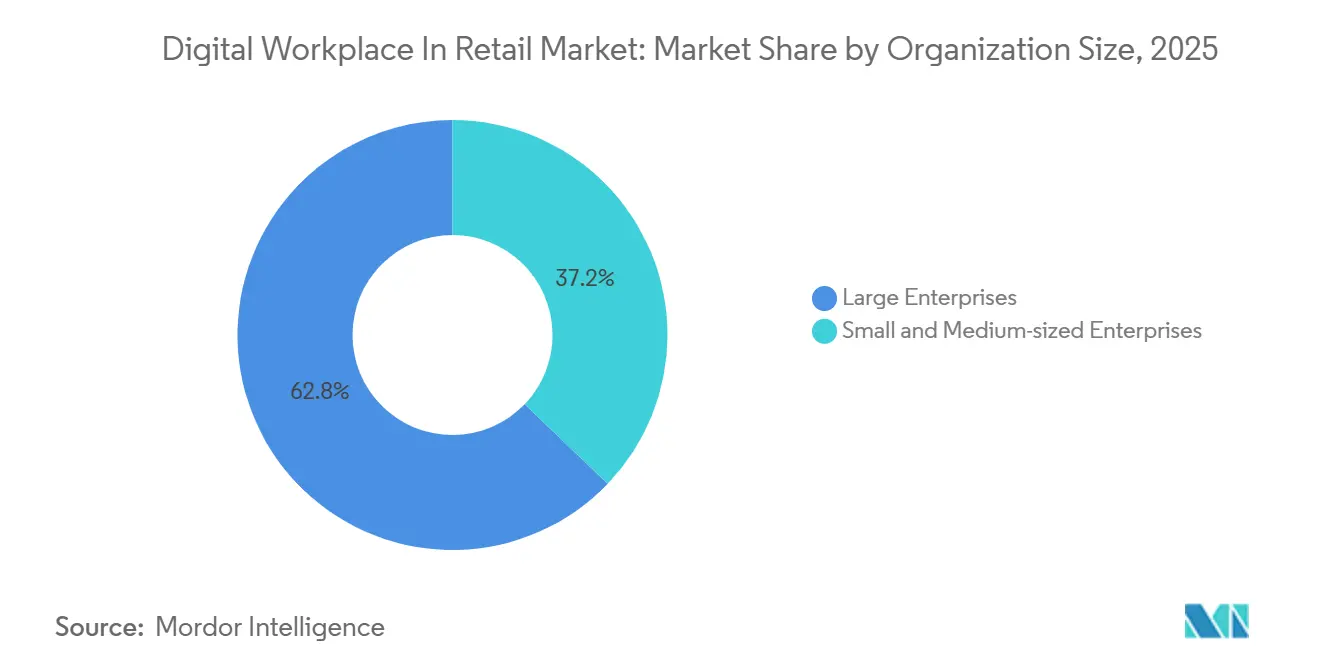
- By organization size, large enterprises held 62.84% share in 2025, while small and medium enterprises are projected to expand at an 18.87% CAGR through 2031.
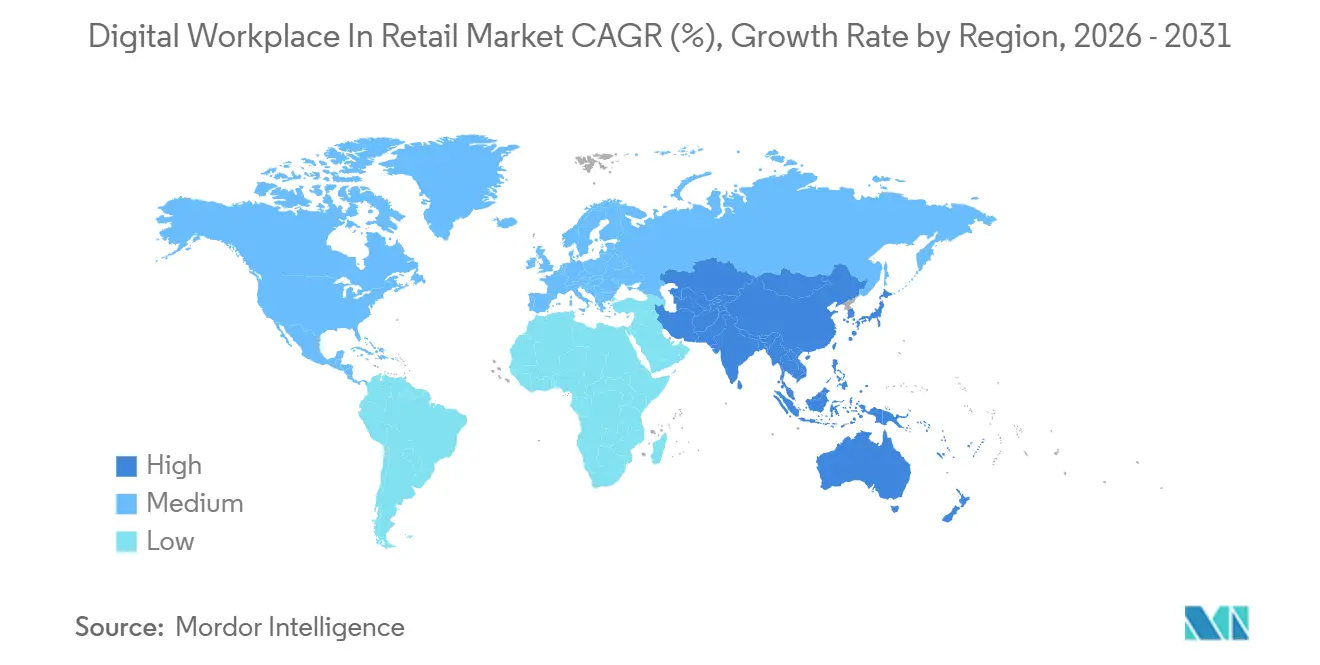
- By geography, North America held 37.42% share in 2025, while Asia-Pacific is projected to expand at a 19.47% CAGR through 2031.
Note: Market size and forecast figures in this report are generated using Mordor Intelligence’s proprietary estimation framework, updated with the latest available data and insights as of January 2026.
Global Digital Workplace In Retail Market Trends and Insights
Drivers Impact Analysis*
| Driver | (~) % Impact on CAGR Forecast | Geographic Relevance | Impact Timeline |
|---|---|---|---|
| Rising Demand for Real-Time Store Associate Communication | +3.2% | Global, with highest intensity in North America, Western Europe, and Japan | Short term (≤ 2 years) |
| Expansion of Omnichannel Retail Operations | +2.8% | North America and Europe, spill-over to Asia-Pacific core | Medium term (2-4 years) |
| Need for Centralized Knowledge and Task Orchestration | +2.5% | Global, led by large enterprise retailers in North America and Asia-Pacific | Medium term (2-4 years) |
| Workforce Mobility and Frontline Productivity Requirements | +2.1% | Global, accelerating in Southeast Asia and South Asia | Short term (≤ 2 years) |
| Increased Adoption of Cloud-Based Retail Collaboration Tools | +1.8% | Asia-Pacific core, North America, spill-over to Middle East and Africa | Medium term (2-4 years) |
| Growing Focus on Employee Experience and Retention | +1.4% | North America and Europe, with early uptake in Asia-Pacific developed markets | Long term (≥ 4 years) |
| Source: Mordor Intelligence | |||
Rising Demand For Real-Time Store Associate Communication
The digital workplace in the retail market is being pushed forward by the growing cost of slow store communication during customer-facing activity. Store teams now need instant access to task updates, service escalations, and product guidance without leaving the sales floor. Email and consumer messaging apps do not solve that need well when the workforce is large, mobile, and spread across long operating hours. Zoom launched Zoom Workplace for Frontline in April 2025 with push-to-talk, AI-assisted shift reporting, shift swapping, task management, and knowledge search in one mobile-first product, which shows how vendors are reshaping the digital workplace in the retail market around deskless work rather than office templates. Aeon Retail also deployed AI-equipped all-in-one devices across 390 stores from June 2025 so associates could search digitized manuals through a conversational AI interface in real time.[1]Nikkei Business, “Aeon Retail To Deploy AI-Equipped All-In-One Devices Across All 390 Stores,” Nikkei, nikkei.com The digital workplace in the retail market benefits when voice, task handling, and knowledge retrieval sit in one associate-facing tool because training becomes easier and daily usage becomes more consistent across store networks.
Expansion of Omnichannel Retail Operations
The digital workplace in the retail market is gaining momentum because omnichannel retail has increased the number of tasks each store associate must manage within the same shift. Fulfilling store purchases, pickup orders, and digital promotions at the same time now requires live coordination between corporate planning data and frontline execution. Manhattan Associates reported in its 2025 retail benchmark work that workforce coordination capability was becoming a more visible differentiator between top-performing retailers and the broader market. NEC announced in May 2025 that Seven-Eleven Japan was deploying around 300,000 mobile and tablet terminals with unified endpoint management, which showed that large convenience operators were treating workforce digitalization as infrastructure rather than optional spend.[2]NEC Corporation, “NEC Builds Next-Generation Store System For Seven-Eleven Japan,” NEC Corporation, jpn.nec.com SAP also used NRF 2026 to show AI-assisted assortment management, promotion pricing, and retail data capabilities that connect store activity more closely to enterprise planning.[3]SAP, “NRF 2026, SAP Builds AI Into The Core Of Retail,” SAP News, news.sap.com The digital workplace in the retail market is therefore moving beyond collaboration software and toward an operational layer that helps retailers manage channel complexity with less delay between planning and execution.
Need for Centralized Knowledge and Task Orchestration
The digital workplace in the retail market is gaining further momentum as retailers seek to reduce the time store teams spend searching for procedures, reconciling instructions, and resolving exceptions across disconnected systems. When associates lack a clear place to find operating guidance, training slows, service quality varies more by store, and team leads spend too much time planning rather than managing the floor. Walmart stated in June 2025 that AI-directed task management reduced team-lead planning time from 90 minutes to 30 minutes per shift, while its conversational AI tools supported more than 900,000 weekly active users and more than 3 million daily queries across its US store network. Cognizant and ServiceNow addressed the same need in January 2025 with Stores 360, a retail-specific platform that connected workflow automation, store task management, and employee productivity tools via ServiceNow's Now Assist generative AI layer. Hanshow and Microsoft extended that model in June 2026 with xPilot, which turned live-store signals such as shelf availability, planogram compliance, and foot traffic into prioritized actions for frontline teams via AI agents and a unified data environment. As retailers move toward searchable knowledge bases and AI-assisted execution, the digital workplace in the retail market is shifting from basic communication support to a broader workforce intelligence role that can improve consistency, reduce onboarding friction, and boost productivity across store networks.
Workforce Mobility and Frontline Productivity Requirements
The digital workplace in the retail market is also shaped by the simple fact that retail work happens on the move across aisles, stockrooms, checkout areas, and pickup zones rather than at desks. Traditional enterprise productivity tools were built around office access, fixed devices, and steady connectivity, which makes them a poor fit for workers who spend most of the day moving through the store. Zoom stated in April 2025 that frontline workers represent more than 80% of the global workforce, which explains why mobile-first design has become a central requirement rather than an added feature in new product launches. Marks and Spencer expanded in this direction in March 2026, when it rolled out 11,000 Microsoft 365 Copilot licenses to store managers and support center staff to reduce administrative workload and improve day-to-day operational capacity. Esperanto Systems moved into the same space in April 2026 with Telecom-One and reported active deployment across more than 800 retail stores in Japan within the year, reflecting clear demand for mobility tools designed for frontline conditions. The digital workplace in the retail market becomes more compelling when retailers can connect recovered planning time, faster communication, and easier access to information to store-level productivity and service outcomes, which is why mobility remains a strong adoption driver across regions and formats.
Restraints Impact Analysis*
| Restraint | (~) % Impact on CAGR Forecast | Geographic Relevance | Impact Timeline |
|---|---|---|---|
| Data Security and Privacy Concerns Across Store Devices | -2.2% | Global, with highest compliance intensity in North America, Europe, and Asia-Pacific developed markets | Short term (≤ 2 years) |
| Integration Complexity with Legacy Retail Systems | -1.8% | Global, most acute in North America and Europe where legacy IT estate is largest | Medium term (2-4 years) |
| High Change Management Burden for Store-Level Adoption | -1.3% | Global, particularly pronounced in markets with dispersed, high-turnover workforces | Medium term (2-4 years) |
| Uneven Digital Maturity across Retail Formats and Regions | -1.0% | Africa, South America, and secondary cities across Southeast Asia | Long term (≥ 4 years) |
| Source: Mordor Intelligence | |||
Data Security and Privacy Concerns Across Store Devices
The digital workplace in the retail market still faces caution from buyers because every new handheld, tablet, kiosk, and shared device expands the number of endpoints that must be secured across the store network. This matters even more when workplace platforms connect with store operations, workforce data, or environments close to payment activity, because retailers then need stronger controls over access rights, device policies, and audit trails. Compliance needs also vary across regions, making rollouts more challenging for retailers operating across several countries and different legal standards. CPA Australia reported in April 2026 that 44% of small businesses in Singapore lost time or money due to cybersecurity incidents in 2025, which showed how security gaps create direct operational and financial disruption rather than only reputational risk. As a result, enterprise-grade mobile device management, role-based access control, and encrypted audit logging have become standard buying criteria for the digital workplace in the retail market, slowing adoption of lower-cost or consumer-style tools that cannot meet those expectations. This also raises the barrier for new vendors because trust, compliance readiness, and proven deployment controls now play a major role in shortlist decisions.
Integration Complexity With Legacy Retail Systems
The digital workplace in retail market also advances more slowly when new platforms must connect with older point-of-sale systems, inventory tools, scheduling software, enterprise resource planning environments, and supplier portals before they can deliver full value. Retailers often run broad technology estates built over different periods and using different standards, which means newer workplace platforms cannot simply be turned on without extensive integration work. This is especially true for large chains where store systems, merchandising applications, and back-office tools were designed long before cloud-native coordination became common. UOB's Business Outlook Study 2026 showed that 86% of ASEAN businesses had adopted digital solutions, but only 61% reported successful implementation, which highlighted the gap between purchase intent and connected execution. SAP's 2026 retail AI releases and Oracle's agentic application push show that major vendors are responding by tightening the links between the workplace, planning, and execution layers, but this does not remove the need for staged migration in most retail environments. The digital workplace in the retail market, therefore, continues to face slower penetration, particularly when integration budgets are limited, custom connectors are required, or internal IT teams cannot support large-scale modernization programs.
*Our forecasts treat driver/restraint impacts as directional, not additive. The impact forecasts reflect baseline growth, mix effects, and variable interactions.
Segment Analysis
By Component: Solutions Platforms Drive Frontline Enablement
Solutions captured 66.38% of the digital workplace in retail market in 2025 and are projected to expand at an 18.93% CAGR through 2031, which keeps the component mix centered on software platforms that can support communication, tasks, and knowledge access in a unified way. Solutions also accounted for 66.38% of the digital workplace in retail market size in 2025 because retailers continue to prefer pre-integrated systems over separate tools that have to be managed one by one across stores. Unified communication and collaboration platforms remain the most common entry point because they give retailers an immediate way to connect headquarters with store teams and reduce day-to-day coordination gaps. Zoom's April 2025 frontline launch reflected that priority by combining push-to-talk communication, AI-assisted shift reporting, task management, and smart knowledge search in one mobile-first environment for deskless work. The digital workplace in retail market is also pushing solution demand higher as retailers add endpoint management, workflow automation, and employee experience functions to the same platform rather than buying new systems for each use case.
The next layer of solution growth is coming from tools that help retailers manage larger device estates, more complex execution workflows, and higher expectations for operational consistency across stores. NEC's next-generation system for Seven-Eleven Japan, built around around 300,000 mobile and tablet terminals and unified endpoint management, showed how far large-format operators are now willing to invest in structured frontline enablement. Employee experience platforms, workflow automation modules, and knowledge management layers are becoming more important because retailers want platforms that not only connect workers but also guide work in a more consistent way. In the digital workplace in retail industry, services still matter because implementation support, managed operations, compliance checks, and custom workflow design often determine whether a platform scales well across countries and formats. That is why the digital workplace in retail market continues to stay solutions-led while services grow in supporting importance as AI layers, workflow updates, and governance needs become a regular part of ongoing platform management.


By Deployment Mode: Cloud Architecture Accelerates Retail Platform Scale
Cloud held 63.91% of the digital workplace in retail market in 2025 and is projected to expand at a 19.09% CAGR through 2031, which makes it both the largest and fastest-growing deployment model in this structure. Cloud represented 63.91% of the digital workplace in retail market size in 2025 because retailers value remote provisioning, faster rollout, centralized policy control, and easier application updates across distributed store networks. The model fits the practical needs of retail operations because software settings, task logic, and device policies can be pushed across many sites without local IT support at each location. Singapore's refreshed Retail Industry Digital Plan reported in May 2026 that 9 in 10 retail SMEs recorded productivity gains from digital adoption in 2025, which supports the role of scalable cloud-based deployment in frontline modernization. The digital workplace in retail market is also seeing cloud demand reinforced by broader regional data center investment, which gives retailers more flexibility around residency, service access, and performance in large multi-country networks.
Cloud growth does not mean on-premises deployment disappears, because some retailers still work within strict regulatory settings or store environments where network conditions are uneven. Hybrid architecture is therefore gaining attention as a practical bridge for operators that want cloud-native frontline tools while keeping older systems in place during transition. UOB's regional 2026 study showed that digital adoption is widespread in ASEAN, but successful implementation still lags behind, which helps explain why staged deployment models remain relevant for retailers balancing ambition with execution limits. In the digital workplace in retail industry, vendors that can support cloud, on-premises, and hybrid environments have an advantage because retail infrastructure rarely evolves at the same pace across every function or geography. The digital workplace in retail market is likely to remain cloud-led, but deployment flexibility will stay important because buyers want faster progress without forcing high-risk, all-at-once migration from legacy estates.
By Organization Size: Large Retailers Lead As SMEs Accelerate
Large enterprises commanded 62.84% of the digital workplace in retail market in 2025, which reflected their broader store footprints, stronger procurement budgets, and better ability to absorb integration work. Large enterprises held 62.84% of the digital workplace in retail market share in 2025 because major chains can spread spending across many stores, negotiate enterprise contracts, and build formal change programs for thousands of managers and associates. Walmart's June 2025 rollout of AI-powered tools to 1.5 million U.S. associates showed how large retailers can connect frontline software investment directly to planning efficiency, translation support, and operational execution at scale. Marks and Spencer added to that pattern in March 2026 by expanding Microsoft 365 Copilot use across 11,000 store managers and support center colleagues, so administrative work could be reduced and more time could be redirected to customer-facing tasks. The digital workplace in the retail market remains concentrated in large enterprises spending today because these retailers can support integration, training, security review, and staged expansion across different regions with fewer execution gaps.
Small and medium enterprises are projected to expand at an 18.87% CAGR through 2031, which makes them the faster-moving adoption cohort even though they remain smaller in current spending. The digital workplace in retail market is becoming more accessible to these businesses because subscription pricing, mobile-first design, and lighter implementation paths reduce the burden that older enterprise software models placed on smaller operators. Singapore's refreshed Retail Industry Digital Plan targeted more than 2,000 SME retailers with AI-powered guidance and support, which shows how public adoption programs are lowering the entry barrier for smaller retail businesses. France Num's 2025 barometer also found that 78% of French small and medium-sized businesses considered digital adoption a real benefit, while the commerce sector recorded a 78% software adoption rate. As cloud availability, government support, and mobile usability continue to improve, the digital workplace in retail market is likely to deepen beyond large chains and gain more traction across organized SME retail networks in both developed and emerging regions.
Geography Analysis
North America held 37.42% of the digital workplace in retail market in 2025, which made it the largest regional contributor. North America also represented 37.42% of the digital workplace in retail market share in 2025 because the region combines deep retail technology spending with strong cloud, device, and communications infrastructure. U.S. retailers have moved beyond simple deployment of messaging tools and into AI-led execution layers that support store planning, translation, and inventory work in real time. Walmart's June 2025 launch of AI-powered tools for 1.5 million associates showed the scale at which North American chains are using digital workplace platforms to reshape daily store operations. The digital workplace in retail market in North America is also helped by a vendor base that can support enterprise rollout, device management, AI integration, and multi-site governance with less friction than in smaller or less connected regions.
Europe remained the second-largest regional market in 2025, with Germany, the United Kingdom, France, Italy, Spain, and the Nordics anchoring demand. The region is moving steadily toward AI-augmented frontline tools, but buyers usually place more weight on auditable deployment, employee data handling, and policy control than on rapid feature adoption alone. Marks and Spencer's 2026 Copilot rollout showed that large European retailers are using digital workplace tools to reduce manager administration and improve store execution quality rather than to follow a general AI trend. France Num's 2025 findings also showed that smaller commerce businesses in Europe are increasingly comfortable with software adoption, which supports a broader base for expansion beyond large chains.
Asia-Pacific is projected to expand at a 19.47% CAGR through 2031, which makes it the fastest-growing regional segment in the digital workplace in retail market. Growth in the region is being supported by large frontline workforces, rising organized retail activity, active public digitalization programs, and broad variation in store formats that favor mobile-first deployment. Japan remains a major reference point because Aeon Retail deployed AI-equipped frontline devices across 390 stores from June 2025, while NEC's Seven-Eleven Japan project added around 300,000 mobile and tablet terminals to support the next-generation store system. Southeast Asia is also gaining momentum as organized retailers adopt unified communications and workflow tools to improve consistency across fast-growing networks. MYDIN's May 2026 partnership with Lark showed how large regional retailers are using the digital workplace in retail market to unify communications, workflows, and employee engagement across national store estates. South America and Africa are building from a smaller base, but Shoprite's rollout of YOOBIC across more than 3,400 stores demonstrated that mobile-first architectures can still support scale in environments where infrastructure conditions are less even. The Middle East is also moving ahead through large retail groups in Saudi Arabia and the United Arab Emirates, where digital economy programs and high smartphone usage are making frontline platform deployment easier to support over time.

Competitive Landscape
The digital workplace in retail market remains fragmented because enterprise software vendors, communications providers, specialized frontline platforms, and device-focused companies all compete for overlapping retail workflows. Buyers rarely choose a vendor only for messaging or only for task management anymore, because the purchase decision is now tied more closely to store execution, device control, AI support, and integration depth. Microsoft holds one of the broadest positions in the digital workplace in retail market through Teams Frontline Worker, Microsoft 365 Copilot, Intune, and its wider AI agent ecosystem. Microsoft and ServiceNow deepened their partnership in May 2026 by linking ServiceNow AI Control Tower with Microsoft Agent 365, which expanded governance across Foundry, Copilot Studio, and broader agent environments for enterprise users. That move matters because large retailers increasingly want AI orchestration and policy control to sit within the same operating model as frontline communication and workflow execution.
Zebra Technologies is shaping a different competitive position by combining frontline hardware, device intelligence, and workflow software into one stack designed for retail operating conditions. Zebra introduced the TC501 and TC701 mobile computers together with Zebra Companion, Workcloud Sync, and Task Management AI at NRF 2026 in January 2026, which tied handheld usage more closely to store execution and associate support. In June 2026, Zebra extended that model with Zebra Nucleus, Workcloud IO, and Workcloud BI, which pushed its position further into oversight, workflow intelligence, and operational analytics. The digital workplace in retail market is therefore seeing stronger competition between device-led ecosystems and software-first platforms because both sides are trying to own the daily execution layer on the store floor.
SAP and Oracle are using long-standing enterprise relationships to move deeper into retail-specific workplace orchestration, especially where store execution must connect closely with planning, assortment, pricing, inventory, and workforce tools. SAP's January 2026 retail announcements showed this direction clearly by embedding AI into the retail core through data, planning, and commerce workflows rather than limiting it to stand-alone assistant features. RingCentral is competing through an integration-led approach, and its Customer Engagement Bundle for Microsoft Teams had already reached more than 5,000 customers by April 2026, with around 40% taking at least one paid AI product. Smaller frontline-native vendors in Southeast Asia and Europe are challenging larger players by offering more localized integration depth and stronger retail workflow focus rather than broader feature catalogs. The digital workplace in retail market is likely to reward vendors that can show faster AI customization, stronger pre-built retail workflows, and clear productivity gains at store level, because buyers increasingly want evidence of operational impact rather than a wide list of software features.
Digital Workplace In Retail Industry Leaders
Microsoft Corporation
Cisco Systems, Inc.
IBM Corporation
SAP SE
Oracle Corporation
- *Disclaimer: Major Players sorted in no particular order

Recent Industry Developments
- June 2026: AllSaints rolled out an AI-powered employee experience platform from Thrive to approximately 2,300 staff globally across stores, studios, and distribution centres in the US, UK, Europe, and Asia, creating a single branded mobile destination for operational communications, leadership updates, and knowledge access; the deployment was completed in under six weeks, reflecting the compressed implementation timelines now achievable with mobile-first cloud platforms.
- June 2026: Hanshow and Microsoft launched xPilot, a real-time store execution AI assistant, at NRF 2026 APAC in Singapore; built on Microsoft Azure and using Microsoft Fabric to unify in-store sensing data with retailer business data, xPilot uses AI agents powered by Microsoft Foundry to convert live store signals-shelf availability, planogram compliance, foot traffic-into prioritized task assignments for frontline teams, advancing the shift from passive reporting to active AI-directed store execution.
- June 2026: Zebra Technologies unveiled Zebra Nucleus, a unified platform for device and ecosystem oversight, alongside Workcloud IO and Workcloud BI-two AI-driven software solutions for real-time frontline workflow intelligence and operational analytics-at its ZONE 2026 customer conference in Nashville, extending the company's connected frontline device-software portfolio into real-time business intelligence for store operations.
- May 2026: ServiceNow and Microsoft deepened their strategic partnership by integrating ServiceNow AI Control Tower with Microsoft Agent 365, extending AI agent governance across Microsoft Foundry, Copilot Studio, and the Agent 365 ecosystem, with ServiceNow AI specialists to be made available in the Microsoft Agent 365 Marketplace-a development with direct implications for retail IT teams managing multi-vendor agentic AI deployments.


Global Digital Workplace In Retail Market Report Scope
Digital Workplace in Retail Market refers to the ecosystem of digital platforms, tools, and applications that enable retail employees and managers to collaborate, communicate, and execute store operations in a unified online environment. It covers solutions such as mobile workforce apps, task management, internal communications, learning and development, and knowledge management, tailored to retail workflows and frontline staff needs.
The Digital Workplace for Retail Report is Segmented by Component (Solutions and Services), Deployment Mode (Cloud, On-Premises, and Hybrid), Organization Size (Large Enterprises and Small and Medium-sized Enterprises), and Geography (North America, South America, Europe, Asia-Pacific, Middle East, and Africa). The Market Forecasts are Provided in Terms of Value (USD).
| Solutions | Unified Communication and Collaboration |
| Unified Endpoint Management | |
| Enterprise Mobility and Management | |
| Employee Experience Platforms and Intranet | |
| Workflow Automation and Knowledge Management | |
| Virtual Desktop Infrastructure and Cloud PC | |
| Services |
| Cloud |
| On-premises |
| Hybrid |
| Large Enterprises |
| Small and Medium-sized Enterprises |
| North America | United States |
| Canada | |
| Mexico | |
| South America | Brazil |
| Argentina | |
| Chile | |
| Colombia | |
| Rest of South America | |
| Europe | Germany |
| United Kingdom | |
| France | |
| Italy | |
| Spain | |
| Netherlands | |
| Nordics | |
| Russia | |
| Rest of Europe | |
| Asia-Pacific | China |
| Japan | |
| India | |
| South Korea | |
| Australia and New Zealand | |
| Southeast Asia | |
| Rest of Asia-Pacific | |
| Middle East | Saudi Arabia |
| United Arab Emirates | |
| Turkey | |
| Israel | |
| Rest of Middle East | |
| Africa | South Africa |
| Egypt | |
| Nigeria | |
| Kenya | |
| Rest of Africa |
| By Component | Solutions | Unified Communication and Collaboration |
| Unified Endpoint Management | ||
| Enterprise Mobility and Management | ||
| Employee Experience Platforms and Intranet | ||
| Workflow Automation and Knowledge Management | ||
| Virtual Desktop Infrastructure and Cloud PC | ||
| Services | ||
| By Deployment Mode | Cloud | |
| On-premises | ||
| Hybrid | ||
| By Organization Size | Large Enterprises | |
| Small and Medium-sized Enterprises | ||
| By Geography | North America | United States |
| Canada | ||
| Mexico | ||
| South America | Brazil | |
| Argentina | ||
| Chile | ||
| Colombia | ||
| Rest of South America | ||
| Europe | Germany | |
| United Kingdom | ||
| France | ||
| Italy | ||
| Spain | ||
| Netherlands | ||
| Nordics | ||
| Russia | ||
| Rest of Europe | ||
| Asia-Pacific | China | |
| Japan | ||
| India | ||
| South Korea | ||
| Australia and New Zealand | ||
| Southeast Asia | ||
| Rest of Asia-Pacific | ||
| Middle East | Saudi Arabia | |
| United Arab Emirates | ||
| Turkey | ||
| Israel | ||
| Rest of Middle East | ||
| Africa | South Africa | |
| Egypt | ||
| Nigeria | ||
| Kenya | ||
| Rest of Africa | ||


Key Questions Answered in the Report
What is the size outlook for the digital workplace in retail market?
The digital workplace in retail market was sized at USD 7.4 billion in 2025, reached USD 8.69 billion in 2026, and is forecast to reach USD 20.34 billion by 2031 at an 18.53% CAGR.
Which segment leads the component structure in retail digital workplace spending?
Solutions led the component structure with 66.38% share in 2025 and are also projected to expand at an 18.93% CAGR through 2031.
Why are retailers investing in frontline workplace platforms?
Retailers are using these platforms to improve real-time communication, coordinate omnichannel work, centralize store knowledge, and reduce planning time for frontline teams.
Which deployment approach is seeing the strongest momentum?
Cloud was the largest deployment model at 63.91% share in 2025 and is also the fastest-growing model with a 19.09% CAGR through 2031.
Which organization type is driving current adoption and which one is growing fastest?
Large enterprises led with 62.84% share in 2025, while small and medium enterprises are projected to grow faster at an 18.87% CAGR through 2031.
Which region is leading today and which one is expanding the fastest?
North America led with 37.42% share in 2025, while Asia-Pacific is projected to record the fastest regional growth at a 19.47% CAGR through 2031.
Page last updated on:





