
Diabetic Lancing Device Market Size and Share
Market Overview
| Study Period | 2020 - 2031 |
|---|---|
| Market Size (2026) | USD 1.13 Billion |
| Market Size (2031) | USD 1.51 Billion |
| Growth Rate (2026 - 2031) | 5.86 % |
| Fastest Growing Market | Asia-Pacific |
| Largest Market | North America |
| Market Concentration | Medium |
Major Players *Disclaimer: Major Players sorted in no particular order Image © Mordor Intelligence. Reuse requires attribution under CC BY 4.0. | |
Diabetic Lancing Device Market Analysis by Mordor Intelligence
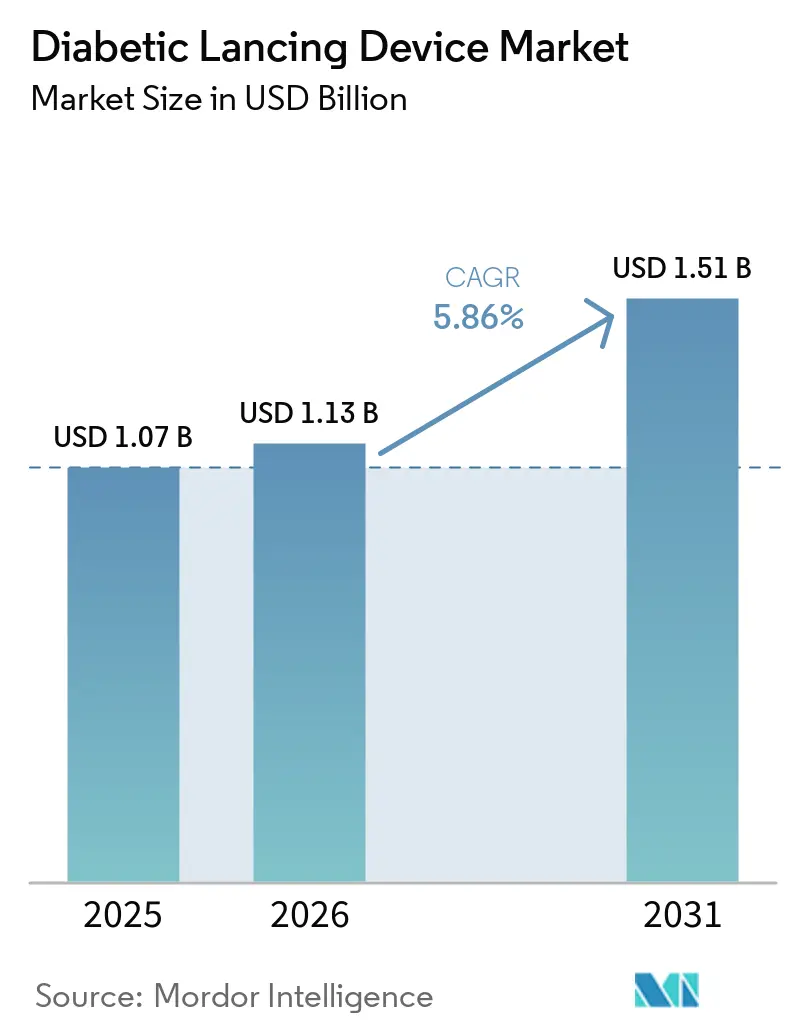
The Diabetic Lancing Device Market size is projected to expand from USD 1.07 billion in 2025 and USD 1.13 billion in 2026 to USD 1.51 billion by 2031, registering a CAGR of 5.86% between 2026 to 2031.
Global diabetes prevalence remained the core volume driver, with 589 million adults living with diabetes in 2024 and 853 million projected by 2050, which keeps routine blood glucose testing relevant across health systems. More than 80% of new diabetes cases were in low and middle-income countries, where continuous glucose monitoring adoption remained limited, and fingerstick testing continued to be the practical default for routine monitoring. This setting keeps the diabetic lancing device market supported in both home care and clinical workflows, especially when newly diagnosed patients enter structured self-monitoring programs and need a simple blood sampling tool from the start. The diabetic lancing device market is also moving from basic price competition toward product differentiation, with safety features, precision depth control, and automation helping suppliers defend premium positioning. Companies that connect lancing devices to wider glucose monitoring kits and digital support tools are better placed to hold repeat demand across the diabetic lancing device market over longer care cycles.
Key Report Takeaways
- By product type, reusable lancing devices held 42.57% share in 2025, while disposable safety lancets are projected to expand at a 6.12% CAGR through 2031 in the diabetic lancing device market.
- By lancet type, the 31G to 33G segment accounted for 48.26% share in 2025, while the 28G to 30G segment is forecast to record the highest CAGR at 6.89% through 2031.
- By usage, home care and self-monitoring led with 73.48% share in 2025, while clinical use is projected to grow fastest at a 7.36% CAGR through 2031 in the diabetic lancing device market.
- By end user, home healthcare captured 62.35% share in 2025, while hospitals and clinics are expected to advance at the highest CAGR of 8.43% through 2031.
- By geography, North America retained 37.46% share in 2025, while Asia-Pacific is forecast to register the fastest CAGR at 9.37% through 2031 in the diabetic lancing device market.
Note: Market size and forecast figures in this report are generated using Mordor Intelligence’s proprietary estimation framework, updated with the latest available data and insights as of January 2026.
Market Trends and Insights
Drivers Impact Analysis of Diabetic Lancing Device Market*
| Driver | (~) % Impact on CAGR Forecast | Geographic Relevance | Impact Timeline |
|---|---|---|---|
| Rising Global Diabetes Prevalence Increasing Demand for SMBG Devices | +1.5% | Global | Long term (≥ 4 years) |
| Increasing Adoption of Home-Based Diabetes Monitoring | +1.1% | North America, Europe, Asia-Pacific urban centers | Medium term (2-4 years) |
| Technological Advancements Toward Painless and Automated Lancing Devices | +0.8% | North America, Europe, Asia-Pacific premium segment | Medium term (2-4 years) |
| Increasing Diabetes Screening Programs in Emerging Markets | +0.6% | Asia-Pacific, Middle East and Africa, South America | Long term (≥ 4 years) |
| Growing Preference for Single-Use Safety Lancets in Clinical Settings | +0.5% | Global, with concentration in North America and the European Union | Short term (≤ 2 years) |
| Integration of Lancing Devices with Connected Diabetes Management Kits | +0.3% | North America, Europe, urban Asia-Pacific | Medium term (2-4 years) |
| Source: Mordor Intelligence | |||
Rising Global Diabetes Prevalence Increasing Demand for SMBG Devices
The International Diabetes Federation reported that 589 million adults were living with diabetes in 2024, and that figure is expected to rise materially over the longer term, which keeps the diabetic lancing device market tied to a steadily expanding care population.[1] The same data showed that more than 80% of new cases were occurring in low and middle-income countries, where continuous glucose monitoring penetration remained low, and SMBG stayed the practical monitoring standard for many patients. This geographic pattern matters because South Asia, Sub-Saharan Africa, and Latin America continue to add first-time users who need capillary blood testing tools early in their care pathway. Those users usually generate lower revenue per patient than consumers in high-income markets, but they also face less risk of shifting quickly to more expensive continuous monitoring alternatives. That makes the diabetic lancing device market more volume resilient than headline technology transition narratives sometimes suggest. It also gives suppliers a durable base of repeat lancet demand that stays relevant even when premium glucose monitoring adoption accelerates elsewhere.
Increasing Adoption of Home-Based Diabetes Monitoring
Home care and self-monitoring show how strongly the diabetic lancing device market still depends on everyday testing behavior outside hospitals and clinics. A 2025 study in BMC Public Health found that reimbursement support for blood glucose test strips was associated with improved glycemic control among insulin-treated type 2 diabetes patients, which supports continued payer logic for covering SMBG consumables that include lancets and lancing devices.[2] Demand in home settings is also reinforced by older patient groups, since people aged 60 years and above often follow care plans that require multiple checks each day. Bundled SMBG kits that combine a meter, strips, a lancing device, and lancets have also made the purchase cycle simpler for consumers and more predictable for suppliers. As online pharmacy and direct-to-consumer channels grow, these bundles help normalize repeat purchasing across chronic care routines. Connected kits add another retention layer because the lancing act becomes part of a broader monitoring routine rather than a separate low-value accessory.
Technological Advancements Toward Painless and Automated Lancing Devices
Innovation in the diabetic lancing device market is moving across needle geometry, actuation control, and alternative blood sampling methods rather than through a single product change. Mechanical and safety design now carries greater commercial weight because buyers increasingly look for less painful sampling, fewer workflow steps, and better sharps protection in one device. ISO 23908:2024 has strengthened this direction by setting clearer expectations for sharps injury protection in single-use needles used in blood testing, which directly affects product design and procurement standards.[3] A 2026 study indexed on ScienceDirect described a microneedle-based system that combined blood sampling, filtration, and electrochemical glucose sensing in one compact format, which points to a longer-term path where sampling and measurement functions may converge.[4] Automatic formats also remain relevant because they can reduce penetration variability for pediatric users and for adults who are sensitive to pain or needle exposure. These changes keep the diabetic lancing device market focused on comfort, consistency, and usability rather than on basic needle supply alone.
Growing Preference for Single-Use Safety Lancets in Clinical Settings
Clinical procurement is increasingly favoring single-use safety formats, which gives the diabetic lancing device market a clear demand tailwind in hospitals, clinics, and laboratory settings. Hospitals and clinics' growth is closely linked to infection control rules that discourage or restrict reusable formats in professional care environments. In the United States, the regulatory framework under 21 CFR §878.4850 places strict controls on blood lancets intended for multiple patient use, which supports a structural preference for single-use safety-engineered products. This preference is commercially important because institutional buyers usually purchase at scale and require consistent product performance across many testing events. The influence of clinical safety standards also extends into home care, since patients often prefer the same safer formats they encounter during supervised testing. That spillover is helping premium single-use categories gain share within the diabetic lancing device market even outside hospitals.
Restraints Impact Analysis of Diabetic Lancing Device Market*
| Restraint | (~) % Impact on CAGR Forecast | Geographic Relevance | Impact Timeline |
|---|---|---|---|
| Growing Adoption of Continuous Glucose Monitoring Systems | -0.9% | North America, European Union, urban Asia-Pacific | Medium term (2-4 years) |
| Limited Awareness and Affordability Challenges in Low-Income Regions | -0.5% | Sub-Saharan Africa, rural South Asia, Latin America | Long term (≥ 4 years) |
| Price pressure from commodity lancets and private label alternatives | -0.5% | Global; most pronounced in North America & EU standard lancet segment | Short term (≤ 2 years) |
| Reuse behavior and low testing compliance in certain patient groups | -0.3% | Global; concentrated in low- and middle-income markets | Long term (≥ 4 years) |
| Source: Mordor Intelligence | |||
Growing Adoption of Continuous Glucose Monitoring Systems
Continuous glucose monitoring remains the strongest structural restraint on the diabetic lancing device market because it reduces the need for repeated fingerstick sampling among high-frequency testers. Abbott secured CE Mark in May 2026 for Libre Duo and Libre Duo 10 Day, which brought dual glucose and ketone sensing into the category and extended the functional advantage of CGM beyond glucose tracking alone. The American Diabetes Association also stated in its 2025 standards of care that CGM should be considered from the outset for insulin-requiring diabetes management, which strengthens institutional support for sensor-based monitoring. Even so, replacement is not immediate because cost, reimbursement gaps, and behavior patterns still slow CGM uptake outside specialist care and higher-income user groups. The result is a medium-term pressure point rather than a complete near-term displacement of fingerstick testing across all patient segments. This means the diabetic lancing device market still retains substantial relevance in mixed-care systems where SMBG and CGM continue to coexist.
Limited Awareness and Affordability Challenges in Low-Income Regions
Affordability and awareness limits continue to cap the full addressable demand of the diabetic lancing device market in many low-income settings despite clear clinical need. A 2026 BMC Public Health study that covered 14 low and middle-income countries found multiple barriers to diabetes screening uptake, including low health literacy, fragmented infrastructure, and income constraints that weaken sustained engagement with monitoring protocols. These barriers do not stop at diagnosis, because regular SMBG requires repeat purchases of strips and lancets that can become burdensome for households with limited disposable income. A 2024 observational study from a Guinean university hospital found that 60% of blood glucose testing errors involved lancet reuse, and the main driver was cost avoidance rather than a lack of awareness of single-use practice. That finding shows how affordability can directly translate into unsafe behavior and weaker product replacement cycles. With reimbursement support still limited in many affected regions, market access often depends on humanitarian or non-governmental procurement channels that remain constrained by budget and scale.
*Our forecasts treat driver/restraint impacts as directional, not additive. The impact forecasts reflect baseline growth, mix effects, and variable interactions.
Diabetic Lancing Device Market Segment Analysis
By Product Type:
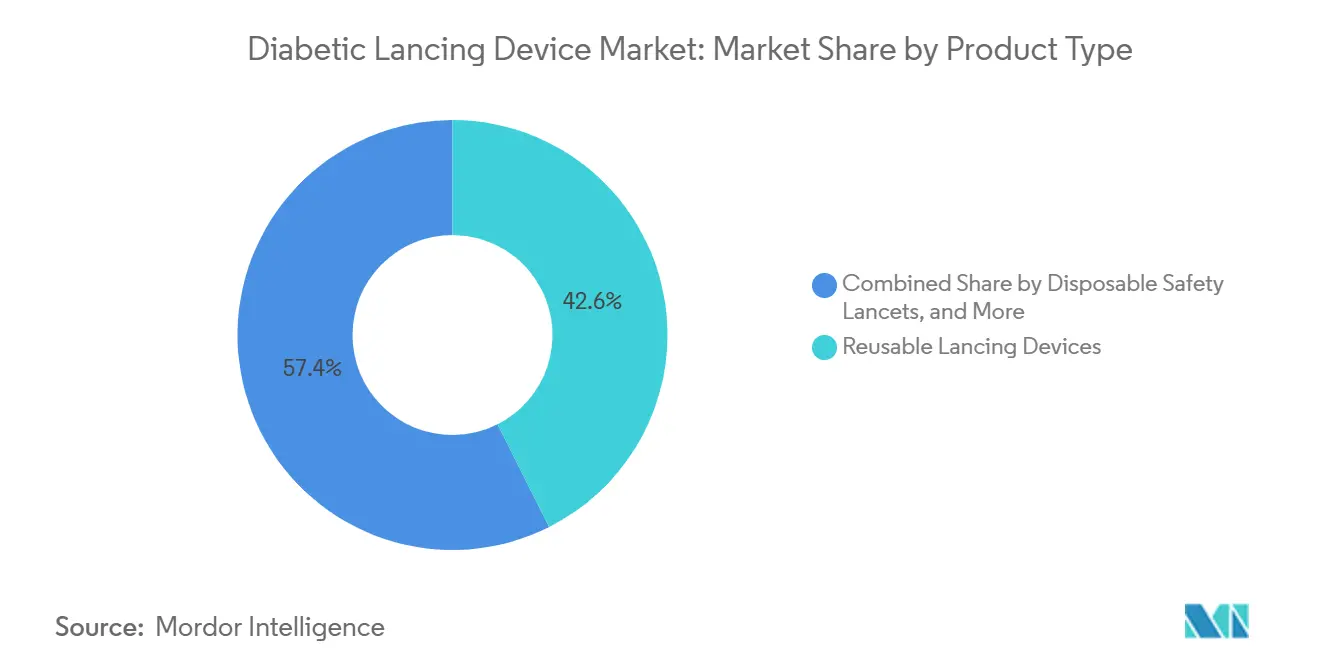
Disposable Formats Gaining Ground on Reusable DominanceReusable lancing devices held 42.57% of the diabetic lancing device market share in 2025, which reflected their long-established role as multi-use systems for people who test frequently at home. Their position remained strong because adjustable penetration depth settings give users better control over comfort and blood volume during routine sampling. Compatibility with a wide range of lancet gauges also lets patients tailor the testing experience without replacing the full device body. This flexibility matters in home care, where users often balance pain tolerance, skin condition, and testing frequency over long periods. It also helps explain why reusable formats still anchor a large part of the diabetic lancing device market despite the rise of safer single-use alternatives.
Disposable safety lancets are projected to expand at a 6.12% CAGR through 2031, making them the fastest-growing product category as infection control requirements keep widening across professional care settings. In the United States, the regulatory treatment of multi-patient blood lancets under 21 CFR §878.4850 continues to channel clinical procurement toward single-use safety-engineered designs. Standard lancets still preserve unit volume in price-sensitive pharmacy channels, but private-label production in China and India continues to tighten margins for that category. Automatic lancing devices occupy a smaller premium niche because they appeal to pediatric users and to adults who want more controlled and less visible penetration. Across the diabetic lancing device industry, the product mix is shifting toward single-use hygiene on one side and comfort-focused automation on the other.

By Lancet Type:
Fine-Gauge Leadership Challenged by Clinical Volume DemandThe 31G to 33G segment represented 48.26% of the diabetic lancing device market size in 2025, showing that finer gauges remain the preferred choice for users who value lower pain and less tissue trauma. That preference matters because discomfort at the sampling point can affect how consistently people follow recommended testing routines. A 2026 observational study in Scientific Reports found that 81.6% of diabetic patients did not replace lancets between fingerstick tests, which highlighted how user behavior and discomfort can still interfere with correct SMBG practice. Fine-gauge demand is also supported by product engineering beyond gauge alone, since coating and entry smoothness can materially change perceived comfort. Ascensia’s MICROLET lancets illustrate this point through a silicone-coated design that aims to improve skin entry performance.
The 28G to 30G segment is expected to grow at a 6.89% CAGR through 2031, mainly because clinical settings often need a larger blood drop and a more dependable sample with lower actuation force. Hospitals and laboratories tend to prioritize adequacy and throughput over maximum comfort when many tests must be performed quickly and consistently. This makes mid-gauge lancets commercially important even as finer gauges lead in home care. The 34G and above category remains smaller and more specialized, with demand concentrated in pediatric and geriatric care where skin fragility is a stronger concern. Across the diabetic lancing device market, gauge choice therefore reflects a split between comfort-led retail use and workflow-led professional use. ISO 23908:2024 further shapes this segment by influencing sharps protection, material requirements, and tip geometry standards across single-use lancet formats.
By Usage:
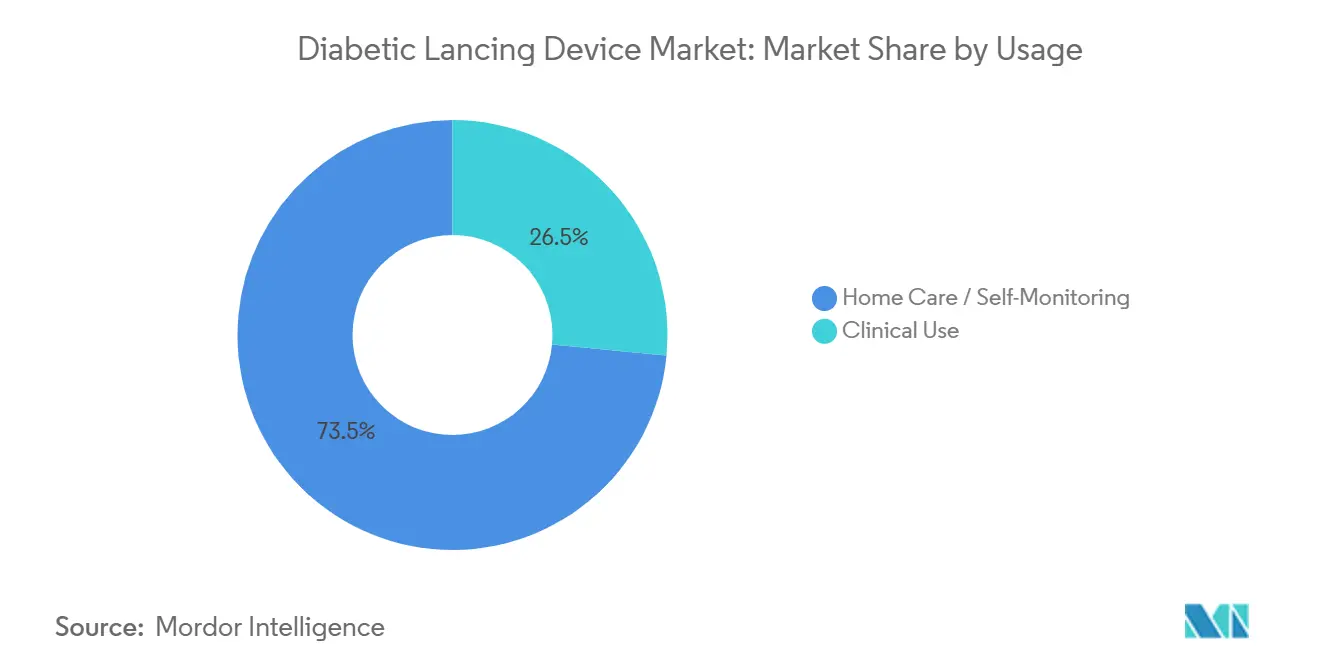
Home Testing Anchors Volumes, Clinical Use AcceleratesHome care and self-monitoring retained 73.48% of the usage segment in 2025, which made it the volume anchor of the diabetic lancing device market. This lead was supported by physician-directed daily testing schedules for insulin-treated patients who need regular capillary blood glucose checks outside the clinic. Bundled SMBG kits sold through pharmacies and retail channels also help patients keep meters, strips, lancing devices, and lancets in a single purchase cycle. That retail structure reduces friction in chronic disease management and supports steady replenishment demand. It also keeps home testing relevant because it is often more convenient and less costly than repeated clinic-based monitoring for ongoing diabetes care.
Clinical use is projected to expand at a 7.36% CAGR through 2031, which means it is growing faster than the overall diabetic lancing device market as formal point-of-care testing expands. Structured screening and outpatient workflows in emerging regions are increasing the number of supervised fingerstick tests performed in organized settings. A 2024 Cureus study on a Saudi Ministry of Health decision-support tool showed how clinical workflows can direct blood glucose monitoring devices more efficiently toward higher-risk patients. At the same time, a 2025 BMC Primary Care study found evidence of reduced SMBG prescribing among certain non-insulin-treated type 2 diabetes patients, which suggests some low-acuity home testing volumes may ease over time in selected primary care settings. The diabetic lancing device market therefore depends on a large home base for scale while clinical use provides the faster near-term expansion path.
By End User:
Home Healthcare Leads, Hospitals Drive Faster Incremental GrowthHome healthcare captured 62.35% of the end-user segment in 2025, reflecting the large population of patients who manage diabetes outside institutional settings. This share remained high because self-managed care requires repeat access to lancets and lancing devices over long treatment periods. Reimbursement support for SMBG supplies in North America and Europe also helps sustain repeat purchasing through formal home procurement channels. That steady replenishment cycle gives manufacturers dependable turnover even when broader healthcare budgets become more selective. It also keeps ease of use, compatibility, and pack convenience central to product design and channel strategy across the diabetic lancing device market.
Hospitals and clinics are projected to grow at a 8.43% CAGR through 2031, which makes them the fastest-moving end-user group in the diabetic lancing device industry. This growth is tied to formal glucose testing workflows, occupational safety standards, and stronger adoption of single-use safety lancets in professional environments. Diagnostic laboratories add another layer of incremental demand as point-of-care blood glucose testing expands across developing healthcare systems. Other channels, including pharmacy-managed testing services and patient assistance programs, remain relevant in markets where public health infrastructure is still broadening but not yet fully mature. The diabetic lancing device industry therefore combines a large self-care base with rising institutional demand that increasingly rewards compliant and safety-engineered products.
Geography Analysis
North America Diabetic Lancing Device Market
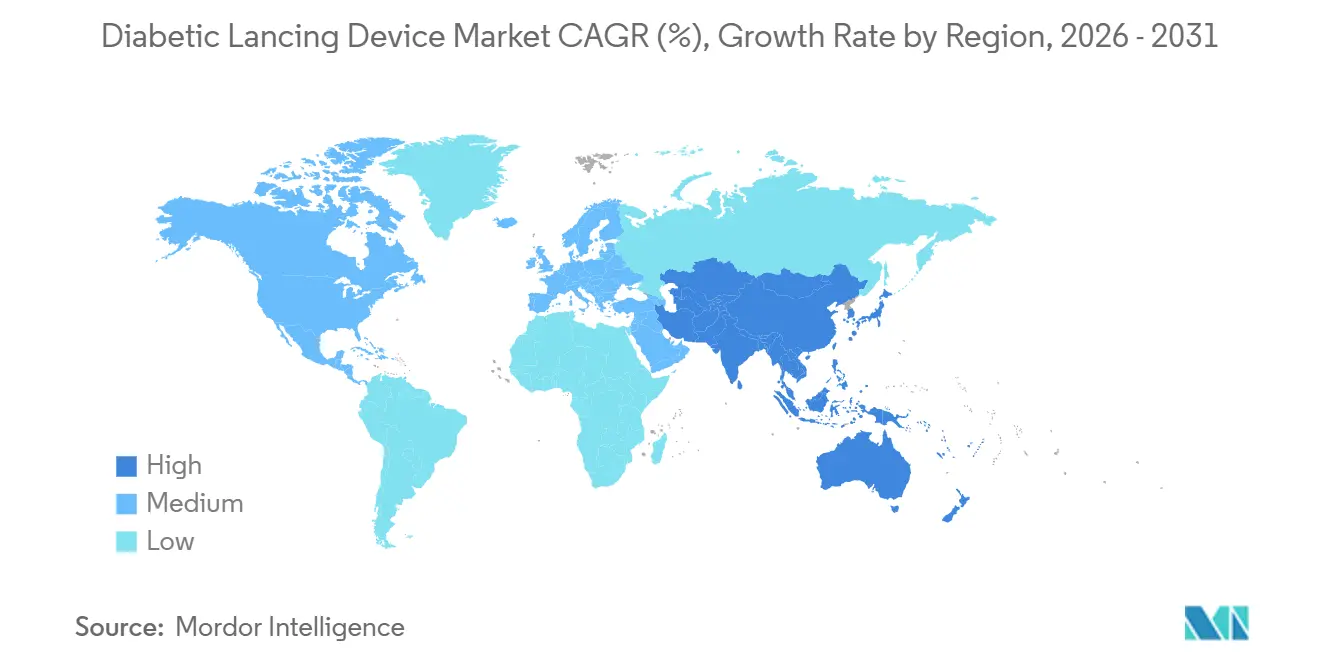
North America held 37.46% of the diabetic lancing device market share in 2025, supported by high SMBG adoption, structured reimbursement, and the entrenched presence of large suppliers such as BD, Roche, and Abbott. The United States remained the largest national market because clinical and retail demand both benefited from established blood glucose monitoring pathways. Regulatory treatment of blood lancets under 21 CFR §878.4850 also reinforced procurement preference for safety-oriented formats in professional care settings. Canada and Mexico added volume through pharmacy and private-label channels that served more price-sensitive buyers. Regional growth was slower than in emerging areas because CGM substitution was stronger among insulin-dependent patients, even though home diagnostics still supported ongoing demand in the diabetic lancing device market.
EMEA Diabetic Lancing Device Market
Europe remained the second-largest regional base for the diabetic lancing device market, with Germany, the United Kingdom, and France acting as the main demand centers for home healthcare and clinical lancet consumption. ISO 23908:2024 and broader European device compliance expectations kept procurement focused on single-use safety products and favored suppliers with stronger post-market systems. These conditions helped established players defend their position and limited faster expansion by low-cost entrants without developed compliance infrastructure. The Middle East and Africa remained smaller in revenue terms, but public screening initiatives were still creating meaningful future demand, as AMPATH Kenya expanded diabetes and hypertension screening across 23 facilities and screened more than 81,000 individuals between July 2024 and December 2025.
APAC and South America Diabetic Lancing Device Market
Asia-Pacific is projected to grow at 9.37% CAGR, which makes it the fastest-rising diabetic lancing device market size through 2031. The region combines a very large diabetes burden with increasing investment in SMBG access, which supports both basic volume growth and a gradual move toward better device quality. China provides a large base for lower-priced domestic supply, while international brands compete more on accuracy, connectivity, and device quality. South America is also moving upward, led by Brazil and Argentina, where urban diabetes management programs and pharmacy distribution continue to support broader product access. Even so, healthcare spending cycles and currency volatility still limit how quickly premium formats can scale across parts of the region.
Competitive Landscape
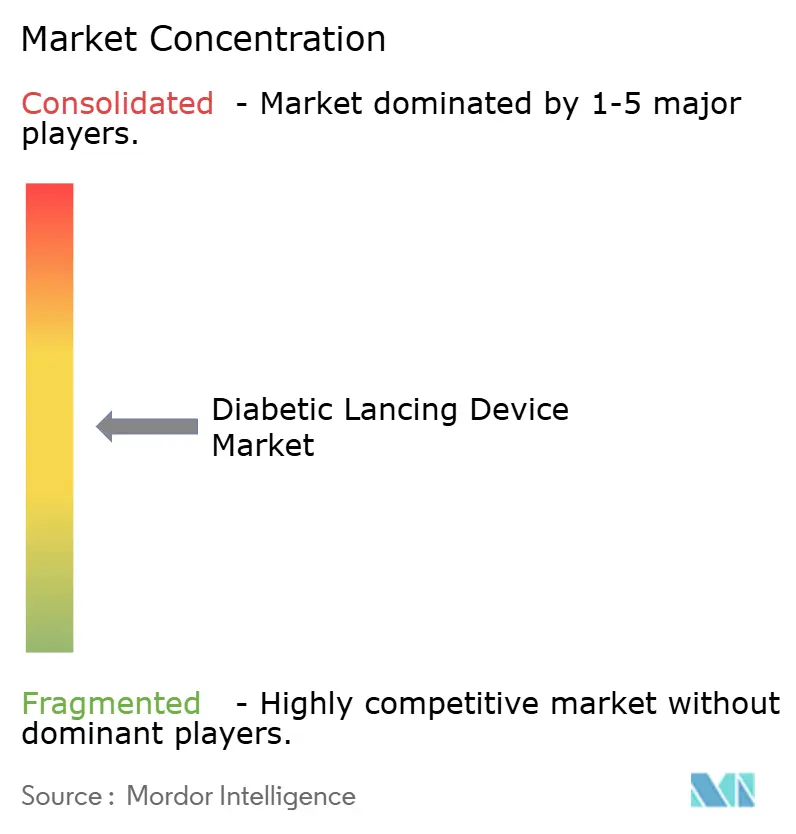
The diabetic lancing device market shows moderate concentration in premium and institutional channels, where BD, Roche, and Abbott benefit from integrated blood glucose monitoring portfolios and well-established distribution networks. Their scale gives them advantages in regulatory execution, manufacturing consistency, and payer or provider relationships that are difficult for smaller competitors to match. Roche keeps its Accu-Chek lancing portfolio tied to a wider diabetes management ecosystem, which supports device retention through connected care routines rather than through a one-time hardware sale alone. Abbott also influences the competitive direction of the diabetic lancing device market because advances in its sensing platforms increase the long-term substitution risk for routine fingerstick testing in higher-income care settings. That dynamic means the leading companies are not only competing inside the category, they are also shaping the pace at which adjacent monitoring technologies affect it.
Specialist suppliers still matter because competitive performance in this category depends heavily on penetration consistency, lancet tip design, sharps protection, and compatibility with existing monitoring routines. HTL-Strefa remains relevant through its lancet-focused positioning and European supply footprint, while other niche manufacturers continue to compete on product engineering rather than full ecosystem ownership. Private-label pressure is also increasing in the lower-cost tier, especially in markets where affordability and cross-device compatibility outweigh brand loyalty. Even so, strict safety and compliance standards continue to slow rapid movement by the lowest-cost suppliers into tightly regulated hospital procurement channels. This keeps value segmentation clear across the diabetic lancing device market, with branded systems stronger in regulated settings and lower-priced formats more active in retail and pharmacy channels.
Corporate restructuring has also altered the mid-tier landscape, as Ypsomed completed the sale of Ypsomed Diabetes Care to TecMed AG for up to CHF 420 million (USD 517.7 million) in 2025, creating an independent competitor with inherited diabetes device capabilities and established brand equity. Roche Diabetes Care also remained active in adjacent intellectual property development, with a 2025 USPTO patent tied to analyte detection technologies that reflected continued investment around biosensing and monitoring workflows. The next competitive opening is likely to remain at the point where lancing hardware, blood glucose testing, and digital record capture overlap in one user journey. Companies that make sampling simpler, safer, and better connected to monitoring records are more likely to protect pricing than firms that keep treating the device as a standalone accessory.
Diabetic Lancing Device Industry Leaders
-
Abbott Laboratories
-
ARKRAY, Inc.
-
B. Braun Melsungen AG
-
Becton Dickinson and Company
-
F. Hoffmann-La Roche Ltd
- *Disclaimer: Major Players sorted in no particular order
Diabetic Lancing Device Market Companies Covered in this Report
- Abbott Laboratories
- AgaMatrix, Inc.
- Arkray
- Ascensia Diabetes Care Holdings AG
- AUVON Technology Co., Ltd.
- B. Braun
- Beckton Dickinson
- Cardinal Health
- Roche
- Genteel LLC
- HTL-Strefa S.A.
- Medline Industries
- Nipro
- Owen Mumford Limited
- Sanofi
- Sarstedt
- Terumo
- Trividia Health, Inc.
- Vitrex Medical A/S
- Ypsomed
Recent Industry Developments in Diabetic Lancing Device Market
- May 2026: Abbott Laboratories secured the CE Mark for Libre Duo and Libre Duo 10 Day, the world's first dual glucose-ketone CGM platform delivering real-time glucose and ketone readings every minute. European commercial launch is planned for later in 2026, intensifying substitution pressure on conventional fingerstick monitoring among type 1 diabetes patients and accelerating the pace of CGM transition in high-income markets.
- May 2025: Ascensia Diabetes Care received U.S. FDA clearance for the MICROLET NEXT 2 Lancing Device. The updated reusable lancing device was designed to improve blood sample consistency, enhance patient comfort, and support more reliable self-monitoring of blood glucose for people with diabetes.
- December 2025: Tianjin Huahong Technology received FDA 510(k) clearance for its HH-XV-T Lancing Device (K253706). The reusable lancing device was cleared for capillary blood sampling to support blood glucose testing and expanded the company's presence in the global diabetic blood sampling device market.
Global Diabetic Lancing Device Market Report Scope
As per the scope of the report, a diabetic lancing device is a small, handheld medical tool used by people with diabetes to obtain a drop of blood for glucose testing. It contains a spring‑loaded mechanism that quickly inserts and withdraws a sterile lancet into the skin, usually on the fingertip, to minimize pain. The device ensures consistent depth of penetration, safety, and hygiene, enabling accurate blood glucose monitoring as part of daily diabetes management.
The diabetic lancing device is segmented by product type, lancet type, usage, end user, and geography. By product type, the market is segmented into reusable lancing devices, disposable safety lancets, standard lancets, and automatic lancing devices. By lancet type, the market is segmented into 28G–30G lancets, 31G–33G lancets, and 34G and above lancets. By usage, the market is segmented into home care / self-monitoring and clinical use. By end user, the market is segmented into hospitals & clinics, diagnostic laboratories, home healthcare, and others. The geography segment is further divided into North America, Europe, Asia-Pacific, the Middle East and Africa, and South America. The report also covers the estimated market sizes and trends for 17 countries across major regions globally. The report offers the market size and forecasts in value (USD) for the above segments.
Segmentation Overview
| Reusable Lancing Devices |
| Disposable Safety Lancets |
| Standard Lancets |
| Automatic Lancing Device |
| 28G–30G Lancets |
| 31G–33G Lancets |
| 34G and Above Lancets |
| Home Care / Self-Monitoring |
| Clinical Use |
| Hospitals & Clinics |
| Diagnostic Laboratories |
| Home Healthcare |
| Others |
| North America | United States |
| Canada | |
| Mexico | |
| Europe | Germany |
| United Kingdom | |
| France | |
| Italy | |
| Spain | |
| Rest of Europe | |
| Asia-Pacific | China |
| India | |
| Japan | |
| Australia | |
| South Korea | |
| Rest of Asia-Pacific | |
| Middle East and Africa | GCC |
| South Africa | |
| Rest of Middle East and Africa | |
| South America | Brazil |
| Argentina | |
| Rest of South America |
| By Product Type | Reusable Lancing Devices | |
| Disposable Safety Lancets | ||
| Standard Lancets | ||
| Automatic Lancing Device | ||
| By Lancet Type | 28G–30G Lancets | |
| 31G–33G Lancets | ||
| 34G and Above Lancets | ||
| By Usage | Home Care / Self-Monitoring | |
| Clinical Use | ||
| By End User | Hospitals & Clinics | |
| Diagnostic Laboratories | ||
| Home Healthcare | ||
| Others | ||
| By Geography | North America | United States |
| Canada | ||
| Mexico | ||
| Europe | Germany | |
| United Kingdom | ||
| France | ||
| Italy | ||
| Spain | ||
| Rest of Europe | ||
| Asia-Pacific | China | |
| India | ||
| Japan | ||
| Australia | ||
| South Korea | ||
| Rest of Asia-Pacific | ||
| Middle East and Africa | GCC | |
| South Africa | ||
| Rest of Middle East and Africa | ||
| South America | Brazil | |
| Argentina | ||
| Rest of South America | ||
Key Questions Answered in the Report
What is the expected value of the diabetic lancing device space by 2031?
It is projected to reach USD 1.51 billion by 2031, up from USD 1.13 billion in 2026, with a 5.86% CAGR over 2026 to 2031.
What is driving demand for diabetic lancing devices the most?
The largest demand factor is the growing number of people living with diabetes, especially in countries where SMBG remains the practical standard for routine monitoring.
Which product type is growing the fastest?
Disposable safety lancets are forecast to grow the fastest, with a 6.12% CAGR through 2031, supported by stronger infection control and single-use protocols.
Which usage setting contributes the most volume?
Home care and self-monitoring remain the largest usage setting, with 73.48% share in 2025, because daily testing often happens outside hospitals.
Which region is expanding the fastest?
Asia-Pacific is expected to grow the fastest, with an 9.37% CAGR through 2031, supported by a large diabetes burden and wider SMBG access.
What is the biggest restraint on future growth?
The main restraint is the wider adoption of continuous glucose monitoring, especially in higher income settings where sensor-based systems can reduce fingerstick frequency.