
Descaling Chemicals Market Size and Share
Market Overview
| Study Period | 2021 - 2031 |
|---|---|
| Market Size (2026) | USD 2.38 Billion |
| Market Size (2031) | USD 3.10 Billion |
| Growth Rate (2026 - 2031) | 5.46 % |
| Fastest Growing Market | Asia-Pacific |
| Largest Market | Asia-Pacific |
| Market Concentration | Medium |
Major Players *Disclaimer: Major Players sorted in no particular order Image © Mordor Intelligence. Reuse requires attribution under CC BY 4.0. | |
Descaling Chemicals Market Analysis by Mordor Intelligence
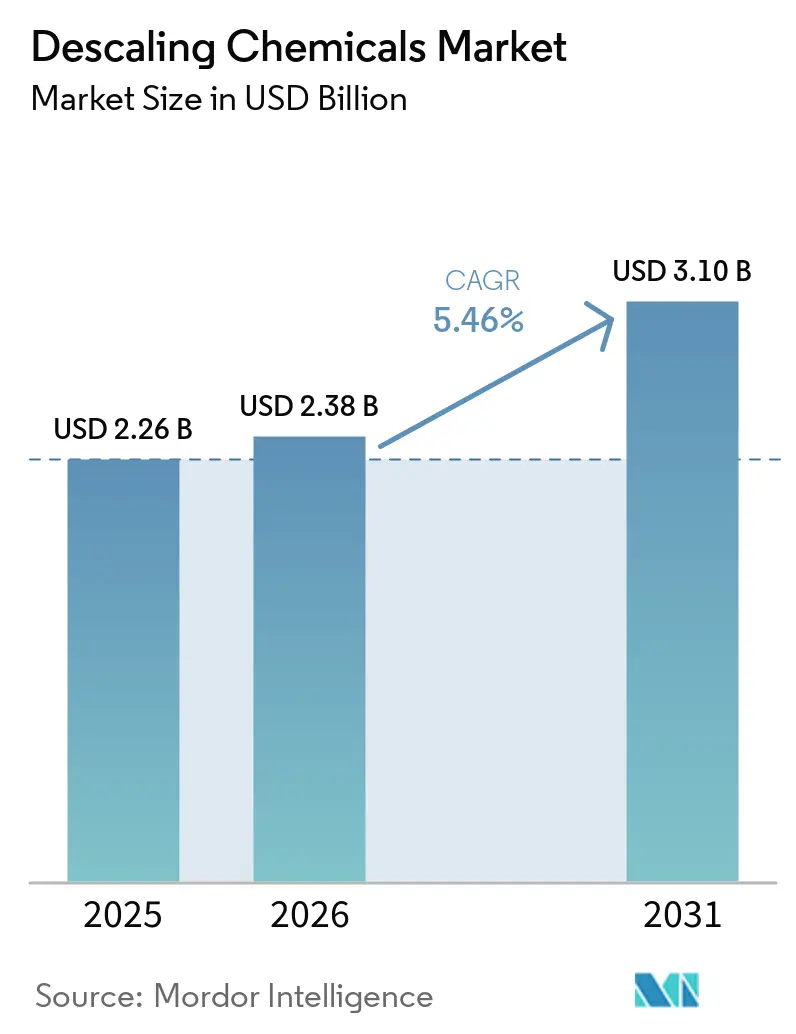
The descaling chemicals market size was estimated at USD 2.26 billion in 2025 and is estimated to grow from USD 2.38 billion in 2026 to USD 3.10 billion by 2031, at a CAGR of 5.46% during the forecast period (2026-2031). The descaling chemicals market is driven by the need to maintain operational efficiency in boilers, cooling towers, heat exchangers, and water circuits. Scale buildup reduces heat transfer and increases fuel consumption, making chemical cleaning an integral part of energy and asset management programs rather than an occasional maintenance activity. Industrial operators are also shifting from reactive cleaning to planned service programs, particularly where food safety, equipment reliability, or water reuse requirements apply. This shift supports recurring demand and gives suppliers an opportunity to combine formulations with monitoring, dosing, and site services. Regulatory attention to acid handling is changing the chemistry mix, while preventive treatments such as antiscalants limit some curative demand but cannot remove existing deposits. The descaling chemicals market therefore continues to serve an essential remediation role even as preventive water treatment programs become more common.
Key Report Takeaways
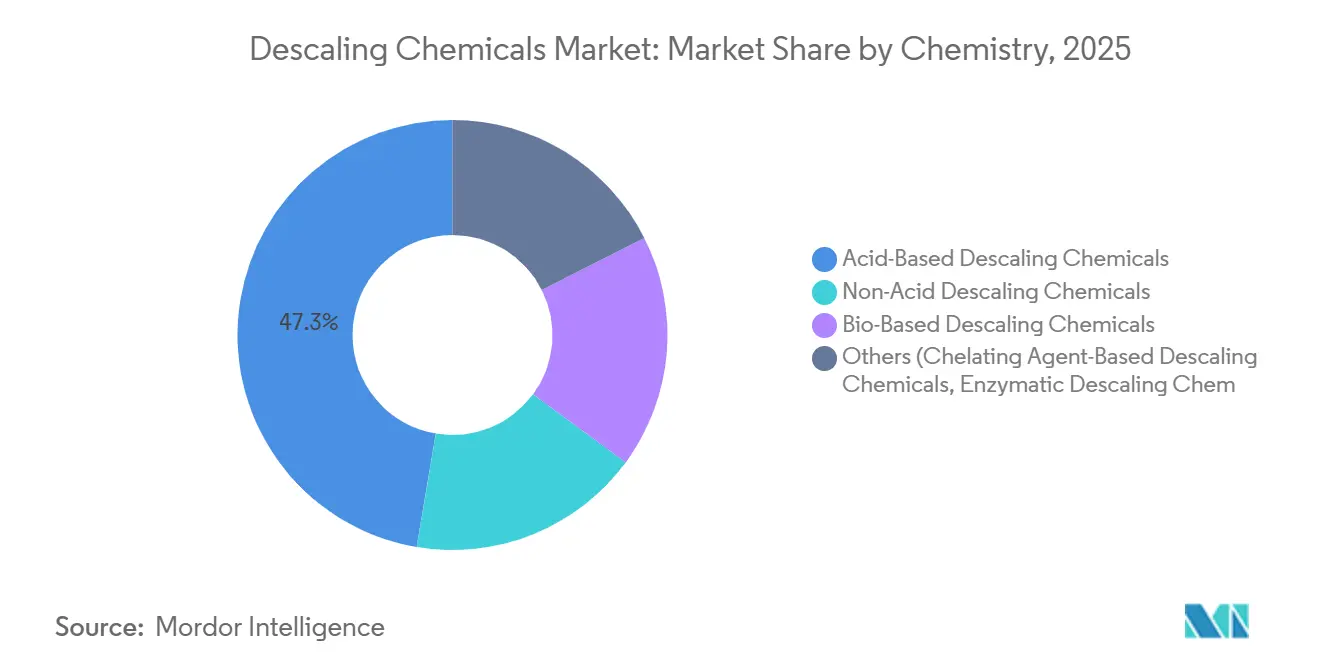
- By chemistry, acid-based products held 47.34% of the descaling chemicals market share in 2025, while bio-based products are projected to grow at a 7.08% CAGR through 2031.
- By application, industrial equipment accounted for 31.63% of the descaling chemicals market share in 2025, while water treatment systems are projected to grow at a 6.15% CAGR through 2031.
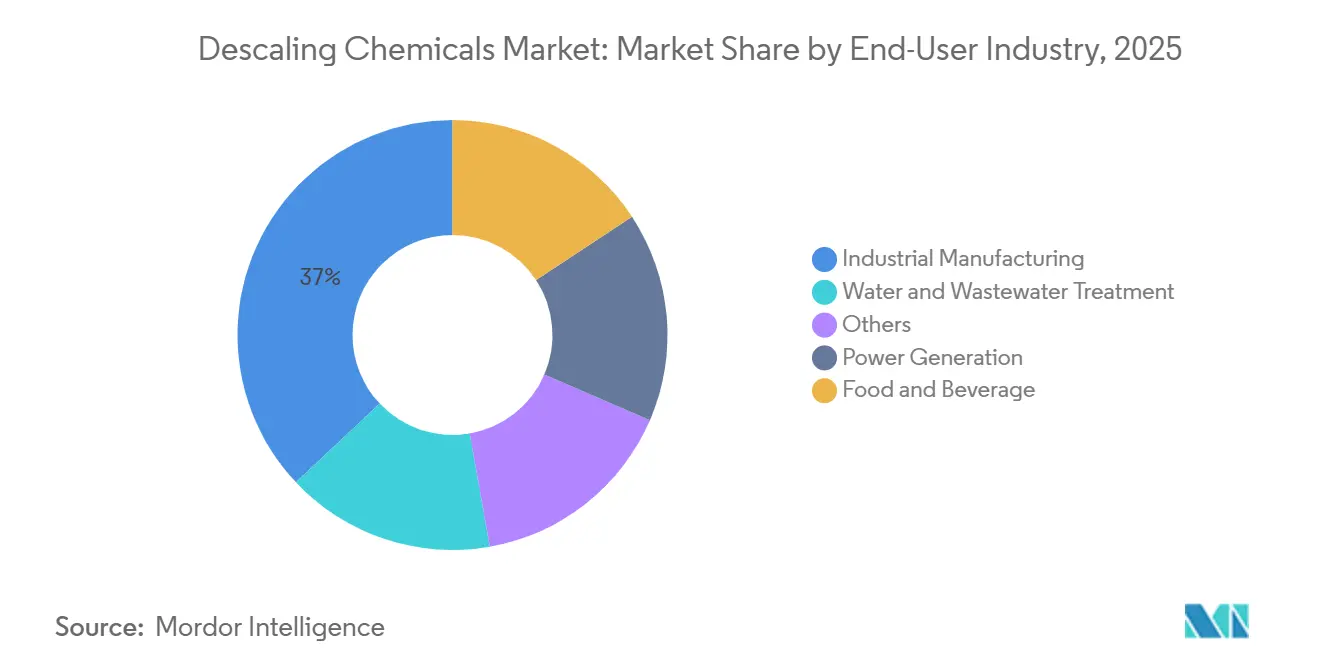
- By end-user industry, industrial manufacturing held 37.02% of the descaling chemicals market share in 2025, while water and wastewater treatment is projected to grow at a 6.47% CAGR through 2031.
- By geography, Asia-Pacific held 32.18% of the descaling chemicals market share in 2025 and is projected to grow at a 6.53% CAGR through 2031.
Note: Market size and forecast figures in this report are generated using Mordor Intelligence’s proprietary estimation framework, updated with the latest available data and insights as of January 2026.
Market Trends and Insights
Drivers Impact Analysis of Descaling Chemicals Market*
| Drivers | (~) % Impact on CAGR Forecast | Geographic Relevance | Impact Timeline |
|---|---|---|---|
| Industrial Energy Efficiency and Equipment Life | +1.6% | Global, with high intensity in North America, Europe, and East Asia | Long term (≥ 4 years) |
| Industrial Water Treatment and Process Cleaning Expansion | +1.4% | Asia-Pacific core, with spillover to the Middle-East and Africa, and South America | Medium term (2-4 years) |
| Preventive Maintenance and Clean-in-Place Programs | +1.1% | Global, with the strongest demand in North America and Europe | Medium term (2-4 years) |
| Digital Monitoring and Predictive Chemical Dosing | +0.7% | North America and Europe, spreading to advanced Asia-Pacific markets | Short term (≤ 2 years) |
| Hard-Water Stress in Emerging Industrial and Foodservice Clusters | +0.8% | Asia-Pacific, the Middle-East, and Africa | Short term (≤ 2 years) |
| Source: Mordor Intelligence | |||
Industrial Energy Efficiency and Equipment-Lifetime Requirements
Scale formation reduces heat transfer across boiler and heat-exchanger surfaces, making it a sustained driver of demand for descaling chemicals. According to Kurita's DReeM Polymer documentation, clean boiler surfaces can improve energy performance and reduce carbon dioxide emissions[1]. When mineral deposits limit heat transfer, operators must consume more fuel to achieve a given steam output. This cost exposure has made cleaning schedules more relevant to energy audits and equipment-life planning. The descaling chemicals market benefits when maintenance teams treat chemical cleaning as a planned measure rather than a response to equipment failure or efficiency decline. The resulting demand is less dependent on short-term production changes because it is tied to performance targets, maintenance procedures, and compliance expectations.
Expansion of Industrial Water Treatment and Process-Cleaning Demand
Industrial water systems require cleaning throughout their operating life, which broadens the use of descaling chemicals across processing and utility applications. Water reuse systems can concentrate minerals in recirculating streams, increasing the risk of deposits inside membranes, piping, heat exchangers, and clarification equipment. This makes the descaling chemicals market relevant to facilities reducing water withdrawals, as well as to those expanding conventional water treatment. New manufacturing, mining, and electricity assets add to the installed equipment base that requires cleaning during scheduled outages. The demand relationship is particularly strong where hard water and closed-loop systems operate together. Chemical suppliers can address this need by offering cleaning programs tailored to the equipment, water quality, deposit type, and operating schedule at each site.
Growth of Preventive Maintenance and Clean-in-Place Programs
Preventive maintenance programs are changing how many users buy and apply descaling formulations. Food and beverage producers use clean-in-place programs to maintain sanitary process equipment, and acid-wash steps remove mineral deposits that remain after production and alkaline-cleaning cycles. These requirements can support contract-based chemical supply and routine service rather than irregular purchases. In September 2025, Ecolab introduced CIP IQ, a digital cleaning solution for food and beverage operations, reporting average customer-site results of 15% greater operating efficiency and 20% lower water use per cleaning cycle. PMMI's 2025 sanitation study reported growing use of digital monitoring and automated cleaning in food manufacturing. The descaling chemicals market benefits from this formalization, as documented programs require consistent cleaning, traceability, and precise chemical use.
Digital Scale Monitoring and Predictive Chemical Dosing
Digital monitoring is making chemical dosing more specific to actual conditions inside industrial water systems. Measurements of turbidity, conductivity, and scale-related indicators can help operators determine when a cleaning cycle is needed. Kurita's S.sensing CS platform uses laser-based turbidity measurement to automate coagulant dosing in real time, illustrating the broader role of sensor-guided water management. In April 2026, Ecolab launched Water Navigator IQ to provide predictive water intelligence across industrial sites. These systems can reduce excess chemical use while helping users avoid delayed cleaning that negatively affects energy performance. For suppliers in the descaling chemicals market, data-driven service platforms can strengthen customer relationships by integrating the formulation within a broader operating program.
Restraints Impact Analysis of Descaling Chemicals Market*
| Restraints | (~) % Impact on CAGR Forecast | Geographic Relevance | Impact Timeline |
|---|---|---|---|
| Hazardous Chemical Handling and Wastewater Compliance Costs | -0.3% | North America and Europe, with increasing enforcement in the Asia-Pacific | Medium term (2-4 years) |
| Water Softening, Antiscalants, and Mechanical Cleaning Substitution | -0.2% | Global, with the highest intensity in Europe | Medium term (2-4 years) |
| Material Compatibility Risk in Mixed-Metallurgy Equipment | -0.1% | Global, with high exposure in aging North American and European assets | Long term (≥ 4 years) |
| Source: Mordor Intelligence | |||
Hazardous-Chemical Handling and Wastewater Compliance Costs
Acid-based formulations can increase costs for handling, storage, worker protection, and wastewater management for industrial users. The U.S. Environmental Protection Agency amended hazardous chemical inventory reporting requirements in November 2025 to align with OSHA hazard communication updates[2]. These obligations can affect facilities that use strong acids and regulated chelating agents at levels above specified limits. European REACH requirements also influence the selection and use of chemical formulations. These conditions can limit the use of conventional acids in the descaling chemicals market, particularly for smaller users and suppliers with limited compliance resources. They also favor bio-based and chelating alternatives that may carry lower handling burdens and support higher-value product positions.
Substitution by Water Softening, Antiscalants, and Mechanical Cleaning
Water softening and antiscalant programs reduce scale formation before it begins, which limits part of the need for curative chemical cleaning. A 2025 study in Environmental Science: Water Research and Technology found that polyaspartic-acid derivative antiscalants achieved 94% to 100% scale inhibition in pilot reverse-osmosis systems. These treatments are most effective when operators apply them early and maintain adequate control of water chemistry. However, they do not remove existing mineral deposits, so descaling chemicals remain necessary when scale has already formed. Mechanical methods can also be impractical for complex heat-exchanger geometries and precision equipment. The descaling chemicals market is therefore moderated by preventive approaches rather than displaced by them, as many facilities use prevention and remediation together.
*Our forecasts treat driver/restraint impacts as directional, not additive. The impact forecasts reflect baseline growth, mix effects, and variable interactions.
Descaling Chemicals Market Segment Analysis
By Chemistry:
Acid-Based Products Lead While Bio-Based Products Gain GroundAcid-based products held 47.34% of the descaling chemicals market share in 2025. Their position reflects established effectiveness in removing calcium carbonate, iron oxide, and silicate deposits from boilers, cooling towers, and heat exchangers. Acid formulations remain widely used where the speed of mineral removal is central to the maintenance plan. A 2026 study in Discover Mechanical Engineering reported rapid carbonate-scale dissolution in hydrochloric acid concentrations from 5 wt% to 15 wt%, while also noting the need for corrosion protection. The need to pair acids with inhibitors gives suppliers room to differentiate through material protection, dosing guidance, and site-specific formulation design. Acid-based products also remain relevant for installed equipment with severe deposits that cannot be addressed through preventive treatment alone. They are especially useful during shutdowns, when maintenance teams need a dependable method to restore access to restricted surfaces. Their continued use reflects practical remediation needs, even where facilities have adopted routine softening or antiscalant treatment.
Bio-based descaling products are forecast to grow at a 7.08% CAGR through 2031, making them the fastest-growing chemistry category. Their growth reflects procurement preferences for lower-impact formulations and the development of plant-derived and biodegradable ingredients. Envirofluid's Triple7 EnviroScale received USDA BioPreferred certification with 96% biobased content, providing a third-party purchasing reference for industrial and institutional users. BASF introduced Trilon G in April 2025 using GLDA chemistry with 56% renewable carbon content and ready biodegradability under OECD 301D. Scientific Reports also documented the performance of bio-derived surfactants in controlling calcium carbonate scale in industrial water systems. These examples indicate why bio-based products are becoming more suitable for applications where operators require both cleaning performance and lower chemical-handling concerns. Their adoption is strongest where procurement rules, wastewater considerations, and sensitive equipment make conventional acid programs less practical. The category still needs to demonstrate fit across varying deposit types and operating conditions.

By Application:
Industrial Equipment Leads While Water Treatment Systems ExpandIndustrial equipment accounted for 31.63% of the descaling chemicals market share in 2025. Boilers, cooling towers, condensers, process piping, and heat exchangers create a large and recurring cleaning base across heavy industry. Many industrial facilities contain aging assets in which accumulated mineral deposits make cleaning a routine maintenance cost. Regular descaling can restore heat transfer, reduce the compressor workload, lower the operating pressure, and extend the equipment's service life. The segment remains important because scale directly affects energy use and equipment reliability. Suppliers can serve it through formulations tailored to equipment design, deposit severity, safety requirements, and cleaning windows. Industrial buyers also need guidance on dilution, circulation time, neutralization, and rinsing, making technical service an important part of the offer rather than an optional addition to chemical supply.
Water treatment systems are projected to grow at a 6.15% CAGR through 2031. Reverse-osmosis plants, membrane bioreactors, clarification systems, and reuse loops all contain surfaces that can accumulate mineral deposits. Higher mineral concentrations in recirculating water can increase the frequency of cleaning in the very systems installed to improve water efficiency. This supports growth in the descaling chemicals market in a part of the value chain that is becoming more important to industrial users. Water treatment equipment also requires careful product selection because membranes, housings, dosing equipment, and drainage systems can have different material limits. The opportunity is strongest for suppliers that can link chemical programs with water analysis, cleaning validation, and operating guidance. As reuse systems become more closely managed, users can identify deposits earlier and schedule cleaning before system performance declines. This creates demand for programs that connect remediation with broader water-management objectives.
By End-User Industry:
Manufacturing Leads While Water and Wastewater Treatment Grows FastestIndustrial manufacturing retained 37.02% of the descaling chemicals market share in 2025. Metals, chemicals, automotive production, and general manufacturing rely on dense networks of steam-generating and heat-transfer equipment. This equipment base requires routine cleaning of boilers, condensers, cooling towers, and pipework. Production stoppages and energy losses can be costly, encouraging scheduled descaling rather than emergency intervention. The segment also uses service agreements and maintenance protocols that help stabilize demand. The descaling chemicals market remains tied to manufacturing because scale control helps protect equipment availability, process efficiency, and maintenance budgets. Metals and chemical plants need reliable heat transfer during continuous operations, while automotive facilities value predictable maintenance windows. These operational needs preserve the role of professional descaling programs across a broad range of industrial processes.
Water and wastewater treatment is projected to grow at a 6.47% CAGR through 2031. Treatment plants need to clean membrane housings, dosing systems, clarification vessels, and associated recirculation circuits. Infrastructure aging and investment gaps across Asian water systems remain material challenges, according to the Asian Development Bank's 2025 Asian Water Development Outlook. These conditions support continuing maintenance requirements within plant assets. The segment benefits from a reinforcing need because treatment facilities use water-management equipment that, in turn, requires scale control. Power generation and food and beverage also provide meaningful demand, as their scheduled maintenance, sanitation, and heat-transfer requirements support regular chemical cleaning. Power facilities seek to avoid fuel inefficiency linked to fouled boiler and condenser surfaces. Food producers need cleaning steps that support validated sanitary procedures without creating compatibility issues in process equipment.
Geography Analysis
APAC Descaling Chemicals Market
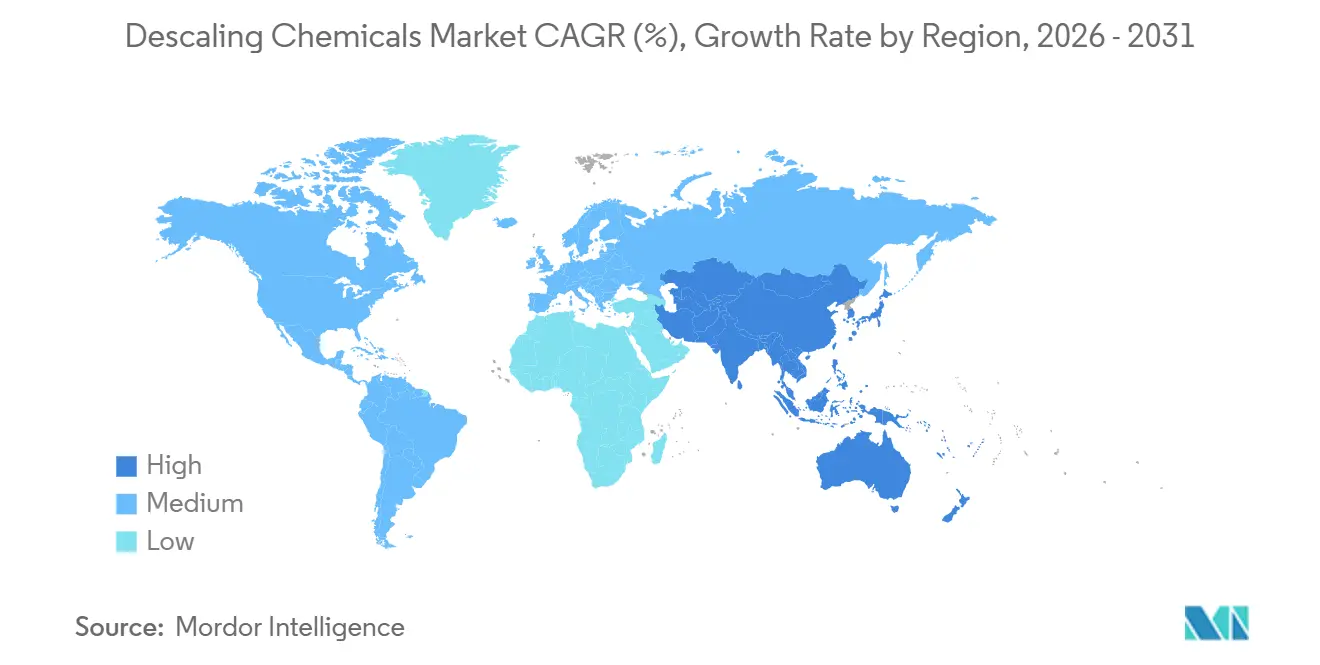
Asia-Pacific held 32.18% of the descaling chemicals market share in 2025 and is projected to grow at a 6.53% CAGR through 2031. China, India, Japan, South Korea, and ASEAN countries combine the expansion of industrial capacity with significant water treatment requirements. Industrial production adds boilers, heat exchangers, cooling systems, and process equipment that require regular cleaning. High mineral loads in parts of the region accelerate scale formation within industrial water circuits. The region is also expanding its water reuse and treatment infrastructure, which concentrates minerals in recirculating systems. These conditions make Asia-Pacific both the largest regional market and the fastest-growing area for descaling chemicals. Demand is distributed across large industrial sites and smaller operators using foodservice, utility, and process equipment. Suppliers that can provide local technical support and formulations suited to regional water conditions hold a commercial advantage.
China, India and Japan Descaling Chemicals Market
China's investment in water efficiency and its broad industrial base support demand across power, chemical, and manufacturing facilities. India presents a relevant profile, as hard groundwater and growing industrial capacity increase cleaning requirements in recirculation systems. The Asian Development Bank documented ongoing water security gaps and infrastructure constraints across the Asia-Pacific region in 2025. Japan is a more mature market where automotive, electronics, and food-processing operators require low-corrosivity products compatible with specialized equipment. Buyers across the region are expected to place greater value on formulations that balance cleaning speed, safety, and material protection. This requirement applies to both mature industrial markets and rapidly expanding manufacturing centers, and it also supports monitoring and dosing services that help users manage cleaning more consistently.
The Americas and EMEA Descaling Chemicals Market
North America and Europe remain high-value markets with formal asset management systems and recurring maintenance protocols. Food processing, power generation, industrial manufacturing, and high-technology facilities support established demand in both regions. North American operators are also adopting suppliers' digital water management tools, as illustrated by Ecolab's Water Navigator IQ launch in 2026. European buyer preferences increasingly favor lower-impact, phosphonate-free chemistry, supporting bio-based alternatives. South America, the Middle-East, and Africa are smaller markets but remain strategically important, as processing industries, desalination-linked systems, mining operations, and hard-water conditions require scale management. Brazil supports South American demand through sugar-ethanol processing and food manufacturing, while Saudi Arabia, Gulf Cooperation Council (GCC) markets, and South Africa support regional demand through industrial, utility, desalination, and mining activity. These markets often require products adapted to local water composition, asset conditions, and operating practices. Their smaller scale does not reduce their relevance for suppliers seeking diversified regional demand.
Competitive Landscape
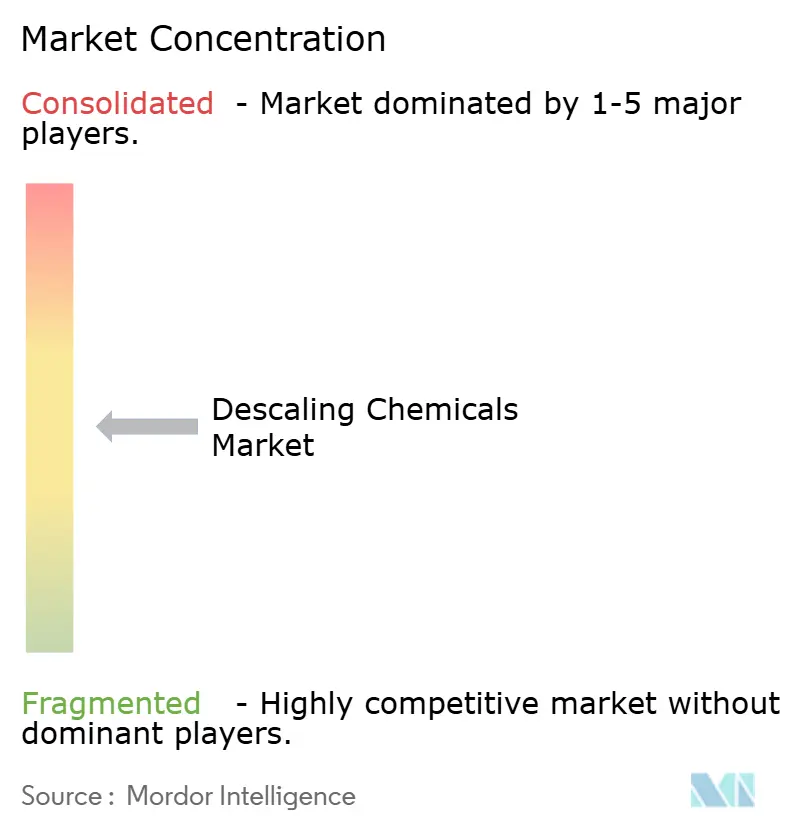
The descaling chemicals market is moderately fragmented, with global specialty chemical companies competing against regional formulators and water-treatment service providers. Competition is shifting from product sales toward managed programs that combine chemistry, monitoring, field service, and dosing support. This approach can increase switching costs because the supplier becomes embedded in the customer's operating process. Ecolab launched Water Navigator IQ in April 2026 as an enterprise water-management platform with predictive water intelligence. The platform illustrates how large suppliers are building recurring relationships that extend beyond chemical supply. Formulation expertise remains important because customers need products that remove deposits without damaging equipment or creating unnecessary wastewater-handling burdens. Suppliers must also translate chemistry performance into clear operating procedures for site personnel. This gives companies with application knowledge and established technical teams an advantage over suppliers focused solely on price.
Bio-based chemistry and green chelating agents are becoming key areas of product differentiation. BASF's April 2025 launch of Trilon G reflects the focus on readily biodegradable chelation chemistry for industrial and institutional cleaning. Envirofluid's USDA BioPreferred certification for Triple7 EnviroScale demonstrates the value of independent recognition of biobased content in procurement decisions. These developments are relevant in food-contact, healthcare, pharmaceutical, and precision applications where handling conventional acid chemistry can be difficult. Smaller providers of enzymatic and bio-enzyme products can find opportunities in these applications when users seek alternatives to conventional acid chemistry. Larger companies retain advantages in formulation development, regulatory support, distribution, and the ability to offer integrated service programs. Smaller competitors can remain effective by specializing in specific end uses or by responding quickly to local service needs. This mix keeps the descaling chemicals market competitive despite the scale of several large suppliers.
Consolidation and portfolio expansion are also shaping the competitive environment. Kemira completed the acquisition of Clear Water Technologies, LLC, in Q2 2026, expanding its industrial water treatment services business with boiler and cooling water chemistry capabilities in North America and supporting its long-term goal of doubling water-related revenue. Ecolab's September 2025 launch of Clean-In-Place IQ (CIP IQ) and its strategic partnership with 4T2 Sensors added a digital element to its food and beverage cleaning offering. BASF expanded its North American water-treatment portfolio with NSF/ANSI/CAN 60-certified sulfite grades in May 2026. These actions indicate that competitive strength increasingly depends on service coverage, digital capability, compliance alignment, and specialized chemistry rather than on output alone. Companies that combine these capabilities can offer a more integrated response to customer requirements, consistent with the broader shift toward managed cleaning and water-treatment relationships.
Descaling Chemicals Industry Leaders
-
Ecolab Inc.
-
BASF
-
Solenis
-
Veolia
-
Kurita Water Industries Ltd.
- *Disclaimer: Major Players sorted in no particular order
Descaling Chemicals Market Companies Covered in this Report
- A.W. Chesterton Company
- Accepta Water Treatment
- BASF
- Betco Corporation
- Diversey Holdings, Ltd.
- Ecolab Inc.
- Goodway Technologies Corp.
- Henkel AG & Co. KGaA
- Kemira Oyj
- Kurita Water Industries Ltd.
- Solenis
- Spartan Chemical Company, Inc.
- The Clorox Company
- Veolia
- Zep Inc.
Recent Industry Developments in Descaling Chemicals Market
- June 2026: Kemira completed the acquisition of Clear Water Technologies, LLC (US), expanding its industrial water treatment services business with boiler and cooling water chemistry capabilities in North America. This acquisition supports its long-term goal of doubling water-related revenue.
- November 2025: Solenis completed the acquisition of NCH Corporation, expanding its presence to more than 160 countries. The deal strengthened Solenis's global reach in middle-market industrial water treatment and process-cleaning chemistry.
Global Descaling Chemicals Market Report Scope
Descaling chemicals are specialized acid-based or chelating liquid and powder solutions used to dissolve and remove hard mineral deposits such as calcium carbonate, magnesium, lime, and rust that accumulate on surfaces in contact with water.
The descaling chemicals market is segmented by chemistry, application, end-user industry, and geography. By chemistry, the market is segmented into acid-based descaling chemicals, non-acid descaling chemicals, bio-based descaling chemicals, and others (chelating agent-based descaling chemicals, enzymatic descaling chemicals, specialty formulations). By application, the market is segmented into industrial equipment, boilers, heat exchangers, water treatment systems, and others. By end-user industry, the market is segmented into industrial manufacturing, power generation, food and beverage, water and wastewater treatment, and others. The report also covers market size and forecasts for descaling chemicals across 15 countries in major regions. The market sizes and forecasts are provided in terms of value (USD).
Segmentation Overview
| Acid-Based Descaling Chemicals |
| Non-Acid Descaling Chemicals |
| Bio-Based Descaling Chemicals |
| Others (Chelating Agent-Based Descaling Chemicals, Enzymatic Descaling Chemicals, Specialty Formulations) |
| Industrial Equipment |
| Boilers |
| Heat Exchangers |
| Water Treatment Systems |
| Others |
| Industrial Manufacturing |
| Power Generation |
| Food and Beverage |
| Water and Wastewater Treatment |
| Others |
| Asia-Pacific | China |
| India | |
| Japan | |
| South Korea | |
| ASEAN Countries | |
| Rest of Asia-Pacific | |
| North America | United States |
| Canada | |
| Mexico | |
| Europe | Germany |
| United Kingdom | |
| France | |
| Italy | |
| NORDIC Countries | |
| Rest of Europe | |
| South America | Brazil |
| Argentina | |
| Rest of South America | |
| Middle-East and Africa | Saudi Arabia |
| South Africa | |
| Rest of Middle-East and Africa |
| By Chemistry | Acid-Based Descaling Chemicals | |
| Non-Acid Descaling Chemicals | ||
| Bio-Based Descaling Chemicals | ||
| Others (Chelating Agent-Based Descaling Chemicals, Enzymatic Descaling Chemicals, Specialty Formulations) | ||
| By Application | Industrial Equipment | |
| Boilers | ||
| Heat Exchangers | ||
| Water Treatment Systems | ||
| Others | ||
| By End-User Industry | Industrial Manufacturing | |
| Power Generation | ||
| Food and Beverage | ||
| Water and Wastewater Treatment | ||
| Others | ||
| By Geography | Asia-Pacific | China |
| India | ||
| Japan | ||
| South Korea | ||
| ASEAN Countries | ||
| Rest of Asia-Pacific | ||
| North America | United States | |
| Canada | ||
| Mexico | ||
| Europe | Germany | |
| United Kingdom | ||
| France | ||
| Italy | ||
| NORDIC Countries | ||
| Rest of Europe | ||
| South America | Brazil | |
| Argentina | ||
| Rest of South America | ||
| Middle-East and Africa | Saudi Arabia | |
| South Africa | ||
| Rest of Middle-East and Africa | ||
Key Questions Answered in the Report
What is current market size of Descaling Chemicals Market?
The descaling chemicals market size was estimated at USD 2.26 billion in 2025 and is estimated to grow from USD 2.38 billion in 2026 to USD 3.10 billion by 2031, at a CAGR of 5.46% during the forecast period (2026-2031).
Which type of chemistry drives descaling chemical sales?
Acid-based products led with a 47.34% share in 2025 because they remain effective at removing mineral deposits from industrial equipment. Their use requires corrosion protection and careful material assessment, especially in equipment containing multiple metals and sensitive alloys.
Which descaling chemistry is growing fastest?
Bio-based products are forecast to grow at a 7.08% CAGR through 2031 as users seek lower-impact and more readily biodegradable options.
Which applications most often use descaling chemicals?
Industrial equipment was the largest application, with a 31.63% share in 2025, while water treatment systems are forecast to grow at a 6.15% CAGR.