
Dental Suction Mirror Market Size and Share
Market Overview
| Study Period | 2020 - 2031 |
|---|---|
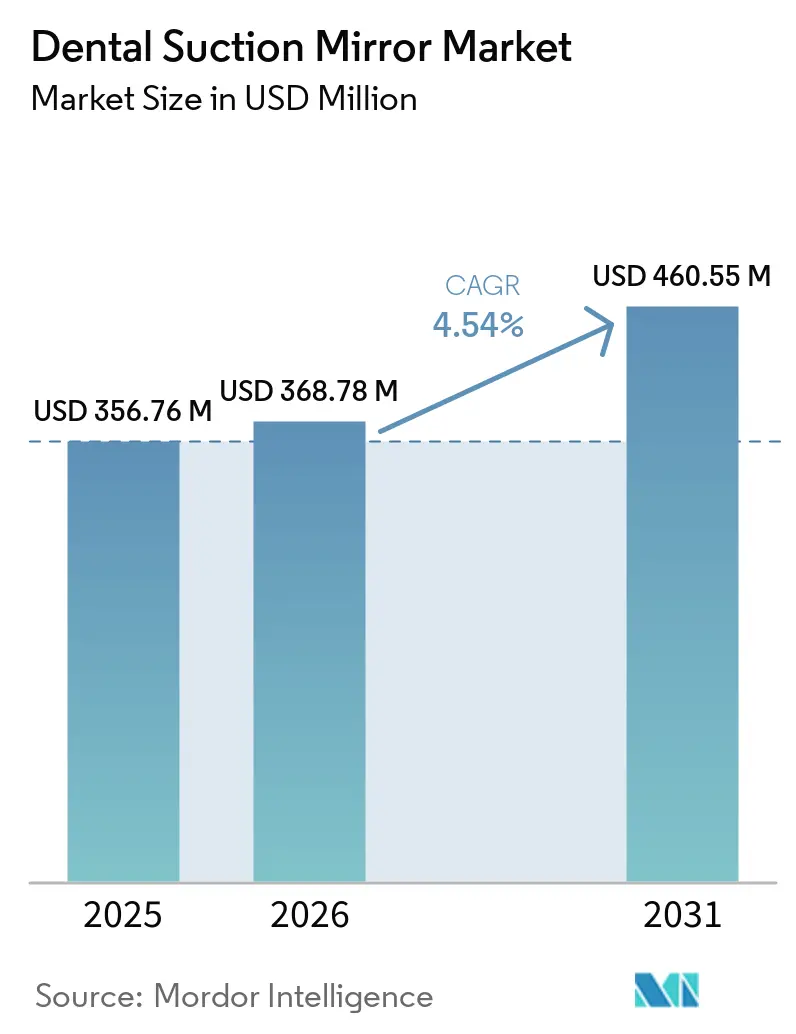
| Market Size (2026) | USD 368.78 Million |
| Market Size (2031) | USD 460.55 Million |
| Growth Rate (2026 - 2031) | 4.54 % |
| Fastest Growing Market | Asia Pacific |
| Largest Market | North America |
| Market Concentration | Medium |
Major Players *Disclaimer: Major Players sorted in no particular order Image © Mordor Intelligence. Reuse requires attribution under CC BY 4.0. | |
Dental Suction Mirror Market Analysis by Mordor Intelligence
The Dental Suction Mirror Market size is expected to increase from USD 356.76 million in 2025 to USD 368.78 million in 2026 and reach USD 460.55 million by 2031, growing at a CAGR of 4.54% over 2026-2031.
This steady growth rests on the shift from standalone mirrors to integrated devices that bundle visualization, high-volume evacuation, and, increasingly, LED illumination. Single-use infection-control protocols introduced after the COVID-19 pandemic are accelerating the replacement of reusable tools with disposable suction mirrors, especially in hospital dental departments and ambulatory surgical centers. Demand also rises as aging populations seek complex restorative services that require moisture-controlled fields, while technology upgrades such as anti-fog coatings and daylight-quality LEDs shorten chair time and improve diagnostic accuracy. Competitive intensity is moderate: global brands focus on ergonomic stainless-steel lines and premium rhodium-glass coatings, whereas regional suppliers court price-sensitive clinics with lower-cost polymer instruments.
Key Report Takeaways
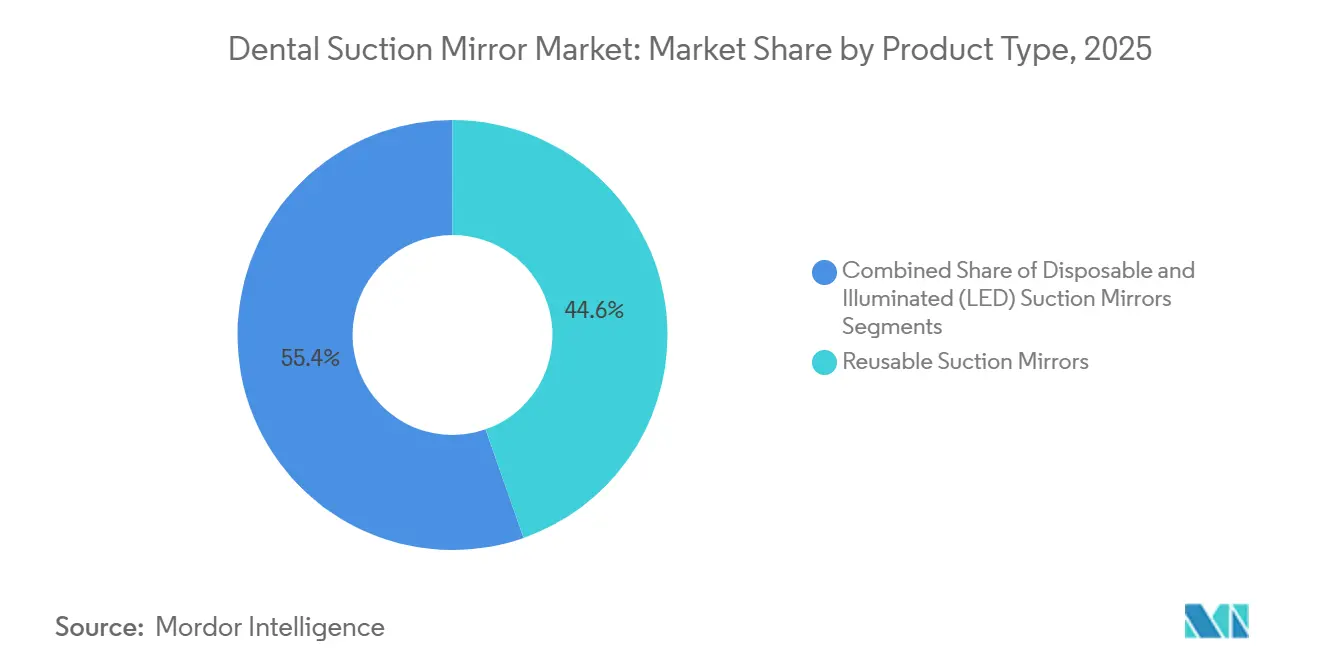
- By product type, reusable suction mirrors held 44.63% of the dental suction mirror market share in 2025, while disposable formats are expanding at an 8.24% CAGR through 2031.
- By material, stainless-steel configurations captured 39.46% revenue in 2025; high-grade plastics are advancing at a 7.24% CAGR on the back of autoclave-stable polymer innovations.
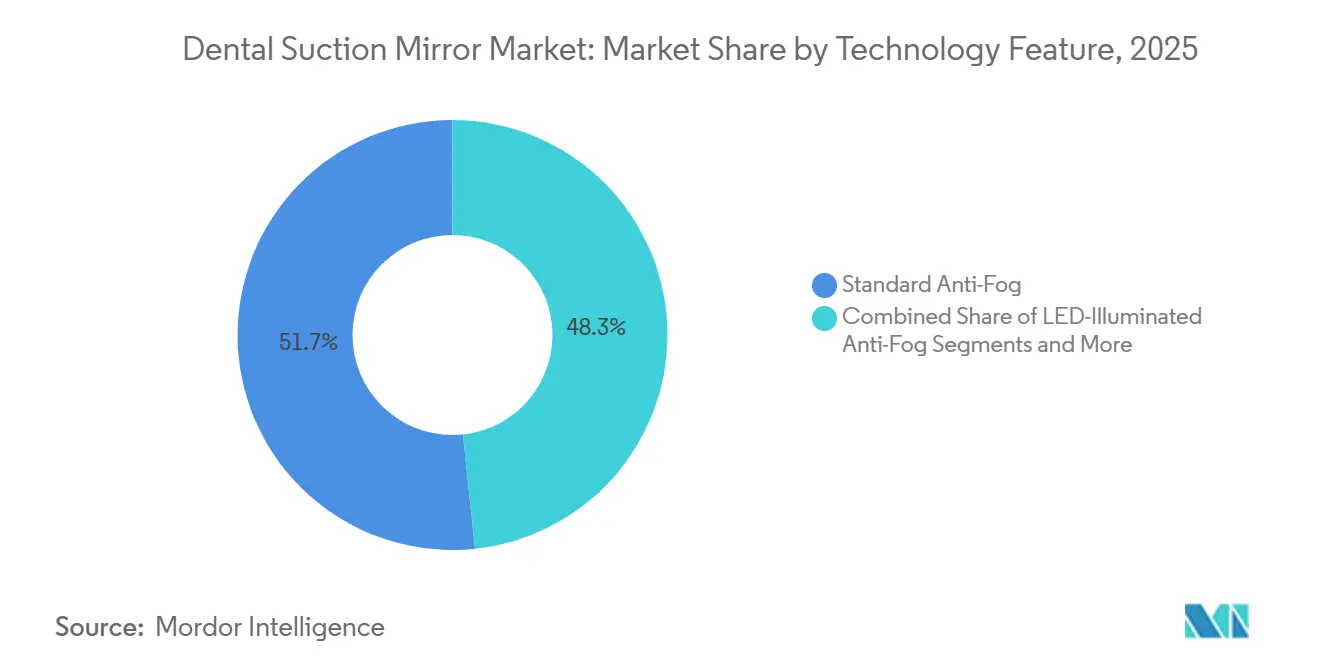
- By technology, standard anti-fog mirrors contributed 51.66% of 2025 sales, yet LED-illuminated anti-fog units are growing at an 8.24% CAGR to 2031.
- By end user, dental clinics accounted for 59.24% of 2025 demand, whereas ambulatory surgical centers are the fastest-growing segment at a 6.13% CAGR.
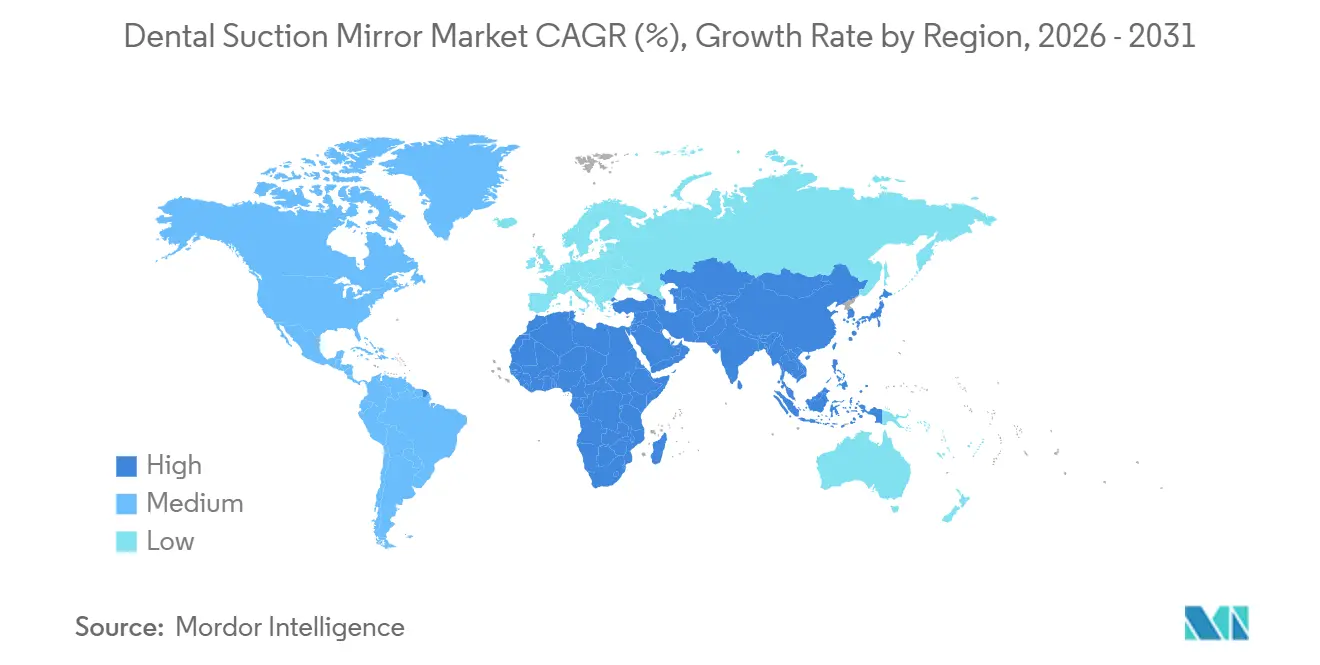
- By geography, North America commanded 37.13% of 2025 revenue; Asia-Pacific is projected to post a 6.73% CAGR through 2031.
Note: Market size and forecast figures in this report are generated using Mordor Intelligence’s proprietary estimation framework, updated with the latest available data and insights as of January 2026.
Market Trends and Insights
Drivers Impact Analysis of Dental Suction Mirror Market*
| Driver | (~) % Impact on CAGR Forecast | Geographic Relevance | Impact Timeline |
|---|---|---|---|
| Rising prevalence of dental caries and periodontal disease | +0.9% | Global, highest burden in South Asia, Sub-Saharan Africa, Latin America | Long term (≥ 4 years) |
| Growing adoption of minimally invasive dentistry and stricter infection-control standards | +1.1% | North America, Europe, advanced Asia-Pacific markets | Medium term (2-4 years) |
| Increasing global geriatric population requiring restorative procedures | +0.8% | Japan, Germany, Italy, North America | Long term (≥ 4 years) |
| Accelerated clinic modernization and equipment replacement cycles | +0.7% | North America, Western Europe, urban China and India | Medium term (2-4 years) |
| Integration of LED illumination and anti-fog coatings | +0.6% | North America, Europe, GCC, urban Asia-Pacific | Short term (≤ 2 years) |
| Demand surge for single-use suction mirrors post-COVID-19 | +0.5% | Global, strongest in hospital settings | Short term (≤ 2 years) |
| Source: Mordor Intelligence | |||
Rising Prevalence of Dental Caries and Periodontal Disease
Untreated caries affects 3.5 billion people and remains the world’s most common non-communicable condition.[1] Severe periodontitis impacts 19% of adults, often leading to tooth loss and the need for restorative treatment. Suction mirrors help clinicians keep operative fields dry during cavity preparation and scaling, improving bond strength and reducing chair time. The WHO’s 2024 oral-health resolution urges universal oral care coverage, promising higher procedure volumes in low-income regions where caries rates exceed 60% among schoolchildren.[2] This epidemiological load supports recurrent instrument demand in both public and private sectors.
Growing Adoption of Minimally Invasive Dentistry and Infection-Control Standards
Minimally invasive dentistry favors micro-preparation and adhesive restorations that require stringent moisture management. The American Dental Association’s 2024 update recommends single-use or high-level disinfection for any device contacting mucous membranes.[3] The CDC’s 2024 guidance warns that integrated suction channels harbor biofilm if sterilization lapses occur. Consequently, many dental schools and group practices standardize on disposable suction mirrors, underpinning the 8.24% CAGR for single-use formats through 2031.
Increasing Global Geriatric Population Requiring Restorative Procedures
The population aged 65 years and older will swell to 1.6 billion by 2050, with rapid growth in East Asia, Southern Europe, and North America. Older adults exhibit higher root-caries and periodontal rates, boosting demand for crown, bridge, and implant procedures that need prolonged visualization. Japan recorded an 18% rise in dental visits among citizens aged 75+ between 2020 and 2025. Suction mirrors ease access in patients with limited mouth opening, supporting ergonomic workflows in geriatric care.
Integration of LED Illumination and Anti-Fog Coatings Enhancing Efficiency
Micro-LED arrays embedded in dental mirror handles deliver 120 lumens per watt with daylight-like color temperatures, removing dependence on overhead lights during posterior work. Hydrophilic anti-fog films spread condensation into a clear micro-layer, retaining reflectance even during aerosol-generating procedures. ISO 7153-1 defines surface flatness and reflectivity norms, while ISO 13485 certification underpins quality-assurance claims. Together, these upgrades justify a 40-60% price premium that high-volume clinics recoup through faster case throughput.
Restraints Impact Analysis of Dental Suction Mirror Market*
| Restraint | (~) % Impact on CAGR Forecast | Geographic Relevance | Impact Timeline |
|---|---|---|---|
| High price sensitivity of small practices in developing countries | -0.6% | South Asia, Sub-Saharan Africa, Southeast Asia, rural Latin America | Medium term (2-4 years) |
| Availability of low-cost mirror plus saliva-ejector combos | -0.4% | Emerging markets worldwide | Short term (≤ 2 years) |
| Sterilization challenges leading to premature disposal of reusable mirrors | -0.3% | Resource-constrained clinics globally | Medium term (2-4 years) |
| EU MDR 2017/745 conformity hurdles for Class II LED mirrors | -0.5% | European Union, export-oriented Asian manufacturers | Short term (≤ 2 years) |
| Source: Mordor Intelligence | |||
High Price Sensitivity of Small Practices in Developing Countries
Solo practitioners in India, Indonesia, and Nigeria face capital constraints and rely on out-of-pocket patient payments that comprise over 60% of dental spending. At USD 15–40 per reusable mirror, premium devices struggle to displace USD 2–5 standalone alternatives. Limited access to reliable electricity further restricts adoption of LED models that need battery recharging. Until low-cost lines emerge or reimbursement broadens, penetration in fast-growing regions remains capped.
EU MDR 2017/745 Conformity Hurdles for Class II LED Mirrors
LED-equipped suction mirrors now require clinical evaluation reports and notified-body audits under EU rules. The number of designated notified bodies fell from 58 in 2020 to 37 in 2024, creating a costly approval bottleneck. Certification expenses that exceed USD 54,000 per product family deter many midsize Asian suppliers, slowing new launches in Europe’s high-value market.
*Our forecasts treat driver/restraint impacts as directional, not additive. The impact forecasts reflect baseline growth, mix effects, and variable interactions.
Dental Suction Mirror Market Segment Analysis
By Product Type:
Disposables Gain Ground on Infection-Control MandatesThe dental suction mirror market size for disposable units is on track to grow at an 8.24% CAGR, almost doubling reusable growth. Reusable devices retained a 44.63% dental suction mirror market share in 2025 thanks to entrenched workflows in high-volume private practices. Yet sterilization labor costs narrow the total-cost-of-ownership gap; at 200 cycles a USD 35 mirror costs USD 0.18 per use before adding USD 0.50–1.00 for reprocessing energy and labor. Disposable LED mirrors priced at USD 4–6 reduce turnover time, appealing to ambulatory centers that handle multiple surgeons daily.
Sustainability initiatives complicate decisions. While single-use plastics elevate waste volume, hospitals increasingly couple disposable procurement with recycling partnerships that convert medical-grade polymers into industrial feedstock. The opposing vectors of environmental stewardship and infection control will shape procurement policy over the forecast window.

By Material:
High-Grade Plastics Challenge Stainless-Steel DominanceStainless-steel instruments held 39.46% of 2025 revenue due to reputation for durability and premium perception. High-grade plastics, however, deliver 30-40% weight savings and withstand 134 °C autoclave cycles. Polysulfone and glass-filled nylon reduce user fatigue during long periodontal surgeries. The dental suction mirror market size for plastic instruments is set to post a 7.24% CAGR through 2031, driven by cost-efficiencies in disposable lines. Adhesive innovations and co-molding techniques are overcoming delamination risks inherent in mixed-material designs. A metal-plastic hybrid may emerge as the optimal compromise, pairing lightweight handles with stainless mirror heads to meet practitioner expectations.
By Technology Feature:
LED Illumination Reshapes Workflow EconomicsStandard anti-fog mirrors delivered 51.66% of 2025 revenue, yet LED-illuminated variants are advancing at 8.24% yearly. As diode costs decline and battery energy density rises, illuminated suction mirrors are shifting from specialty to mainstream. Early adopters note 12% fewer crown-margin remakes when using LED-assisted assessment. Mirror-plus-saliva-ejector combos face ergonomic objections, though they gain favor in pediatric settings where one-handed operation simplifies isolation.
By End User:
Ambulatory Centers Drive Fastest UptakeDental clinics generated 59.24% of 2025 demand, reflecting their volume dominance. The dental suction mirror market share for ambulatory surgical centers is modest today but rising at 6.13% CAGR. CMS data show a 22% surge in oral procedures at U.S. centers from 2020 to 2024. Hospitals lean toward disposables to simplify compliance, while universities adopt them to instill best-practice habits in graduates, ensuring future replacement demand.
Geography Analysis
North America Dental Suction Mirror Market
North America maintained 37.13% market share in 2025, underpinned by 201,117 active U.S. dentists and annual dental expenditures exceeding USD 140 billion. Regulatory barriers are low: non-illuminated mirrors are Class I exempt under FDA rules; LED versions secure 510(k) clearance within six months at moderate cost. Canada’s mixed public-private payment model encourages mid-tier reusable purchases, while Mexico’s booming dental-tourism corridor modernizes clinics to attract U.S. patients.
APAC Dental Suction Mirror Market
Asia-Pacific is the fastest-growing region, with a projected 6.73% CAGR. China added 18,000 dental clinics in 2024 alone. India’s corporate chains standardize infection-control kits across hundreds of outlets, boosting bulk orders for disposable mirrors. Japan’s super-aged society sustains high restorative volumes, and South Korea’s cosmetic dentistry boom fuels demand for premium LED tools. Australia’s Therapeutic Goods Administration enforces strict listing requirements, preserving premium pricing for multinational lines.
Europe, Middle East and South America Dental Suction Mirror Market
Europe faces slower adoption of LED-integrated models due to MDR certification delays. Germany’s 71,000 dentists prefer reusable stainless-steel devices aligned with waste-reduction goals. France’s fee caps restrain capital spend, while the United Kingdom’s shift to private care prompts clinics to adopt advanced mirrors for competitive differentiation. The GCC invests heavily in premium clinics oriented toward medical tourists, pushing high-spec LED sales. South America remains price-sensitive, although Brazil’s large private sector offers scale once currency volatility stabilizes.
Competitive Landscape
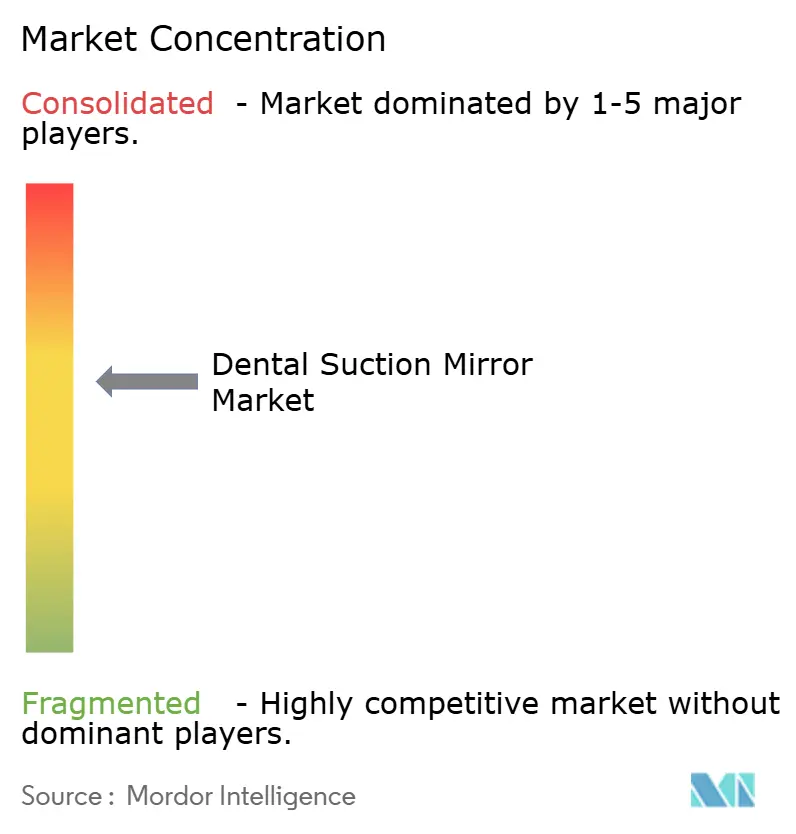
The dental suction mirror market shows moderate fragmentation. Hu-Friedy pairs its Harmony ergonomic handle across categories, leveraging scale economics. Ultradent Products emphasizes proprietary rhodium coatings for superior reflectivity, whereas Directa AB focuses on Scandinavian design ergonomics. Disposable specialists such as Medicom and Pac-Dent gain share by mastering injection-molding scale and supplying color-coded single-use kits. Regulatory readiness becomes a strategic moat; firms with ISO 13485 processes navigate EU MDR hurdles faster than regional startups. Technology roadmaps emphasize wireless battery management, RFID inventory tracking, and antimicrobial handles. Expect selective consolidation as premium brands acquire polymer specialists to expand disposable footprints.
Dental Suction Mirror Industry Leaders
-
DenMat Holdings
-
Richmond Dental & Medical
-
Medicom Group
-
Zirc Dental Products
-
Hager Worldwide GmbH
- *Disclaimer: Major Players sorted in no particular order
Dental Suction Mirror Market Companies Covered in this Report
- ASA Dental
- B. N. D. Dental
- Carl Martin
- DenMat Holdings
- Directa AB
- Hager Worldwide GmbH
- Hu-Friedy Mfg.
- Kerr
- LM-Dental
- Medicom Group (MirrorLite / Safe-T-Brite)
- Miltex (Integra LifeSciences)
- Pac-Dent
- Practicon
- Richmond Dental & Medical
- Ultradent Products
- Vista Dental Products
- YDM Corporation
- Zirc Dental Products
Recent Industry Developments in Dental Suction Mirror Market
- September 2025: OptiView Technologies began pilot shipments of its Smart Dental Mirror, embedding an AI-enabled camera that streams real-time images to chairside tablets, enhancing patient engagement.
- August 2025: Osung USA launched large-format front-surface spoon mirrors designed for superior clarity in posterior quadrants.
Global Dental Suction Mirror Market Report Scope
A dental suction mirror is a disposable dental instrument that combines a high-definition, anti-fog mirror with High-Volume Evacuation (HVE) suction, enabling visualization, tissue retraction, and moisture/aerosol removal during procedures.
The Dental Suction Mirror Market Report is segmented by Product Type, Material, Technology Feature, End User, and Geography. By Product Type, the market is segmented into Reusable, Disposable, and Illuminated LED. By Material, the market is segmented into Stainless-Steel, Rhodium Glass, and High-grade Plastic. By Technology Feature, the market is segmented into Standard Anti-Fog, LED-Illuminated Anti-Fog, and Mirror + Saliva Ejector. By End User, the market is segmented into Dental Clinics, Hospitals & Dental Schools, and Ambulatory Surgical Centers. By Geography, the market is segmented into North America, Europe, Asia-Pacific, Middle East & Africa, and South America. The market report also covers the estimated market sizes and trends for 17 countries across major regions globally. Market Forecasts are Provided in Terms of Value (USD).
Segmentation Overview
| Reusable Suction Mirrors |
| Disposable Suction Mirrors |
| Illuminated (LED) Suction Mirrors |
| Stainless-Steel Head & Handle |
| Front-Surface Rhodium Glass |
| High-grade Plastic |
| Standard Anti-Fog |
| LED-Illuminated Anti-Fog |
| Mirror + Integrated Saliva Ejector |
| Dental Clinics |
| Hospitals & Dental Schools |
| Ambulatory Surgical Centers |
| North America | United States |
| Canada | |
| Mexico | |
| Europe | Germany |
| France | |
| United Kingdom | |
| Italy | |
| Spain | |
| Rest of Europe | |
| Asia-Pacific | China |
| Japan | |
| India | |
| South Korea | |
| Australia | |
| Rest of Asia-Pacific | |
| Middle East & Africa | GCC |
| South Africa | |
| Rest of Middle East & Africa | |
| South America | Brazil |
| Argentina | |
| Rest of South America |
| By Product Type | Reusable Suction Mirrors | |
| Disposable Suction Mirrors | ||
| Illuminated (LED) Suction Mirrors | ||
| By Material | Stainless-Steel Head & Handle | |
| Front-Surface Rhodium Glass | ||
| High-grade Plastic | ||
| By Technology Feature | Standard Anti-Fog | |
| LED-Illuminated Anti-Fog | ||
| Mirror + Integrated Saliva Ejector | ||
| By End User | Dental Clinics | |
| Hospitals & Dental Schools | ||
| Ambulatory Surgical Centers | ||
| By Geography | North America | United States |
| Canada | ||
| Mexico | ||
| Europe | Germany | |
| France | ||
| United Kingdom | ||
| Italy | ||
| Spain | ||
| Rest of Europe | ||
| Asia-Pacific | China | |
| Japan | ||
| India | ||
| South Korea | ||
| Australia | ||
| Rest of Asia-Pacific | ||
| Middle East & Africa | GCC | |
| South Africa | ||
| Rest of Middle East & Africa | ||
| South America | Brazil | |
| Argentina | ||
| Rest of South America | ||
Key Questions Answered in the Report
What is the current value of the dental suction mirror market?
The dental suction mirror market size stands at USD 368.78 million in 2026.
How fast will the market grow over the next five years?
It is projected to advance at a 4.54% CAGR, reaching USD 460.55 million by 2031.
Which segment is expanding the quickest?
Disposable suction mirrors are growing at an 8.24% CAGR due to strict infection-control mandates.
Why are LED-illuminated mirrors gaining popularity?
LED units offer shadow-free light and anti-fog clarity, cutting chair time and enhancing accuracy.
Which region shows the highest growth outlook?
Asia-Pacific is expected to register a 6.73% CAGR, propelled by clinic expansion in China and India.