
Dental Polishing Machine Market Size and Share
Market Overview
| Study Period | 2020 - 2031 |
|---|---|
| Market Size (2026) | USD 351.54 Million |
| Market Size (2031) | USD 534.61 Million |
| Growth Rate (2026 - 2031) | 8.75 % |
| Fastest Growing Market | Asia-Pacific |
| Largest Market | North America |
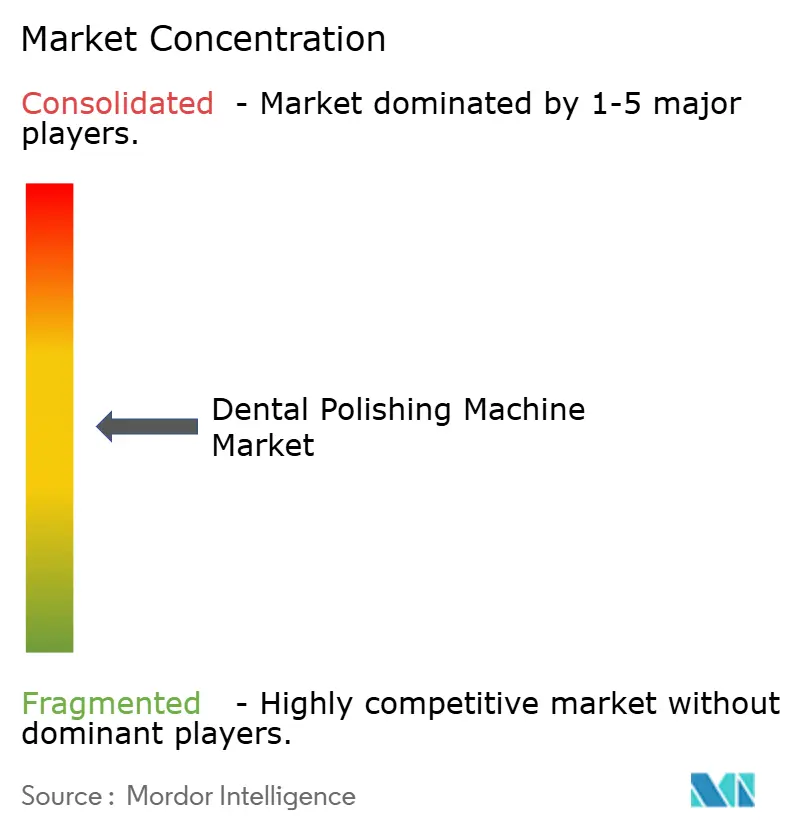
| Market Concentration | Medium |
Major Players *Disclaimer: Major Players sorted in no particular order Image © Mordor Intelligence. Reuse requires attribution under CC BY 4.0. | |
Dental Polishing Machine Market Analysis by Mordor Intelligence
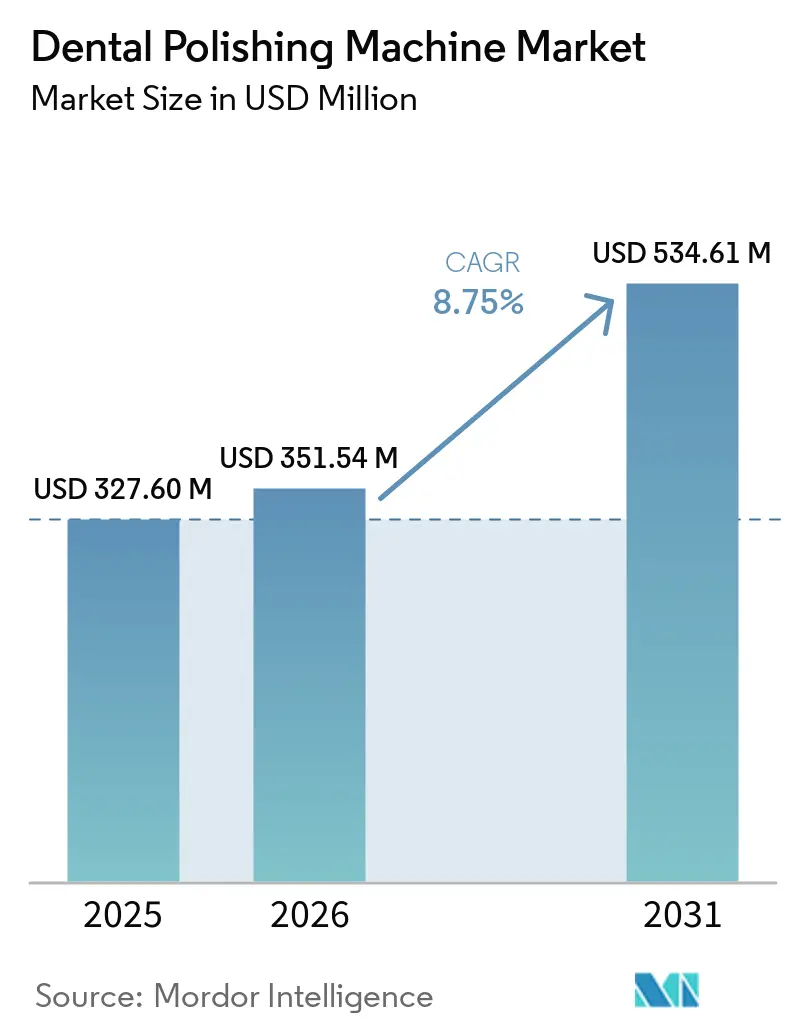
The Dental Polishing Machine Market size is projected to expand from USD 327.60 million in 2025 and USD 351.54 million in 2026 to USD 534.61 million by 2031, registering a CAGR of 8.75% between 2026 to 2031.
The dental polishing machine market is gaining relevance as professional polishing moves beyond routine prophylaxis into periodontal maintenance, implant care, and restorative finishing. Preventive oral care protocols are widening the number of visits where air polishing, scaling, and surface finishing can be used. Larger clinic networks are also standardizing equipment choices across multiple locations, which supports fleet purchases and recurring consumable demand. Connected platforms and predictive maintenance features give suppliers a route to build longer relationships with customers after the initial device sale. Cost, reimbursement gaps, and infection-control requirements remain important constraints, especially for smaller practices and lower-income settings.
Key Report Takeaways
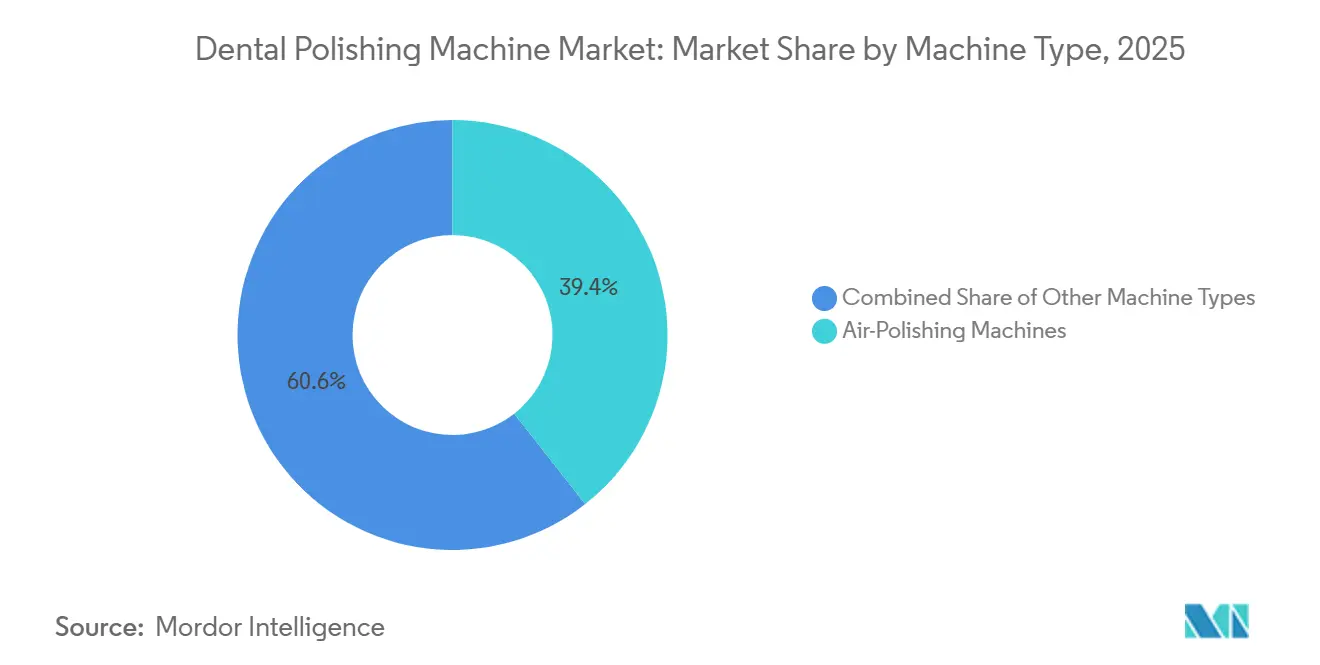
By machine type, air-polishing machines held 39.4% of the dental polishing machine market share in 2025, while integrated dental polishing systems are forecast to grow at a 9.8% CAGR through 2031.
By product configuration, portable units held 44.8% of the dental polishing machine market share in 2025, while integrated dental-unit systems are forecast to grow at a 10.4% CAGR through 2031.
By consumables, polishing powders held 62.7% of 2025 consumable revenue and are forecast to grow at a 9.1% CAGR through 2031.
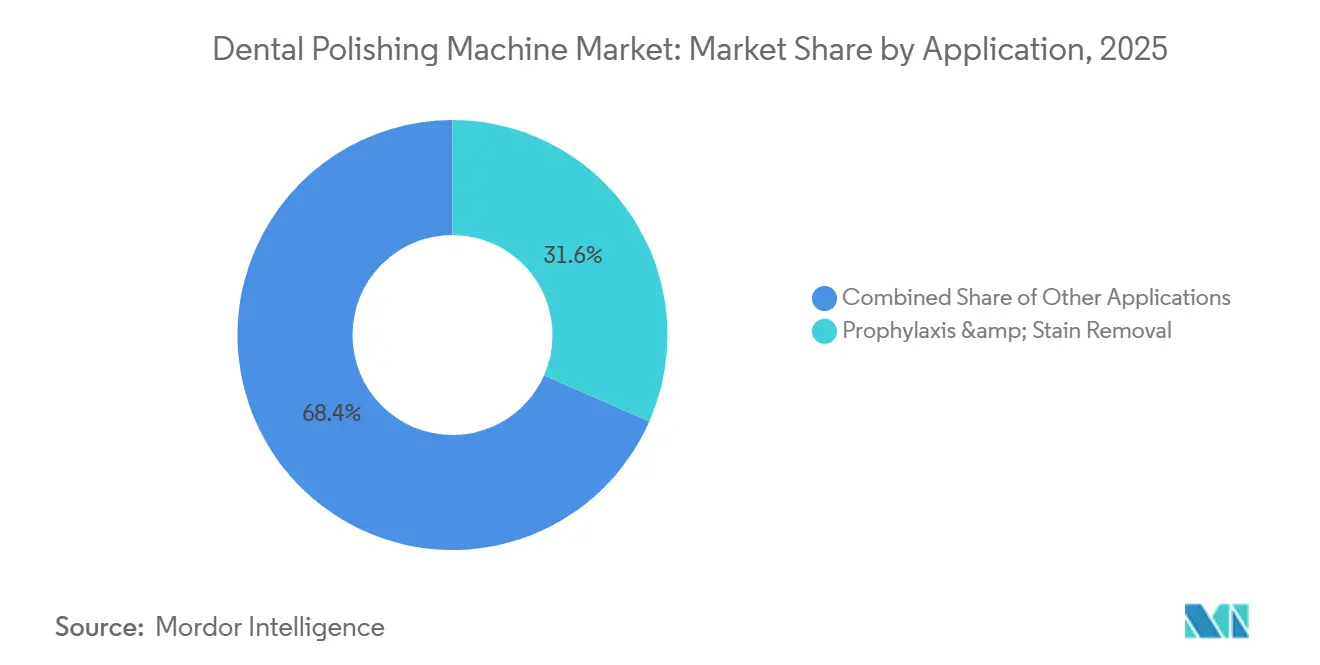
By application, prophylaxis and stain removal held 31.6% of 2025 revenue, while implant and orthodontic maintenance is forecast to grow at a 9.7% CAGR through 2031.
By end user, dental clinics held 58.3% of 2025 revenue, while dental service organizations are forecast to grow at a 10.1% CAGR through 2031.
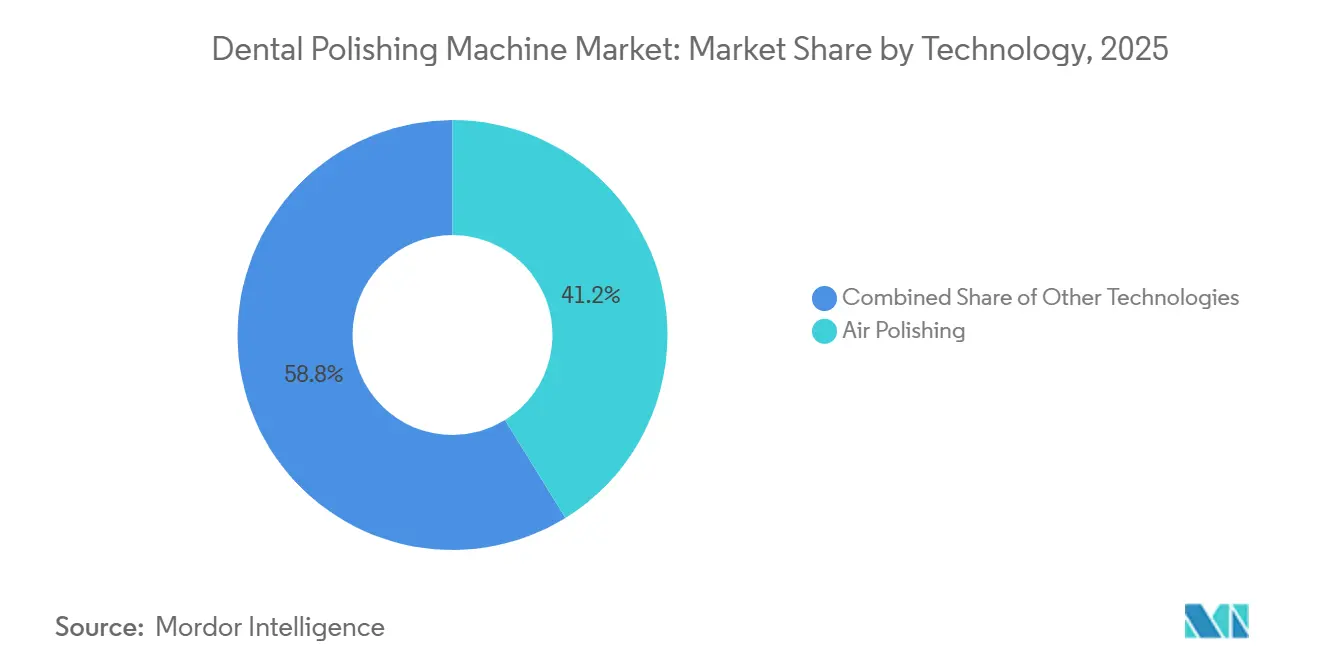
By technology, air polishing held 41.2% of 2025 revenue, while hybrid and automated systems are forecast to grow at a 9.2% CAGR through 2031.
By material processed, natural teeth enamel held 46.5% of 2025 revenue, while ceramics and zirconia are forecast to grow at a 10.5% CAGR through 2031.
Note: Market size and forecast figures in this report are generated using Mordor Intelligence’s proprietary estimation framework, updated with the latest available data and insights as of January 2026.
Market Trends and Insights
Drivers Impact Analysis of Dental Polishing Machine Market*
| Driver | (~) % Impact on CAGR Forecast | Geographic Relevance | Impact Timeline |
|---|---|---|---|
| Preventive, Periodontal, and Biofilm-Management Procedure Growth | +2.5% | Global | Long term (≥ 4 years) |
| Rising Cosmetic and Aesthetic Dentistry Demand | +1.8% | North America, Europe, APAC | Medium term (2-4 years) |
| Dental Clinic and Dental Service Organization Expansion | +1.4% | North America, APAC | Medium term (2-4 years) |
| Digital Workflow and Chairside Laboratory Integration | +1.1% | North America, Europe | Medium term (2-4 years) |
| Compact Automation for Dental Laboratories | +0.7% | Europe, APAC | Long term (≥ 4 years) |
| Proprietary Powder and Consumable Ecosystems | +0.5% | Global | Short term (≤ 2 years) |
| Source: Mordor Intelligence | |||
Preventive, Periodontal, and Biofilm-Management Procedure Growth
Biofilm management is becoming a first-line part of periodontal maintenance and implant care rather than an added hygiene service. A 2025 network meta-analysis[1]Y. Li et al., “Clinical Effects of Erythritol, Glycine and Trehalose as Subgingival Air-Polishing Powders,” Frontiers in Physiology found that erythritol powder ranked highest among 3 subgingival powder agents for probing pocket-depth reduction, with a SUCRA value of 84.1. A 2026 clinical trial found that endoscope-assisted scaling and root planing combined with glycine air polishing resulted in 89.2% of sites reaching a pocket depth of 4 mm or less after 6 months, compared with 55.2% for scaling alone. These findings support more standardized use of air polishing in periodontal protocols. The dental polishing machine market, therefore, benefits when clinics add repeat maintenance visits and implant-support programs. The World Health Organization continues to emphasize prevention and early oral care, which can strengthen demand for hygiene services across public and private settings.
Rising Cosmetic and Aesthetic Dentistry Demand
Cosmetic procedures create additional polishing needs after veneer placement, crown adjustment, cement removal, and whitening-related care. A 2024 Journal of Dental Sciences study reported a 43% increase in elective dental inquiries associated with video-call use. The same study reported a 42% increase in teeth-whitening demand and a 36% increase in veneer consultations among frequent video users. Ceramic veneers and CAD/CAM crowns need controlled finishing after intraoral adjustment. A 2026 study found that chairside zirconia polishing produced a mean surface roughness of 0.180 µm, while furnace glazing produced 0.637 µm. The result supports material-specific polishing as restorative practices use more zirconia restorations.
Dental Clinic, DSO, and Consumable Ecosystem Expansion
The dental polishing machine market is supported by the growth of clinic networks that can set common equipment and hygiene protocols across multiple sites. Larger organizations can move purchasing from isolated device orders toward coordinated replacement and consumable programs. This approach favors systems with dependable servicing, operator training, and compatibility across locations. Proprietary powders, compatible handpieces, and related accessories can create recurring revenue once a platform is placed. That commercial structure is especially important for air-polishing systems because powder use is necessary for routine operation. It also increases the importance of total cost of ownership when a buyer chooses between premium and generic platforms.
Digital Workflow, Chairside Integration, and Laboratory Automation
Intraoral scanning, CAD design, and chairside milling are moving more restorative finishing tasks into the clinic. Amann Girrbach integrated 5 Ceramill milling systems into the iTero Design Suite in 2025, linking restoration design, milling, and finishing within a chairside workflow. A 2026 review described combined clinical and laboratory digital workflows as an emerging standard in prosthodontic practice. Each additional chairside milling workflow can add demand for polishing after grinding or surface adjustment. The dental polishing machine market also gains from compact automation in laboratories that need consistent finishing steps for ceramics, metals, and composite restorations. ISO 6872 identifies surface requirements for dental ceramic materials, which reinforces the need to control finishing quality after adjustment.
Restraints Impact Analysis of Dental Polishing Machine Market*
| Restraint | (~) % Impact on CAGR Forecast | Geographic Relevance | Impact Timeline |
|---|---|---|---|
| High Equipment, Service, and Training Costs | -1.3% | Global, especially emerging markets | Short term (≤ 2 years) |
| Reimbursement Gaps and Small-Practice Capital Constraints | -0.9% | South America, Middle East and Africa, APAC | Medium term (2-4 years) |
| Aerosol, Particulate, and Infection-Control Compliance | -0.6% | Global | Short term (≤ 2 years) |
| Material-Specific Process Validation and Operator Variability | -0.4% | Global | Long term (≥ 4 years) |
| Source: Mordor Intelligence | |||
Equipment Costs and Reimbursement Constraints
High equipment, service, consumable, and training costs can delay adoption by independent practices. Premium air-polishing platforms require continued spending on powders, handpieces, servicing, and staff training after the initial purchase. Public and private reimbursement often does not fully cover polishing and periodontal maintenance procedures, particularly in price-sensitive markets. Practices that depend on out-of-pocket payment can struggle to recover the premium of air polishing over conventional rubber-cup methods. The dental polishing machine market can consequently split between well-funded DSOs and hospital-affiliated clinics that buy premium systems and smaller operators that choose lower-cost alternatives. Device clearance and conformity requirements can also increase development costs for manufacturers and limit the number of affordable options.
Aerosol Control and Process Variability
Air polishing can add infection-control procedures because the device creates aerosol and particulate matter during treatment. The Centers for Disease Control and Prevention[2]International Organization for Standardization, “ISO 20608:2018 Dentistry Powder Jet Handpieces and Powders,” International Organization for Standardization provides infection-control guidance for dental procedures and highlights the importance of appropriate equipment processing and clinical safeguards. Practices with limited space, staffing, or evacuation capacity may delay the use of air-polishing systems. Material-specific polishing also requires operators to select the correct powder, tool, pressure, and sequence for enamel, titanium, zirconia, and composites. Inconsistent technique can affect surface quality and reduce confidence in the equipment. Suppliers therefore need to pair product sales with practical clinical training and clear protocols.
*Our forecasts treat driver/restraint impacts as directional, not additive. The impact forecasts reflect baseline growth, mix effects, and variable interactions.
Dental Polishing Machine Market Segment Analysis
By Machine Type:
Air Polishing Leads While Integrated Systems Gain GroundAir-polishing machines held 39.4% of 2025 machine-type revenue. Their leadership reflects use in supragingival prophylaxis, subgingival periodontal maintenance, and implant care. Non-contact biofilm removal supports their use on surfaces where clinicians seek to limit mechanical damage. Recurring powder sales also encourage suppliers to maintain installed systems and provide clinical training. Rotary and electric polishing machines remain important in laboratory workflows for metal frameworks and composite restorations. Other machines include combination modalities that bring together more than 1 hygiene function.
Integrated dental polishing systems are forecast to grow at a 9.8% CAGR through 2031. These platforms combine scaling, air polishing, and subgingival therapy in 1 console. EMS introduced its GBT Machine at IDS 2025 with powder delivery, piezo scaling, and digital monitoring features. EMS-The combined configuration can reduce equipment footprint in a hygiene room. It can also simplify the handoff between scaling and polishing during the same appointment. The dental polishing machine market is moving toward systems that combine device sales with servicing and data functions.



Restraints Impact Analysis of Dental Polishing Machine Market
| Restraint | (~) % Impact on CAGR Forecast | Geographic Relevance | Impact Timeline |
|---|---|---|---|
| High Equipment, Service, and Training Costs | -1.3% | Global, especially emerging markets | Short term (≤ 2 years) |
| Reimbursement Gaps and Small-Practice Capital Constraints | -0.9% | South America, Middle East and Africa, APAC | Medium term (2-4 years) |
| Aerosol, Particulate, and Infection-Control Compliance | -0.6% | Global | Short term (≤ 2 years) |
| Material-Specific Process Validation and Operator Variability | -0.4% | Global | Long term (≥ 4 years) |
| Source: Mordor Intelligence | |||
By Product Configuration:
Portable Units Lead While Chair Integration ExpandsPortable units held 44.8% of 2025 product-configuration revenue. Their position reflects lower entry costs and flexibility across different operatory layouts. Mobile dental programs and satellite clinics can also move portable equipment where it is needed. This format remains useful in markets where practices share equipment between chairs. Benchtop and stationary units are established in laboratories that require repeatable speeds and material settings. These units support finishing work on metallic and ceramic restorations.
Integrated dental-unit systems are projected to grow at a 10.4% CAGR through 2031. Embedded modules can reduce clutter and support more consistent operator positioning. The 2026 zirconia study showed that controlled chairside polishing achieved surface roughness below the 0.2 µm clinical threshold. This need for consistent, material-specific treatment supports systems that can store defined operating settings. ISO 20608:2018[3]Centers for Disease Control and Prevention, “Best Practices for Dental Handpieces,” Centers for Disease Control and Prevention covers powder jet handpieces and powders used in dentistry. Institutional buyers may favor systems that support documented safety and performance requirements.
By Application:
Prophylaxis Leads While Implant and Orthodontic Maintenance ExpandsProphylaxis and stain removal held 31.6% of 2025 application revenue. Routine hygiene visits make this the main use case for professional polishing. Plaque and biofilm removal and periodontal therapy add repeat demand through maintenance care. The European Federation of Periodontology has addressed air polishing within supportive periodontal care guidance. These applications support regular use of systems in hygiene departments. Restorative and prosthetic finishing provides an additional workflow as milled restorations need surface adjustment after placement.
Implant and orthodontic maintenance is forecast to grow at a 9.7% CAGR through 2031. The installed base of implants increases the need for repeat peri-implant maintenance. A 2025 study found air polishing was the most effective method among those tested for cleaning peri-implant mucosa and limiting microbial biofilm formation. Implant maintenance guidance also identifies low-abrasive air polishing as a method that limits surface alteration. The dental polishing machine market can therefore gain from clinical programs that frame polishing as part of long-term implant care.
By End User:
Clinics Remain the Main Channel While DSOs Grow FastestDental clinics held 58.3% of 2025 end-user revenue. They are the main site for professional prophylaxis, periodontal maintenance, and restorative adjustment. Private practices can favor premium platforms when they offer clinical support and low maintenance burden. Community clinics may place more weight on durability and operating cost. Hospitals form a secondary channel with demand centered in periodontal and implant departments. Academic and research institutes influence protocol development and clinician training.
Dental service organizations are forecast to grow at a 10.1% CAGR through 2031. Consolidated groups can standardize equipment across multiple practices and negotiate larger supply arrangements. This procurement model gives suppliers an incentive to provide service coverage, training, and compatible consumables. Dental laboratories also remain a distinct end-user group for rotary and electropolishing systems. They use these systems for metallic frameworks and complex prosthetic components. The dental polishing machine market has an opportunity to serve each end user with a different mix of device capability, consumables, and support.
By Technology:
Air Polishing Leads While Hybrid Platforms Improve WorkflowAir polishing accounted for 41.2% of 2025 technology-segment revenue. It serves prophylaxis, subgingival maintenance, and implant-surface cleaning with appropriate powders and settings. This versatility differentiates it from rotary techniques used mainly for laboratory and restorative work. Rotary mechanical polishing retains a substantial installed base for metallic alloys and restorations. Electropolishing remains a specialized method for precision metal frameworks and implant components. The technology mix allows providers to select tools according to surface material and clinical procedure.
Hybrid and automated systems are forecast to grow at a 9.2% CAGR through 2031. These platforms support a hygiene appointment that combines scaling and polishing without moving between separate units. NSK launched the Varios Combi Pro2 at IDS 2025 with automatic power adjustment during scaling. ACTEON introduced the OPUS combined ultrasonic and air-polishing platform at IDS 2025. The systems can reduce equipment footprint and simplify staff training. The dental polishing machine industry is likely to see further competition around combined hygiene platforms.
By Material Processed:
Enamel Leads While Ceramics and Zirconia Advance FastestNatural teeth enamel held 46.5% of 2025 material-processed revenue. Enamel remains the main surface treated during routine prophylaxis, stain removal, and supportive periodontal therapy. Metals such as titanium, stainless steel, and cobalt-chromium support demand in implant maintenance and prosthetic framework finishing. Composites and acrylics form a growing niche as restoration volumes rise. Each material requires a suitable abrasive and process sequence. This need adds value to systems that offer controlled settings and material-specific accessories.
Ceramics and zirconia are forecast to grow at a 10.5% CAGR through 2031. The dental polishing machine market size for this segment grows as CAD/CAM zirconia crowns, bridges, and implant-supported restorations are used more widely. The 2026 study evaluated 135 specimens and found that OptraFine chairside polishing achieved a mean roughness of 0.180 µm plus or minus 0.029 µm. Furnace glazing produced a mean roughness of 0.637 µm plus or minus 0.302 µm in the same study. Clinical guidance also supports standardized polishing sequences for different zirconia types. Material-specific kits can improve consistent finishing outcomes across restorative workflows.
Geography Analysis
North America Dental Polishing Machine Market
North America held 38.7% of 2025 global revenue. High preventive-visit frequency and private coverage for prophylaxis support the region’s use of advanced hygiene equipment. The growth of multi-site dental organizations also supports network-level purchasing and standardized protocols. Connected dentistry workflows extend demand into restorative departments that use scanning, chairside milling, and finishing. The Centers for Disease Control and Prevention continues to shape dental infection-control practices in the United States. Canada and Mexico contribute secondary demand, while Mexico benefits from dental tourism and cross-border patient flows.
Europe Dental Polishing Machine Market
Europe is the second-largest regional market in the dental polishing machine market. Germany, France, the United Kingdom, Italy, and Spain combine mature dental infrastructure with established preventive-care practices. The EU Medical Device Regulation[4]European Commission, “New Regulations,” European Commission raises traceability and post-market surveillance expectations for device suppliers. Germany remained a major launch venue when suppliers presented new prophylaxis platforms at IDS 2025 in Cologne. EMS presented the GBT Machine, NSK presented the Varios Combi Pro2, and ACTEON presented OPUS at the event. Western European markets tend to adopt advanced hygiene technology earlier, while other regional markets provide additional room for prevention-focused equipment.
APAC, South America and MEA Dental Polishing Machine Market
Asia-Pacific is forecast to grow at a 9.5% CAGR through 2031, making it the fastest-growing geography in the dental polishing machine market. China is shifting from extraction-focused care toward more preventive procedures in tier-2 cities. India continues to add dental professionals, which expands capacity for hygiene and restorative workflows. South Korea, Japan, and Australia contribute demand for advanced clinical equipment. South America gains support from private dental networks and dental tourism, particularly in Brazil and Argentina. Middle East and Africa remains smaller but is supported by dental-facility modernization in GCC countries and private clinic growth in South Africa.
Competitive Landscape
The dental polishing machine market has moderate-to-high concentration in premium air-polishing and combined-modality systems. EMS Electro Medical Systems, Dentsply Sirona, NSK Nakanishi, W&H Dentalwerk Bürmoos, and ACTEON Group compete through powder ecosystems, clinical education, and product integration. The dental polishing machine market also includes more fragmented mid-market suppliers. Chinese manufacturers apply price pressure in APAC and Latin America with lower-cost combined tabletop systems. Premium suppliers seek to protect their position through proprietary powders, compatible tips, clinician training, and documented performance. These factors can make switching systems more difficult after a practice standardizes its hygiene protocols.
Digital connectivity is becoming an important point of competition in the dental polishing machine market. EMS introduced its connected GBT Machine in 2025 with features for treatment data, powder consumption, and maintenance monitoring. NSK expanded its periodontal portfolio in 2025 with the Perio-Mate Neo and described connectivity across its clinical equipment ecosystem. These features help vendors connect equipment use with preventive maintenance and service planning. Combined ultrasonic and air-polishing platforms also allow suppliers to compete for a larger portion of hygiene-room spending. Smaller suppliers can respond with consumable-agnostic and open-platform offerings for practices focused on operating costs.
Clinical education remains a major competitive tool in the dental polishing machine market because clinicians need clear protocols for periodontal, implant, and restorative use. EMS has tied its platform to Guided Biofilm Therapy training and its GBT Machine product line. EMS introduced the AIRFLOW MAX handpiece in June 2026 with Laminar AIRFLOW Technology and a nozzle design intended to deliver a controlled powder spray. W&H presented the Synea Power Edition for high-strength ceramics, including zirconia, at IDS 2025. ISO 20608:2018 and ISO 13485 quality systems are important requirements for suppliers serving hospitals and large dental organizations.
Dental Polishing Machine Industry Leaders
3M
Ivoclar Vivadent AG
KaVo Dental
Kerr Corporation
Dentsply Sirona
- *Disclaimer: Major Players sorted in no particular order
Dental Polishing Machine Market Companies Covered in this Report
- 3M
- Acteon Group
- A-dec
- Bien Air
- Danaher
- Dentsply Sirona
- D�RR DENTAL SE
- EMS Electro Medical Systems
- GC Corporation
- Henry Schein
- HuFriedyGroup
- Ivoclar Vivadent
- Kavo Dental
- Kerr
- Mectron S.p.A.
- NSK Nakanishi Inc.
- Planmeca
- SHOFU INC.
- Ultradent Products, Inc.
- W&H Dentalwerk B�rmoos GmbH
- Young Innovations, Inc.
- GPAINNOVA

Recent Industry Developments in Dental Polishing Machine Market
- June 2026: EMS Electro Medical Systems introduced the AIRFLOW MAX handpiece featuring patented Laminar AIRFLOW Technology, delivering a precisely staged, reduced-aerosol powder spray via a Swiss-patented nozzle design. The product extends EMS’s GBT platform across implants, restorations, and sensitive periodontal sites.
- April 2025: NSK expanded its periodontal portfolio with the Perio-Mate Neo subgingival air polisher, a surgical micromotor, and an implant stability measurement device designed for connectivity across the operatory ecosystem.
- March 2025: W&H Dentalwerk presented the Synea Power Edition, a handpiece line optimized for cutting high-strength ceramics including zirconia, and the Lisa Mini type B sterilizer for handpiece reprocessing.
- March 2025: NSK Nakanishi launched the Varios Combi Pro2 at IDS 2025, a combined ultrasonic and powder therapy device with automatic power adjustment that adapts scaling energy in real time.


Global Dental Polishing Machine Market Report Scope
| Air-Polishing Machines |
| Rotary/Electric Polishing Machines |
| Integrated Dental Polishing Systems |
| Other Machines |
| Portable Units |
| Benchtop & Stationary Units |
| Integrated Dental-Unit Systems |
| Prophylaxis & Stain Removal |
| Plaque & Biofilm Removal |
| Periodontal Therapy |
| Orthodontic & Implant Maintenance |
| Restorative & Prosthetic Finishing |
| Dental Clinics |
| Hospitals |
| Dental Laboratories |
| Academic & Research Institutes |
| Air Polishing |
| Rotary Mechanical Polishing |
| Electropolishing |
| Hybrid & Automated Systems |
| Natural Teeth (Enamel) |
| Metals (Titanium, Stainless Steel, Co-Cr) |
| Ceramics & Zirconia |
| Composites & Acrylics |
| North America | United States |
| Canada | |
| Mexico | |
| Europe | Germany |
| United Kingdom | |
| France | |
| Italy | |
| Spain | |
| Rest of Europe | |
| Asia-Pacific | China |
| Japan | |
| India | |
| South Korea | |
| Australia | |
| Rest of Asia-Pacific | |
| Middle East and africa | GCC |
| South Africa | |
| Rest of Middle East and Africa | |
| South America | Brazil |
| Argentina | |
| Rest of South America |
| By Machine Type | Air-Polishing Machines | |
| Rotary/Electric Polishing Machines | ||
| Integrated Dental Polishing Systems | ||
| Other Machines | ||
| By Product Configuration | Portable Units | |
| Benchtop & Stationary Units | ||
| Integrated Dental-Unit Systems | ||
| By Application | Prophylaxis & Stain Removal | |
| Plaque & Biofilm Removal | ||
| Periodontal Therapy | ||
| Orthodontic & Implant Maintenance | ||
| Restorative & Prosthetic Finishing | ||
| By End User | Dental Clinics | |
| Hospitals | ||
| Dental Laboratories | ||
| Academic & Research Institutes | ||
| By Technology | Air Polishing | |
| Rotary Mechanical Polishing | ||
| Electropolishing | ||
| Hybrid & Automated Systems | ||
| By Material Processed | Natural Teeth (Enamel) | |
| Metals (Titanium, Stainless Steel, Co-Cr) | ||
| Ceramics & Zirconia | ||
| Composites & Acrylics | ||
| By Geography, Value | North America | United States |
| Canada | ||
| Mexico | ||
| Europe | Germany | |
| United Kingdom | ||
| France | ||
| Italy | ||
| Spain | ||
| Rest of Europe | ||
| Asia-Pacific | China | |
| Japan | ||
| India | ||
| South Korea | ||
| Australia | ||
| Rest of Asia-Pacific | ||
| Middle East and africa | GCC | |
| South Africa | ||
| Rest of Middle East and Africa | ||
| South America | Brazil | |
| Argentina | ||
| Rest of South America | ||


Key Questions Answered in the Report
What is the dental polishing machine market projected value by 2031?
The dental polishing machine market is projected to reach USD 534.6 million by 2031, from USD 351.5 million in 2026, at an 8.7% CAGR.
Which machine type has the largest revenue position?
Air-polishing machines held 39.4% of 2025 revenue because they support prophylaxis, periodontal maintenance, and implant care.
Why are integrated dental-unit systems growing quickly?
The dental polishing machine market supports integrated dental-unit systems as they are forecast to grow at a 10.4% CAGR through 2031, combining functions and reducing operatory equipment footprint.
Which region is expanding fastest for dental polishing equipment?
Asia-Pacific is forecast to grow at a 9.5% CAGR through 2031, supported by expanding preventive and restorative dental care.
What limits adoption by smaller dental practices?
Equipment, service, powder, and training costs, together with incomplete reimbursement, can limit adoption of premium air-polishing systems.
Page last updated on:





