
Denmark Wire and Cable Market Size and Share
Market Overview
| Study Period | 2020 - 2031 |
|---|---|
| Forecast Data Period | 2026 - 2031 |
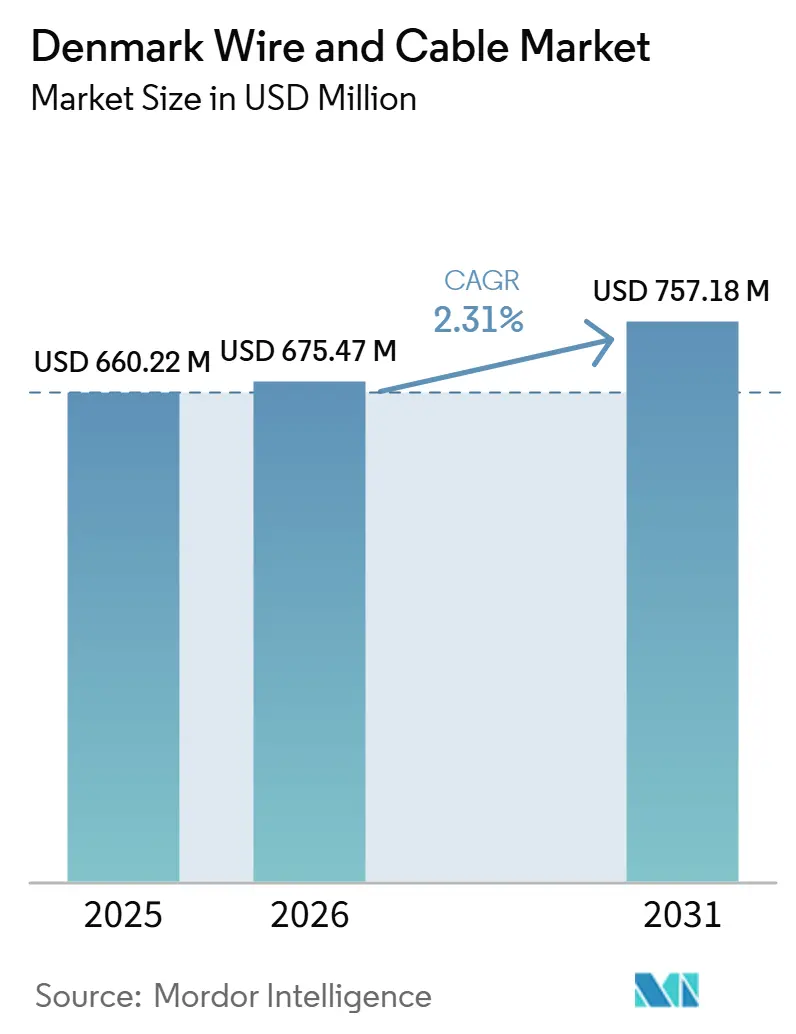
| Base Year Market Size (2025) | USD 660.22 Million |
| Market Size (2026) | USD 675.47 Million |
| Market Size (2031) | USD 757.18 Million |
| Growth Rate (2026 - 2031) | 2.31 % |
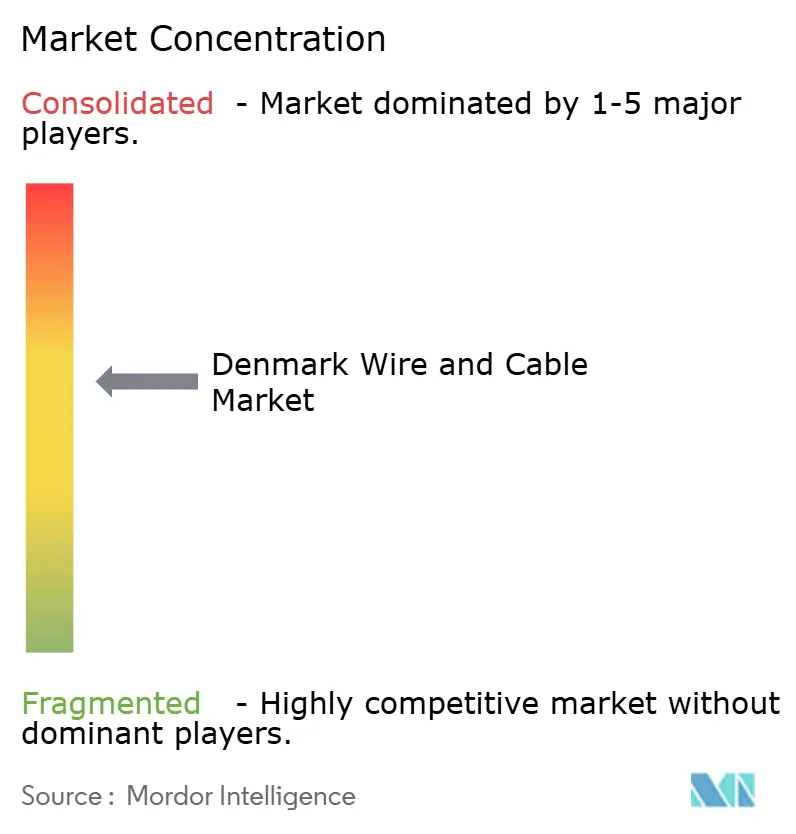
| Market Concentration | Medium |
Major Players *Disclaimer: Major Players sorted in no particular order Image © Mordor Intelligence. Reuse requires attribution under CC BY 4.0. | |
Denmark Wire and Cable Market Analysis by Mordor Intelligence
The Denmark wire and cable market size is projected to expand from USD 660.22 million in 2025 and USD 675.47 million in 2026 to USD 757.18 million by 2031, registering a CAGR of 2.31% from 2026 to 2031. Grid investment, offshore wind connections, and the replacement of copper telecommunications networks with fiber support the Denmark wire and cable market. Energinet completed 29 commissioning and construction projects in 2025, with total construction costs of DKK 3 billion (USD 433 million), and had 184 active grid projects in its portfolio in 2026. Denmark’s plan to increase electricity production 5-fold by 2040, while consumption is expected to triple, supports a longer pipeline for transmission and distribution cables. Large suppliers are concentrating on high-voltage contracts and offshore installation capacity, while distributors and specialized manufacturers compete on availability, engineering support, and delivery. Material price volatility and approval delays could defer procurement, although grid and digital infrastructure programs continue to support demand.
Key Report Takeaways
- By voltage, low-voltage (below 1 kV) cables held 43.68% of revenue share in the Denmark wire and cable market in 2025, while extra- and high-voltage (above 35 kV) cables are projected to expand at a 3.26% CAGR through 2031.
- By cable type, power cables accounted for 69.42% of revenue share in the Denmark wire and cable market in 2025, and are projected to expand at a 2.98% CAGR through 2031.
- By conductor material, copper held 51.86% of revenue share in the Denmark wire and cable market in 2025, while aluminum conductors are projected to expand at a 2.84% CAGR through 2031.
- By installation, underground cables held 55.74% of revenue share in the Denmark wire and cable market in 2025, while submarine cables are projected to expand at a 3.54% CAGR through 2031.
- By end-user vertical, power infrastructure (utilities and renewables) held 28.63% of revenue share in the Denmark wire and cable market in 2025 and is projected to expand at a 3.38% CAGR through 2031.
- By insulation, insulated cables held 94.18% of revenue share in the Denmark wire and cable market in 2025 and are projected to expand at a 2.43% CAGR through 2031.
Note: Market size and forecast figures in this report are generated using Mordor Intelligence’s proprietary estimation framework, updated with the latest available data and insights as of January 2026.
Denmark Wire and Cable Market Trends and Insights
Drivers Impact Analysis*
| Driver | (~) % Impact on CAGR Forecast | Geographic Relevance | Impact Timeline |
|---|---|---|---|
| Offshore Wind and Energy-Island Cable Buildout | +0.80% | Bornholm, Baltic Sea, Western Jutland, North Sea, Danish EEZ | Long term (≥ 4 years) |
| Transmission-Grid Reinforcement and Undergrounding | +0.50% | National, with focus on Jutland, Zealand, and Lolland-Falster | Medium term (2-4 years) |
| Fiber-Optic Network Expansion and Copper-Network Phase-Out | +0.30% | National, led by Greater Copenhagen, Aarhus, and Odense corridors | Short term (≤ 2 years) |
| Electrification of Transport, Buildings, and Industry | +0.20% | National, concentrated in Greater Copenhagen and Eastern Jutland | Medium term (2-4 years) |
| Power-to-X and High-Capacity Industrial Connections | +0.15% | Esbjerg, Aabenraa, and Fredericia industrial clusters | Long term (≥ 4 years) |
| Digitalized Grid Monitoring and Cable Lifecycle Services | +0.10% | National, with early adoption at major Energinet substations | Medium term (2-4 years) |
| Source: Mordor Intelligence | |||
Offshore Wind and Energy-Island Cable Buildout
Offshore wind development is the strongest demand driver for extra- and high-voltage cables through the late 2030s. The Bornholm Energy Island project aggregates up to 3.8 GW of Baltic Sea offshore wind and requires a connection to Zealand. Energinet awarded NKT A/S a EUR 650 million (USD 700 million) contract on September 3, 2025, for 525 kV HVDC cable systems covering 200 km offshore and 16.8 km onshore, with commissioning expected in 2032.[1]NKT A/S, “NKT Awarded the Power Cable Connection Between Bornholm Energy Island and Zealand in Denmark,” NKT, investors.nkt.com Germany and Denmark signed a joint development agreement in January 2026, supported by a EUR 645 million (USD 735 million) Connecting Europe Facility grant.[2]European Commission Directorate-General for Energy, “Energy Highways Germany and Denmark Agree on Joint Development of Bornholm Energy Island Offshore Wind,” European Commission, energy.ec.europa.eu The agreement positions the project as a model for offshore interconnectors. NKT Eleonora is expected to become operational in 2027, and vessel availability will influence project schedules alongside manufacturing capacity.
Transmission-Grid Reinforcement and Undergrounding
Energinet’s 184 active electricity grid projects support medium- and high-voltage cable demand through 2031. The completed 172 km West Coast Connection and the 21 km 150 kV Herning-Videbæk underground section reflect the conversion of overhead lines to XLPE cable systems. The Environmental Assessment Act reform, effective January 1, 2026, lets Energinet conduct in-house screening for qualifying projects. The company had applied the process to 28 projects by the first quarter of 2026. The reform could shorten commissioning timelines by 6 to 12 months. Approval backlogs will still affect the timing of cable orders, especially before projects reach procurement.
Fiber-Optic Network Expansion and Copper-Network Phase-Out
The retirement of the copper network creates demand for decommissioning work, fiber deployment, civil works, and new submarine connections. TDC Net retired 178 central offices in 2025 and announced 273 additional closures for 2026, targeting 38% of its network for active shutdown by the end of 2026. The company operates 130,000 km of copper cable and plans a full phase-out by 2030, while fiber revenue grew 23% in 2025.[3]TDC Net, “TDC Net Annual Report 2025,” TDC Net, tdcnet.com BEREC confirmed in June 2025 that Denmark was among 9 European markets with a publicly committed copper closure date. TDC Net also recovered more than 700 tonnes of copper cable in 2025. This recovered material provides a limited secondary supply stream for firms with cable recycling agreements.
Electrification of Transport, Buildings, and Industry
Building rules require EV-ready conduit in new non-residential parking structures with more than 10 spaces and in qualifying renovations. Clever and Andel committed DKK 1 billion (USD 153 million) in 2026 to add 3,000 public charging points, building on a national network of more than 16,000 points. The Danish Road Directorate commissioned 22 motorway charging parks in 2026, adding 288 charging points rated at up to 400 kW each. Each location requires dedicated medium- and low-voltage cable runs. By early 2026, more than 583,000 electric vehicles were registered in Denmark, and 30% participated in smart charging programs. The early development of heavy-duty charging at logistics hubs also adds demand for higher-capacity installations.
Restraints Impact Analysis*
| Restraint | (~) % Impact on CAGR Forecast | Geographic Relevance | Impact Timeline |
|---|---|---|---|
| Copper and Aluminum Price Volatility | -0.40% | Global raw material market, with pass-through to all Danish cable buyers | Short term (≤ 2 years) |
| Long Environmental Approval and Grid-Connection Timelines | -0.30% | National, most acute for Jutland and offshore projects | Medium term (2-4 years) |
| Subsea Installation Complexity and Weather Exposure | -0.15% | Baltic Sea, North Sea, Oresund, and Kattegat offshore routes | Long term (≥ 4 years) |
| Skilled Cable-Engineering and Jointing Capacity Constraints | -0.10% | National, concentrated at specialized high-voltage jointing firms | Medium term (2-4 years) |
| Source: Mordor Intelligence | |||
Copper and Aluminum Price Volatility
Copper reached USD 13,544 per tonne on the London Metal Exchange in May 2026, changing procurement economics for cable buyers. The copper-to-aluminum price ratio reached 4.3 in January 2026 and remained near 4.2 through mid-2026. This ratio is above the 3.5-4.0 range, which can prompt procurement teams to review aluminum substitution. Copper accounts for 70% to 85% of the production cost of copper-conductor cable. Sustained price increases can compress distributor margins and place pressure on multiyear supply agreements. Quarterly adjustments under LME-linked pricing also make long-term budgeting more difficult for distribution operators, developers, and offshore wind contractors.
Long Environmental Approval and Grid-Connection Timelines
Environmental approvals are a major structural constraint despite strong underlying demand in the Denmark wire and cable market. The Danish National Audit Office found that 70% of Energinet projects were delayed by an average of 29 months by late 2025. Average authority processing time had risen to 800 days per project. Energinet paused new large grid connection agreements in March 2026 after data centers, battery storage projects, and Power-to-X projects queued for 60 GW against peak consumption of 7 GW. The self-screening reform offers partial relief, but delayed projects will continue to affect procurement timing. The impact is greatest on submarine and extra-high-voltage projects because they require large cable volumes per installation.
*Our forecasts treat driver/restraint impacts as directional, not additive. The impact forecasts reflect baseline growth, mix effects, and variable interactions.
Segment Analysis
By Voltage: Extra- and High-Voltage Cables Support Long-Term Growth
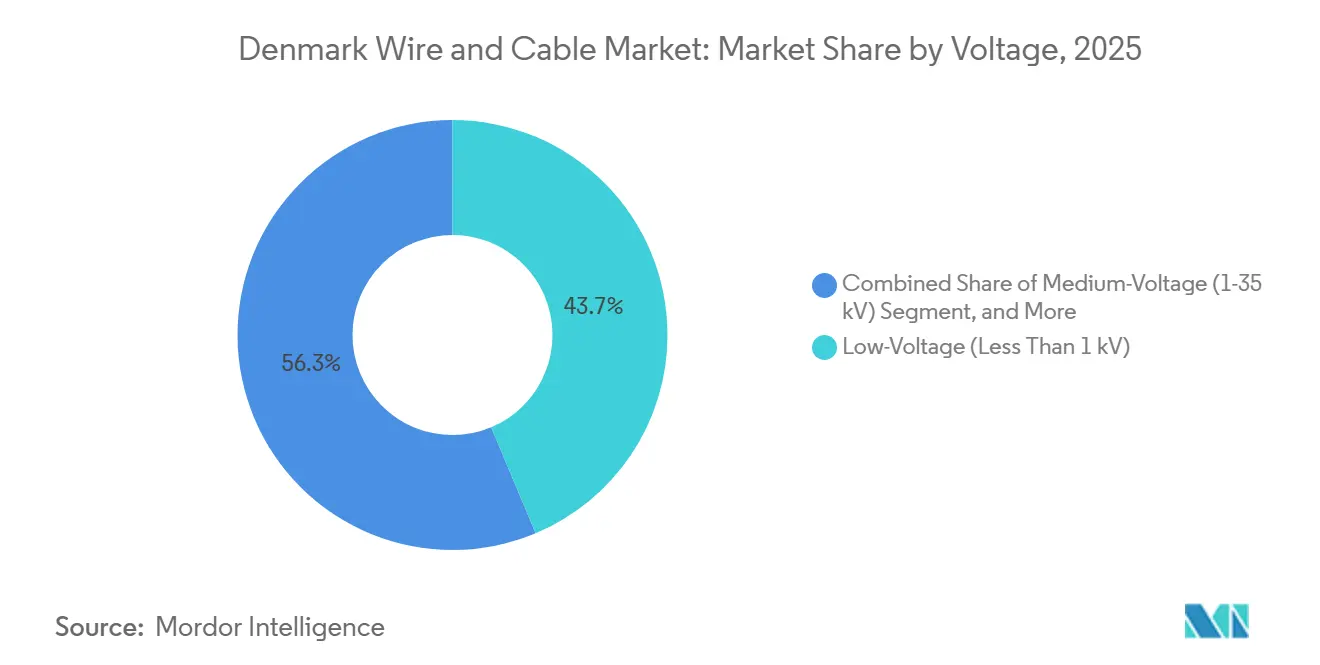
Low-voltage cables held 43.68% of the Denmark wire and cable market share in 2025. Residential wiring, EV charging conduit, and distribution-level industrial connections support this volume. These uses create broad demand across new buildings, renovation, and local distribution work. Medium-voltage cables serve distribution substations, industrial parks, and wind farm collector systems. NKT completed an Asnaes capacity upgrade in June 2026, strengthening its ability to supply this tier.
Extra- and high-voltage cables are projected to grow at a 3.26% CAGR through 2031. NKT reported a Transmission order backlog of EUR 13.5 billion (USD 15.39 billion) at the end of the first quarter of 2026. Denmark’s undergrounding program has developed experienced contractors and high-voltage engineering capacity. This experience is being applied to HVDC links, offshore connections, and large grid reinforcement work, where design, jointing, testing, and installation must meet demanding utility requirements. IEC 60228 and IEC 62067 remain important technical standards for conductor classification and the qualification of high-voltage extruded cables.



By Cable Type: Power Cables Maintain Their Leading Position
Power cables accounted for 69.42% of the Denmark wire and cable market size in 2025. They are also projected to grow at a 2.98% CAGR through 2031. Energinet’s completed projects in 2025 used hundreds of kilometers of underground power cable. Grid reinforcement needs power cables in transmission corridors, local distribution systems, substations, wind farm collector networks, and the connections that link these assets. This makes power infrastructure the primary source of cable volume.
Fiber-optic cable is an important secondary category due to the copper network phase-out and the emergence of new subsea systems. TDC Net reported 23% growth in fiber revenue in 2025. Signal and control cables remain in demand for offshore platforms, industrial automation, and data centers. Coaxial and data cables face lower residential volumes as copper broadband is retired. Prysmian’s July 2026 agreement with Molex, valued at up to EUR 5.5 billion (USD 6.27 billion), suggests that global optical cable capacity may become tighter as data center demand rises.
By Conductor Material: Aluminum Gains From Cost Substitution
Copper conductors held 51.86% of the Denmark wire and cable market share in 2025. They remain necessary for HVDC transmission, high-reliability control wiring, and data center power distribution where resistivity requirements are strict. Optical glass and polymer conductors serve a growing niche linked to fiber deployment. Copper, therefore, remains important even as buyers consider material substitution. Its technical limitations limit its use in the most demanding electrical applications, particularly where project specifications require dependable conductivity and long service life.
Aluminum conductors are projected to grow at a 2.84% CAGR through 2031. Higher copper prices encourage the use of aluminum-core XLPE underground cables in medium-voltage distribution projects where standards allow. The shift is gradual because copper remains the standard for HVDC and precision control applications. TDC Net recovered more than 700 tonnes of copper cable in 2025, providing a limited secondary supply. Recycling arrangements may reduce exposure to peak spot prices for participating manufacturers.
By Installation: Submarine Cables Lead Growth
Underground cables held 55.74% of the installation mix in 2025. Their position reflects a long-running policy of replacing overhead lines with underground XLPE systems. Overhead cables are the smallest installation category and face declining demand. Underground systems remain central to transmission reinforcement and local distribution upgrades. This established base gives the Denmark wire and cable market a substantial installed network for renewal, maintenance, fault repair, and capacity upgrades as electricity demand changes.
Submarine cables are projected to grow at a 3.54% CAGR through 2031, the highest rate among installation types. Offshore wind export systems, HVDC interconnectors, and submarine fiber networks support this growth. Energinet replaced 3,400 kV submarine cables across the Oresund in 2026. Narrow weather windows and multi-authority permitting add complexity to cable laying. NKT Eleonora is expected to become operational in 2027, although its vessel capacity will remain limited relative to committed offshore projects.
By End-User Vertical: Power Infrastructure Leads Volume and Growth
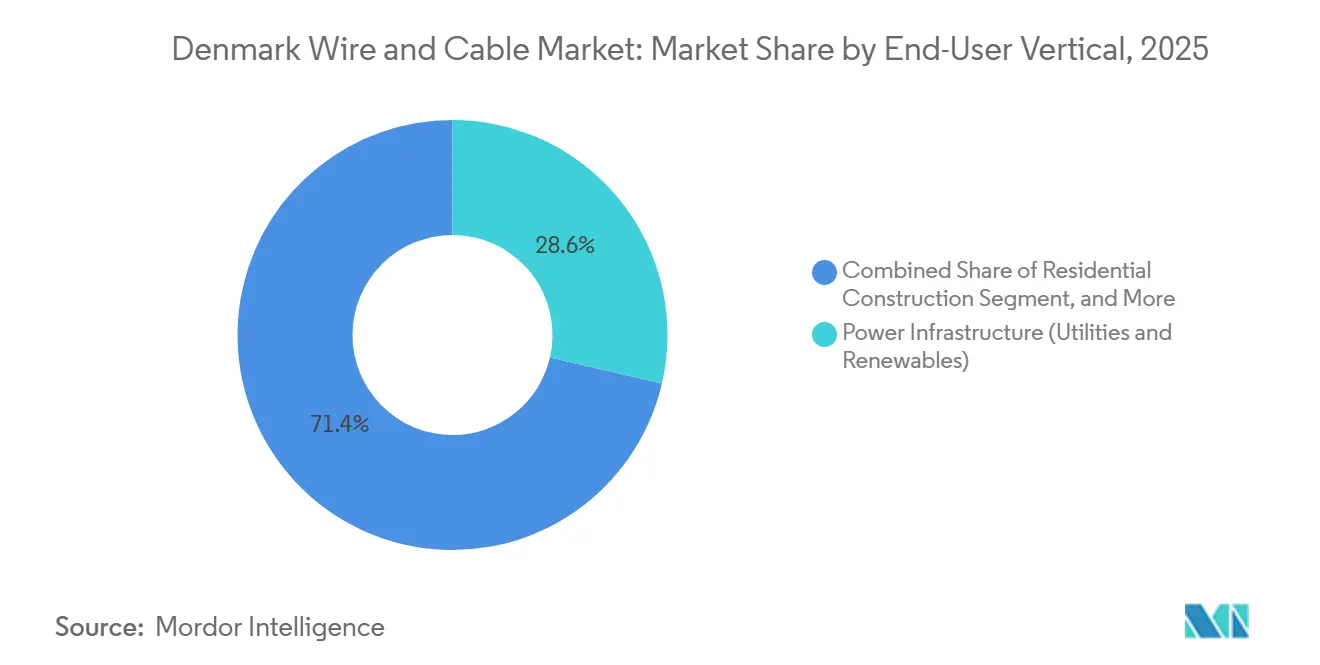
Power infrastructure, including utilities and renewables, accounted for 28.63% of the Denmark wire and cable market in 2025. It is also projected to grow at a 3.38% CAGR through 2031. Energinet’s active grid projects require cable procurement across voltage classes. Offshore wind and Power-to-X facilities add further demand for transmission connections. The concentration of public and utility investment makes this the leading end-user area, linking national energy planning with recurring requirements for cable supply and installation.
Telecommunications and data centers are the fastest-emerging secondary end-user areas. Danish data center capacity increased from 258 MW in 2024 to 335 MW in 2025 and was estimated at 400 MW in 2026. NKT supplied 50 kV and 132 kV connections for 3 Greater Copenhagen data centers in May 2026. Data centers had requested 14 GW of capacity by early 2026, representing 40% of the queued capacity. The planned return of grid connection agreements in autumn 2026 could lead to concentrated procurement periods.
By Insulation: Insulated Cables Set the Product Standard
Insulated cables accounted for 94.18% of the insulation category in 2025. They are projected to grow at a 2.43% CAGR through 2031. XLPE is widely used in medium- and high-voltage underground and submarine power cable applications. It supports the Bornholm Energy Island connection and the Øresund replacement program. Its use reflects the technical requirements of major power cable installations.
PVC and LSZH Power Infrastructure (Utilities and Renewables) compounds serve low-voltage building wiring. CPR Euroclass fire reaction requirements support the use of LSZH products in new construction and renovation. Non-insulated cables represented the remaining 5.82% share and face pressure as overhead networks are undergrounded. TDC Net’s recovery of more than 700 tonnes of insulated copper cable in 2025 also creates a stream of reclaimed insulation material. Specialty processors can support this developing recycling activity by separating recoverable metal and insulation materials from cables removed during network modernization.
Geography Analysis
Greater Copenhagen and Zealand are major cable demand centers because of data center construction, commercial development, and grid upgrades. NKT delivered underground 50 kV and 132 kV connections for 3 new data centers in Greater Copenhagen in May 2026. Energinet completed major work on the Zealand substation in 2025, including the Rødbyhavn substation for the Fehmarn Belt fixed link. The 400 kV Øresund submarine cable replacement also concentrates high-value work in the Danish-Swedish corridor. Data center capacity is projected to reach 1.2 GW by 2030, supporting ongoing medium-voltage reinforcement and new cable routes across the eastern islands within the Denmark wire and cable market.
Jutland is a central area for grid reinforcement and renewable energy connections within the Denmark wire and cable market. The 21 km 150 kV Herning-Videbæk section was commissioned in 2025 as the second of 9 planned sections. The 172 km West Coast Connection forms a transmission route for North Sea offshore wind exports. Esbjerg supports Power-to-X and offshore wind, including a planned 1 GW HØST PtX electrolyzer plant. The government approved a 133 km hydrogen pipeline from Esbjerg to the German border, budgeted at DKK 6.9 billion (USD 996 million) in 2025 prices.
Island territories and offshore maritime zones are emerging areas of cable demand. Bornholm’s energy island role is tied to 3.8 GW of Baltic Sea offshore wind and a 525 kV HVDC connection to Zealand. Lolland commissioned 30 km of 132 kV underground cable and 3 substations in 2025, supporting the Fehmarn Belt link and the electrification of logistics. Smaller South Fyn Archipelago islands are receiving submarine connectivity through the Broadband Pool program, which runs to 2027.
Competitive Landscape
The Denmark wire and cable market has a two-tier competitive structure. NKT A/S, Nexans SA, and Prysmian S.p.A. lead the transmission and high-voltage layer. NKT has a domestic position because it is the only Denmark-headquartered manufacturer with HVDC manufacturing and local installation infrastructure. Its high-voltage backlog increased from EUR 10.2 billion (USD 10.98 billion) at the end of 2025 to EUR 13.5 billion (USD 15.39 billion) at the end of the first quarter of 2026. The backlog included the EUR 2.2 billion (USD 2.51 billion) Eastern Green Link 3 contract and 2 Scottish HVDC awards totaling EUR 2 billion (USD 2.28 billion).
Prysmian acquired submarine cable installation provider ACSM for EUR 169 million (USD 193 million) in February 2026, strengthening its offshore capability. Nexans commissioned its third cable-laying vessel in June 2026 to serve European offshore wind and interconnector work. NKT also expanded its medium-voltage production facility at Asnaes in June 2026. These moves address manufacturing and installation constraints in the Denmark wire and cable market, where large projects require cable, vessels, engineering teams, and installation slots simultaneously. Digitalized cable condition monitoring remains less developed, so asset owners continue to rely largely on scheduled maintenance.
The medium- and low-voltage layer of the Denmark wire and cable market is more fragmented. Draka Denmark A/S, LAPP Denmark ApS, HELUKABEL Danmark ApS, TKF, Scankab Cables A/S, Coferro Cables A/S, and DanCables ApS compete through stock availability, application support, and logistics. BizLink Industry Denmark ApS serves precision automation applications, while EUPEN Cable uses the Nexans network for specialty medium-voltage products. Nexans announced plans to divest its Autoelectric automotive harness business to Motherson for EUR 207 million (USD 223 million) in December 2025.
Denmark Wire and Cable Industry Leaders
NKT A/S
Nexans SA
Prysmian S.p.A.
LAPP Denmark ApS
HELUKABEL Danmark ApS
- *Disclaimer: Major Players sorted in no particular order

Recent Industry Developments
- July 2026: Prysmian S.p.A. signed a long-term optical cable supply agreement with Molex (Koch Inc.) valued at up to EUR 5.5 billion (USD 6.27 billion) over 10 years, including a EUR 550 million (USD 627 million) upfront payment, for deployment inside AI data centers, one of the largest commercial contracts in cable history, and a signal of structural demand shifting toward fiber-optic infrastructure.
- July 2026: NKT completed the expansion of its medium-voltage power cable production facility at Asnaes, Denmark, initiated in 2024, adding a new production hall, new test equipment, and more than 100 employees to significantly boost output capacity for European grid-upgrade and renewable-integration projects.


Denmark Wire and Cable Market Report Scope
The Denmark wire and cable market revenue is generated through the sale of low-, medium-, and high-voltage wires and cables, including power, fiber-optic, signal and control, and coaxial/data cables with copper, aluminum, or optical glass/polymer conductors, along with associated value-added products and installation-specific solutions for overhead, underground, and submarine network deployments.
The Denmark wire and cable market report is segmented by voltage (extra- and high-voltage (greater than 35 kV), medium-voltage (1-35 kV), and low-voltage (less than 1 kV)), cable type (power cable, fiber-optic cable, signal and control cable, and coaxial and data cable), conductor material (copper, aluminum, and optical glass/polymer), installation (overhead, underground, and submarine), end-user vertical (residential construction, commercial construction, power infrastructure (utilities and renewables), telecommunications and data centers, oil and gas and petrochemicals, automotive and mobility, and industrial manufacturing), and insulation (insulated and non-insulated). The market forecasts are provided in terms of value (USD).
| Extra- and High-Voltage (Greater Than 35 kV) |
| Medium-Voltage (1-35 kV) |
| Low-Voltage (Less Than 1 kV) |
| Power Cable |
| Fiber-Optic Cable |
| Signal and Control Cable |
| Coaxial and Data Cable |
| Copper |
| Aluminum |
| Optical Glass/Polymer |
| Overhead |
| Underground |
| Submarine |
| Residential Construction |
| Commercial Construction |
| Power Infrastructure (Utilities and Renewables) |
| Telecommunications and Data Centers |
| Oil and Gas and Petrochemicals |
| Automotive and Mobility |
| Industrial Manufacturing |
| Insulated |
| Non-Insulated |
| By Voltage | Extra- and High-Voltage (Greater Than 35 kV) |
| Medium-Voltage (1-35 kV) | |
| Low-Voltage (Less Than 1 kV) | |
| By Cable Type | Power Cable |
| Fiber-Optic Cable | |
| Signal and Control Cable | |
| Coaxial and Data Cable | |
| By Conductor Material | Copper |
| Aluminum | |
| Optical Glass/Polymer | |
| By Installation | Overhead |
| Underground | |
| Submarine | |
| By End-User Vertical | Residential Construction |
| Commercial Construction | |
| Power Infrastructure (Utilities and Renewables) | |
| Telecommunications and Data Centers | |
| Oil and Gas and Petrochemicals | |
| Automotive and Mobility | |
| Industrial Manufacturing | |
| By Insulation | Insulated |
| Non-Insulated |


Key Questions Answered in the Report
What is the Denmark wire and cable market size?
The Denmark wire and cable market was valued at USD 660.22 million in 2025, is estimated at USD 675.47 million in 2026, and is forecast to reach USD 757.18 million by 2031.
What growth rate is forecast for wire and cable demand in Denmark?
The market is projected to grow at a 2.31% CAGR between 2026 and 2031, supported by grid reinforcement, offshore wind, and fiber deployment.
Which cable installation type is growing fastest in Denmark?
Submarine cables are projected to grow at a 3.54% CAGR through 2031 as offshore wind, interconnectors, and fiber systems require subsea links.
Why are high-voltage cables important to Denmark's energy plans?
Extra- and high-voltage cables are projected to grow at a 3.26% CAGR because they connect offshore wind, HVDC systems, and large grid reinforcement projects.
Which end user has the strongest demand for cables in Denmark?
Power infrastructure held 28.63% share in 2025 and is projected to grow at a 3.38% CAGR through 2031.
What factors could delay cable projects in Denmark?
Material price volatility, long environmental approvals, subsea installation conditions, and limited specialist jointing capacity can delay procurement and construction.
Page last updated on:





