
Demi Fine Jewelry Market Size and Share
Market Overview
| Study Period | 2021 - 2031 |
|---|---|
| Market Size (2026) | USD 3.78 Billion |
| Market Size (2031) | USD 5.74 Billion |
| Growth Rate (2026 - 2031) | 8.71 % |
| Fastest Growing Market | Asia-Pacific |
| Largest Market | North America |
| Market Concentration | Medium |
Major Players *Disclaimer: Major Players sorted in no particular order Image © Mordor Intelligence. Reuse requires attribution under CC BY 4.0. | |
Demi Fine Jewelry Market Analysis by Mordor Intelligence
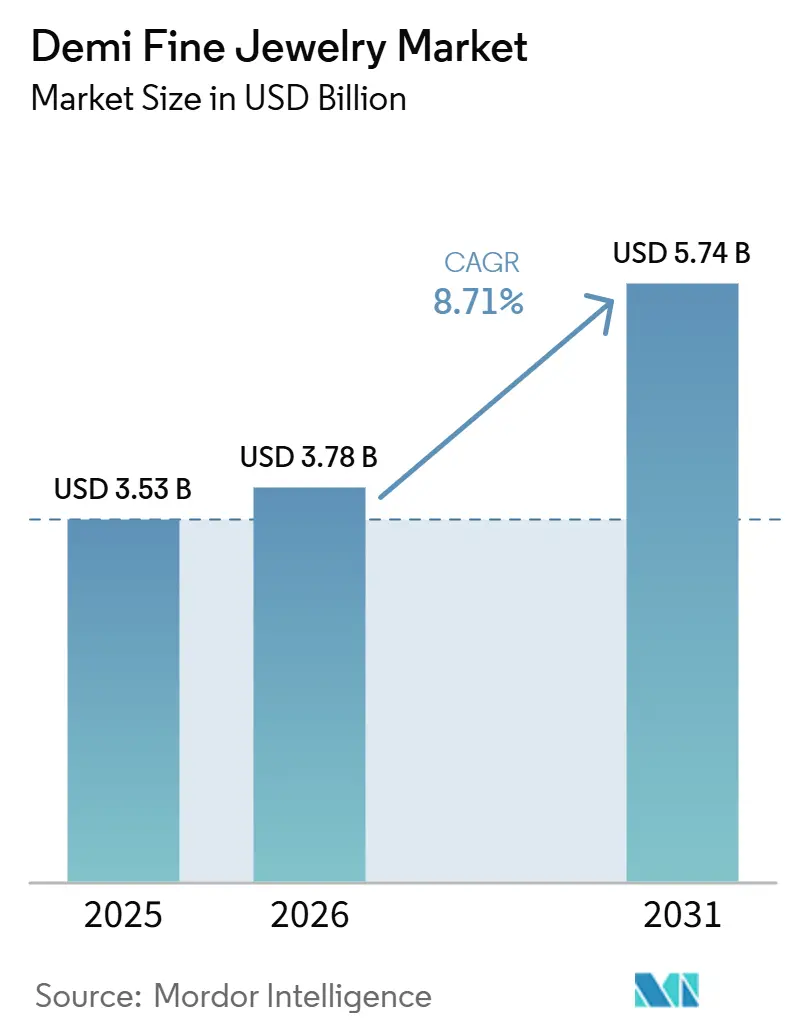
The demi fine jewelry market size is expected to grow from USD 3.53 billion in 2025 to USD 3.78 billion in 2026 and is forecast to reach USD 5.74 billion by 2031 at 8.71% CAGR over 2026-2031. The market is witnessing strong expansion as consumers increasingly seek affordable luxury jewelry that combines premium aesthetics with accessible pricing. Rising disposable incomes, especially among millennials and Gen Z consumers, are encouraging frequent purchases of stylish and personalized jewelry pieces. Growing preference for sustainable materials, ethical sourcing, and lightweight everyday jewelry is further supporting market growth. The increasing influence of social media platforms, celebrity endorsements, and digital jewelry brands is accelerating consumer awareness and online adoption. Additionally, innovations in gold vermeil, sterling silver, and gemstone-based designs are enabling brands to offer premium-looking products at lower price points compared with fine jewelry.
Key Report Takeaways
- By product type, rings held 31.61% of the demi fine jewelry market share in 2025, while necklaces and pendants are forecast to grow at a 10.15% CAGR through 2031.
- By material type, sterling silver accounted for 41.25% of the demi fine jewelry market share in 2025, while gold vermeil is projected to expand at a 10.61% CAGR through 2031.
- By end user, women accounted for 74.06% of revenue in 2025, while the unisex segment is forecast to advance at a 10.29% CAGR through 2031.
- By distribution channel, offline retail stores accounted for 80.28% of revenue in 2025, while online retail stores are projected to grow at an 11.36% CAGR through 2031.
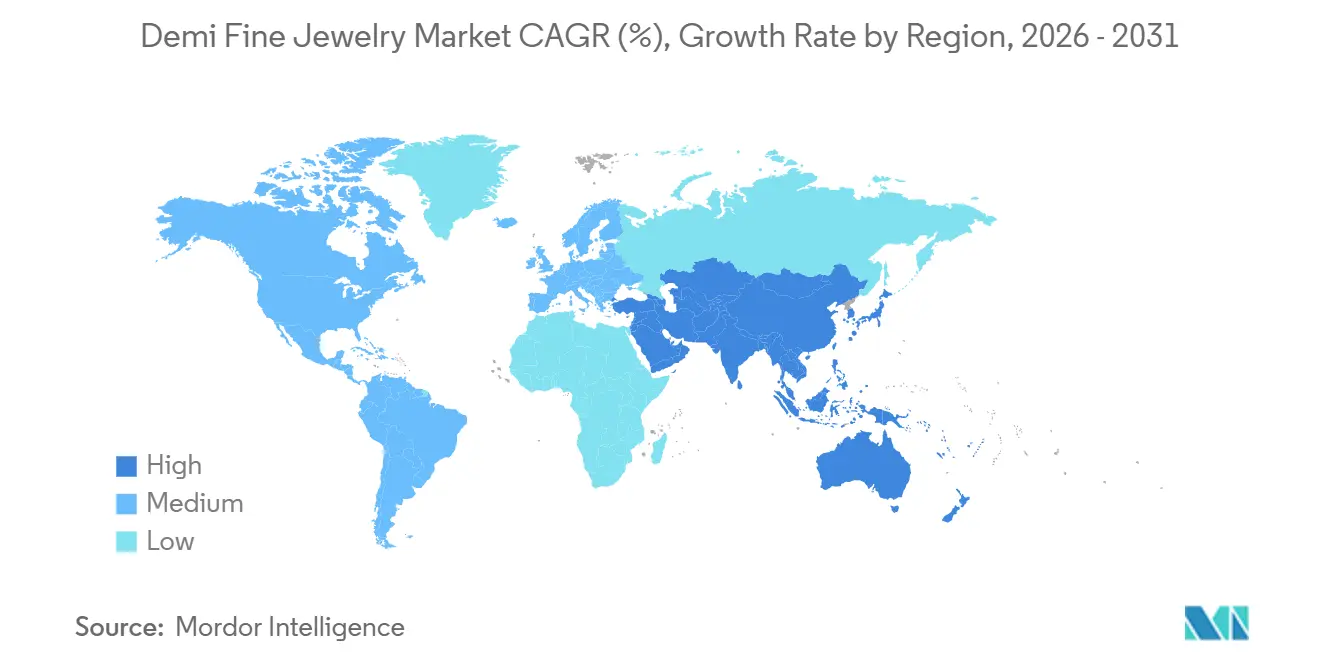
- By geography, North America accounted for 36.13% of revenue in 2025, while Asia-Pacific is forecast to grow at a 10.89% CAGR through 2031.
Note: Market size and forecast figures in this report are generated using Mordor Intelligence’s proprietary estimation framework, updated with the latest available data and insights as of January 2026.
Market Trends and Insights
Drivers Impact Analysis of Demi Fine Jewelry Market*
| Driver | (~) % Impact on CAGR Forecast | Geographic Relevance | Impact Timeline |
|---|---|---|---|
| Rising demand for affordable luxury jewelry | +2.2% | Global | Short term (≤ 2 years) |
| Growing popularity of everyday wearable fine-style jewelry | +1.5% | North America and Europe | Short term (≤ 2 years) |
| Increasing adoption of lab-grown diamonds and gemstones | +1.0% | Global | Medium term (2-4 years) |
| Rising consumer preference for sustainable and ethically sourced jewelry | +0.7% | Europe and North America | Long term (≥ 4 years) |
| Strong influence of social media and influencer-led fashion trends | +0.9% | Global, particularly younger consumers | Short term (≤ 2 years) |
| Premiumization of fashion accessories among Millennials and Gen Z | +0.8% | North America, Europe, and Asia-Pacific | Medium term (2-4 years) |
| Source: Mordor Intelligence | |||
Rising demand for affordable luxury jewelry
Consumers increasingly prefer versatile, lightweight, and wearable jewelry, which supports demand for demi-fine jewelry products designed for daily use. They are moving away from occasion-based jewelry purchases and choosing accessories they can style across work, casual, and social settings. This shift encourages brands to expand their collections with pieces that balance everyday functionality, refined aesthetics, accessible pricing, and durability for frequent wear. It also drives demand for designs that offer a premium look without the high cost or limited usability of traditional fine jewelry. According to Vogue Business’ analysis of Gen Z jewelry preferences for 2025, younger consumers increasingly seek jewelry that reflects personal identity, customization, affordability, and everyday styling, rather than only traditional luxury value.
Rising consumer preference for sustainable and ethically sourced jewelry
Increasing consumer awareness regarding environmental responsibility, ethical sourcing, and circular consumption is encouraging demi fine jewelry brands to adopt sustainable materials, recycled metals, and transparent supply chains. According to the European Commission’s 2024 Eurobarometer survey on attitudes toward the environment, nearly six in ten Europeans (59%) expressed willingness to pay more for products that are recyclable, easier to repair, or produced in an environmentally sustainable manner[1]Source: European Environment Agency, “Public Views on the Circular Economy”, eea.europa.eu. Additionally, the survey found that 92% of Europeans believe companies should be responsible for addressing pollution-related costs, highlighting rising expectations for corporate sustainability practices. These sustainability preferences are supporting demand for demi fine jewelry products that incorporate recycled gold, ethically sourced gemstones, and responsible production methods.
Strong influence of social media and influencer-led fashion trends
The increasing penetration of social media platforms is significantly influencing jewelry discovery, brand engagement, and purchasing decisions, particularly among younger consumers. Social media adoption is particularly strong among younger consumers, with 97% of EU individuals aged 16–29 reporting daily internet usage in 2024, indicating a highly connected demographic that is more receptive to influencer-driven fashion trends and digital brand interactions[2]Source: European Commission, “97% of young people in the EU use the internet daily”, ec.europa.eu. This growing digital engagement is enabling demi fine jewelry brands to leverage influencer collaborations, user-generated content, and social commerce strategies to reach Millennials and Gen Z consumers.
Premiumization of fashion accessories among Millennials and Gen Z
Premiumization of fashion accessories among Millennials and Gen Z is emerging as a significant driver of the demi fine jewelry market, as younger consumers increasingly seek jewelry that combines luxury aesthetics with affordability and everyday wearability. These demographics view jewelry as a form of self-expression, personal identity, and lifestyle enhancement, leading to higher spending on accessible premium products. The International Monetary Fund (IMF) reports that global GDP per capita reached USD 14,210 in 2025, reflecting stronger financial capacity among consumers and greater discretionary spending potential across many markets[3]Source: International Monetary Fund, “World Data Sets”, imf.org. This improvement in purchasing power is encouraging Millennials and Gen Z to invest in higher-quality accessories such as gold vermeil, sterling silver, and lab-grown gemstone jewelry rather than conventional fashion jewelry.
Restraints Impact Analysis of Demi Fine Jewelry Market*
| Restraint | (~) % Impact on CAGR Forecast | Geographic Relevance | Impact Timeline |
|---|---|---|---|
| High price sensitivity among target consumers | -1.0% | Global | Short term (≤ 2 years) |
| Intense competition from fashion jewelry and fine jewelry brands | -0.8% | North America and Europe | Short term (≤ 2 years) |
| Volatility in gold, silver, and gemstone prices | -1.2% | Global | Short term (≤ 2 years) |
| Concerns over durability and plating wear in gold-vermeil products | -0.6% | Global | Medium term (2-4 years) |
| Source: Mordor Intelligence | |||
High price sensitivity among target consumers
Price sensitivity among the primary consumer base remains a significant challenge for the demi fine jewelry market, particularly because many buyers belong to millennials and Gen Z demographics that are highly value-conscious. Although demi fine jewelry offers a premium appearance at a lower cost than fine jewelry, it is still considerably more expensive than fashion or costume jewelry alternatives. Consumers often compare prices across online marketplaces and competing brands, making it difficult for companies to maintain premium pricing and healthy profit margins. During periods of inflation, economic uncertainty, or reduced discretionary spending, buyers tend to postpone non-essential purchases such as jewelry and accessories. The availability of discounted fashion jewelry and frequent promotional campaigns from competing retailers further intensifies pricing pressure.
Intense competition from fashion jewelry and fine jewelry brands
Competition from both fashion jewelry and traditional fine jewelry brands continues to restrain the growth of the demi fine jewelry market by placing pressure on pricing, brand positioning, and customer acquisition. Fashion jewelry brands attract price-conscious consumers with inexpensive, trend-driven products that are frequently updated to match changing fashion preferences. At the same time, established fine jewelry brands compete for consumers seeking long-term value, precious metals, and investment-grade jewelry pieces. This creates a challenging middle-ground position for demi fine jewelry brands, which must justify higher prices than fashion jewelry while remaining more affordable than fine jewelry.
*Our forecasts treat driver/restraint impacts as directional, not additive. The impact forecasts reflect baseline growth, mix effects, and variable interactions.
Demi Fine Jewelry Market Segment Analysis
By Product Type:
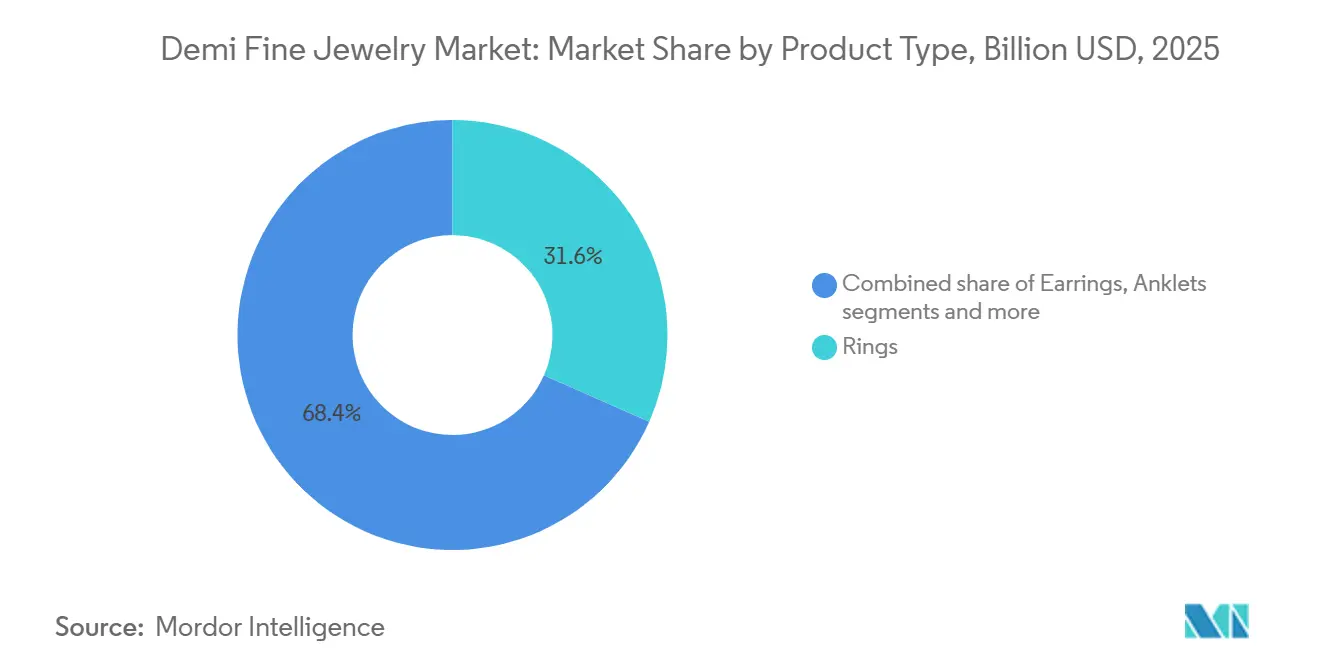
Rings Lead Revenue While Necklaces and Pendants Grow FastestRings accounted for the largest share of the demi fine jewelry market, representing 31.61% of the market in 2025. The dominance of rings is attributed to their widespread popularity as everyday accessories, gifting options, and symbols of personal expression. Demi fine rings offer consumers an affordable alternative to traditional fine jewelry while maintaining premium appeal through materials such as gold vermeil, sterling silver, and gemstones. The growing demand for minimalist, stackable, and customizable ring designs among millennials and Gen Z consumers is further supporting segment growth.
Necklaces and pendants are projected to be the fastest-growing product type segment in the demi fine jewelry market, registering a CAGR of 10.15% through 2031. Growth in this segment is driven by increasing consumer preference for personalized jewelry, including name necklaces, birthstone pendants, and customized designs. Necklaces and pendants are gaining popularity due to their ability to complement various fashion styles and serve as statement pieces for everyday wear. The influence of social media trends, fashion influencers, and celebrity styling is further accelerating demand for unique and layered necklace designs.



By Material Type:
Sterling Silver Supports Volume While Gold Vermeil Gains MomentumSterling silver held the largest share of the demi fine jewelry market, accounting for 41.25% of the market in 2025. The segment’s leading position is supported by the material’s affordability, durability, and ability to provide a premium appearance at a lower price point compared with traditional precious metals. Sterling silver jewelry is widely preferred among consumers seeking versatile and everyday-wear accessories that combine style with cost-effectiveness. The growing popularity of minimalist jewelry, contemporary designs, and sustainable material choices is further contributing to the demand for sterling silver products.
Gold vermeil is projected to be the fastest-growing material type segment in the demi fine jewelry market, expanding at a CAGR of 10.61% through 2031. The segment’s growth is driven by increasing consumer preference for affordable luxury jewelry that delivers the appearance of solid gold without the higher price associated with fine jewelry. Gold vermeil, which combines a thick layer of gold over sterling silver, offers improved quality and longevity compared with conventional gold-plated alternatives, making it attractive to value-conscious consumers.
By End User:
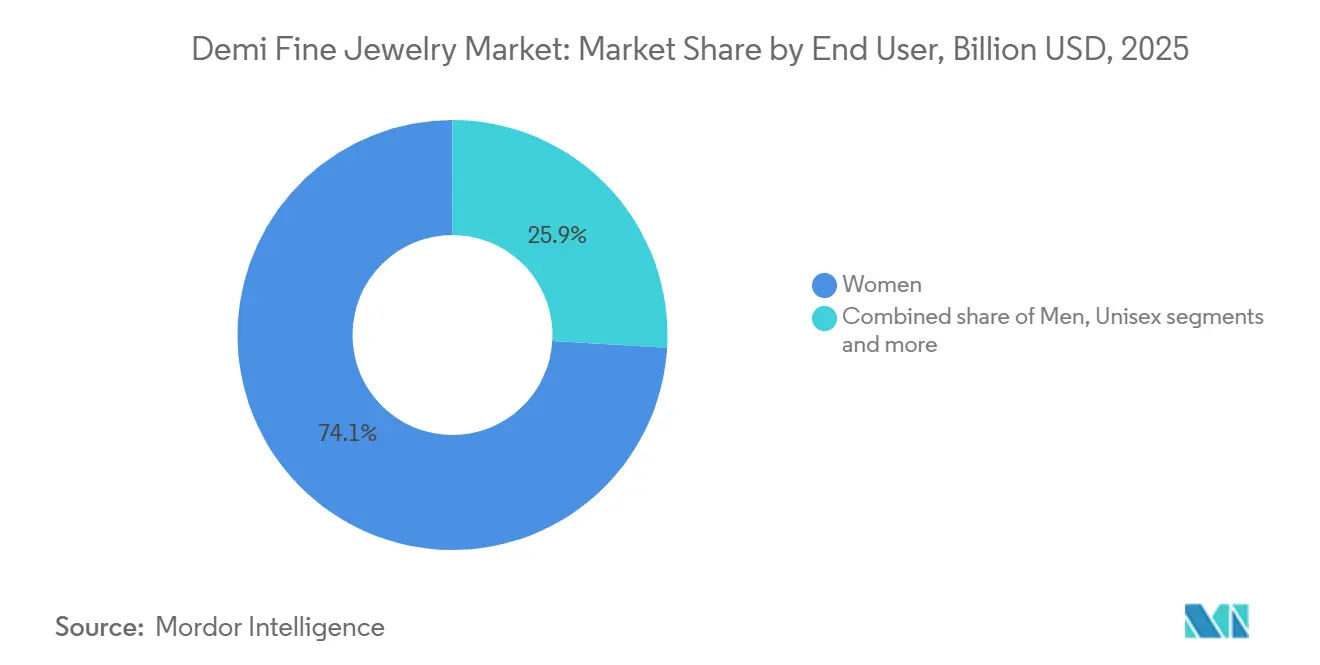
Women Remain the Core Customer While Unisex Demand ExpandsWomen represented the dominant segment in the demi fine jewelry market, accounting for 74.06% of revenue in 2025. The strong market position of this segment is driven by women’s higher preference for jewelry as a form of self-expression, fashion enhancement, and personal investment. Demi fine jewelry has gained popularity among female consumers due to its balance of affordability, premium appearance, and suitability for everyday wear. The increasing demand for minimalist, personalized, and versatile jewelry pieces is encouraging women to purchase multiple accessories for different occasions.
The unisex segment is projected to be the fastest-growing end-user category in the demi fine jewelry market, expanding at a CAGR of 10.29% through 2031. Growth in this segment is supported by changing consumer perceptions of jewelry, with increasing preference for gender-neutral designs and inclusive fashion choices. Younger consumers, particularly millennials and Gen Z, are driving demand for versatile jewelry pieces that can be worn across different styles and identities. The rising popularity of minimalist chains, bracelets, rings, and pendants with universal appeal is further accelerating the adoption of unisex demi fine jewelry.
By Distribution Channel:
Offline Stores Retain Scale While Online Retail AcceleratesOffline retail stores accounted for the largest share of the demi fine jewelry market, representing 80.28% of revenue in 2025. The dominance of offline channels is attributed to consumers’ preference for physically examining jewelry quality, designs, finishes, and material authenticity before making a purchase. Brick-and-mortar stores provide personalized shopping experiences, expert guidance, and immediate product availability, which continue to influence purchasing decisions in the jewelry sector. Additionally, the ability to try on products and evaluate the fit and appearance of jewelry enhances customer confidence, particularly for premium and demi fine jewelry purchases.
Online retail stores are projected to be the fastest-growing distribution channel in the demi fine jewelry market, expanding at a CAGR of 11.36% through 2031. The rapid growth of this segment is driven by increasing consumer adoption of e-commerce platforms, improved digital payment systems, and greater accessibility to a wide range of jewelry collections. Online channels enable brands to reach a broader customer base by offering extensive product assortments, competitive pricing, customization options, and convenient home delivery services. The growing influence of social media marketing, influencer collaborations, and digital-first jewelry brands is further encouraging consumers to discover and purchase demi fine jewelry online.
Geography Analysis
North America Demi Fine Jewelry Market
North America accounted for the largest share of the demi fine jewelry market, contributing 36.13% of revenue in 2025. The region’s leading position is supported by strong consumer demand for affordable luxury products, rising preference for everyday jewelry, and high purchasing power among consumers. The growing popularity of personalized, minimalist, and sustainable jewelry designs is encouraging adoption of demi fine jewelry across the United States and Canada. Younger consumers, particularly millennials and Gen Z, are increasingly purchasing demi fine pieces as accessible alternatives to traditional fine jewelry while maintaining premium aesthetics.
APAC Demi Fine Jewelry Market
Asia-Pacific is projected to be the fastest-growing regional market for demi fine jewelry, registering a CAGR of 10.89% through 2031. Growth in the region is driven by rising disposable incomes, expanding middle-class populations, and increasing consumer interest in fashion-oriented accessories. Countries such as China, India, Japan, and South Korea are witnessing growing demand for affordable luxury jewelry as consumers seek products that combine quality, style, and accessibility. The influence of social commerce, digital marketplaces, and local jewelry startups is accelerating the adoption of demi fine jewelry among younger demographics.
EMEA and South America Demi Fine Jewelry Market
Europe represents a significant market for demi fine jewelry due to its strong fashion culture, preference for high-quality accessories, and growing demand for sustainable and ethically sourced materials. South America is experiencing gradual growth, supported by rising fashion consciousness and increasing availability of affordable luxury jewelry through online channels. The Middle East and Africa market is also expanding, driven by premiumization trends, increasing disposable incomes, and growing interest in contemporary jewelry designs.

Competitive Landscape
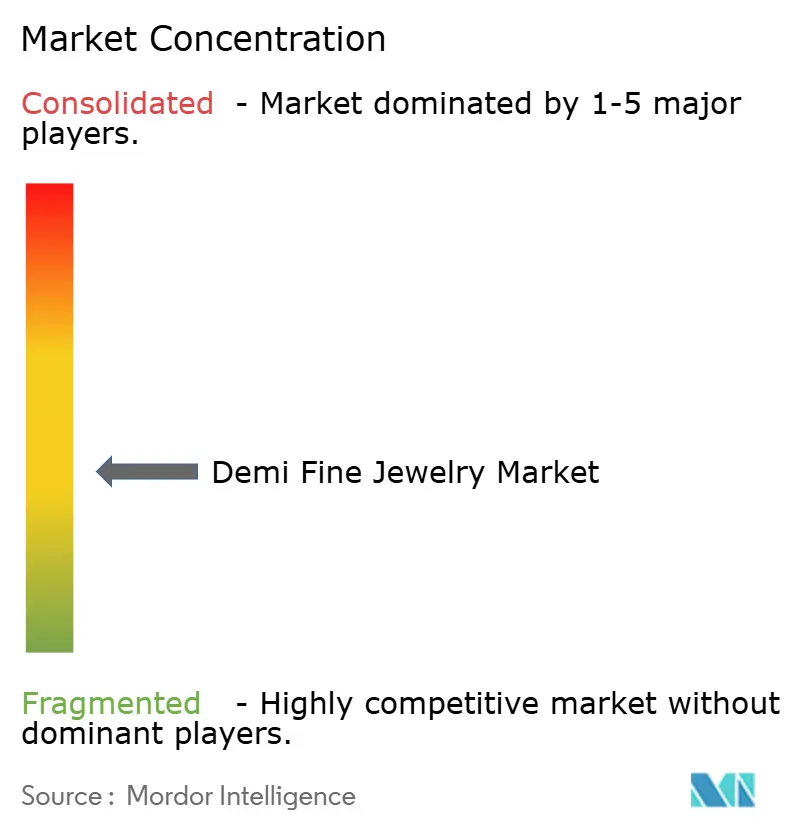
The demi fine jewelry market is moderately fragmented, with the presence of several established jewelry brands, emerging direct-to-consumer companies, and online-first players competing across product categories, materials, and price points. Companies are focusing on offering affordable luxury jewelry that combines premium aesthetics with accessible pricing to attract a broader consumer base. Key players such as Mejuri, Ana Luisa, and Monica Vinader have strengthened their market presence through personalized designs, sustainable sourcing initiatives, and digital-first strategies.
Major players in the demi fine jewelry market are adopting strategies such as product launches, partnerships, geographic expansion, and investments in digital retail capabilities to gain a competitive advantage. Companies are expanding their product portfolios by introducing collections featuring gold vermeil, sterling silver, gemstones, and personalized jewelry options to meet evolving consumer preferences. For instance, brands such as Catbird and Missoma have gained consumer traction by offering contemporary designs focused on everyday wear and customization.
The market is also witnessing rising competition from traditional jewelry retailers entering the demi fine segment to capture demand for affordable premium products. Companies are differentiating themselves through ethical sourcing, recycled materials, transparent supply chains, and unique design concepts to appeal to environmentally conscious consumers. Online marketplaces and direct-to-consumer brands continue to reshape the competitive landscape by offering wider product selections, competitive pricing, and convenient shopping experiences.
Demi Fine Jewelry Industry Leaders
Mejuri Inc.
Monica Vinader Ltd
Missoma Ltd
Catbird NYC LLC
Maria Black ApS
- *Disclaimer: Major Players sorted in no particular order
Demi Fine Jewelry Market Companies Covered in this Report
- Mejuri Inc.
- Monica Vinader Ltd
- Missoma Ltd
- Catbird NYC LLC
- Maria Black ApS
- Ana Luisa Inc.
- Aurate New York, Inc.
- Astrid & Miyu Ltd
- Gorjana & Griffin, Inc.
- Abbott Lyon Ltd
- Otiumberg Limited
- Shyla London Ltd
- Roxanne First Ltd
- Kimai SA
- Lark & Berry Ltd
- Oak & Luna LLC
- Hey Harper Jewelry, Lda
- Maison Miru LLC
- GIVA Jewellery
- Trisu

Recent Industry Developments in Demi Fine Jewelry Market
- May 2026: Catbird unveiled “A Dream This Time,” its third jewelry capsule collaboration with musician Clairo. The collection featured recycled 14k and 10k gold and sterling silver pieces priced from USD 68 to USD 878. The ongoing series established a recurring drop model that helped the brand sustain relevance among a culturally influential audience beyond its core consumers.
- April 2026: Monica Vinader launched the MV Siren Diamond collection, marking its formal entry into the bridal and engagement category. The collection featured a proprietary 64-facet asymmetric lab-grown diamond cut, certified by the International Gemological Institute and produced using 100% renewable energy under the SCS-007 sustainability standard.
- March 2026: Mejuri expanded its Puzzle collection, the brand’s highest-selling product launch to date, into sterling silver and introduced modular slider charms for necklaces. These additions enabled more than 16 million combinations across metals and stones. The expansion directly addressed continued consumer demand for silver and mixed-metal styling while reinforcing personalization as a commercial differentiator.


Global Demi Fine Jewelry Market Report Scope
Demi Fine Jewelry typically features precious metals such as gold vermeil, sterling silver, and gold-plated silver, often complemented with semi-precious gemstones, diamonds, or other decorative stones. The demi fine jewelry market is segmented by product type, material type, end user, distribution channel and geography. Based on product type, the market is segmented into rings, earrings, necklaces and pendants, bracelets and bangles, anklets and other product types. Based on material type, the market is segmented into gold vermeil, sterling silver, gold-plated silver and other demi-fine materials. Based on end user, the market is segmented into women, men and unisex. Based on distribution channel, the market is segmented into offline retail stores and online retail stores. By geography, the market is segmented into North America, Europe, Asia-Pacific, South America, and Middle-East and Africa. For each segment, the market sizing and forecasting have been done in value terms (USD billion).
| Rings |
| Earrings |
| Necklaces and Pendants |
| Bracelets and Bangles |
| Anklets |
| Other Product Types |
| Gold Vermeil |
| Sterling Silver |
| Gold-Plated Silver |
| Other Demi-Fine Materials |
| Men |
| Women |
| Unisex |
| Offline Retail Stores |
| Online Retail Stores |
| North America | United States |
| Canada | |
| Mexico | |
| Rest of North America | |
| Europe | Germany |
| United Kingdom | |
| Italy | |
| France | |
| Spain | |
| Netherlands | |
| Poland | |
| Belgium | |
| Sweden | |
| Rest of Europe | |
| Asia-Pacific | China |
| India | |
| Japan | |
| Australia | |
| Indonesia | |
| South Korea | |
| Thailand | |
| Singapore | |
| Rest of Asia-Pacific | |
| South America | Brazil |
| Argentina | |
| Colombia | |
| Chile | |
| Peru | |
| Rest of South America | |
| Middle East and Africa | South Africa |
| Saudi Arabia | |
| United Arab Emirates | |
| Nigeria | |
| Egypt | |
| Morocco | |
| Türkiye | |
| Rest of Middle East and Africa |
| By Product Type | Rings | |
| Earrings | ||
| Necklaces and Pendants | ||
| Bracelets and Bangles | ||
| Anklets | ||
| Other Product Types | ||
| By Material Type | Gold Vermeil | |
| Sterling Silver | ||
| Gold-Plated Silver | ||
| Other Demi-Fine Materials | ||
| By End User | Men | |
| Women | ||
| Unisex | ||
| By Distribution Channel | Offline Retail Stores | |
| Online Retail Stores | ||
| By Geography | North America | United States |
| Canada | ||
| Mexico | ||
| Rest of North America | ||
| Europe | Germany | |
| United Kingdom | ||
| Italy | ||
| France | ||
| Spain | ||
| Netherlands | ||
| Poland | ||
| Belgium | ||
| Sweden | ||
| Rest of Europe | ||
| Asia-Pacific | China | |
| India | ||
| Japan | ||
| Australia | ||
| Indonesia | ||
| South Korea | ||
| Thailand | ||
| Singapore | ||
| Rest of Asia-Pacific | ||
| South America | Brazil | |
| Argentina | ||
| Colombia | ||
| Chile | ||
| Peru | ||
| Rest of South America | ||
| Middle East and Africa | South Africa | |
| Saudi Arabia | ||
| United Arab Emirates | ||
| Nigeria | ||
| Egypt | ||
| Morocco | ||
| Türkiye | ||
| Rest of Middle East and Africa | ||


Key Questions Answered in the Report
What is driving growth in demi fine jewelry?
Higher precious-metal prices, demand for accessible premium designs, social-media discovery, and personalized products are supporting demand. The category is forecast to grow at an 8.71% CAGR from 2026 to 2031.
Which product type leads revenue?
Rings led revenue with 31.61% share in 2025. Necklaces and pendants are expected to grow the fastest at a 10.15% CAGR through 2031.
Why is sterling silver important to this category?
Sterling silver held 41.25% share in 2025 because it offers durability, a lower entry price, and established hallmarking.
Which sales channel is growing fastest?
Online retail is forecast to grow at an 11.36% CAGR through 2031.
Which region is growing fastest?
Asia-Pacific is projected to grow at a 10.89% CAGR through 2031, supported by rising disposable income, gifting traditions, and digital product discovery.
Page last updated on:





