
Demand Generation Services Market Size and Share
Market Overview
| Study Period | 2020 - 2031 |
|---|---|
| Market Size (2026) | USD 9.54 Billion |
| Market Size (2031) | USD 13.51 Billion |
| Growth Rate (2026 - 2031) | 7.21 % |
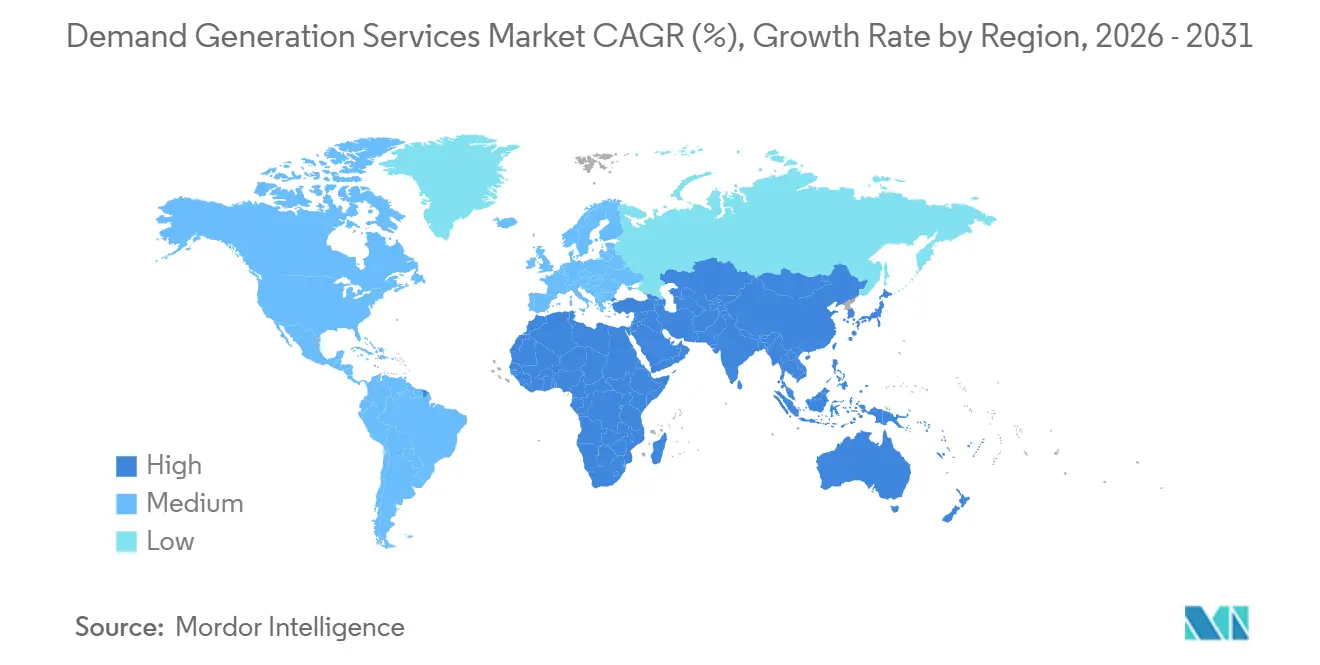
| Fastest Growing Market | Asia-Pacific |
| Largest Market | North America |
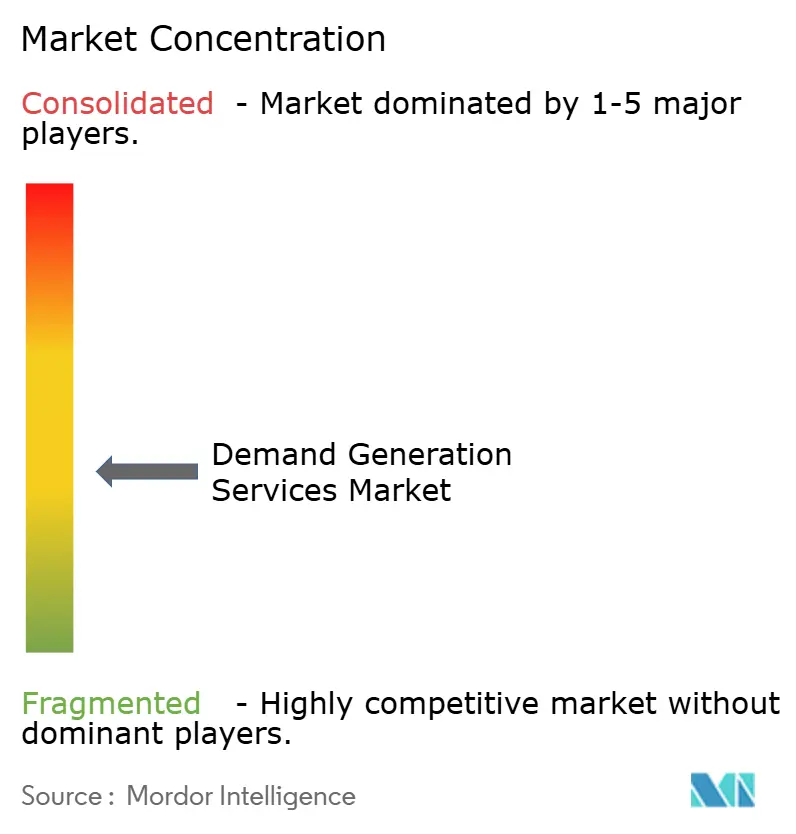
| Market Concentration | Medium |
Major Players *Disclaimer: Major Players sorted in no particular order Image © Mordor Intelligence. Reuse requires attribution under CC BY 4.0. | |
Demand Generation Services Market Analysis by Mordor Intelligence
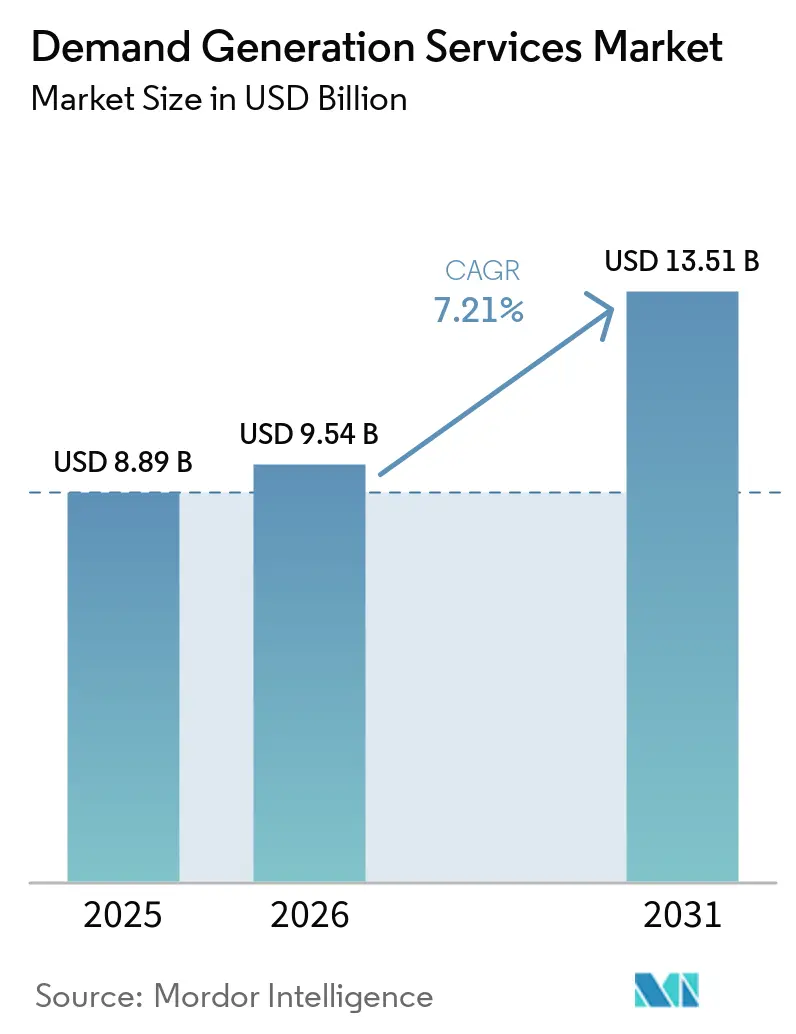
The demand generation services market size is projected to be USD 8.89 billion in 2025, USD 9.54 billion in 2026, and reach USD 13.51 billion by 2031, growing at a CAGR of 7.21% from 2026 to 2031. Buyers are placing greater weight on pipeline and revenue outcomes, rather than lead volume alone. This is increasing demand for providers that connect campaign activity with clear commercial attribution. Buyer research is also moving earlier into the purchase process, which increases the value of consistent content and engagement across channels. The demand generation services market is therefore rewarding providers that combine data, content, activation, and CRM-connected execution. Budget scrutiny is also changing contract structures, with clients favoring commercial terms linked to qualified meetings and influenced pipeline.
Key Report Takeaways
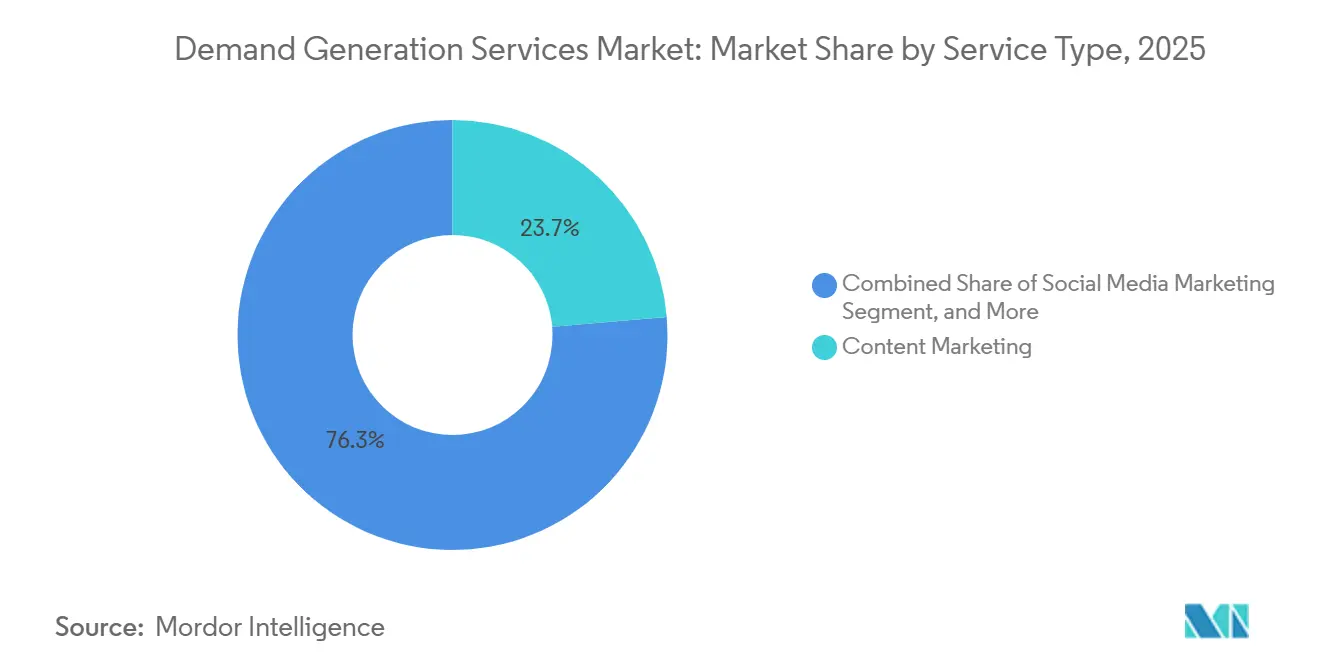
- By service type, content marketing held 23.67% of the demand generation services market share in 2025, while paid advertising and performance marketing are projected to expand at a 7.68% CAGR through 2031.
- By organization size, large enterprises held 59.42% of revenue in 2025, while Small and Medium Enterprises are projected to grow at a CAGR of 8.15% through 2031.
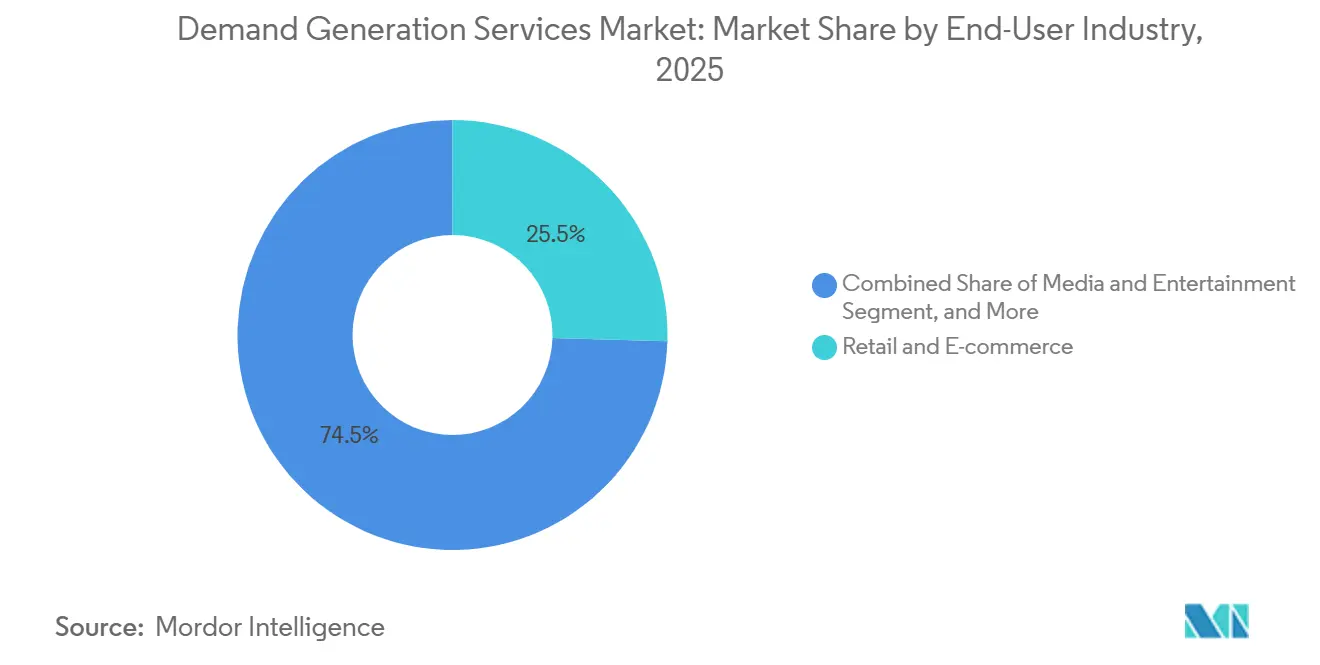
- By end-user industry, retail and e-commerce accounted for 25.46% of revenue in 2025, while healthcare is projected to grow at an 8.24% CAGR through 2031.
- By geography, North America held 34.68% of global revenue in 2025, while Asia-Pacific is projected to expand at a 7.89% CAGR through 2031.
Note: Market size and forecast figures in this report are generated using Mordor Intelligence’s proprietary estimation framework, updated with the latest available data and insights as of January 2026.
Market Trends and Insights
Drivers Impact Analysis of Demand Generation Services Market*
| Driver | (~) % Impact on CAGR Forecast | Geographic Relevance | Impact Timeline |
|---|---|---|---|
| AI-Powered Personalization and Predictive Lead Scoring Adoption | +2.0% | Global, particularly North America and Asia-Pacific | Medium term (2-4 years) |
| Shift From MQL Tracking to Pipeline and Revenue Accountability | +1.2% | Global, strongest in North America and Europe | Short term (≤ 2 years) |
| Rising Account-Based Marketing and Buying Group Orchestration Spend | +1.3% | North America and Europe, with Asia-Pacific emerging | Medium term (2-4 years) |
| Growing Need for Omnichannel Automation and CRM-Connected Execution | +0.9% | Global | Medium term (2-4 years) |
| Generative Engine Optimization and AI Search Discovery Services | +0.7% | North America, Europe, and Asia-Pacific | Short term (≤ 2 years) |
| Dark-Funnel Intelligence and Micro-Event Activation Strategies | +0.5% | North America and Europe | Medium term (2-4 years) |
| Source: Mordor Intelligence | |||
AI-Powered Personalization and Predictive Lead Scoring Adoption
AI-powered personalization is becoming a core delivery capability for demand generation service providers. In 2026, lead-scoring tools combine behavioral, firmographic, technographic, and intent signals to identify accounts with greater purchase potential. This allows teams to focus outreach on accounts that show active buying behavior during commercially relevant purchase windows. The demand generation services market benefits from the fact that many organizations still need implementation support beyond basic content generation. The Pedowitz Group reported that 28% of B2B organizations were AI-fluent beyond basic content generation in 2025.[1] Providers that connect scoring to CRM actions can demonstrate a closer link between marketing activity, sales follow-up, pipeline progress, and commercial outcomes.
Shift From MQL Tracking to Pipeline and Revenue Accountability
Marketing-qualified leads are becoming less useful as the primary measure of demand-generation performance. Clients increasingly want evidence that campaigns create opportunities, influence deal movement, and support closed revenue. The Pedowitz Group found that 74% of B2B organizations used pipeline or revenue as their main metric in 2025, although only 18% had reached revenue marketing maturity. This gap creates work for providers that can build full-funnel attribution, reporting, and practical coordination with sales teams. The demand generation services market is moving toward agreements that measure qualified opportunities, pipeline contribution, deal movement, and renewal value. Agencies that report only registrations or form fills are more exposed when clients reallocate budgets toward measurable commercial results.
Rising Account-Based Marketing and Buying Group Orchestration Spend
Account-based marketing is shifting from individual account targeting toward buying-group engagement. Large B2B purchases often include economic buyers, technical reviewers, end users, procurement teams, and internal risk owners. Demand generation providers can add value by identifying these roles and delivering relevant content to each audience simultaneously. Inflection Group found that 86% of surveyed account-based marketing programs had stable or growing budgets in 2026. The demand generation services market can benefit as clients replace single-lead programs with coordinated workflows across advertising, content, sales development, and account intelligence. Providers with strong persona mapping and activation capabilities can justify higher fees than providers focused only on isolated lead capture.
Growing Need for Omnichannel Automation and CRM-Connected Execution
Clients increasingly expect demand programs to operate across advertising, email, web activity, sales outreach, and CRM systems. A connected workflow makes it easier to react to signals such as job changes, funding events, technology purchases, and active content engagement. SyncGTM reported that signal-driven outbound generated 58% of the outbound pipeline at high-growth B2B companies in 2026. LeanData identified integration complexity as the leading barrier to marketing maturity for 51% of respondents in 2026. The demand generation services market is benefiting from this complexity, as clients often need external implementation, data coordination, and ongoing operational support. Providers that establish CRM-linked attribution quickly have an advantage over firms with long setup periods and separate channel reporting.
Restraints Impact Analysis of Demand Generation Services Market*
| Restraint | (~) % Impact on CAGR Forecast | Geographic Relevance | Impact Timeline |
|---|---|---|---|
| Data Privacy, Consent, and Cookie-Less Targeting Limits | -1.3% | Global, most acute in Europe and Asia-Pacific | Short term (≤ 2 years) |
| Rising Cost Per Lead and Paid Media Saturation | -0.9% | North America and Western Europe | Medium term (2-4 years) |
| CRM-Native AI Compressing Standalone Service Differentiation | -0.6% | Global, particularly North America | Medium term (2-4 years) |
| AI Content Glut and Buyer Trust Erosion | -0.5% | Global | Long term (≥ 4 years) |
| Source: Mordor Intelligence | |||
Data Privacy, Consent, and Cookie-Less Targeting Limits
Privacy rules and cookie restrictions are narrowing the data available for cross-border targeting. Providers must adapt campaigns to comply with consent requirements under the GDPR, the CCPA, and Asia-Pacific privacy frameworks. This complicates audience building, campaign measurement, multi-touch attribution, and proof of commercial value across client teams. The demand generation services market faces higher operating requirements as clients expect privacy-compliant execution across regions. More investment is moving toward first-party and consent-based data, while contextual approaches provide only partial support for specialized B2B targeting. These conditions increase compliance costs and favor firms with established data governance processes, regional delivery experience, and formal privacy management practices.
Rising Cost Per Lead and Paid Media Saturation
Paid media costs are increasing across LinkedIn, programmatic display, and search channels. This creates a combined cost issue for clients who pay both media budgets and service fees. The demand generation services market is affected because clients are looking more closely at cost per qualified meeting, opportunity creation, and pipeline contribution. Broad-reach campaigns can be difficult to defend when conversion into sales opportunities remains limited. Providers without strong media execution or proprietary audience intelligence can face volume pressure and margin pressure as clients favor account-focused programs. The result is a stronger preference for CRM-connected programs with visible commercial outcomes, disciplined targeting, and clear performance review.
*Our forecasts treat driver/restraint impacts as directional, not additive. The impact forecasts reflect baseline growth, mix effects, and variable interactions.
Demand Generation Services Market Segment Analysis
By Service Type:
Content Marketing Held the Largest Share While Performance Programs Expanded FasterContent marketing held 23.67% of the demand generation services market share in 2025. Its position reflects its role in educating buyers and supplying material for AI-powered search and citation experiences. Content Marketing Institute reported that content marketing received 26% of total B2B marketing budgets in 2026.[2] Providers are adapting content production to support both conventional search and visibility in generative engines. SEO and SEM continue to support sustained volume, as organic discovery can deliver long-term returns. Social media marketing, especially LinkedIn activity, supports account-targeted distribution and buyer engagement. Email marketing and marketing automation remain important when CRM-triggered sequences replace broad outbound messages. These tools help teams respond to engagement signals with more timely communication. The demand generation services market increasingly requires content that can serve education, discovery, nurture, and sales conversations. This broad use makes content programs central to many integrated delivery plans.
Paid advertising and performance marketing are projected to expand at a 7.68% CAGR through 2031. This growth reflects client demand for service models with clear attribution and commercial accountability. Performance-linked billing can align service fees with qualified meetings or pipeline targets. This shifts more execution risk to the service provider, which is attractive during periods of stricter financial review. Account-based display and content syndication are also gaining relevance as buying groups include more stakeholders. These channels increase the number of contacts that can be activated within a target account. The demand generation services industry is therefore placing more emphasis on measurable campaign delivery across paid channels and integrated reporting. Providers also need to balance campaign scale with precise audience selection and accountable sales follow-up. The demand generation services market favors operators that can show how paid activity supports named accounts and revenue opportunities. This requires media planning, audience management, and performance reporting to operate as one service.

By Organization Size:
Large Enterprises Retained Scale While SMEs Increased AdoptionLarge enterprises accounted for 59.42% of revenue in 2025. Their position is supported by complex technology stacks, longer contracts, and multi-region campaign requirements. Comprehensive account-based programs require spending on platforms, media, content, staffing, and compliance management. Large enterprises also manage broader buying committees, which increases the need for specialized services. Their programs often require simultaneous compliance with North American and European consent requirements. Demandbase was named a Leader in the Forrester Wave for Revenue Marketing Platforms for B2B in January 2026. This illustrates why enterprise buyers favor established providers that can connect account intelligence, activation, and reporting. The segment remains important for agencies that can manage extensive programs without fragmented delivery. The demand generation services market continues to rely on these large programs for complex, multi-stakeholder engagements. Their requirements also support recurring service relationships rather than short campaign assignments.
SMEs are projected to grow at an 8.15% CAGR from 2026 to 2031. Modular, outcome-priced services are making multi-channel demand programs more accessible to mid-market buyers. AI automation can reduce the staffing needs that previously made advanced programs difficult for smaller organizations. Intent data platforms are also becoming available for shorter commercial cycles and more limited budgets. These conditions support faster adoption of external services that can be launched quickly and adjusted against live campaign signals. The demand generation services market size for SMEs is projected to expand at an 8.15% CAGR between 2026 and 2031. This approach is more focused on speed, automation, and accountable outcomes than on copying enterprise operating models. Smaller teams can use specialist providers to access campaign skills without building every capability internally. The demand generation services market is opening to organizations that need flexible commercial terms and practical implementation support. This can broaden the customer base beyond firms that previously maintained dedicated in-house teams.
By End-User Industry:
Retail and E-Commerce Led While Healthcare Developed Specialized DemandRetail and e-commerce accounted for 25.46% of revenue in 2025. High transaction frequency and mature attribution systems allow these companies to adjust campaigns quickly based on conversion activity. Shorter buying cycles also make performance feedback easier to interpret. Retail and e-commerce buyers have long used data-driven marketing, which supports sustained demand for external campaign services. Media and entertainment are increasingly using these services as streaming and digital media businesses expand advertising and partnership pipelines. BFSI remains a high-value customer group because financial services campaigns require careful handling of permissioned data. Providers serving BFSI must also accommodate legal and compliance review across complex buying processes. These requirements can favor specialist firms with experience in controlled data environments. The demand generation services market also benefits when these sectors require campaign programs across several products, audiences, and channels. That breadth of operations can make outside execution support more valuable than isolated campaign assistance.
Healthcare is projected to grow at an 8.24% CAGR through 2031. Hospital systems, health technology vendors, pharmaceutical companies, and medical device firms are increasing their use of structured pipeline development. Their purchase decisions involve clinical, administrative, and IT stakeholders, which makes buying-group campaigns particularly relevant. Providers must meet demanding requirements for data protection, identity handling, and regulated communications. This can direct spending toward vendors that demonstrate credible governance practices. Travel and hospitality is also renewing demand as corporate travel recovers and loyalty marketing reconnects with enterprise buyers. IT and telecom remains a high-volume area because technology-literate buying committees create broad opportunities for account activation. The demand generation services market size for healthcare is projected to grow at an 8.24% CAGR from 2026 to 2031. Providers that can manage stakeholder complexity are better positioned in this vertical. Specialized delivery can also help healthcare buyers coordinate information across commercial and clinical decision makers.
Geography Analysis
North America Demand Generation Services Market
North America held 34.68% of global revenue in 2025. The region benefits from a dense base of enterprise technology firms, account-based marketing platforms, and specialist agencies. Demandbase introduced Demandbase AI in April 2026, including workflow integration and conversational measurement features. ZoomInfo made its GTM.AI platform generally available in June 2026 to connect verified commercial data with AI agents.[3] Informa TechTarget is also repositioning its business around unified demand, combining brand, content, leads, and intent data.
APAC Demand Generation Services Market
Asia-Pacific is projected to grow at a 7.89% CAGR from 2026 to 2031. India is a central source of regional momentum as enterprise buyers increase investment in digital and AI-related capabilities. The India Brand Equity Foundation reported that India’s B2B e-commerce sector is projected to expand significantly in the near term. China’s expanding enterprise software deployment and growing digital advertising activity in Southeast Asia also support demand. Privacy rules across India, Japan, South Korea, and China increase the value of regional data governance expertise.
EMEA and South America Demand Generation Services Market
Europe has a distinct operating environment because GDPR encourages privacy-first and first-party data strategies. The bvik Trendbarometer found that most respondents considered generative engine optimization essential in the near term, while many prioritized AI-driven personalization. A smaller share reported cost savings from AI, which indicates that adoption is still uneven. The United Kingdom and France retain established account-based marketing ecosystems, while Spain and Italy are developing mid-market service capacity. South America, the Middle East, and Africa offer longer-term demand as digital adoption and enterprise software use increase.
Competitive Landscape
The demand generation services market is moderately fragmented, although consolidation pressure is increasing. Platform providers are adding managed services, while data intelligence firms are embedding service delivery in their product offerings. Demandbase introduced Demandbase AI in April 2026 with workflow integration, site customization, and pipeline influence measurement. This move places more platform capabilities within the provider’s direct delivery model. Buyers increasingly seek one accountable partner that combines intelligence, activation, revenue attribution, and practical coordination with sales teams.
Specialist agencies such as Callbox, Belkins, and Martal Group compete through vertical experience and execution speed. MemoryBlue formed a partnership with Mindtickle in March 2026 to embed AI-enabled sales development coaching within its service delivery.[4] MemoryBlue also partnered with TechCXO to combine its operating approach with fractional executive support. These moves show how service firms are expanding beyond appointment setting and standalone campaign delivery. Informa TechTarget launched an AI Visibility Audit and a GEO Topic Planner in March 2026, using AI search visibility as a point of service differentiation.
Data governance is becoming a qualifying requirement in enterprise procurement. ZoomInfo stated that GTM.AI held ISO 27001, ISO 27701, SOC 2 Type II, and TRUSTe GDPR certifications when it launched in June 2026. The demand generation services market is also being shaped by outcome-tied buying criteria and demands for proof within existing commercial systems. Mid-tier firms without proprietary data, integration capabilities, or sector depth face greater pressure. Providers with CRM-native workflows can make a stronger case for renewals, premium pricing, and long-term client relationships.
Demand Generation Services Industry Leaders
-
Informa TechTarget, Inc.
-
Demand Science Group Inc.
-
Madison Logic, Inc.
-
CIENCE Technologies, Inc.
-
Transmission Agency Ltd.
- *Disclaimer: Major Players sorted in no particular order
Demand Generation Services Market Companies Covered in this Report
- Informa TechTarget, Inc.
- Demand Science Group Inc.
- Madison Logic, Inc.
- CIENCE Technologies, Inc.
- Transmission Agency Ltd.
- The Marketing Practice
- Walker Sands Communications, LLC
- memoryBlue, LLC
- Ironpaper, Inc.
- Demandbase, Inc.
- 6sense Insights, Inc.
- ZoomInfo Technologies LLC
- Cognism Limited
- Belkins Inc.
- Martal Group Inc.
- Callbox Inc.
- Directive Consulting LLC
- Gripped Ltd.
Recent Industry Developments in Demand Generation Services Market
- June 2026: ZoomInfo made its GTM.AI platform generally available as a headless GTM context layer, providing verified B2B intelligence spanning 100 million companies, 500 million contacts, and billions of buying signals to AI agents, including Claude, ChatGPT, Microsoft Copilot, Salesforce Agentforce, and HubSpot Breeze via the Model Context Protocol.
- April 2026: Demandbase debuted Demandbase AI at its annual GO London customer conference, unveiling a simplified conversational interface for GTM orchestration, LLM workflow integration via the Model Context Protocol for data interoperability with ChatGPT and Claude, a Site Customization Agent for real-time landing page adaptation, and Pipeline Influence measurement through conversational AI. Demandbase simultaneously launched an AI GTM Certification program for demand generation practitioners.
- March 2026: MemoryBlue announced a strategic partnership with Mindtickle, embedding Mindtickle's AI-powered revenue enablement platform into the standard memoryBlue service delivery model. The integration provides clients with a Standard Enablement Package and an Advanced AI Coaching Suite, giving all active memoryBlue engagements access to AI-driven sales development representative coaching from the outset of their programs.
- March 2026: Informa TechTarget launched the AI Visibility Audit and the GEO Topic Planner, 2 content strategy solutions enabling B2B brands to establish citations in AI-generated search results. The launch followed Informa TechTarget's own 2025 milestone of increasing AI-driven traffic to its media properties by 235% and quadrupling membership sign-ups from AI referrals, providing a practitioner-validated basis for the new service offerings.
Global Demand Generation Services Market Report Scope
Demand generation services help businesses create awareness, attract qualified prospects, and nurture leads through coordinated marketing programs, data analytics, content strategies, and sales alignment. The market includes agencies, platforms, and managed service providers that support campaign planning, audience targeting, lead scoring, automation, performance measurement, and revenue pipeline development across industries.
The Demand Generation Services Market Report is Segmented by Service Type (Content Marketing, SEO and SEM, Social Media Marketing, Email Marketing and Marketing Automation, Paid Advertising and Performance Marketing, and Other Service Types), Organization Size (Large Enterprises, and Small and Medium Enterprises), End-User Industry (Retail and E-commerce, Media and Entertainment, BFSI, IT and Telecom, Travel and Hospitality, Healthcare, and Other End-User Industries), and Geography (North America, South America, Europe, Asia-Pacific, Middle East, and Africa). The Market Forecasts are Provided in Terms of Value (USD).
Segmentation Overview
| Content Marketing |
| SEO and SEM |
| Social Media Marketing |
| Email Marketing and Marketing Automation |
| Paid Advertising and Performance Marketing |
| Other Service Types |
| Large Enterprises |
| Small and Medium Enterprises |
| Retail and E-commerce |
| Media and Entertainment |
| BFSI |
| IT and Telecom |
| Travel and Hospitality |
| Healthcare |
| Other End-User Industries |
| North America | United States |
| Canada | |
| Mexico | |
| South America | Brazil |
| Argentina | |
| Chile | |
| Rest of South America | |
| Europe | Germany |
| United Kingdom | |
| France | |
| Italy | |
| Spain | |
| Rest of Europe | |
| Asia-Pacific | China |
| Japan | |
| India | |
| South Korea | |
| Australia | |
| Rest of Asia-Pacific | |
| Middle East | United Arab Emirates |
| Saudi Arabia | |
| Qatar | |
| Rest of Middle East | |
| Africa | South Africa |
| Egypt | |
| Nigeria | |
| Rest of Africa |
| By Service Type | Content Marketing | |
| SEO and SEM | ||
| Social Media Marketing | ||
| Email Marketing and Marketing Automation | ||
| Paid Advertising and Performance Marketing | ||
| Other Service Types | ||
| By Organization Size | Large Enterprises | |
| Small and Medium Enterprises | ||
| By End-User Industry | Retail and E-commerce | |
| Media and Entertainment | ||
| BFSI | ||
| IT and Telecom | ||
| Travel and Hospitality | ||
| Healthcare | ||
| Other End-User Industries | ||
| By Geography | North America | United States |
| Canada | ||
| Mexico | ||
| South America | Brazil | |
| Argentina | ||
| Chile | ||
| Rest of South America | ||
| Europe | Germany | |
| United Kingdom | ||
| France | ||
| Italy | ||
| Spain | ||
| Rest of Europe | ||
| Asia-Pacific | China | |
| Japan | ||
| India | ||
| South Korea | ||
| Australia | ||
| Rest of Asia-Pacific | ||
| Middle East | United Arab Emirates | |
| Saudi Arabia | ||
| Qatar | ||
| Rest of Middle East | ||
| Africa | South Africa | |
| Egypt | ||
| Nigeria | ||
| Rest of Africa | ||
Key Questions Answered in the Report
What is the size of the demand generation services market?
The demand generation services market size is projected to reach USD 9.54 billion in 2026 and USD 13.51 billion by 2031, at a CAGR of 7.21%.
What is driving growth in demand generation services?
Demand is supported by AI-enabled scoring, account-based marketing, CRM-connected campaign delivery, and stronger client focus on pipeline accountability.
Which service type is growing fastest in demand generation services?
Paid advertising and performance marketing is projected to record the fastest service-type growth at a 7.68% CAGR through 2031.
Which organizations are adopting these services fastest?
SMEs are projected to grow at an 8.15% CAGR as modular and automation-led offerings lower the operating demands of multi-channel programs.
Which end-user sector has the strongest growth outlook?
Healthcare is projected to grow at an 8.24% CAGR through 2031, supported by complex procurement and increasing demand for coordinated stakeholder engagement.
Which region is expected to grow fastest?
Asia-Pacific is projected to expand at a 7.89% CAGR through 2031, supported by adoption in India, China, and Southeast Asia.