
Market Overview
| Study Period | 2021 - 2031 |
|---|---|
| Forecast Data Period | 2026 - 2031 |
| Historical Data Period | 2021 - 2024 |
| Growth Rate | 10.33 % |
| Fastest Growing Market | Middle East and Africa |
| Largest Market | Middle East and Africa |
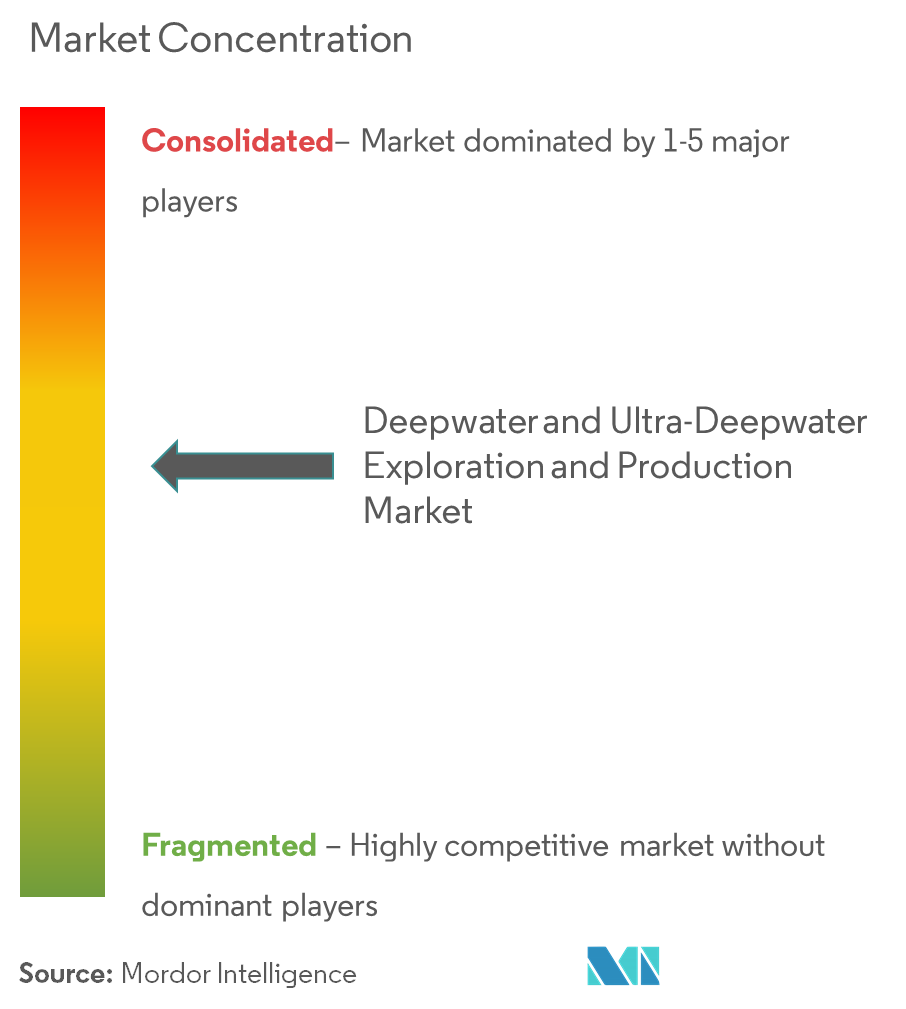
| Market Concentration | Medium |
Major Players *Disclaimer: Major Players sorted in no particular order Image © Mordor Intelligence. Reuse requires attribution under CC BY 4.0. | |
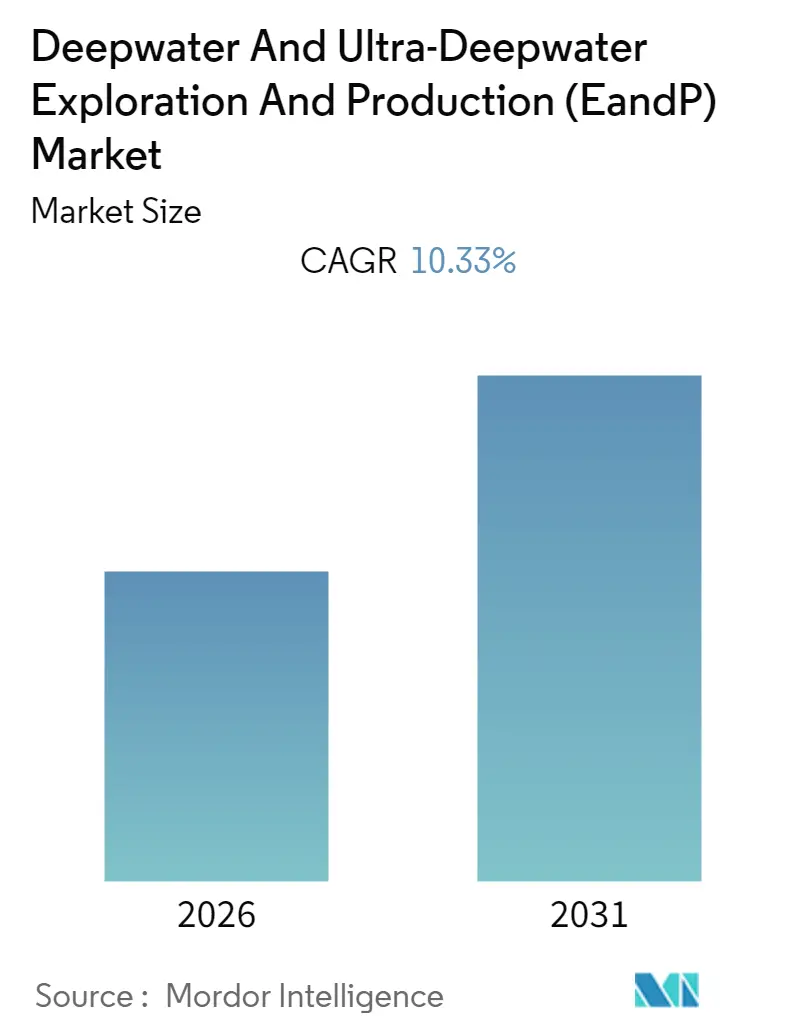
Deepwater And Ultra-Deepwater Exploration And Production (E&P) Market Analysis by Mordor Intelligence
The Deepwater And Ultra-Deepwater Exploration And Production (E&P) Market size is expected to register a CAGR of 10.33% during the forecast period.
- The deepwater segment is expected to witness a significant growth rate during the forecast period.
- Factors such as technological improvements and the discovery of new oil & gas fields in Gabon, Senegal, Guyana, Trinidad & Tobago, Egypt, and the Gulf of Mexico are actively promoting the development of deepwater and ultra-deepwater reserves. This, in turn, is expected to create significant opportunities for the operating countries in the near future.
- Middle-East and Africa dominated the global market, with the majority of demand coming from Nigeria, Angola, and Egypt.
Note: Market size and forecast figures in this report are generated using Mordor Intelligence’s proprietary estimation framework, updated with the latest available data and insights as of 2026.
Global Deepwater And Ultra-Deepwater Exploration And Production (E&P) Market Trends and Insights
Deepwater Segment to Witness Significant Growth
- The constant and ever-increasing demand for fossil fuels, particularly oil and gas, has pushed the exploration and production industry to drill in deep waters ranging from 1000 to 5000 feet.
- Owing to the oil price volatility starting in mid-2014, the oil and gas operators worldwide undertook several cost-cutting and efficiency gains measures, which resulted in the cost-reduction of deepwater approximately 30-40% from 2014-2017. Furthermore, with the improvement in oil prices, several deepwater has become viable to operate and have resulted in increased investments for deepwater exdeepwater and production activities. Also, the breakeven for deepwater exdeepwater and production has fallen since 2014 and is expected to follow the same trend during the forecast period.
- From 2014 to 2020, global deepwater exdeepwater has increased, and regions, such as Brazil, the United States Gulf of Mexico (GoM), Norway, Angola, and Nigeria constitute a large amount of this capital expenditure, respectively, with West Africa anticipated to have the greatest regional growth.
- In April 2021, Reliance Industries Limited (RIL) and BP Plc announced the start of production from the Satellite Cluster gas field in block KG D6 off the east coast of India. They have been developing three deepwater projects in block KG D6 - R Cluster, Satellite Cluster, and MJ - which together are expected to produce around 30 mmscmd (1 billion cubic feet a day) of natural gas by 2023, meeting up to 15% of India's natural gas demand.
- Moreover, the recent waves of cost reductions and critical technological breakthroughs have enabled many oil and gas exploration and production companies to expand their portfolio of sustainable deepwater.
- Therefore, based on the above-mentioned factors, there is expected to be significant demand for the deepwater segment and the deepwater and deepwater exploration and production market during the forecast period.
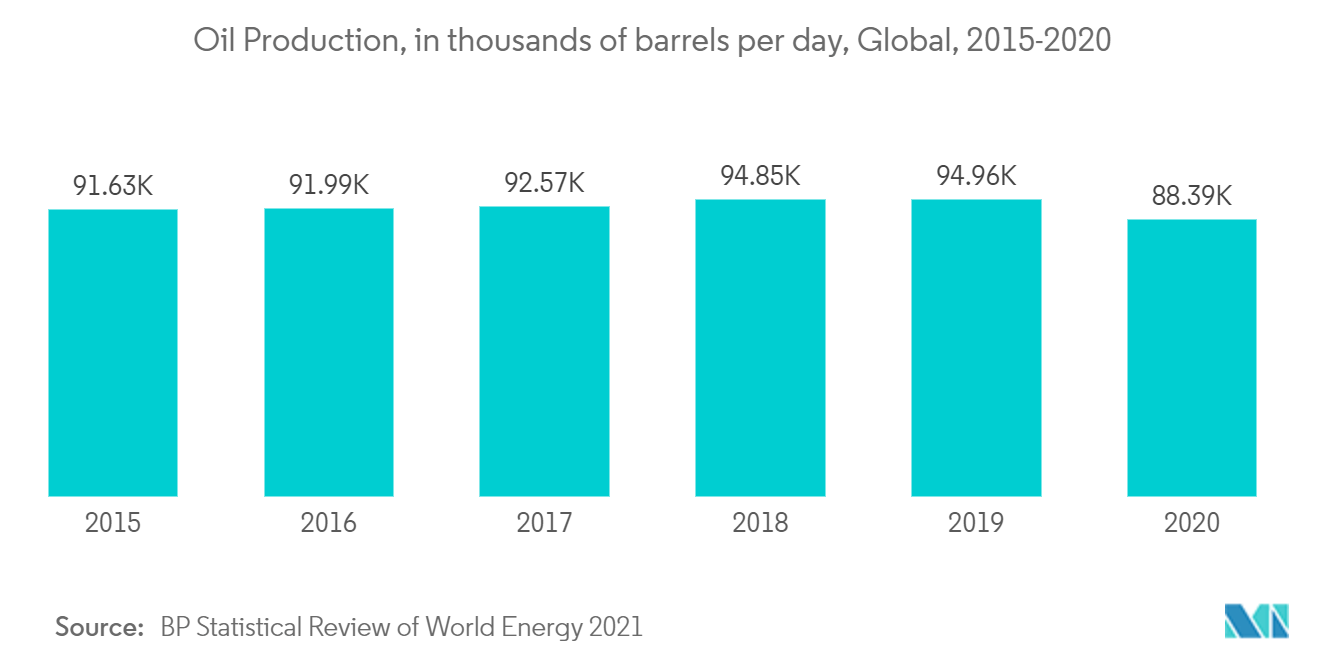


Middle-East and Africa to Dominate the Market
- The Middle-East and African region holds a leading share of oil and gas production. The region's oil production comes from offshore projects, with deepwater and ultra-deepwater accounting for the major share of offshore production.
- The Angolan offshore is among the most prospective plays in Africa and continues to draw high levels of investment. Drilling results are broadly positive, with exploration yielding several high-impact discoveries in recent years. A heavy focus on the Kwanza Basin pre-salt has returned five major discoveries since 2011: Bicuar, Cameia, Lontra, Mavinga, and Orca, in blocks 20 and 21.
- On the flip side, with Angola's most prospective acreage in the deepwater, ultra-deepwater, and pre-salt areas, exploration can be characterized as high-risk, high-reward. The bulk of drilling is expected to continue to target deepwater and pre-salt prospects, spearheaded by industry giants, such as Chevron, BP, Eni, Exxon Mobil, Statoil, and Total, along with national oil company Sonangol.
- Nigeria holds the top position among the ten countries, with the largest remaining crude oil and condensate deepwater reserves. Most reserves are along the country's Niger River Delta and offshore in the Bight of Benin, the Gulf of Guinea, and the Bight of Bonny. As of now, exploration activities are mostly focused on the deep and ultra-deep offshore, although some onshore exploration is also taking place.
- The first Nigerian commercial deepwater discovery, the Bonga oil field, was awarded to Shell Nigeria Exploration and Production Company (SNEPCO) in 1993. However, production did not start till 2005. After Bonga's success, several other deepwater oil explorations followed in quick succession, including Agbami (Chevron), Erha (ExxonMobil), and Akpo, Egina, and Usan (Total), among others.
- Furthermore, in February 2020, ENI started drilling a deepwater exploration well for offshore Oman in the Block 52 concession. The well is believed to be the nation's first in deep water offshore.
- In January 2021, Egypt's Minister of Petroleum and Mineral Resources signed a concession agreement with Mubadala Petroleum for oil and gas exploration activities in Red Sea block 4.
- Therefore, increasing investments and surging demand for oil and gas exports are expected to drive the deepwater and ultra-deepwater exploration and production market in the Middle-East and African region during the forecast period.
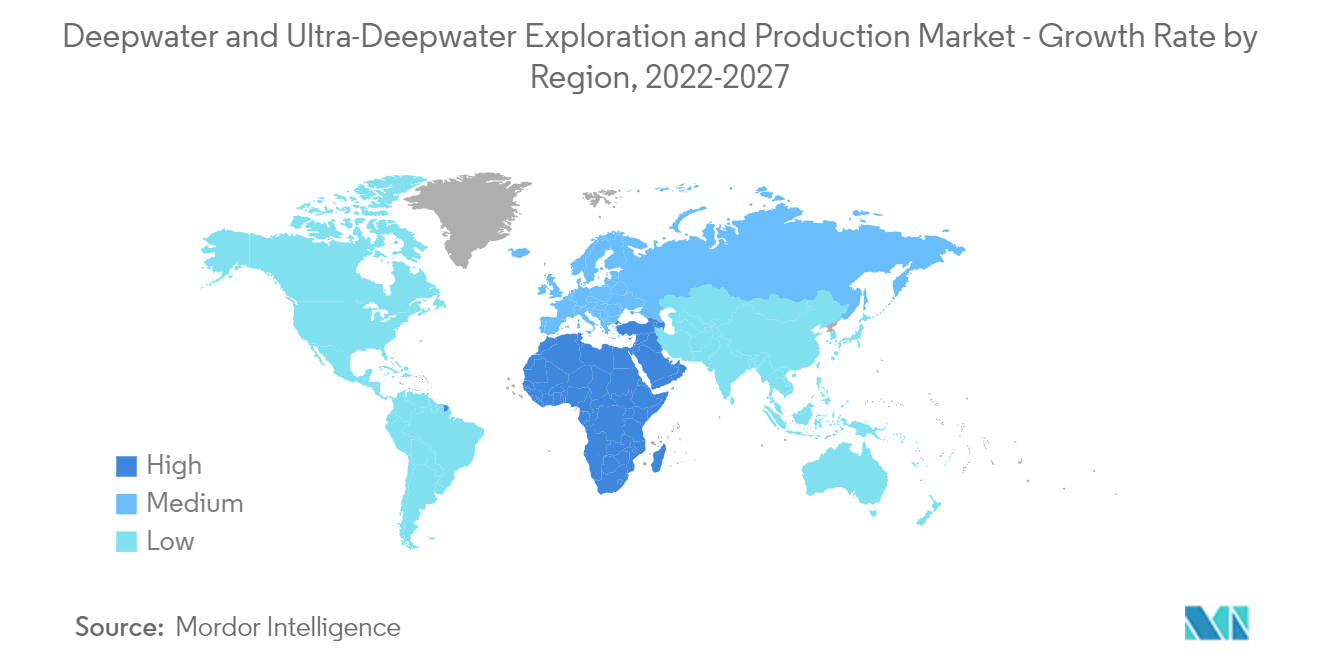

Regulatory Landscape
Deepwater and ultra-deepwater E&P regulations continue to tighten around well control, safety assurance, and permitting, particularly in the United States Outer Continental Shelf where BOEM and BSEE oversee leasing and offshore operational compliance. In August 2024, BSEE finalized updates affecting high pressure high temperature (HPHT) environments and related submissions, including Deepwater Operations Plans. These changes increase the compliance burden for technically complex deepwater developments and reinforce the role of third-party verification for new or unusual technologies.
At the same time, multi-year leasing and regulatory agendas are being formalized in key offshore provinces, shaping project pipelines. In the United States, BOEM leasing under the OBBBA provides a defined schedule of Gulf of America lease sales through 2039 (and Cook Inlet sales through 2032), supporting longer-range acreage planning for deepwater operators. In Brazil, ANP published its 2025-2026 Regulatory Agenda, including multiple E&P actions, while a draft decree reported in 2026 to expand ANP powers signals evolving institutional oversight alongside emerging mandates tied to hydrogen and carbon capture that can influence offshore project approvals and reporting requirements.
Value Chain Analysis
The deepwater and ultra-deepwater E&P value chain spans (i) acreage access and licensing, (ii) exploration and appraisal (geoscience, seismic, drilling), (iii) project sanction and engineering (FEED and detailed design), (iv) procurement and fabrication of long-lead equipment (subsea trees and controls, umbilicals, risers and flowlines, mooring systems, and topsides modules), (v) installation and commissioning (drillships, heavy lift, SURF installation, and subsea tie-ins), and (vi) operations and maintenance (integrity management, interventions, and brownfield optimization). Recent project sanctions and start-ups point to the integrated nature of this chain. For example, bp received US Department of the Interior approval for the Kaskida ultra-deepwater development in the Gulf of Mexico, while Eni took FIDs on deepwater gas hubs in Indonesia's Kutei Basin, both of which translate into multi-year demand for rigs, subsea hardware, and floating production systems.
Execution risk and cost are increasingly concentrated in constrained links such as SURF manufacturing and FPSO fabrication and commissioning capacity. Evidence in 2026 points to long lead times for complex flexible-pipe SURF configurations (often cited at 30-36 months) and committed FPSO yard capacity in major hubs such as Singapore and South Korea extending into the late-2020s. As a result, operators tend to move toward earlier procurement, standardized designs, and integrated delivery models, including iEPCI-style contracting, to reduce interface risk between equipment supply and offshore installation. This environment increases the strategic importance of subsea OEMs, installation contractors, and rig contractors that can secure schedules and deliver HPHT-capable systems and wells on time.
Competitive Landscape
The deepwater and ultra-deepwater exploration and production market is moderately consolidated. The key players in the market include BP PLC, Chevron Corporation, China National Offshore Oil Corporation, Exxon Mobil Corporation, and Shell PLC, among others.
Deepwater And Ultra-Deepwater Exploration And Production (E&P) Industry Leaders
BP PLC
Chevron Corporation
China National Offshore Oil Corporation
Exxon Mobil Corporation
Shell PLC
- *Disclaimer: Major Players sorted in no particular order

Market Opportunities and Future Outlook
One opportunity area is the commercialization of HPHT deepwater resources through higher-pressure subsea systems and subsea boosting, which expands the set of technically developable reservoirs and supports production optimization in complex fields. Operational proof points include Chevron's Anchor project achieving first oil using a 20,000 psi subsea production system, and Beacon Offshore Energy's award to SLB OneSubsea in April 2026 for an HPHT multiphase boosting system at the Shenandoah field in the US Gulf of Mexico. These milestones translate into demand for qualified HPHT hardware, specialty metallurgy, testing and certification services, and subsea power and controls, alongside engineering and integration capabilities across OEMs and EPCIC contractors.
A second opportunity set centers on new deepwater project sanctioning and the associated demand for rigs, subsea equipment, and floating production units in Brazil, West Africa, and Southeast Asia, supported by recent FIDs and approvals. Petrobras decided in April 2026 to green-light the Sergipe-Deepwater (SEAP I) project offshore Brazil, and Azule Energy's June 2026 FID for the Greater PAJ ultradeepwater development offshore Angola, which includes a large installation scope, highlights an active pipeline for SURF, installation, and subsea production systems. With FPSO fabrication slots and SURF manufacturing constrained, there is room for capacity additions, local-content compliant fabrication partnerships, and schedule-secured contracting models that reduce delivery risk for operators developing deepwater hubs and tie-backs.
Recent Industry Developments
- July 2026: ExxonMobil announced a USD 1 billion investment for an infill drilling project at the Usan field in Nigeria (OML 138). The program targets incremental production and leverages existing deepwater infrastructure, reinforcing the role of brownfield and near-field opportunities in sustaining deepwater output.
- June 2026: Baker Hughes won a contract from Azule Energy to supply subsea production systems for the Greater PAJ development offshore Angola, including 10,000 psi horizontal tree systems. The award supports near-term subsea equipment demand in West Africa's ultradeepwater projects and underscores the need for qualified high-pressure subsea hardware and integration capability.
- August 2024: Chevron started production at the Anchor project in the US Gulf of Mexico, deploying an industry-first 20,000 psi deepwater subsea system. The start-up validated a new HPHT threshold for commercial deepwater developments and expanded the technology set available for previously challenging reservoirs.


Research Methodology Framework and Report Scope
Market Definition and Coverage
This market tracks spending linked to offshore oil and gas exploration and production activity that happens in deep water and ultra-deep water, including the key work needed to find, drill, develop, and produce from those fields.
Scope exclusions: Onshore, shallow-water offshore activity, and downstream refining and marketing are excluded from this market sizing.
Segmentation Overview
- Water Depth
- Deepwater
- Ultra-Deepwater
- Geography
- North America
- Europe
- Asia-Pacific
- South America
- Middle-East and Africa
Data Sources, Market Sizing, and Validation
Desk Research
We start with desk work to build the basic demand picture for deepwater and ultra-deepwater E&P, and to understand where projects are moving from concept to drilling to production. Public sources help us anchor the model to reality, especially when project timing and cost inflation can change quickly.
Typical sources include data and publications such as the US Energy Information Administration, US Bureau of Ocean Energy Management, International Energy Agency, OPEC statistical releases, and offshore regulators and petroleum ministries in key producing countries. We also use company annual reports, investor presentations, earnings call transcripts, and reputable industry press for project milestones, capex guidance, and asset start-up dates, supported by paid subscriptions for company financials and intelligence, news and financials, patent databases, and selective contracts and tenders tracking. This list is not exhaustive, and many other public sources were also referred to for data collection, validation, and clarification.
Primary Interviews and Surveys
To make sure the desk inputs hold up, we speak with a mix of upstream planners, offshore project teams, service-side specialists, and independent experts who track deepwater developments across regions. From these discussions, we confirm what is actually being sanctioned, how schedules are shifting, and which cost items are being repriced, which then helps us tighten assumptions and close data gaps.
Distribution of primary research fieldwork respondents
| Company type | Respondent position | Region |
|---|---|---|
| Top tier: 25% | CXOs: 17% | APAC: 44% |
| Mid tier: 55% | Functional/Unit leaders: 31% | EMEA: 37% |
| Smaller Players: 20% | Managers: 52% | Americas: 19% |
Market-Sizing & Forecasting
Sizing is built using a top-down approach where offshore upstream spending is reconstructed by depth category, and then filtered into deepwater and ultra-deepwater activity using project lists, development timing, and expected work scopes. To keep totals realistic, the output is checked using selective bottom-up approximations, such as sampled project capex roll-ups, observed rig and vessel utilization signals, and typical day-rate and service cost ranges.
Key inputs that shape the model include the count of deepwater and ultra-deepwater projects reaching FID, active rig demand and expected drilling days, subsea tree and tieback intensity per development, floating production system deployments, and oil price and cost inflation expectations that influence project pacing. When project-level data is incomplete, gaps are handled through peer project analogs by basin and water depth, followed by expert checks on whether the implied spend per barrel and schedule looks practical.
Forecasting is run using scenario analysis tied to oil price bands, offshore cost inflation, and expected sanctioning cadence, and then stress-tested with short time-series smoothing on leading indicators like offshore capex guidance and tendering activity. Before finalizing, we confirm with interview feedback whether the scenario mix matches how the industry is planning for the next few years.
Data Validation & Update Cycle
We validate outputs by triangulating the model against independent signals, including offshore capex guidance, project sanction announcements, and observed rig and FPS utilization trends, which helps highlight outliers early. If any region shows an unusual jump, the assumptions behind project timing, cost escalation, and depth mix are re-checked, and clarification is sought again where needed.
A multi-step internal review is followed before sign-off so calculation logic and unit consistency are verified. The report is refreshed annually, with interim updates when material events occur, such as a major sanction wave, a sharp cost reset, or policy changes that alter offshore economics. Right before delivery, we do a final pass so clients receive the latest updated view.
Mordor Intelligence's Deep Water and Ultra Deep Water Exploration Production Ep Market Size Compared Against Other Published Estimates
Published market sizes for deepwater and ultra-deepwater E&P can look far apart because not everyone counts the same spend items, and the project timing assumptions can vary a lot from one model to another. Differences also come from how firms treat cost inflation, currency timing, and whether the estimate is built from project sanction reality or from broad upstream spend shares.
Onshore drilling and shallow-water offshore spend sit outside Mordor Intelligence's scope, which is why some broader upstream totals seen elsewhere do not line up with this number even if the label looks similar. Another common gap is that some estimates lean heavily on aggressive sanctioning schedules or bundle midstream export infrastructure into E&P, whereas our model keeps the demand pool tied to deepwater and ultra-deepwater exploration and production work scopes that can be validated through project and activity signals.
Benchmark comparison
| Source | Market Size | Gaps in Research Methodology |
|---|---|---|
| Mordor Intelligence | USD 7.40 B (2024) | |
| Global Consultancy A | USD 7.40 B (2023) | Uses a prior base year and can understate the current level when 2024 project sanction timing and cost escalation are not fully carried through to the spend build. |
| Industry Publisher B | USD 7.40 B (2024) | Often framed as a depth-based upstream view (for example, 500m+), which can lead to mix differences if drilling, subsea, and production system scopes are grouped differently across regions. |
Overall, the spread across published figures is mainly explained by what gets counted inside E&P versus adjacent upstream items, plus the year and price deck used for converting activity into dollars. By tying inputs to project cadence, depth mix, and service cost signals, the estimate stays transparent and repeatable even when market conditions shift.


Key Questions Answered in the Report
What is the current Deepwater and Ultra-Deepwater Exploration and Production Market size?
The Deepwater and Ultra-Deepwater Exploration and Production Market is projected to register a CAGR of 10.33% during the forecast period (2026-2031)
Who are the key players in Deepwater and Ultra-Deepwater Exploration and Production Market?
BP PLC, Chevron Corporation, China National Offshore Oil Corporation, Exxon Mobil Corporation and Shell PLC are the major companies operating in the Deepwater and Ultra-Deepwater Exploration and Production Market.
Which is the fastest growing region in Deepwater and Ultra-Deepwater Exploration and Production Market?
Middle East and Africa is estimated to grow at the highest CAGR over the forecast period (2026-2031).
Which region has the biggest share in Deepwater and Ultra-Deepwater Exploration and Production Market?
In 2025, the Middle East and Africa accounts for the largest market share in Deepwater and Ultra-Deepwater Exploration and Production Market.
What years does this Deepwater and Ultra-Deepwater Exploration and Production Market cover?
The report covers the Deepwater and Ultra-Deepwater Exploration and Production Market historical market size for years: 2020, 2021, 2022, 2023 and 2024. The report also forecasts the Deepwater and Ultra-Deepwater Exploration and Production Market size for years: 2026, 2027, 2028, 2029, 2030 and 2031.
Page last updated on:


 Your data is secure and never sold or shared.


