
Debt Collection Services Market Size and Share
Market Overview
| Study Period | 2020 - 2031 |
|---|---|
| Market Size (2026) | USD 30.93 Billion |
| Market Size (2031) | USD 37.74 Billion |
| Growth Rate (2026 - 2031) | 4.06 % |
| Fastest Growing Market | Asia-Pacific |
| Largest Market | North America |
| Market Concentration | Low |
Major Players *Disclaimer: Major Players sorted in no particular order Image © Mordor Intelligence. Reuse requires attribution under CC BY 4.0. | |
Debt Collection Services Market Analysis by Mordor Intelligence
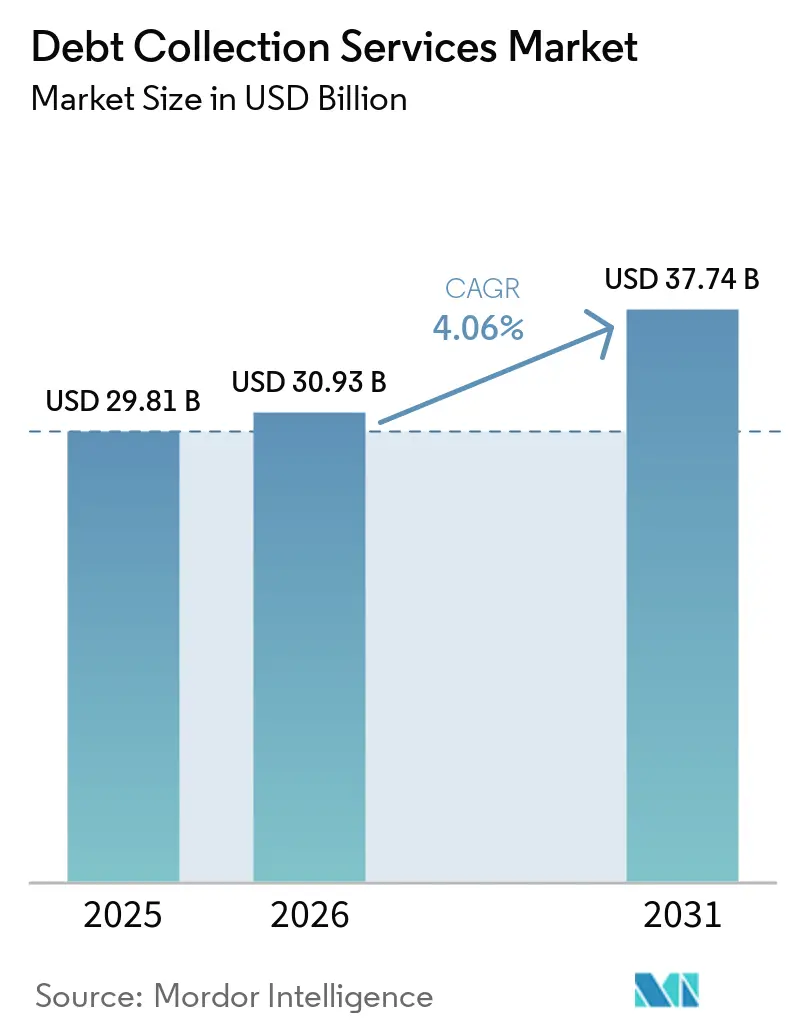
The Debt Collection Services Market size is expected to increase from USD 29.81 billion in 2025 to USD 30.93 billion in 2026 and reach USD 37.74 billion by 2031, growing at a CAGR of 4.06% over 2026-2031.
Higher delinquency volumes are supporting placement activity across consumer credit products, particularly credit cards and personal lending. The Federal Reserve Bank of New York reported that 4.7% of outstanding United States household debt was in some stage of delinquency in Q2 2026, which supports a continuing need for structured recovery services. Creditors are increasingly seeking agencies that can identify repayment capacity and tailor the timing and method of contact. Compliance capabilities are also becoming more important as collection rules, artificial intelligence governance, and data-handling requirements become stricter. These conditions favor larger providers that can combine operational scale, technology investment, and documented control processes.
Key Report Takeaways
- By service model, third-party collection services captured 57.89% of the debt collection services market share in 2025, while credit and special servicing are projected to grow at a 6.31% CAGR through 2031.
- By debt type, consumer debt accounted for 68.12% of the debt collection services market share in 2025, while public-law and statutory debt is projected to grow at a 5.68% CAGR through 2031.
- By collection stage, late-stage, post-charge-off, and non-performing loan collection accounted for 47.66% of the debt collection services market share in 2025, while pre-delinquency and early-stage collection are projected to grow at a 5.89% CAGR through 2031.
- By commercial model, contingency or commission-based pricing accounted for 52.23% of the debt collection services market share in 2025, while servicing fees on assets under management or gross book value are projected to grow at a 6.07% CAGR through 2031.
- By creditor industry, banking and consumer financial services accounted for 37.87% of the debt collection services market share in 2025, while healthcare and medical are projected to grow at a 5.24% CAGR through 2031.
- By geography, North America captured 56.52% of the debt collection services market share in 2025, while Asia-Pacific is projected to grow at a 6.77% CAGR through 2031.
Note: Market size and forecast figures in this report are generated using Mordor Intelligence’s proprietary estimation framework, updated with the latest available data and insights as of January 2026.
Market Trends and Insights
Drivers Impact Analysis of Debt Collection Services Market*
| Driver | (~) % Impact on CAGR Forecast | Geographic Relevance | Impact Timeline |
|---|---|---|---|
| Rising Consumer and Commercial Debt Delinquencies | +1.2% | North America, Europe, Asia-Pacific | Short term (≤ 2 years) |
| Increasing Outsourcing of Debt Collection Activities | +0.9% | Global | Medium term (2-4 years) |
| Expansion of Digital Lending, Buy Now, Pay Later, and Fintech Credit | +0.7% | Asia-Pacific, with spillover to North America and Europe | Medium term (2-4 years) |
| Growing Healthcare and Medical-Billing Delinquencies | +0.6% | North America | Short term (≤ 2 years) |
| Adoption of Digital and Omnichannel Collection Services | +0.8% | North America and Europe, with Asia-Pacific catch-up | Medium term (2-4 years) |
| Demand for Data-Driven Debtor Segmentation and Contactability | +0.5% | Global | Long term (≥ 4 years) |
| Source: Mordor Intelligence | |||
Rising Consumer and Commercial Debt Delinquencies
The accumulation of overdue consumer debt remains an immediate source of new placements for debt collection services market agencies. The Federal Reserve Bank of New York reported that 4.7% of United States household debt was delinquent in Q2 2026. The annualized flow of credit card balances into serious delinquency was 6.97%, compared with 6.93% in Q2 2025[1]. More than 23 million Americans carried charged-off credit card balances on their credit reports in Q2 2026. Lower-income and younger borrowers often have smaller balances and lower payment capacity, which can reduce recovery per account while increasing total placement volumes. This pattern increases creditor demand for tools that identify accounts with a realistic repayment path before collection resources are committed.
Expansion of Digital Lending, Buy Now, Pay Later, and Fintech Credit
Digital lending and buy now, pay later credit are increasing the number of smaller delinquent balances entering collection workflows across Asia-Pacific. These balances often originate through retail checkout platforms and may have less complete borrower information than conventional bank lending. Limited payment history and weaker customer identification records can make initial recovery more difficult. India’s digital lending guidelines require board-level approval and independent model validation for artificial intelligence used in collection workflows[2]. These requirements raise the compliance burden for providers that support lenders in India. The debt collection services market is therefore creating room for larger specialist agencies that can support digital lenders while meeting regulatory requirements.
Growing Healthcare and Medical-Billing Delinquencies
Healthcare receivables are shaping demand in the debt collection services market because medical debt can arise even when wider consumer credit conditions are stable. KFF reported that Americans owed at least USD 220 billion in medical debt, and 100 million adults carried medical balances[3]. It also found that medical debt represented the majority of consumer debt in active collections nationally. Rising deductibles and lower insured payment rates are increasing bad-debt pressure for healthcare providers. State-level rules on medical debt reporting also vary, which creates a more complex operating environment for agencies. Healthcare-focused providers can use this complexity to build specialized compliance processes and longer client relationships.
Growing Demand for Data-Driven Debtor Segmentation and Contactability
Creditors increasingly expect agencies to assess portfolios before accounts are assigned for active recovery. Collection platforms use payment-propensity scores, channel preferences, contact windows, and expected liquidation yields to organize outreach. TrueAccord stated that its Heartbeat machine-learning system continuously adjusts message tone, frequency, and channel based on consumer engagement data. A fintech client using the platform recovered USD 500,000 in 9 months, and 95% of consumers resolved accounts through self-service channels[4]. Better contactability data can also inform a lender’s own credit scoring and loss-provisioning process. The debt collection services market is benefiting as lenders seek partners that can apply those capabilities across the full delinquency cycle.
Restraints Impact Analysis of Debt Collection Services Market*
| Restraint | (~) % Impact on CAGR Forecast | Geographic Relevance | Impact Timeline |
|---|---|---|---|
| Tightening Consumer-Protection and Debt-Collection Regulations | -1.2% | North America, Europe | Short term (≤ 2 years) |
| Rising Compliance, Licensing, and Audit Requirements | -0.8% | Global | Medium term (2-4 years) |
| Data-Privacy and Cross-Border Data-Transfer Constraints | -0.6% | Europe, Asia-Pacific | Long term (≥ 4 years) |
| Algorithmic Bias and Fairness Risks in Automated Collection Decisions | -0.4% | North America, Europe | Medium term (2-4 years) |
| Source: Mordor Intelligence | |||
Tightening Consumer-Protection and Debt-Collection Regulations
Consumer-protection rules are increasing the operating cost of collection activity in the debt collection services market across major regions. In the United States, Regulation F addresses call-frequency limits, channel-specific opt-out management, and validation notice requirements. Agencies must maintain systems that can evidence compliant conduct across voice, text, email, and digital channels. France adopted Law No. 2026-307 on April 23, 2026, which established a structured procedure for uncontested commercial debt recovery through court officers. The law adds documentation requirements for creditors seeking enforcement. These obligations can constrain smaller agencies, while established firms can spread control and audit costs across a larger account base.
Increasing Data-Privacy and Cross-Border Data-Transfer Constraints
Cross-border handling of debtor information remains complex for servicers operating in the European Union and non-European Economic Area jurisdictions. The General Data Protection Regulation requires a lawful basis for processing personal data and meaningful human oversight for significant automated decisions. The European Data Protection Board recognized the Europrivacy certification scheme as a transfer tool under Article 46 in Opinion 15/2026. The decision provides another compliance pathway but also increases audit expectations for servicers handling European Union debtor information. Asia-Pacific providers face separate requirements under Singapore’s Personal Data Protection Act, India’s Digital Personal Data Protection Act, and China’s Personal Information Protection Law. Agencies with configurable data-processing systems can better support cross-border mandates and may be better positioned when creditors select providers.
*Our forecasts treat driver/restraint impacts as directional, not additive. The impact forecasts reflect baseline growth, mix effects, and variable interactions.
Debt Collection Services Market Segment Analysis
By Service Model:
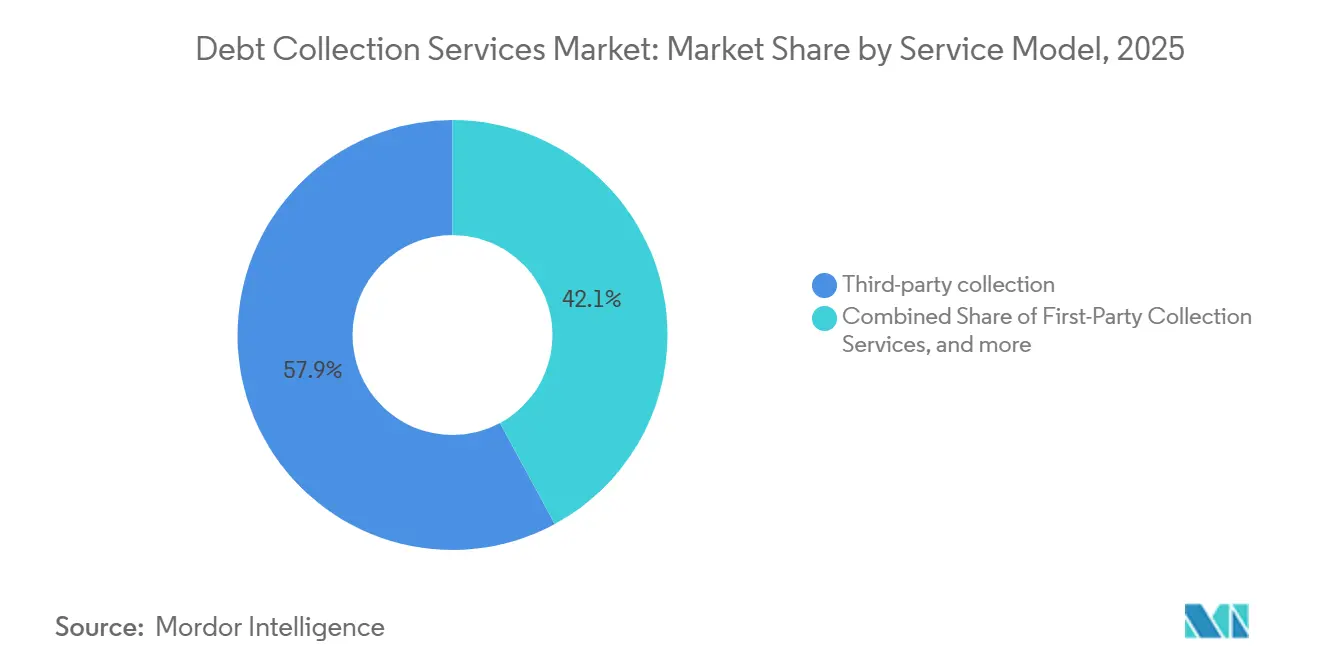
Third-Party Collections Lead While Servicing Fees Gain GroundThird-party collection services accounted for 57.89% of the debt collection services market share by service model in 2025. The longstanding use of outsourced recovery for charged-off consumer balances in North America and Europe supports this segment. Commercial banks, card issuers, auto lenders, and digital finance companies continue to use third-party placement after internal recovery activity reaches its limit. Banks and credit unions commonly use first-party collection services for brand-consistent outreach before an account moves to an external agency. Debt management and consolidation services serve borrowers with larger balances where structured repayment plans can produce better long-term outcomes. The debt collection services market has increasingly required providers to support several stages of recovery instead of a single point in the process.
Credit and special servicing are forecast to grow at a 6.31% CAGR from 2026 to 2031, exceeding the overall rate. The segment is linked to expanding institutional purchases of non-performing loan portfolios and regulated loan servicing in Europe. European Union Directive 2021/2167 set a framework for credit servicers and credit purchasers, and national implementation continued to develop through 2025. Credit servicers manage performing and sub-performing loans under continuing oversight, unlike agencies focused on isolated contingency placements. TrueAccord launched branded first-party services through Sentry Credit in February 2026, extending its platform from early engagement to later-stage resolution. This broader service design allows agencies to pursue recurring mandates rather than rely only on transaction-based collections, supporting the debt collection services market size over the forecast period.
By Debt Type:
Consumer Debt Holds Volume While Public-Law Claims AdvanceConsumer debt accounted for 68.12% of debt-type revenue in 2025, giving it the leading position in the debt collection services market share by debt type. Credit cards, auto loans, personal finance, and buy now, pay later receivables create the broad volume base for this category. The Federal Reserve Bank of New York reported a 6.97% annualized flow of credit card balances into serious delinquency in Q2 2026. It also reported that more than 23 million Americans had charged-off credit card balances on their credit reports. Auto lending remains relevant for providers with collateral management and repossession capabilities in the United States and selected European countries. Buy now, pay later receivables are producing high account volumes with lower average balances, which supports the use of digital self-service tools.
Commercial debt remains a premium part of the debt collection services market because business-to-business cases often involve larger balances, disputes, and shorter limitation periods. Public-law and statutory debt is forecast to grow at a 5.68% CAGR from 2026 to 2031. This growth is associated with the end of public payment forbearance, unpaid tax assessments, student loan arrears, and local-authority fee balances. Regulation (EU) 2024/789 expanded the European Payment Order procedure to commercial claims of up to EUR 100,000 (USD 108,000). The wider procedure can increase the pool of recoverable cross-border commercial and public-sector claims. Agencies serving this area need public-sector permissions, court-filing capability, and multilingual compliance processes, supporting the debt collection services market size over the forecast period.
By Collection Stage:
Late-Stage Collections Remain Largest as Early Intervention ExpandsLate-stage, post-charge-off, and NPL collection accounted for 47.66% of collection-stage revenue in 2025. This level shows that much outsourced volume still reaches agencies after a creditor writes off the balance and completes internal recovery activity. Portfolio purchasers such as Encore Capital, KRUK, and Hoist Finance acquire charged-off receivables and apply recovery analytics to those books. Encore Capital reported USD 2.59 billion in full-year 2025 global collections, up 20% from the prior year. Mid-stage collection covers accounts that are 30 to 180 days past due and requires a more active operating model. Secondary placements also remain part of the late-stage system when accounts are returned by an initial agency and sent to later providers. This reinforces the importance of late-stage recovery within the debt collection services market share.
Pre-delinquency and early-stage collection is forecast to grow at a 5.89% CAGR from 2026 to 2031. Creditors are using earlier engagement because it can lower charge-off rates and preserve customer relationships. Automated outreach helps agencies serve small-balance portfolios that may not support human-agent assignment. TrueAccord stated that its Heartbeat system adjusts timing, tone, channel, and messaging to support self-service resolution. One fintech client recovered USD 500,000 in 9 months, with 95% of consumers resolving accounts through self-service channels. The debt collection services industry is moving some outsourcing activity earlier in the delinquency cycle as creditors seek lower unit costs and more complete lifecycle support, contributing to the expansion of the debt collection services market size.
By Commercial Model:
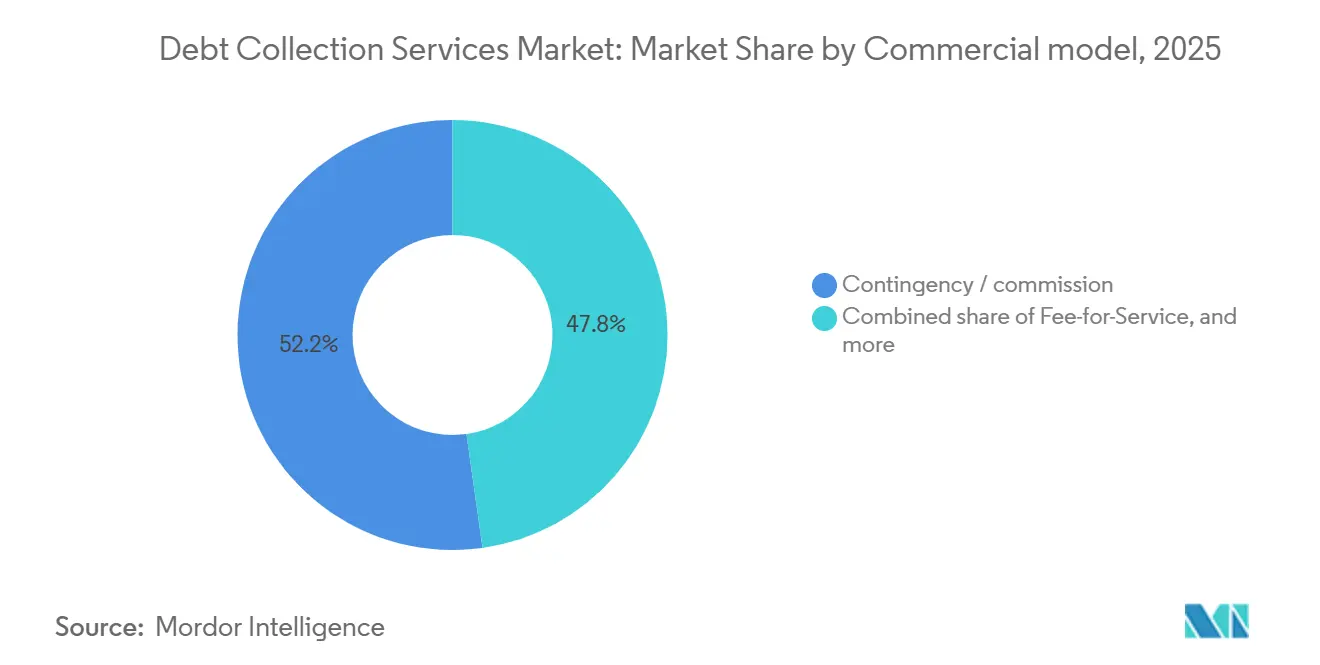
Contingency Pricing Leads as AUM-Based Fees ExpandContingency or commission-based pricing accounted for 52.23% of commercial-model revenue in 2025. Under this model, an agency earns only when it recovers a balance and receives a share of collections. The structure remains common in North American consumer collections, where banking, telecommunications, and retail placements provide substantial account volumes. Fee-for-service pricing remains relevant in healthcare and government work, where percentage-based fees can face closer regulatory attention. Hybrid arrangements combine a fixed servicing payment with a performance-based component. These models are more common where large creditors require both service commitments and recovery incentives, supporting their position in the debt collection services market share.
Servicing fees based on assets under management or gross book value are forecast to grow at a 6.07% CAGR from 2026 to 2031. These fees provide recurring revenue based on an outstanding portfolio book instead of a payment that depends only on individual recoveries. This format supports continuing investment in compliance, technology, borrower engagement, and investor reporting. Intrum announced that it obtained creditor consents for a portfolio sale to Brocc Finance above book value in July 2026 while retaining the servicing mandate. Providers seeking these mandates need evidence of performance, regulatory licensing, and reliable reporting systems. Recurring servicing models can support the debt collection services market size as institutional portfolio purchasers increasingly seek long-term administration rather than one-time recovery programs.
By Creditor Industry:
Banking Leads While Healthcare Shows Faster GrowthBanking and consumer financial services accounted for 37.87% of creditor-industry revenue in 2025. The segment includes credit cards, personal loans, auto finance, mortgages, and digital-lending receivables. Credit card balances outstanding reached USD 1.263 trillion, according to the Federal Reserve Bank of New York’s Q2 2026 report. The stock of seriously delinquent credit card accounts was 12.8% in Q1 2026. Digital lenders and neobanks can generate earlier outsourced placements because their loan books grow rapidly, and their in-house collection capacity may be limited. Telecommunications, utilities, and energy providers also create high volumes of moderate-balance accounts suited to digital repayment channels, reinforcing the segment’s contribution to the debt collection services market share.
Healthcare and medical is forecast to grow at a 5.24% CAGR from 2026 to 2031 within the debt collection services market. Patient cost sharing, insurer payment rates, and hospital bad-debt levels are supporting collection demand in this segment. KFF found that 100 million adults carried medical debt, totaling at least USD 220 billion. Healthcare agencies must manage patient data restrictions and different state medical debt rules. The Consumer Financial Protection Bureau’s January 2025 rule concerning medical debt on consumer credit reports remains subject to legal uncertainty. These requirements create a role for specialized providers that can support hospitals and healthcare systems under detailed compliance expectations, contributing to the debt collection services market size.
Geography Analysis
North America Debt Collection Services Market
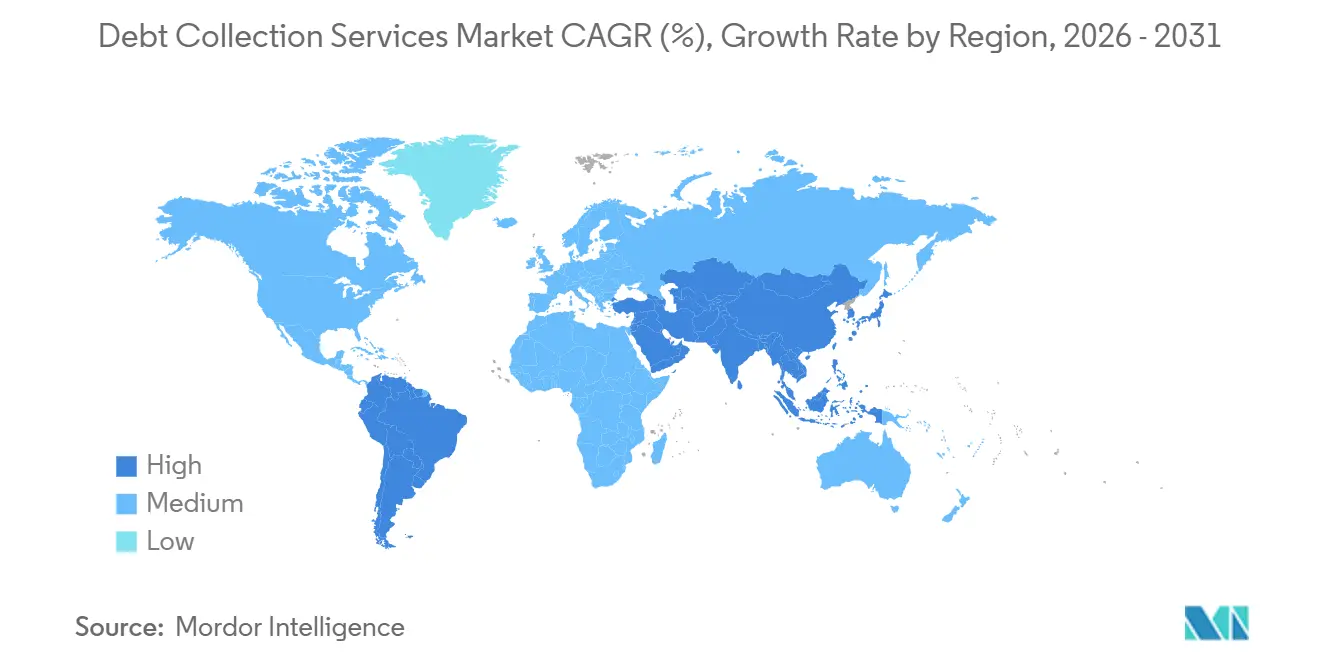
North America accounted for 56.52% of global revenue in 2025, giving it the largest debt collection services market share by region. The region has extensive credit bureau integration, established contingency-fee networks, and long-standing collection rules. The Federal Reserve Board showed that commercial bank credit card delinquency rates declined from 2.95% in Q4 2025 to 2.85% in Q2 2026. The stock of balances more than 90 days delinquent remained elevated at 12.8% in Q1 2026. Canada adds cross-border receivables activity with the United States and Mexico. Colorado Senate Bill 26-189, signed in May 2026, establishes artificial intelligence disclosure and human-review requirements for specified consequential decisions from January 2027. These requirements favor providers that already have structured artificial intelligence governance and review processes.
Europe Debt Collection Services Market
Europe is the second-largest regional debt collection services market and remains active in non-performing loan secondary transactions. Implementation of European Union Directive 2021/2167 is expanding opportunities for credit servicers while increasing licensing requirements for entrants. The United Kingdom operates as a separate post-Brexit regulatory jurisdiction. Hoist Finance completed its acquisition of the United Kingdom small and medium-sized enterprise non-performing loan purchaser Azzurro Associates in June 2026, which doubled its United Kingdom portfolio book value to GBP 400 million (USD 506 million). KRUK invested PLN 864 million (USD 217 million) in portfolios during H1 2026, with Italy accounting for 47% and Poland accounting for 31%. This distribution underscores the continued importance of Italian and Polish portfolio markets. Licensing, documentation, and multilingual servicing remain important requirements for cross-border mandates in Europe.
APAC, MEA and South America Debt Collection Services Market
Asia-Pacific is projected to grow at a 6.77% CAGR from 2026 to 2031, the fastest rate within the debt collection services market. Buy now, pay later products, fintech lending, and digital credit expansion are increasing delinquent account volumes across South and Southeast Asia. Outsourced collections remain less established in many Asia-Pacific markets than in North America or Europe. India is a fast-growing country market because non-bank and fintech lenders are extending credit to borrowers with limited credit history. South America, the Middle East, and Africa are earlier-stage regions, with Brazil and South Africa acting as primary anchors. Their collection frameworks are less formalized than those in North America and Europe, which can create openings for providers that invest in local compliance and language capability. The debt collection services market size in these regions depends on the development of lender outsourcing practices and formal recovery processes.
Competitive Landscape
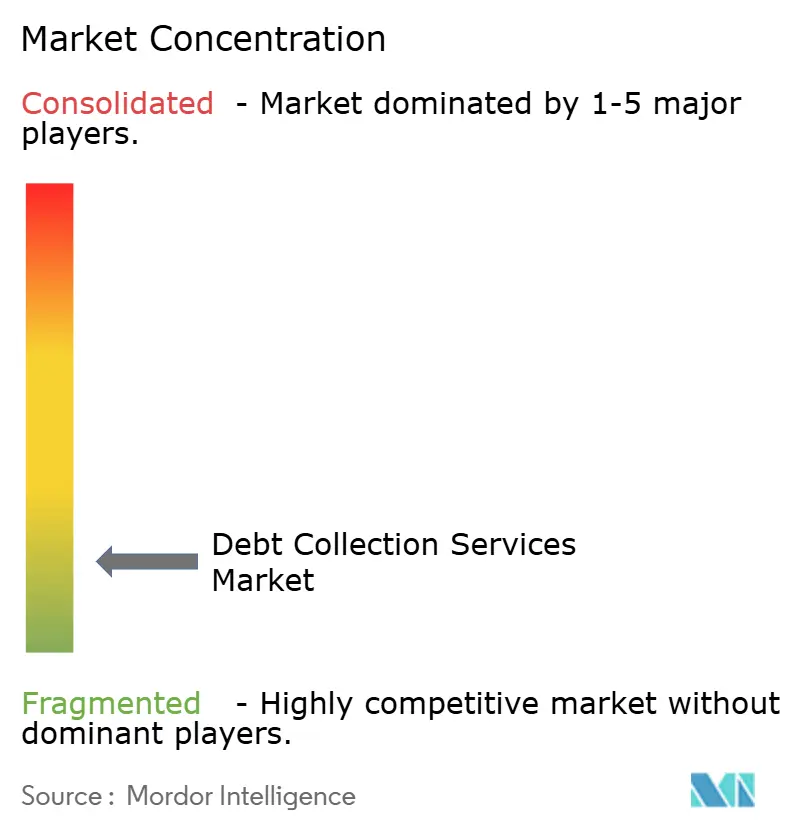
The debt collection services market is fragmented. Five to seven scaled international providers control meaningful non-performing loan purchasing and credit-servicing volumes, while many regional and specialist agencies manage first-party and contingency work. Encore Capital raised its full-year 2026 global collections guidance to USD 2.80 billion to USD 2.85 billion after reporting Q2 2026 portfolio purchases of USD 444 million and collections of USD 737 million. Larger operators are improving scale through portfolio purchases, servicing mandates, and systems that support regulated operations. Their advantage rests on access to capital, established compliance functions, and data-supported recovery processes.
Intrum’s July 2026 sale of its remaining 35% portfolio stake in a joint venture to Brocc Finance was completed above the EUR 182 million (USD 214 million) book value, while the company retained the servicing relationship. The move reflects a focus on capital-light, fee-based servicing rather than portfolio ownership. KRUK reported PLN 864 million (USD 233 million) in H1 2026 portfolio investments, with Italy and Poland receiving most of that investment. TrueAccord expanded into branded first-party collection services through Sentry Credit in February 2026. Its Heartbeat system uses consumer engagement data to adjust digital communications. These actions show how providers are broadening lifecycle coverage and prioritizing recurring servicing income.
Smaller agencies remain important for local collections, specialized creditor categories, and country-specific requirements. However, higher licensing, data-security, audit, and artificial intelligence governance costs are increasing the advantages of better-resourced firms. Compliance-embedded digital collection services for small and mid-sized creditors remain an area of opportunity. Multilingual cross-border recovery also remains relevant for international buy now, pay later and fintech portfolios. The debt collection services industry requires agencies to balance collection performance with consumer-protection obligations.
Debt Collection Services Industry Leaders
-
Encore Capital Group, Inc.
-
PRA Group, Inc.
-
Intrum AB
-
EOS Group
-
Transworld Systems Inc.
- *Disclaimer: Major Players sorted in no particular order
Debt Collection Services Market Companies Covered in this Report
- Encore Capital Group, Inc.
- PRA Group, Inc.
- Intrum AB
- EOS Group
- KRUK Group
- Lowell Group
- Cabot Credit Management Group
- Arrow Global Group
- Hoist Finance AB
- Credit Corp Group Limited
- Midland Credit Management, Inc.
- Transworld Systems Inc. (TSI)
- CBE Group
- Convergent Outsourcing Solutions, Inc.
- IC System, Inc.
- Link Financial Outsourcing Ltd.
- Atradius Collections B.V.
- Baycorp Holdings Pty Limited
- Bierens Debt Recovery Lawyers
- TrueAccord Corp.
Recent Industry Developments in Debt Collection Services Market
- July 2026: Intrum completed the sale of its remaining 35% portfolio stake in a joint venture to Brocc Finance above the EUR 182 million (USD 213 million) book value. Net proceeds of EUR 35 million (USD 38 million) were used to reduce second-lien exchange notes. The transaction improved Intrum’s leverage ratio by 0.2x.
- June 2026: Hoist Finance completed the acquisition of the United Kingdom small and medium-sized enterprise non-performing loan purchaser Azzurro Associates. The acquisition doubled Hoist Finance’s United Kingdom portfolio and established an in-house servicing capability in the United Kingdom small and medium-sized enterprise non-performing loan segment.
- February 2026: TrueAccord launched its first-party debt collection service through Sentry Credit, Inc. The service uses its Heartbeat artificial intelligence engine and supports collection activity from pre-delinquency engagement to late-stage resolution under the creditor’s brand.
- January 2026: Intrum announced a fully guaranteed SEK 7.5 billion (USD 0.71 billion) capital raise alongside the planned portfolio sale to Brocc Finance. The initiative was intended to strengthen the company’s financial position and support its capital-light servicing strategy.
Global Debt Collection Services Market Report Scope
Segmentation Overview
| First-Party Collection Services |
| Third-Party Collection Services |
| Credit and Special Servicing |
| Consumer Debt |
| Commercial Debt |
| Public-law and Statutory Debt |
| Pre-Delinquency and Early-Stage Collection |
| Mid-stage / Primary Delinquency |
| Late-Stage, Post-Charge-off and NPL |
| Contingency / Commission on Amounts Recovered |
| Fee-for-Service |
| Servicing Fee on Assets Under Management / GBV |
| Hybrid |
| Banking and Consumer Financial Services |
| Healthcare and Medical |
| Telecommunications, Utilities and Energy |
| Retail, E-Commerce and Other Consumer Non-Financial Trade |
| Government and Public Administration |
| Education Institutions |
| Commercial and Corporate Trade Creditors |
| Other (Insurance and Subrogation, Rental/HOA, Parking and Tolls, and Residual) |
| North America | United States |
| Canada | |
| Mexico | |
| South America | Brazil |
| Argentina | |
| Rest of South America | |
| Europe | United Kingdom |
| Germany | |
| France | |
| Italy | |
| Spain | |
| Rest of Europe | |
| Asia-Pacific | China |
| Japan | |
| India | |
| South Korea | |
| Australia | |
| Indonesia | |
| Thailand | |
| Malaysia | |
| Singapore | |
| Vietnam | |
| Rest of Asia-Pacific | |
| Middle East and Africa | Saudi Arabia |
| United Arab Emirates | |
| Turkey | |
| South Africa | |
| Egypt | |
| Rest of Middle East and Africa |
| By Service Model | First-Party Collection Services | |
| Third-Party Collection Services | ||
| Credit and Special Servicing | ||
| By Debt Type | Consumer Debt | |
| Commercial Debt | ||
| Public-law and Statutory Debt | ||
| By Collection Stage | Pre-Delinquency and Early-Stage Collection | |
| Mid-stage / Primary Delinquency | ||
| Late-Stage, Post-Charge-off and NPL | ||
| By Commercial Model | Contingency / Commission on Amounts Recovered | |
| Fee-for-Service | ||
| Servicing Fee on Assets Under Management / GBV | ||
| Hybrid | ||
| By Creditor Industry | Banking and Consumer Financial Services | |
| Healthcare and Medical | ||
| Telecommunications, Utilities and Energy | ||
| Retail, E-Commerce and Other Consumer Non-Financial Trade | ||
| Government and Public Administration | ||
| Education Institutions | ||
| Commercial and Corporate Trade Creditors | ||
| Other (Insurance and Subrogation, Rental/HOA, Parking and Tolls, and Residual) | ||
| By Geography | North America | United States |
| Canada | ||
| Mexico | ||
| South America | Brazil | |
| Argentina | ||
| Rest of South America | ||
| Europe | United Kingdom | |
| Germany | ||
| France | ||
| Italy | ||
| Spain | ||
| Rest of Europe | ||
| Asia-Pacific | China | |
| Japan | ||
| India | ||
| South Korea | ||
| Australia | ||
| Indonesia | ||
| Thailand | ||
| Malaysia | ||
| Singapore | ||
| Vietnam | ||
| Rest of Asia-Pacific | ||
| Middle East and Africa | Saudi Arabia | |
| United Arab Emirates | ||
| Turkey | ||
| South Africa | ||
| Egypt | ||
| Rest of Middle East and Africa | ||
Key Questions Answered in the Report
What is the projected value of debt collection services by 2031?
The sector is forecast to reach USD 37.74 billion by 2031, from USD 30.93 billion in 2026, at a 4.1% CAGR.
Which service model has the largest revenue position?
Third-party collection services led service-model revenue with a 57.89% share in 2025.
Why is early-stage debt recovery growing faster?
Pre-delinquency and early-stage collection is forecast to grow at a 5.89% CAGR as creditors use earlier engagement to reduce charge-offs and preserve customer relationships.
Which creditor category is growing fastest for collection agencies?
Healthcare and medical is forecast to grow at a 5.24% CAGR through 2031, supported by patient cost sharing and medical debt balances.
Which region is growing fastest for debt collection providers?
Asia-Pacific is forecast to grow at a 6.77% CAGR through 2031, supported by digital lending and buy now, pay later credit expansion.
How are digital tools changing debt recovery operations?
Digital platforms use payment propensity, contact preferences, and self-service channels to tailor engagement and reduce recovery costs.