
DDR5 Memory Module SPD Hub IC Market Size and Share
Market Overview
| Study Period | 2020 - 2031 |
|---|---|
| Market Size (2026) | USD 134.07 Million |
| Market Size (2031) | USD 162.86 Million |
| Growth Rate (2026 - 2031) | 3.97 % |
| Fastest Growing Market | North America |
| Largest Market | Asia-Pacific |
| Market Concentration | Medium |
Major Players *Disclaimer: Major Players sorted in no particular order Image © Mordor Intelligence. Reuse requires attribution under CC BY 4.0. | |
DDR5 Memory Module SPD Hub IC Market Analysis by Mordor Intelligence
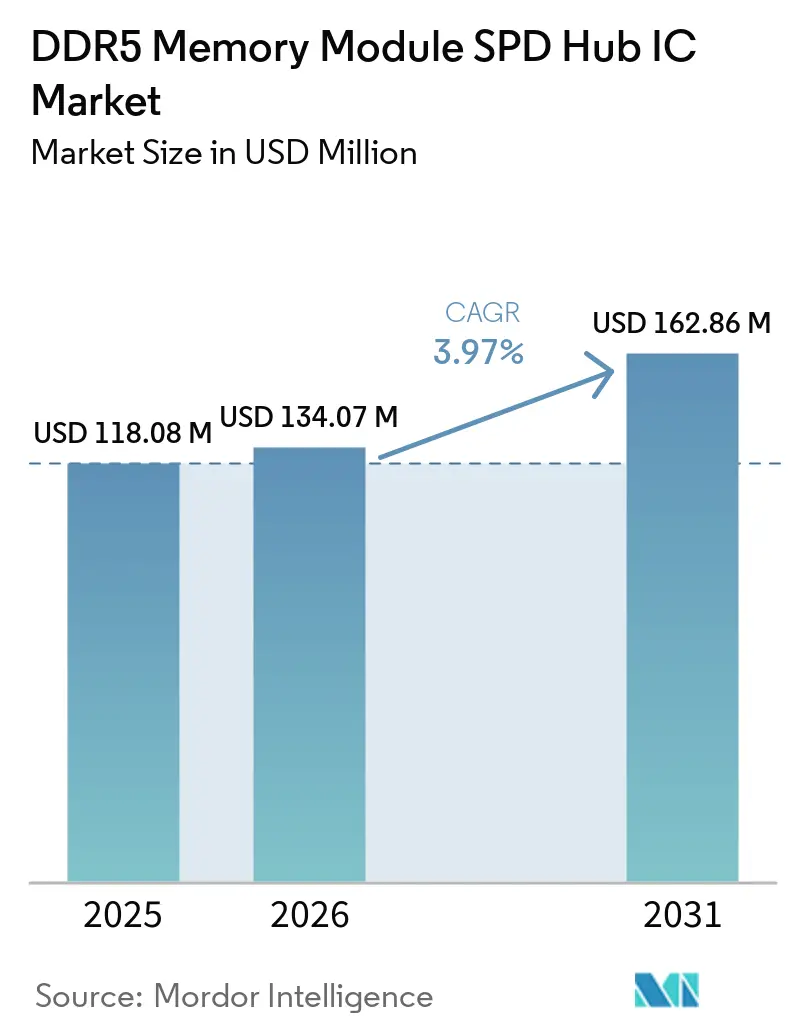
The DDR5 Memory Module SPD Hub IC Market size was valued at USD 118.08 million in 2025 and estimated to grow from USD 134.07 million in 2026 to reach USD 162.86 million by 2031, at a CAGR of 3.97% during the forecast period (2026-2031). SPD Hub ICs have become required active devices in JEDEC-compliant DDR5 modules, rather than passive configuration components. Their functions now include serial presence detection, sideband bus management, and temperature monitoring for supported module designs. Demand is shaped by simultaneous server refreshes and new AI PC memory configurations that use clocked client modules. Suppliers increasingly compete through validated chipset families that combine SPD Hubs with related clock, power, and thermal components. The main constraint is timing, since platform qualification can delay module adoption even after a component is available.
Key Report Takeaways
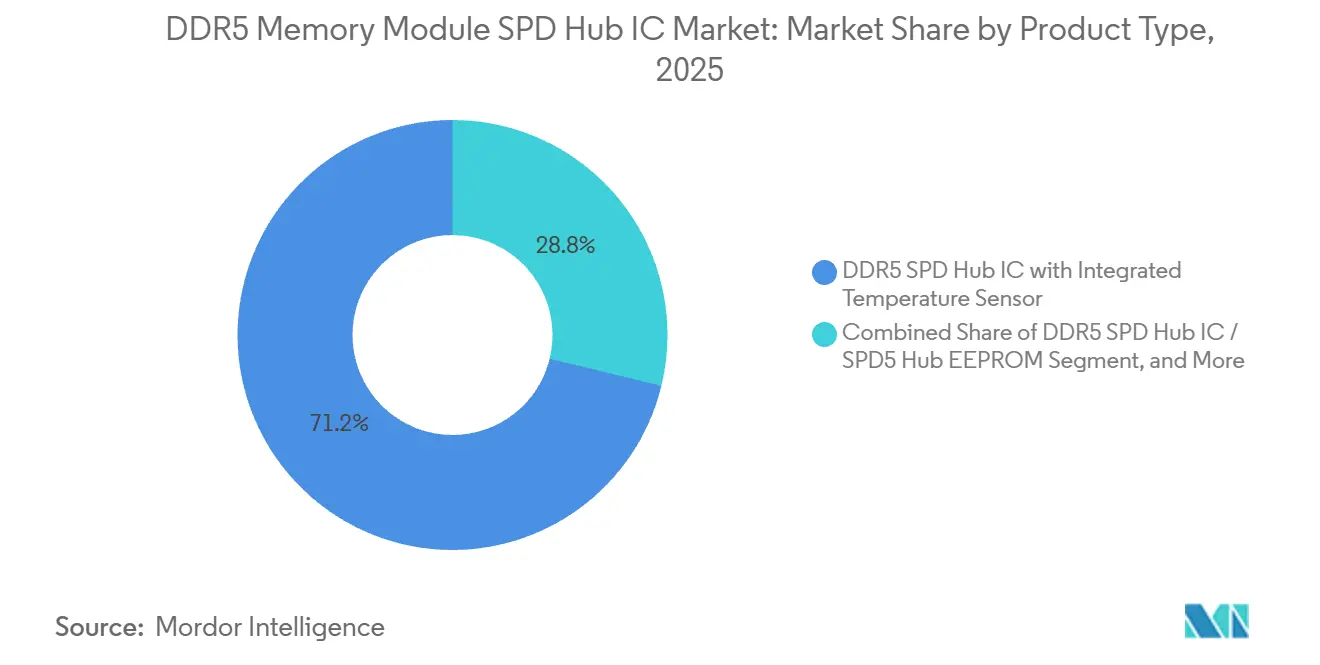
- By product type, DDR5 SPD Hub ICs with integrated temperature sensors held a 71.20% revenue share in 2025, and this product type is forecast to grow at a 4.46% CAGR through 2031 in the DDR5 Memory Module SPD Hub IC market.
- By interface mode, dual I²C/I³C SPD Hub devices held 87.30% revenue share in 2025, while I³C Basic mode is forecast to grow at a 4.61% CAGR through 2031 in the DDR5 Memory Module SPD Hub IC market.
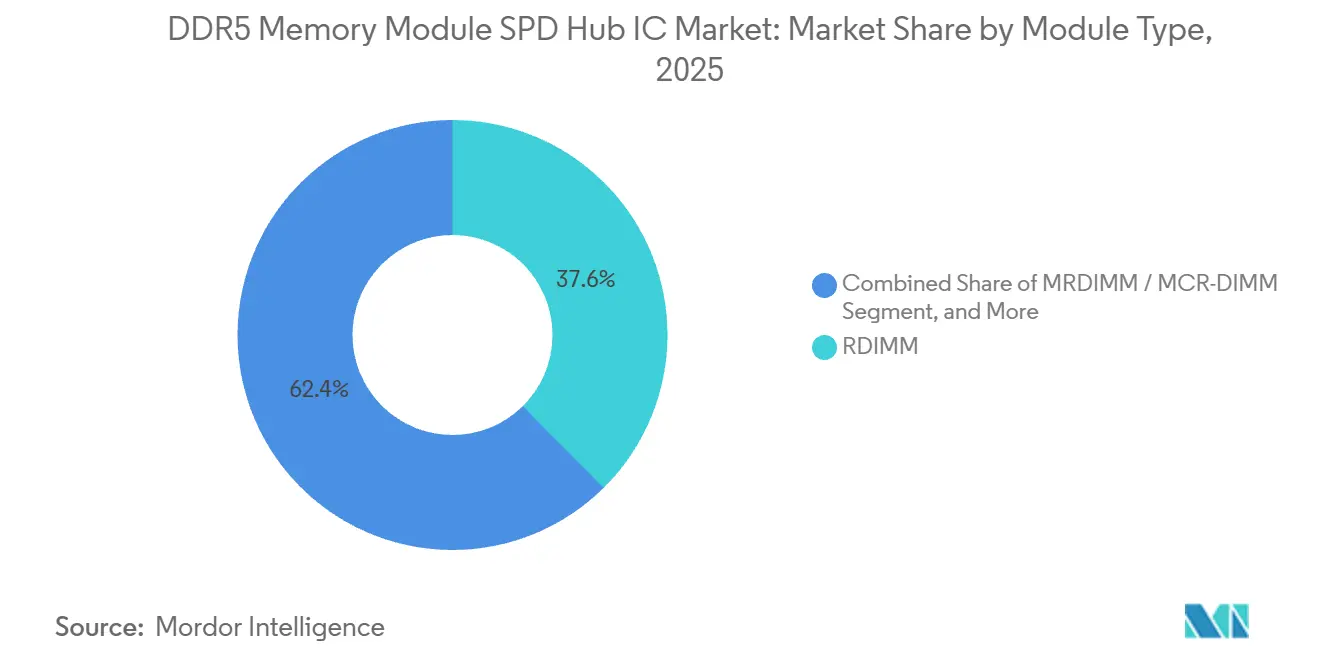
- By module type, RDIMM held 37.60% revenue share in 2025, while MRDIMM/MCR-DIMM is forecast to grow at a 4.72% CAGR through 2031 in the DDR5 Memory Module SPD Hub IC market.
- By application, servers and data centers held 46.40% revenue share in 2025, while AI and HPC systems are forecast to grow at a 4.83% CAGR through 2031 in the DDR5 Memory Module SPD Hub IC market.
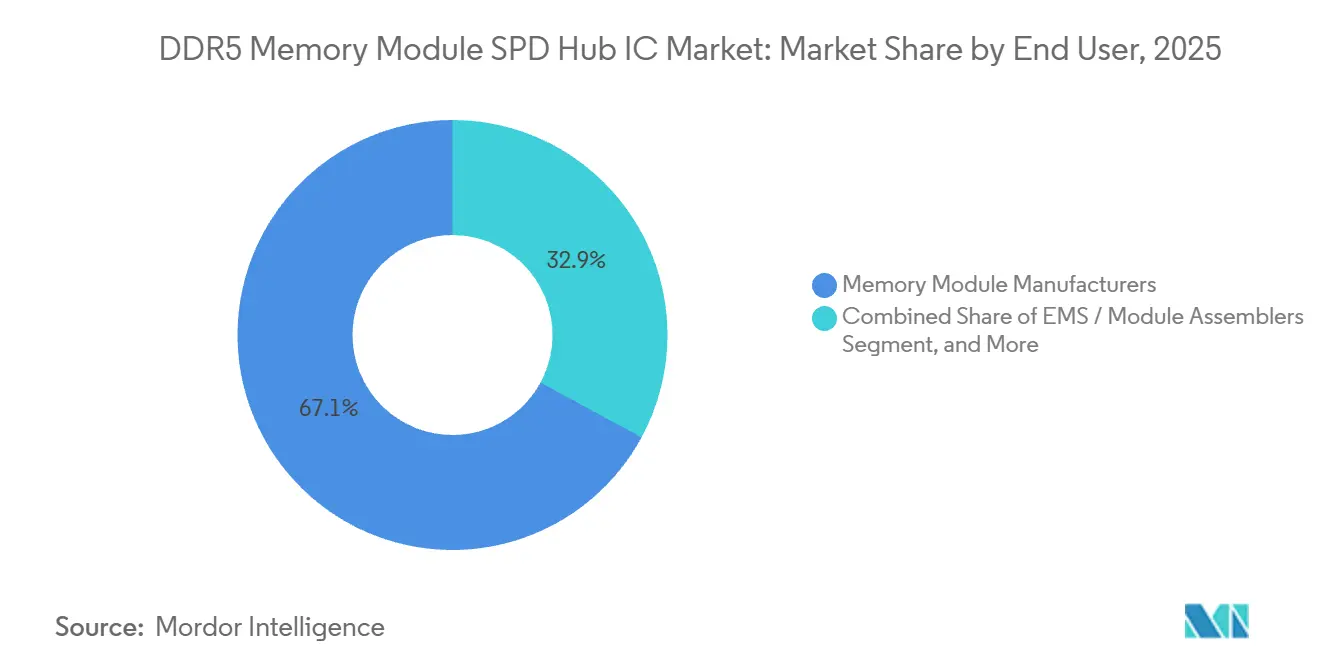
- By end user, memory module manufacturers held 67.10% revenue share in 2025, while EMS and module assemblers are forecast to grow at a 4.28% CAGR through 2031 in the DDR5 Memory Module SPD Hub IC market.
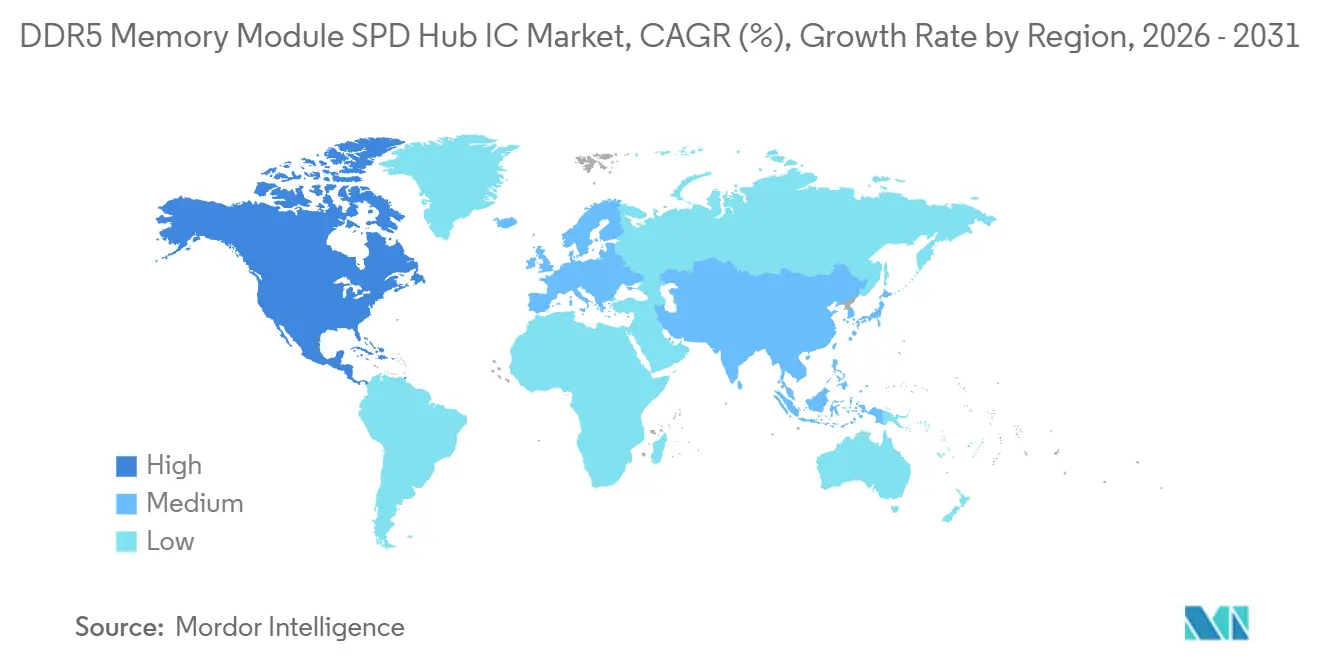
- By geography, the Asia Pacific held 85.40% revenue share in 2025, while North America is forecast to grow at a 4.57% CAGR through 2031 in the DDR5 Memory Module SPD Hub IC market.
Note: Market size and forecast figures in this report are generated using Mordor Intelligence’s proprietary estimation framework, updated with the latest available data and insights as of January 2026.
Global DDR5 Memory Module SPD Hub IC Market Trends and Insights
Drivers Impact Analysis*
| Driver | (~) % Impact on CAGR Forecast | Geographic Relevance | Impact Timeline |
|---|---|---|---|
| AI-Driven Memory Bottlenecks in Heterogeneous Compute | +12.5% | Global, with highest intensity in North America and Asia-Pacific AI infrastructure clusters | Short term (≤ 2 years) |
| Memory Disaggregation for Better Utilization and Lower TCO | +8.3% | Global, with early commercial adoption in North American hyperscalers and Asia-Pacific enterprise data centers | Medium term (2-4 years) |
| CXL 3.x Ecosystem Readiness Across CPUs, Memory, and Switches | +6.2% | North America and Asia-Pacific, with spillover to Europe as AI data center investment advances | Medium term (2-4 years) |
| Hyperscale Demand for Composable Infrastructure | +5.1% | North America, China, Japan, South Korea, Taiwan, and Europe | Medium term (2-4 years) |
| Software-Defined Memory Tiering in Enterprise Data Centers | +3.8% | North America and Europe, with early gains in Asia-Pacific financial-services clusters | Long term (≥ 4 years) |
| Rack-Scale and Multi-Host Memory Sharing Requirements | +2.4% | Global, led initially by hyperscalers and followed by enterprises | Long term (≥ 4 years) |
| Source: Mordor Intelligence | |||
Growing Adoption of DDR5 Across Client, Server, and AI PC Platforms
DDR5 has moved from a server-first specialty deployment to a broad platform standard, pulling SPD Hub ICs into virtually every new memory module design across server and client tiers. DDR5's share of server DRAM shipments exceeded 80% in 2025 and is forecast to reach 90% in 2026, a pace that renders DDR4 module tooling and related components obsolete well ahead of earlier industry projections. The emergence of AI PC platforms specifically CUDIMM and CSODIMM modules introduced SPD Hub IC demand into the client computing segment at meaningful scale for the first time; Rambus confirmed this on May 26, 2026, announcing its complete DDR5 9600 Client Memory Module Chipset including an SPD Hub for CUDIMM, CQDIMM, and CSODIMM modules at 9,600 MT/s. Module makers serving both client and server programs now require unified SPD Hub qualification across form factors, a pressure that accelerates design consolidation around chipset suppliers with the broadest JEDEC DDR5 coverage.
Demand for On-Module Identification, Telemetry, and Thermal Management
The DDR5 Memory Module SPD Hub IC market benefits because the component performs active management functions at higher memory speeds and densities. The JEDEC SPD5118 standard defines the device as a hub with serial presence detection functions, separating local device buses from the host controller bus.[1] This architecture is important when a DDR5 RDIMM has many module-side devices that need managed sideband communication. Integrated temperature sensing also provides memory controllers with thermal control data before operating conditions affect DRAM stability. ABLIC stated that its S-34HTS08AB device provides ±0.5°C typical accuracy from +75°C to +95°C, a range relevant to server operation. The added management role increases the value of qualified SPD Hub ICs within high-specification module designs.
Expansion of JEDEC-Compliant DDR5 Module Variants
The DDR5 Memory Module SPD Hub IC market is driven by higher data-rate requirements, which place greater demands on sideband communication and module configuration. The DDR5 Memory Module SPD Hub IC market is seeing increased demand as JEDEC-standard module variants broaden the range of supported memory modules. JEDEC committees published the DDR5 MDB02 multiplexed rank data buffer standard, JESD82-552, in April 2026 and advanced work on MRDIMM specifications. Each supported variant requires a compatible sideband management design and a qualified SPD Hub. The JESD400-5D specification also covers SPD Hub configurations for the SOCAMM2 form factor, widening the range of next-generation modules that use the technology JEDEC.ORG. RDIMM, MRDIMM, CUDIMM, CSODIMM, and LPCAMM2 designs therefore create several pathways for device demand. Suppliers that qualify early for these variants can remain attached to a module program through its product cycle.
Higher Memory Speeds and Configuration Complexity
The DDR5 Memory Module SPD Hub IC market is supported by higher data-rate requirements that place greater demands on sideband communication and module configuration. DDR5 operation above 6,400 MT/s raises issues involving clock timing, signal integrity, and configuration sequences across associated interface components. Rambus stated in July 2026 that its DDR5 9600 server RDIMM chipset combines clocking, control, and power-management functions to improve signal and power integrity at high data rates. The company’s chipset includes an SPD Hub with an integrated temperature sensor. I³C-based operation provides a higher-speed sideband option than legacy I²C-compatible implementations. This shift favors dual I²C/I³C devices and designs built for I³C Basic mode as memory platforms advance.
Restraints Impact Analysis*
| Restraint | (~) % Impact on CAGR Forecast | Geographic Relevance | Impact Timeline |
|---|---|---|---|
| Dependence on a Small Group of Module Makers and Chipset Platforms | -0.4% | Global, most acute in North America for OEM platform gating and Asia Pacific for module programs | Short term (≤ 2 years) |
| Lengthy Qualification Cycles and JEDEC Compliance Testing | -0.3% | Global, with friction in Asia Pacific to North America cross-qualification | Medium term (2-4 years) |
| Price Sensitivity in Mainstream Memory Modules | -0.2% | Asia Pacific consumer module markets, with spillover to Europe | Medium term (2-4 years) |
| Concentration in Advanced Analog and EEPROM Fabrication | -0.1% | Global, with concentration in Taiwan and Japan | Long term (≥ 4 years) |
| Source: Mordor Intelligence | |||
Dependence on a Small Group of Module Makers and Chipset Platforms
The DDR5 Memory Module SPD Hub IC market operates within a demand funnel converging on fewer than a dozen tier-1 module manufacturers that define the bill of materials for the vast majority of server RDIMM and MRDIMM designs. When Samsung, SK hynix, or Micron qualifies an SPD Hub IC vendor, that certification cascades into large-volume programs; a design rejection removes a supplier from an entire generation of module designs with equal force. SK hynix's December 2025 completion of Intel Data Center Certification for its 256GB DDR5 RDIMM on the Intel Xeon 6 platform illustrates this gating dynamic: the certification determined which module manufacturers and which SPD Hub IC suppliers could address the highest-value server memory segment at commercial launch. This concentration requires SPD Hub IC suppliers to maintain simultaneous co-design relationships with CPU platform vendors and DRAM module manufacturers, a resource burden that structurally favors incumbent chipset suppliers over new entrants.
Qualification Cycles and JEDEC Compliance Testing Lengthen Adoption Time
Navigating the JEDEC compliance framework for DDR5 modules imposes a qualification horizon routinely extending 12–18 months from IC sampling to module production readiness, compressing revenue timing for SPD Hub IC suppliers. The JEDEC SPD5118 standard (JESD300-5B.01) requires interface parameter validation, signaling protocol certification, hub function testing, and EEPROM endurance qualification, a multi-stage process not amenable to acceleration without platform partner cooperation. The MDB02 and MRCD02 standard updates from April 2026 introduced new compliance requirements for MRDIMM Gen2 that SPD Hub IC suppliers must re-validate before Gen2 modules achieve commercial availability, creating revenue timing gaps even where design wins are secured. New entrants targeting LPCAMM2 or SOCAMM2 face the compounded challenge of validating against a standards revision cycle still in progress, a structural temporal advantage for suppliers already embedded in JEDEC working groups.
*Our forecasts treat driver/restraint impacts as directional, not additive. The impact forecasts reflect baseline growth, mix effects, and variable interactions.
Segment Analysis
By Product Type: Integrated Temperature Sensing Sets the Standard
DDR5 SPD Hub ICs with integrated temperature sensors held 71.20% of the DDR5 Memory Module SPD Hub IC market share in 2025. This product type is also forecast to expand at a 4.46% CAGR through 2031. The position reflects the functional requirements of JEDEC SPD5118 for server-grade and premium client modules. Integrated sensing supports memory-controller responses when module temperatures rise under demanding workloads. The DDR5 Memory Module SPD Hub IC industry uses these devices in RDIMM, MRDIMM, and CUDIMM designs that require on-module monitoring. The standalone DDR5 SPD Hub IC or SPD5 Hub EEPROM remains relevant in cost-sensitive UDIMM and basic SO-DIMM applications.
The standalone version is suitable for systems where thermal throttling is controlled at the memory-controller level. Products with optional or external sensor support fill a middle tier for module makers seeking more design flexibility. An integrated sensor avoids the local bus communication step required when a separate temperature IC is polled. That difference matters when a module operates at higher data rates and requires faster thermal-event responses. ABLIC introduced the JEDEC SPD5118-compliant S-34HTS08AB in August 2024 with an integrated hub, temperature sensor, and 8 Kbit EEPROM. Higher per-module power density in future MRDIMM systems is expected to reinforce the preference for the integrated design.

By Interface Mode: Dual I²C/I³C Leads While I³C Basic Expands
Dual I²C/I³C SPD Hub devices held 87.30% of interface-mode revenue in 2025. Their leading position reflects module makers’ need to maintain compatibility with existing I²C-based server management equipment. A dual-mode device can operate in I²C-compatible mode on older host buses and I³C Basic mode on newer platforms. JEDEC’s Module Sideband Bus specification, JESD403-1, provides the interoperability framework for this transition JEDEC.ORG. I³C Basic mode is forecast to grow at a 4.61% CAGR through 2031. Higher DDR5 rates make the limited bandwidth of I²C less suited to the more demanding operations of modules.
Intel specified I³C-based SPD Hub access at 12.5 MHz for its Eagle Stream platform, providing a defined migration path for server implementations.[2] I²C-compatible mode remains in infrastructure upgrades and cost-controlled client modules. Its share is declining as new systems are designed around faster sideband support. MIPI I3C Basic serves as the foundation for JEDEC DDR5 sideband communication under a royalty-free arrangement. Signal integrity testing and manufacturing alignment remain important requirements for each new implementation. Established suppliers retain an advantage because they are already engaged in multi-form-factor JEDEC compliance programs.
By Module Type: RDIMM Provides Volume While MRDIMM/MCR-DIMM Grows Faster
RDIMM held 37.60% of module-type revenue in 2025. It remains the foundational server memory format across Intel Xeon and AMD EPYC platform families. Well-established signal margins and a mature JEDEC qualification process support the continued use of RDIMMs. Broad supply chain support also makes RDIMM the primary volume format for enterprise and cloud server refreshes. UDIMM/CUDIMM and SO-DIMM/CSODIMM serve client systems transitioning to higher-speed DDR5 configurations. That shift creates demand for SPD Hubs in form factors that formerly required basic EEPROM components.
LRDIMM and 3DS RDIMM serve high-capacity servers where buffering and stacked DRAM extend capacity beyond standard RDIMM configurations. MRDIMM/MCR-DIMM is forecast to grow at a 4.72% CAGR through 2031, the highest rate within the module-type grouping. JEDEC’s April 2026 MDB02 publication supported the development path for newer multiplexed-rank modules. Renesas announced its third-generation MRDIMM chipset in July 2026 with speeds up to 16,000 MT/s and a platform that includes SPD Hubs and temperature sensors.[3] Micron states that its DDR5 MRDIMM can deliver up to 39% more bandwidth than standard RDIMMs for AI and HPC workloads. These advanced modules require more complex interface and management content than standard server DIMMs.
By Application: Servers and Data Centers Lead, While AI and HPC Systems Advance
Servers and data centers accounted for 46.40% of application revenue in 2025. This application is supported by the broad use of DDR5 RDIMM in current server generations. Data center deployments need reliable configuration, telemetry, and thermal monitoring at the module level. These needs make the SPD Hub a relevant component within high-specification DDR5 RDIMM configurations. Desktop PCs and workstations form a separate demand pool for client memory modules. Laptops and notebooks add demand through AI PC configurations and clocked module formats.
Networking, telecom, and embedded systems use DDR5 in advanced switching and buffer-memory applications. AI and HPC systems are forecast to grow at a 4.83% CAGR from 2026 to 2031. Their workloads place pressure on both memory bandwidth and module-management functions. Rambus identified large-language-model inference and key-value caching as target workloads for its DDR5 9600 server RDIMM chipset. The chipset combines an SPD Hub with temperature sensing for operation at up to 9,600 MT/s. As AI inference moves into CPU-based server configurations, real-time monitoring remains important to dependable system operation.
By End User: Module Manufacturers Retain Purchasing Control, While EMS and Module Assemblers Gain Ground
Memory module manufacturers held 67.10% of end-user revenue in 2025. SPD Hub purchasing decisions are generally made during module design and qualification. Samsung, SK hynix, and Micron influence demand through RDIMM, MRDIMM, UDIMM, and SO-DIMM programs. Their approved-vendor decisions determine which IC suppliers can reach commercial scale. Server and PC OEMs influence component selection through their platform specifications. Original design manufacturers also shape module requirements for their customers.
Semiconductor and memory subsystem suppliers work with SPD Hub suppliers to improve performance across a complete chipset. EMS and module assemblers are forecast to grow at a 4.28% CAGR through 2031. Contract electronics manufacturers are increasingly designing and assembling premium DDR5 modules for hyperscaler white-box servers. This change puts EMS providers in direct contact with SPD Hub suppliers for procurement. It may help second-source suppliers qualify for programs that were previously single-sourced. The development is most relevant to high-volume server memory assembly programs in Taiwan, South Korea, and China.
Geography Analysis
Asia Pacific held 85.40% of the DDR5 Memory Module SPD Hub IC market share in 2025. The region is both the primary location for DDR5 module production and the largest consumption hub. South Korea anchors this position through Samsung Electronics and SK hynix, which operate advanced DRAM fabrication and module programs. Those programs form a large demand base for qualified SPD Hub ICs. Taiwan adds a second layer of demand through contract module assembly. Japan provides analog and mixed-signal manufacturing capacity used by several memory-interface suppliers.
SK hynix announced in August 2026 that it would invest KRW 54 trillion (USD 38.3 billion) in the Yongin Y2 and Cheongju M17 facilities to secure a production base to meet AI memory demand.[4] The investment supports DDR5 module production capacity through the early 2030s. China’s domestic DDR5 infrastructure deployment is adding demand within the broader Asia-Pacific footprint. Renesas, headquartered in Japan, announced its Gen 3 MRDIMM chipset with SPD Hub components in July 2026. Montage Technology began sampling its Gen6 DDR5 RCD06 at up to 9,200 MT/s in June 2026, illustrating continued local capability building for the domestic module assembly base. This local development may affect suppliers that depend on Asia Pacific module makers for volume.
North America is forecast to expand at a 4.57% CAGR from 2026 to 2031, making it the fastest-growing region in the DDR5 Memory Module SPD Hub IC market. The region’s growth is linked to hyperscale infrastructure investment and domestic memory manufacturing initiatives. Micron confirmed investment in two memory fabrication facilities in Boise, Idaho, with wafer production at the first facility expected in 2027. The company also announced a campus in Clay, New York. These initiatives support future demand from domestic module production and procurement programs. Europe and the rest of the world remain smaller contributors, though enterprise server refreshes and data-center efficiency requirements support premium DDR5 module configurations.
Competitive Landscape
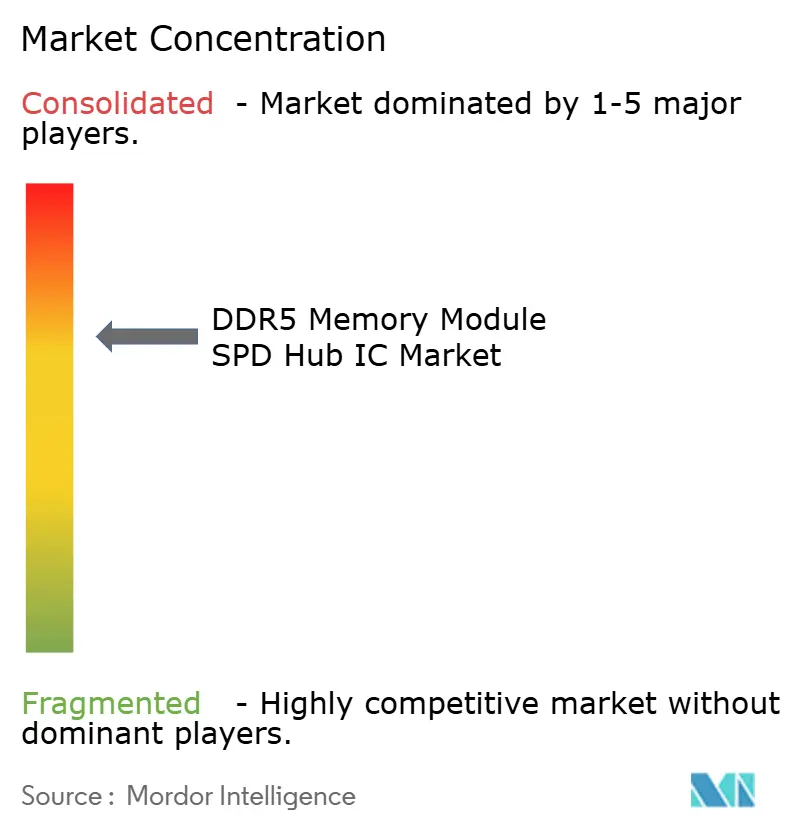
The DDR5 Memory Module SPD Hub IC market is consolidated, with Renesas Electronics, Rambus, Montage Technology, and ABLIC as the leading players. These suppliers hold many design wins across server and client module programs. Renesas offers a full DDR5 memory interface set that includes RCD, CKD, DB, PMIC, SPD Hub, and temperature sensor components. This co-validated product-family approach reduces the qualification work required from module manufacturers. It also gives Renesas a strong position in complex module types, including MRDIMM. Competition is shaped less by a single SPD Hub specification than by the ability to provide a complete validated chipset.
Rambus strengthened its portfolio in July 2026 with a DDR5 9600 server RDIMM chipset comprising an RCD06, PMIC5030, and an SPD Hub with an integrated temperature sensor. In May 2026, the company also announced a client chipset that included an SPD Hub for CUDIMM, CQDIMM, and CSODIMM modules. Renesas followed with its Gen 3 MRDIMM chipset in July 2026, which includes SPD Hubs and temperature sensors. These launches show that strategic competition centers on integrated solutions for faster DDR5 modules. Intellectual property in hub isolation and I³C in-band interrupt functions provide an additional point of differentiation as core specifications converge. Suppliers that can validate several components together are better positioned to win complex server programs.
Montage Technology and Giantec Semiconductor are intensifying competition in the Asia Pacific module assembly market, where domestic sourcing priorities influence procurement. Montage markets its M88SPD5118 as JEDEC SPD5118-compliant for MRDIMM, RDIMM, LRDIMM, UDIMM, SO-DIMM, CUDIMM, CSODIMM, CAMM, and LPCAMM configurations. This coverage is intended to reduce form-factor differences between suppliers. LPCAMM2 and SOCAMM2 remain areas where the supporting supply chain is still developing. Early qualification may secure program positions that remain in place for several years. Smaller specialists such as ROHM, Nuvoton, and Macronix need to demonstrate JEDEC compliance and thermal management performance at a competitive cost. No combined market-share figure has been disclosed for the leading suppliers, so a quantified concentration score cannot be derived from the supplied material.
DDR5 Memory Module SPD Hub IC Industry Leaders
-
Montage Technology Co., Ltd.
-
Renesas Electronics Corporation
-
Rambus Inc.
-
Samsung Electronics Co., Ltd.
-
SK hynix Inc.
- *Disclaimer: Major Players sorted in no particular order
Recent Industry Developments
- August 2026: SK hynix announced an investment of KRW 54 trillion (USD 39.7 billion) in new memory fab facilities at Yongin Y2 and Cheongju M17 to expand production capacity to meet AI memory demand, under its KRW 600 trillion Yongin Semiconductor Cluster master plan. The initiative directly expanded DDR5 module production volumes and sustained downstream SPD Hub IC unit demand through the forecast period.
- July 2026: Renesas Electronics announced its third-generation DDR5 MRDIMM chipset solutions on July 30, 2026, delivering server-class DDR5 MRDIMM speeds up to 16,000 MT/s, 25% higher bandwidth than its second-generation solutions, with sampling underway at all major DRAM suppliers and production availability expected in the 2nd half of 2027. The complete Gen 3 platform includes MRCD, MDB, PMICs, SPD Hubs, and temperature sensors.
- July 2026: Rambus announced its DDR5 9600 Server RDIMM Chipset on July 8, 2026, for next-generation CPU-based data center platforms. The chipset comprises a 6th-generation RCD06 delivering 20% higher bandwidth over the prior generation, PMIC5030, and an SPD Hub with integrated temperature sensor. It supports DDR5 RDIMM operation at up to 9,600 MT/s and targets agentic AI inference, HPC, and cloud workloads.
- June 2026: Montage Technology began sampling its Gen6 DDR5 Registering Clock Driver, RCD06, at data rates up to 9,200 MT/s, 15% higher than its prior generation, to key customers globally. The device incorporates Continuous Time Linear Equalization and a low-jitter Phase-Locked Loop to address DDR5 signal integrity requirements at next-generation server data rates.
Global DDR5 Memory Module SPD Hub IC Market Report Scope
The DDR5 Memory Module SPD Hub IC Market Report is Segmented by Product Type (DDR5 SPD Hub IC / SPD5 Hub EEPROM, DDR5 SPD Hub IC with Integrated Temperature Sensor, DDR5 SPD Hub IC with Optional / External Temperature Sensor Support), Interface Mode (I²C-Compatible Mode, I³C Basic Mode, Dual I²C / I³C SPD Hub Devices), Module Type (UDIMM / CUDIMM, SO-DIMM / CSODIMM, RDIMM, LRDIMM / 3DS RDIMM, MRDIMM / MCR-DIMM), Application (Desktop PCs and Workstations, Laptops and Notebooks, Servers and Data Centers, AI and High-Performance Computing Systems, Networking, Telecom, and Embedded Systems), End User (Memory Module Manufacturers, Server and PC OEMs, Original Design Manufacturers, EMS / Module Assemblers, Semiconductor and Memory Subsystem Suppliers), and Geography (North America, Europe, Asia Pacific, Rest of the World). The Market Forecasts are Provided in Terms of Value (USD).
| DDR5 SPD Hub IC / SPD5 Hub EEPROM |
| DDR5 SPD Hub IC with Integrated Temperature Sensor |
| DDR5 SPD Hub IC with Optional / External Temperature Sensor Support |
| I²C-Compatible Mode |
| I³C Basic Mode |
| Dual I²C / I³C SPD Hub Devices |
| UDIMM / CUDIMM |
| SO-DIMM / CSODIMM |
| RDIMM |
| LRDIMM / 3DS RDIMM |
| MRDIMM / MCR-DIMM |
| Desktop PCs and Workstations |
| Laptops and Notebooks |
| Servers and Data Centers |
| AI and High-Performance Computing Systems |
| Networking, Telecom, and Embedded Systems |
| Memory Module Manufacturers |
| Server and PC OEMs |
| Original Design Manufacturers |
| EMS / Module Assemblers |
| Semiconductor and Memory Subsystem Suppliers |
| North America | |
| Europe | |
| Asia Pacific | China |
| Japan | |
| South Korea | |
| Taiwan | |
| Rest of Asia Pacific | |
| Rest of the World |
| By Product Type | DDR5 SPD Hub IC / SPD5 Hub EEPROM | |
| DDR5 SPD Hub IC with Integrated Temperature Sensor | ||
| DDR5 SPD Hub IC with Optional / External Temperature Sensor Support | ||
| By Interface Mode | I²C-Compatible Mode | |
| I³C Basic Mode | ||
| Dual I²C / I³C SPD Hub Devices | ||
| By Module Type | UDIMM / CUDIMM | |
| SO-DIMM / CSODIMM | ||
| RDIMM | ||
| LRDIMM / 3DS RDIMM | ||
| MRDIMM / MCR-DIMM | ||
| By Application | Desktop PCs and Workstations | |
| Laptops and Notebooks | ||
| Servers and Data Centers | ||
| AI and High-Performance Computing Systems | ||
| Networking, Telecom, and Embedded Systems | ||
| By End User | Memory Module Manufacturers | |
| Server and PC OEMs | ||
| Original Design Manufacturers | ||
| EMS / Module Assemblers | ||
| Semiconductor and Memory Subsystem Suppliers | ||
| By Geography | North America | |
| Europe | ||
| Asia Pacific | China | |
| Japan | ||
| South Korea | ||
| Taiwan | ||
| Rest of Asia Pacific | ||
| Rest of the World | ||
Key Questions Answered in the Report
What is the size of the DDR5 Memory Module SPD Hub IC market in 2026?
The DDR5 Memory Module SPD Hub IC market size was estimated at USD 134.07 million in 2026. The DDR5 Memory Module SPD Hub IC market is forecast to reach USD 162.86 million by 2031 at a 3.97% CAGR during 2026-2031, reflecting continued adoption of qualified DDR5 module designs.
What is driving demand for DDR5 Memory Module SPD Hub ICs?
The DDR5 Memory Module SPD Hub IC market is supported by broader DDR5 adoption across server and client module designs. The DDR5 Memory Module SPD Hub IC market also benefits when new CUDIMM, CSODIMM, RDIMM, and MRDIMM programs need configuration, sideband management, telemetry, and thermal monitoring.
Which product type leads DDR5 SPD Hub IC demand?
In the DDR5 Memory Module SPD Hub IC market, integrated temperature-sensor devices led with 71.20% revenue share in 2025. This product type is forecast to grow at a 4.46% CAGR through 2031 because the DDR5 Memory Module SPD Hub IC market uses on-module monitoring in server-grade and premium client memory configurations.
Why are I³C-enabled SPD Hubs becoming more important?
The DDR5 Memory Module SPD Hub IC market needs faster sideband communication as DDR5 data rates rise. Dual I²C/I³C devices retain compatibility with existing equipment, while I³C Basic mode is forecast to expand at a 4.64% CAGR through 2031 and supports newer platform designs.
Which module type is growing fastest for SPD Hub suppliers?
Within the DDR5 Memory Module SPD Hub IC market, MRDIMM/MCR-DIMM is forecast to grow at a 4.72% CAGR through 2031. The format is used in advanced server, AI, and HPC systems because these workloads need higher bandwidth and more complex memory-interface components, including qualified SPD Hubs and temperature sensors.