
Data Center Water Treatment and Recycling Market Size and Share
Market Overview
| Study Period | 2021 - 2032 |
|---|---|
| Market Size (2027) | USD 4.36 Billion |
| Market Size (2032) | USD 7.09 Billion |
| Growth Rate (2027 - 2032) | 10.21 % |
| Fastest Growing Market | Asia-Pacific |
| Largest Market | North America |
| Market Concentration | Low |
Major Players *Disclaimer: Major Players sorted in no particular order Image © Mordor Intelligence. Reuse requires attribution under CC BY 4.0. | |
Data Center Water Treatment and Recycling Market Analysis by Mordor Intelligence
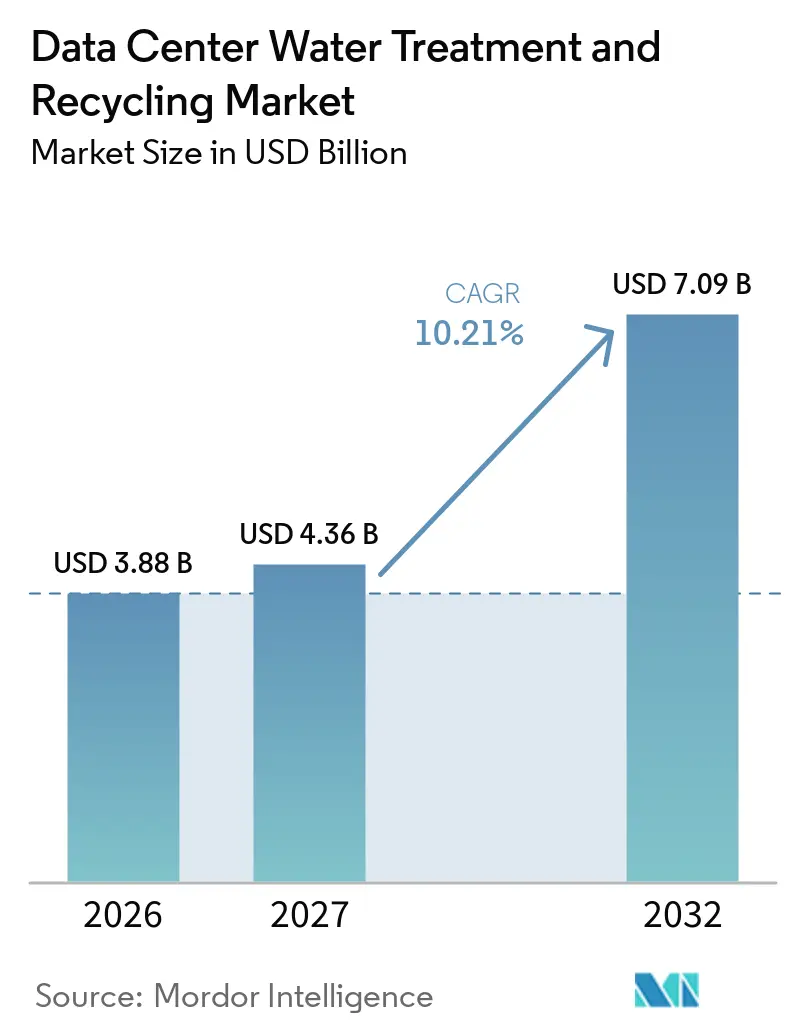
The data center water treatment and recycling market size is projected to expand from USD 3.88 billion in 2026 to USD 7.09 billion by 2032, registering a CAGR of 10.21% between 2027 and 2032. AI-related computing demand is increasing the need for reliable cooling water and is moving water treatment from a support function to a core part of facility design. Water stress around major data center locations is also making reclaimed water, higher cooling cycles, and lower blowdown volumes more valuable to operators. Large cloud operators are using longer procurement programs and water commitments to secure equipment, chemicals, and monitoring systems. This creates room for suppliers that can combine treatment technology with operating support, while high capital costs remain a constraint for smaller operators.
Key Report Takeaways
- By treatment technology, reverse osmosis held 23.98% of the data center water treatment and recycling market share in 2026, while membrane bioreactors are projected to expand at a 10.44% CAGR through 2032.
- By water source, municipal water held 41.86% of segment revenue in 2026, while reclaimed municipal wastewater is projected to expand at a 10.57% CAGR through 2032.
- By treatment application, cooling tower makeup water treatment held 33.76% of segment revenue in 2026, while water recycling and reuse is projected to expand at a 10.88% CAGR through 2032.
- By solution type, water treatment equipment held 37.33% of segment revenue in 2026, while water quality monitoring and control systems are projected to expand at a 10.36% CAGR through 2032.
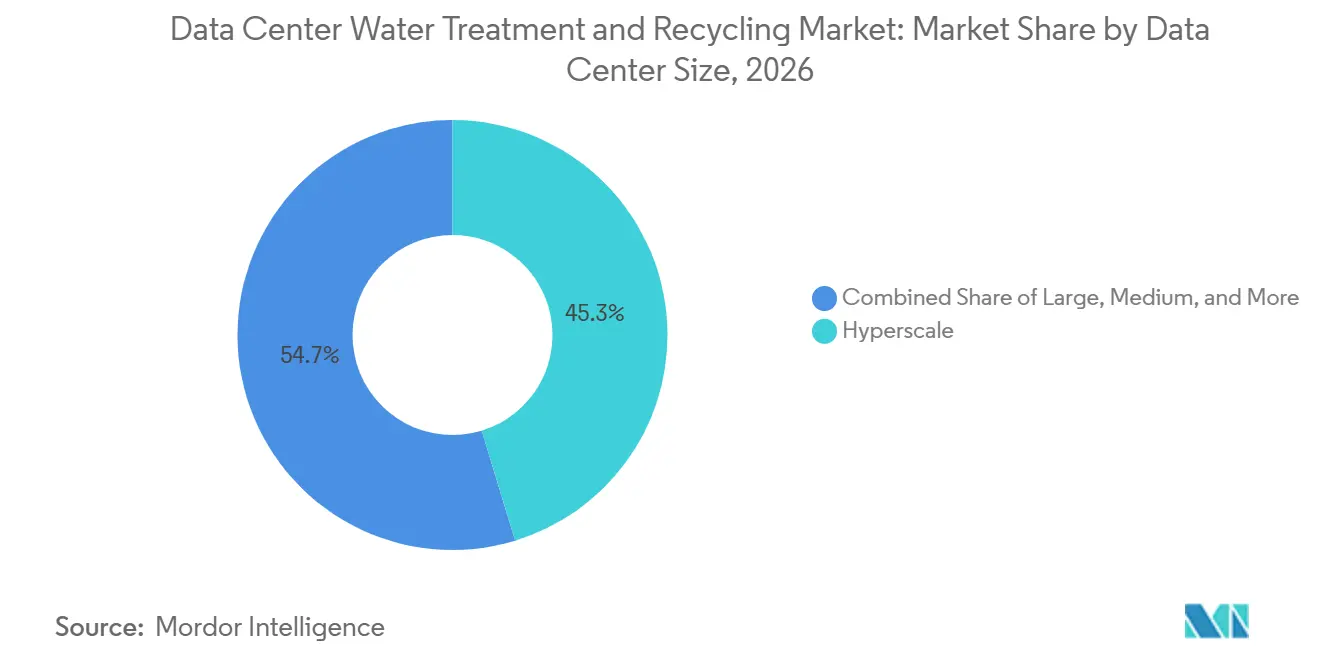
- By data center size, hyperscale facilities held 45.29% of revenue in 2026 and are projected to expand at a 10.83% CAGR through 2032.
- By data center type, cloud service providers held 41.97% of revenue in 2026 and are projected to expand at a 10.92% CAGR through 2032.
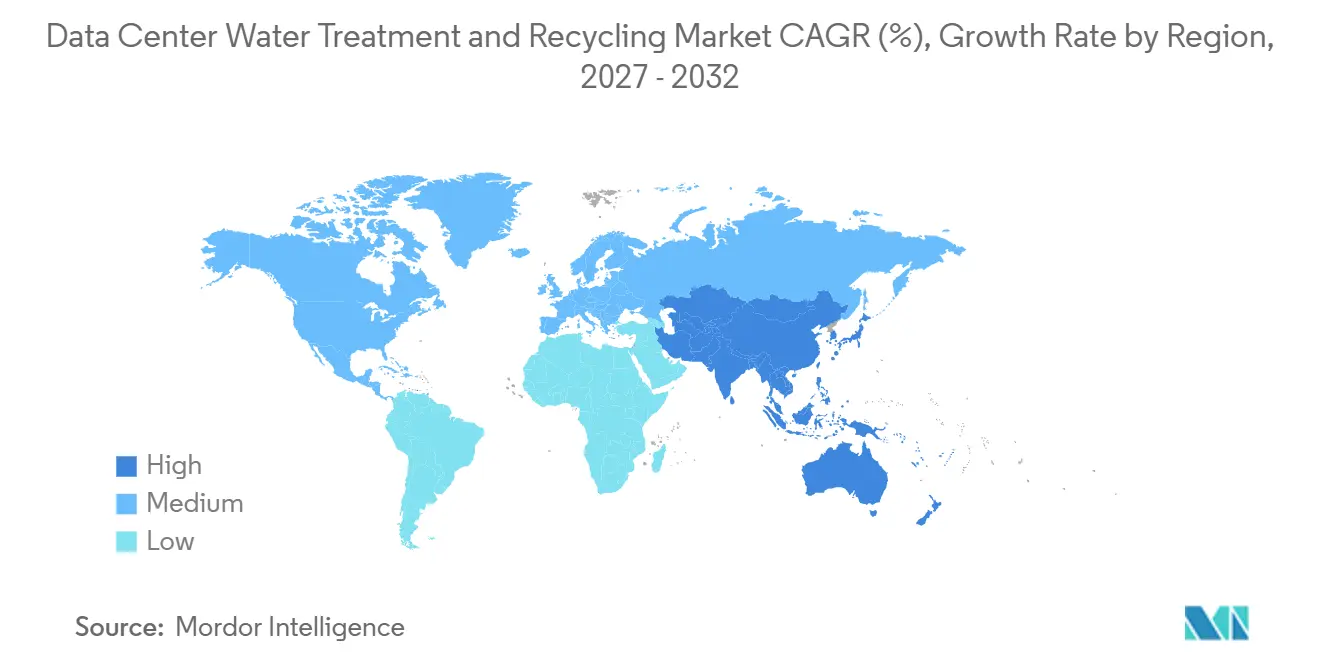
- By geography, North America held 32.84% of revenue in 2026, while Asia-Pacific is projected to expand at a 10.94% CAGR through 2032.
Note: Market numbers in this report are based on Mordor Intelligence's proprietary estimation framework, which combines nine months of actuals with Q4 projections for base year 2026.
Market Trends and Insights
Drivers Impact Analysis of Data Center Water Treatment and Recycling Market*
| Driver | (~) % Impact on CAGR Forecast | Geographic Relevance | Impact Timeline |
|---|---|---|---|
| Rising Demand for Treated Water in Data Center Cooling Systems | +2.5% | Global, concentrated in North America and Asia-Pacific | Short term (≤ 2 years) |
| Increasing Adoption of Wastewater Recycling and Water Reuse | +1.8% | Global, with early leadership in North America, Asia-Pacific, and Europe | Medium term (2-4 years) |
| Freshwater Scarcity and Restrictions on Industrial Water Consumption | +1.6% | North America, Middle East and Africa, South and Southeast Asia | Short term (≤ 2 years) |
| Greater Use of Reclaimed Water and Alternative Water Sources | +1.2% | Asia-Pacific and North America | Medium term (2-4 years) |
| Regulatory Requirements for Wastewater Discharge and Water Quality | +0.9% | Europe, China, and the United States | Medium term (2-4 years) |
| Corporate Sustainability Targets for Reducing Freshwater Withdrawal | +0.7% | Global, strongest in North America and Europe | Long term (≥ 4 years) |
| Source: Mordor Intelligence | |||
Rising Demand for Treated Water in Data Center Cooling Systems
AI infrastructure is raising the volume and quality requirements for cooling water at large facilities. U.S. data centers consume 449 million gallons of water each day, and AI-driven expansion could add 697 million to 1,451 million gallons a day by 2030.[1] Cooling towers concentrate dissolved solids and biological material as water evaporates, which makes treatment necessary for reliable operation. A higher cycle of concentration can reduce both makeup-water demand and blowdown volume when water quality is managed properly. The data center water treatment and recycling market, therefore, benefits when operators treat water efficiency as an operating priority rather than a compliance expense. This need is strongest where high-density computing raises cooling loads at the same time that local water supplies face pressure.
Increasing Adoption of Wastewater Recycling and Water Reuse
Wastewater recycling is becoming a practical route to secure a cooling supply at large campuses in constrained locations. Bridge Data Centers opened Malaysia's first data center-integrated water reclamation plant at its Johor campus in 2025, using membrane bioreactor and reverse osmosis processes for cooling-grade water. These projects can align data center demand with municipal investments in treatment capacity. The arrangement can also improve permitting discussions when a project reduces reliance on potable water and supports a wider local water system. The data center water treatment and recycling market gains from this shift because treatment trains need membranes, controls, chemicals, and ongoing service. Reuse programs also make system design more complex because the water source requires closer quality monitoring than a conventional municipal supply.
Freshwater Scarcity and Restrictions on Industrial Water Consumption
Water stress is influencing site selection and equipment decisions earlier in the development process. Nearly two-thirds of U.S. data centers built since 2022 have been located in areas with high water stress, including California, Arizona, and Texas. Operators in these locations face greater pressure to limit freshwater withdrawal and improve cooling efficiency. Reclaimed water and higher-recovery treatment can help maintain operations when the potable supply is constrained. The data center water treatment and recycling market is supported by this planning shift because water management is considered alongside power and land availability. It also favors suppliers that can help operators navigate water permits, discharge rules, and local infrastructure limits.
Greater Use of Reclaimed Water and Alternative Water Sources
Alternative water sources are moving from pilot projects to larger operating systems. The Johor reclamation plant uses a staged membrane bioreactor and reverse osmosis treatment and is designed to achieve more than 85% water recovery for a 200 MW campus. The reverse osmosis stage can lower conductivity in the cooling feedwater and support better control of scaling and blowdown. Veolia and Amazon announced a Mississippi collaboration in April 2026 that is expected to reuse more than 83 million gallons of potable water each year. Such commitments give the data center water treatment and recycling market a clearer project pipeline for treatment equipment and operating services. They also show why modular systems can be useful where operators need faster deployment across more than one site.
Restraints Impact Analysis of Data Center Water Treatment and Recycling Market*
| Restraint | (~) % Impact on CAGR Forecast | Geographic Relevance | Impact Timeline |
|---|---|---|---|
| High Capital Costs of Advanced Treatment and Recycling Systems | -1.0% | Global, most pronounced in emerging markets and smaller operators | Medium term (2-4 years) |
| Variable Quality and Availability of Reclaimed Wastewater | -0.7% | Asia-Pacific, Middle East and Africa, and South America | Medium term (2-4 years) |
| Energy and Chemical Requirements for Treatment Processes | -0.5% | Global, amplified in high-electricity-tariff regions | Long term (≥ 4 years) |
| Challenges in Managing Scaling, Corrosion, and Biological Growth | -0.4% | Global | Short term (≤ 2 years) |
| Complex Permitting and Wastewater Discharge Requirements | -0.3% | Europe and the United States | Medium term (2-4 years) |
| Source: Mordor Intelligence | |||
High Capital Costs of Advanced Treatment and Recycling Systems
High capital requirements limit the use of advanced treatment systems among operators below the hyperscale tier. Zero liquid discharge systems can require mechanical vapor compression and thermal crystallization, which are energy-intensive processes. These systems are most viable where water scarcity or discharge requirements justify the added cost. Minimal liquid discharge can offer a lower-cost alternative where high recovery is still required. DuPont introduced its IntegraTec XTP 100 IG ultrafiltration modules in 2025 with up to 30% more flow per module, which can simplify plant design and lower the capital cost per unit of treated water.[2] The data center water treatment and recycling market must therefore balance high-performance systems with designs that are accessible to mid-scale and colocation operators.
Variable Quality and Availability of Reclaimed Wastewater
Reclaimed wastewater can vary by municipal treatment configuration, seasonal load, industrial discharge, and operating consistency. This variability requires treatment systems that can respond to changing dissolved solids, biological oxygen demand, and trace metals. A 100 MW facility can use daily water volumes comparable to 6,500 households, which may exceed the supply available from a smaller wastewater plant.[3] Operators may need to locate near large treatment plants or develop other sources before construction starts. These requirements can lengthen project planning and create risk for treatment-system procurement. The data center water treatment and recycling market needs adaptable multi-stage systems to make reclaimed water dependable for continuous cooling.
*Our forecasts treat driver/restraint impacts as directional, not additive. The impact forecasts reflect baseline growth, mix effects, and variable interactions.
Data Center Water Treatment and Recycling Market Segment Analysis
By Treatment Technology:
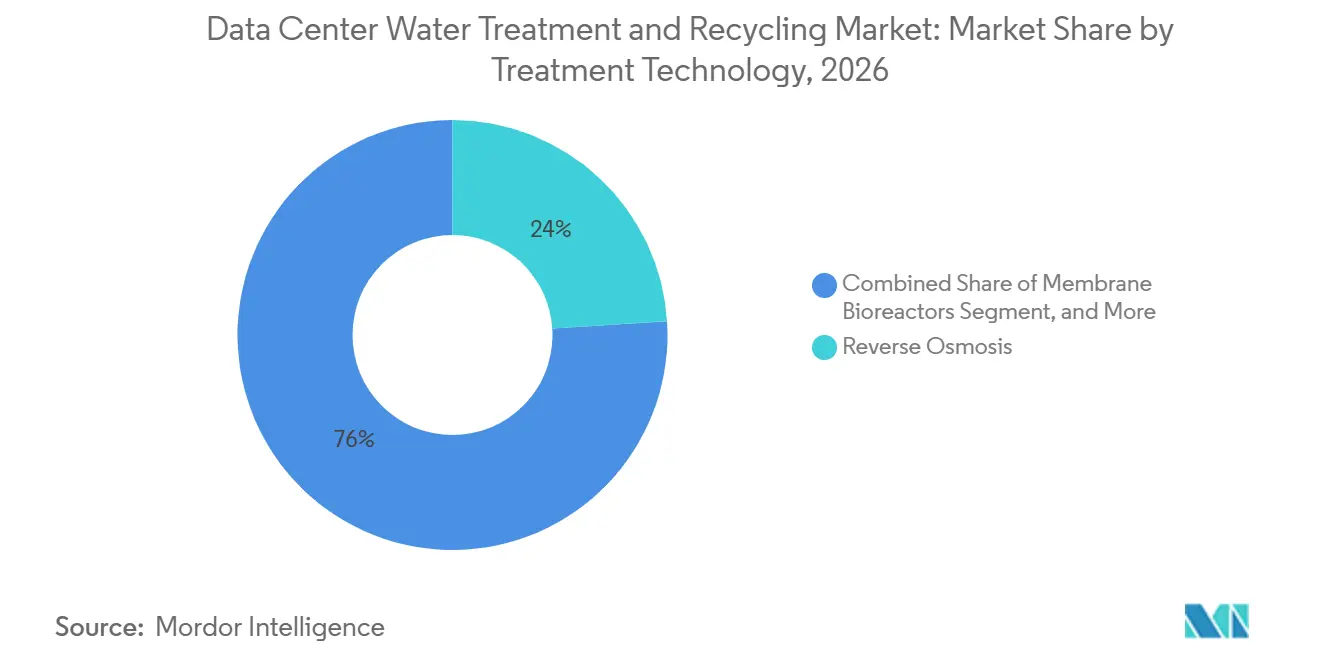
Reverse Osmosis Supports High-Purity Cooling WaterReverse osmosis held 23.98% of the data center water treatment and recycling market share in 2026. It removes dissolved solids, silica, and other constituents that accumulate in evaporative cooling cycles and can affect heat-transfer equipment. This role makes it useful as a makeup-water system and as a polishing step after biological treatment of reclaimed water. Ion exchange, water softening, electrodeionization, filtration, ultrafiltration, chemical treatment, and disinfection address related needs, including corrosion control, scale prevention, biological management, and final polishing. The data center water treatment and recycling market size for reverse osmosis reflects its use in new facilities, retrofit projects, and systems that must operate reliably across variable feedwater conditions.
Membrane bioreactors are projected to expand at a 10.44% CAGR through 2032. They provide a biological treatment stage that can prepare reclaimed municipal water for reverse osmosis and cooling reuse. Combined membrane bioreactor and reverse osmosis systems can achieve water recovery above 85%, compared with 40% to 50% for ultrafiltration-only configurations. This combination is particularly relevant for hyperscale campuses in water-constrained locations, where a consistent supply of reuse water supports both cooling continuity and local water goals. DuPont agreed to acquire Sinochem Ningbo RO Memtech in September 2025 to expand FilmTec reverse osmosis membrane manufacturing in China, reflecting supplier interest in high-recovery treatment demand across Asia-Pacific.

By Water Source:
Municipal Water Remains the Main Supply, While Reclaimed Water Gains GroundMunicipal water held 41.86% of segment revenue in 2026. Its lead reflects the availability of utility connections at established data center locations and the familiarity of municipal feedwater in conventional cooling-system design. Groundwater and surface water remain relevant where municipal supply is unavailable or carries a high cost, while industrial recycled water can serve campuses near suitable industrial infrastructure. Other alternative sources remain limited because they require site-specific development, treatment, and operational planning. The data center water treatment and recycling market continues to rely on municipal water, but this reliance is under pressure where potable supply is constrained, or new withdrawals face scrutiny.
Reclaimed municipal wastewater is projected to expand at a 10.57% CAGR through 2032. Its use can reduce dependence on drinking water and provide a more secure source for high-load cooling systems when the required treatment infrastructure is available. Bridge Data Centers applied treated sewage effluent to cooling at its Johor campus through an integrated reclamation plant. The approach requires treatment trains that handle changing source-water conditions while maintaining the water quality needed for cooling equipment. Veolia's modular reclaimed-water project with Amazon in Mississippi indicates that packaged formats can support deployment at more than one location.
By Treatment Application:
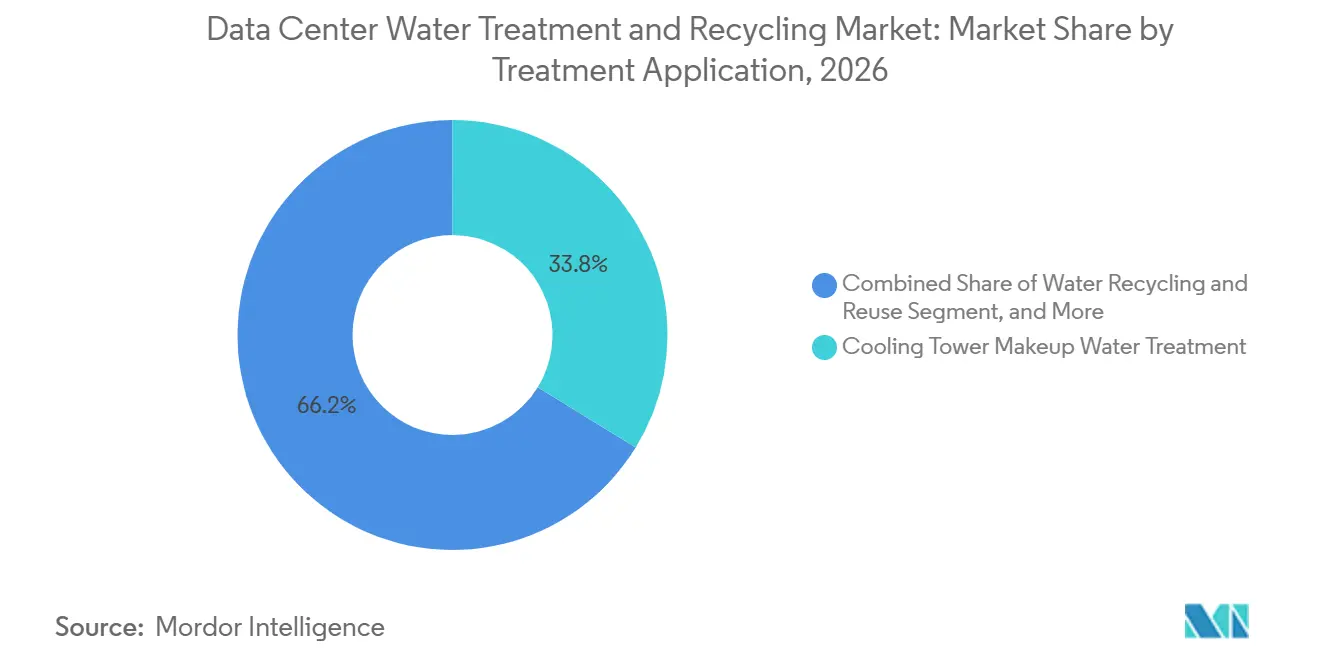
Cooling Tower Makeup Water Is the Largest Use, While Recycling ExpandsCooling tower makeup water treatment held 33.76% of the segment revenue in 2026. Cooling towers are the main point of water use in conventional evaporative cooling plants, so treatment directly affects water consumption and equipment reliability. Treatment controls mineral concentration, corrosion, biological growth, and blowdown volumes as cooling water recirculates through the system. Chilled-water and closed-loop treatment, boiler and heat-rejection treatment, wastewater treatment, and concentrate management serve the broader plant water balance at different levels of treatment intensity. The data center water treatment and recycling market relies on these applications because stable water conditions are closely linked to uninterrupted cooling performance.
Water recycling and reuse are projected to expand at a 10.88% CAGR through 2032. Operators are adopting closed-loop approaches that return treated water to cooling processes instead of relying solely on fresh makeup water. The change is especially relevant where local rules limit freshwater withdrawal or reclaimed water is available from municipal facilities. Recycling systems add treatment stages, concentrate controls, and monitoring requirements, which increases the importance of integrated system design. The size of this application benefits from reuse targets and from the need to reduce potable-water demand without changing the core cooling function of a facility.
By Solution Type:
Equipment Leads, While Monitoring and Control Become More ImportantWater treatment equipment held 37.33% of the segment revenue in 2026. This category includes membrane skids, filtration columns, ion-exchange vessels, and evaporation systems that form the physical base of a treatment plant. These assets account for a large share of upfront project spending because they are selected and installed during facility construction or major retrofits. Water treatment chemicals create recurring demand for corrosion inhibition, biological control, and scale prevention as the system operates. Ecolab's 3D TRASAR platform automates dosing using real-time operating conditions rather than fixed schedules, linking equipment performance with more responsive chemical management.
Water quality monitoring and control systems are projected to expand at a 10.36% CAGR through 2032. Real-time data helps operators respond to changes in reclaimed-water quality, maintain cooling-water conditions, and avoid unnecessary chemical use. It can also help extend membrane service intervals by identifying operating issues before they become more serious. Gradiant has presented SmartOps as an AI-based operations platform for managing water recovery, energy use, and membrane performance. The data center water treatment and recycling market is therefore moving toward solutions that join physical treatment equipment with controls, analytics, and continuing operational support.
By Data Center Size:
Hyperscale Facilities Set the Pace for ProcurementHyperscale facilities held 45.29% of the data center water treatment and recycling market size in 2026 and are projected to expand at a 10.83% CAGR through 2032. Their scale creates continuous demand for treatment, monitoring, and chemical solutions across large multi-year construction and operating programs. A 100 MW campus can have water needs comparable to those of 6,500 households, making water planning a central facility-design consideration. Large data centers are also active buyers because they support enterprise cloud and government computing workloads with similar, though lower, total cooling demands. The data center water treatment and recycling market is led by hyperscale procurement because these operators can fund comprehensive systems, long-term service agreements, and reuse projects with complex treatment requirements.
Small and medium facilities are expanding with edge deployments in secondary cities. These sites need treatment systems that can be installed quickly, scaled with computing capacity, and operated with limited site resources. Containerized designs can reduce civil-work requirements and simplify commissioning while retaining the ability to manage cooling-water quality. Veolia's planned autonomous containerized systems for Amazon illustrate this delivery model. This creates an opportunity for suppliers to offer modular equipment and managed services that match lower-volume operations without requiring a complex zero liquid discharge installation.
By Data Center Type:
Cloud Service Providers Combine Scale With Water CommitmentsCloud service providers held 41.97% of segment revenue in 2026 and are projected to expand at a 10.92% CAGR through 2032. Their lead reflects the scale of their facilities, their public commitments on water use, and their ability to standardize treatment designs across regions. These operators can place multi-year orders for reclaimed-water systems, monitoring platforms, chemicals, and maintenance support. The data center water treatment and recycling market benefits when cloud providers make water systems part of a broader operating model instead of treating them as isolated utility assets. This procurement approach raises the value of global service coverage, common technical standards, and systems that can be repeated across a portfolio.
Colocation providers manage shared infrastructure for tenants with different sustainability expectations, which can complicate the allocation of treatment costs and water-performance benefits. Enterprise and edge facilities have smaller cooling loads, but retrofitted liquid-cooled server racks can increase the need for stable closed-loop water quality. These operators may favor packaged systems that fit within existing buildings and need limited on-site support. Ecolab launched a Cooling as a Service program in 2025 that combines direct-to-chip cooling, coolant distribution units, and water-quality monitoring. This type of integrated service can address different data center types without requiring every operator to manage specialist treatment infrastructure alone.
Geography Analysis
North America
North America held 32.84% of regional revenue in 2026. The United States supports this position through hyperscale construction in Northern Virginia, Texas, Arizona, and Georgia, where water-stressed locations are increasing attention on reclaimed water, cooling efficiency, and reliable discharge management. Essential Utilities announced a USD 26 million investment for an 18-million-gallon-per-day plant intended to serve a data center and its on-site power facility, showing how large campuses can act as anchor customers for purpose-built treatment capacity. State-level water rights, industrial discharge permits, and reclaimed-water approvals vary across the United States, which favors providers with broad local execution capability. In Canada, the Quebec and Ontario corridor has a different profile because water-system reliability can be more important than absolute scarcity.
Asia-Pacific
Asia-Pacific is projected to expand at a 10.94% CAGR through 2032. China is a key driver because national and local water-efficiency rules are increasing the value of monitoring, water-use effectiveness measurement, and reuse systems. The GB/T 32910.6-2025 standard establishes water-use effectiveness measurement for data centers, while an Alibaba Cloud facility in Beijing continued to meet its targets after 3 years using ultrafiltration and double-stage reverse osmosis. Malaysia, Singapore, India, and South Korea add demand through data center construction and growing scrutiny of resource efficiency. Regional demand is also supported by projects that use treated effluent to reduce dependence on potable supply.
Europe
Europe is a major regional bloc where disclosure and permitting requirements shape treatment decisions, including water reporting under the EU Corporate Sustainability Reporting Directive and EU Taxonomy from 2025. Germany's Wasserhaushaltsgesetz adds site-specific obligations for cooling-water extraction and thermal discharge, while the Netherlands and Ireland have faced greater scrutiny around water and land use at large campuses.
South America, Middle East and Africa
In South America, water availability and distance from large wastewater plants can limit reclaimed-water use, while severe constraints in Saudi Arabia, the United Arab Emirates, and Qatar make reuse, desalination, and zero liquid discharge more relevant. These mixed regions require technical choices that reflect local hydrology, regulation, and available infrastructure.
Competitive Landscape
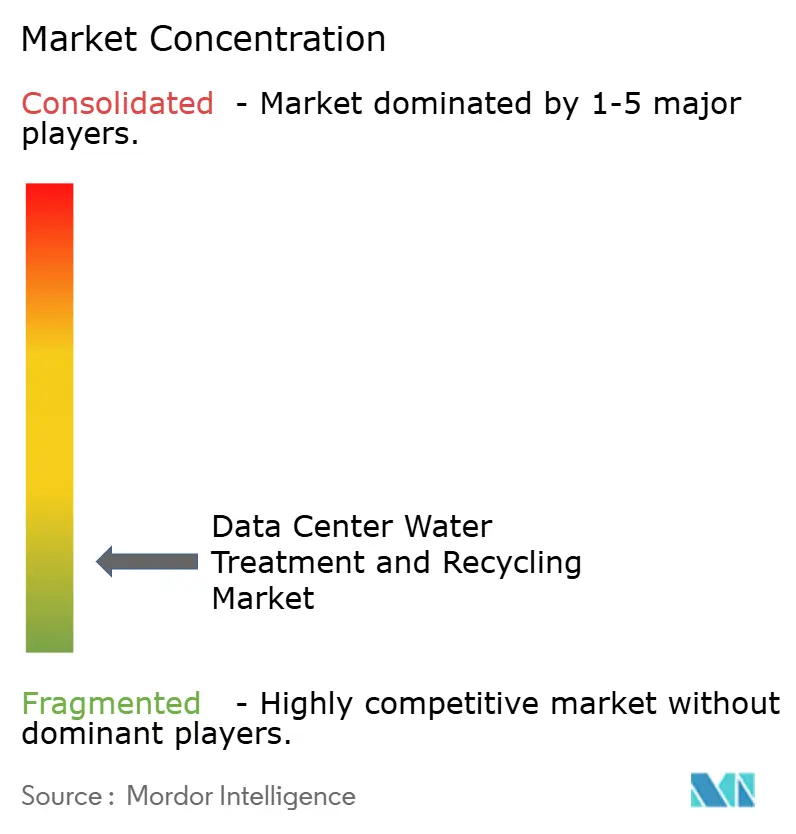
The data center water treatment and recycling market is fragmented, and no supplier holds a dominant overall share. Ecolab, Veolia, and Xylem compete through portfolios that combine equipment, chemicals, monitoring, and long-term managed services, while Gradiant, Kurita, DuPont, Toray, Saltworks Technologies, and IDE Technologies compete through depth in zero liquid discharge, membrane bioreactors, high-recovery reverse osmosis, and reclaimed-water treatment. The market concentration score is 1 out of 10 because no top player holds 5% or more of the fragmented global market, while competition remains dispersed across integrated providers and specialists. New technical approaches are also entering the field, including a 2026 U.S. patent covering intelligent trickling-filter water recycling for evaporative data center cooling. This structure means the data center water treatment and recycling market rewards product performance, service capability, and regional delivery capacity.
Ecolab closed its acquisition of Ovivo's Electronics ultrapure water business in December 2025 for USD 1.6 billion in cash, expanding its high-tech water capabilities for electronics and data center customers. DuPont announced the acquisition of Sinochem Ningbo RO Memtech in September 2025 to add reverse osmosis membrane manufacturing capacity in China. These moves show that suppliers are using acquisitions to add technology depth and regional production capacity. The data center water treatment and recycling market also places greater value on digital operating tools that can manage water recovery, membrane life, and chemical use. Gradiant's SmartOps, Ecolab's 3D TRASAR, and Xylem Vue illustrate this move toward connected water operations.
The data center water treatment and recycling market leaves opportunities in managed water services for mid-scale colocation sites and packaged systems for edge deployments. Veolia's planned autonomous containerized treatment systems with Amazon in Mississippi show how modular formats can serve large operators and provide a model for wider use. Suppliers must show that their systems can manage variable reclaimed-water quality without compromising uptime, which makes field service, process design, and control software as important as membranes and chemicals. Competitive positions will continue to depend on technical performance, regional presence, and the ability to support long-term water-management programs.
Data Center Water Treatment and Recycling Industry Leaders
-
Veolia Environnement S.A.
-
Ecolab Inc.
-
Xylem Inc.
-
Solenis LLC
-
Aquatech International LLC
- *Disclaimer: Major Players sorted in no particular order
Data Center Water Treatment and Recycling Market Companies Covered in this Report
- Ecolab Inc.
- Veolia Environnement S.A.
- Xylem Inc.
- Kurita Water Industries Ltd.
- Aquatech International LLC
- DuPont de Nemours, Inc.
- Pentair plc
- Evoqua Water Technologies LLC
- Gradiant Corporation
- Ovivo Inc.
- H2O Innovation Inc.
- A. O. Smith Corporation
- Watts Water Technologies, Inc.
- Thermax Limited
- VA Tech Wabag Limited
- Organo Corporation
- Samco Technologies, Inc.
- Pall Corporation
- Hydranautics
- Toray Industries, Inc.
- Solenis LLC
- Saltworks Technologies Inc.
- Lenntech B.V.
- IDE Technologies
- ChemTreat, Inc.
- Dow Inc.
- Genesis Water Technologies, Inc.
- BWT Holding GmbH
- Graver Technologies, LLC
Recent Industry Developments in Data Center Water Treatment and Recycling Market
- October 2026: Gradiant announced an agreement to provide turnkey water-supply and wastewater-treatment infrastructure for a hyperscale AI data-center campus in West Texas. Its HyperSolved platform is designed to maximize water recovery and reuse, use alternative water sources such as treated wastewater and brackish groundwater, and minimize liquid discharge. The development demonstrates demand for integrated water-treatment solutions in water-constrained data-center locations.
- October 2026: Endeavour partnered with Trevi Systems to integrate heat-driven desalination with waste heat from Endeavour's ThermalWorks cooling platform. The proposed system targets water production from brackish groundwater and other challenging water sources, with the first deployments planned for Endeavour's US data-center portfolio. The technology is not yet deployed at a data center, and its commercial performance remains to be demonstrated.
- June 2026: Vertiv launched PurgeRite NearZero, a fluid-management service for commissioning closed-loop hydronic systems in data centers. It combines engineered flushing, water treatment, filtration, reverse osmosis, water recycling, and continuous water-quality monitoring. Vertiv reported reductions of up to 78% in total water consumption and 91% in water haul-off volumes in selected deployments compared with conventional commissioning methods.
- April 2026: Veolia and Amazon announced a collaboration to deploy autonomous containerized reclaimed water treatment systems at Amazon data centers in Mississippi, under Veolia's Data Center Resource 360 program. The project, with the first facility expected to be operational in 2027, is set to reuse more than 83 million gallons of potable water per year, with a modular design intended for global replication.
Global Data Center Water Treatment and Recycling Market Report Scope
The Data Center Water Treatment and Recycling Market comprises the technologies, equipment, and services used to purify, condition, treat, and recycle water within data center operations primarily for cooling systems, covering raw water pretreatment, high-purity water treatment, cooling water treatment, wastewater treatment, water reuse/recovery, and zero liquid discharge (ZLD).
The Data Center Water Treatment and Recycling Market Report is Segmented by Treatment Technology (Filtration and Ultrafiltration, Reverse Osmosis, Ion Exchange and Water Softening, Electrodeionization, Chemical Treatment and Disinfection, Membrane Bioreactors, and Other Water Treatment Technologies), Water Source (Municipal Water, Groundwater, Surface Water, Reclaimed Municipal Wastewater, Industrial Recycled Water, and Other Alternative Water Sources), Treatment Application (Cooling Tower Makeup Water Treatment, Chilled Water and Closed-Loop Water Treatment, Boiler and Heat Rejection System Water Treatment, Wastewater Treatment, Water Recycling and Reuse, and Zero Liquid Discharge and Concentrate Management), Solution Type (Water Treatment Equipment, Water Treatment Chemicals, Water Quality Monitoring and Control Systems, Treatment Plant Design and Engineering, and Operation and Maintenance Services), Data Center Size (Small, Medium, Large, and Hyperscale), Data Center Type (Colocation, Cloud Service Providers, and Enterprise and Edge), and Geography (North America, South America, Europe, Asia-Pacific, and Middle East and Africa). The Market Forecasts Are Provided in Terms of Value (USD).
Segmentation Overview
| Filtration and Ultrafiltration |
| Reverse Osmosis |
| Ion Exchange and Water Softening |
| Electrodeionization |
| Chemical Treatment and Disinfection |
| Membrane Bioreactors |
| Other Water Treatment Technologies |
| Municipal Water |
| Groundwater |
| Surface Water |
| Reclaimed Municipal Wastewater |
| Industrial Recycled Water |
| Other Alternative Water Sources |
| Cooling Tower Makeup Water Treatment |
| Chilled Water and Closed-Loop Water Treatment |
| Boiler and Heat Rejection System Water Treatment |
| Wastewater Treatment |
| Water Recycling and Reuse |
| Zero Liquid Discharge and Concentrate Management |
| Water Treatment Equipment |
| Water Treatment Chemicals |
| Water Quality Monitoring and Control Systems |
| Treatment Plant Design and Engineering |
| Operation and Maintenance Services |
| Small |
| Medium |
| Large |
| Hyperscale |
| Colocation |
| Cloud Service Providers |
| Enterprise and Edge |
| North America | United States |
| Canada | |
| Mexico | |
| South America | Brazil |
| Chile | |
| Colombia | |
| Argentina | |
| Peru | |
| Rest of South America | |
| Europe | United Kingdom |
| Germany | |
| France | |
| Netherlands | |
| Ireland | |
| Spain | |
| Italy | |
| Nordics | |
| Rest of Europe | |
| Asia-Pacific | China |
| India | |
| Japan | |
| Singapore | |
| South Korea | |
| Malaysia | |
| Indonesia | |
| Australia | |
| Rest of Asia-Pacific | |
| Middle East and Africa | Saudi Arabia |
| United Arab Emirates | |
| South Africa | |
| Israel | |
| Qatar | |
| Egypt | |
| Rest of Middle East and Africa |
| By Treatment Technology | Filtration and Ultrafiltration | |
| Reverse Osmosis | ||
| Ion Exchange and Water Softening | ||
| Electrodeionization | ||
| Chemical Treatment and Disinfection | ||
| Membrane Bioreactors | ||
| Other Water Treatment Technologies | ||
| By Water Source | Municipal Water | |
| Groundwater | ||
| Surface Water | ||
| Reclaimed Municipal Wastewater | ||
| Industrial Recycled Water | ||
| Other Alternative Water Sources | ||
| By Treatment Application | Cooling Tower Makeup Water Treatment | |
| Chilled Water and Closed-Loop Water Treatment | ||
| Boiler and Heat Rejection System Water Treatment | ||
| Wastewater Treatment | ||
| Water Recycling and Reuse | ||
| Zero Liquid Discharge and Concentrate Management | ||
| By Solution Type | Water Treatment Equipment | |
| Water Treatment Chemicals | ||
| Water Quality Monitoring and Control Systems | ||
| Treatment Plant Design and Engineering | ||
| Operation and Maintenance Services | ||
| By Data Center Size | Small | |
| Medium | ||
| Large | ||
| Hyperscale | ||
| By Data Center Type | Colocation | |
| Cloud Service Providers | ||
| Enterprise and Edge | ||
| By Geography | North America | United States |
| Canada | ||
| Mexico | ||
| South America | Brazil | |
| Chile | ||
| Colombia | ||
| Argentina | ||
| Peru | ||
| Rest of South America | ||
| Europe | United Kingdom | |
| Germany | ||
| France | ||
| Netherlands | ||
| Ireland | ||
| Spain | ||
| Italy | ||
| Nordics | ||
| Rest of Europe | ||
| Asia-Pacific | China | |
| India | ||
| Japan | ||
| Singapore | ||
| South Korea | ||
| Malaysia | ||
| Indonesia | ||
| Australia | ||
| Rest of Asia-Pacific | ||
| Middle East and Africa | Saudi Arabia | |
| United Arab Emirates | ||
| South Africa | ||
| Israel | ||
| Qatar | ||
| Egypt | ||
| Rest of Middle East and Africa | ||
Key Questions Answered in the Report
What is the size of the data center water treatment and recycling market?
The data center water treatment and recycling market is valued at USD 3.88 billion in 2026 and is projected to reach USD 7.09 billion by 2032, at a 10.21% CAGR. Reclaimed-water systems and monitoring platforms are becoming important parts of new cooling-water investments.
What is driving demand for data center water treatment systems?
AI-related computing, cooling-water demand, water stress, and reuse programs are increasing the need for treatment, monitoring, and recycling systems. The need is strongest where potable water supply and discharge capacity are constrained.
Which treatment technology leads data center water management?
Reverse osmosis held 23.98% share in 2026 because it helps control dissolved solids and supports high-purity cooling-water applications. It is also used as a polishing step in treatment trains for reclaimed municipal water.
Why are hyperscale facilities important to water-treatment suppliers?
Hyperscale facilities held 45.29% of revenue in 2026 and require recurring investment in treatment, monitoring, and chemical systems across large campuses. Their multi-year procurement programs can support full-service treatment arrangements.
Which region is expanding fastest for data center water recycling?
Asia-Pacific is projected to expand at a 10.94% CAGR through 2032, supported by water-efficiency requirements and reclaimed-water projects. China is a central source of demand for monitoring and higher-recovery treatment systems.
How does reclaimed wastewater support data center cooling?
Reclaimed municipal wastewater can reduce potable-water demand, but it requires adaptable treatment and monitoring to manage variable source-water quality. Membrane bioreactor and reverse osmosis systems are widely used to achieve cooling-grade water.