
Data Center Technical Workforce Market Size and Share
Market Overview
| Study Period | 2021 - 2032 |
|---|---|
| Market Size (2027) | USD 112.13 Billion |
| Market Size (2032) | USD 253.49 Billion |
| Growth Rate (2027 - 2032) | 17.72 % |
| Fastest Growing Market | Asia-Pacific |
| Largest Market | North America |
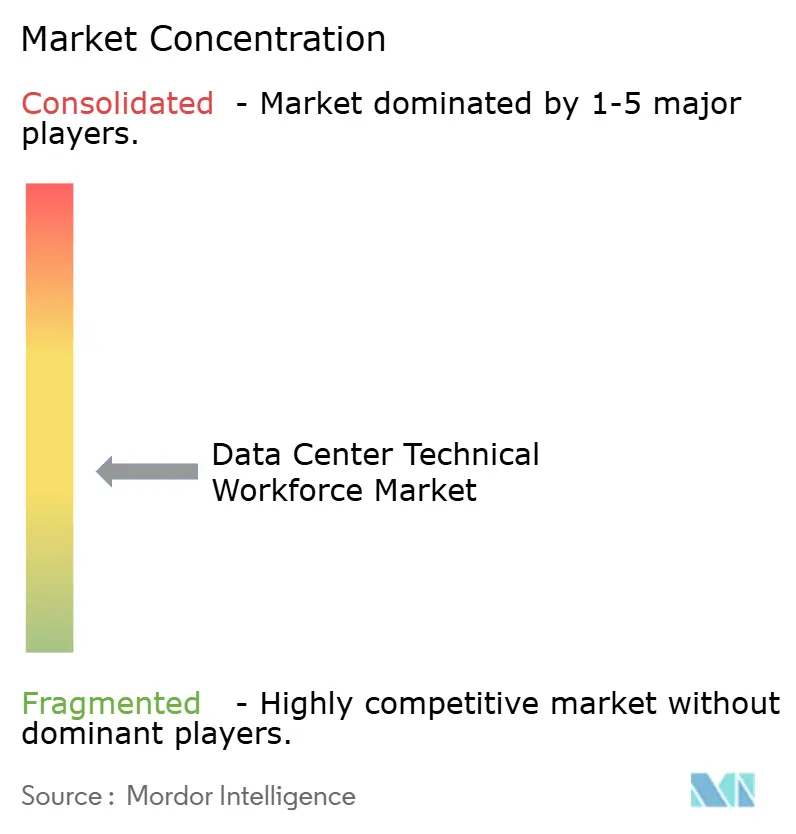
| Market Concentration | Medium |
Major Players *Disclaimer: Major Players sorted in no particular order Image © Mordor Intelligence. Reuse requires attribution under CC BY 4.0. | |
Data Center Technical Workforce Market Analysis by Mordor Intelligence
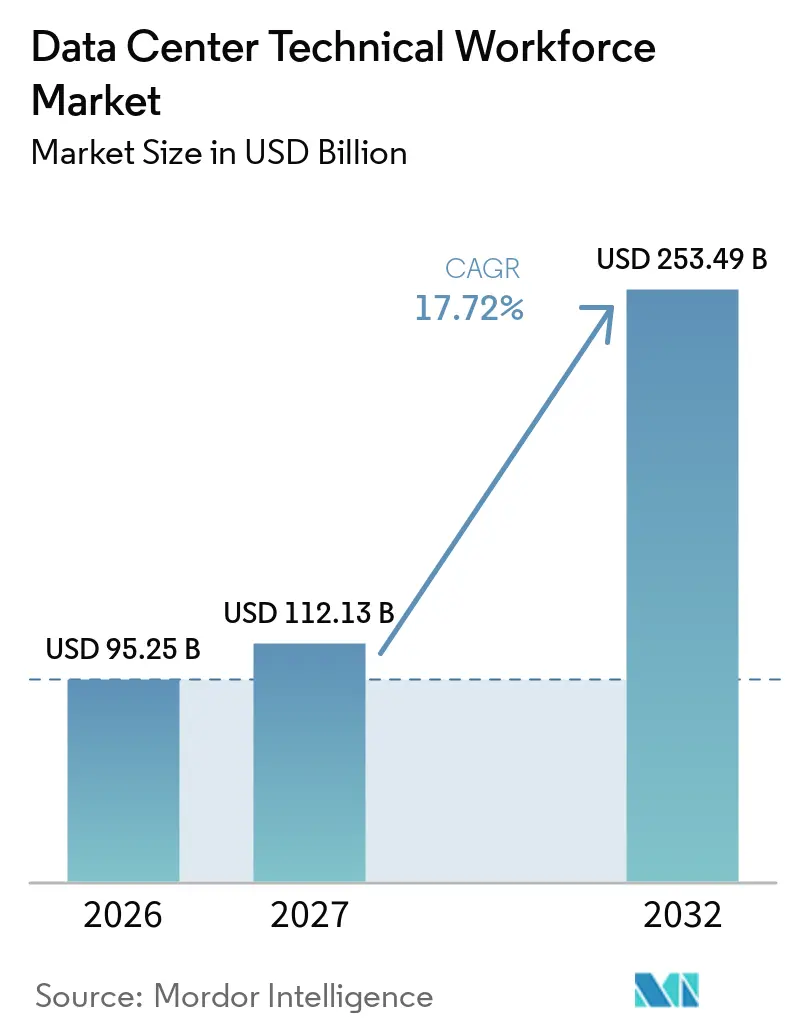
The data center technical workforce market size is projected to expand from USD 95.25 billion in 2026 and USD 112.13 billion in 2027 to USD 253.49 billion by 2032, registering a CAGR of 17.72% between 2027 and 2032. The rapid buildout of AI capacity is increasing demand for people who can design, build, commission, and operate high-density facilities. Operators are competing for technicians and engineers with skills across mechanical, electrical, and digital systems, rather than relying on narrowly defined roles. Domestic training has become more important in markets that are seeking to reduce dependence on imported technical talent. Predictive maintenance can help smaller teams oversee more equipment, but it does not remove the need for qualified staff during construction, commissioning, and critical operations. The data center technical workforce market is also shaped by the sequence of work, because labor is needed first for development and testing, then for continuous monitoring, maintenance, security, and incident response after a site begins operating.
Key Report Takeaways
- By workforce function, Project Development Workforce held 50.24% of the data center technical workforce market share in 2026, while IT and Digital Infrastructure Workforce is projected to expand at an 18.86% CAGR through 2032.
- By employment model, In-house Workforce held 66.32% share in 2026, while External Workforce Services is projected to expand at an 18.91% CAGR through 2032.
- By data center type, Hyperscale Data Centers accounted for 38.28% of the data center technical workforce market size in 2026 and are projected to expand at an 18.62% CAGR through 2032.
- By geography, North America held 37.78% share in 2026, while Asia-Pacific is projected to expand at an 18.84% CAGR through 2032.
Note: Market numbers in this report are based on Mordor Intelligence's proprietary estimation framework, which combines nine months of actuals with Q4 projections for base year 2026.
Global Data Center Technical Workforce Market Trends and Insights
Drivers Impact Analysis*
| Driver | (~) % Impact on CAGR Forecast | Geographic Relevance | Impact Timeline |
|---|---|---|---|
| Rising AI and High-Density Data Center Buildout | +4.5% | Global, concentrated in North America, Asia-Pacific core markets, and Middle East and Africa AI growth zones | Long term (≥ 4 years) |
| Hyperscale and Colocation Capacity Expansion | +3.8% | North America and Asia-Pacific, with spillover to Europe and Middle East and Africa | Medium term (2-4 years) |
| Lifecycle-Critical Commissioning and Uptime Requirements | +2.5% | Global, most acute in North America and Europe | Medium term (2-4 years) |
| Workforce Development and Technical Certification Investment | +2.1% | Global, with early gains in North America, India, and East Africa | Long term (≥ 4 years) |
| Digitalization of Facilities Management and Predictive Maintenance | +1.5% | Global, led by North America and Europe with spillover to GCC countries | Medium term (2-4 years) |
| Rural and Secondary-Market Workforce Localization | +0.8% | North America, India Tier-2 cities, and Southeast Asian secondary markets | Long term (≥ 4 years) |
| Source: Mordor Intelligence | |||
Rising AI and High-Density Data Center Buildout
AI workloads are the main demand catalyst for the data center technical workforce market. High-density clusters require personnel who understand cooling, power, networking, and software-supported operations. The need for this hybrid capability makes training more demanding than for single-discipline roles. IEEE Spectrum reported that data center managers identified multi-skilled operators, engineers, and security specialists as areas of increasing workforce need in 2025.[1] The same report described how faster campus delivery schedules are increasing demand for staff across design, construction, and commissioning. This pattern keeps the data center technical workforce market tied to the pace of AI infrastructure deployment and the availability of people who can work across these connected systems.
Hyperscale and Colocation Capacity Expansion
Capacity expansion creates simultaneous hiring needs across planning, construction, commissioning, and operations. This concentration is particularly difficult for workforce planning because the same local labor pool is needed at several phases. Meta stated in July 2026 that its Richland Parish campus expansion would reach 5 GW of IT capacity, with 7,500 peak construction jobs and nearly 1,000 permanent operational.[2] Such projects can absorb technical labor from surrounding markets before the facility enters service. Multi-tenant facilities also require continuous site coverage and client-specific service management after construction is complete. The data center technical workforce market, therefore, benefits when project pipelines move from announced capacity into active delivery.
Lifecycle-Critical Commissioning and Uptime Requirements
Commissioning remains a critical part of the data center technical workforce market because it connects construction with reliable operations. Engineers in this function need practical experience with mechanical, electrical, and plumbing systems, integrated testing, and risk documentation. The required knowledge is developed through field exposure and cannot be replaced quickly by short courses. Uptime Institute reported that staffing and skills challenges remain among the principal issues facing operators in its 2025 global survey. Delayed handover can postpone capacity availability, which gives operators a strong reason to retain experienced commissioning staff. Sustainability reporting requirements also add new documentation responsibilities to roles that already require extensive technical judgment.
Workforce Development and Technical Certification Investment
Training programs and certification partnerships are becoming a practical response to persistent talent gaps. They give employers a clearer basis for assessing readiness for design, installation, commissioning, and operations work. Vertiv partnered with IIT Madras and IIT Madras Pravartak Technologies Foundation to support student training in data center operations and maintenance.[3] Programs tied to equipment suppliers, educational institutions, and local employers can make entry-level routes more visible to prospective workers. They also support employers that need familiar technical standards across more than one location. The data center technical workforce market benefits when training capacity is linked directly to local hiring needs and longer-term mentoring.
Restraints Impact Analysis*
| Restraint | (~) % Impact on CAGR Forecast | Geographic Relevance | Impact Timeline |
|---|---|---|---|
| Limited Availability of Experienced Technical Talent | -2.0% | Global, most acute in North America, Europe, and GCC countries | Short term (≤ 2 years) |
| Aging Workforce and Knowledge Transfer Challenges | -1.5% | Global, especially North America and Europe | Long term (≥ 4 years) |
| Lengthy Training and Certification Requirements | -1.0% | Global | Medium term (2-4 years) |
| Rising Labor Costs and Talent Retention Pressure | -0.7% | North America, Europe, and GCC countries | Short term (≤ 2 years) |
| Power, Permitting, and Site Dispersion Stretching Local Labor Pools | -0.5% | North America, Europe, including the Netherlands and Ireland, and GCC countries | Medium term (2-4 years) |
| Source: Mordor Intelligence | |||
Limited Availability of Experienced Technical Talent
The limited supply of experienced personnel constrains the data center technical workforce market in the near term. Uptime Institute found that nearly two-thirds of operators reported difficulty retaining staff, finding qualified candidates, or both in 2025. The problem is most visible in roles that require operational experience, not only formal qualifications. Companies can raise pay or use external services, but neither approach immediately creates senior commissioning, power, or operations expertise. A limited pool can extend recruitment cycles and delay site readiness. It also places greater pressure on employers to retain staff who understand facility-specific procedures.
Aging Workforce and Knowledge Transfer Challenges
An aging technical workforce creates a separate risk for the data center technical workforce market. Experienced professionals often hold practical knowledge of safety processes, emergency responses, and system dependencies that are not fully documented. Uptime Institute noted that operators were finding senior-level recruitment more difficult than early-career recruitment in its 2025 survey. The U.S. construction workforce also faces demographic pressure, with the Center for Strategic and International Studies reporting that 25% of construction workers were older than 55 in 2025. Structured mentoring and documented operating practices can reduce the risk of knowledge leaving with retiring employees. Without these measures, less-experienced teams may face greater difficulty managing mission-critical assets.
*Our forecasts treat driver/restraint impacts as directional, not additive. The impact forecasts reflect baseline growth, mix effects, and variable interactions.
Segment Analysis
By Workforce Function: IT and Digital Infrastructure Workforce Is the Fastest-Growing Function
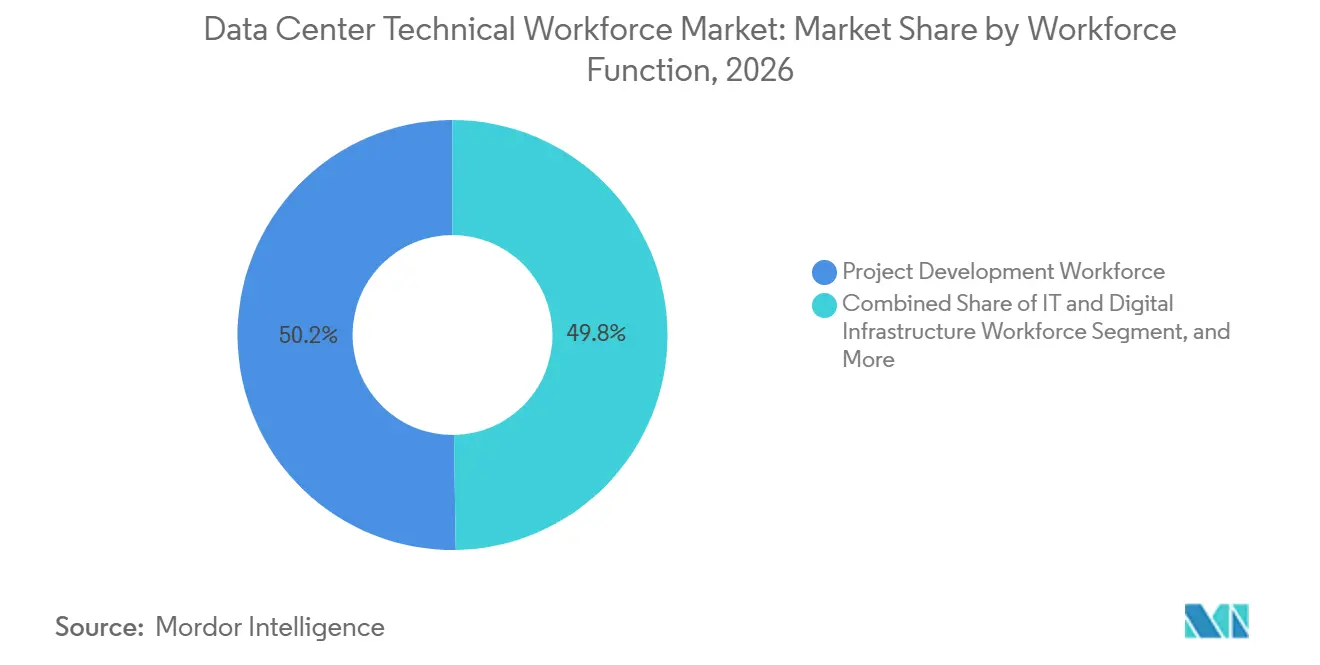
Project Development Workforce held 50.24% of the data center technical workforce market share in 2026. The share reflects the substantial volume of design, engineering, construction, installation, testing, and commissioning activity required before a facility can enter service. Project teams must coordinate electrical systems, mechanical cooling, controls, network connections, safety requirements, supplier schedules, and site access at the same time. Testing and commissioning roles are particularly important because they verify that separate systems function reliably when operated together under realistic conditions. The scale of AI campuses means that operators also need experienced construction managers and site teams that can move from one delivery phase to the next without compromising technical documentation or safety controls.
The IT and Digital Infrastructure Workforce is projected to expand at an 18.86% CAGR through 2032. AI infrastructure engineers, cybersecurity specialists, cloud architects, network specialists, and data professionals are increasingly required alongside facility teams as equipment becomes more closely connected and workloads become more demanding. Colt Data Centers cited persistent skills gaps in networking, cybersecurity, and data, AI, and automation functions in its January 2026 analysis. Facility operations are also changing as real-time monitoring tools reduce some routine site visits and provide earlier warning of performance issues. Schneider Electric stated that condition-based maintenance can help operators identify equipment issues before they affect availability, but staff must still interpret the information, decide on the response, and manage work in a live environment. The data center technical workforce market therefore requires digital specialists who can work effectively with engineering and operations teams.

By Employment Model: External Workforce Services Is the Fastest-Growing Model
In-house Workforce held 66.32% share in 2026. Operators prefer dedicated teams because site familiarity supports operational continuity, faster recovery from incidents, and consistent application of local procedures. The model is especially important in facilities where staff must understand customer commitments, equipment histories, security requirements, and the relationship between critical assets. In-house teams also give operators greater direct control as they bring new capacity online and transfer knowledge across shifts. CBRE reported USD 1.7 billion in critical infrastructure services revenue in 2025, showing the scale of services built around embedded technical delivery and long-term site support.
External Workforce Services is projected to expand at an 18.91% CAGR through 2032. Operators use external providers when internal recruitment cannot keep pace with needs in commissioning, cybersecurity, and AI infrastructure engineering, or when demand rises sharply during a specific project phase. The model can give companies access to specialists for defined tasks, temporary peaks, wider regional coverage, and service continuity across several sites. Kyndryl provides infrastructure services across 6 continents, illustrating the global delivery footprint available to some managed-service providers. The data center technical workforce market continues to depend on in-house teams where long-term site knowledge, operational accountability, and familiarity with local systems are central to facility performance.
By Data Center Type: Hyperscale Centers Drive Share and Pace of Growth
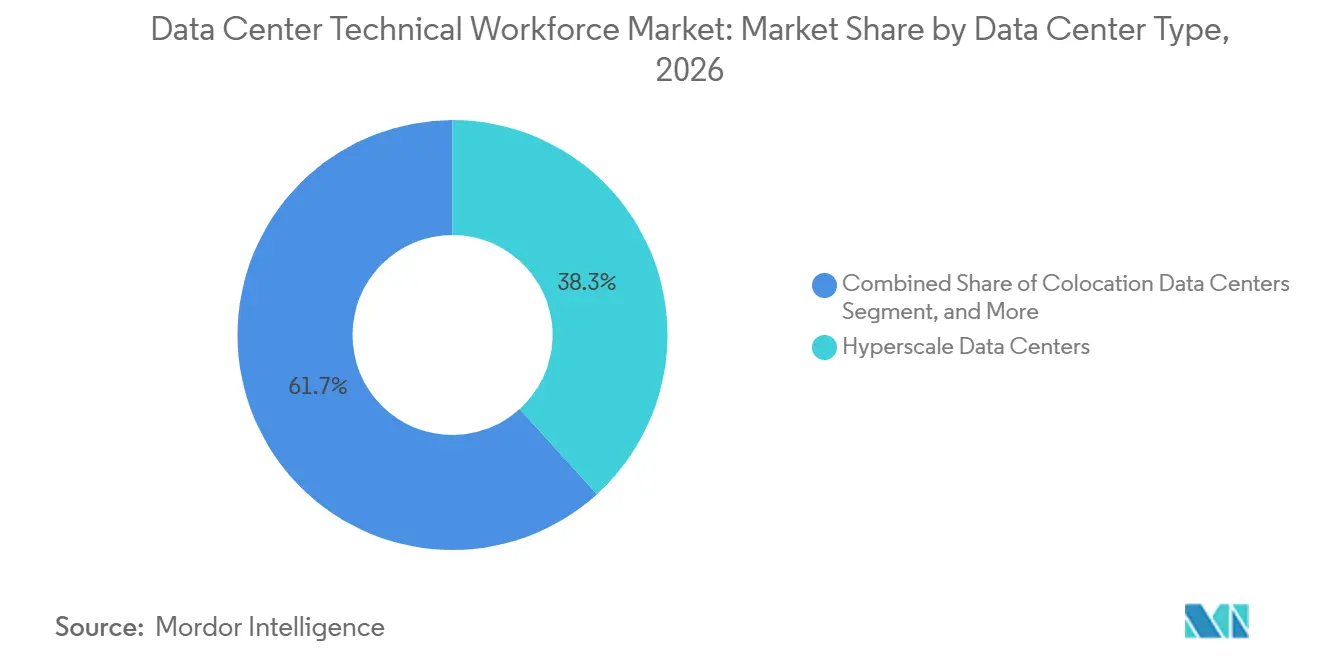
Hyperscale Data Centers accounted for 38.28% of the data center technical workforce market size in 2026. These campuses require a high concentration of technical roles from initial planning and design through construction, integrated testing, commissioning, and steady-state operations. Their large power, cooling, controls, and network systems increase the need for experienced electrical, mechanical, and digital infrastructure personnel. A small number of large projects can tighten labor availability across an entire region by drawing from the same specialist and trade workforce. Meta’s 5 GW Richland Parish campus illustrates the construction and operations staffing that a single AI facility can require.
Hyperscale Data Centers are projected to expand at an 18.62% CAGR through 2032. Colocation facilities retain a distinct staffing model because multi-tenant environments need continuous monitoring, rotating shifts, customer-specific service management, and clear accountability for availability. Enterprise, edge, and modular sites create a different challenge because their geographic spread can make local hiring difficult, even where large-city talent pools are available. Secondary markets may not have established pools of people with data center-specific technical credentials or prior experience with mission-critical operations. The data center technical workforce industry will therefore need both centralized specialist teams and local operations talent as facility formats diversify and new locations become operational.
Geography Analysis
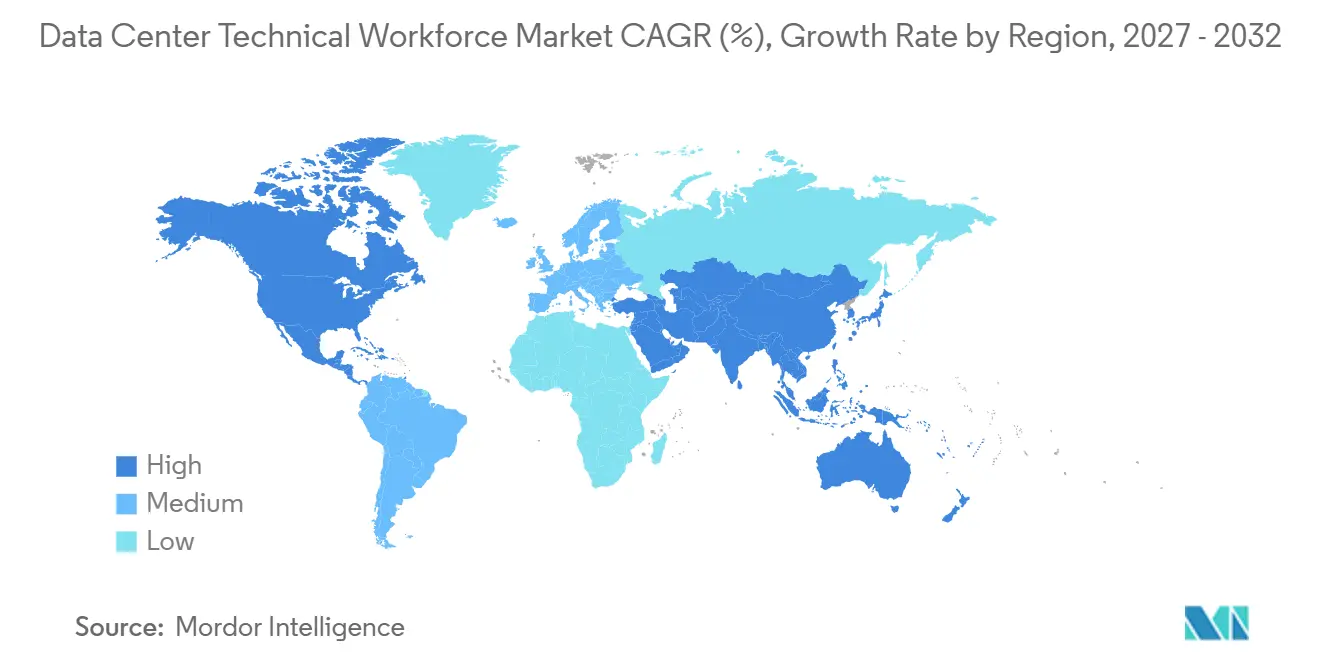
North America held 37.78% share in 2026. The region has a large concentration of AI-related projects in Virginia, Texas, Georgia, Ohio, and Arizona, which supports demand for construction, commissioning, and operations personnel. Meta’s Louisiana expansion shows how large projects can increase demand for construction and operations roles in local markets. Domestic training has become a priority because employers cannot meet all staffing needs through existing labor pools. The data center technical workforce market is supported by training commitments, including Meta’s USD 115 million construction craft workforce initiative and Google’s USD 50 million commitment through Google.org to skilled-trades training.
Asia-Pacific is projected to expand at an 18.84% CAGR through 2032. India, Malaysia, and Singapore are central to the region’s capacity expansion and its need for people trained in operations, maintenance, commissioning, and facility support. Vertiv’s partnership with IIT Madras supports skills development for operations and maintenance in India. DayOne stated that it established an operations and training center in Johor in February 2026 to develop engineers for its regional network. The data center technical workforce market in the region depends on workforce localization because rapid development can outpace the supply of experienced staff in host cities.
Europe has mature data center hubs in London, Frankfurt, Amsterdam, Paris, and Dublin, where established clusters continue to compete for technical talent, while activity in Spain, Italy, Ireland, and Nordic markets extends demand into additional hiring locations. Middle East and Africa markets face related challenges as national localization policies change how operators build technical teams and reduce reliance on international hires. Saudi Arabia’s workforce localization efforts and the United Arab Emirates’ Emiratisation requirements support domestic participation in technology roles.
Competitive Landscape
The data center technical workforce market is moderately fragmented. Competition includes facilities management firms, engineering and construction contractors, managed-service providers, specialist staffing companies, and training organizations, although these groups do not all compete for the same work. Project delivery, equipment maintenance, technical staffing, and long-term site operations require different forms of expertise, which limits direct overlap between many providers. CBRE acquired Pearce Services in November 2025 for USD 1.2 billion, adding more than 4,000 technical employees and 28 U.S. locations. The acquisition expanded CBRE’s capabilities in critical power, cooling, renewable energy, and network services and strengthened its ability to offer several technical functions under one commercial arrangement.
Equipment manufacturers are extending their role in workforce development and operations support. Vertiv launched its Next Predict AI-powered predictive maintenance service in January 2026 to analyze behavior across power, cooling, and IT systems before risks materialize. Schneider Electric published research on condition-based maintenance for AI-era data centers in July 2026, describing a service approach that can reduce routine visits and help teams manage equipment performance. Vertiv also collaborated with Zagreb University of Applied Sciences in February 2026 to launch a data center design professional program. These actions show how providers are combining technical services, digital monitoring, and talent development rather than treating them as separate activities.
Provider differentiation depends on technical depth, geographic reach, training access, and the ability to maintain operational accountability. Managed-service providers can support clients that need coverage across multiple sites, while operators continue to retain dedicated teams for core facility roles. Workforce platforms that can match qualified workers with openings across several operators remain limited in scale. CBRE and Meta have developed LevelUp, a multi-city trade-skills training program for data center roles, while localized apprenticeship programs can give early movers better access to talent in developing hubs.
Data Center Technical Workforce Industry Leaders
-
CBRE Group, Inc.
-
Jones Lang LaSalle Incorporated
-
AECOM
-
Schneider Electric SE
-
Vertiv Holdings Co.
- *Disclaimer: Major Players sorted in no particular order
Recent Industry Developments
- September 2026: Fermi Inc. signed a five-year management agreement naming CBRE as the exclusive operations and maintenance provider for its first data center in the Texas Panhandle, with CBRE site leaders beginning transition work up to 120 days before the facility's go-live to build maintenance programs and train the operations team.
- August 2026: Kyndryl and consortium partners received a European Commission award for an external IT services framework contract valued at EUR 3,971,638,879 (USD 4.5 billion), covering digital solution lifecycle services, design, construction, operations, and support, across the European Economic Area.
- July 2026: Meta announced an expansion of its Richland Parish, Louisiana data center campus to 5 GW of IT capacity with a total investment commitment exceeding USD 50 billion, expected to support 7,500 peak construction jobs and nearly 1,000 permanent operational roles. The campus will house Hyperion, Meta's largest AI training cluster.
- July 2026: Schneider Electric published the IDC White Paper "The Self-Aware Datacenter: How Condition-Based Maintenance Turns Fragmented, Multi-Vendor Datacenters into Predictable Infrastructure and System Intelligence," establishing condition-based AI-enabled maintenance as a formal industry response to technician shortages and rising rack densities.
Global Data Center Technical Workforce Market Report Scope
The Data Center Technical Workforce Market encompasses the supply, demand, recruitment, training, deployment, and management of skilled professionals required to design, build, commission, operate, maintain, secure, and upgrade data center facilities and their supporting IT infrastructure.
The Data Center Technical Workforce Market Report is Segmented by Workforce Function (Project Development Workforce [Design and Engineering Workforce, Construction and Installation Workforce, Testing and Commissioning Workforce], Facility Operations and Maintenance Workforce [Data Center Operations Workforce, Facility Management Workforce, Maintenance and Reliability Workforce], and IT and Digital Infrastructure Workforce [IT Hardware and Cloud Infrastructure Workforce, Network Infrastructure Workforce, Cybersecurity and Technical Security Workforce, AI Infrastructure Workforce]), Employment Model (In-house Workforce, and External Workforce Services), Data Center Type (Hyperscale Data Centers, Colocation Data Centers, and Enterprise, Edge and Modular Data Centers), and Geography (North America [United States, Canada, and Mexico], South America [Brazil, Chile, Argentina, and Rest of South America], Europe [Germany, Netherlands, United Kingdom, Ireland, Spain, Italy, Sweden, Norway, Finland, and Rest of Europe], Asia-Pacific [China, India, Japan, Indonesia, Australia, Singapore, Malaysia, Vietnam, Thailand, Taiwan, Philippines, and Rest of Asia-Pacific], and Middle East and Africa [Saudi Arabia, United Arab Emirates, South Africa, Nigeria, Egypt, and Rest of Middle East and Africa]). The Market Forecasts are Provided in Terms of Value (USD).
| Project Development Workforce | Design and Engineering Workforce |
| Construction and Installation Workforce | |
| Testing and Commissioning Workforce | |
| Facility Operations and Maintenance Workforce | Data Center Operations Workforce |
| Facility Management Workforce | |
| Maintenance and Reliability Workforce | |
| IT and Digital Infrastructure Workforce | IT Hardware and Cloud Infrastructure Workforce |
| Network Infrastructure Workforce | |
| Cybersecurity and Technical Security Workforce | |
| AI Infrastructure Workforce |
| In-house Workforce |
| External Workforce Services |
| Hyperscale Data Centers |
| Colocation Data Centers |
| Enterprise, Edge and Modular Data Centers |
| North America | United States |
| Canada | |
| Mexico | |
| South America | Brazil |
| Chile | |
| Argentina | |
| Rest of South America | |
| Europe | Germany |
| Netherlands | |
| United Kingdom | |
| Ireland | |
| Spain | |
| Italy | |
| Sweden | |
| Norway | |
| Finland | |
| Rest of Europe | |
| Asia-Pacific | China |
| India | |
| Japan | |
| Indonesia | |
| Australia | |
| Singapore | |
| Malaysia | |
| Vietnam | |
| Thailand | |
| Taiwan | |
| Philippines | |
| Rest of Asia-Pacific | |
| Middle East and Africa | Saudi Arabia |
| United Arab Emirates | |
| South Africa | |
| Nigeria | |
| Egypt | |
| Rest of Middle East and Africa |
| By Workforce Function | Project Development Workforce | Design and Engineering Workforce |
| Construction and Installation Workforce | ||
| Testing and Commissioning Workforce | ||
| Facility Operations and Maintenance Workforce | Data Center Operations Workforce | |
| Facility Management Workforce | ||
| Maintenance and Reliability Workforce | ||
| IT and Digital Infrastructure Workforce | IT Hardware and Cloud Infrastructure Workforce | |
| Network Infrastructure Workforce | ||
| Cybersecurity and Technical Security Workforce | ||
| AI Infrastructure Workforce | ||
| By Employment Model | In-house Workforce | |
| External Workforce Services | ||
| By Data Center Type | Hyperscale Data Centers | |
| Colocation Data Centers | ||
| Enterprise, Edge and Modular Data Centers | ||
| By Geography | North America | United States |
| Canada | ||
| Mexico | ||
| South America | Brazil | |
| Chile | ||
| Argentina | ||
| Rest of South America | ||
| Europe | Germany | |
| Netherlands | ||
| United Kingdom | ||
| Ireland | ||
| Spain | ||
| Italy | ||
| Sweden | ||
| Norway | ||
| Finland | ||
| Rest of Europe | ||
| Asia-Pacific | China | |
| India | ||
| Japan | ||
| Indonesia | ||
| Australia | ||
| Singapore | ||
| Malaysia | ||
| Vietnam | ||
| Thailand | ||
| Taiwan | ||
| Philippines | ||
| Rest of Asia-Pacific | ||
| Middle East and Africa | Saudi Arabia | |
| United Arab Emirates | ||
| South Africa | ||
| Nigeria | ||
| Egypt | ||
| Rest of Middle East and Africa | ||
Key Questions Answered in the Report
What is the size of the data center technical workforce market?
The data center technical workforce market is projected at USD 112.13 billion in 2027 and is forecast to reach USD 253.49 billion by 2032, expanding at a CAGR of 17.72% during the forecast period.
What is driving demand for technical data center staff?
Demand for technical data center personnel is being fueled by AI infrastructure deployment, high-density computing environments, hyperscale data center construction, and the growing requirement for reliable commissioning, maintenance, and uninterrupted facility operations.
Which workforce function is expected to expand the fastest?
IT and Digital Infrastructure Workforce is projected to expand at a CAGR of 18.86% through 2032, driven by increasing demand for professionals specializing in AI infrastructure, cloud computing, networking, cybersecurity, and integrated digital facility management.
Which employment model has the largest share?
In-house Workforce held the largest market share at 66.32% in 2026, as data center operators prioritize dedicated personnel with deep familiarity with facility processes, equipment performance history, compliance requirements, and emergency response protocols.
Why are hyperscale facilities important to staffing demand?
Hyperscale Data Centers accounted for 38.28% of the market in 2026 and are projected to grow at a CAGR of 18.62% through 2032. Their continued expansion drives workforce demand across facility design, construction, commissioning, infrastructure management, and long-term operations.
Which region is expected to expand the fastest?
Asia-Pacific is projected to be the fastest-growing region with a CAGR of 18.84% through 2032, supported by rapid capacity additions in countries such as India, Malaysia, and Singapore, alongside investments in technical training, workforce development, and localization initiatives.