
Data Center Risk Intelligence and Monitoring Market Size and Share
Market Overview
| Study Period | 2021 - 2032 |
|---|---|
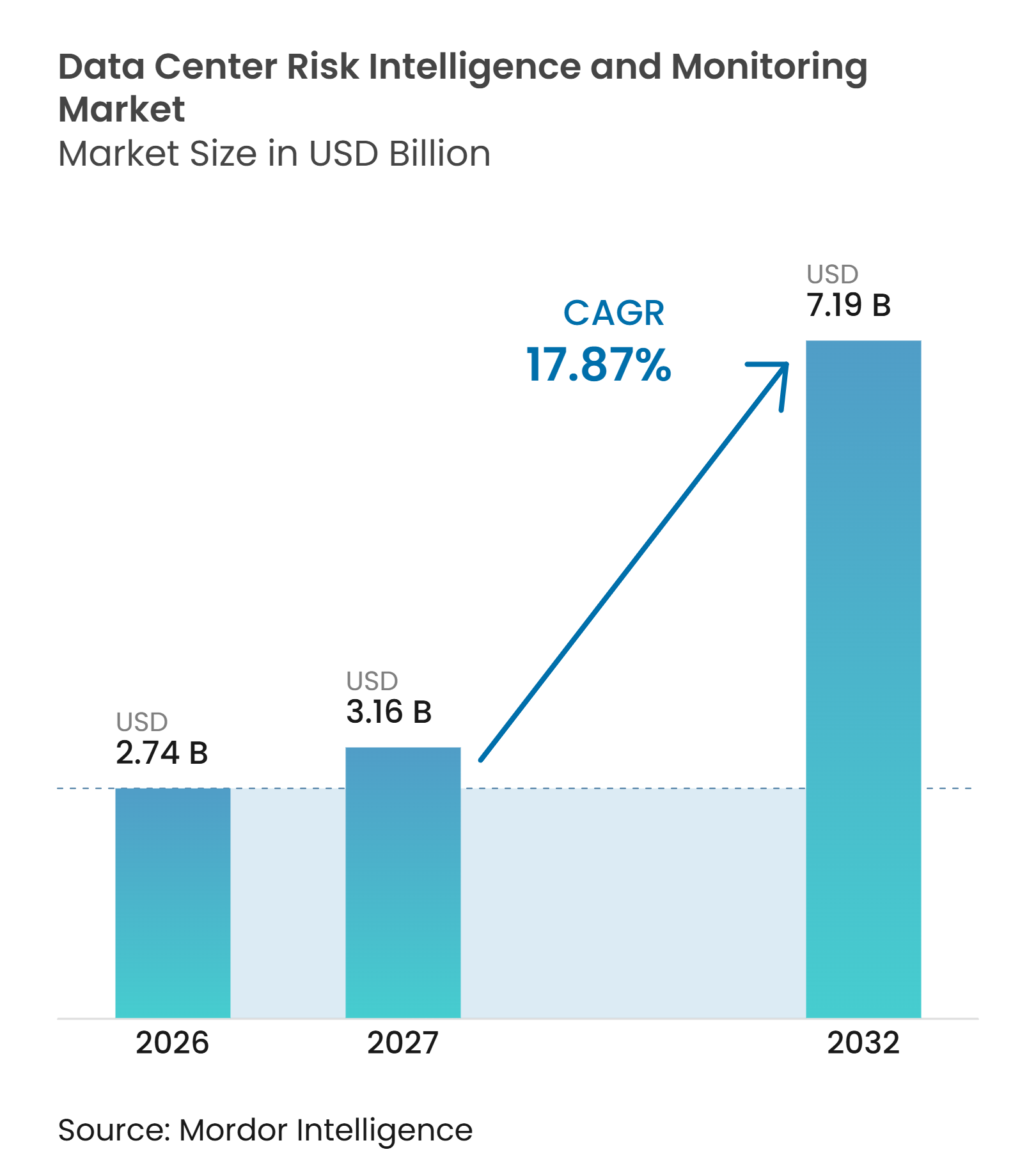
| Market Size (2027) | USD 3.16 Billion |
| Market Size (2032) | USD 7.19 Billion |
| Growth Rate (2027 - 2032) | 17.87 % |
| Fastest Growing Market | Asia-Pacific |
| Largest Market | North America |
| Market Concentration | Medium |
Major Players *Disclaimer: Major Players sorted in no particular order Image © Mordor Intelligence. Reuse requires attribution under CC BY 4.0. | |
Data Center Risk Intelligence and Monitoring Market Analysis by Mordor Intelligence
The data center risk intelligence and monitoring market size is projected to be USD 2.74 billion in 2026, USD 3.16 billion in 2027, and reach USD 7.19 billion by 2032, growing at a CAGR of 17.87% from 2027 to 2032. AI workloads are placing greater pressure on power and cooling systems, increasing the value of continuous monitoring and early warning of equipment issues across both new and operating sites. The cost of outages is also moving risk management from a facility concern to a financial control issue for operators with major service commitments and customers that expect consistent availability, especially when an equipment fault can affect several dependent systems. Energy reporting, resilience requirements, and data auditability are becoming part of operational requirements in several regions, increasing the need for complete, easy-to-review records across facilities and operating teams. Vendors are responding by combining infrastructure telemetry, external hazard data, and cyber risk signals in platforms that can support portfolio-level decisions, reduce reliance on separate point tools, and give decision-makers a more connected view of exposure.
Key Report Takeaways
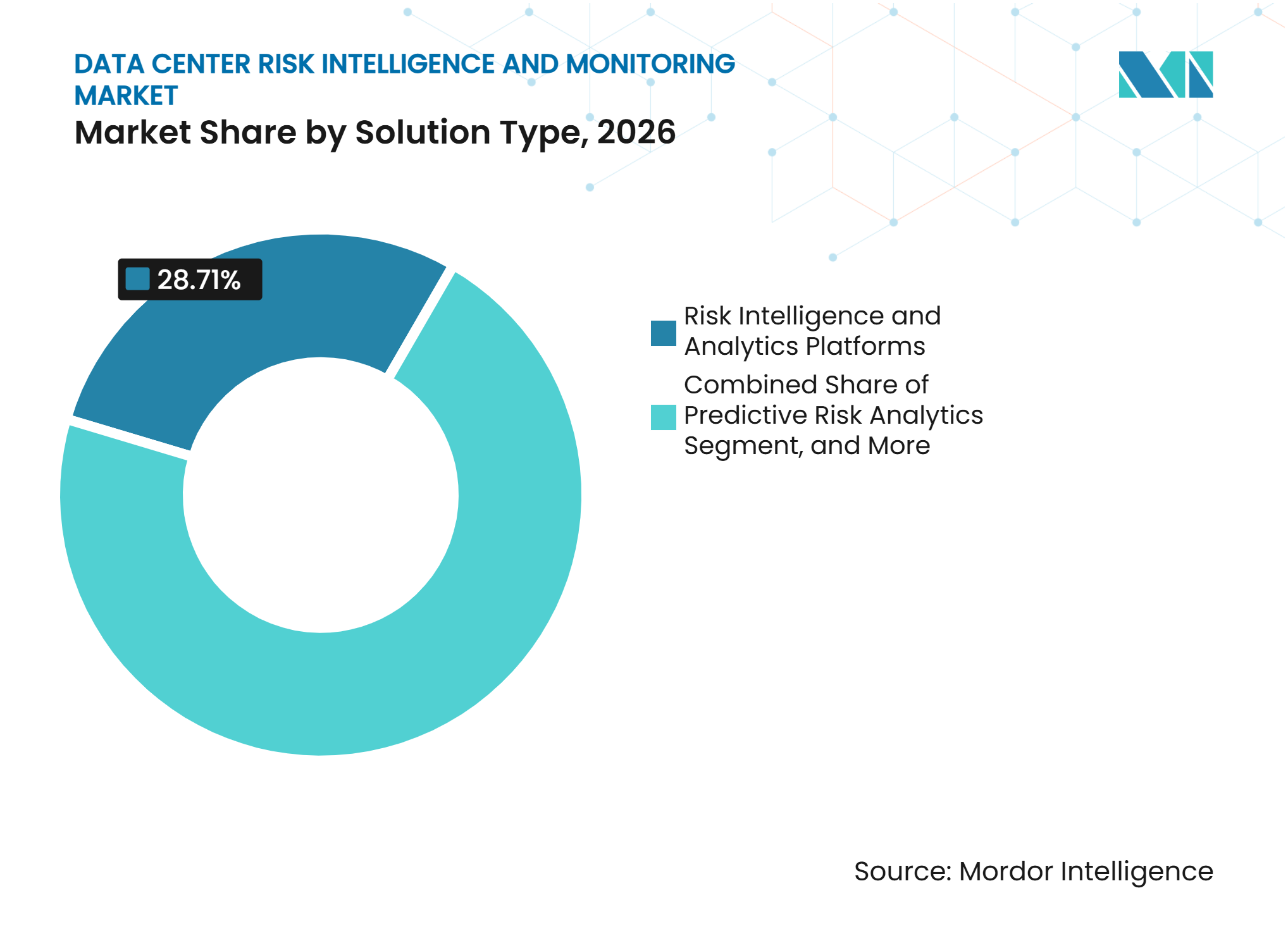
- By solution type, Risk Intelligence and Analytics Platforms held 28.71% of the data center risk intelligence and monitoring market share in 2026, while Predictive Risk Analytics is projected to expand at an 18.92% CAGR through 2032.
- By risk data category, Facility and Equipment Condition Data accounted for 29.21% of the data center risk intelligence and monitoring market size in 2026, while Regulatory and Compliance Risk Data is projected to expand at an 18.63% CAGR through 2032.
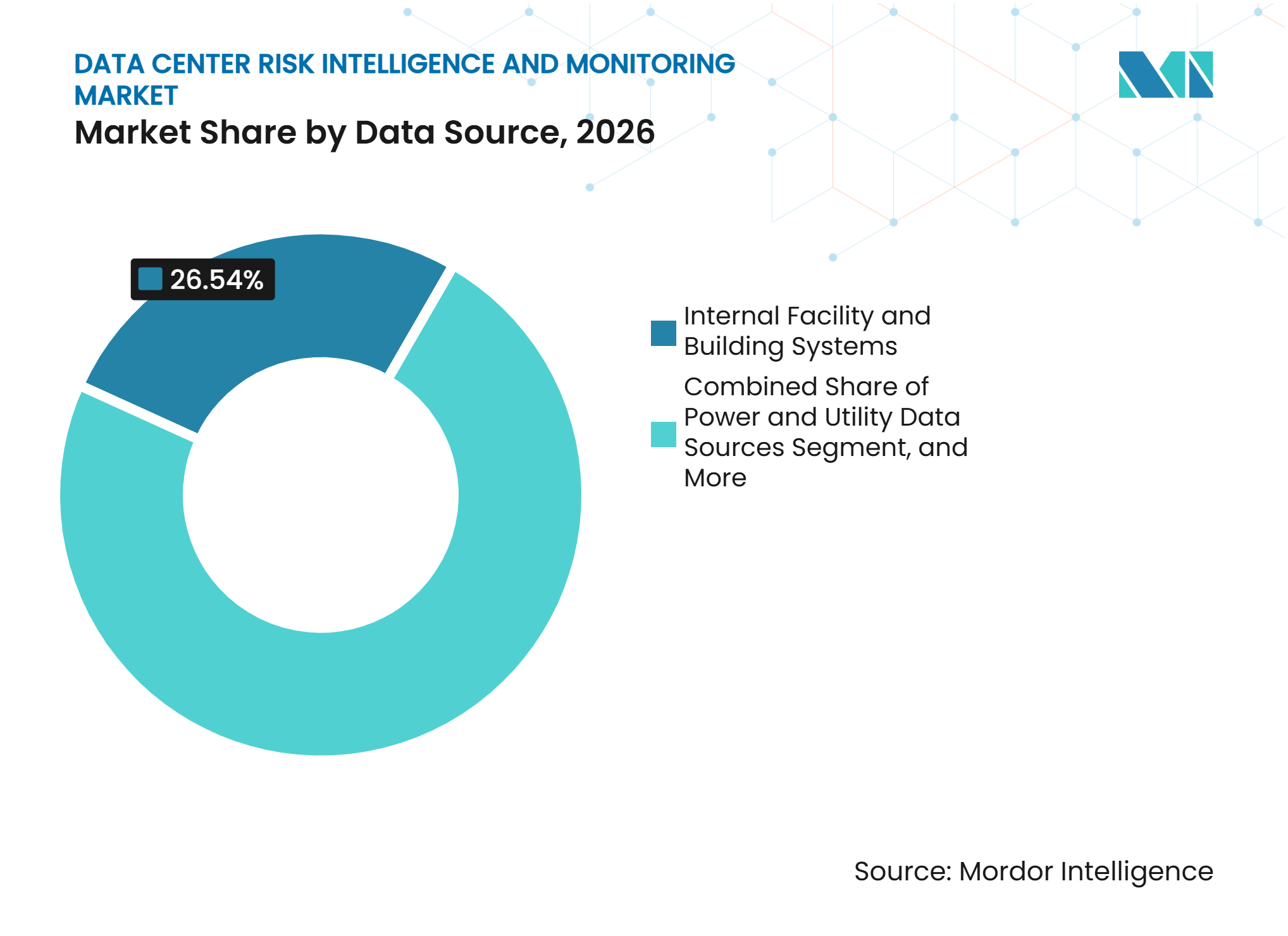
- By data source, Internal Facility and Building Systems held 26.54% of revenue in 2026, while Public Safety and Regulatory Information Sources are expected to expand at a 19.59% CAGR through 2032.
- By application, Operational Risk Monitoring held 26.28% of revenue in 2026, while Site Selection and Portfolio Risk Assessment is projected to expand at a 21.27% CAGR through 2032.
- By deployment model, Cloud-Based Platforms accounted for 67.64% of revenue in 2026 and are projected to expand at an 18.38% CAGR through 2032.
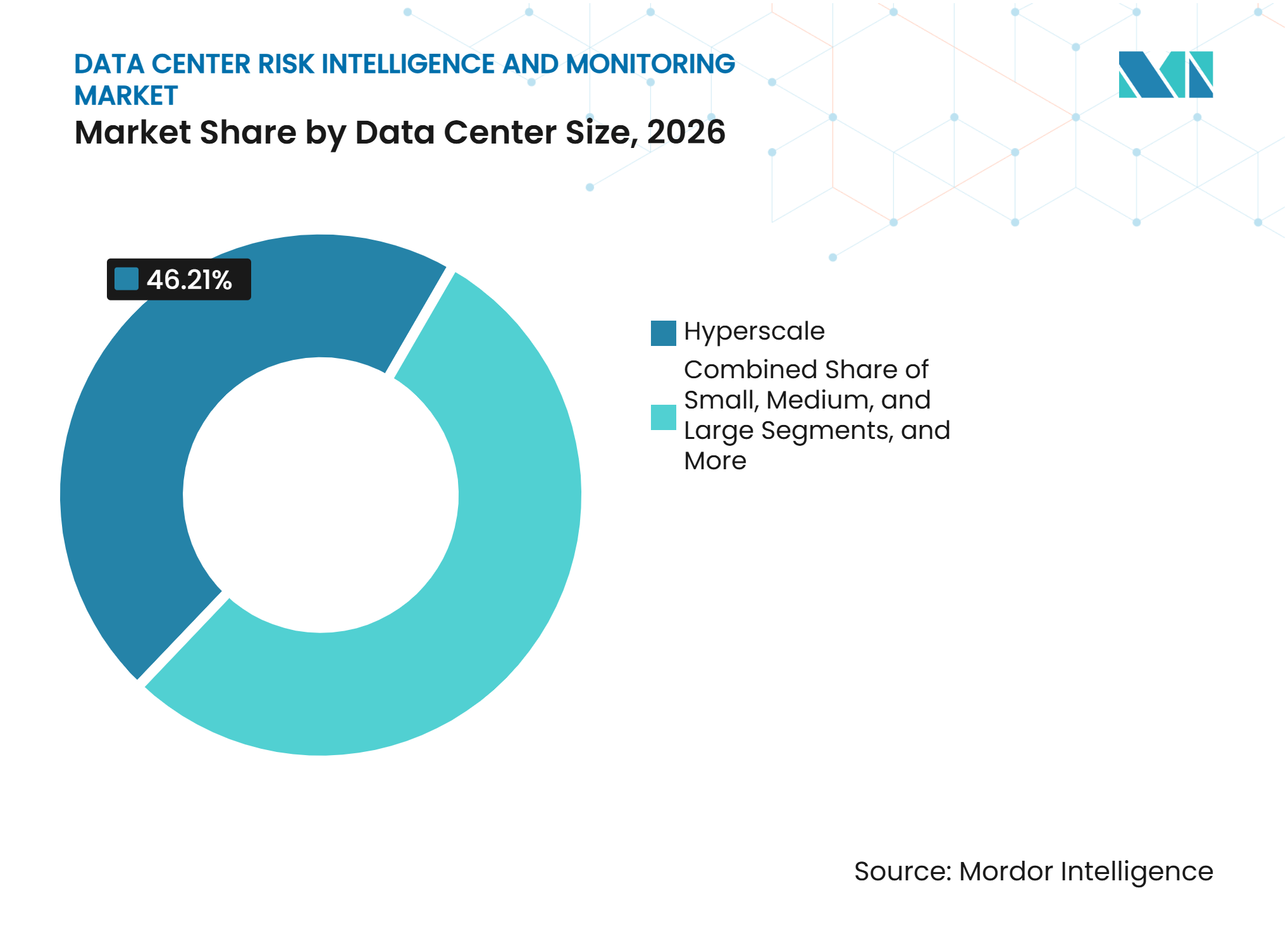
- By data center size, Hyperscale data centers held 46.21% of the data center risk intelligence and monitoring market revenue in 2026 and are projected to expand at a 19.27% CAGR through 2032.
- By data center type, Cloud Service Providers held 48.64% of revenue in 2026 and are expected to expand at a 20.38% CAGR through 2032.
- By geography, North America held 39.42% of the data center risk intelligence and monitoring market revenue in 2026, while Asia-Pacific is projected to expand at a 21.91% CAGR through 2032.
Note: Market numbers in this report are based on Mordor Intelligence's proprietary estimation framework, which combines nine months of actuals with Q4 projections for base year 2026.
Market Trends and Insights
Drivers Impact Analysis of Data Center Risk Intelligence and Monitoring Market*
| Driver | (~) % Impact on CAGR Forecast | Geographic Relevance | Impact Timeline |
|---|---|---|---|
| AI and High-Density Workloads Increasing Thermal and Power Risk | +5.2% | Global, concentrated in North America, Asia-Pacific core markets, and Western Europe | Short term (≤ 2 years) |
| Escalating Cost of Unplanned Downtime | +4.1% | Global | Short term (≤ 2 years) |
| Regulatory Pressure for Energy, Resilience, and Auditability | +3.3% | North America and Europe, with spillover to Asia-Pacific and the Middle East | Medium term (2-4 years) |
| Convergence of Cyber and Physical Risk Intelligence | +2.4% | Global, with early deployment in North America and Western Europe | Medium term (2-4 years) |
| Expansion of Edge and Distributed Data Center Footprints | +1.8% | Asia-Pacific core markets, with spillover to South America and Africa | Medium term (2-4 years) |
| Shift From Calendar-Based to Condition-Based Maintenance | +1.2% | Global, with early adoption in North America and Europe | Long term (≥ 4 years) |
| Source: Mordor Intelligence | |||
AI and High-Density Workloads Increase Thermal and Power Risk
AI workloads place power and thermal systems under conditions that conventional monitoring tools were not designed to manage. AI server power density increased 11 times between 2020 and 2025, and the International Energy Agency expects a further fourfold increase by 2027. An advanced AI rack can draw peak electricity equivalent to 65 households, which increases the importance of coordinated power and cooling oversight.[1] Operators need real-time signals that relate power loads to cooling availability and UPS health rather than separate alarm streams. Inference workloads can also create rapid start-stop demand patterns that are harder to model than more continuous training workloads. This operating environment is strengthening the data center risk intelligence and monitoring market for predictive analytics because fixed thresholds may not recognize developing risk soon enough.
Escalating Cost of Unplanned Downtime
The financial impact of an outage is making continuous risk monitoring more important in investment decisions. In Uptime Institute's 2025 survey, 20% of respondents reporting a significant outage said the incident cost more than USD 1 million. A further 37% reported costs from USD 100,000 to USD 1 million, while power issues remained the leading cause of impactful incidents at 45%.[2] For AI-intensive facilities, an interruption can combine service-level penalties with unrecoverable compute time from disrupted workloads. This exposure supports the data center risk intelligence and monitoring market for tools that identify power, cooling, and equipment risks before service is affected.
Regulatory Pressure for Energy, Resilience, and Auditability
Energy and resilience rules are making verified operating records more important for data center operators. The European Commission requires reporting of power usage effectiveness and water usage effectiveness metrics through the European data center database. In September 2026, the Commission opened a consultation on minimum performance standards and a common energy rating scheme, with a legislative proposal planned for the second quarter of 2027. These requirements favor systems that create continuous records of equipment condition, energy use, and resilience status. Automated data integration supports the data center risk intelligence and monitoring market by helping operators prepare evidence for compliance reviews instead of assembling it after an issue occurs.
Cyber and Physical Risk Intelligence Converge
The integration of IT and operational technology has made physical security and cyber risk more closely linked. Dragos reported that adversaries are targeting DCIM software because it sits at the intersection of IT and facility operations, where responsibility is often unclear. The ISC survey found that 93% of organizations had adopted hybrid cyber and physical monitoring solutions, yet 77% still suspected coverage gaps. Operators therefore need platforms that can integrate access anomalies, sensor readings, and network events into a single operational view. This need supports the data center risk intelligence and monitoring market for explainable risk scoring, since an inaccurate all-clear signal can be more damaging than an alert that requires review.
Restraints Impact Analysis of Data Center Risk Intelligence and Monitoring Market*
| Restraint | (~) % Impact on CAGR Forecast | Geographic Relevance | Impact Timeline |
|---|---|---|---|
| High Implementation Cost and Integration Complexity | -2.4% | Global, most acute in emerging markets and enterprises with legacy infrastructure | Medium term (2-4 years) |
| Cybersecurity and Model-Governance Concerns Around Connected Monitoring | -1.9% | Global, with greatest sensitivity in regulated North American and European sectors | Medium term (2-4 years) |
| Shortage of Data Center Operations and Reliability Specialists | -1.3% | Global, most severe in emerging Asia-Pacific markets and Africa | Long term (≥ 4 years) |
| Incomplete Asset, Sensor, and Maintenance Data | -0.8% | Global, most acute in legacy enterprise and colocation environments | Long term (≥ 4 years) |
| Source: Mordor Intelligence | |||
High Implementation Cost and Integration Complexity
Risk intelligence deployments can require custom connectors, sensor upgrades, hardware changes, and workforce training before they operate at the asset level. These needs are especially demanding when facilities use equipment from several manufacturers and rely on long-established operational systems. Integration work is also organizational because facility, IT, and security teams often classify incidents differently and use separate tools. This can delay a common view of power, cooling, and security conditions. Mid-sized operators and providers in developing markets face the same need for better monitoring as large operators but have fewer engineering resources. The data center risk intelligence and monitoring market therefore faces a practical adoption barrier where integration cost is difficult to separate from the value of the software itself.
Cybersecurity and Model Governance Concerns Around Connected Monitoring
A platform that connects IT, operational technology, and physical security data can add new points of exposure. A Department of Energy cohort report identified interconnection vulnerabilities, fragmented governance, and inconsistent cybersecurity requirements as cross-cutting issues in data center monitoring environments. Uptime Intelligence also reported an increase in CVE disclosures for established DCIM products, alongside more ransomware activity affecting operational technology. Operators must balance broader visibility against tighter controls over how telemetry is collected, stored, and accessed. Model governance matters for the same reason because incomplete or manipulated inputs can lead to misleading risk scores. NIST's AI Risk Management Framework is consequently becoming relevant to vendor evaluation where AI-based monitoring is proposed.
*Our forecasts treat driver/restraint impacts as directional, not additive. The impact forecasts reflect baseline growth, mix effects, and variable interactions.
Data Center Risk Intelligence and Monitoring Market Segment Analysis
By Solution Type:
Platform Consolidation Supports Earlier Risk DetectionRisk Intelligence and Analytics Platforms held 28.71% of revenue in 2026. Their position reflects a preference for tools that combine multiple sources of operational and external risk data instead of separate applications for each use case. Real-Time Risk Monitoring Software, reporting tools, and early warning systems remain relevant where operators need direct visibility into specific events. However, high-density facilities require a broader view because a power issue can quickly influence cooling and IT performance. The data center risk intelligence and monitoring industry is moving away from isolated alarm management toward coordinated review of risk conditions.
Predictive Risk Analytics is projected to expand at an 18.92% CAGR through 2032. The segment addresses the need to identify failure patterns from equipment and environmental data before an incident occurs, especially where rapidly changing AI loads make simple static thresholds less useful. In January 2026, Vertiv introduced Vertiv Next Predict, a managed predictive maintenance service that applies machine learning across power, cooling, and IT systems.[3] Data integration platforms and managed services add value for operators that have limited internal analytics capacity and lack teams dedicated to interpreting diverse facility signals. These offerings extend the addressable need beyond software licenses to continuing support for data interpretation, maintenance planning, and action.



By Risk Data Category:
Equipment Data Leads While Compliance Data AdvancesFacility and Equipment Condition Data held 29.21% of category revenue in 2026. Thermal, vibration, and electrical monitoring of power and cooling assets is central to operating high-density facilities safely. This data supports decisions on equipment health, maintenance timing, and potential service disruption. Weather, utility, climate, incident, supply chain, physical security, and regulatory data provide additional context for these decisions. A combined data model is becoming more useful as portfolios expand across locations with different exposures.
Regulatory and Compliance Risk Data is projected to expand at an 18.63% CAGR through 2032. The segment supports continuous records for operators that must demonstrate energy performance, water use, and resilience across facilities with different operating and reporting requirements. S&P Global Sustainable reported that 43% of global data centers face high water stress in the 2020s, reinforcing the operational role of environmental data in site resilience planning. Schneider Electric stated that its condition-based maintenance programs can reduce on-site maintenance interventions by up to 40% and total cost of ownership by 20%.[4] This need is supporting the data center risk intelligence and monitoring market through demand for operating evidence that also serves compliance needs and allows teams to identify issues before a formal review.
By Data Source:
Internal Systems Remain the Core Operational InputInternal Facility and Building Systems held 26.54% of data source revenue in 2026. Building management systems, DCIM platforms, and SCADA systems provide core telemetry on physical assets and facility performance. Their value depends increasingly on data normalization, lower latency, and links to external information. Equipment networks, utility feeds, environmental providers, geospatial sources, and vendor data add the wider context needed for operational decisions. Internal systems remain the foundation for local asset visibility in the data center risk intelligence and monitoring market.
Public Safety and Regulatory Information Sources are projected to expand at a 19.59% CAGR through 2032. Operators use these sources to bring regulatory updates, grid notices, and public safety alerts into a more complete risk view that complements equipment telemetry from inside the facility. This process can help teams identify exposure before it appears in internal equipment readings or develops into a direct service incident. It also makes compliance information a live operating input rather than a record used only for reporting after an event. The result is a more layered architecture that connects facility telemetry with risks beyond the site boundary and supports a shared view across operating functions.

By Application:
Operational Monitoring Remains the Base Use CaseOperational Risk Monitoring accounted for 26.28% of application revenue in 2026. It remains the basic application because all facility operators need a current view of equipment, power, cooling, and potential disruptions. Monitoring for utilities, climate hazards, equipment failures, security events, suppliers, and business continuity serves more specific operating needs. Those applications are increasingly being connected in broader platforms. This approach helps teams assess how a problem in one area could affect service in another.
Site Selection and Portfolio Risk Assessment is projected to expand at a 21.27% CAGR through 2032. The application is becoming more important as developers evaluate power availability, climate exposure, regulation, water conditions, and infrastructure readiness before committing capital to a location. It also helps operators compare risk across existing locations rather than reviewing each site in isolation with separate assumptions and data sources. Integrated assessment can inform greenfield development, acquisitions, and expansion plans, particularly when time between a site decision and construction is limited. This change supports the data center risk intelligence and monitoring market because site and portfolio decisions require data that goes beyond conventional facility monitoring.
By Deployment Model:
Cloud Platforms Support Multi-Site OperationsCloud-Based Platforms accounted for 67.64% of deployment revenue in 2026. The large share reflects the need to manage geographically distributed portfolios from a central environment. Cloud delivery can reduce the burden of maintaining separate software instances at each location. It can also support consistent reporting and access across operating teams. The data center risk intelligence and monitoring market is therefore centered on scalable, centrally managed architectures for many operators.
Cloud-Based Platforms are projected to expand at an 18.38% CAGR through 2032. In May 2026, IBM introduced Concert as a platform available through SaaS and on-premises deployment. The availability of both models recognizes that some regulated customers retain data residency or control requirements and cannot apply one deployment approach to every workload. Hybrid platforms can keep operational technology telemetry closer to the facility while using cloud tools for aggregation, reporting, and coordinated analysis across sites. This flexibility supports the data center risk intelligence and monitoring market where sovereignty rules limit how certain data can be routed.
By Data Center Size:
Hyperscale Facilities Combine Scale and Fast ExpansionHyperscale data centers held 46.21% of revenue by data center size in 2026. These facilities manage large power loads and concentrated computing capacity, creating demand for risk tools that can operate across complex physical systems. Large and medium facilities also need these tools, although their operational scope is often more limited. Small sites can use condition monitoring to extend asset life and delay replacements. Edge facilities add another need for lightweight monitoring that can operate with limited local resources.
Hyperscale facilities are projected to expand at a 19.27% CAGR through 2032. New hyperscale facilities require risk management systems to be considered alongside design and commissioning because power, cooling, and IT systems are closely interdependent at these sites. The data center risk intelligence and monitoring market must scale oversight as physical capacity is added and operating teams need a consistent view across large technical estates. Edge deployments also broaden demand where dispersed sites require monitoring suited to their smaller footprint, limited staffing, and different latency requirements. This mix of large centralized sites and smaller distributed sites requires distinct monitoring models and deployment options.
By Data Center Type:
Cloud Service Providers Lead DemandCloud Service Providers held 48.64% of revenue by data center type in 2026. Their multi-region footprints and rapid capacity additions make continuous risk intelligence necessary across many facilities. Colocation providers have different needs because they support multiple tenants whose workloads can vary significantly. Enterprise and edge facilities are smaller individually, but their combined number still creates a material base for monitoring deployments. The data center risk intelligence industry increasingly serves cloud and colocation providers as important buyers of platform-level systems.
Cloud Service Providers are projected to expand at a 20.38% CAGR through 2032. The segment needs risk information that can be applied consistently across regions, operating teams, and facilities that may have different equipment and utility conditions. It also benefits from central systems that relate infrastructure conditions to service-level commitments, helping teams prioritize issues that could affect customers. Colocation providers need tenant-aware reporting and visibility across shared physical assets because workload patterns can differ across customers within one site. Enterprise and edge operators continue to add demand as they address aging equipment, local resilience, and AI inference workloads.
Geography Analysis
North America
North America held 39.42% of revenue in 2026. The region has the highest concentration of hyperscale and colocation capacity, which gives risk platform vendors a large installed base. Development is extending into West Texas, Pennsylvania, and Alberta, where power, water, and grid conditions can differ from established hubs. The Federal Reserve estimated that annualized U.S. data center investment would reach USD 370 billion by the second quarter of 2026, making portfolio-level site and operational risk assessment more valuable. NIST guidance on operational technology security exerts regulatory influence on connected monitoring deployments, while the data center risk intelligence and monitoring market benefits from systems that can assess varying local conditions.
Asia-Pacific
Asia-Pacific is projected to expand at a 21.91% CAGR through 2032. The region combines rapid construction with a wide range of climate, power, and regulatory conditions. Operators must manage local data requirements, energy efficiency obligations, seismic risk, and varied grid conditions across markets. These factors increase the relevance of regulatory, utility, and environmental data in the data center risk intelligence and monitoring market. More automated data management can help providers apply consistent controls across locations without treating the region as a single operating environment.
Europe, South America, the Middle East, and Africa
Europe is shaped by energy performance and reporting rules that encourage the maintenance of continuous, auditable operating records. The European Commission's work on data center performance standards and ratings gives energy and water metrics greater regulatory influence, while the United Kingdom, Germany, the Netherlands, and France retain mature colocation markets. Poland, Spain, and Scandinavia attract investment linked to power availability and renewable energy, while South America, the Middle East, and Africa add demand through developing cloud, colocation, and AI capacity. Brazil leads early cloud and colocation expansion, while the UAE, Saudi Arabia, South Africa, Egypt, and Kenya face different combinations of heat, power constraints, climate variability, and local compliance factors. These regional conditions create a broader need for tools that combine operational data with local hazards and evolving compliance requirements in the data center risk intelligence and monitoring market.
Competitive Landscape
Market Concentration
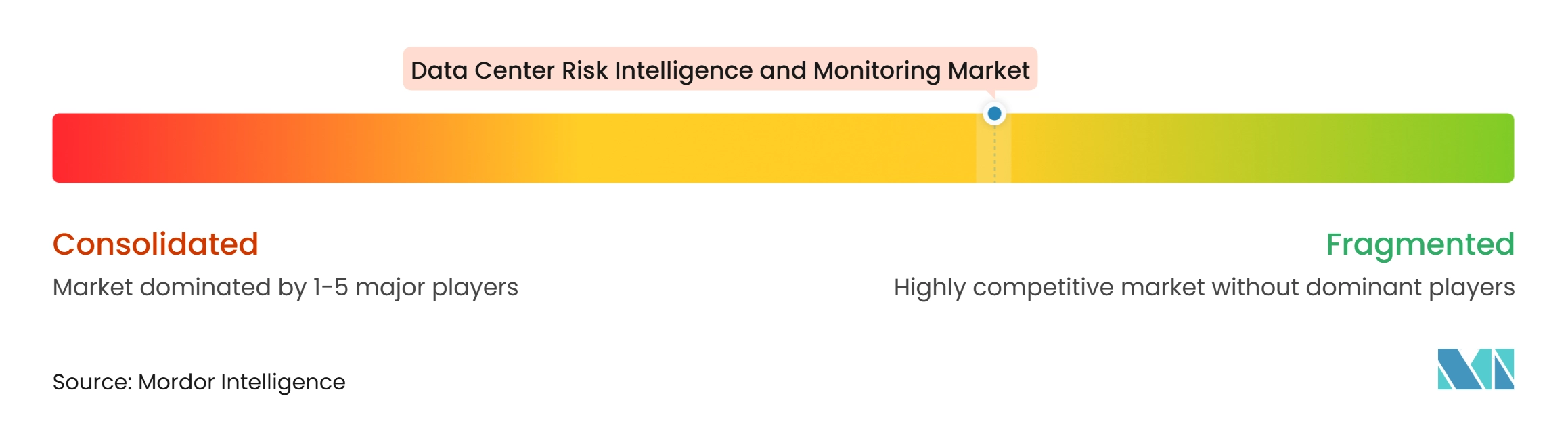
The data center risk intelligence and monitoring market is moderately fragmented because no single supplier fully covers facility monitoring, external risk data, event management, and cyber-physical integration. Schneider Electric, Vertiv, Siemens, Honeywell, and Johnson Controls compete through infrastructure management and DCIM capabilities. Everbridge and AlertMedia address critical event communication and incident response, while Verisk, Moody's, S&P Global, and Jupiter Intelligence bring external climate and risk information into related use cases. This mix creates a clear need for interoperability among products designed for different parts of the risk process.
Schneider Electric expanded the AI capabilities of EcoStruxure IT in July 2026, shifting the platform toward predictive anomaly detection, alarm analysis, and optimization recommendations. IBM introduced Concert in May 2026 to bring observability, incident management, resource optimization, and risk exposure management together across technology environments. Dataminr launched Dataminr for Cyber Defense in March 2026, combining external risk intelligence with internal threat posture data. These moves show that suppliers are adding predictive and cross-domain capabilities rather than relying on conventional status reporting. Partnerships and data integrations are also becoming a practical way to expand coverage without rebuilding every capability internally.
Opportunities remain among mid-sized colocation providers, edge sites, and owners with mixed portfolios of monitoring systems. These buyers need broad functional coverage but may not have the budget or engineering teams that hyperscale operators do. Suppliers that simplify integration and deliver actionable information from heterogeneous data can address this gap. Alignment with NIST SP 800-82 and the NIST AI Risk Management Framework can help vendors meet governance expectations in regulated procurement. The competitive outcome in the data center risk intelligence and monitoring market will depend on how well platforms connect physical, cyber, environmental, and regulatory information without increasing implementation burdens.
Data Center Risk Intelligence and Monitoring Industry Leaders
-
Everbridge, Inc.
-
ServiceNow
-
IBM Corporation
-
Microsoft Corporation
-
Dataminr
- *Disclaimer: Major Players sorted in no particular order
Data Center Risk Intelligence and Monitoring Market Companies Covered in this Report
- Everbridge, Inc.
- ServiceNow
- IBM Corporation
- Microsoft Corporation
- Dataminr
- AlertMedia
- Riskonnect
- Resolver
- DNV
- Verisk Analytics, Inc.
- Moody’s
- SandP Global
- Jupiter Intelligence
- Climate X
- Vaisala
- Tomorrow.io
- Schneider Electric SE
- Vertiv Holdings Co
- Siemens AG
- Honeywell International Inc.
- Johnson Controls International plc
- Huawei Technologies Co., Ltd.
- Cisco Systems, Inc.
Recent Industry Developments in Data Center Risk Intelligence and Monitoring Market
- September 2026: The European Commission launched a public consultation and call for evidence on proposed minimum performance standards for data centers on September 21, 2026, alongside a proposed common energy rating scheme. The legislative proposal is planned for Q2 2027 and introduces quantified energy and water efficiency benchmarks as enforceable prerequisites for grid connection permits across EU member states, with significant implications for risk intelligence and compliance data demand.
- July 2026: Schneider Electric expanded the AI capabilities of its EcoStruxure IT platform, transitioning the product from conventional infrastructure monitoring to predictive, AI-driven anomaly detection, alarm analysis, and optimization recommendations. This positions EcoStruxure IT as a proactive risk intelligence and operations management platform, extending Schneider Electric's competitive reach beyond DCIM into the risk analytics layer.
- June 2026: Everbridge and ServiceNow expanded their strategic partnership through Everbridge xMatters, enabling AI-driven digital operations workflow orchestration for major incident response. The integration automates response workflows, engages response teams faster, and coordinates actions across monitoring, ITSM, collaboration, and remediation systems, extending the earlier Emergency Event Management partnership into continuous digital operations.
- May 2026: IBM launched Concert platform, an agentic operations platform unifying full-stack observability, resource optimization, incident management, and risk exposure management across applications, infrastructure, networks, and security. Concert platform became available as both a SaaS offering and through on-premises deployment, addressing regulated environments that require data residency control alongside cloud-delivered analytics.
Global Data Center Risk Intelligence and Monitoring Market Report Scope
The data center risk intelligence and monitoring market comprises solutions and services that continuously identify, assess, monitor, and help mitigate risks to data center facilities, infrastructure, operations, and connectivity. These offerings combine real-time monitoring, threat intelligence, analytics, and expert advisory to address physical security, cyber threats, power and cooling failures, environmental hazards, supply-chain disruption, regulatory changes, and geopolitical risks.
The Data Center Risk Intelligence and Monitoring Market Report is Segmented by Solution Type (Risk Intelligence and Analytics Platforms, Real-Time Risk Monitoring Software, Risk Dashboard and Reporting Solutions, Predictive Risk Analytics, Early Warning and Alerting Systems, Risk Data Integration and Aggregation Platforms, and Risk Intelligence Advisory and Managed Services), Risk Data Category (Weather and Natural Hazard Data, Climate and Environmental Risk Data, Power Grid and Utility Risk Data, Facility and Equipment Condition Data, Operational Incident and Downtime Data, Supply Chain and Vendor Risk Data, Physical Security Risk Data, and Regulatory and Compliance Risk Data), Data Source (Internal Facility and Building Systems, Power and Utility Data Sources, Weather and Environmental Data Providers, External Hazard and Geospatial Data, Equipment and Sensor Networks, Third-Party Vendor and Supply Chain Data, and Public Safety and Regulatory Information Sources), Application (Operational Risk Monitoring, Power and Utility Disruption Monitoring, Climate and Natural Hazard Monitoring, Equipment Failure and Maintenance Risk, Security Incident Monitoring, Supplier and Supply Chain Risk Monitoring, Business Continuity and Incident Response Support, and Site Selection and Portfolio Risk Assessment), Deployment Model (Cloud-Based Platforms, On-Premises Platforms, and Hybrid Platforms), Data Center Size (Small, Medium, Large, and Hyperscale), Data Center Type (Colocation, Cloud Service Providers (CSPs), and Enterprise and Edge), and Geography (North America, South America, Europe, Asia-Pacific, Middle East, and Africa). The Market Forecasts are Provided in Terms of Value (USD).
Segmentation Overview
| Risk Intelligence and Analytics Platforms |
| Real-Time Risk Monitoring Software |
| Risk Dashboard and Reporting Solutions |
| Predictive Risk Analytics |
| Early Warning and Alerting Systems |
| Risk Data Integration and Aggregation Platforms |
| Risk Intelligence Advisory and Managed Services |
| Weather and Natural Hazard Data |
| Climate and Environmental Risk Data |
| Power Grid and Utility Risk Data |
| Facility and Equipment Condition Data |
| Operational Incident and Downtime Data |
| Supply Chain and Vendor Risk Data |
| Physical Security Risk Data |
| Regulatory and Compliance Risk Data |
| Internal Facility and Building Systems |
| Power and Utility Data Sources |
| Weather and Environmental Data Providers |
| External Hazard and Geospatial Data |
| Equipment and Sensor Networks |
| Third-Party Vendor and Supply Chain Data |
| Public Safety and Regulatory Information Sources |
| Operational Risk Monitoring |
| Power and Utility Disruption Monitoring |
| Climate and Natural Hazard Monitoring |
| Equipment Failure and Maintenance Risk |
| Security Incident Monitoring |
| Supplier and Supply Chain Risk Monitoring |
| Business Continuity and Incident Response Support |
| Site Selection and Portfolio Risk Assessment |
| Cloud-Based Platforms |
| On-Premises Platforms |
| Hybrid Platforms |
| Small |
| Medium |
| Large |
| Hyperscale |
| Colocation |
| Cloud Service Providers (CSPs) |
| Enterprise and Edge |
| North America | United States |
| Canada | |
| Mexico | |
| South America | Brazil |
| Argentina | |
| Chile | |
| Colombia | |
| Rest of South America | |
| Europe | United Kingdom |
| Germany | |
| France | |
| Netherlands | |
| Rest of Europe | |
| Asia-Pacific | China |
| India | |
| Japan | |
| Singapore | |
| Australia | |
| Rest of Asia-Pacific | |
| Middle East | United Arab Emirates |
| Saudi Arabia | |
| Israel | |
| Rest of Middle East | |
| Africa | South Africa |
| Egypt | |
| Kenya | |
| Rest of Africa |
| By Solution Type | Risk Intelligence and Analytics Platforms | |
| Real-Time Risk Monitoring Software | ||
| Risk Dashboard and Reporting Solutions | ||
| Predictive Risk Analytics | ||
| Early Warning and Alerting Systems | ||
| Risk Data Integration and Aggregation Platforms | ||
| Risk Intelligence Advisory and Managed Services | ||
| By Risk Data Category | Weather and Natural Hazard Data | |
| Climate and Environmental Risk Data | ||
| Power Grid and Utility Risk Data | ||
| Facility and Equipment Condition Data | ||
| Operational Incident and Downtime Data | ||
| Supply Chain and Vendor Risk Data | ||
| Physical Security Risk Data | ||
| Regulatory and Compliance Risk Data | ||
| By Data Source | Internal Facility and Building Systems | |
| Power and Utility Data Sources | ||
| Weather and Environmental Data Providers | ||
| External Hazard and Geospatial Data | ||
| Equipment and Sensor Networks | ||
| Third-Party Vendor and Supply Chain Data | ||
| Public Safety and Regulatory Information Sources | ||
| By Application | Operational Risk Monitoring | |
| Power and Utility Disruption Monitoring | ||
| Climate and Natural Hazard Monitoring | ||
| Equipment Failure and Maintenance Risk | ||
| Security Incident Monitoring | ||
| Supplier and Supply Chain Risk Monitoring | ||
| Business Continuity and Incident Response Support | ||
| Site Selection and Portfolio Risk Assessment | ||
| By Deployment Model | Cloud-Based Platforms | |
| On-Premises Platforms | ||
| Hybrid Platforms | ||
| By Data Center Size | Small | |
| Medium | ||
| Large | ||
| Hyperscale | ||
| By Data Center Type | Colocation | |
| Cloud Service Providers (CSPs) | ||
| Enterprise and Edge | ||
| By Geography | North America | United States |
| Canada | ||
| Mexico | ||
| South America | Brazil | |
| Argentina | ||
| Chile | ||
| Colombia | ||
| Rest of South America | ||
| Europe | United Kingdom | |
| Germany | ||
| France | ||
| Netherlands | ||
| Rest of Europe | ||
| Asia-Pacific | China | |
| India | ||
| Japan | ||
| Singapore | ||
| Australia | ||
| Rest of Asia-Pacific | ||
| Middle East | United Arab Emirates | |
| Saudi Arabia | ||
| Israel | ||
| Rest of Middle East | ||
| Africa | South Africa | |
| Egypt | ||
| Kenya | ||
| Rest of Africa | ||
Key Questions Answered in the Report
What is the data center risk intelligence and monitoring market size?
The data center risk intelligence and monitoring market size is projected to be USD 2.74 billion in 2026, USD 3.16 billion in 2027, and reach USD 7.19 billion by 2032, growing at a CAGR of 17.87% from 2027 to 2032.
What is driving adoption of data center risk intelligence platforms?
High-density AI workloads, outage costs, energy and resilience requirements, and the need to connect cyber and physical risk signals support adoption. These factors make integrated monitoring more relevant to operating and investment decisions.
Which solution type leads data center risk intelligence and monitoring?
Risk Intelligence and Analytics Platforms lead with a 28.71% share in 2026, while Predictive Risk Analytics is projected to expand at an 18.92% CAGR through 2032. The combination reflects a move toward connected and forward-looking analysis.
Why are cloud-based platforms important for risk monitoring?
Cloud-Based Platforms held 67.64% of revenue in 2026 because they support centralized management across multi-site portfolios. Hybrid deployment remains relevant where operational data must remain closer to the facility.
Which region is expanding fastest for data center risk intelligence and monitoring?
Asia-Pacific is projected to expand at a 21.91% CAGR through 2032, supported by rapid construction and varied power, climate, and regulatory needs. These differences increase the value of local risk context and consistent controls.
How do data centers use predictive risk analytics?
Predictive analytics reviews equipment and environmental patterns to identify developing failure risks before they interrupt power, cooling, or IT services. This allows maintenance and operating teams to act earlier on emerging concerns, prioritize inspections from changing equipment conditions, and coordinate corrective action before a developing fault becomes a wider service interruption.