
Cryogenic PPE Market Size and Share
Market Overview
| Study Period | 2020 - 2031 |
|---|---|
| Market Size (2026) | USD 271.55 Million |
| Market Size (2031) | USD 376.06 Million |
| Growth Rate (2026 - 2031) | 6.73 % |
| Fastest Growing Market | Asia-Pacific |
| Largest Market | North America |
| Market Concentration | Medium |
Major Players *Disclaimer: Major Players sorted in no particular order Image © Mordor Intelligence. Reuse requires attribution under CC BY 4.0. | |
Cryogenic PPE Market Analysis by Mordor Intelligence
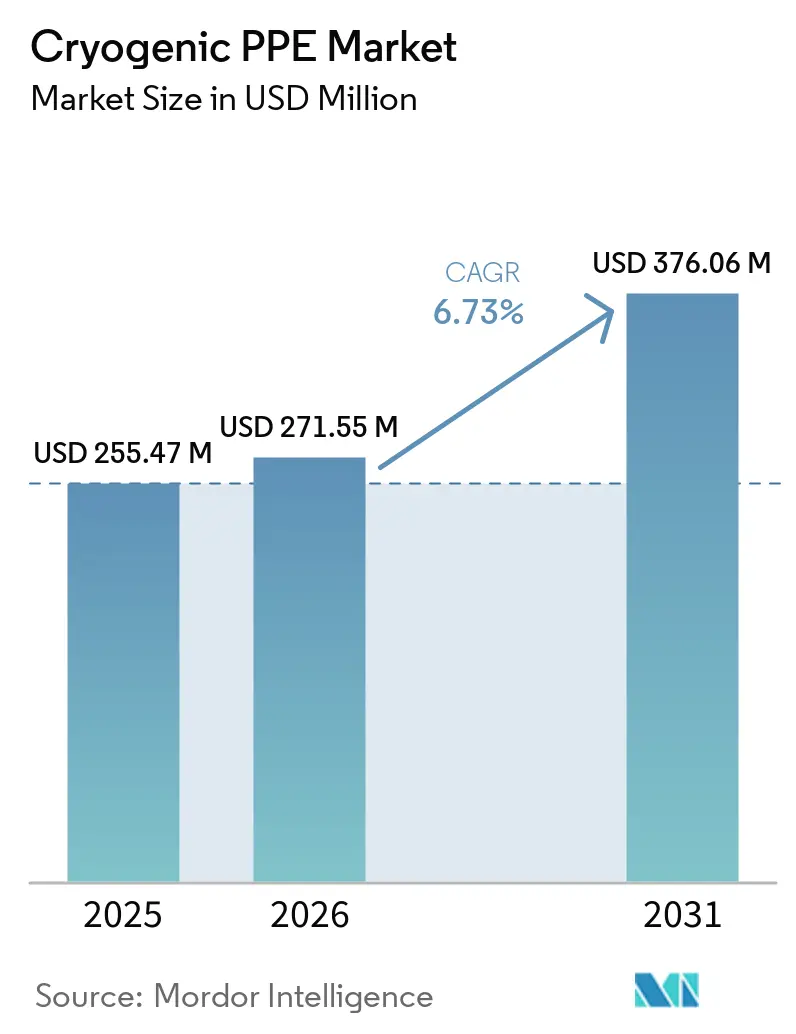
The cryogenic PPE market is projected to expand from USD 255.47 million in 2025 and USD 271.55 million in 2026 to USD 376.06 million by 2031, registering a CAGR of 6.73% between 2026 and 2031. The cryogenic PPE market is moving toward planned institutional purchasing as biomedical research and regulated cold-chain operations increase. Cell and gene therapy programs require controlled cryopreservation workflows, which make protective equipment part of routine operating procedures. Vaccine distribution hubs and new cold-storage capacity are extending cryogen handling into locations that have not previously purchased dedicated protection. Safety rules and facility audits are also making documented equipment selection more important in clinical and research settings. This shift supports recurring orders for suppliers that can provide certified products and complete documentation.
Key Report Takeaways
- By product type, cryogenic gloves held 40.13% of the cryogenic PPE market share in 2025, while integrated PPE kits are projected to grow at a 7.11% CAGR through 2031.
- By application, biobanking and stem cells accounted for 39.44% of the cryogenic PPE market in 2025, while clinical labs and pathology are forecasted to advance at an 8.37% CAGR through 2031.
- By end-user, hospitals and surgical centers held 46.22% of the cryogenic PPE market share in 2025, while clinical research laboratories are expected to expand at a 7.73% CAGR through 2031.
- By geography, North America accounted for 47.23% of revenue in 2025, while Asia-Pacific is forecasted to grow at an 8.22% CAGR through 2031.
Note: Market size and forecast figures in this report are generated using Mordor Intelligence’s proprietary estimation framework, updated with the latest available data and insights as of January 2026.
Market Trends and Insights
Drivers Impact Analysis of Cryogenic PPE Market*
| Driver | (~) % Impact on CAGR Forecast | Geographic Relevance | Impact Timeline |
|---|---|---|---|
| Growth in Biobanking and Cell Therapy Adoption | +1.8% | Global, concentrated in North America, Europe, and East Asia | Long term (≥ 4 years) |
| Expansion of Cryogenic Vaccine Storage Infrastructure | +1.3% | Global, with emphasis on Asia-Pacific and Africa | Medium term (2-4 years) |
| Rising Safety Regulations in Clinical Labs | +1.0% | North America and Europe | Medium term (2-4 years) |
| Increasing Radiopharmaceutical Demand | +0.8% | North America, Europe, and Asia-Pacific | Long term (≥ 4 years) |
| Expansion of Blood and Plasma Preservation Programs | +0.7% | Global, with emphasis on Asia and the Middle East and Africa | Medium term (2-4 years) |
| Integration of Cryogenic PPE into Hospital Safety Frameworks | +0.6% | North America and Europe | Short term (≤ 2 years) |
| Source: Mordor Intelligence | |||
Growth in Biobanking and Cell Therapy Adoption
Biobanking expansion is the strongest demand driver for the cryogenic PPE market. Multi-site cell and gene therapy trials require controlled cryopreservation from collection through processing and storage. Each liquid nitrogen handling point requires formal protective procedures. In June 2026, Cryoport’s IntegriCell service was selected by Verismo Therapeutics to support Phase 1 KIR-CAR T-cell therapy programs. The work covers GMP-compliant cryopreservation for leukapheresis starting material, where documented protective practices form part of the operating environment.[1]As more programs move across distributed clinical sites, protective equipment changes from an occasional purchase into a planned operating requirement.
Expansion of Cryogenic Vaccine Storage Infrastructure
Vaccine cold-chain expansion creates a separate source of demand for the cryogenic PPE market. New distribution hubs place advanced cold storage and handling activities in more locations. The GSK and Abu Dhabi Department of Health partnership opened the region’s first centralized vaccine distribution hub in 2026. The hub is designed to handle more than 20 vaccine types and distribute millions of doses across a network reaching from the Gulf to sub-Saharan Africa.[2] Facilities adding cryogenic capability need worker protection at the same time as they install storage and handling processes. This creates an opening for suppliers that can support first-time buyers with product selection, training material, and dependable local distribution.
Rising Safety Regulations in Clinical Labs
Clinical laboratory safety requirements are making dedicated cryogenic protection more relevant to purchasing decisions. The European Industrial Gases Association issued its updated guidance for the safe installation and use of cryogenic equipment in May 2025. The document directs users to related guidance on selecting protective equipment for cryogen handling.[3] Such guidance encourages facilities to formalize training, operating procedures, and equipment selection. Audits can reveal gaps where sites have used standard laboratory gloves or incomplete protective combinations. The cryogenic PPE market benefits when safety requirements become part of documented laboratory practice rather than an informal local decision.
Increasing Radiopharmaceutical Demand
Radiopharmaceutical production and distribution add specialized handling environments to the cryogenic PPE market. Radioligand therapies and related isotope workflows require tight temperature control from production through dispensing. Workers may face both cryogenic and radiological hazards, which increases the need for clearly specified equipment. In October 2025, Cryoport opened a 55,000-square-foot Global Supply Chain Center in Louvres, France, to support cell and gene therapies and temperature-sensitive biologics. New facilities of this type add points where cold-chain work must be performed under controlled procedures. Suppliers with products supported by relevant cold-contact and chemical-resistance documentation are better placed to compete for these requirements.
Restraints Impact Analysis of Cryogenic PPE Market*
| Restraint | (~) % Impact on CAGR Forecast | Geographic Relevance | Impact Timeline |
|---|---|---|---|
| High Cost of Advanced Cryogenic PPE | -1.2% | Global, especially the Middle East and Africa and South America | Long term (≥ 4 years) |
| Limited Awareness in Smaller Healthcare Facilities | -0.8% | South America, the Middle East and Africa, and Southeast Asia | Medium term (2-4 years) |
| Ergonomic Challenges in Prolonged Use | -0.5% | Global | Short term (≤ 2 years) |
| Supply Chain Constraints for Specialized PPE | -0.4% | Global, concentrated in developing markets | Medium term (2-4 years) |
| Source: Mordor Intelligence | |||
High Cost of Advanced Cryogenic PPE
Advanced cryogenic assemblies remain expensive for many healthcare facilities. Multi-layer kits may include compliant gloves, aluminized face shields, cryogenic aprons, waterproof liners, and thermal construction. These designs require specialized materials and manufacturing processes that limit low-cost substitution. Smaller hospitals, independent laboratories, and biobanks may instead buy general-purpose gloves despite the different risk posed by liquid nitrogen at -196°C. Price pressure is strongest in South America, parts of Southeast Asia, and sub-Saharan Africa, where safety budgets are often not planned in advance. The cryogenic PPE market, therefore, faces slower uptake for integrated kits where procurement decisions are led primarily by unit price.
Limited Awareness in Smaller Healthcare Facilities
Many smaller facilities use liquid nitrogen for cryotherapy, pathology preservation, or vaccine storage without adopting suitable protection. Standard latex and nitrile gloves do not provide the tested protection needed for cryogenic handling. Local hospitals and diagnostic laboratories may not receive the same audit coverage or distributor guidance as larger institutions. Distributors may stock only a small selection of cryogenic gloves and may not explain the need for face shields, aprons, or full kits. Extended use can also cause discomfort, which can reduce compliance if products restrict hand movement or visibility. Supply constraints for specialized fabrics and insulating materials further complicate access in developing locations, but channel education can help suppliers address the resulting gap in India, Brazil, and Southeast Asia.
*Our forecasts treat driver/restraint impacts as directional, not additive. The impact forecasts reflect baseline growth, mix effects, and variable interactions.
Cryogenic PPE Market Segment Analysis
By Product Type:
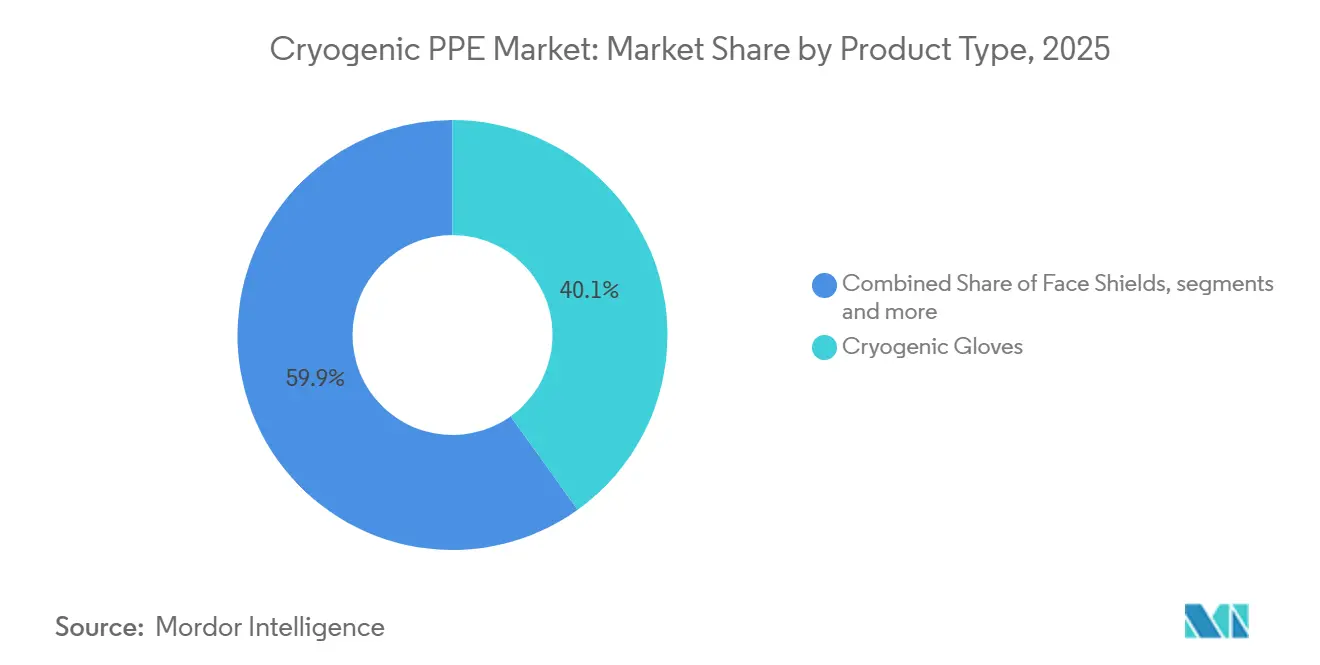
Gloves Lead Revenue While Kits Support Standardized PurchasingCryogenic gloves captured 40.13% of revenue in 2025 and remained the largest product category in the cryogenic PPE market. They are used across cryogen transfer, storage, sample handling, and related laboratory tasks. Berkeley Lab and Cornell University both identify cryogenic gloves as essential protection for work involving cryogenic liquids. Face shields, aprons, lab coats, and related products often follow as facilities develop fuller protection requirements.
Integrated PPE kits are projected to post the highest product type CAGR at 7.11% through 2031. These kits combine several items into a single documented solution for buyers managing complex safety requirements. Hospitals and biobanking facilities can use kits to simplify product selection and compliance records. Consolidating several protective items under fewer stock-keeping units can also reduce administrative work for group purchasing organizations. The Cryogenic PPE industry is likely to see kit demand strengthen where institutions standardize procedures across multiple sites.

By Application:
Biobanking Leads Demand While Clinical Labs Grow FasterBiobanking and stem cell work accounted for 39.44% of the cryogenic PPE market in 2025. These activities have high liquid nitrogen use and operate across academic repositories, commercial archives, and cell therapy manufacturing facilities. Their protective needs extend beyond thermal protection because cleanroom compatibility and quality documentation can influence equipment selection. Vaccine and biologic storage are the next major applications because pharmaceutical plants and distribution facilities require cold-chain handling.
Clinical labs and pathology are forecasted to grow at a 8.37% CAGR through 2031, the fastest application rate in the cryogenic PPE market. Cryogenic tissue sectioning, cryostat work, and specimen processing are expanding in tertiary diagnostic settings. Radiopharmaceutical and isotope applications are smaller but require higher specifications because users may need protection against cryogenic and ionizing radiation hazards. Application growth is therefore shifting demand toward settings where safety requirements are closely linked with operational quality systems.
By End-User:
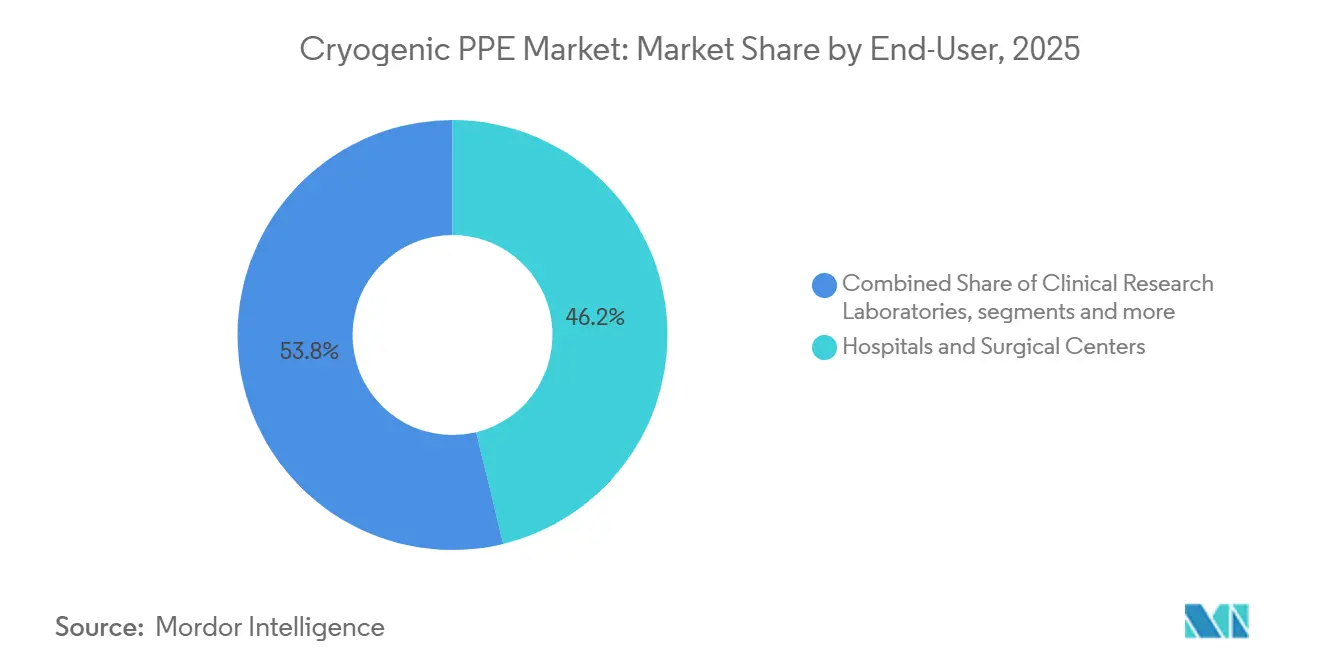
Hospitals Hold the Largest Base While Research Labs AccelerateHospitals and surgical centers generated 46.22% of revenue in 2025, the largest end-user share in the cryogenic PPE market. Cryosurgery, liquid nitrogen dermatology procedures, and cryogenic specimen management support regular product consumption. Large suppliers benefit from existing hospital distribution relationships and the ability to meet tender requirements. Biopharma manufacturers also have high average transaction values because cleanroom and processing environments require traceable, documented equipment.
Clinical research laboratories are projected to expand at a 7.73% CAGR through 2031. Growth is connected to additional cell therapy trial sites, decentralized biobanking, and academic-commercial research partnerships. Other end-users, including veterinary facilities and food research laboratories, provide a smaller but stable base of demand for gloves and aprons. The Cryogenic PPE industry can gain from these customers when suppliers offer practical products for routine handling. The growth profile remains strongest where clinical research shifts from centralized activity to networks of smaller operating sites.
Geography Analysis
North America Cryogenic PPE Market
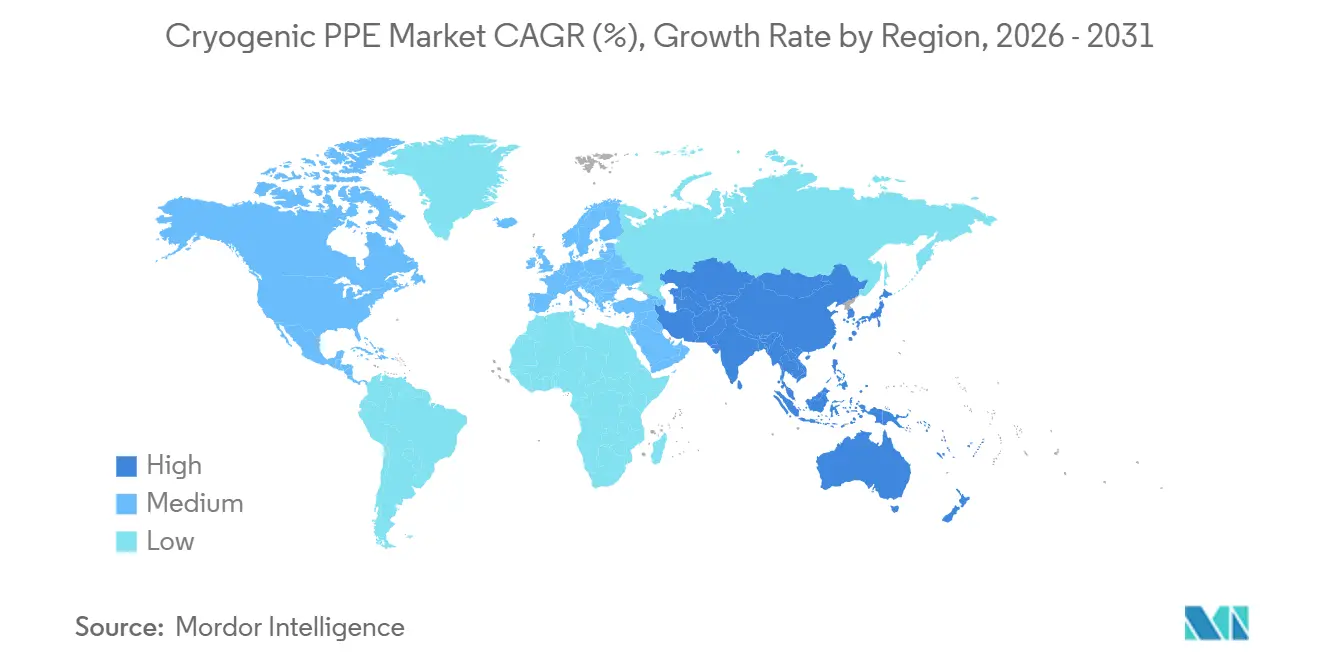
North America held 47.23% of revenue in 2025 and represented the largest geographic share of the cryogenic PPE market. The region has a large concentration of regulated biopharma manufacturing, biobanks, and cell therapy trial sites. Procurement is closely tied to facility compliance reviews and internal safety procedures. The United States provides a substantial base of activity through its clinical research and biologics infrastructure. Canada adds demand through publicly funded biobanking programs, while Mexico’s pharmaceutical contract manufacturing sector is creating new handling environments.
Europe Cryogenic PPE Market
Europe remains a major regulated market for cryogenic protection. EU personal protective equipment requirements and EN standards shape product access and buyer specifications. Germany and the United Kingdom are important procurement centers for hospitals and pharmaceutical manufacturing. Aenova announced in June 2025 that it was adding a cold-chain warehouse at its sterile site in Latina, Italy, with full operational readiness expected in the first quarter of 2026. These additions expand the number of locations that require controlled cold-chain handling and supporting protection.
APAC, MEA and South America Cryogenic PPE Market
Asia-Pacific is forecasted to grow at an 8.22% CAGR through 2031, the highest regional rate in the cryogenic PPE market. China and India are investing in biobanking capacity, while Japan, South Korea, and Australia support demand through radiopharmaceutical, plasma, and clinical research activity. In the Rest of the World (RoW) market, comprising regions such as the Middle East and Africa, Grifols strengthened plasma infrastructure development by committing an additional EUR 180 million (USD 195.3 million) to its plasma processing and logistics project in Egypt, with the first phase expected to be operational by October 2026. South America remains the smallest regional base, with demand concentrated in Brazil’s pharmaceutical manufacturing sector and Argentina’s biomedical institutions. Cost-sensitive purchasing and limited access to certified distribution continue to restrict adoption there.
Competitive Landscape
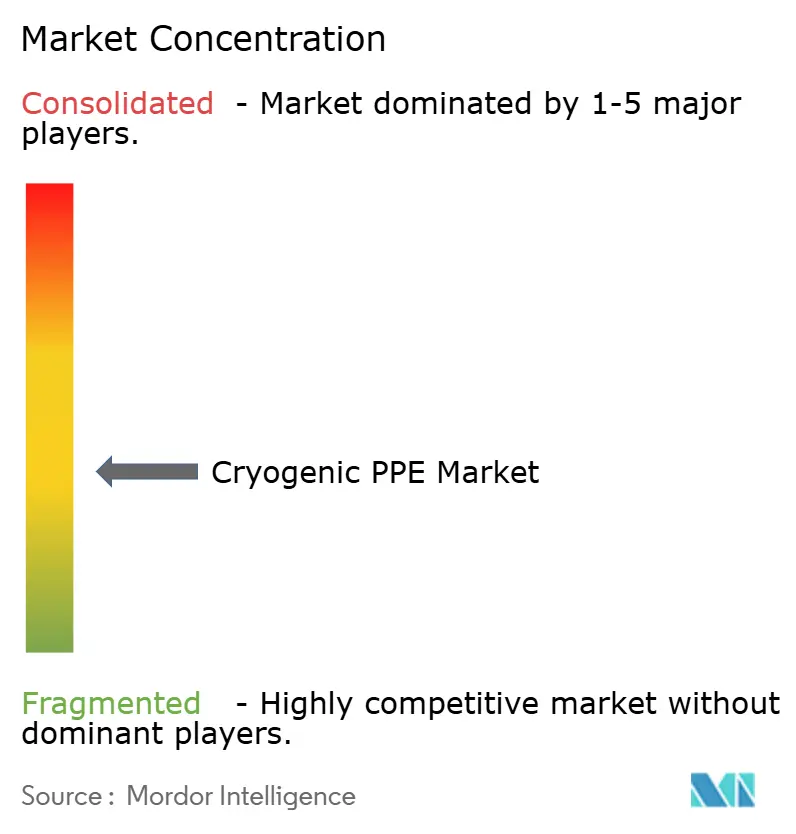
The cryogenic PPE market is moderately fragmented, with diversified safety suppliers competing alongside focused specialists. Honeywell Safety Products and Ansell Healthcare have broad product portfolios and established global distribution networks. Their hospital and biopharma relationships support access to tenders and group purchasing structures. Drägerwerk AG and Kimberly-Clark Professional add depth in clinical protective equipment. MAPA Professional and MCR Safety also serve industrial-adjacent cryogenic handling requirements.
Tempshield Cryo-Protection is differentiated by a specialist product line designed for cryogenic work. Its kit format provides documented product combinations that appeal to regulated institutional buyers. Indian manufacturers, including HiCare Protective Wear and Sarvam Safety Equipment, compete more directly in standard glove and apron categories. Their lower-priced ISO 13688-compliant products can put pressure on Western suppliers where buyers are focused on basic protective items. Integrated kits are less exposed to this price pressure because certification and documentation requirements are more complex. Supplier selection in the cryogenic PPE market is increasingly shaped by the ability to meet specification, traceability, and distribution requirements together.
In March 2026, Lakeland Industries sold its FR/AR apparel and high-visibility clothing line to National Safety Apparel, narrowing Lakeland’s focus toward chemical and disposable protective categories. The transaction changes the product positioning of both companies within specialized protective clothing. Certification remains a central competitive tool as EN and ISO standards shape customer requirements. Product development is focused on insulating composites, waterproof liner construction, seam sealing, and modular kit designs. A remaining product gap involves equipment designed for combined cryogenic and radiation hazards in radiopharmaceutical settings. Suppliers that can support both types of protection with clear documentation could compete in a small but demanding customer group.
Cryogenic PPE Industry Leaders
-
Tempshield Cryo-Protection
-
Honeywell International
-
Air Liquide
-
National Safety Apparel (NSA)
-
Ansell Healthcare
- *Disclaimer: Major Players sorted in no particular order
Cryogenic PPE Market Companies Covered in this Report
- Abdos Labtech Pvt. Ltd.
- Ansell Healthcare
- Core Safety Group
- Cryokit
- Delta Plus Group
- Dragerwerk
- HiCare Protective Wear Pvt. Ltd.
- Honeywell Safety Products
- Inovet Healthcare
- Kimberly-Clark Professional
- Lakeland Industries, Inc.
- MAPA Professional
- MCR Safety
- Najmi Health Care
- National Safety Apparel (NSA)
- Sarvam Safety Equipment Pvt. Ltd.
- Speciality Safety Engineers
- Super Safety Services
- Tempshield Cryo-Protection
- Unique Safety Services
Recent Industry Developments in Cryogenic PPE Market
- July 2026: The United States FDA issued new guidance requiring all -86°C ULT freezers used to store human biologics, including mRNA vaccines, stem cells, and clinical-grade biospecimens, to obtain UL 8601-2026 Class II-B certification. The guidance expands compliance obligations across regulated facilities throughout North America and is expected to trigger facility-level PPE safety audits as sites bring cold-storage equipment into compliance.
- June 2026: Cryoport, Inc. announced that its IntegriCell cryopreservation service was selected by Verismo Therapeutics to support Phase 1 clinical KIR-CAR T cell therapy programs. The collaboration covers process development, technology transfer, and GMP-compliant cryopreservation for leukapheresis starting material, a workflow environment in which cryogenic PPE is integral to the quality management system.
- February 2026: CaseBioscience launched CaseCryo CTG DMSO and CaseStor HSS at Advanced Therapies Week 2026, expanding its biopreservation portfolio for clinical cell therapy development. These products introduce new GMP-compliant cryopreservation workflows at additional manufacturing sites, directly expanding the operational environments requiring certified cryogenic PPE.
Global Cryogenic PPE Market Report Scope
According to the report’s scope, the cryogenic PPE market refers to the global industry for personal protective equipment designed to safeguard healthcare and laboratory workers from extreme cold hazards associated with handling cryogenic materials such as liquid nitrogen, cryogenic gases, and ultra‑low temperature freezers.
The cryogenic PPE market is segmented into product type, application, end-user, and geography. By product type, the market is segmented into cryogenic gloves, face shields, aprons and lab coats, and integrated PPE kits. By application, the market is segmented into biobanking and stem cells, vaccine and biologic storage, clinical labs and pathology, radiopharmaceuticals and isotopes, and other applications. By end-user, the market is segmented into hospitals and surgical centers, clinical research laboratories, biopharma manufacturing facilities, and other end-users. By geography, the market is segmented into North America, Europe, Asia-Pacific, and the Rest of the World. The report offers values (USD) for all the above segments.
Segmentation Overview
| Cryogenic Gloves |
| Face Shields |
| Aprons and Lab Coats |
| Integrated PPE Kits |
| Biobanking and Stem Cells |
| Vaccine and Biologic Storage |
| Clinical Labs and Pathology |
| Radiopharmaceuticals and Isotopes |
| Other Applications |
| Hospitals and Surgical Centers |
| Clinical Research Laboratories |
| Biopharma Manufacturing Facilities |
| Other End-Users |
| North America | United States |
| Canada | |
| Mexico | |
| Europe | Germany |
| United Kingdom | |
| France | |
| Italy | |
| Spain | |
| Rest of Europe | |
| Asia-Pacific | China |
| Japan | |
| India | |
| Australia | |
| South Korea | |
| Rest of Asia-Pacific | |
| Rest of the World |
| By Product Type | Cryogenic Gloves | |
| Face Shields | ||
| Aprons and Lab Coats | ||
| Integrated PPE Kits | ||
| By Application | Biobanking and Stem Cells | |
| Vaccine and Biologic Storage | ||
| Clinical Labs and Pathology | ||
| Radiopharmaceuticals and Isotopes | ||
| Other Applications | ||
| By End-User | Hospitals and Surgical Centers | |
| Clinical Research Laboratories | ||
| Biopharma Manufacturing Facilities | ||
| Other End-Users | ||
| By Geography | North America | United States |
| Canada | ||
| Mexico | ||
| Europe | Germany | |
| United Kingdom | ||
| France | ||
| Italy | ||
| Spain | ||
| Rest of Europe | ||
| Asia-Pacific | China | |
| Japan | ||
| India | ||
| Australia | ||
| South Korea | ||
| Rest of Asia-Pacific | ||
| Rest of the World | ||
Key Questions Answered in the Report
How large is the cryogenic PPE market in 2026?
The cryogenic PPE market is expected to increase from USD 255.47 million in 2025 to USD 271.55 million in 2026 and to reach USD 376.06 million by 2031 at a 6.73% CAGR.
Which cryogenic PPE product has the largest revenue share?
Cryogenic gloves led product revenue with 40.13% in 2025, while integrated kits are expected to grow at a 7.11% CAGR through 2031.
Which application is growing fastest through 2031?
Clinical labs and pathology are expected to grow at a 8.37% CAGR through 2031. Biobanking and stem cells remained the largest application in 2025 with a 39.44% share.
Which region is growing fastest for cryogenic PPE?
Asia-Pacific is projected to grow at an 8.22% CAGR through 2031, while North America remained the largest regional contributor in 2025 with 47.23% of revenue.