
Crowdsourced (Gig Economy Couriers) Delivery Service Market Size and Share
Market Overview
| Study Period | 2021 - 2032 |
|---|---|
| Market Size (2027) | USD 103.93 Billion |
| Market Size (2032) | USD 153.61 Billion |
| Growth Rate (2027 - 2032) | 8.13 % |
| Fastest Growing Market | Middle East and Africa |
| Largest Market | Asia-Pacific |
| Market Concentration | Medium |
Major Players *Disclaimer: Major Players sorted in no particular order Image © Mordor Intelligence. Reuse requires attribution under CC BY 4.0. | |
Crowdsourced (Gig Economy Couriers) Delivery Service Market Analysis by Mordor Intelligence
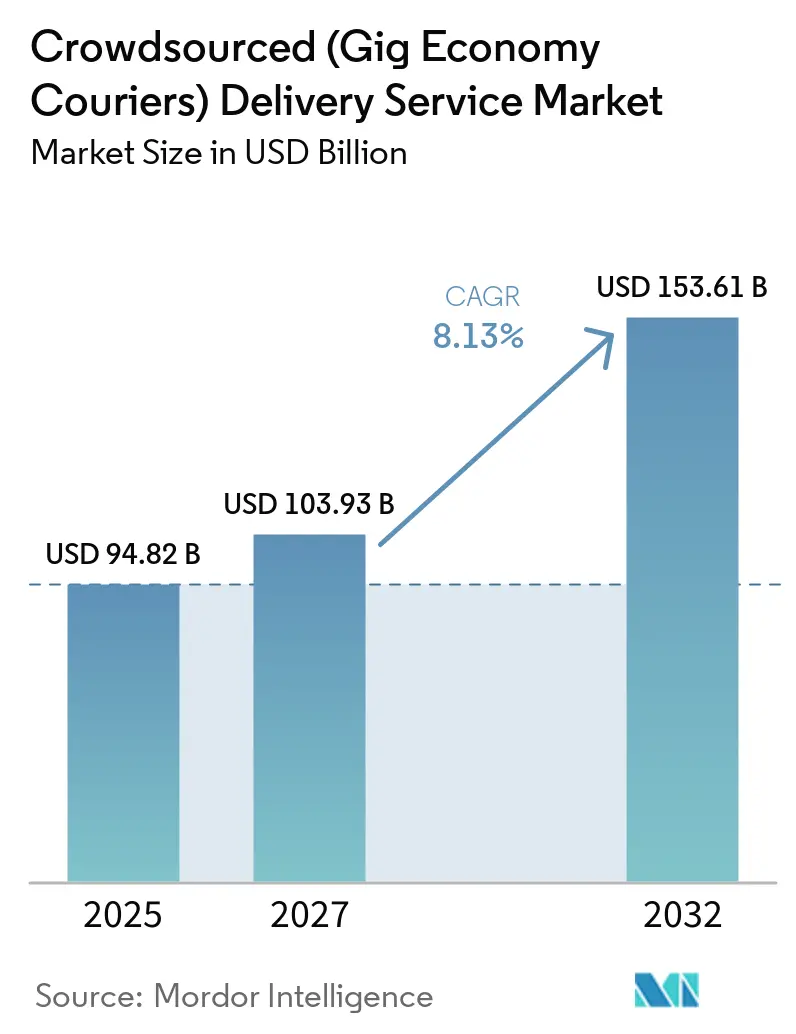
The crowdsourced (gig economy couriers) delivery service market size is valued at USD 94.82 billion in 2025 and is estimated to grow from USD 103.93 billion in 2027 to reach USD 153.61 billion by 2032, at a CAGR of 8.13% during the forecast period (2027-2032).
Retailers, restaurants, and platform-native businesses increasingly use on-demand courier networks as part of their fulfillment models. In the United States, app-based platforms supported USD 414 billion in economic activity during 2025, while 9.4 million couriers completed 6.3 billion rideshare and delivery orders, a 29% increase from 2022. These networks also generated USD 53 billion in additional revenue for local businesses and restaurants during 2025.[1] The crowdsourced delivery service market is becoming more consolidated as large platforms use acquisitions and retailer partnerships to expand their operating reach. Labor classification, courier availability, low basket values, and longer routes remain material constraints on operating economics.
Key Report Takeaways
- By delivery type, on-demand and instant delivery held 42.57% of the crowdsourced (gig economy couriers) delivery service market share in 2026, while same-day delivery is projected to grow at a 10.58% CAGR through 2032.
- By business model, B2C held 68.09% of the crowdsourced (gig economy couriers) delivery service market size in 2026 and is projected to grow at a 10.11% CAGR through 2032.
- By delivery distance, urban and intra-city delivery held 48.65% of the crowdsourced (gig economy couriers) delivery service market share in 2026, while extended urban and peri-urban delivery is projected to grow at a 10.89% CAGR through 2032.
- By courier engagement model, independent gig couriers held 62.15% of the crowdsourced (gig economy couriers) delivery service market size in 2026, while part-time contracted drivers are projected to grow at a 9.52% CAGR through 2032.
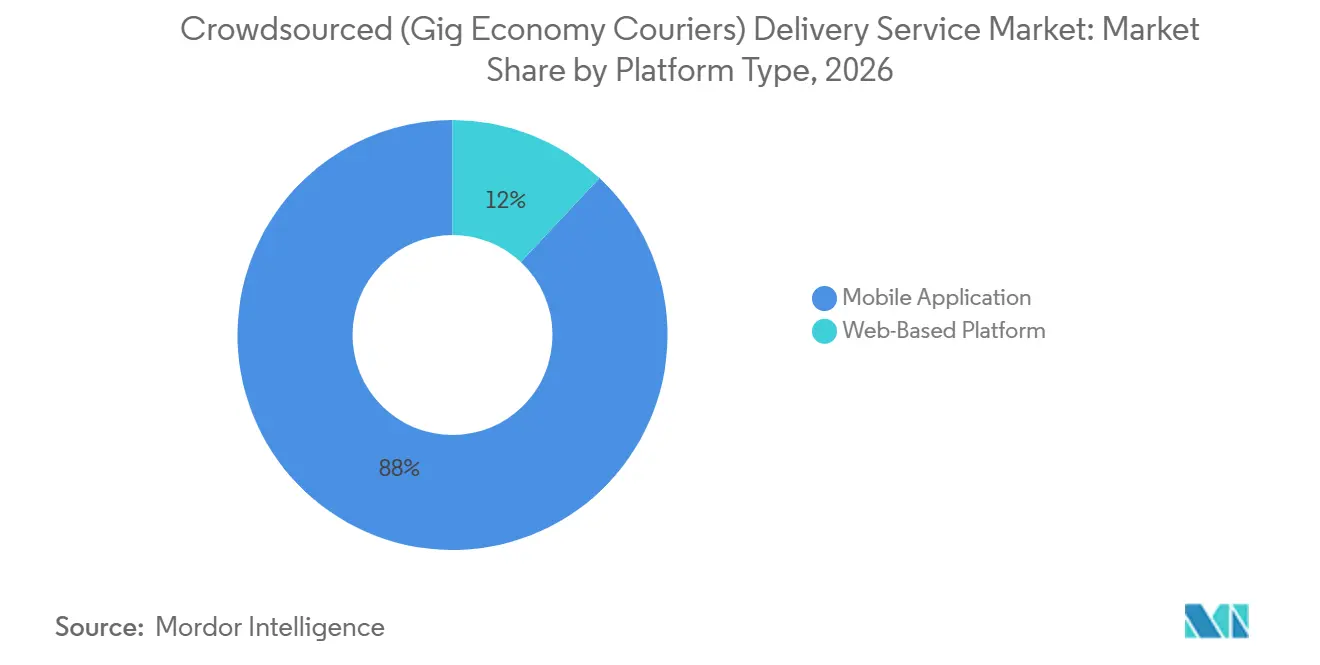
- By platform type, mobile application-based platforms held 88.02% of the crowdsourced (gig economy couriers) delivery service market share in 2026, while web-based platforms are projected to grow at a 9.24% CAGR through 2032.
- By vehicle type, two-wheelers held 55.14% of the crowdsourced (gig economy couriers) delivery service market size in 2026, while drones and autonomous vehicles are projected to grow at a 22.03% CAGR through 2032.
- By end user, e-commerce and online retail held 42.46% of the crowdsourced (gig economy couriers) delivery service market share in 2026, while quick commerce is projected to grow at a 14.08% CAGR through 2032.
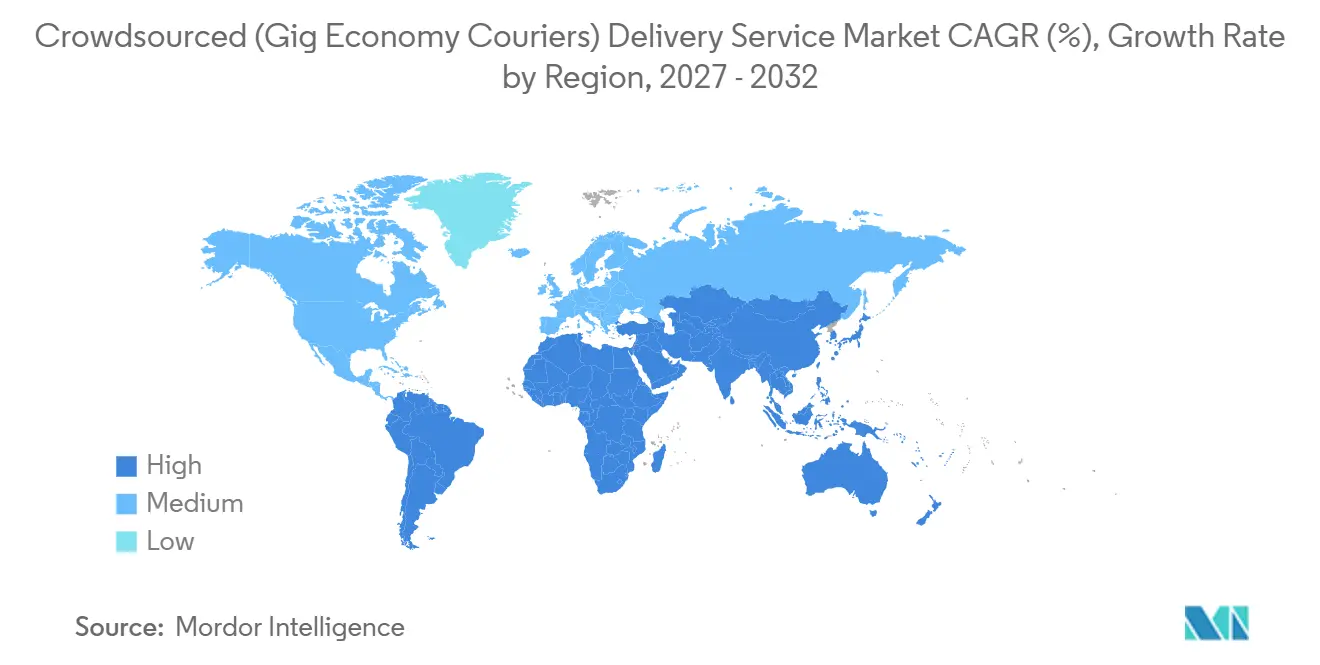
- By geography, Asia-Pacific held 36.52% of the crowdsourced (gig economy couriers) delivery service market size in 2026, while the Middle East and Africa is projected to grow at an 11.57% CAGR through 2032.
Note: Market numbers in this report are based on Mordor Intelligence's proprietary estimation framework, which combines nine months of actuals with Q4 projections for base year 2026.
Market Trends and Insights
Drivers Impact Analysis of Crowdsourced (Gig Economy Couriers) Delivery Service Market*
| Driver | (~) % Impact on CAGR Forecast | Geographic Relevance | Impact Timeline |
|---|---|---|---|
| E-Commerce and Omnichannel Fulfillment Expansion | +2.5% | Global | Medium term (2-4 years) |
| Consumer Adoption of Same-Day and On-Demand Delivery | +1.8% | Global, strongest in North America and Asia-Pacific | Short term (≤ 2 years) |
| Asset-Light Peak-Capacity Scaling | +1.0% | Global, high relevance in North America and Europe | Medium term (2-4 years) |
| Mobile Matching, Routing, and Real-Time Visibility | +0.8% | Global, strongest in Asia-Pacific and Southeast Asia | Short term (≤ 2 years) |
| Underutilized Vehicle Capacity Monetization | +0.6% | Asia-Pacific core, with spillover to South America and the Middle East and Africa | Long term (≥ 4 years) |
| Quick Commerce, Grocery, and Urban Convenience Demand | +1.5% | Asia-Pacific core, expanding in Europe and the Middle East and Africa | Short term (≤ 2 years) |
| Source: Mordor Intelligence | |||
E-Commerce and Omnichannel Fulfillment Expansion Drives Structural Order Volume
China’s courier sector processed nearly 200 billion parcels in 2025, an increase of 13.7% from the prior year, and accounted for more than 60% of global parcel growth during 2021-2025.[2] This volume supports the crowdsourced delivery service market because merchants need flexible capacity at the final delivery stage. Growth in parcel demand extends into areas where traditional delivery networks face higher operating costs. Crowdsourced operators can add capacity without building a fully owned fleet in every location. The model is becoming a core layer of retail fulfillment rather than an occasional option for peak periods.
Consumer Adoption of Same-Day and On-Demand Delivery Reshapes Fulfillment Expectations
Demand for shorter delivery windows is shifting merchant fulfillment commitments toward same-day service. On-demand food delivery has set customer expectations for fast order confirmation, tracking, and delivery. This behavior is extending to grocery, pharmacy, and general retail transactions. The crowdsourced delivery service market benefits when merchants need delivery capacity that can be activated close to the point of sale. Retailers also face higher customer-acquisition costs when delivery speed falls below customer expectations.
Asset-Light Peak-Capacity Scaling Provides Structural Cost Advantage to Platform Operators
Traditional courier networks carry fixed staffing and fleet costs even when order volumes decline. Crowdsourced operators use independent couriers who can enter active delivery periods when orders are available. Amazon is investing more than USD 4 billion to expand its rural delivery network and plans to use the Amazon Flex program to extend coverage by the end of 2026. This approach provides geographic reach without a comparable increase in owned delivery assets. The crowdsourced (gig economy couriers) delivery service market, therefore, offers a flexible capacity option for seasonal peaks and dispersed locations.
Quick Commerce, Grocery, and Urban Convenience Demand Anchors Platform Density Economics
Quick commerce is increasing the frequency of small, time-sensitive orders in urban areas. Shorter distances between dark stores, merchants, and customers can improve courier route utilization. Dense delivery zones also allow platforms to match couriers with more orders during a shift. This improves the operating case for grocery, pharmacy, and convenience deliveries. The crowdsourced (gig economy couriers) delivery service market gains from these dense local networks because they reduce the distance and time attached to each order.
Restraints Impact Analysis of Crowdsourced (Gig Economy Couriers) Delivery Service Market*
| Restraint | (~) % Impact on CAGR Forecast | Geographic Relevance | Impact Timeline |
|---|---|---|---|
| Worker Classification and Platform Labor Cost Exposure | -1.5% | North America and the European Union, with global spillover | Short term (≤ 2 years) |
| Variable Service Quality and Courier Availability | -0.8% | Global | Medium term (2-4 years) |
| Insurance, Liability, and Safety-Cost Complexity | -0.6% | North America and Europe | Medium term (2-4 years) |
| Delivery Economics Under Low Basket Values and High Deadhead Miles | -0.7% | Emerging markets and rural corridors globally | Long term (≥ 4 years) |
| Source: Mordor Intelligence | |||
Worker Classification and Platform Labor Cost Exposure Introduces Structural Uncertainty
The EU Platform Work Directive is going to take effect in December 2026 and establish a legal presumption of employment when a platform exercises specified forms of control over a worker.[3] Platforms need to rebut that presumption, which can increase legal and administrative costs. In January 2026, San Francisco secured a USD 4.5 million settlement involving the misclassification of delivery drivers by WorkWhile. These developments can change contractor agreements, benefits costs, and pricing models. The crowdsourced (gig economy couriers) delivery service market faces greater pressure where platform control over pay, schedules, and performance is closely regulated.
Variable Service Quality and Courier Availability Creates Fulfillment Gaps at Scale
Independent courier networks can face coverage gaps during demand peaks, poor weather, or competing promotions. Singapore’s Platform Workers Trilateral Group published 10 recommendations in September 2025 addressing unauthorized platform work and unsafe incentive structures.[4] Nine major platform operators adopted the recommendations, including Amazon Flex, Deliveroo, Lalamove, and Grab. The response shows that reliability and safety depend on network design, not only on individual courier performance. Platforms with limited retention tools or weak courier engagement can lose merchant confidence during periods of high demand.
*Our forecasts treat driver/restraint impacts as directional, not additive. The impact forecasts reflect baseline growth, mix effects, and variable interactions.
Crowdsourced (Gig Economy Couriers) Delivery Service Market Segment Analysis
By Delivery Type:
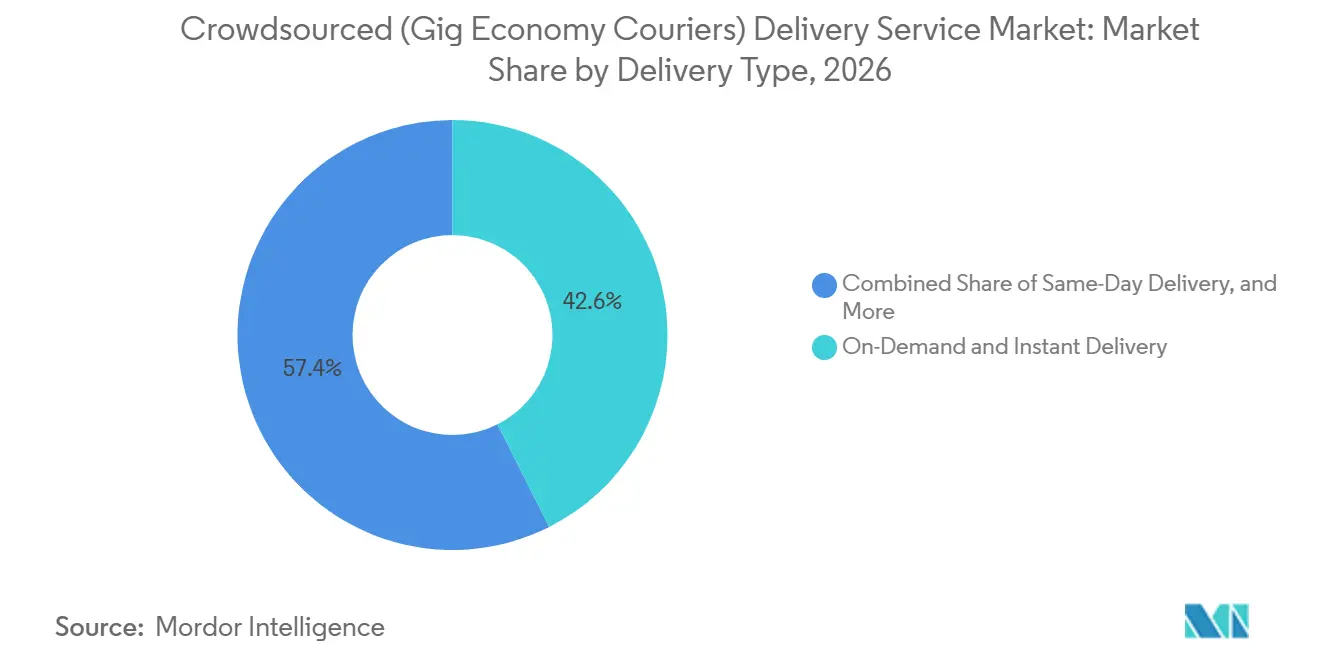
Instant Fulfillment Anchors Volume While Same-Day Commands GrowthOn-demand and instant delivery held 42.57% of the crowdsourced (gig economy couriers) delivery service market share in 2026. Food delivery, quick commerce, and pharmacy orders support this leading position because delivery speed is central to the service promise. App-based ordering also makes instant fulfillment easy to access for customers. Merchants use the model where a delay can reduce the value of the order. Scheduled delivery continues to serve non-urgent residential orders and subscriptions. Other delivery types remain relevant for cross-border, document, and time-critical healthcare uses.
Same-day delivery is projected to grow at a 10.58% CAGR through 2032. Retailers in home improvement, fashion, and consumer electronics are adding same-day options to their fulfillment models. This broadens platform demand beyond food and grocery. The shift can draw orders from next-day and express services. The crowdsourced (gig economy couriers) delivery service market can serve this need through local courier matching and merchant integrations. Its growth depends on delivery density, retailer participation, and the ability to provide predictable service windows.

By Business Model:
B2C Anchors the Market as Retail Delivery Consolidates Around PlatformsB2C held 68.09% of the crowdsourced (gig economy couriers) delivery service market size in 2026 and recorded the fastest projected CAGR of 10.11% through 2032. Consumer-facing platforms connect retailers, restaurants, and customers through a single ordering and tracking interface. This model allows merchants to outsource courier management while retaining visibility into fulfillment activity. Instacart and Kroger expanded their relationship in November 2025, retaining Instacart as Kroger’s primary delivery fulfillment partner across nearly 2,700 stores and more than 20 banners. Such partnerships strengthen the role of platform-enabled delivery in grocery retail. B2C demand also benefits from recurring grocery and restaurant ordering.
B2B delivery serves same-day transfers between sites, trade deliveries, and wholesale fulfillment. These orders often have different routing, vehicle, and integration requirements from consumer deliveries. C2C delivery remains smaller and serves peer-to-peer parcel exchanges and personal deliveries within cities. The crowdsourced (gig economy couriers) delivery service industry uses these models to reach customers with different service needs. B2B growth supports web-based integrations, while C2C activity depends on local marketplace use. Each model requires clear pricing and reliable proof of delivery.
By Delivery Distance:
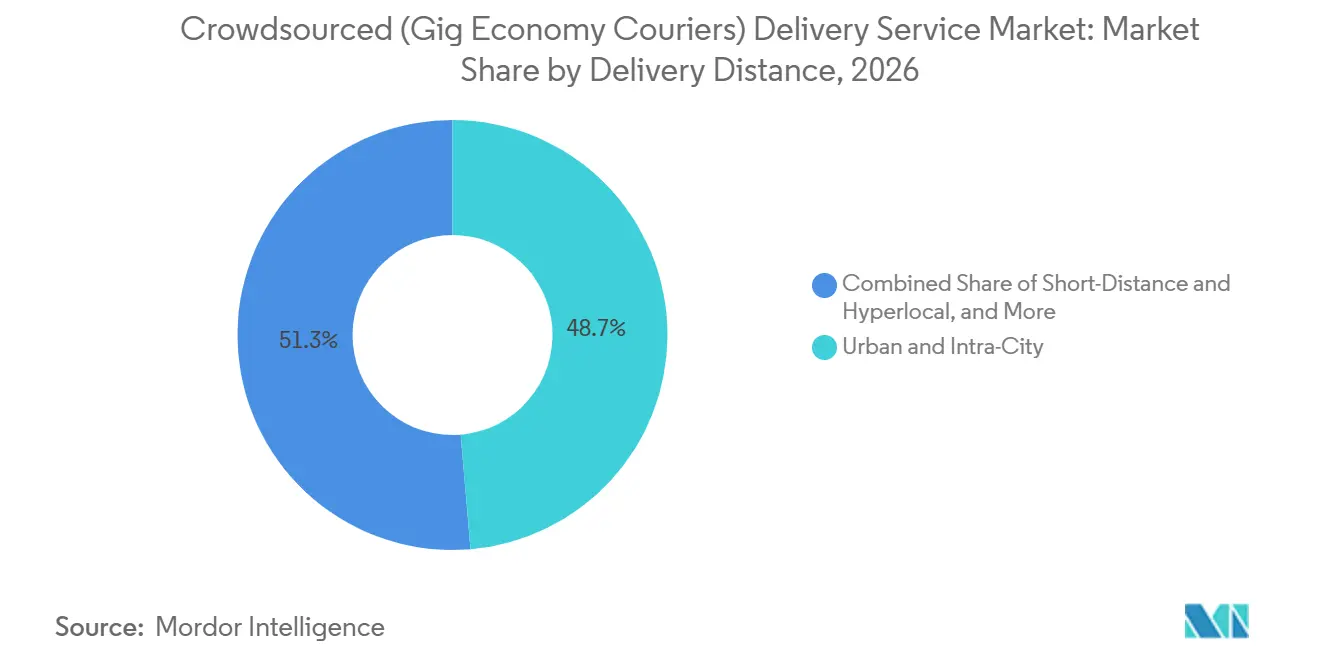
Urban Corridors Dominate Volume While Peri-Urban Corridors Lead GrowthUrban and intra-city delivery held 48.65% of the crowdsourced (gig economy couriers) delivery service market share in 2026. Dense neighborhoods reduce the distance between merchants, couriers, and customers. This supports more delivery stops per courier shift. It also helps platforms offer prices that remain acceptable to consumers. Short-distance and hyperlocal delivery is closely linked to dark-store quick commerce. The crowdsourced (gig economy couriers) delivery service market relies on these dense corridors to support fast and frequent order fulfillment.
Extended urban and peri-urban delivery is projected to grow at a 10.89% CAGR through 2032. Platforms are extending service into secondary cities, suburbs, and satellite towns where online retail use is rising. Regional parcel hubs can move orders closer to residential endpoints before final delivery. Veho expanded from 44 to 66 United States markets in February 2026, adding Phoenix, Las Vegas, San Diego, and the Los Angeles metropolitan area. This operating approach can support wider delivery coverage without sending every order from a central urban core. Longer routes still require enough order density to protect courier economics.
By Courier Engagement Model:
Independent Gig Couriers Lead as Part-Time Models Gain StructureIndependent gig couriers held 62.15% of the crowdsourced (gig economy couriers) delivery service market size in 2026. The model gives couriers flexibility and allows platforms to add capacity as order demand changes. It is especially useful for food, grocery, and retail orders that vary by hour and location. Independent networks also avoid maintaining a fully employed delivery workforce in every service area. The crowdsourced delivery service market depends on these couriers for a large share of its flexible delivery capacity. Retention, safety, and service consistency remain important operating considerations.
Part-time contracted drivers are projected to grow at a 9.52% CAGR through 2032. Platforms are using more structured engagement to improve availability and reduce service gaps. Singapore’s 2025 platform-worker recommendations added pressure for safer practices and clearer operating arrangements. Full-time partnered drivers serve selected grocery and healthcare corridors where dependable coverage can justify higher fixed costs. The crowdsourced (gig economy couriers) delivery service industry is, therefore, moving toward a mix of flexible and more structured engagement models. Labor rules will influence how each model is designed.
By Platform Type:
Mobile Apps Dominate While Web-Based Channels Expand in B2BMobile application-based platforms held 88.02% of the crowdsourced (gig economy couriers) delivery service market share in 2026. Smartphones remain the main interface for ordering, courier matching, payment, and real-time tracking. This format is deeply established in food, grocery, and retail delivery. Mobile platforms also allow customers to make repeat purchases with limited friction. The crowdsourced delivery service market has built much of its customer demand around these app-based habits. Leading operators continue to use mobile products as the main point of consumer engagement.
Web-based platforms are projected to grow at a 9.24% CAGR through 2032. Enterprise shippers, retailers, and logistics providers use browser-based interfaces and system integrations to manage larger order flows. This model can connect delivery capacity with order management and warehouse systems. It is particularly relevant for B2B delivery and third-party logistics use cases. The crowdsourced (gig economy couriers) delivery service market can use web channels to reach procurement teams and business users. The difference between mobile and web growth reflects the different needs of consumer and enterprise buyers.
By Vehicle Type:
Two-Wheelers Power Urban Economics While Drones Set Long-Run GrowthTwo-wheelers held 55.14% of the crowdsourced (gig economy couriers) delivery service market size in 2026. Their cost profile and ability to move through congested streets make them suitable for food, grocery, and document deliveries. Shadowfax reported a 66% increase in order volume in FY 2026, with two-wheeled couriers supporting its hyperlocal operations across 14,758 serviceable pin codes. This vehicle type remains relevant for small orders in dense urban areas. The market uses two-wheelers where speed and local access matter more than cargo capacity. Four-wheelers, vans, and light commercial vehicles serve bulk, furniture, and B2B orders.
Drones and autonomous vehicles are projected to grow at a 22.03% CAGR through 2032. In August 2025, the Federal Aviation Administration published a proposed rule for beyond visual line of sight drone operations. The proposal provides a path for commercial drone delivery at greater scale in the United States. DoorDash and Serve Robotics announced a multi-year partnership in October 2025 to use autonomous sidewalk robots on the DoorDash platform. These technologies can complement gig couriers rather than replace them across every order type. Regulatory approval and safe deployment will determine the pace of adoption.
By End User:
E-Commerce Commands Share as Quick Commerce Rewrites Growth ExpectationsE-commerce and online retail held 42.46% of the crowdsourced (gig economy couriers) delivery service market size in 2026. Parcel fulfillment supports transactions across a wide range of consumer categories. China’s large parcel base shows the scale of delivery activity tied to online retail. Retailers use local delivery networks to give customers more choice over speed and delivery location. The crowdsourced delivery service market supports this model where merchants need last-mile capacity without expanding their own fleets. Foodservice, traditional retail, healthcare, and financial-document delivery remain important additional uses.
Quick commerce is projected to grow at a 14.08% CAGR through 2032. Grocery, convenience, and pharmacy orders place a premium on nearby inventory and rapid fulfillment. Dark stores can reduce the distance between stocked goods and customers. This can improve courier productivity when order density is high. The industry gains when platforms can connect local inventory with short delivery routes. Cold-chain handling, chain-of-custody controls, and reliable delivery times can differentiate operators in specialized end-user categories.
Geography Analysis
Asia-Pacific held 36.52% of the global crowdsourced (gig economy couriers) delivery service market share in 2026. China’s parcel sector processed nearly 200 billion parcels in 2025, while e-commerce activity reached more remote provinces. India adds demand through urban delivery networks and fast-growing online retail use. Southeast Asia has high-frequency delivery use cases that support super-app models. Grab agreed in March 2026 to acquire Delivery Hero’s foodpanda delivery business in Taiwan for USD 600 million, marking its first expansion beyond Southeast Asia. Japan, South Korea, and Australia provide mature markets for premium same-day services.
North America remains the second-largest regional area for the crowdsourced delivery service market. Amazon plans to invest more than USD 4 billion in its rural delivery network and use Amazon Flex to serve more than 13,000 ZIP codes by the end of 2026. This plan shows that flexible courier networks can extend into lower-density service areas. DoorDash expanded its relationship with Costco in September 2026, bringing delivery coverage to nearly 630 United States stores across 47 states. Canada and Mexico remain smaller regional markets with expanding urban logistics needs. Grocery and restaurant delivery continue to shape the region’s platform competition.
The Middle East and Africa is projected to grow at an 11.57% CAGR through 2032, the fastest regional rate. Lalamove launched in Riyadh in July 2026 after entering Dubai in 2025, linking its expansion to Saudi Arabia’s logistics strategy and targeting 1.7 million SMEs. Europe remains shaped by the December 2026 application of the EU Platform Work Directive. DoorDash completed its Deliveroo acquisition in October 2025, extending the combined group across more than 40 markets. South America contributes through urban food and grocery delivery, with Brazil and Argentina serving as important demand centers.
Competitive Landscape
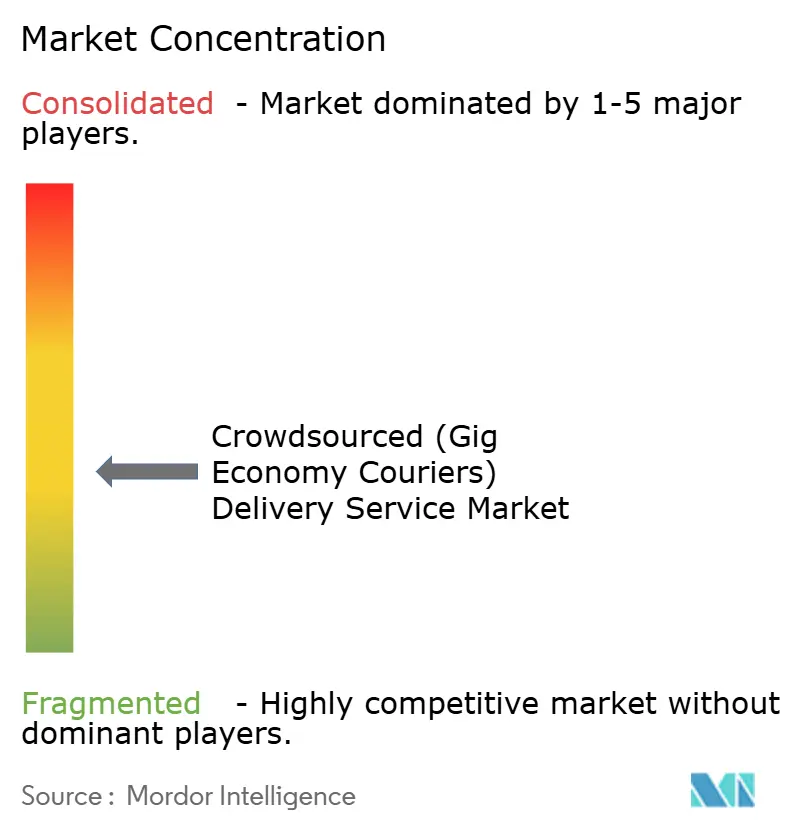
The crowdsourced (gig economy couriers) delivery service market is moderately fragmented globally, although several regions have concentrated platform competition. No platform holds a dominant position across every geography. Acquisitions and partnerships have become a more common route to geographic expansion than building every market from the ground up. DoorDash completed its acquisition of Deliveroo for USD 3.9 billion in October 2025. The combined business operates in more than 40 markets and serves more than 50 million monthly active users. Grab’s USD 600 million agreement to acquire foodpanda Taiwan reflects a similar effort to add an established merchant and courier network.
Competition increasingly centers on the range of delivery options and the quality of merchant integration. Operators that can route orders across couriers, robots, and drones can serve more use cases through one platform. DoorDash’s partnership with Serve Robotics brings autonomous sidewalk robots into its order-routing platform. Instacart’s expanded relationship with Kroger places its delivery fulfillment tools across nearly 2,700 stores. These moves place merchant technology and fulfillment capacity at the center of platform differentiation. Well-capitalized operators can invest more in data controls, labor compliance, and multi-modal delivery systems.
Smaller operators remain relevant by serving specific verticals or local areas where large platforms have limited depth. Stuart partnered with Iceland Foods in September 2025 to support same-day delivery from more than 100 United Kingdom supermarket locations. Veho expanded its United States network to 66 markets in February 2026 and opened parcel-injection hubs in Phoenix and Ontario, California. Shadowfax reported an increase in its e-commerce shipment share from 8% in FY 2022 to 23-24% by H1 FY 2026. The crowdsourced delivery service market, therefore, retains room for regional specialists alongside large multi-country platforms. Data protection, service reliability, and compliance remain essential capabilities for every operator.
Crowdsourced (Gig Economy Couriers) Delivery Service Industry Leaders
-
United Parcel Service of America, Inc. (UPS)
-
Instacart
-
DoorDash
-
Uber Technologies, Inc.
-
Amazon, Inc.
- *Disclaimer: Major Players sorted in no particular order
Crowdsourced (Gig Economy Couriers) Delivery Service Market Companies Covered in this Report
- DoorDash, Inc.
- Uber Technologies, Inc.
- Lalatech Holdings Limited (Lalamove)
- Amazon.com, Inc.
- GoShare
- Borzo
- Stuart
- United Parcel Service, Inc. (Roadie)
- Veho
- Dolly
- Burq
- Delivery Hero SE
- Grab Holdings Limited
- Rappi Inc.
- Shadowfax Technologies Private Limited
- Delhivery Limited
- Zoom2u
- Maplebear Inc.
- Dispatch, Inc.
- Curri, Inc.
Recent Industry Developments in Crowdsourced (Gig Economy Couriers) Delivery Service Market
- September 2026: DoorDash and Uber Technologies each expanded their delivery partnerships with Costco Wholesale to cover all United States store locations: nearly 630 stores for DoorDash across 47 states and approximately 600 locations for Uber Eats. The agreement gives Costco members same-day and scheduled delivery options through both platforms.
- July 2026: Lalamove officially launched operations in Riyadh, Saudi Arabia, its first entry into the Kingdom, following its Dubai launch in 2025. The expansion targets the Kingdom’s 1.7 million SMEs with on-demand delivery through sedan, van, pickup, and 4-ton vehicle options, along with bilingual Arabic-English customer support.
- May 2026: Lalamove entered Germany through a Berlin metropolitan area launch, marking the company’s first presence in Europe’s largest economy. The platform targets German SMEs with flexible, contract-free delivery options and plans to expand to additional German cities and broader EMEA markets.
- March 2026: Grab Holdings agreed to acquire Delivery Hero’s foodpanda delivery business in Taiwan for USD 600 million in cash, marking Grab’s first expansion beyond Southeast Asia into its 9th market. The foodpanda Taiwan business generated USD 1.8 billion in GMV in 2025.
Global Crowdsourced (Gig Economy Couriers) Delivery Service Market Report Scope
Segmentation Overview
| Instant Delivery |
| Under-Two-Hour Delivery |
| Same-Day Delivery (Standard and Scheduled) |
| End-of-Day Delivery |
| Business-to-Business (B2B) |
| Business-to-Consumer (B2C) |
| Consumer-to-Consumer (C2C) |
| Short-Distance and Hyperlocal |
| Urban and Intra-City |
| Extended Urban and Peri-Urban |
| Independent Gig Couriers |
| Part-Time Contracted Drivers |
| Full-Time Partnered Drivers |
| Mobile Application |
| Web-Based Platform |
| Two-Wheelers |
| Four-Wheelers |
| Vans and Light Commercial Vehicles |
| Drones and Autonomous Vehicles |
| Other Vehicle Types |
| E-Commerce and Online Retail |
| Quick Commerce (Q-Commerce) |
| Foodservice and Restaurant |
| Grocery and Traditional Retail |
| Healthcare and Pharmaceuticals |
| Documents, Legal, and Financial Services |
| Other Commercial and Specialized Deliveries |
| North America | United States |
| Canada | |
| Mexico | |
| South America | Brazil |
| Argentina | |
| Peru | |
| Chile | |
| Rest of South America | |
| Europe | Germany |
| United Kingdom | |
| France | |
| Italy | |
| Spain | |
| Russia | |
| Nordics (Denmark, Finland, Iceland, Norway, and Sweden) | |
| Rest of Europe | |
| Asia-Pacific | China |
| India | |
| Japan | |
| South Korea | |
| Australia | |
| Southeast Asia (ASEAN) | |
| Rest of Asia-Pacific | |
| Middle East and Africa | Saudi Arabia |
| United Arab Emirates | |
| Qatar | |
| South Africa | |
| Nigeria | |
| Egypt | |
| Rest of Middle East and Africa |
| By Service Type | Instant Delivery | |
| Under-Two-Hour Delivery | ||
| Same-Day Delivery (Standard and Scheduled) | ||
| End-of-Day Delivery | ||
| By Business Model | Business-to-Business (B2B) | |
| Business-to-Consumer (B2C) | ||
| Consumer-to-Consumer (C2C) | ||
| By Delivery Distance | Short-Distance and Hyperlocal | |
| Urban and Intra-City | ||
| Extended Urban and Peri-Urban | ||
| By Courier Engagement Model | Independent Gig Couriers | |
| Part-Time Contracted Drivers | ||
| Full-Time Partnered Drivers | ||
| By Platform Type | Mobile Application | |
| Web-Based Platform | ||
| By Vehicle Type | Two-Wheelers | |
| Four-Wheelers | ||
| Vans and Light Commercial Vehicles | ||
| Drones and Autonomous Vehicles | ||
| Other Vehicle Types | ||
| By End User | E-Commerce and Online Retail | |
| Quick Commerce (Q-Commerce) | ||
| Foodservice and Restaurant | ||
| Grocery and Traditional Retail | ||
| Healthcare and Pharmaceuticals | ||
| Documents, Legal, and Financial Services | ||
| Other Commercial and Specialized Deliveries | ||
| By Geography | North America | United States |
| Canada | ||
| Mexico | ||
| South America | Brazil | |
| Argentina | ||
| Peru | ||
| Chile | ||
| Rest of South America | ||
| Europe | Germany | |
| United Kingdom | ||
| France | ||
| Italy | ||
| Spain | ||
| Russia | ||
| Nordics (Denmark, Finland, Iceland, Norway, and Sweden) | ||
| Rest of Europe | ||
| Asia-Pacific | China | |
| India | ||
| Japan | ||
| South Korea | ||
| Australia | ||
| Southeast Asia (ASEAN) | ||
| Rest of Asia-Pacific | ||
| Middle East and Africa | Saudi Arabia | |
| United Arab Emirates | ||
| Qatar | ||
| South Africa | ||
| Nigeria | ||
| Egypt | ||
| Rest of Middle East and Africa | ||
Key Questions Answered in the Report
What is the value of the crowdsourced delivery service market?
The crowdsourced (gig economy couriers) delivery service market was valued at USD 94.82 billion in 2026 and will reach USD 153.61 billion by 2032, at an 8.13% CAGR during 2027-2032.
Which delivery type leads crowdsourced delivery services?
On-demand and instant delivery led with 42.57% in 2026, while same-day delivery records the highest projected growth at a 10.58% CAGR through 2032.
Which business model has the largest role in crowdsourced delivery?
B2C held 68.09% in 2026 and also records the highest projected CAGR of 10.11% through 2032.
Which region leads global demand for crowdsourced delivery?
Asia-Pacific held 36.52% in 2026, supported by parcel volumes, dense cities, and established courier networks.
What is driving autonomous delivery adoption?
Drones and autonomous vehicles are projected to grow at a 22.03% CAGR through 2032, supported by the FAA’s 2025 proposed rule for beyond visual line of sight operations.
What are the main risks for delivery platforms?
Worker classification rules, variable courier availability, insurance and safety costs, and weak economics on low-value long-distance orders remain key challenges.