
CRM-Integrated Enterprise Resource Planning Market Size and Share
Market Overview
| Study Period | 2020 - 2031 |
|---|---|
| Market Size (2026) | USD 4.23 Billion |
| Market Size (2031) | USD 5.76 Billion |
| Growth Rate (2026 - 2031) | 6.35 % |
| Fastest Growing Market | Asia Pacific |
| Largest Market | North America |
| Market Concentration | Medium |
Major Players *Disclaimer: Major Players sorted in no particular order Image © Mordor Intelligence. Reuse requires attribution under CC BY 4.0. | |
CRM-Integrated Enterprise Resource Planning Market Analysis by Mordor Intelligence
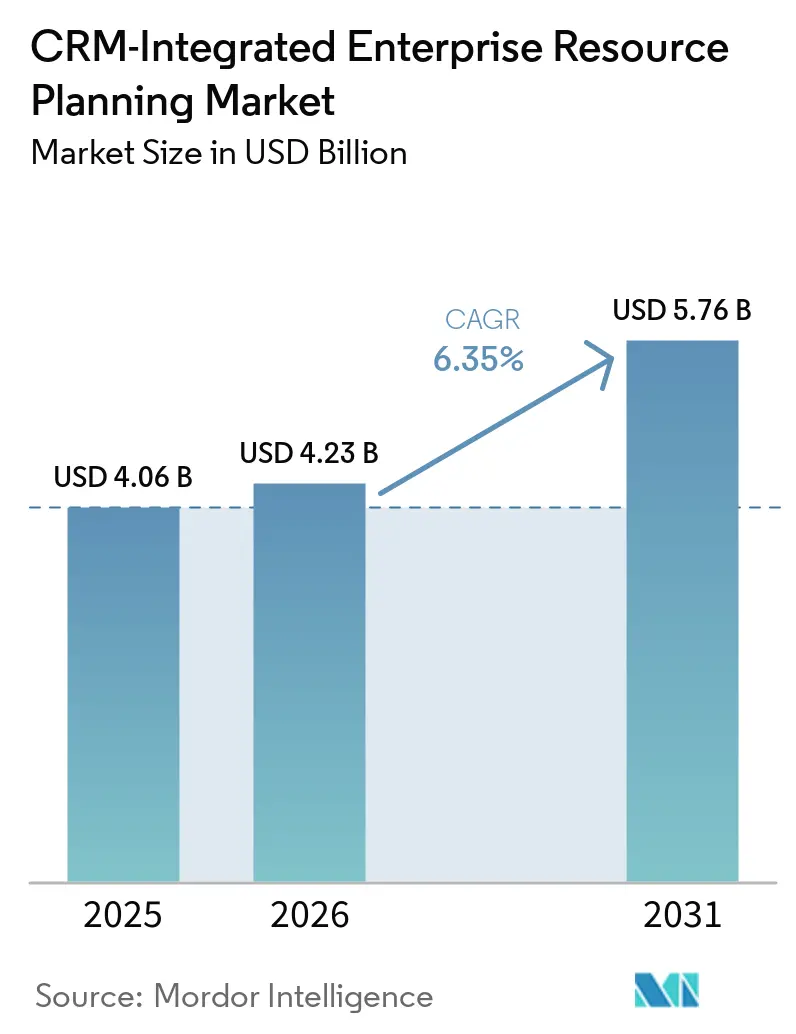
The CRM-Integrated ERP market size is expected to grow from USD 4.23 billion in 2026 to USD 5.76 billion by 2031 at a CAGR of 6.35% over 2026-2031. Heightened cloud adoption, AI-driven process automation, and government incentives for digitalization are reshaping vendor economics, while subscription pricing compresses switching costs for buyers. The shift to cloud platforms is enabling real-time synchronization of customer and back-office data, helping companies cut order-to-cash cycles and surface predictive insights that were impossible in siloed environments. At the same time, rising cybersecurity risks and divergent data-sovereignty rules are fragmenting product roadmaps, compelling vendors to localize hosting and compliance features. Competitive intensity is increasing as vertical specialists and open-source suites undercut incumbents on price, forcing the largest players to double down on ecosystem depth and AI differentiation.
Key Report Takeaways
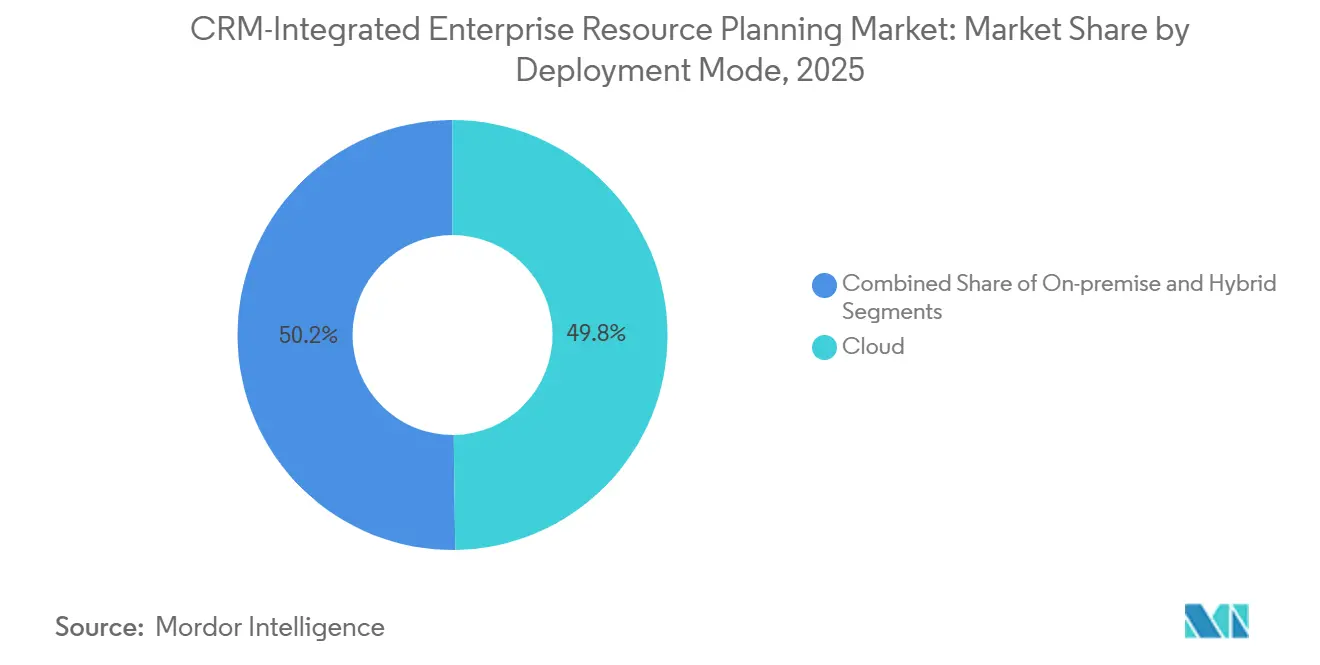
- By deployment mode, cloud commanded 49.80% of the CRM-Integrated ERP market share in 2025 and is expanding at a 14.20% CAGR through 2031.
- By industry vertical, manufacturing led with 23.40% revenue share in 2025, while healthcare is projected to grow at a 16.40% CAGR to 2031.
- By organization size, small and medium enterprises accounted for a 15.90% CAGR between 2026-2031, outpacing large enterprises by nearly threefold.
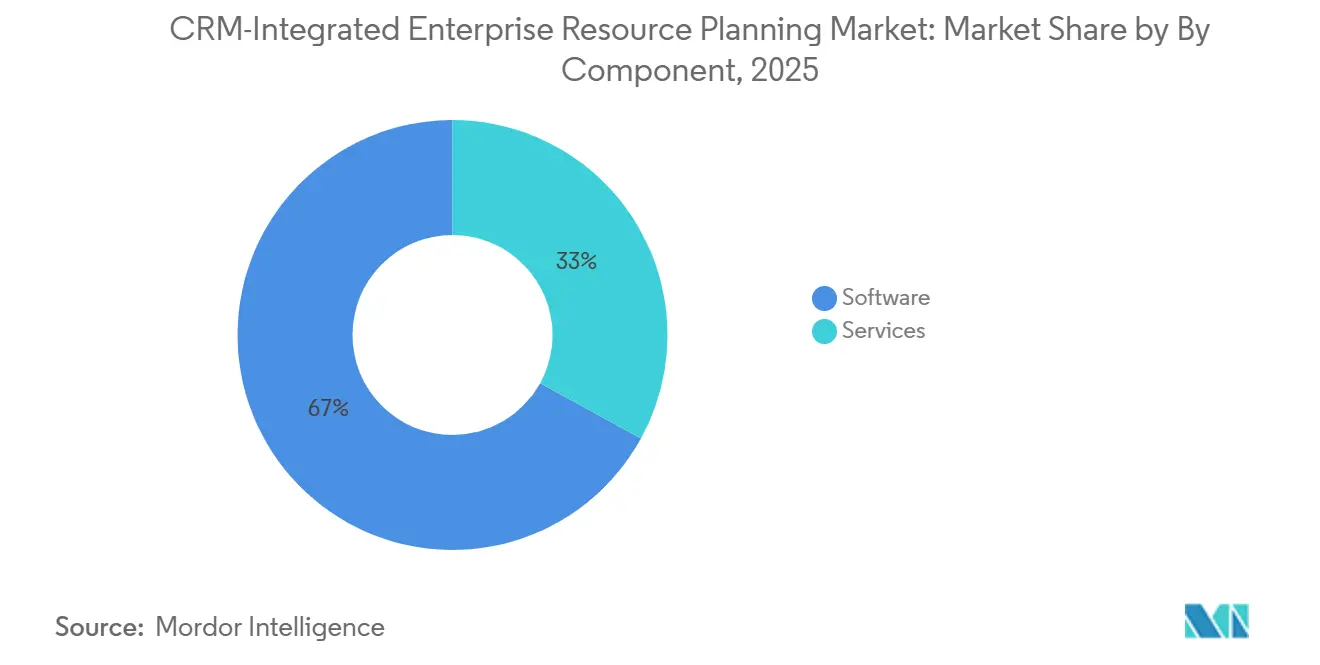
- By component, software captured 67.00% of the CRM-Integrated ERP market size in 2025, but services are forecast to grow at a 13.70% CAGR during 2026-2031.
- Asia-Pacific is the fastest-growing geography, advancing at a 13.80% CAGR, whereas North America retained 38.20% of global revenue in 2025.
Note: Market size and forecast figures in this report are generated using Mordor Intelligence’s proprietary estimation framework, updated with the latest available data and insights as of January 2026.
Market Trends and Insights
Drivers Impact Analysis of CRM-Integrated Enterprise Resource Planning Market*
| Driver | (~) % Impact on CAGR Forecast | Geographic Relevance | Impact Timeline |
|---|---|---|---|
| Cloud-First Digital Transformation Mandates | +2.1% | Global, strongest in North America and Asia-Pacific | Medium term (2-4 years) |
| Need for Unified Customer and Operational Data | +1.8% | Global, acute in BFSI and retail | Short term (≤ 2 years) |
| Rapid Adoption of AI-Driven Process Automation | +1.5% | North America and Europe lead, Asia-Pacific accelerating | Medium term (2-4 years) |
| Rising Subscription-Based Licensing Models | +1.3% | Global, SME focus in Europe and South America | Short term (≤ 2 years) |
| Growing Demand for Vertical-Specific ERP Suites | +1.0% | Manufacturing and healthcare in North America, BFSI in Europe and Middle East | Long term (≥ 4 years) |
| Government Incentives for SME Digitalization | +0.9% | Asia-Pacific, Europe, Middle East | Medium term (2-4 years) |
| Source: Mordor Intelligence | |||
Cloud-First Digital Transformation Mandates
Cloud deployments are growing at a 14.20% CAGR through 2031, more than double the overall CRM-Integrated ERP market rate, as enterprises retire on-premises hardware in favor of scalable platforms that synchronize customer and transactional data in real time. Middle Eastern e-invoicing deadlines for 2026 and 2027, together with Japan’s subsidy program that funds up to 50% of migration costs for SMEs, are accelerating this movement. Microsoft Dynamics 365 users have already cut average order-to-cash cycles by 30% after consolidating finance, inventory, and customer modules.[1] Vendors are responding by embedding tax engines and localization packs that update automatically, removing the manual patching burden that plagued on-premises systems.
Need for Unified Customer and Operational Data
Fragmented databases inflate hidden costs that integrated suites eliminate. Enterprises with unified CRM-ERP platforms reported 40% fewer quote errors and 25% better on-time delivery because customer credit, inventory, and logistics data are validated before order confirmation. BFSI adopters are harnessing 360-degree customer views to recommend cross-sell offers in real time, while retailers synchronize online and store inventory to avert costly stock-outs. An API-first design underpins these gains, exposing event-driven endpoints that third-party apps consume without brittle batch interfaces.
Rapid Adoption of AI-Driven Process Automation
Artificial intelligence has shifted from experimental add-on to core functionality, with several vendors embedding AI into ERP-CRM workflows by 2025. Generative agents now draft purchase orders, prepare renewal quotes, and flag credit risks by analyzing multi-variant data sets. Acumatica’s natural-language interface lets users ask complex financial or supply-chain queries without SQL skills, and predictive maintenance modules are shaving up to 35% of unplanned downtime in manufacturing plants. These benefits, however, depend on disciplined data-governance programs that cleanse and standardize historical records.
Rising Subscription-Based Licensing Models
Subscription contracts captured a significant share of new ERP deals in 2025, converting capital outlays into operating expenses and lowering entry barriers for SMEs. Zoho and Odoo offer CRM-ERP bundles from USD 50 per user per month, while large enterprises negotiate consumption-based terms linked to transaction volumes. Although the five-year total cost of ownership can converge with perpetual models, the pay-as-you-go approach defers significant upfront cash requirements and aligns vendor incentives with customer success.
Restraints Impact Analysis of CRM-Integrated Enterprise Resource Planning Market*
| Restraint | (~) % Impact on CAGR Forecast | Geographic Relevance | Impact Timeline |
|---|---|---|---|
| High Total Cost of Ownership for Complex Deployments | -1.4% | Global, most acute in mid-market firms | Short term (≤ 2 years) |
| Cyber-Security and Data-Sovereignty Concerns | -1.1% | Europe, Asia-Pacific, Middle East | Medium term (2-4 years) |
| Limited Qualified Implementation Talent Pool | -0.8% | North America, Europe, emerging markets | Medium term (2-4 years) |
| Interoperability Challenges with Legacy Systems | -0.7% | Manufacturing and BFSI verticals | Long term (≥ 4 years) |
| Source: Mordor Intelligence | |||
High Total Cost of Ownership for Complex Deployments
Software licenses account for just 20%-30% of project spend, with the rest consumed by data migration, customization, and change management that can triple budgets. Consultants bill USD 200-350 per hour, while regulated industries face extra validation steps, such as FDA 21 CFR Part 11 testing, which adds another 25%-40%.[2] Underfunded training often leads to user resistance, pushing failure rates above 60% when less than 15% of budgets go to change programs. Even cloud customers must guard against subscription sprawl, as unused SaaS seats can inflate recurring costs.
Cyber-Security and Data-Sovereignty Concerns
Centralized financial and customer data make ERP databases lucrative ransomware targets, with typical demands ranging from USD 2 million to USD 5 million for mid-market victims. Multi-tenant breaches in 2024 exposed weaknesses in tenant isolation, prompting regulators in China, India, and Saudi Arabia to require in-country hosting. EU GDPR rules and the U.K.’s diverging data act impose dual-compliance overheads on cross-border deployments, while sovereign-cloud mandates in the Middle East restrict vendor choice and elevate infrastructure costs.
*Our forecasts treat driver/restraint impacts as directional, not additive. The impact forecasts reflect baseline growth, mix effects, and variable interactions.
CRM-Integrated Enterprise Resource Planning Market Segment Analysis
By Deployment Mode:
Cloud Dominance Reshapes Infrastructure EconomicsCloud deployments secured 49.80% of 2025 revenue and are forecast to grow at 14.20% CAGR, more than twice the CRM-Integrated ERP market benchmark. Enterprises are routing capital away from servers toward analytics and innovation, while vendors reinforce regional capacity, such as Oracle’s USD 8 billion Tokyo build-out.[3] The EU Data Act eases provider switching by mandating data portability, yet China’s localization rules temper public cloud adoption. Hybrid architectures act as a compromise, but integration latency and security management can erode savings if poorly engineered.
Hybrid and on-premises options persist where intellectual-property concerns or defense regulations prohibit external hosting. Pharmaceutical firms still maintain validated manufacturing modules on-site, even as they place HR and procurement in the cloud. Consequently, the CRM-Integrated ERP market continues to support multiple deployment models, though the usage tilt clearly favors SaaS.

By Organization Size:
SMEs Outpace Enterprises in Adoption VelocitySmall and medium enterprises are advancing at a 15.90% CAGR, nearly triple the overall CRM-Integrated ERP market growth rate. Government programs such as India’s INR 2,925.39 crore (USD 350 million) PACS ERP initiative subsidize rural cooperatives,[4] while European Union Digital Decade grants aim to achieve 90% digitization of SMEs by 2030. Large enterprises, which still held 54.10% market share in 2025, face slower growth due to longer refresh cycles and entrenched custom code. Yet they are consolidating disparate stacks into unified suites to minimize integration overhead.
SMEs often skip on-premises footprints entirely, adopting modular cloud bundles that expand as business needs grow. The risk is subscription fatigue, as incremental add-ons can escalate monthly spend from USD 500 to USD 5,000, converging with perpetual ownership costs over time. Nevertheless, accessibility to AI features and real-time analytics is narrowing the capability gap between small firms and global incumbents.
By Component:
Services Growth Signals Implementation ComplexitySoftware accounted for 67.00% of 2025 revenue, but services are projected to grow at a 13.70% CAGR, driven by rising customization and integration workloads. Vertical-specific logic, such as ISO-compliant documentation in aerospace or patient-billing integration in healthcare, consumes up to 60% of implementation budgets. A global shortage of ERP consultants has pushed North American billing rates to USD 250 per hour, and vendors are expanding partner ecosystems to close delivery gaps.
Post-implementation managed services are becoming routine, priced at 15%-20% of annual subscription fees. Data-migration engagements can cost USD 500,000-2 million for mid-market rollouts, while generative-AI interfaces require fresh training programs even for seasoned operators. This dynamic shifts value capture from software licenses to high-margin professional services within the CRM-Integrated ERP market.
By Industry Vertical:
Healthcare Surge Challenges Manufacturing DominanceManufacturing maintained a 23.40% market share in 2025 due to decades of investment in production planning and supply-chain orchestration. Healthcare, however, is forecast to expand at a 16.40% CAGR through 2031, propelled by value-based reimbursement models that demand unified clinical and financial data. HIPAA-compliant audit trails, encryption, and role-based access controls are now bundled into industry templates, accelerating adoption among hospitals.
BFSI institutions deploy CRM-ERP suites to integrate loan, deposit, and insurance data, delivering real-time profitability views for relationship managers. Retailers synchronize omnichannel inventory to curb USD 1 trillion in annual lost sales from stock-outs. Public-sector projects such as Saudi Arabia’s Vision 2030 and India’s PACS ERP showcase how integrated platforms streamline citizen services and budgeting.
Geography Analysis
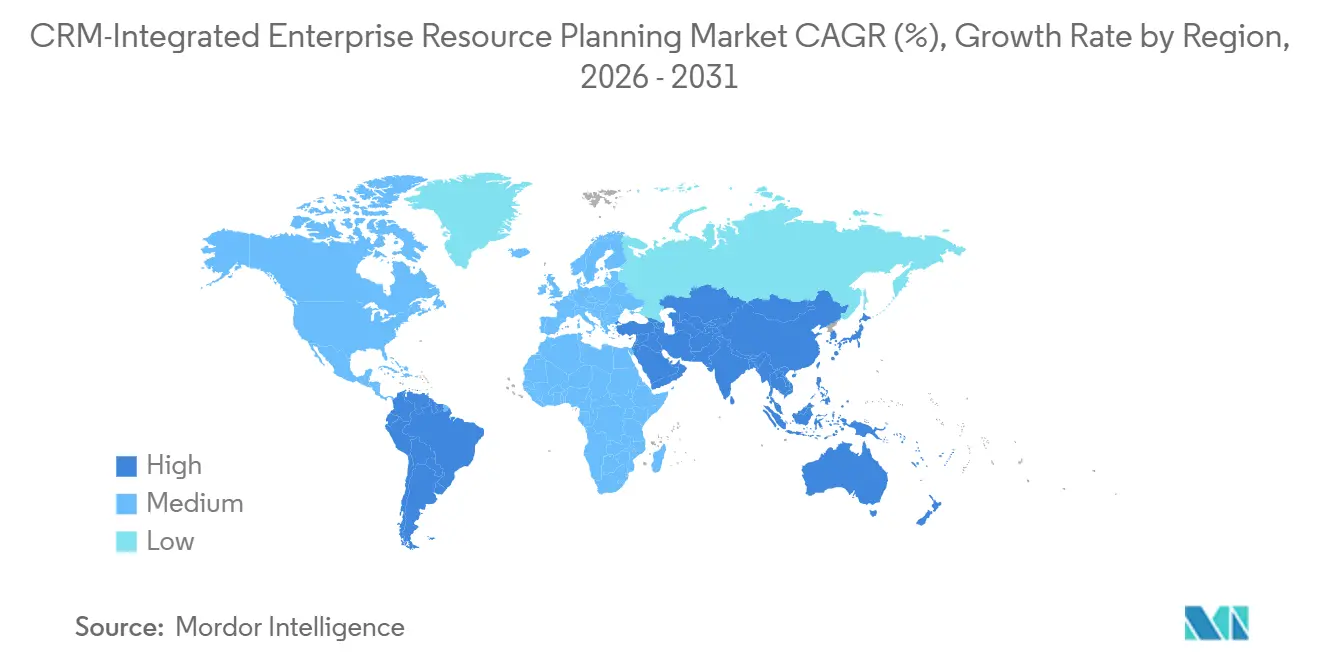
North America CRM-Integrated Enterprise Resource Planning Market
North America led with 38.20% revenue in 2025. Mature penetration limits new-logo growth, steering vendors toward replacements, AI add-ons, and vertical expansions. Cross-border trade under USMCA is stimulating demand for suites that automate tariff and origin documentation in real time.
APAC CRM-Integrated Enterprise Resource Planning Market
Asia-Pacific is the fastest-growing region, with a 13.80% CAGR. China’s cybersecurity statutes obligate domestic hosting, giving local suppliers an edge and compelling multinationals to build in-country data centers. India’s national PACS rollout, Japan’s USD 660 million SME subsidy, and Oracle’s Tokyo capacity expansion are powering rapid SaaS uptake. Diverse languages and regulations inflate localization costs but create openings for regional niche players.
EMEA and South America CRM-Integrated Enterprise Resource Planning Market
Europe’s growth is moderated by dual compliance with the EU Data Act and the U.K.’s post-Brexit data regime, which forces parallel governance frameworks for cross-border deployments. Germany, the United Kingdom, and France account for a significant share of regional spend, with Germany favoring on-premises control of proprietary scheduling algorithms. The Middle East is accelerating under mandatory e-invoicing laws, while Africa and South America remain emerging but demonstrate strong cloud adoption where legacy IT debt is minimal.
Competitive Landscape
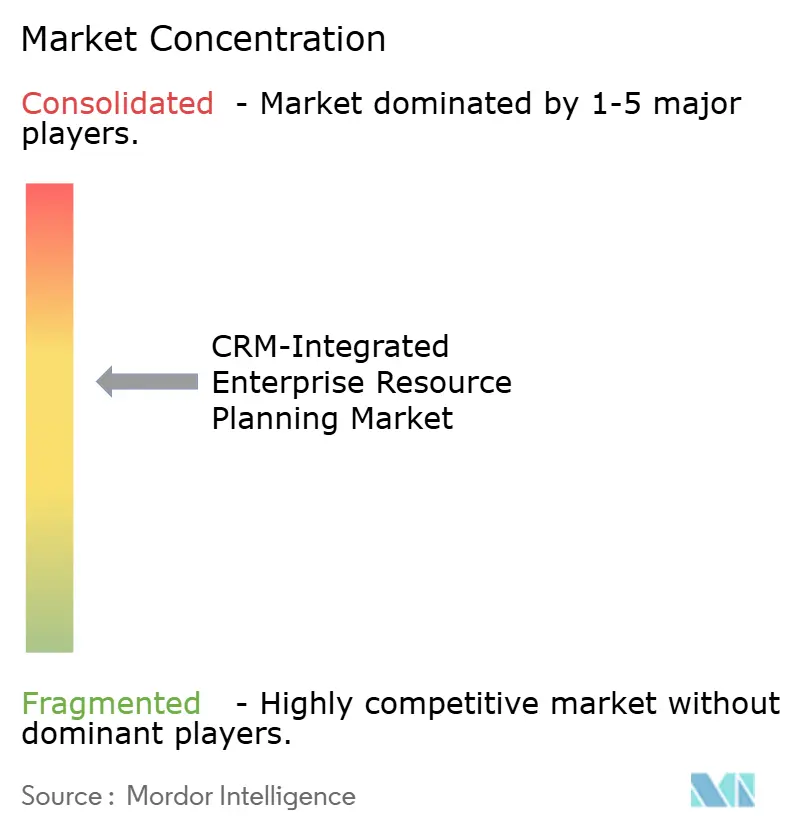
The CRM-Integrated ERP market is moderately concentrated: the top five vendors, SAP, Oracle, Microsoft, Workday, and Infor, collectively hold a significant percentage of global revenue, leaving meaningful share to regional specialists and open-source challengers. Subscription pricing and cloud deployment shorten sales cycles, lowering historical switching barriers and intensifying rivalry. Strategic playbooks hinge on vertical depth, geographic localization, and AI-powered differentiation.
Disruptors such as Odoo and Zoho leverage open-source or freemium models to attract cost-sensitive SMEs, then monetize premium modules and managed services. Hyperscalers are reshaping dynamics by hosting ERP marketplaces within their clouds, offering consumption-based billing that removes upfront license hurdles. IBM’s watsonx partnership with SAP and Oracle layers cross-vendor AI services that commoditize functional parity, shifting competitive moats toward partner ecosystems, industry templates, and post-go-live support.
Regulatory compliance and data sovereignty are also influencing vendor strategy. TOTVS dominates Brazil through deep localization of tax and labor rules, whereas Ramco Systems captures Indian public-sector contracts through domestic hosting and local-language support. Epicor’s acquisition of Bistrack reflects a micro-vertical approach, enabling tailored workflows for lumber and building-materials distributors that broader suites struggle to match.
CRM-Integrated Enterprise Resource Planning Industry Leaders
-
SAP SE
-
Oracle Corporation
-
Microsoft Corporation
-
Infor Inc.
-
Epicor Software Corporation
- *Disclaimer: Major Players sorted in no particular order
CRM-Integrated Enterprise Resource Planning Market Companies Covered in this Report
- SAP SE
- Oracle Corporation
- Microsoft Corporation
- Infor Inc.
- Epicor Software Corporation
- Workday Inc.
- Sage Group plc
- IFS AB
- Syspro (Pty) Ltd.
- Unit4 N.V.
- Acumatica, Inc.
- Plex Systems, Inc.
- QAD Inc.
- Deltek, Inc.
- Ramco Systems Limited
- Odoo SA
- Zoho Corporation Pvt. Ltd.
- Priority Software Ltd.
- TOTVS S.A.
- Epicor Kinetic (Epicor rebrand)
- Infor M3 (Infor solution)
Recent Industry Developments in CRM-Integrated Enterprise Resource Planning Market
- February 2026: Microsoft released Dynamics 365 Copilot for Sales and Customer Service, embedding generative AI that drafts emails, summarizes calls, and produces renewal quotes from unified CRM-ERP data.
- January 2026: SAP closed its USD 1.2 billion acquisition of LeanIX, enhancing migration road-mapping from legacy platforms to S/4HANA Cloud.
- August 2025: Oracle pledged USD 8 billion to triple data-center capacity in Tokyo and Osaka, supporting low-latency cloud ERP workloads.
- June 2025: Workday launched Illuminate, a generative AI layer across financial and HCM suites to enable conversational analytics.
Global CRM-Integrated Enterprise Resource Planning Market Report Scope
The CRM-Integrated ERP market refers to the ecosystem of software solutions and associated services that combine Enterprise Resource Planning (ERP) and Customer Relationship Management (CRM) functionalities into a unified platform or tightly integrated architecture.
The CRM-Integrated ERP Market Report is Segmented by Deployment Mode (On-Premises, Cloud, Hybrid), Organization Size (Small and Medium Enterprises, Large Enterprises), Component (Software, Services), Industry Vertical (Manufacturing, Retail and E-Commerce, Healthcare, Banking Financial Services and Insurance, Information Technology and Telecommunications, Government, Other Industry Verticals), and Geography (North America, South America, Europe, Asia-Pacific, Middle East, Africa). The Market Forecasts are Provided in Terms of Value (USD).
Segmentation Overview
| On-Premises |
| Cloud |
| Hybrid |
| Small and Medium Enterprises |
| Large Enterprises |
| Software |
| Services |
| Manufacturing |
| Retail and E-Commerce |
| Healthcare |
| Banking, Financial Services and Insurance |
| Information Technology and Telecommunications |
| Government |
| Other Industry Verticals |
| North America | United States |
| Canada | |
| Mexico | |
| South America | Brazil |
| Argentina | |
| Rest of South America | |
| Europe | Germany |
| United Kingdom | |
| France | |
| Rest of Europe | |
| Asia-Pacific | China |
| Japan | |
| India | |
| Rest of Asia-Pacific | |
| Middle East | Saudi Arabia |
| United Arab Emirates | |
| Rest of Middle East | |
| Africa | South Africa |
| Nigeria | |
| Rest of Africa |
| By Deployment Mode | On-Premises | |
| Cloud | ||
| Hybrid | ||
| By Organization Size | Small and Medium Enterprises | |
| Large Enterprises | ||
| By Component | Software | |
| Services | ||
| By Industry Vertical | Manufacturing | |
| Retail and E-Commerce | ||
| Healthcare | ||
| Banking, Financial Services and Insurance | ||
| Information Technology and Telecommunications | ||
| Government | ||
| Other Industry Verticals | ||
| By Geography | North America | United States |
| Canada | ||
| Mexico | ||
| South America | Brazil | |
| Argentina | ||
| Rest of South America | ||
| Europe | Germany | |
| United Kingdom | ||
| France | ||
| Rest of Europe | ||
| Asia-Pacific | China | |
| Japan | ||
| India | ||
| Rest of Asia-Pacific | ||
| Middle East | Saudi Arabia | |
| United Arab Emirates | ||
| Rest of Middle East | ||
| Africa | South Africa | |
| Nigeria | ||
| Rest of Africa | ||
Key Questions Answered in the Report
How fast is the CRM-Integrated ERP market expected to expand through 2031?
The sector is projected to climb from USD 4.23 billion in 2026 to USD 5.76 billion by 2031, reflecting a 6.35% CAGR.
Which deployment model is growing the quickest?
Cloud solutions lead, holding 49.80% share in 2025 and advancing at a 14.20% CAGR on the back of lower capital requirements and real-time data integration.
Why are small and medium enterprises adopting CRM-ERP suites so rapidly?
Subscription pricing, government subsidies, and pre-configured templates reduce upfront investment and complexity, driving a 15.90% CAGR among SMEs.
What is the primary restraint on large-scale rollouts?
Total cost of ownership, driven by customization, data migration, and change management, can exceed initial software spend by up to 300%.
Which region offers the strongest near-term growth prospects?
Asia-Pacific is expected to progress at 13.80% CAGR thanks to data-localization mandates, public subsidies, and major cloud investments.
How are vendors differentiating in a crowded market?
Leaders are prioritizing vertical specialization, localized compliance features, and embedded AI agents to automate finance, supply chain, and customer-engagement processes.