
Creator Marketing Services Market Size and Share
Market Overview
| Study Period | 2020 - 2031 |
|---|---|
| Market Size (2026) | USD 67.52 Billion |
| Market Size (2031) | USD 192.55 Billion |
| Growth Rate (2026 - 2031) | 23.32 % |
| Fastest Growing Market | North America |
| Largest Market | Asia-Pacific |
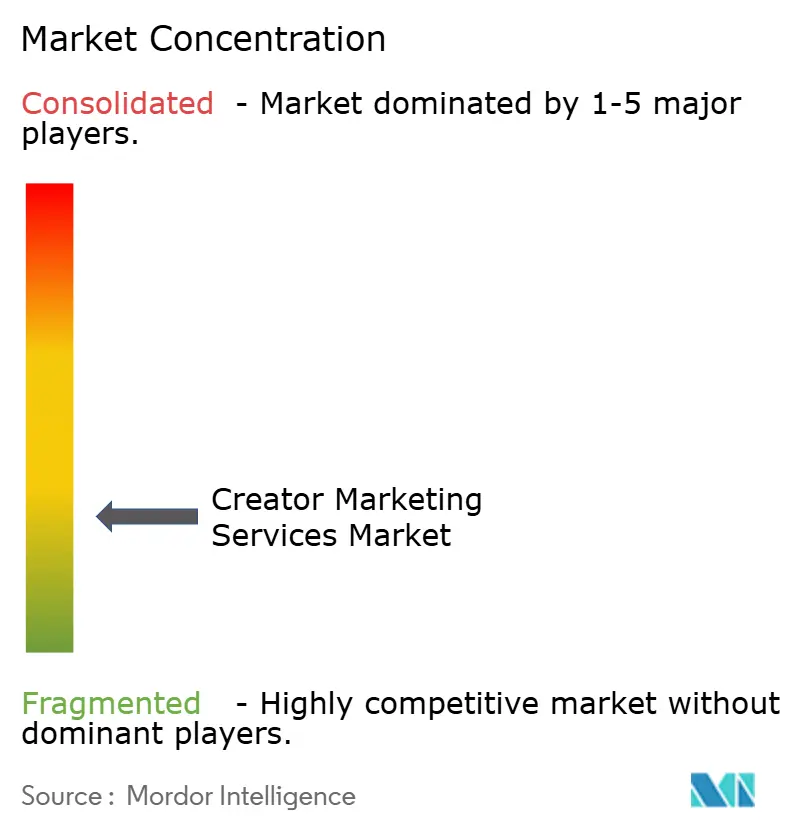
| Market Concentration | Low |
Major Players *Disclaimer: Major Players sorted in no particular order Image © Mordor Intelligence. Reuse requires attribution under CC BY 4.0. | |
Creator Marketing Services Market Analysis by Mordor Intelligence
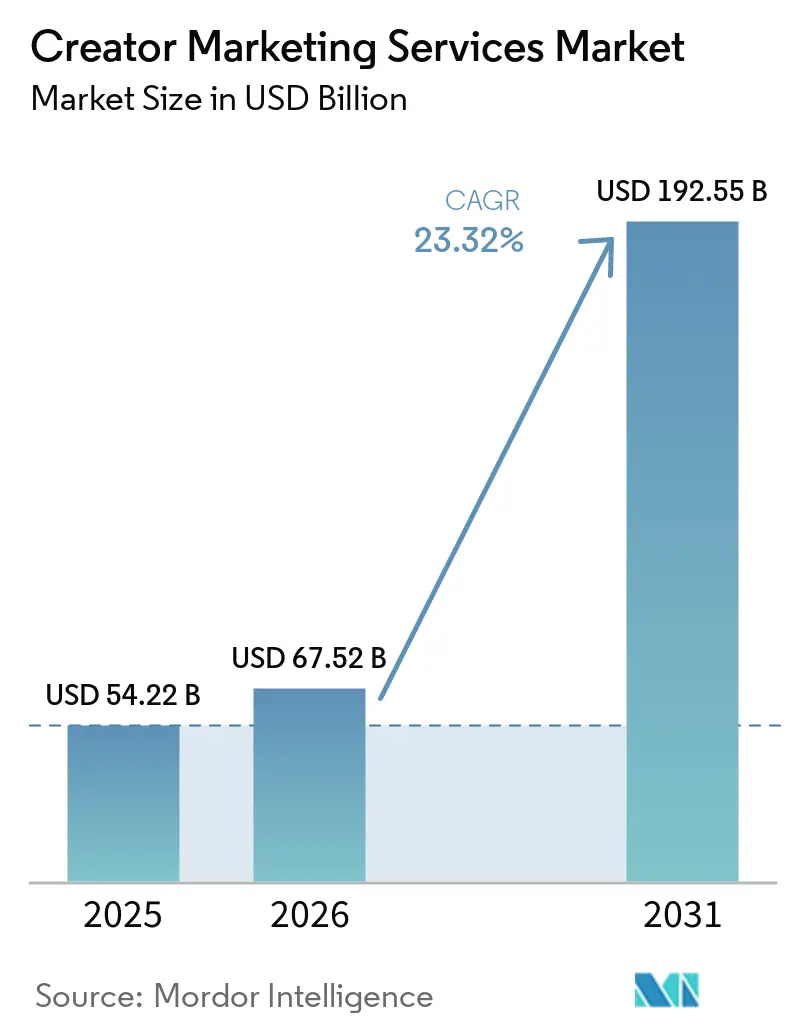
The creator marketing services market size was valued at USD 54.22 billion in 2025 and is estimated to grow from USD 67.52 billion in 2026 to reach USD 192.55 billion by 2031, at a CAGR of 23.32% during the forecast period (2026-2031). Growth reflects a lasting change in the way brands assign media budgets, with creator programs moving from occasional tests into regular advertising plans that receive clearer internal ownership. Creator-led media also gives brands a route to audiences that are difficult to reach through conventional display formats, particularly where viewers spend more time with social and video content. Social commerce is making creator content more directly connected to product discovery and purchase activity, which gives commercial teams a more direct reason to include creators in campaign planning. Providers that combine creator selection, campaign operations, relationship administration, and independent performance reporting are better placed to serve larger programs that run across several platforms and creator groups. Data policy and sponsored-content requirements are also increasing demand for systems that manage creator relationships, contracts, approvals, payments, and campaign records in a consistent way.
Key Report Takeaways
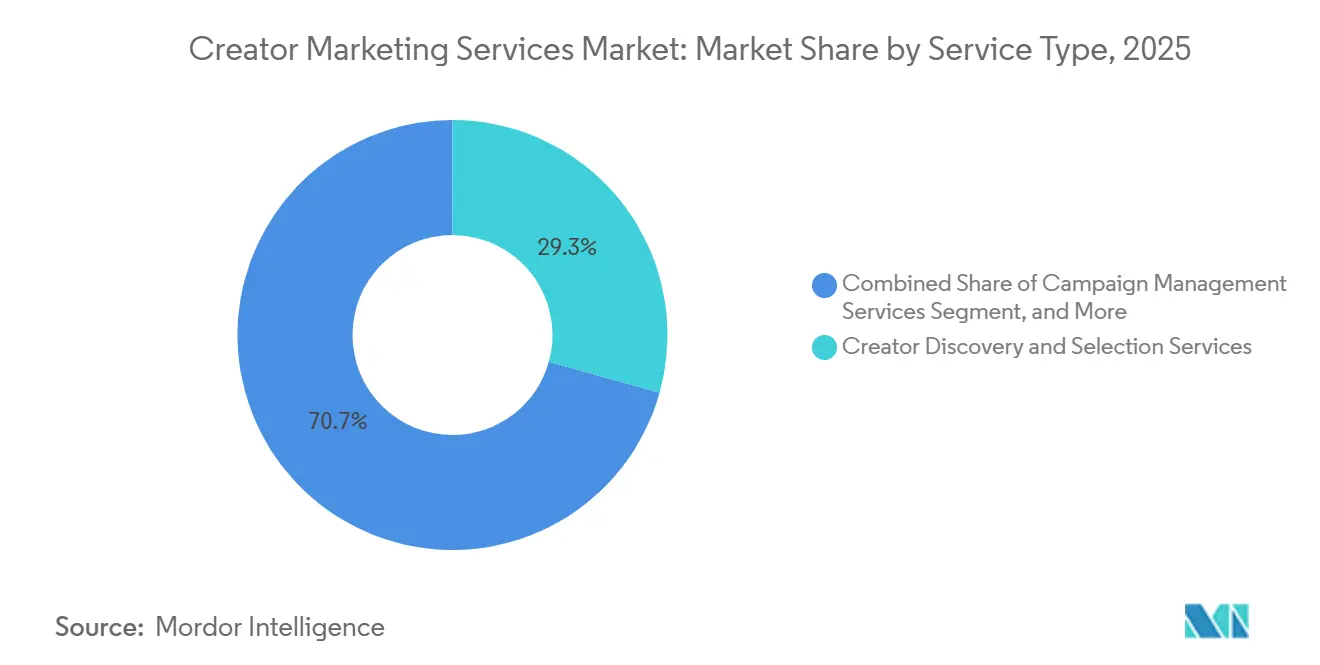
- By service type, Creator Discovery and Selection Services held 29.33% of the creator marketing services market share in 2025, while Content Creation and Production Services is projected to expand at a 24.66% CAGR through 2031.
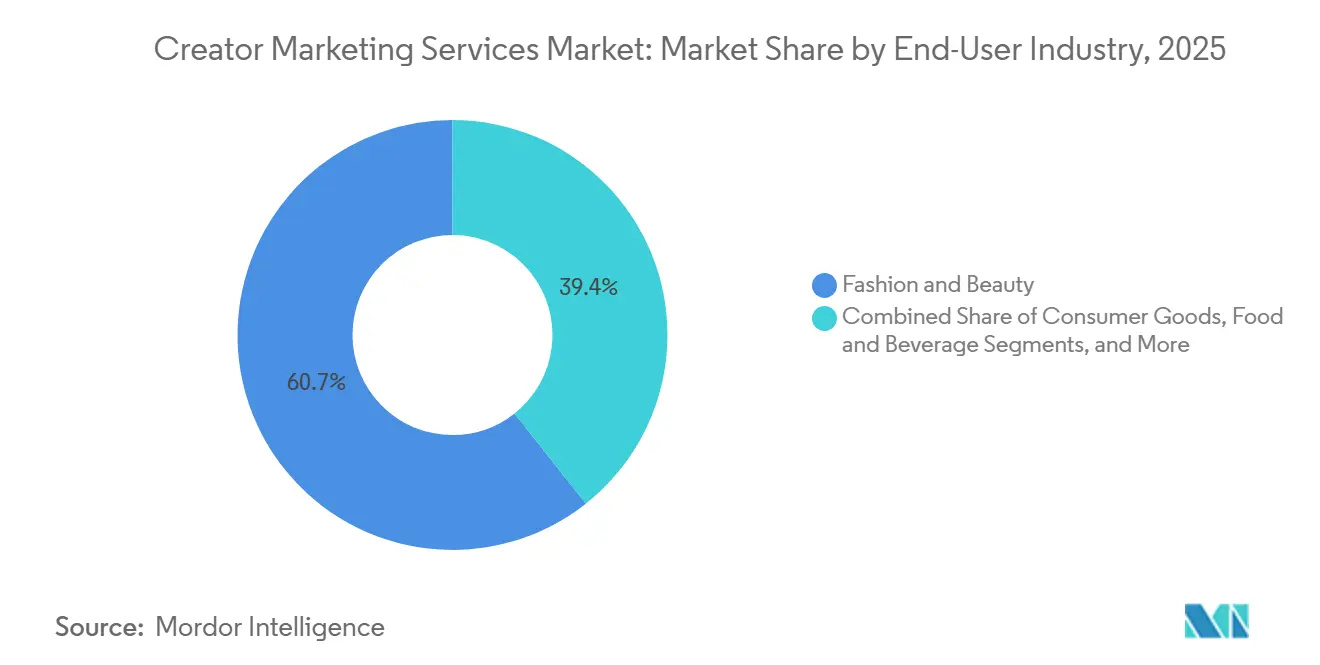
- By end-user industry, Fashion and Beauty held 60.65% of the creator marketing services market share in 2025, while Gaming and Entertainment is projected to expand at a 24.87% CAGR through 2031.
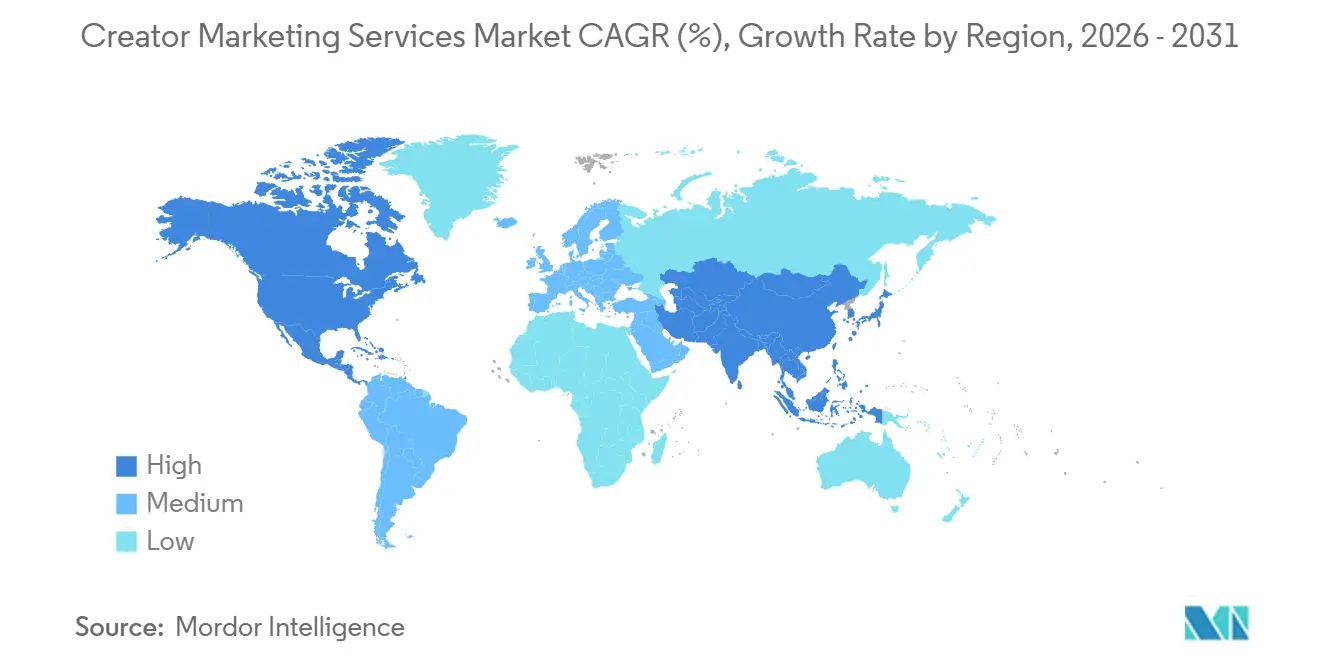
- By geography, North America held 36.52% of the creator marketing services market share in 2025, while Asia-Pacific is projected to expand at a 24.34% CAGR through 2031.
Note: Market size and forecast figures in this report are generated using Mordor Intelligence’s proprietary estimation framework, updated with the latest available data and insights as of January 2026.
Market Trends and Insights
Drivers Impact Analysis of Creator Marketing Services Market*
| Driver | (~) % Impact on CAGR Forecast | Geographic Relevance | Impact Timeline |
|---|---|---|---|
| Rising Reallocation of Digital Advertising Budgets Toward Creator-Led Media | +5.2% | Global | Short term (≤ 2 years) |
| Expansion of Social Commerce Integrations Driving Shoppable Creator Content | +4.1% | Asia-Pacific core, spillover to North America and Europe | Medium term (2-4 years) |
| AI-Enabled Creator Discovery, Matching, and Campaign Optimization | +3.8% | Global | Short term (≤ 2 years) |
| Accelerating Adoption of Short-Form Video Formats by Brands Globally | +3.5% | Global | Short term (≤ 2 years) |
| B2B Enterprise Adoption of Creator Marketing for Thought Leadership and Executive Positioning on LinkedIn | +2.4% | North America and Europe | Medium term (2-4 years) |
| Agentic AI Deployment in Autonomous Creator Campaign Management Reducing Human Overhead | +2.1% | North America, early adoption in Asia-Pacific | Long term (≥ 4 years) |
| Source: Mordor Intelligence | |||
Rising Reallocation of Digital Advertising Budgets Toward Creator-Led Media
The shift in budget source is a major force in the creator marketing services market. Creator-economy advertising spending reached USD 37 billion in 2025 and is expected to reach USD 43.91 billion in 2026.[1] The IAB described creator advertising as a core media channel, which places it closer to planned media activity than discretionary experimentation. Spending is increasingly redirected from traditional digital and paid channels rather than funded only through new advertising budgets. That movement brings stronger expectations for reporting, attribution, and performance-based contracts. It also increases demand for service providers that can operate creator programs with the controls used in established media channels. Brands are moving from occasional activations to continuous creator programs that need regular planning and supply of content. This change can make creator budgets more durable when programs show consistent commercial value. It also puts pressure on providers to connect campaign activity with business measures rather than engagement alone. The creator marketing services market gains from this shift because advertisers need discovery, contract administration, production, tracking, and creator relationship support. Agencies with limited measurement capabilities may find it harder to defend their fees as budgets become more accountable. Platforms that provide reliable data can become central to a brand's operating model.
Expansion of Social Commerce Integrations Driving Shoppable Creator Content
Social commerce expands the role of creator activity from awareness building to transaction support. Creator content can now lead consumers from product discovery to a purchase within the same platform session. This process is especially relevant to categories where demonstrations, reviews, and personal recommendations influence conversion. The creator marketing services market benefits when agencies manage both content and commerce-linked creator relationships. Service providers must then coordinate links, affiliate terms, product availability, creative approvals, and performance reporting. These activities require a more connected workflow than a conventional sponsored post campaign. The effect is particularly important across China and India, where social and commerce systems are closely connected. Fashion, beauty, consumer goods, food and beverage, and travel have clear use cases because creators can showcase products and offer a direct purchase path. Brand teams can use affiliate structures to connect compensation with sales outcomes. This gives finance and marketing teams a clearer basis for assessing program results. It also makes creator selection more consequential because the creator becomes part of the customer acquisition process. The creator marketing services market can therefore reward operators with commerce data and established retailer or platform connections.
AI-Enabled Creator Discovery, Matching, and Campaign Optimization
AI tools are changing how agencies and platforms identify creators and manage campaigns. Creator discovery can consider audience relevance, content subject, historical engagement, and brand requirements at a scale that manual review cannot sustain. Upfluence launched an AI-powered creator discovery and campaign optimization update in February 2026, with predictive analytics and workflow automation.[2] This type of system reduces the time required for initial screening and campaign coordination. It can also help teams apply consistent criteria across large creator pools. The creator marketing services market is increasingly reliant on platforms that integrate AI tools with reliable underlying creator data. The practical value of AI depends on the quality of the data and the safeguards behind its use. Automated recommendations still require human review for brand suitability, disclosure needs, and campaign context. Larger holding companies have more resources to develop integrated data systems and can apply them across media planning and creator services. Smaller agencies can remain competitive through sector expertise, trusted creator relationships, and specialized operating models. However, they may face longer turnaround times if they lack comparable matching and reporting tools. The creator marketing services market is likely to separate providers that use AI as a practical workflow capability from those that offer only manual coordination.
Accelerating Adoption of Short-Form Video Formats by Brands Globally
Short-form video has become a standard format for many creator programs. Its concise structure suits product demonstrations, trend participation, testimonials, and discovery-led content. The IAB expects U.S. digital video spending to reach USD 80 billion in 2026, while social video spending is expected to grow 13% year over year. This environment directs more brand attention toward creator-hosted video inventory. The creator marketing services market benefits because brands need help producing, approving, adapting, and amplifying frequent video assets. Efficient workflows become essential when content must be refreshed quickly. Short-form video also changes the service mix required from agencies. Teams must manage format specifications, creator briefs, usage rights, and paid amplification alongside creative direction. A single creative concept may require several versions for different audiences and platforms. This increases the value of production coordination and content libraries. Brands that already have creator networks can respond faster to changes in platform trends. Smaller providers can compete when they have strong format knowledge and fast approvals. The creator marketing services market therefore supports continued demand for production services as brands maintain a regular flow of vertical video.
Restraints Impact Analysis of Creator Marketing Services Market*
| Restraint | (~) % Impact on CAGR Forecast | Geographic Relevance | Impact Timeline |
|---|---|---|---|
| Persistent Measurement and ROI Attribution Challenges Limiting Budget Confidence | -2.8% | Global | Medium term (2-4 years) |
| Influencer Fraud, Fake Engagement, and Brand Safety Incidents Eroding Advertiser Trust | -2.2% | Global | Short term (≤ 2 years) |
| Creator Talent Burnout and High Attrition Rates Disrupting Long-Term Brand Partnership Continuity | -1.5% | North America and Europe | Medium term (2-4 years) |
| Fragmented Global Regulatory Frameworks for Sponsored Content Disclosure Creating Compliance Complexity | -1.1% | Global | Long term (≥ 4 years) |
| Source: Mordor Intelligence | |||
Persistent Measurement and ROI Attribution Challenges Limiting Budget Confidence
Measurement fragmentation remains a major restraint for the creator marketing services market. Discovery, contracting, payment, and performance reporting are often handled through separate tools. Platform reporting systems also use different measures and attribution rules. This makes direct comparisons between campaigns harder for advertisers. The IAB identified measurement and attribution as a central barrier to additional creator investment. Brands may therefore rely on proxy metrics when they cannot connect creator activity to a business outcome. The issue is more significant for products with long buying cycles or sales that occur offline. In these cases, a view or click alone may not show whether creator content influenced a later purchase. Marketing teams need consistent definitions and reporting methods across TikTok, Meta, YouTube, and other platforms. Agency operations must also align commercial objectives, content, and measurement before a campaign begins. Providers that can produce transparent reporting are better placed to retain recurring budgets. The creator marketing services market will continue to face a medium-term constraint until shared measurement practices become more widely adopted.
Influencer Fraud, Fake Engagement, and Brand Safety Incidents Eroding Advertiser Trust
Inauthentic followers, automated engagement, and poor brand fit can weaken advertiser confidence. These issues create a risk that reported reach does not represent a real or relevant audience. They can also cause brands to pay for activity that does not lead to consideration or sales. The Federal Trade Commission's endorsement guidance reinforces the need for transparent sponsored content practices.[3] Disclosure alone does not prevent fraudulent engagement, but it establishes a baseline for clearer commercial relationships. The creator marketing services market needs verification systems that assess audience quality as well as content compliance. Brand safety requires review of a creator's prior content, current public behavior, and suitability for a campaign. This work is harder when creator rosters are large, and campaign timetables are short. Platforms have an important role in addressing coordinated inauthentic behavior, while agencies must use their own screening procedures. Advertisers also need contractual protections and clear escalation processes. The constraint is not limited to a single platform or geography. It will remain relevant until verification practices, platform enforcement, and client due diligence become more consistent.
*Our forecasts treat driver/restraint impacts as directional, not additive. The impact forecasts reflect baseline growth, mix effects, and variable interactions.
Creator Marketing Services Market Segment Analysis
By Service Type:
Creator Selection Leads While Content Production Grows FastestCreator Discovery and Selection Services held 29.33% of the creator marketing services market share in 2025. The position reflects the importance of matching a creator with the right audience, brand setting, and campaign objective. A poor selection can affect several campaigns when brands work with creators on an ongoing basis. Campaign Management Services and Creator Relationship Management Services address the operational work of coordinating creator groups, approvals, and payments. These services help brands scale programs without increasing internal staffing at the same pace.
Content Creation and Production Services is projected to record a 24.66% CAGR from 2026 to 2031. The creator marketing services market size for this service is supported by demand for content that can appear in organic social posts, paid partnership ads, retail media, and connected television. Brands increasingly seek creator material that can be adapted across several media placements. AI-assisted production tools can help creators increase output while keeping content suited to each platform. Agentio stated that its infrastructure allowed brands to move from creative insight to live partnership ads in less than 1 week. This compares with traditional agency production schedules of 6-10 weeks described in the supplied material.

By End-User Industry:
Fashion and Beauty Provides Scale While Gaming and Entertainment ExpandsFashion and Beauty accounted for 60.65% of the creator marketing services market share by end-user industry in 2025. The category depends heavily on visual social proof and has a close fit with creator audiences for beauty and apparel. Retail and consumer packaged goods, including beauty and personal care, led creator ad spending categories in the IAB data. Creator content can link product presentation to in-platform commerce, which gives these brands a clearer route from content to a sales event. Consumer Goods and Food and Beverage also use creator relationships to support product trial and repeat purchase, especially in Southeast Asian and South American markets.
Gaming and Entertainment is projected to grow at a 24.87% CAGR from 2026 to 2031. Gaming livestreams, esports sponsorships, and native entertainment formats give brands access to Gen Z audiences through active communities. Technology and Electronics companies are also increasing creator use for product launches and B2B thought leadership. Healthcare and Wellness require tighter vetting because health claims must meet U.S. Food and Drug Administration and European advertising rules. This requirement supports demand for specialist service providers that can manage compliant creator partnerships. Travel and Hospitality is rebuilding creator programs with a stronger focus on experience-led content than transactional promotion.
Geography Analysis
North America Creator Marketing Services Market
North America accounted for 36.52% of the creator marketing services market size in 2025. The United States leads the region because large advertisers, platforms, agencies, and creator networks are concentrated there. The IAB's treatment of creator advertising as a core media channel supports more formal budget planning. Federal Trade Commission guidance provides rules for endorsements, influencers, and reviews. The Consumer Reviews and Testimonials Rule adds a further compliance framework for deceptive practices.
North America and Europe Creator Marketing Services Market
Canada contributes bilingual creator talent that can support cross-border campaigns. Mexico is becoming more important as its creator ecosystem and e-commerce activity develop. U.S. advertisers are expected to bring creator production and paid amplification closer together by 2027. Europe is shaped by disclosure expectations, data privacy requirements, and AI-content transparency obligations. Germany, the United Kingdom, France, Italy, and Spain form a developed regional base for creator marketing operations. Clear disclosure can support advertiser confidence by setting transparent rules for sponsored activity.
APAC, South America and MEA Creator Marketing Services Market
Asia-Pacific is expected to be the fastest-growing regional area at a 24.34% CAGR through 2031. China's live-commerce systems support direct paths from content to purchases. India's creator economy benefits from widespread mobile usage and closer links to domestic commerce platforms. South Korea combines K-beauty and K-pop creator networks with global cultural influence. Japan's compliance requirements have encouraged formal disclosure procedures among brands and agencies. South America and the Middle East and Africa provide additional growth paths where mobile-first audiences and creator trust can extend commerce activity beyond traditional media.
Competitive Landscape
The creator marketing services market includes global holding companies, specialist agencies, and software platforms. Publicis Groupe, WPP, Omnicom, Interpublic Group, and Dentsu offer creator capabilities as part of integrated media services. Specialist providers compete through creator data, campaign support, analytics, and category expertise. The competitive structure is more concentrated among enterprise providers than among smaller specialists. Larger groups can combine media planning, audience data, and creator operations within a broader client relationship. This gives them an advantage when clients want fewer service partners.
Publicis Groupe acquired Captiv8 in May 2025 and added creator technology to its wider connected offering.[4] The deal brought a creator network that covered 15 million creators in 120 countries and processed more than 2.5 billion social posts annually. Agentio announced a Meta advertising integration in July 2026 that supports automated creator advertising across Instagram and Facebook. The move shows how platform automation can shorten the route from campaign planning to live advertising. LinkedIn launched Creator Marketplace and BrandWorks in June 2026 to support B2B creator discovery and paid amplification.
CreatorIQ, Traackr, Grin Technologies, and Upfluence compete through creator information and platform connections. LTK, Impact.com, and Later focus more closely on commerce-linked activation and retailer connections. Agentic workflow tools may reduce manual work in creator discovery, outreach, verification, and payment. This creates price pressure for service-heavy agencies that cannot show a clear strategic or operational advantage. Meltwater should be positioned as a broader media intelligence and social listening provider with creator functions, rather than as a pure creator specialist. Impact.com should be positioned as a wider partnerships automation platform whose creator capabilities sit within a broader offering.
Creator Marketing Services Industry Leaders
-
Publicis Groupe S.A.
-
WPP plc
-
Omnicom Group Inc.
-
Dentsu Inc.
-
Whalar Group Ltd.
- *Disclaimer: Major Players sorted in no particular order
Creator Marketing Services Market Companies Covered in this Report
- Publicis Groupe S.A.
- WPP plc
- Interpublic Group of Companies, Inc.
- Omnicom Group Inc.
- Dentsu Inc.
- Daniel J. Edelman Holdings, Inc.
- Whalar Group Ltd.
- IZEA Worldwide, Inc.
- Viral Nation Inc.
- Billion Dollar Boy Ltd.
- Open Influence, Inc.
- Obviously Social LLC
- HireInfluence LLC
- Socially Powerful Ltd.
- The Influencer Marketing Factory LLC
- CreatorIQ Inc.
- Traackr, Inc.
- Upfluence SAS
- Onalytica Ltd.
- TopRank Marketing, Inc.
- NeoReach Inc.
- Linqia, Inc.
- LTK Co.
- AnyMind Group, Inc.
- Later, Inc.
- Meltwater NV
- Impact.com, Inc.
- Grin Technologies Inc.
Recent Industry Developments in Creator Marketing Services Market
- July 2026: Agentio announced an advertising integration partnership with Meta, enabling brands to launch creator Partnership Ads across Instagram and Facebook in days using AI-driven creative intelligence. The integration positions AI-native workflow automation as a direct competitive challenge to traditional influencer marketing agency campaign management services, compressing timelines and reducing human overhead across the discovery-to-live campaign workflow.
- June 2026: Accenture agreed to acquire Whalar, the creator and social agency, from Whalar Group, adding the agency's operations — which have managed over USD 600 million in creator campaigns across 40+ countries and 15 languages — to Accenture Song. The deal, described by Whalar Group co-CEO Neil Waller as a C-suite priority signal for the creator economy, was preceded by a three-year strategic partnership with Whalar Group for ongoing creator innovation.
- March 2026: LTK launched Quick Collabs within the LTK Brand Platform, a streamlined workflow enabling brands to discover, offer, and pay creators in a single interface. Since the platform's November 2025 debut, over 1,200 brands have joined, with the commission-on-sales model replacing subscription fees as LTK's primary revenue mechanism.
- January 2026: PMG acquired Digital Voices, a London and New York-based influencer marketing agency specializing in data-driven creator campaigns. The acquisition, PMG's fourth in its history, adds influencer marketing agency depth to its integrated media and technology stack and extends EMEA coverage following PMG's Alli Marketplace launch and EMEA expansion in 2025.
- September 2025: LTK, in partnership with Northwestern University's Retail Analytics Council, published its annual CMO Creator Marketing Study, finding that creators rank as the number one channel for planned marketing investment increases in 2026 among organizations with USD 10 million and above in revenue. Creators ranked above AI-driven search, paid social, and paid search — a ranking with direct implications for influencer marketing agency new business pipelines.
Global Creator Marketing Services Market Report Scope
The Creator Marketing Services Market Report is Segmented by Service Type (Creator Discovery and Selection Services, Campaign Management Services, Creator Relationship Management Services, Content Creation and Production Services, Performance Tracking and Analytics Services, and Other Platforms), End-User Industry (Fashion and Beauty, Consumer Goods, Food and Beverage, Technology and Electronics, Healthcare and Wellness, Travel and Hospitality, Media and Entertainment, and Other End-user Industries), and Geography (North America, South America, Europe, Asia-Pacific, and Middle East and Africa). The Market Forecasts are Provided in Terms of Value (USD).
Segmentation Overview
| Creator Discovery and Selection Services |
| Campaign Management Services |
| Creator Relationship Management Services |
| Content Creation and Production Services |
| Performance Tracking and Analytics Services |
| Other Service Types |
| Fashion and Beauty |
| Consumer Goods |
| Food and Beverage |
| Technology and Electronics |
| Healthcare and Wellness |
| Travel and Hospitality |
| Gaming and Entertainment |
| Other End-user Industries |
| North America | United States |
| Canada | |
| Mexico | |
| South America | Brazil |
| Argentina | |
| Chile | |
| Rest of South America | |
| Europe | Germany |
| United Kingdom | |
| France | |
| Italy | |
| Spain | |
| Rest of Europe | |
| Asia-Pacific | China |
| Japan | |
| India | |
| South Korea | |
| Australia | |
| Rest of Asia-Pacific | |
| Middle East and Africa | Saudi Arabia |
| United Arab Emirates | |
| South Africa | |
| Rest of Middle East and Africa |
| By Service Type | Creator Discovery and Selection Services | |
| Campaign Management Services | ||
| Creator Relationship Management Services | ||
| Content Creation and Production Services | ||
| Performance Tracking and Analytics Services | ||
| Other Service Types | ||
| By End-User Industry | Fashion and Beauty | |
| Consumer Goods | ||
| Food and Beverage | ||
| Technology and Electronics | ||
| Healthcare and Wellness | ||
| Travel and Hospitality | ||
| Gaming and Entertainment | ||
| Other End-user Industries | ||
| By Geography | North America | United States |
| Canada | ||
| Mexico | ||
| South America | Brazil | |
| Argentina | ||
| Chile | ||
| Rest of South America | ||
| Europe | Germany | |
| United Kingdom | ||
| France | ||
| Italy | ||
| Spain | ||
| Rest of Europe | ||
| Asia-Pacific | China | |
| Japan | ||
| India | ||
| South Korea | ||
| Australia | ||
| Rest of Asia-Pacific | ||
| Middle East and Africa | Saudi Arabia | |
| United Arab Emirates | ||
| South Africa | ||
| Rest of Middle East and Africa | ||
Key Questions Answered in the Report
What is the size of the Creator Marketing Services Market?
The Creator Marketing Services Market was valued at USD 54.22 billion in 2025 and is estimated at USD 67.52 billion in 2026. It is projected to reach USD 192.55 billion by 2031.
What is driving growth in creator marketing services?
Budget reallocation toward creator-led media, social commerce, AI-enabled creator selection, and short-form video adoption are supporting expansion.
Which service type holds the largest share?
Creator Discovery and Selection Services held the largest share at 29.33% in 2025.
Which service type is growing fastest?
Content Creation and Production Services is projected to grow at a 24.66% CAGR from 2026 to 2031.
Which end-user sector leads demand?
Fashion and Beauty accounted for 60.65% of demand in 2025, supported by product demonstration content and creator-linked commerce.
Which region is expanding fastest?
Asia-Pacific is projected to expand at a 24.34% CAGR through 2031, led by social-commerce activity and mobile-first creator ecosystems.