
Creator Economy Software Market Size and Share
Market Overview
| Study Period | 2020 - 2031 |
|---|---|
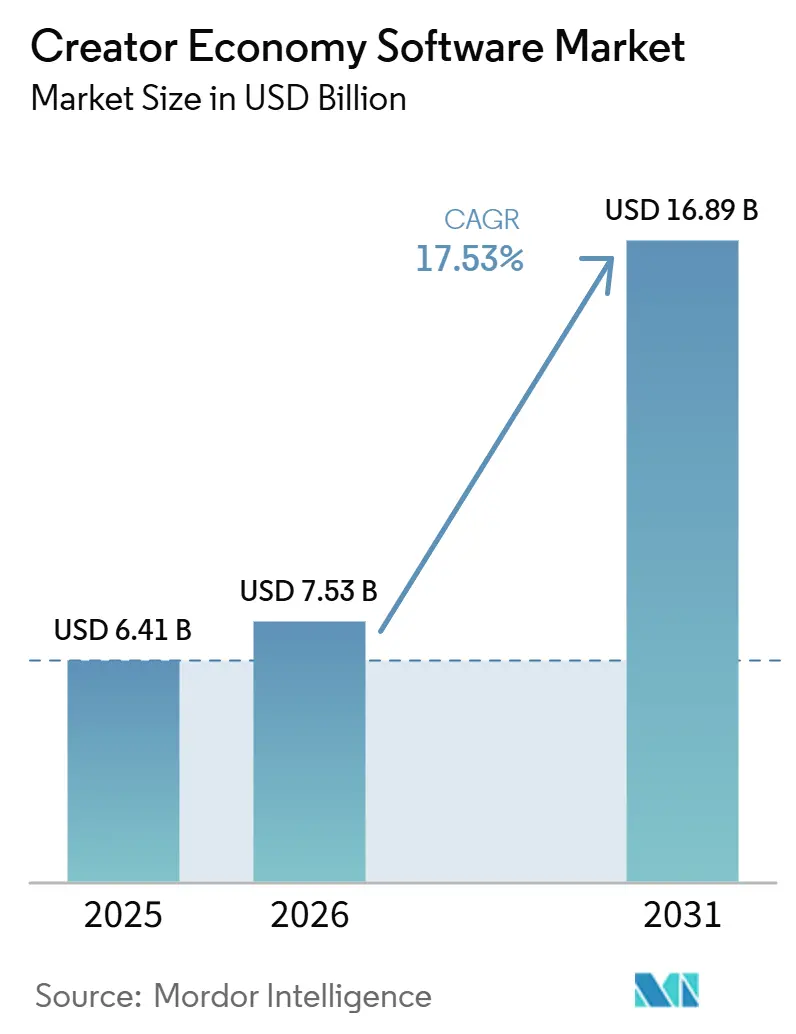
| Market Size (2026) | USD 7.53 Billion |
| Market Size (2031) | USD 16.89 Billion |
| Growth Rate (2026 - 2031) | 17.53 % |
| Fastest Growing Market | Asia-Pacific |
| Largest Market | North America |
| Market Concentration | Medium |
Major Players *Disclaimer: Major Players sorted in no particular order Image © Mordor Intelligence. Reuse requires attribution under CC BY 4.0. | |
Creator Economy Software Market Analysis by Mordor Intelligence
The creator economy software market size was valued at USD 6.41 billion in 2025 and is estimated to grow from USD 7.53 billion in 2026 to reach USD 16.89 billion by 2031, at a CAGR of 17.53% during the forecast period 2026-2031. Growth reflects a shift by independent creators, publishers, and brands toward direct audience monetization rather than dependence on advertising revenue from social platforms. Platforms that combine subscriptions, community functions, payment processing, and commerce tools are becoming more relevant because multi-tool workflows can be costly and difficult to manage. Regulatory reporting requirements in the United States and Europe are also increasing the value of embedded payment, tax, and compliance functions. The creator economy software market remains moderately fragmented, although platforms with broader product capabilities and lower transaction costs are competing for creator migrations. Companies that serve the mid-market with integrated creator collaboration, payments, compliance, and audience data tools have a clear opportunity.
Key Report Takeaways
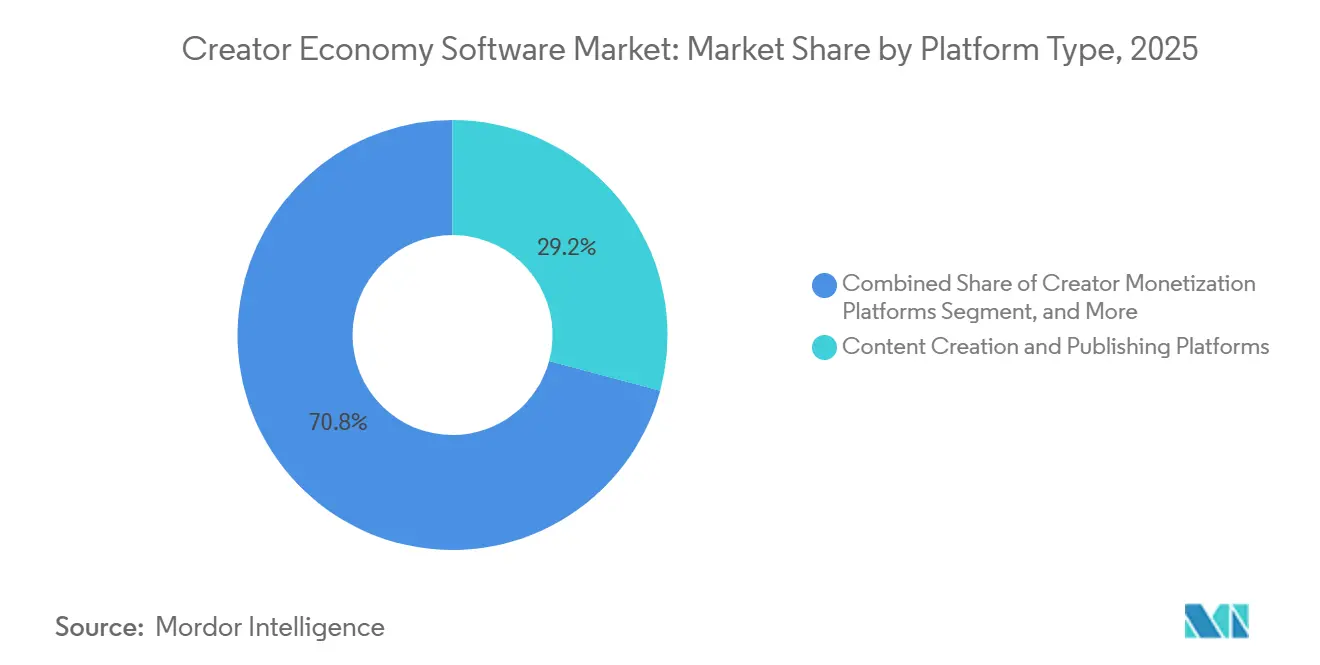
- By platform type, content creation and publishing platforms held 29.18% of revenue in 2025, while creator commerce platforms are projected to expand at a CAGR of 19.82% through 2031.
- By deployment, cloud-based deployment accounted for 87.53% of the creator economy software market in 2025 and is expected to grow at a CAGR of 18.26% through 2031.
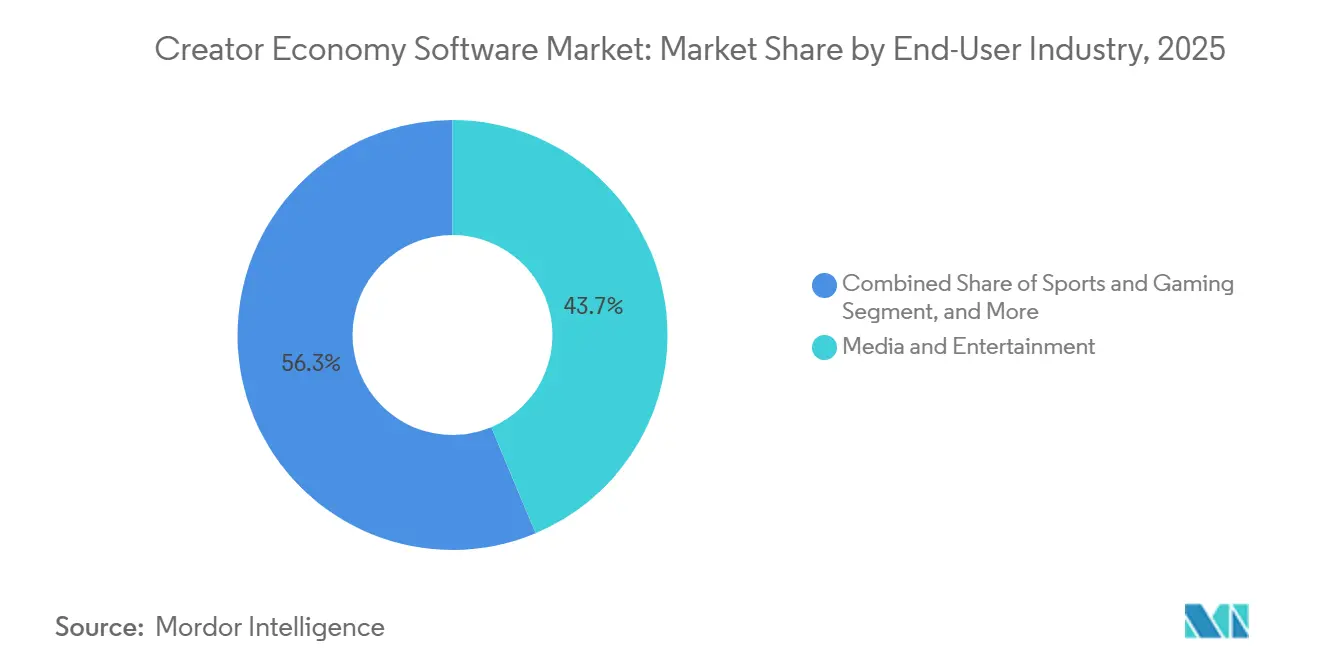
- By end-user industry, media and entertainment held 43.67% of revenue in 2025, while brands and marketing agencies are projected to record the highest CAGR of 21.16% through 2031.
- By geography, North America accounted for 37.49% of revenue in 2025, while Asia-Pacific is expected to expand at a CAGR of 23.59% through 2031.
Note: Market size and forecast figures in this report are generated using Mordor Intelligence’s proprietary estimation framework, updated with the latest available data and insights as of January 2026.
Global Creator Economy Software Market Trends and Insights
Drivers Impact Analysis*
| DRIVER | (~) % IMPACT ON CAGR FORECAST | GEOGRAPHIC RELEVANCE | IMPACT TIMELINE |
|---|---|---|---|
| Rising Demand for Direct-to-Fan Monetization | +3.4% | Global, with concentration in North America and Europe | Short term (≤ 2 years) |
| Rapid Adoption of AI-Enabled Content Operations | +3.1% | Global, with early gains in North America and spillover to Asia-Pacific | Medium term (2-4 years) |
| Expansion of Creator-Owned Commerce Workflows | +2.6% | North America and Asia-Pacific, with spillover to Europe | Short term (≤ 2 years) |
| Growth of Subscription-Based Audience Ownership Models | +2.2% | Global, with strongest uptake in North America and Western Europe | Medium term (2-4 years) |
| Platform Bundling Across Community, Email, and Payments | +1.7% | North America and Europe, with early gains in Asia-Pacific | Medium term (2-4 years) |
| Enterprise Demand for Creator Collaboration and Governance Tools | +1.2% | North America and the European Union, with spillover to the Middle East and Africa and Asia-Pacific | Long term (≥ 4 years) |
| Source: Mordor Intelligence | |||
Rising Demand for Direct-to-Fan Monetization Suites
Direct-to-fan monetization is a central demand driver for the creator economy software market. Creators are increasingly seeking subscription income, memberships, paid communities, and digital product sales that are not dependent on social platform advertising policies. Patreon had distributed more than USD 10 billion in creator payments and served more than 25 million paid memberships. Subscription platforms have also benefited as creators diversify after changes to social media payout structures. The shift matters because creators can use direct payments and first-party audience data to build more stable commercial relationships. Higher U.S. creator advertising spending also supports demand for software that handles payments, subscriber records, audience communication, and commerce workflows.
Rapid Adoption of AI-Enabled Content Operations
AI tools are changing how creators plan, produce, distribute, and assess content across the creator economy software market. Automation can reduce the time spent on campaign reporting, subscriber grouping, sponsorship pricing, and content scheduling. This helps individual creators and smaller teams perform tasks that previously required separate production, marketing, and operations staff. AI functions are becoming more useful when they are integrated within publishing, community, commerce, and analytics tools rather than offered as separate features. Enterprise users also need stronger creator suitability and brand safety reviews across large campaigns. CreatorIQ reported that organizations use an average of 3 tools to assess creator suitability, which supports demand for more integrated governance platforms.[1]CreatorIQ, “CreatorIQ Introduces SafeIQ: The First Enterprise-Grade, AI-Native Brand Safety Infrastructure for Creator Marketing,” Business Wire, businesswire.com
Expansion of Creator-Owned Commerce Workflows
Creator-owned commerce is expanding as creators sell physical products, digital goods, memberships, and affiliate offerings to their own audiences. The creator economy software market benefits when transaction, fulfillment, and community tools are connected within a single workflow. Creator platforms can capture purchase histories and subscriber behavior that are generally unavailable through advertising-led revenue models. This information can support more relevant offers and repeat purchase activity. Kajabi reported that creators on its platform had surpassed USD 10 billion in cumulative sales, showing the scale of course and digital-product commerce. Commerce platforms are also attracting creators who previously used general-purpose e-commerce services that were not designed for audience-led selling.
Growth of Subscription-Based Audience Ownership Models
Subscription models give creators a more predictable income source than advertising revenue linked to changing algorithms and platform policies. Changes to YouTube Shorts payouts, TikTok creator funding, and Instagram Reels bonuses encouraged more creators to diversify through owned subscription channels. This has increased demand for software that manages memberships, paywalls, billing, newsletters, and retention activity. Beehiiv reported that paid subscription revenue doubled to USD 19 million in 2025 from USD 8 million in 2024. The company projected paid subscription revenue of USD 35 million by the end of 2026. Lower subscriber churn can also encourage creators to invest further in platforms that improve payment recovery, subscriber engagement, and retention.[2]beehiiv, “beehiiv Paid Newsletter Revenue Doubles to USD 19 Million in 2025,” beehiiv, emitpost.com
Restraints Impact Analysis*
| RESTRAINT | (~) % IMPACT ON CAGR FORECAST | GEOGRAPHIC RELEVANCE | IMPACT TIMELINE |
|---|---|---|---|
| Fragmented Payment, Tax, and Compliance Workflows | -2.0% | Global, most acute in Europe and for cross-border payouts in the Middle East and Africa and Asia-Pacific | Medium term (2-4 years) |
| Creator Churn Across Multi-Platform Monetization Stacks | -1.6% | Global, with the highest exposure in North America and Europe | Short term (≤ 2 years) |
| Rising Take-Rate Sensitivity Among Mid-Tier Creators | -1.2% | Global, with concentration in North America and Europe | Short term (≤ 2 years) |
| Limited Interoperability Across Audience, Commerce, and Analytics Modules | -0.9% | Global, with the greatest effect on enterprise brands managing cross-platform programs | Long term (≥ 4 years) |
| Source: Mordor Intelligence | |||
Fragmented Payments, Tax, and Compliance Workflows Across Jurisdictions
Cross-border payment and compliance requirements can limit adoption in the creator economy software market. A large enterprise campaign may involve more than 200 creators across 15 or more countries with different withholding, value-added tax, identity verification, and reporting requirements. The European Union’s DAC7 requirements have increased reporting responsibilities for digital platforms that facilitate income-generating activity. Smaller platforms may lack the regulatory and engineering resources needed to build native multi-jurisdiction tax functions. The revised U.S. Form 1099-K threshold of USD 600 per platform per year also increases administrative requirements for smaller creator payments. Merchant of Record models and embedded tax automation can reduce this burden, but developing those capabilities requires significant infrastructure investment.
Creator Churn Across Multi-Platform Monetization Stacks
Creator churn can weaken recurring revenue when creators use several monetization services without integrated payment recovery or audience management. Failed card payments, expired payment methods, and incomplete renewal processes can lead to involuntary membership losses. The issue becomes more difficult when creators operate subscriptions across 3 or more platforms.[3]https://paprika.bot/blog/how-to-build-a-creator-business, Paprika.bot referencing Recurly research Low data portability also complicates platform changes because subscriber behavior, purchase records, and audience tags may not transfer easily. This can reduce the quality of migration decisions while leaving creators dissatisfied with disconnected workflows. Platforms that improve payment recovery, behavioral segmentation, and subscriber retention can reduce churn more effectively than platforms focused only on customer acquisition.
*Our forecasts treat driver/restraint impacts as directional, not additive. The impact forecasts reflect baseline growth, mix effects, and variable interactions.
Segment Analysis
By Platform Type: Content Platforms Lead Revenue While Creator Commerce Gains Momentum
Content creation and publishing platforms held 29.18% of the creator economy software market share in 2025. The segment benefits from the fact that publishing and distribution are often the first software needs for individual creators and independent publishers. These platforms support content scheduling, email delivery, search optimization, and the distribution of written, audio, and video formats. Their role in a creator workflow makes it difficult to replace them once creators build archives, subscriber lists, and recurring publishing processes. Audience Growth and Community Management Platforms also serve a growing need because follower counts on social networks do not provide the same control as owned subscriber communities.
Creator commerce platforms are projected to grow at a CAGR of 19.82% from 2026 to 2031. The segment benefits as creators connect merchandise, digital downloads, memberships, and affiliate sales directly to their content. This approach reduces reliance on external storefronts and gives creators more control over the buyer journey. The creator economy software market size for commerce-focused tools is supported by first-party transaction information, which can improve product recommendations and repeat sales. Commerce providers are therefore competing on more than storefront design because payment, fulfillment, membership, and audience functions need to work together.



By Deployment: Cloud Delivery Dominates While On-Premises Serves Regulated Needs
Cloud-based deployment accounted for 87.53% of the creator economy software market in 2025. Creators and small teams value browser access, automatic updates, subscription pricing, and the absence of server management. Cloud platforms also support real-time audience grouping, content recommendations, programmatic advertising functions, and integrations with payment services. Persistent cloud data can make it easier to connect audience activity across publishing, community, and commerce tools. Beehiiv, Kajabi, Substack, and Fourthwall use cloud-native delivery models that fit these requirements.
Cloud-based deployment is expected to grow at a CAGR of 18.26% through 2031. Mid-sized media companies and brand content teams are also moving to software-as-a-service systems for creator program management. This shift supports demand for tools that combine content operations with audience analytics and subscriber payments. The cloud model enables faster feature releases, which can be important as platforms add AI capabilities and new monetization options. It also lowers the initial technology burden for creators who need professional functions without dedicated information technology staff. Furthermore, on-premises deployment represented a smaller part of the creator economy software market in 2025. It remains relevant for enterprise organizations in financial services, healthcare, and government-related media that cannot place subscriber or payment records on shared cloud infrastructure. Data residency requirements can affect how these organizations select creator software. Cross-border transfer rules under the General Data Protection Regulation can create additional concerns for companies handling data across jurisdictions. Data localization requirements in China, Russia, and India can also limit the use of cloud-only delivery models.
By End-User Industry: Media and Entertainment Holds the Largest Position
Media and entertainment accounted for 43.67% of the creator economy software market share in 2025. Podcast networks, newsletter publishers, video studios, and sports broadcasters adopted audience monetization systems early because their business models align with subscriptions and direct fan engagement. These organizations often need tools for publishing, paywalls, membership management, advertising, and audience analytics. Their early adoption created accumulated content libraries, subscriber data, and operating processes that can increase switching costs. This supports the segment’s leading position within the creator economy software market.
Brands and marketing agencies are projected to expand at a CAGR of 21.16% from 2026 to 2031. Organizations are moving from managed-service influencer programs toward internally operated creator collaborations. This increases the need for systems that handle creator discovery, campaign planning, contracts, payments, performance reporting, and compliance. Brands also need consistent governance across creator programs that operate in multiple countries. The creator economy software industry can address this need through platforms that combine collaboration management with payment and safety functions. Furthermore, CreatorIQ reported in October 2025 that 74% of enterprise organizations said brand safety had become more important over the previous year. It also reported that 82% of brands prioritizing creator safety infrastructure recorded year-over-year return on investment growth 15% higher than peers that did not prioritize those capabilities. These requirements can accelerate the procurement of integrated creator management platforms. Large companies must manage reporting requirements, General Data Protection Regulation obligations, and internal brand safety rules at the same time. This favors software providers that treat creator collaboration, payment management, and compliance as connected functions.
Geography Analysis
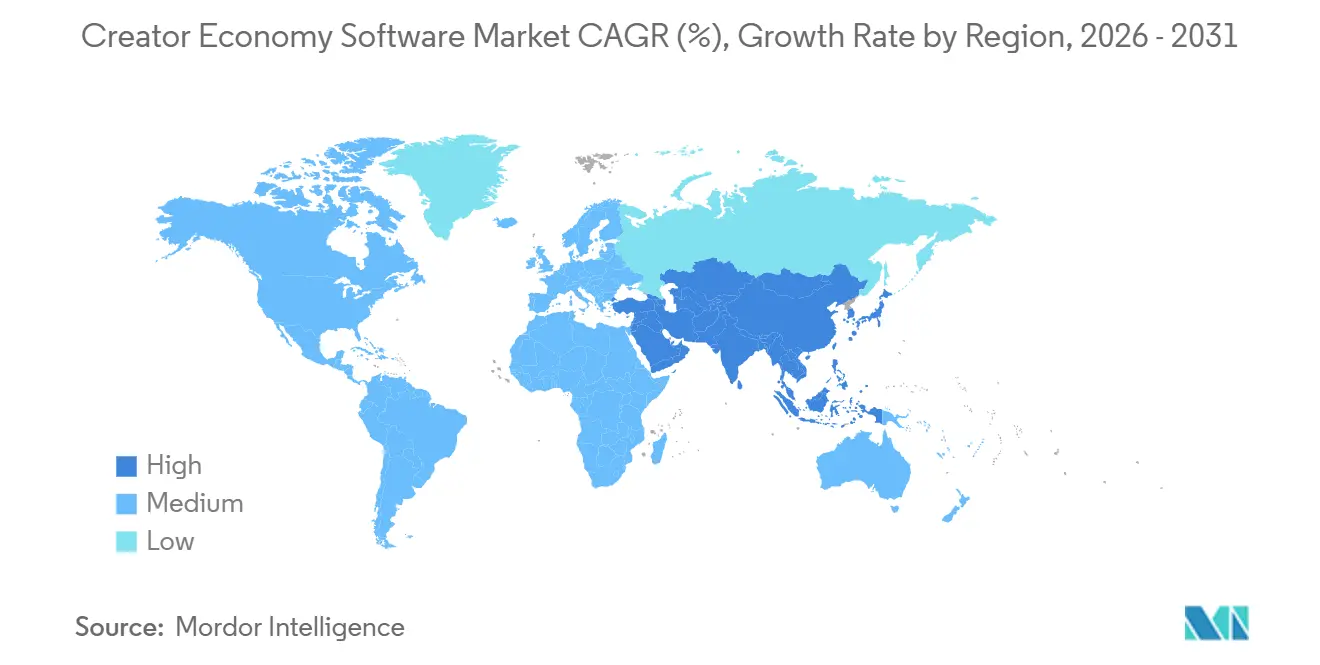
North America held 37.49% of the creator economy software market share in 2025. The region has a high concentration of professional creators, established subscription services, and large brand marketing budgets. U.S. creator advertising spending reached USD 37 billion in 2025. This commercial base supports creator management platforms used by publishers, individual creators, and enterprise marketing teams. The United States also remains a major source of venture-backed creator software development. Furthermore, creator economy infrastructure funding in the United States exceeded USD 670 million during the 12 months through April 2026. Median funding rounds were close to USD 19 million. This capital concentration can support product development and faster feature releases by U.S.-based platforms. South America is also developing as an important demand area, especially in Brazil. Brazil has high social media engagement, while improved internet access and platform localization are supporting subscriptions and community-based creator activity. Mexico is contributing to demand as its digital creator base and mobile digital consumption expand.
Europe has a meaningful position in the creator economy software market, supported by the United Kingdom, Germany, and France. These countries have established independent publishing, newsletter, podcasting, and subscription communities. European regulation creates both costs and opportunities for platform providers. DAC7 compliance can burden smaller platforms, while providers with multi-jurisdiction tax functions can use compliance capabilities to differentiate their services. Russia has a large creator population, but global platforms face access and payment constraints in its more isolated digital environment.
Asia-Pacific is projected to grow at a CAGR of 23.59% from 2026 to 2031. Japan’s domestic creator economy has grown into a significant industry, with estimates highlighting its strong market presence and substantial potential for expansion. According to the Creator Economy Association of Japan and Mitsubishi UFJ Research, the sector represents a major opportunity, with a vast addressable market that underscores the importance of creators in shaping future digital and economic ecosystems. South Korea’s digital creator media industry generated KRW 5.5503 trillion, equivalent to USD 4.07 billion, in 2024, based on an average 2024 exchange rate of KRW 1,363 per USD.[4]Mitsubishi UFJ Research and Consulting and Creator Economy Association of Japan, “Survey Results on the Domestic Creator Economy,” Mitsubishi UFJ Research and Consulting, murc.jp Moreover, the Middle East and Africa represent an emerging demand area for creator software. Saudi Arabia and the United Arab Emirates are investing in digital economy infrastructure that can support creators and digital businesses. African creators are increasingly using mobile-first tools for payments, communities, events, and audience engagement. Regional demand can favor providers that support mobile payments and local currency transactions. These requirements may create opportunities for local platforms that are designed around regional financial infrastructure.

Competitive Landscape
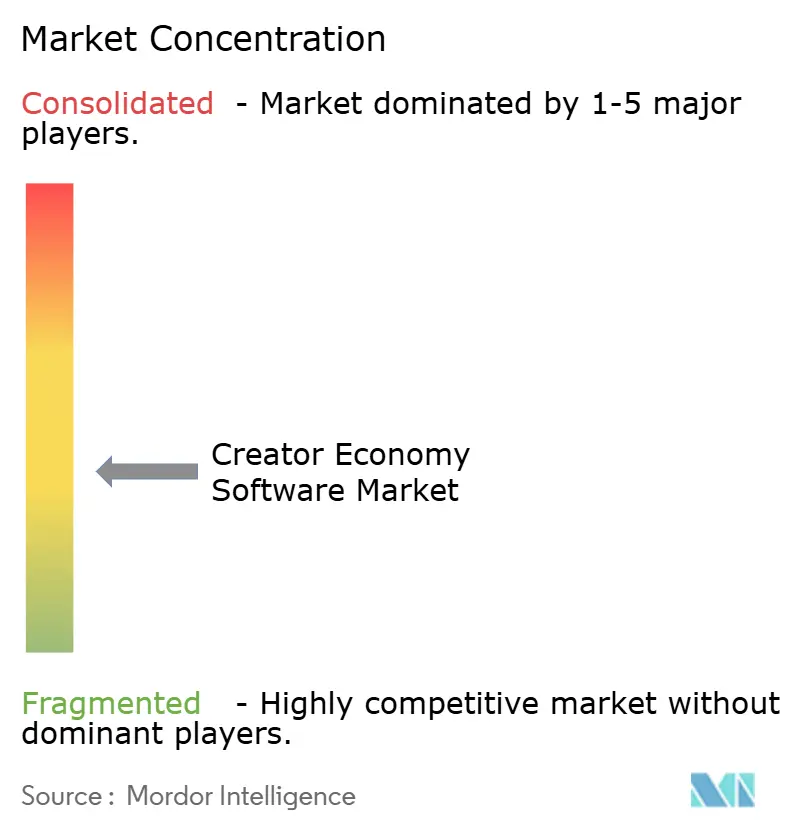
The creator economy software market remains moderately fragmented, with no single provider controlling more than a mid-single-digit share of total revenue. Providers are competing across several related functions, including publishing, audience ownership, subscriptions, digital products, community management, analytics, payments, and creator governance. Substack, beehiiv, and Ghost focus strongly on publisher infrastructure and owned audience relationships. Kajabi, Teachable, Thinkific, and Mighty Networks focus more heavily on commerce, courses, memberships, and community functions. The boundaries between these groups are narrowing as each company develops broader product capabilities.
beehiiv expanded its platform in July 2026 through the introduction of community memberships, AI Copilot, programmatic advertising, podcast hosting, webinar capabilities, and a redesigned Visual Editor. The release positioned the company as a broader operating platform for creators and publishers. The company’s strategy directly increased competition with Patreon, Substack, Circle, and other community and publishing providers. Beehiiv also expanded into native podcast hosting, webinars, metered paywalls, and paid trials in April 2026. These moves show how leading providers are seeking to consolidate creator workflows that were previously handled through several separate applications.
AI is becoming a connecting layer across creator software workflows rather than a standalone product feature. CreatorIQ introduced SafeIQ in October 2025 to embed AI-based brand safety and compliance processes in creator marketing programs. The platform processed 123 million social posts each day for more than 1,300 global brand and agency clients. This scale shows why proprietary data and integrated governance are becoming more important competitive factors. Brands managing 50-500 active creators remain a key opportunity because many still depend on spreadsheets and disconnected software tools.
Creator Economy Software Industry Leaders
Patreon, Inc.
Substack Inc.
Kajabi LLC
Linktree Pty Ltd
Mighty Networks, Inc.
- *Disclaimer: Major Players sorted in no particular order

Recent Industry Developments
- July 2026: beehiiv launched its most significant platform expansion at the beehiiv Summer Release Event 2026, introducing Community, AI Copilot, programmatic advertising, a redesigned Visual Editor, and podcast and webinar capabilities, cementing its positioning as a full-stack creator operating system and directly challenging Patreon, Substack, and Circle across multiple product categories.
- June 2026: Fypro.ai, Caelith AI, publicly launched its AI Creator Growth Engine, a platform that reads a creator's social account in under 10 minutes, builds a branded website and storefront, and assembles a CRM with purchase history and repeat-buyer signals.
- April 2026: Picsart launched a creator monetization program open to all creators without minimum audience requirements, alongside an AI agent marketplace enabling creators to hire AI assistants for social content production and Shopify product editing.
- October 2025: CreatorIQ introduced SafeIQ, an enterprise AI-native brand safety infrastructure for creator marketing. The platform integrated multimodal AI detection across text, images, video, and audio and processed 123 million social posts daily.


Global Creator Economy Software Market Report Scope
The creator economy software market refers to the digital platforms and tools that enable independent creators, including influencers, streamers, educators, and artists, to create, distribute, monetize, and manage content across social, video, audio, and commerce channels. The market includes solutions for content creation, audience engagement, monetization, and analytics. Growth in the market is driven by the expanding creator economy, increasing demand for authentic digital experiences, and the shift toward decentralized, creator-led business models that allow creators to connect directly with audiences and brands.
The Creator Economy Software Market Report is Segmented by Platform Type (Content Creation and Publishing Platforms, Audience Growth and Community Management Platforms, Creator Monetization Platforms, Creator Commerce Platforms, Creator Analytics and Business Management Platforms, and Link-in-Bio and Discovery Platforms), Deployment (Cloud-Based, and On-Premises), End-user Industry (Media and Entertainment, Brands and Marketing Agencies, Education and E-learning, Retail and Consumer Brands, Sports and Gaming, and Other End-user Industries), and Geography (North America, South America, Europe, Asia-Pacific, and Middle East and Africa). The Market Forecasts are Provided in Terms of Value (USD).
| Content Creation and Publishing Platforms |
| Audience Growth and Community Management Platforms |
| Creator Monetization Platforms |
| Creator Commerce Platforms |
| Creator Analytics and Business Management Platforms |
| Link-in-Bio and Discovery Platforms |
| Cloud-Based |
| On-Premises |
| Media and Entertainment |
| Brands and Marketing Agencies |
| Education and E-learning |
| Retail and Consumer Brands |
| Sports and Gaming |
| Other End-user Industries |
| North America | United States | |
| Canada | ||
| Mexico | ||
| South America | Brazil | |
| Argentina | ||
| Rest of South America | ||
| Europe | United Kingdom | |
| Germany | ||
| France | ||
| Italy | ||
| Spain | ||
| Russia | ||
| Rest of Europe | ||
| Asia-Pacific | China | |
| India | ||
| Japan | ||
| South Korea | ||
| Australia | ||
| Rest of Asia-Pacific | ||
| Middle East and Africa | Middle East | Turkey |
| Saudi Arabia | ||
| United Arab Emirates | ||
| Rest of Middle East | ||
| Africa | South Africa | |
| Egypt | ||
| Rest of Africa | ||
| By Platform Type | Content Creation and Publishing Platforms | ||
| Audience Growth and Community Management Platforms | |||
| Creator Monetization Platforms | |||
| Creator Commerce Platforms | |||
| Creator Analytics and Business Management Platforms | |||
| Link-in-Bio and Discovery Platforms | |||
| By Deployment | Cloud-Based | ||
| On-Premises | |||
| By End-user Industry | Media and Entertainment | ||
| Brands and Marketing Agencies | |||
| Education and E-learning | |||
| Retail and Consumer Brands | |||
| Sports and Gaming | |||
| Other End-user Industries | |||
| By Geography | North America | United States | |
| Canada | |||
| Mexico | |||
| South America | Brazil | ||
| Argentina | |||
| Rest of South America | |||
| Europe | United Kingdom | ||
| Germany | |||
| France | |||
| Italy | |||
| Spain | |||
| Russia | |||
| Rest of Europe | |||
| Asia-Pacific | China | ||
| India | |||
| Japan | |||
| South Korea | |||
| Australia | |||
| Rest of Asia-Pacific | |||
| Middle East and Africa | Middle East | Turkey | |
| Saudi Arabia | |||
| United Arab Emirates | |||
| Rest of Middle East | |||
| Africa | South Africa | ||
| Egypt | |||
| Rest of Africa | |||


Key Questions Answered in the Report
What is the creator economy software market size?
The creator economy software market size was valued at USD 6.41 billion in 2025 and is estimated to grow from USD 7.53 billion in 2026 to reach USD 16.89 billion by 2031, at a CAGR of 17.53% during the forecast period 2026-2031.
Which platform type holds the largest share of creator economy software revenue?
Content Creation and Publishing Platforms led platform type revenue with a 29.18% share in 2025.
Which creator software platform segment is growing fastest?
Creator Commerce Platforms are projected to record the highest platform-type CAGR of 19.82% from 2026 to 2031.
Why is cloud deployment dominant in creator software?
Cloud-Based deployment held 87.53% of revenue in 2025 because it offers cross-device access, automatic updates, subscription pricing, and lower infrastructure requirements.
Which end-user group is expected to grow fastest?
Brands and Marketing Agencies are expected to expand at a CAGR of 21.16% through 2031 as they build internal creator program capabilities.
Which region is projected to lead growth through 2031?
Asia-Pacific is expected to be the fastest-growing region, with a projected CAGR of 23.59% from 2026 to 2031.
Page last updated on:





