
Creative Automation Software Market Size and Share
Market Overview
| Study Period | 2020 - 2031 |
|---|---|
| Market Size (2026) | USD 2.51 Billion |
| Market Size (2031) | USD 5.51 Billion |
| Growth Rate (2026 - 2031) | 17.03 % |
| Fastest Growing Market | Asia-Pacific |
| Largest Market | North America |
| Market Concentration | Low |
Major Players *Disclaimer: Major Players sorted in no particular order Image © Mordor Intelligence. Reuse requires attribution under CC BY 4.0. | |
Creative Automation Software Market Analysis by Mordor Intelligence
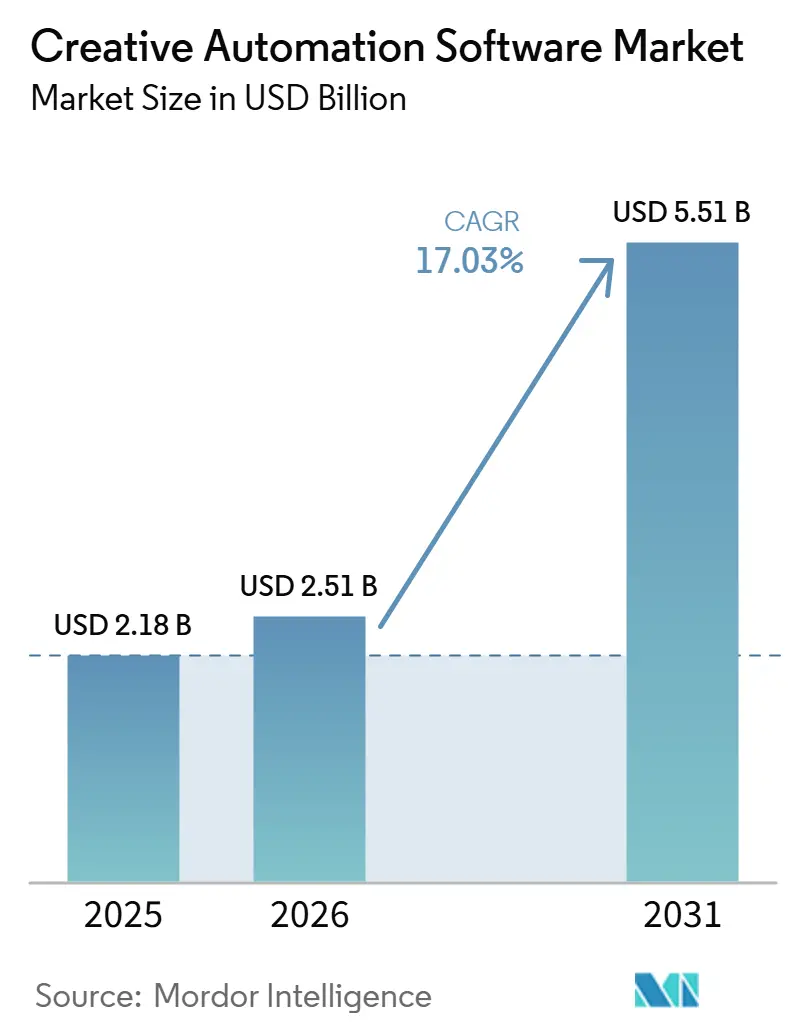
The creative automation software market size is projected to expand from USD 2.18 billion in 2025 and USD 2.51 billion in 2026 to USD 5.51 billion by 2031, registering a CAGR of 17.03% between 2026 and 2031. The creative automation software market is moving from template-led production toward prompt-led workflows that connect content development, approval, and media activation. Higher output requirements across digital channels are making versioning and asset management more important for marketing teams. Multimodal AI models are also making it easier to create and adapt visual content within the same workflow. Providers are responding by combining production tools with performance measurement and delivery integrations. This favors platforms that can govern brand assets across several channels while helping teams act on campaign results.
Key Report Takeaways
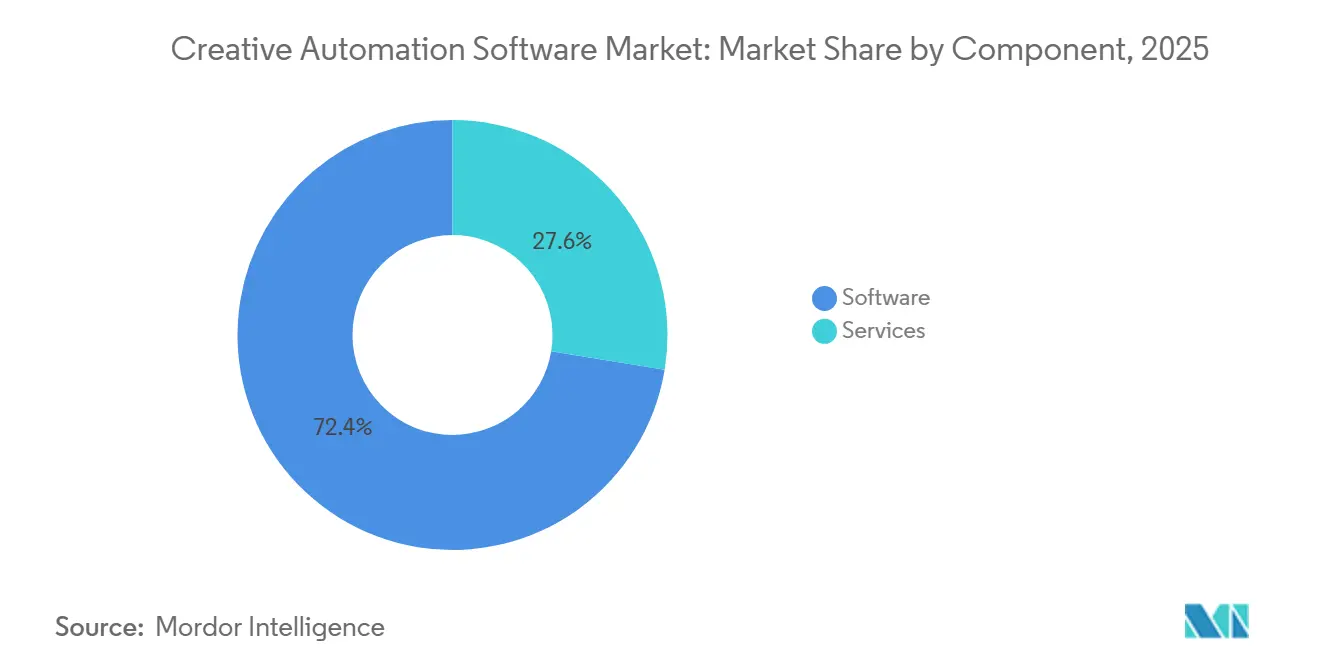
- By component, software accounted for 72.41% of the creative automation market share in 2025, while services are projected to expand at a 18.82% CAGR through 2031.
- By deployment mode, cloud held 74.18% of the market in 2025, while hybrid deployment is projected to expand at a 17.69% CAGR through 2031.
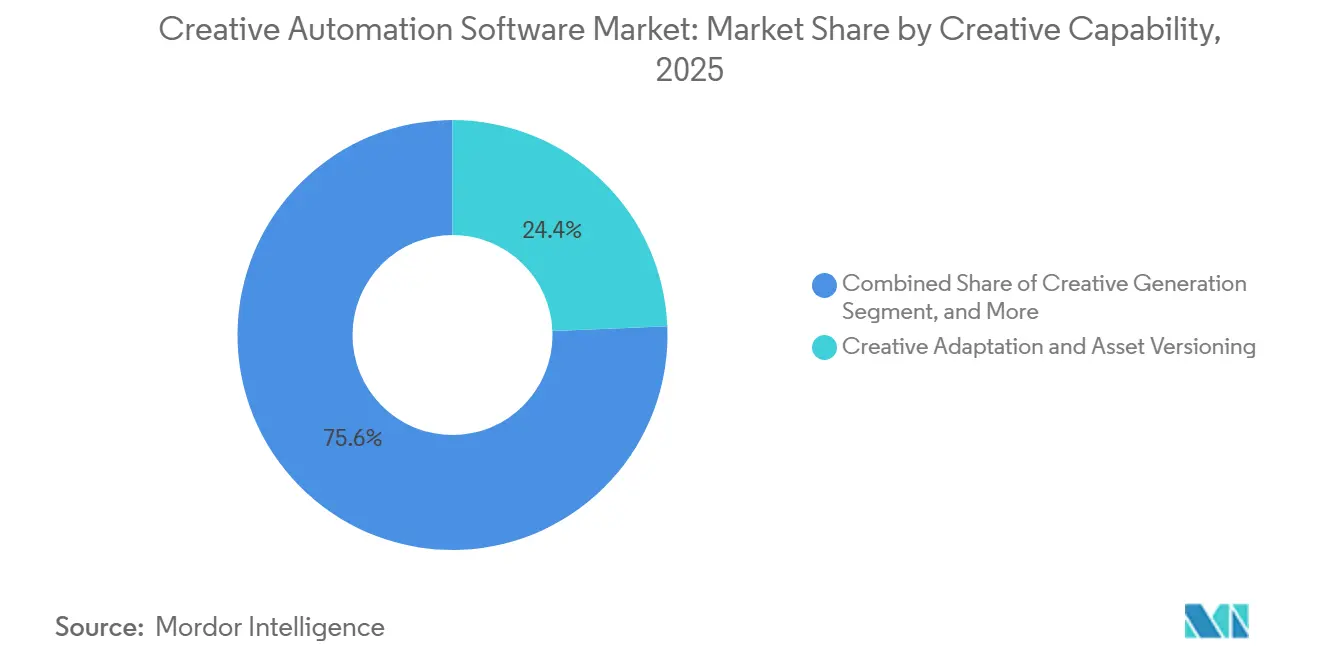
- By capability, creative adaptation and asset versioning held 24.36% of the market in the creative automation software market in 2025, while creative generation is projected to expand at a 19.43% CAGR through 2031.
- By enterprise size, large enterprises held 68.42% of the market in 2025, while small and medium enterprises are projected to expand at a 20.24% CAGR through 2031.
- By end-user industry, media and entertainment accounted for 22.19% of the creative automation software market in 2025, while retail and e-commerce are projected to expand at an 18.91% CAGR through 2031.
- By buyer type, advertising agencies held 34.62% of the market in 2025, while e-commerce merchants are projected to expand at a 19.18% CAGR through 2031.
- By geography, North America held 36.73% of the creative automation software market in 2025, while Asia-Pacific is projected to expand at a 20.83% CAGR through 2031.
Note: Market size and forecast figures in this report are generated using Mordor Intelligence’s proprietary estimation framework, updated with the latest available data and insights as of January 2026.
Market Trends and Insights
Drivers Impact Analysis of Creative Automation Software Market*
| Driver | (~) % Impact on CAGR Forecast | Geographic Relevance | Impact Timeline |
|---|---|---|---|
| Rising Omnichannel Creative Production Requirements | +3.2% | Global, with concentration in North America and Europe | Short term (≤ 2 years) |
| Generative AI Integration Into Creative Workflows | +2.8% | Global, highest adoption in North America and Asia-Pacific | Short term (≤ 2 years) |
| Growing Demand for Personalized Advertising Content | +2.3% | North America, Europe, and Asia-Pacific | Medium term (2-4 years) |
| Cloud-Based Adoption by Small and Medium Enterprises | +2.0% | Asia-Pacific, North America, and South America | Medium term (2-4 years) |
| Creative-Media Feedback Loops as Performance Infrastructure | +1.6% | North America, with growing adoption in Europe | Medium term (2-4 years) |
| Retail Media Catalog Volatility | +1.3% | North America, Europe, and Asia-Pacific e-commerce hubs | Long term (≥ 4 years) |
| Source: Mordor Intelligence | |||
Rising Omnichannel Creative Production Requirements
Brand teams manage an average of 6 retail media networks in 2026, and that number is projected to reach 8 by year-end. Each network uses different requirements for display, video, and performance formats. A single campaign can therefore require hundreds of versions across social platforms, connected TV, programmatic display, and retail media. The creative automation software market benefits because manual teams cannot consistently deliver this volume at campaign speed. The 2025 State of Creative Ops report found that 53% of marketing and creative professionals said AI tools had accelerated their workflows.[1] Companies without automated versioning can face delayed launches and lower media efficiency, particularly in FMCG, retail, and media campaigns with short cycles and varied formats.
Generative AI Integration Into Creative Workflows
Generative AI is changing creative automation from template population to the production of new assets from prompts and briefs. This can reduce the time between a campaign brief and usable creative output. Adobe introduced Firefly Design Intelligence, a no-code Workflow Builder, and a Content Production Agent in October 2025 to support brand-compliant content production at scale.[2] Adobe stated that nearly 90% of its top 50 enterprise accounts had adopted its AI-first innovations, while 99% of Fortune 100 companies had used AI within an Adobe application. Germany’s Bitkom found that 84% of surveyed enterprises ranked AI as the most influential trend, and 76% expected marketing automation to gain strategic importance. The creative automation software market is therefore absorbing work that once sat between the briefing, production, and media teams, thereby changing how agencies and brands organize campaign delivery.
Growing Demand for Personalized Advertising Content
Personalization has become a routine production requirement as platforms use more viewer and audience signals to select advertising content. The Association of National Advertisers reported in June 2026 that dynamic creative optimization platforms are evolving from separate personalization tools into broader systems for creative automation, personalization, and intelligence.[3] This change encourages buyers to consider the full workflow rather than purchasing a narrow personalization feature. The creative automation software market gains when approved assets can be adapted to more relevant audiences without creating separate manual production processes. Healthcare marketing shows why governance matters, since creative variants must operate within regulated communication rules. Consumer reaction remains important because a 2026 Canva survey found that 70% of consumers considered AI-generated advertisements generic, increasing the importance of testing, review, and brand controls.
Cloud-Based Adoption by Small and Medium Enterprises
Cloud delivery lowers the infrastructure barrier that previously limited high-volume creative production to larger organizations. An Adobe study of 431 small business owners published in April 2026 found that 85% were using generative AI tools. The same study found that 28% used AI for paid social advertising, reported average annual time savings of 67 hours, and 47% reported average revenue gains of 21% from AI adoption.[4] QuickBooks reported that AI adoption among small businesses in the United States, Canada, the United Kingdom, and Australia rose from 48% in July 2024 to 77% in January 2026. The creative automation software market can reach this group through self-service deployment and pricing that does not require a large internal production team. Regional platforms such as Rocketium also show how accessible cloud tools can enter enterprise production environments through supplier and agency relationships.
Restraints Impact Analysis of Creative Automation Software Market*
| Restraint | (~) % Impact on CAGR Forecast | Geographic Relevance | Impact Timeline |
|---|---|---|---|
| Data Privacy and Intellectual Property Uncertainty | -1.9% | Global, highest in the EU, United Kingdom, and regulated Asia-Pacific markets | Medium term (2-4 years) |
| Commoditization of Basic Creative Generation Features | -1.5% | Global, most acute in North America and Europe | Short term (≤ 2 years) |
| Structural Disconnect Between Creative and Media Teams | -1.1% | Global | Medium term (2-4 years) |
| Platform Rejection, Brand Authenticity, and Quality-Control Risk | -0.8% | Global, higher in consumer-facing regulated industries | Long term (≥ 4 years) |
| Source: Mordor Intelligence | |||
Data Privacy and Intellectual Property Uncertainty
Legal rules for AI-generated content remain unsettled across major purchasing markets, which can extend software buying cycles. The U.S. Copyright Office’s reports on copyright and AI state that copyright protection requires human authorship, creating ownership questions for content created with heavily automated workflows. The EU AI Act’s Article 53 requirements on copyright compliance and training-data disclosures also affect providers using general-purpose AI models for brand customers. These rules are particularly relevant to BFSI and healthcare advertisers, where legal review is closely tied to campaign approvals. Procurement teams must also consider GDPR Article 22, the EU Digital Single Market Directive, and the UK Data (Use and Access) Act 2025. The creative automation software market must demonstrate clear controls over training data, asset rights, human review, and data handling to limit this friction.
Commoditization of Basic Creative Generation Features
Creative functions built into advertising platforms are putting pressure on entry-level standalone tools. Google expanded Product Studio within Merchant Center in May 2026 with AI-generated lifestyle imagery, seasonal overlays, and testable variants. Meta Advantage+ creative tools and Amazon’s responsive e-commerce creative functions offer similar basic generation capabilities to advertisers already spending on their platforms. As these features become easier to access, resizing and simple variant production become harder for independent vendors to price separately. The creative automation software market is consequently shifting toward platforms that can coordinate activity across several media environments. Providers with stronger governance, cross-platform orchestration, and analytical capabilities have more room to defend their value than vendors focused only on asset volume.
*Our forecasts treat driver/restraint impacts as directional, not additive. The impact forecasts reflect baseline growth, mix effects, and variable interactions.
Creative Automation Software Market Segment Analysis
By Component:
Software Leads Scale While Services Deepen DeliverySoftware held 72.41% of the creative automation software market share in 2025, reflecting enterprise preference for centralized software-as-a-service platforms. Platform selection and integration remained the main early investment because buyers need common templates, approved assets, review stages, and delivery formats. These systems support repeatable work across brands, campaign teams, media channels, and locations, which makes high-volume production more consistent. The creative automation software industry depends on this shared operating layer to connect design, marketing, compliance, and media operations without relying on disconnected handoffs. Enterprise customers also value the ability to apply brand rules across a broad portfolio of campaigns while retaining oversight of who can change or approve an asset.
Services are projected to expand at an 18.82% CAGR through 2031, making them the fastest-growing component. They include implementation, API integration, custom model training, managed creative operations, and ongoing optimization, which many internal teams cannot support alone. Rocketium’s managed service model, used by Amazon, Walmart, General Mills, and Colgate-Palmolive for visual content production, demonstrates the demand for support that extends beyond a software subscription. Vendors can add professional services to annual contracts, while agencies can provide managed delivery using established software stacks and their existing client relationships. This creates a split between software providers defending retention through platform capabilities and service providers competing on workflow depth, delivery support, and accountable creative outcomes, especially where customers need help translating broad campaign requirements into repeatable production rules, approval stages, and finished assets that media teams can use without further rework.
By Deployment Mode:
Cloud Leads While Hybrid Use ExpandsCloud deployment held 74.18% of the market in 2025 because it lets brands add production capacity without purchasing their own infrastructure. It is useful during retail periods, new product launches, and campaign events that require rapid versioning. Cloud systems also enable dispersed teams and agencies to use the same approved assets, controls, and workflow history. The creative automation software market size for cloud delivery is tied to the operational need for shared production tools that can generate, adapt, and distribute content quickly. Its lead reflects the value of flexible capacity, centralized access, and recurring updates when pricing, products, or promotional information changes.
Hybrid deployment is projected to expand at a 17.69% CAGR through 2031, making it the fastest-growing model. Financial services, healthcare, and government advertisers can keep sensitive data in controlled environments while using cloud services for selected production workloads. This arrangement addresses data governance and sovereignty requirements without giving up access to cloud-scale creative generation and workflow capabilities. On-premises systems remain relevant in markets with strict data-residency rules, including Germany and the wider European Union. GDPR, EU AI Act transparency requirements, and national data localization rules are making deployment architecture a practical business requirement for regulated buyers, since the location of data, the review of generated content, and the separation of audience information from finished creative can affect procurement decisions, operating processes, and the way a platform is configured.
By Creative Capability:
Asset Versioning Leads While Generation Grows FastestCreative adaptation and asset versioning held 24.36% of the market in 2025, making it the largest creative capability. The work includes resizing, reformatting, and localizing approved master assets for each distribution channel and advertising format. An omnichannel campaign may need versions for display, social, video, and connected TV, which makes this capability a practical entry point for enterprise adoption. Its 24.36% share reflects the need to retain brand consistency while handling high volumes of approved content and fast changes to distribution requirements. It solves a recurring production problem without requiring a company to fully change how it develops the central campaign concept.
Creative generation is projected to expand at a 19.43% CAGR through 2031, making it the fastest-growing capability. It creates new assets from text prompts, product feeds, or brand briefs, and multimodal models produced more usable visual and video material in 2025. Dynamic creative optimization, localization and personalization, analytics and testing, and workflow automation remain complementary functions for organizations with broader campaign needs. Dentsu introduced Idea Builder with Google Cloud to connect generation, validation, and testing in a single process. The creative automation software market is shifting toward connected production systems that combine these functions, rather than offering isolated tools for each step, allowing teams to move from a campaign brief through generation, validation, testing, approval, and distribution within a more coordinated process that reduces unnecessary transfers between specialist teams.

By Enterprise Size:
Large Enterprises Anchor Demand While SMEs AccelerateLarge enterprises held 68.42% of the market in 2025 because they have larger advertising budgets, higher content volumes, and established marketing technology procurement processes. Their requirements extend across brands, geographies, campaign formats, review steps, and access rights, which favors platforms with formal governance and collaboration controls. Celtra’s work as Unilever’s global creative automation partner demonstrates the depth of integration required to support a large brand portfolio. The creative automation software market continues to depend on these organizations for large, multi-year implementations that may connect creative, media, data, and asset management systems. Embedded workflow relationships can also create a durable competitive advantage for vendors that consistently meet these operational needs, because changing a platform may require a brand to revisit templates, access controls, approval rules, campaign archives, agency relationships, and links to established media or asset management systems.
Small and medium enterprises are projected to expand at a 20.24% CAGR through 2031, the fastest rate among enterprise sizes. Cloud pricing and self-service generative AI are reducing the time, cost, and technical expertise required to get started with these tools. Adobe found that 85% of surveyed small business owners actively used generative AI tools in April 2026, and QuickBooks reported that AI adoption rose from 48% in July 2024 to 77% in January 2026 across 4 countries. Wider use by smaller businesses may pressure lower-tier pricing, while enterprise vendors must show value through governance, compliance, and performance measurement. This group broadens the creative automation software market while increasing the importance of simple deployment, practical templates, and direct links between production and marketing activity, since smaller organizations often need to begin with limited staff, few specialized technical resources, and an immediate need to turn existing product or campaign information into usable content.
By End-User Industry:
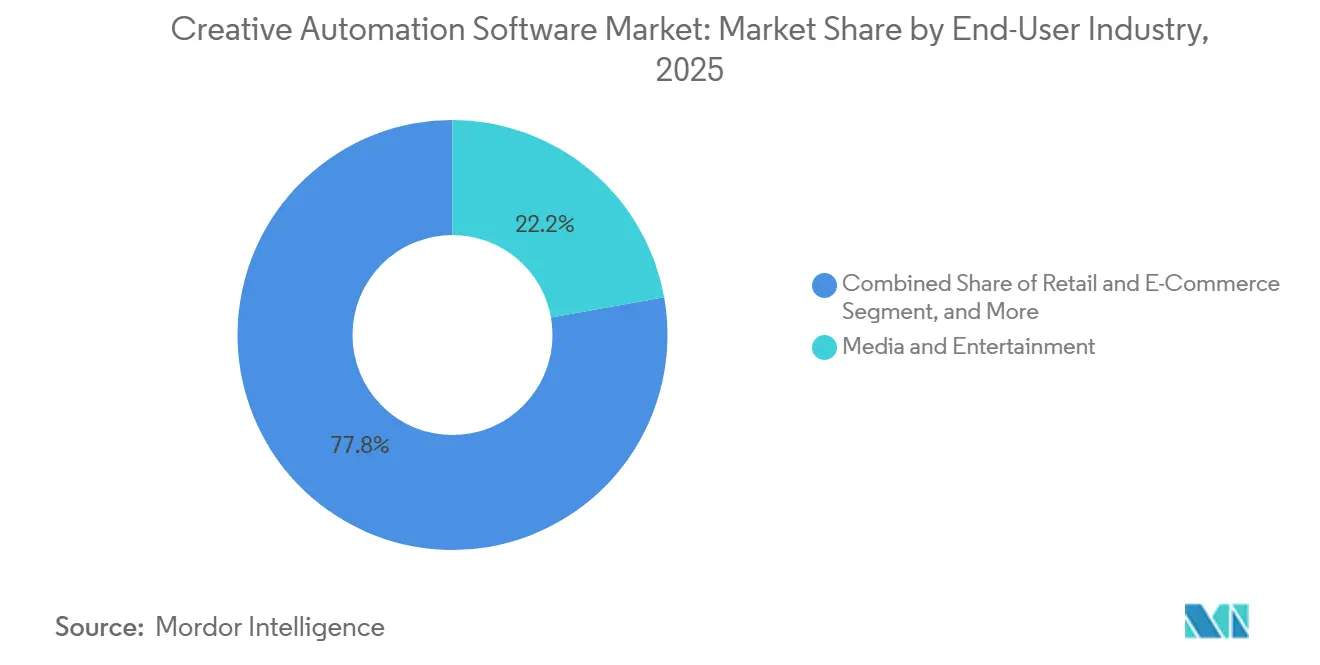
Media Leads Volume While Retail and E-Commerce Grow FastestMedia and entertainment accounted for 22.19% of the market in 2025 because streaming services, broadcasters, and content distributors require frequent creative refreshes. They update content for audience acquisition, retention, programming, and promotional inventory, which turns high-volume production into a routine operating requirement. The creative automation software market helps these organizations adapt content for different audiences, formats, and distribution channels by leveraging large content libraries. Automation can keep assets current without requiring teams to rebuild each version from the start whenever a placement or audience changes. The segment’s size shows why workflow management, approvals, and asset control remain as important to buyers as AI-driven generation.
Retail and e-commerce are projected to expand at an 18.91% CAGR through 2031, the fastest rate among end-user industries. Product availability, pricing, and promotions can change faster than manual teams can revise advertising assets, especially during seasonal selling periods. Adobe introduced GenStudio for Commerce Media Networks in 2026 to generate creative from product listing data and distribute it to retail media networks, including Walmart Connect, Kroger Precision Marketing, and Amazon DSP. BFSI uses dynamic creative and personalization to deliver compliant, audience-specific messaging, while healthcare and life sciences use personalization within regulatory constraints. IT and telecommunications, industrial manufacturing, education and research, government and administration, and travel and hospitality account for the remaining demand as their acquisition and communication budgets shift toward digital channels.
By Buyer Type:
Agencies Lead While E-Commerce Merchants ExpandAdvertising agencies held 34.62% of the market in 2025, making them the largest buyer group. They connect technology providers with brands that lack large internal production teams, combining creative operations, media services, and implementation in a single relationship. Agency buyers can manage recurring campaign output for many clients and use common platforms to support multi-language work across countries and formats. The creative automation software market benefits when agencies standardize production workflows across their client base and introduce tools through managed services. Their role remains important for brands that want faster output but do not want to develop every operational capability in-house.
E-commerce merchants are projected to expand at a 19.18% CAGR through 2031, the fastest rate among buyer types. Their demand is tied to the direct relationship between creative quality and conversion outcomes in retail media, as well as frequent catalog changes across many product listings. Brands and advertisers, publishers and media owners, and in-house creative teams account for the remaining demand, with in-house teams seeking faster iteration and more control over production costs. Omneky launched a public API and Model Context Protocol server in July 2026 so AI agents and platforms could request finished multi-format creative without using a visual interface. These developments broaden purchasing patterns from agency-managed work to direct brand, publisher, and commerce deployment across the creative automation software market, giving organizations more ways to integrate creative output with their own data, product catalogs, media processes, and internal campaign workflows, rather than relying solely on a traditional agency production model.
Geography Analysis
North America Creative Automation Software Market
North America held 36.73% of the market in 2025, supported by extensive programmatic advertising activity and a dense base of vendors and large buyers. U.S. retail media spending reached USD 107.6 billion in 2025, accounting for 30% of U.S. digital advertising spend. Brand teams in the region manage an average of 6 retail media networks in 2026, and that count is projected to reach 8 by year-end. Each network requires distinct creative formats, which increases demand for automated production and asset versioning. Canada and Mexico add to regional demand through cross-border campaigns, expanding digital retail activity, and growing access to platform-native creative tools for smaller businesses.
Europe and APAC Creative Automation Software Market
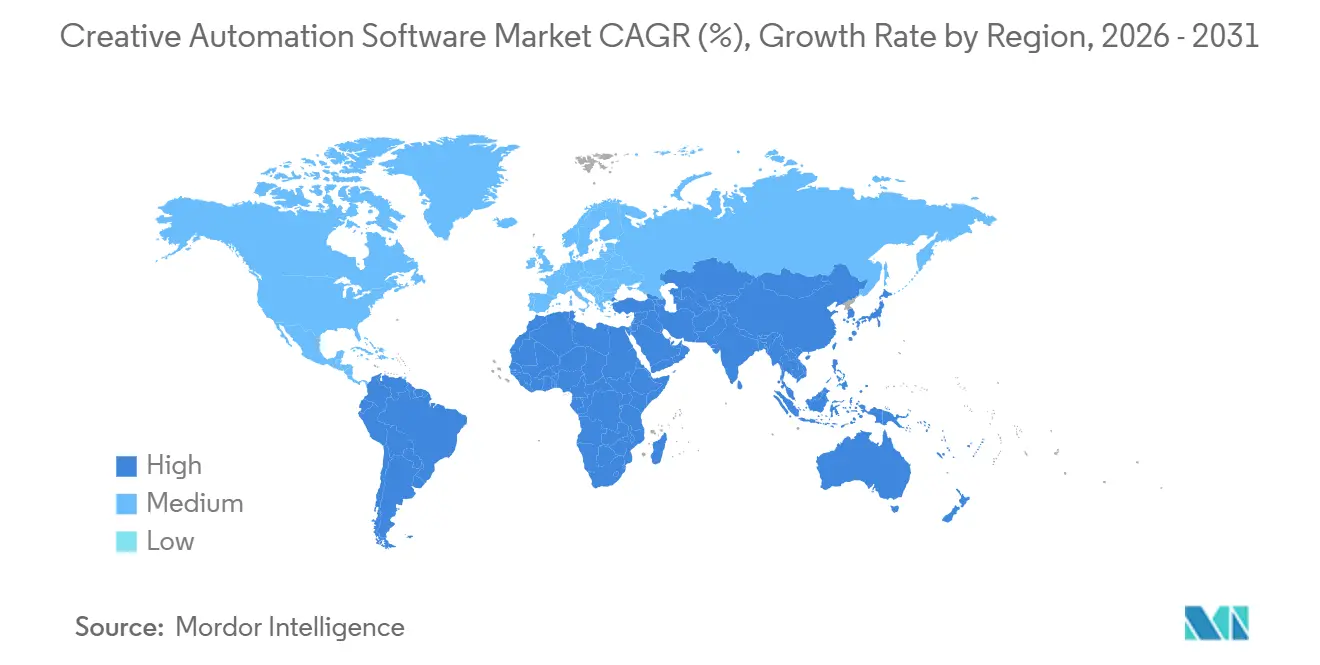
Europe is the second-largest regional market, with the United Kingdom, Germany, and France supporting enterprise adoption. Bitkom reported that 84% of surveyed German companies ranked AI as the most influential trend, and 76% expected marketing automation to become more important. European data protection requirements encourage hybrid deployments that preserve data sovereignty while using cloud services for production. Asia-Pacific is projected to expand at a 20.83% CAGR through 2031, the fastest regional rate. India, China, Japan, South Korea, and Southeast Asia are increasing digital advertising activity and need content that can serve varied languages and local audiences.
MEA, South America and APAC Creative Automation Software Market
The Middle East, Africa, and South America are earlier-stage markets, but both show conditions that can support wider adoption. Saudi Arabia and the United Arab Emirates are investing in digital advertising infrastructure as part of economic diversification programs. Brazil leads South American activity through a mature digital advertising environment and rising social commerce use, while Argentina and other South American countries have lower enterprise adoption but can use cloud platforms without local technology infrastructure. India’s 22 official languages and varied consumer behavior create demand for localization, while Dentsu Japan’s AI For Growth Creative Lines combines branded content, performance advertising, and process transformation through a unified AI infrastructure.
Competitive Landscape
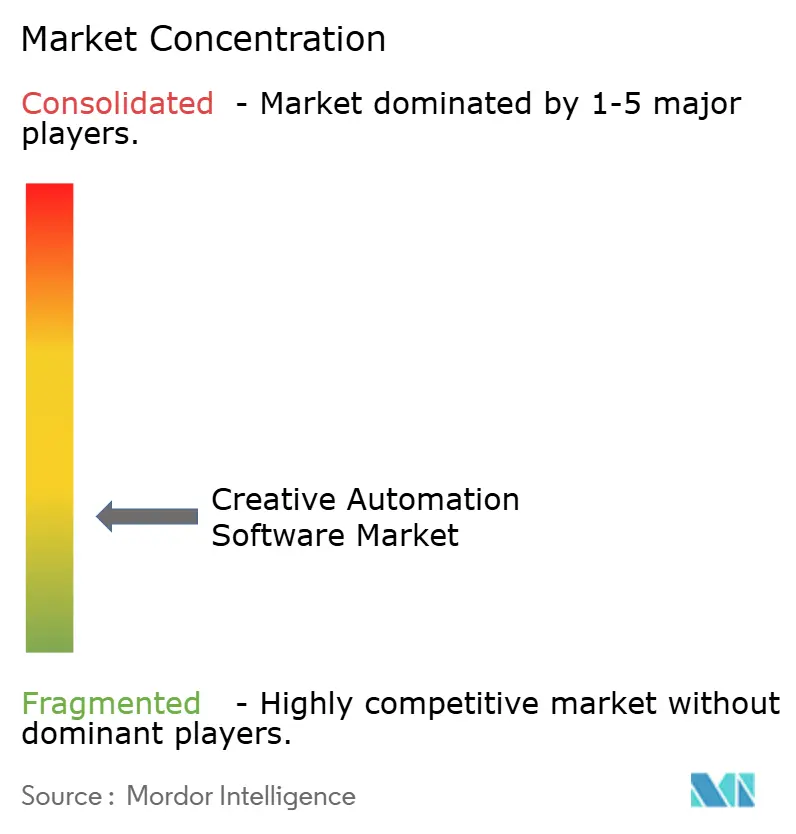
The creative automation software market is moderately fragmented, with no single platform leading across all enterprise sizes, capabilities, and buyer groups. The creative automation software market includes enterprise creative management systems, AI-native full-funnel platforms, and specialized tools for generation, dynamic optimization, localization, and workflow automation. Celtra plays a strong enterprise role as Unilever’s global creative automation partner, while Smartly.io and VidMob compete by connecting creative activity to media outcomes. Vendors are pursuing acquisition-led expansion and open API integration to broaden their role in marketing workflows.
Smartly completed its acquisition of INCRMNTAL in May 2026 to combine creative and media optimization with real-time causal attribution. This move gives marketers a closer link between specific creative decisions and incremental business outcomes. Creative intelligence and marketing mix modeling offer an opportunity for vendors seeking to stand apart. Privacy restrictions are reducing the usefulness of some platform-level attribution, which makes first-party creative data more valuable as an input to performance analysis. Omneky’s July 2026 public API and Model Context Protocol server showed a move toward making creative generation available as embedded infrastructure.
Smaller companies, including Rocketium, Shuttlerock, Hunch Insights, Marpipe, and Mediawide, serve regional or format-specific needs. These companies face price pressure when large advertising platforms provide basic asset variants within their own products. Adobe expanded GenStudio in October 2025 with Firefly Design Intelligence, a no-code Workflow Builder, a Content Production Agent, and Firefly Foundry for custom model training on proprietary brand intellectual property. Adobe also announced campaign activation integrations with Amazon Ads, Google Campaign Manager 360, LinkedIn, and TikTok. The competitive position of a provider increasingly depends on brand control, cross-platform coordination, and usable performance evidence.
Creative Automation Software Industry Leaders
-
Celtra, Inc.
-
Smartly.io Solutions Oy
-
Bannerflow AB
-
Inspired Thinking Group (ITG) Limited
-
Cape.io Limited
- *Disclaimer: Major Players sorted in no particular order
Creative Automation Software Market Companies Covered in this Report
- Celtra, Inc.
- Smartly.io Solutions Oy
- Bannerflow AB
- Inspired Thinking Group (ITG) Limited
- Cape.io Limited
- The Brief AI, Inc.
- Rocketium Technologies Private Limited
- Marpipe, Inc.
- Hunch Insights Private Limited
- Ziflow, Inc.
- Mediawide Systems Limited
- Jivox Corporation
- RevJet, Inc.
- Pencil Technologies, Inc.
- Typeface, Inc.
- Omneky, Inc.
- VidMob, Inc.
- Shuttlerock Limited
- AdCreative.ai
- Madgicx Ltd.
- Inmagine Group Pte. Ltd.
- Lumen5 Technologies Inc.
Recent Industry Developments in Creative Automation Software Market
- May 2026: Smartly completed its acquisition of INCRMNTAL, an AI-powered incrementality measurement platform. The combined entity integrates real-time causal attribution with Smartly's creative and media optimization platform, enabling brands and agencies to link creative decisions directly to incremental business outcomes with greater speed and precision.
- April 2026: Dentsu Japan, in collaboration with Dentsu Creative Pictures Inc., Dentsu Promotion Inc., and Tag Japan, launched "AI For Growth Creative Lines," a creative supply service combining branded content, performance advertising, and process transformation on a proprietary "Core Engine" AI infrastructure platform.
- October 2025: Adobe announced significant GenStudio expansions at Adobe MAX, including Firefly Design Intelligence for brand-compliant creative scaling, a no-code Workflow Builder for enterprise-scale creative production, the Content Production Agent beta for automated asset creation from marketing briefs, and Firefly Foundry for custom generative AI model training on proprietary brand IP. Expanded integrations with Amazon Ads, Google Campaign Manager 360, LinkedIn, and TikTok for campaign activation were announced simultaneously.
- March 2025: Adobe expanded its GenStudio Content Supply Chain offering, introducing the Content Production Agent for automated marketing asset creation from campaign briefs and Firefly Creative Production for scalable no-code creative variant generation. Adobe reported that nearly 90% of its top 50 enterprise accounts had adopted AI-first GenStudio innovations at the time of announcement.
Global Creative Automation Software Market Report Scope
The creative automation software market refers to the ecosystem of software solutions and associated services that leverage artificial intelligence, machine learning, and rule-based templates to automate the design, production, versioning, and distribution of digital marketing assets. This market encompasses a broad range of capabilities, including automated creative generation, large-scale asset adaptation and versioning, localized and personalized content delivery, dynamic creative optimization (DCO), and automated creative testing, analytics, and approval workflows. Deployed via cloud, on-premise, or hybrid models, these solutions cater to organizations of varying sizes across diverse industries and are specifically procured by brands, advertising agencies, publishers, and e-commerce merchants. By significantly reducing manual design bottlenecks and enabling the mass production of hyper-personalized, high-quality creative variations at scale, creative automation software empowers organizations to accelerate time-to-market, optimize marketing return on investment (ROI), and drive higher engagement and conversion rates across multiple digital channels.
The Creative Automation Software Market Report is Segmented by Component (Software, and Services), Deployment Mode (Cloud, On-Premise, and Hybrid), Creative Capability (Creative Generation, Creative Adaptation and Asset Versioning, Creative Localization and Personalization, Dynamic Creative Optimization, Creative Analytics and Testing, and Creative Workflow and Approval Automation), Enterprise Size (Large Enterprises, and Small and Medium Enterprises), End-User Industry (IT and Telecommunication, BFSI, Healthcare and Life Sciences, Retail and E-Commerce, Industrial Manufacturing, Education and Research Institutions, Media and Entertainment, Government and Administration, and Travel and Hospitality), Buyer Type (Brands and Advertisers, Advertising Agencies, Publishers and Media Owners, E-Commerce Merchants, and In-House Creative Teams), and Geography (North America, South America, Europe, Asia-Pacific, and Middle East and Africa). The Market Forecasts are Provided in Terms of Value (USD).
Segmentation Overview
| Software |
| Services |
| Cloud |
| On-Premise |
| Hybrid |
| Creative Generation |
| Creative Adaptation and Asset Versioning |
| Creative Localization and Personalization |
| Dynamic Creative Optimization |
| Creative Analytics and Testing |
| Creative Workflow and Approval Automation |
| Large Enterprises |
| Small and Medium Enterprises |
| IT and Telecommunication |
| BFSI |
| Healthcare and Life Sciences |
| Retail and E-Commerce |
| Industrial Manufacturing |
| Education and Research Institutions |
| Media and Entertainment |
| Government and Administration |
| Travel and Hospitality |
| Brands and Advertisers |
| Advertising Agencies |
| Publishers and Media Owners |
| E-Commerce Merchants |
| In-House Creative Teams |
| North America | United States | |
| Canada | ||
| Mexico | ||
| South America | Brazil | |
| Argentina | ||
| Rest of South America | ||
| Europe | Germany | |
| United Kingdom | ||
| France | ||
| Russia | ||
| Spain | ||
| Rest of Europe | ||
| Asia-Pacific | China | |
| Japan | ||
| India | ||
| South Korea | ||
| Southeast Asia | ||
| Rest of Asia-Pacific | ||
| Middle East and Africa | Middle East | Saudi Arabia |
| United Arab Emirates | ||
| Rest of Middle East | ||
| Africa | South Africa | |
| Nigeria | ||
| Rest of Africa | ||
| By Component | Software | ||
| Services | |||
| By Deployment Mode | Cloud | ||
| On-Premise | |||
| Hybrid | |||
| By Creative Capability | Creative Generation | ||
| Creative Adaptation and Asset Versioning | |||
| Creative Localization and Personalization | |||
| Dynamic Creative Optimization | |||
| Creative Analytics and Testing | |||
| Creative Workflow and Approval Automation | |||
| By Enterprise Size | Large Enterprises | ||
| Small and Medium Enterprises | |||
| By End-User Industry | IT and Telecommunication | ||
| BFSI | |||
| Healthcare and Life Sciences | |||
| Retail and E-Commerce | |||
| Industrial Manufacturing | |||
| Education and Research Institutions | |||
| Media and Entertainment | |||
| Government and Administration | |||
| Travel and Hospitality | |||
| By Buyer Type | Brands and Advertisers | ||
| Advertising Agencies | |||
| Publishers and Media Owners | |||
| E-Commerce Merchants | |||
| In-House Creative Teams | |||
| By Geography | North America | United States | |
| Canada | |||
| Mexico | |||
| South America | Brazil | ||
| Argentina | |||
| Rest of South America | |||
| Europe | Germany | ||
| United Kingdom | |||
| France | |||
| Russia | |||
| Spain | |||
| Rest of Europe | |||
| Asia-Pacific | China | ||
| Japan | |||
| India | |||
| South Korea | |||
| Southeast Asia | |||
| Rest of Asia-Pacific | |||
| Middle East and Africa | Middle East | Saudi Arabia | |
| United Arab Emirates | |||
| Rest of Middle East | |||
| Africa | South Africa | ||
| Nigeria | |||
| Rest of Africa | |||
Key Questions Answered in the Report
What is the creative automation software market size?
The creative automation software market was valued at USD 2.51 billion in 2026 and is projected to reach USD 5.51 billion by 2031 at a 17.03% CAGR. The forecast reflects greater demand for connected creative production, adaptation, review, and delivery workflows.
What is driving adoption of creative automation software?
The creative automation software market is supported by omnichannel production needs, generative AI, personalization, and cloud access for small and medium enterprises. These factors help teams produce more approved versions across channels without expanding production work at the same pace.
Which creative automation software capability is growing fastest?
Creative generation is projected to expand at a 19.43% CAGR through 2031, supported by prompt-led asset production from briefs and product data. It is increasingly used alongside testing, localization, governance, and approval capabilities rather than as a standalone function.
Which deployment model leads creative automation software use?
Cloud deployment led with 74.18% share in 2025 because it gives teams flexible production capacity and centralized access to assets. Hybrid models are growing where companies need to preserve sensitive data in controlled environments.
Which end-user segment is growing fastest?
Retail and e-commerce is projected to expand at an 18.91% CAGR through 2031 as frequent catalog and promotion changes require faster creative updates. Retail media activity makes timely, brand-compliant versions of product content more valuable to merchants and advertisers.
Which region is growing fastest for creative automation software?
Asia-Pacific is projected to expand at a 20.83% CAGR through 2031, supported by digital advertising growth and multilingual content needs. Its varied consumer languages and regional campaign requirements make localization and format adaptation important for buyers.