
Court Technology Software Market Size and Share
Market Overview
| Study Period | 2020 - 2031 |
|---|---|
| Market Size (2026) | USD 3.79 Billion |
| Market Size (2031) | USD 6.37 Billion |
| Growth Rate (2026 - 2031) | 10.94 % |
| Fastest Growing Market | Asia-Pacific |
| Largest Market | North America |
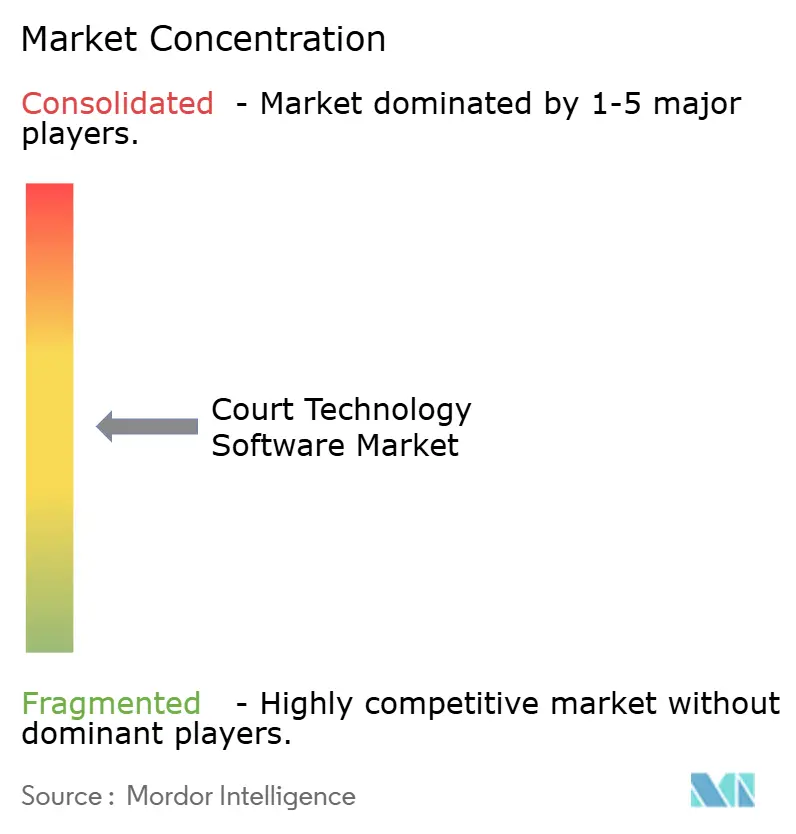
| Market Concentration | Medium |
Major Players *Disclaimer: Major Players sorted in no particular order Image © Mordor Intelligence. Reuse requires attribution under CC BY 4.0. | |
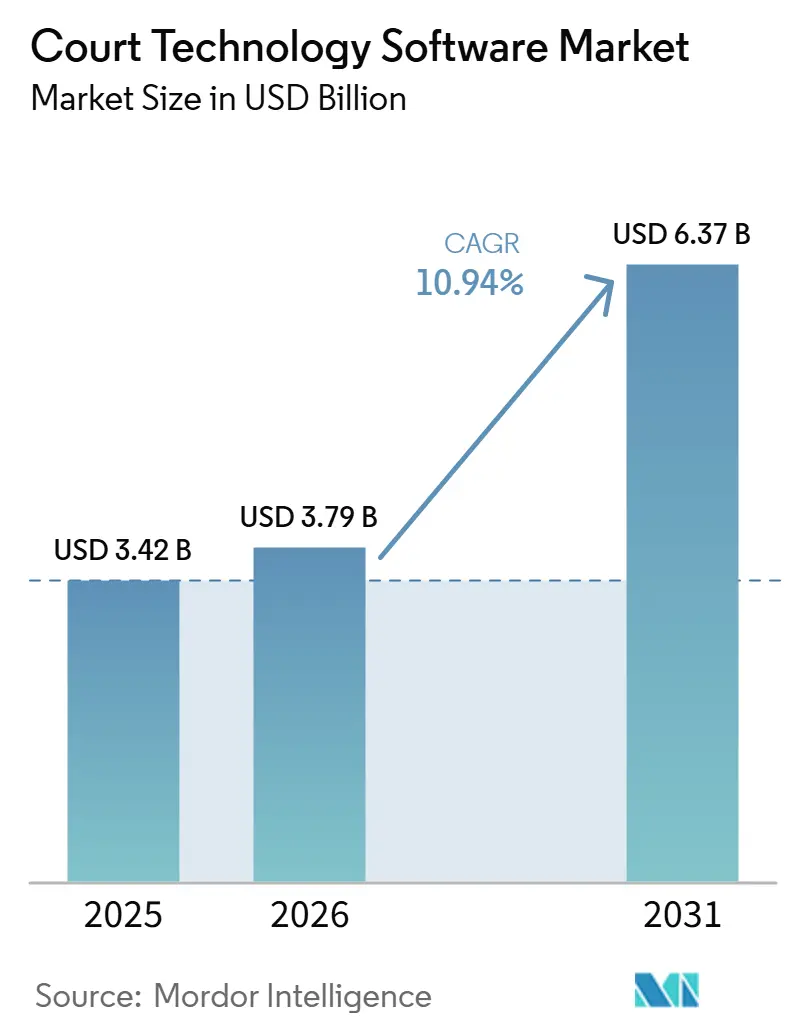
Court Technology Software Market Analysis by Mordor Intelligence
The court technology software market size was valued at USD 3.42 billion in 2025 and estimated to grow from USD 3.79 billion in 2026 to reach USD 6.37 billion by 2031, at a CAGR of 10.94% during the forecast period 2026-2031. Legislative requirements for electronic filing and digital case files are moving technology spending from optional modernization to required operational investment. Persistent case backlogs also make workflow automation more relevant, as courts must improve throughput without relying solely on additional staff. Cloud-based delivery is widening access to remote court services, especially for jurisdictions that delayed earlier technology investment. The Court technology software market, therefore, has room to expand among administrative tribunals, lower-income countries, and midsize U.S. states. Procurement delays and higher cybersecurity requirements can slow individual projects, but they can also produce large, long-term contracts when a jurisdiction completes a modernization program.
Key Report Takeaways
- By solution, court case management software led with 29.32% of Court technology software market share in 2025, while virtual hearings are projected to expand at a 14.92% CAGR through 2031.
- By deployment, cloud SaaS held 63.54% of the Court technology software market share in 2025 and is projected to grow at a 13.36% CAGR through 2031.
- By court type, civil courts accounted for 34.81% of the market in 2025, while administrative and regulatory courts are projected to record the highest CAGR of 12.86% through 2031.
- By geography, North America accounted for 39.81% of the Court technology software market in 2025, while Asia-Pacific is projected to expand at a 15.47% CAGR through 2031.
Note: Market size and forecast figures in this report are generated using Mordor Intelligence’s proprietary estimation framework, updated with the latest available data and insights as of January 2026.
Market Trends and Insights
Drivers Impact Analysis of Court Technology Software Market*
| DRIVER | (~) % IMPACT ON CAGR FORECAST | GEOGRAPHIC RELEVANCE | IMPACT TIMELINE |
|---|---|---|---|
| Government-Led E-Filing and Court Digitization Mandates | +3.2% | Global, with highest intensity in North America, Europe, and South and Southeast Asia | Short term (≤ 2 years) |
| Persistent Court Backlogs and Caseload Complexity | +2.1% | Global, concentrated in South Asia, South America, and Middle East and Africa | Medium term (2-4 years) |
| Cloud Migration and Remote Court Service Delivery | +1.8% | North America, Western Europe, Australia | Short term (≤ 2 years) |
| Rising Volume and Evidentiary Complexity of Digital Records | +1.4% | Global, with early gains in North America and East Asia | Medium term (2-4 years) |
| Self-Represented Litigant Demand for Guided Digital Access | +0.9% | North America and Europe | Medium term (2-4 years) |
| Interoperability Requirements Across Justice Agencies | +0.7% | Asia-Pacific core, with spillover to Middle East and Africa | Long term (≥ 4 years) |
| Source: Mordor Intelligence | |||
Government-Led E-Filing and Court Digitization Mandates
Government mandates are a major reason courts adopt electronic filing and digital case management systems. Germany’s electronic case file rules took effect on January 1, 2026, requiring federal courts and public prosecutors to use digital case files, with a transition option until January 2027 for jurisdictions that needed more time.[1]Bundesministerium der Justiz, “Gesetz Zur Änderung Der Vorschriften über Die Einführung Der Elektronischen Akte in Der Justiz,” Federal Ministry of Justice, bmjv.de. France also continued its penal procedure digitization program, supported by EUR 24.2 million in transformation funding, equal to USD 26.6 million.[2]Fonds pour la Transformation de l’Action Publique, “Procédure Pénale Numérique: Rendre La Justice Plus Rapidement,” Government of France, modernisation.gouv.fr. Such requirements give the Court a technology software market defined demand around formal implementation programs. They can shorten the period between a policy decision and a procurement process, although local approvals still matter. The Court technology software market benefits when digitization targets are paired with public funding, staff training, and a clear implementation schedule that courts can realistically follow.
Persistent Court Backlogs and Caseload Complexity
Court backlogs increase the need for systems that support filing, scheduling, case tracking, and document handling. India’s Supreme Court launched the One Case One Data initiative in May 2026 to consolidate judicial data from taluka courts into a single national platform. China’s smart court reform used automated transcription and AI-assisted workflow tools, and a study reported a 30% reduction in average trial duration. These examples show why the Court technology software market depends on measurable improvements in case flow. The same pressure affects civil, criminal, administrative, and appellate proceedings, although each has different procedural requirements. The Court technology software market can benefit from this demand when platforms demonstrate that they improve the quality and speed of routine judicial work without making procedures more difficult for users.
Cloud Migration and Remote Court Service Delivery
Cloud deployment supports remote access across the Court technology software market for judges, staff, lawyers, and court users. The U.S. federal judiciary’s FY2026 IT Long-Range Plan described multi-cloud and zero-trust architecture as important for secure access across hundreds of courts. Remote hearing and digital filing services are difficult to scale through a single on-premises environment when users need access from multiple locations. Cloud delivery can also help courts update applications and maintain service continuity, but it does not remove cost concerns. Washington State’s 2026 IT Portfolio Report noted that cloud subscription costs were rising relative to earlier on-premises maintenance costs. Court technology suppliers must therefore explain security, pricing, and lifecycle costs in terms that fit fixed public-sector budgets.
Rising Volume and Evidentiary Complexity of Digital Records
The Court technology software market increasingly manages body-camera video, social media records, encrypted messages, and AI-generated material as case-file evidence. These records require more than basic document storage because users need reliable capture, search, access controls, and links to the case docket. Tyler Technologies completed its purchase of For The Record in April 2026 for USD 212.5 million, adding AI-supported speech-to-text, multilingual transcription, and digital court recording capabilities to its Odyssey platform.[3]Tyler Technologies, “Tyler Technologies Completes Acquisition of For The Record,” U.S. Securities and Exchange Commission, sec.gov. Singapore, Morocco, and Tanzania also used locally adapted transcription systems, showing that the issue reaches beyond North American courts. Digital evidence tools are becoming more closely connected to core case management rather than operating as separate products. This gives integrated providers an advantage where courts want one platform for the hearing record, evidence, and case workflow.
Restraints Impact Analysis of Court Technology Software Market*
| RESTRAINT | (~) % IMPACT ON CAGR FORECAST | GEOGRAPHIC RELEVANCE | IMPACT TIMELINE |
|---|---|---|---|
| Cybersecurity, Privacy, and Evidentiary Integrity Exposure | -1.4% | Global, most acute in North America and Europe | Short term (≤ 2 years) |
| Lengthy Public-Sector Procurement and Implementation Cycles | -1.1% | Global, most severe in South Asia, South America, and Middle East and Africa | Long term (≥ 4 years) |
| Legacy-System Lock-In and Jurisdiction-Specific Customization | -0.8% | North America, Europe | Medium term (2-4 years) |
| Algorithmic Accountability and Judicial Acceptance Constraints | -0.5% | Global | Long term (≥ 4 years) |
| Source: Mordor Intelligence | |||
Cybersecurity, Privacy, and Evidentiary Integrity Exposure
Cybersecurity has become a direct limit on court modernization because judicial platforms hold highly sensitive case information. The U.S. federal judiciary confirmed in August 2025 that its case management system had faced sophisticated and persistent cyberattacks, leading to strengthened cybersecurity measures. Some courts temporarily used paper intake for sensitive material after the incident, which showed how a security event can disrupt normal digital processes. The judiciary then moved toward broader multi-factor authentication and an IT modernization response. Vendors seeking court contracts need to meet stronger expectations for access controls, audit records, data protection, and system resilience. These requirements can raise development and implementation costs, particularly for smaller providers in the Court technology software market that have fewer resources for compliance testing and specialist implementation work.
Lengthy Public-Sector Procurement and Implementation Cycles
Public procurement can create a long interval between a Court technology software market need and live software use. Tennessee issued a competitive request for proposals for its statewide court information system in July 2025, issued a notice of award in December 2025, and remained in an early implementation stage in 2026. Germany’s digital case file transition also required an extension option for jurisdictions that could not meet the original date. Integration with legacy systems, public funding rules, and local workflow changes all extend delivery schedules. Suppliers may face delayed revenue recognition after winning a contract because billing often depends on deployment milestones. These conditions favor firms that can sustain long sales cycles and provide implementation support over several years.
*Our forecasts treat driver/restraint impacts as directional, not additive. The impact forecasts reflect baseline growth, mix effects, and variable interactions.
Court Technology Software Market Segment Analysis
By Solution:
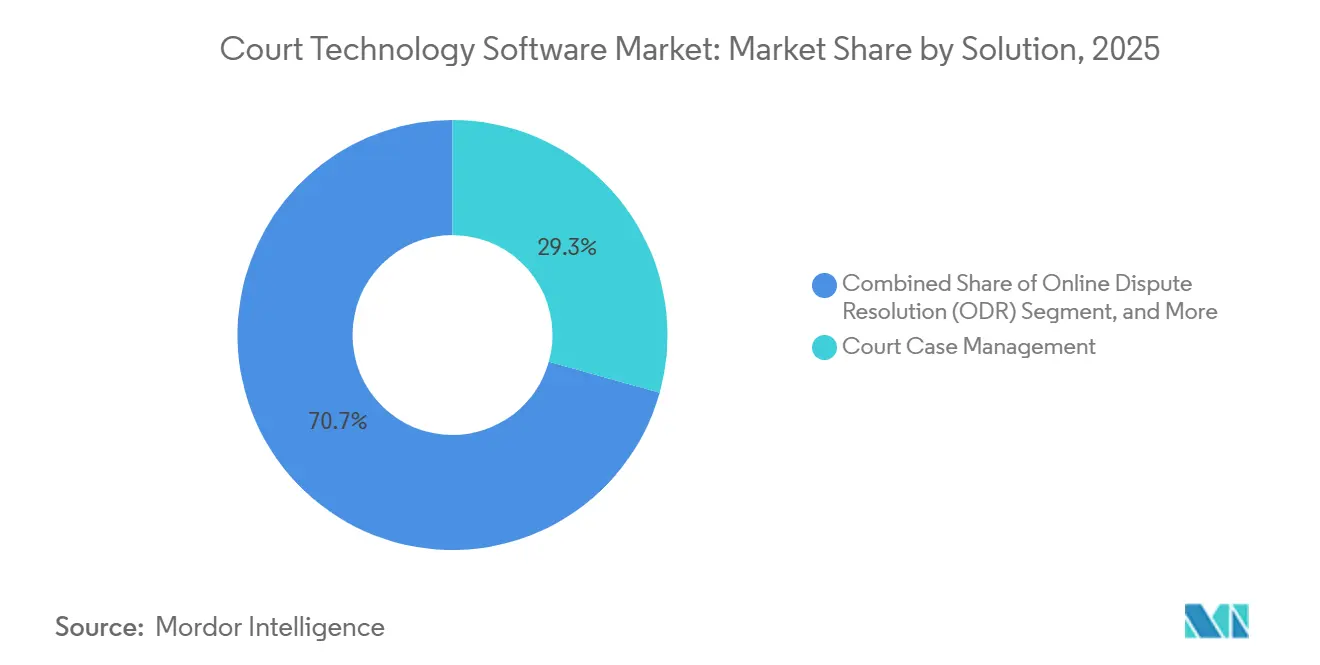
Case Management Anchors Revenue While Virtual Hearings AccelerateCourt case management software accounted for 29.32% of the Court technology software market size in 2025. It serves as the operational foundation for intake, docketing, scheduling, document management, and case disposition. Its position means that courts often add electronic filing, evidence management, recording, and analytics tools to an existing core platform. The Court technology software industry, therefore, rewards suppliers that can connect modules without forcing court staff to move between separate systems. Electronic filing and case intake remain important adjacent areas because they bring new cases into the court workflow. Digital evidence and document management also add value when the system can link files directly to hearings, deadlines, and case records.
Large national court modernization programs can support demand across the solution portfolio instead of a single product category. Virtual hearings are projected to grow at a 14.92% CAGR from 2026 to 2031 as remote proceedings become part of planned court operations. The Administrative Justice Council in the United Kingdom recommended long-term digital infrastructure for remote hearings and the use of AI in case triage, summarization, and transcription.[4]Administrative Justice Council, “AJC Publishes Final Report on Digitisation and the User Experience in the Tribunals System,” Judiciary of England and Wales, judiciary.uk. In April 2026, the Superior Court of Los Angeles County, Stanford Law School, and ODR.com began a partnership to develop a next-generation online case resolution system.



By Deployment:
Cloud SaaS Consolidates Leadership, Hybrid Gains as Migration BridgeCloud SaaS held 63.54% of the Court technology software market size in 2025 and is projected to register a 13.36% CAGR through 2031. New court implementations increasingly favor cloud-first designs because they can support distributed users and reduce dependence on locally maintained infrastructure. The U.S. federal judiciary’s FY2026 plan connected its transition to multi-cloud and zero-trust architecture with secure access across geographically dispersed courts. These advantages are important for courts that provide e-filing, public portals, online hearings, and internal case management through the same service environment. The Court technology software market has a strong preference for the cloud, but adoption remains tied to local security certification, procurement rules, and annual budget limits.
Within the Court technology software market, on-premises systems remain relevant where data sovereignty rules are strict or a court has recently invested in local infrastructure. These conditions are especially material in parts of continental Europe and the Middle East, where government cloud certification can complicate migration. Hybrid deployment serves as a bridge for courts that must connect legacy applications to new cloud services during a gradual transition. The Washington State report showed why cost remains a practical issue, as subscription spending can exceed historical maintenance costs. Providers need to demonstrate lifecycle savings and operational gains, not only technical flexibility.
By Court Type:
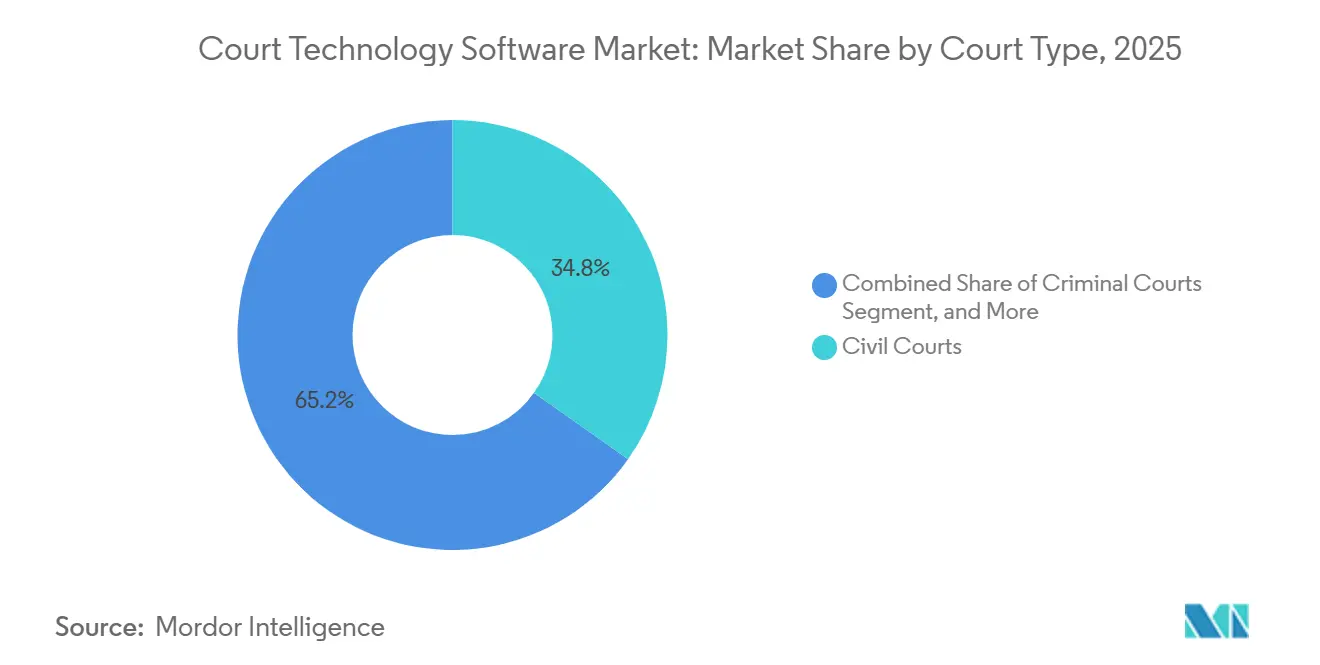
Administrative and Regulatory Courts Emerge as Technology’s Last FrontierCivil courts accounted for 34.81% of the global market in 2025. Commercial disputes, consumer claims, housing matters, and personal injury cases create recurring workflows that are well-suited to electronic filing and case management. Criminal courts are another major area of spending because disclosure rules and data exchange with police and corrections systems require reliable digital processes. Family and juvenile courts need specialized workflows for guardianship, domestic relations, and youth justice matters. The Court technology software industry must support this variety without making the system difficult for courts to configure and use.
Administrative and regulatory courts are projected to grow at a 12.86% CAGR from 2026 to 2031. Their caseloads include immigration appeals, tax disputes, environmental permit challenges, benefits adjudication, and enforcement matters. In March 2026, Bridg Software and Atos launched a fully digital platform for Belgium’s Council for Permit Disputes and Enforcement College.[5]Bridg Software, “Bridg Launches Digital Platform for Administrative Law in Flanders in Collaboration with DBRC,” Bridg Software, bridg-software.eu. The U.S. federal judiciary’s phased replacement of CM/ECF also covers appellate and bankruptcy courts after the district courts implement it. Accessibility requirements, data rules, and emerging guidance on AI use will continue to shape platform requirements across every court type.
Geography Analysis
The Americas Court Technology Software Market
North America accounted for 39.81% of the Court technology software market in 2025. U.S. Senate bill S.4667 proposed modernizing electronic case management systems with accessibility, mobile design, and cybersecurity provisions. Canada’s Digital Strategy 2025-2027 also identified modernization of core case management and digital services as a priority for the Courts Administration Service.[6]Courts Administration Service, “Digital Strategy 2025-2027,” Government of Canada, cas-satj.gc.ca. South America remains smaller, but Brazil, Colombia, and Chile are moving beyond early e-filing pilots toward integrated platforms.
Europe Court Technology Software Market
The Court technology software market in Europe combines well-funded Western European projects with older court infrastructure in Central and Eastern Europe. Germany’s E-Akte rules require digital files across civil, criminal, labor, and family proceedings, although some jurisdictions have a transition period until January 2027. France’s digital justice program included EUR 24.2 million (USD 26.6 million) for digitizing the penal procedure. France also advanced the deployment of Portalis and digital penal court certification programs across tribunals. The United Kingdom’s Administrative Justice Council recommended commercial off-the-shelf systems for unreformed tribunals and investment in durable remote-hearing infrastructure.
APAC and MEA Court Technology Software Market
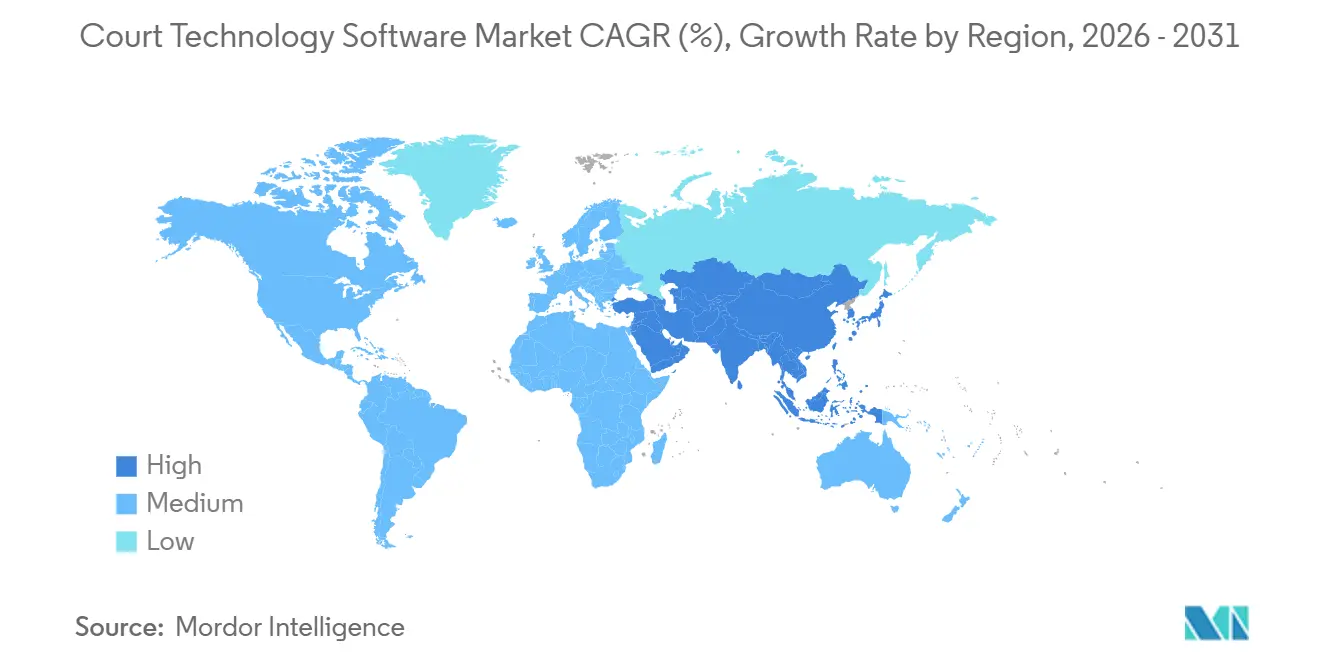
Asia-Pacific is projected to record the fastest regional CAGR of 15.47% in the Court technology software market between 2026 and 2031. India’s court modernization program supports changes across high-court services through 2027. The One Case One Data initiative and the Su Sahay digital service show a focus on linking judicial data and improving user access. China, Japan, South Korea, and Southeast Asian jurisdictions also form part of the region’s wider court digitization activity. The Middle East and Africa have the smallest revenue base, yet their courts are also developing digital services to address case backlogs.

Competitive Landscape
The Court technology software market is moderately consolidated in North America and fragmented across many other regions. Tyler Technologies has a strong position in U.S. court case management, supported by its footprint across more than 28 states and its integration with justice-agency data exchanges. Thomson Reuters operates in content intelligence that sits alongside case management activities. Equivant, Catalis, and i3 Verticals address middle-market and specialist court needs, including criminal, family, and municipal functions.
Acquisition has become an important way for larger vendors to broaden their court technology offerings. Tyler Technologies completed the USD 212.5 million purchase of For The Record in April 2026, bringing court recording, speech-to-text, multilingual transcription, and cloud distribution capabilities into its Odyssey platform. The transaction reduces the space available to standalone recording and transcription suppliers that do not offer a connected case management platform. Bridg Software and Atos also introduced a digital case management platform for Flemish administrative courts in March 2026. The Court technology software market remains open to providers that combine proven implementation capability with local legal knowledge, language support, and practical training for court staff.
Within the Court technology software market, administrative and regulatory courts remain a meaningful opportunity because they have historically received less systematic technology investment. AI-enabled workflow tools, transcript intelligence, and online dispute resolution systems are also attracting attention across the court technology software market. Steno raised USD 49 million in Series C funding in March 2026 to develop its Transcript Genius AI platform for litigation teams. The National Center for State Courts and the Council of Europe’s CEPEJ framework are raising attention to interoperability and accessibility expectations.
Court Technology Software Industry Leaders
Tyler Technologies, Inc.
Thomson Reuters Corporation
Journal Technologies, Inc.
Equivant, Inc.
Catalis, Inc.
- *Disclaimer: Major Players sorted in no particular order
Court Technology Software Market Companies Covered in this Report
- Tyler Technologies, Inc.
- Thomson Reuters Corporation
- Journal Technologies, Inc.
- Equivant, Inc.
- Catalis, Inc.
- Hyland Software, Inc.
- ImageSoft, Inc.
- i3 Verticals, Inc.
- Justice Systems, Inc.
- Pioneer Technology Group, Inc.
- Matrix Pointe Software, LLC
- Cott Systems, Inc.
- For The Record, Inc.
- BIS Digital, Inc.
- Synergy International Systems, Inc.
- Relational Semantics, Inc.
- Civitek Solutions, LLC
- Neumo, Inc.
- Judicial Systems, Inc.
- Microsoft Corporation
- Modria
- CourtView Justice Solutions

Recent Industry Developments in Court Technology Software Market
- May 2026: India’s Chief Justice Surya Kant announced the "One Case One Data" initiative in open court, designed to integrate judicial data from taluka courts to the Supreme Court into a single unified national case management platform. The Supreme Court simultaneously launched "Su Sahay," an AI-powered chatbot developed by the National Informatics Centre, to facilitate litigant access to court services and information digitally.
- April 2026: Tyler Technologies completed its acquisition of For The Record, a digital court recording pioneer, for a cash purchase price of approximately USD 212.5 million, as disclosed in a filing with the U.S. Securities and Exchange Commission. The acquisition integrates For The Record’s AI-powered speech-to-text, real-time multilingual transcription, and FTR Justice Cloud capabilities into Tyler’s Odyssey courts and justice platform, enabling near real-time transcript access linked to case management records.
- March 2026: The U.S. federal judiciary announced plans to expedite replacement of its CM/ECF case management system, relied upon for nearly 3 decades, following the significant cyberattack of summer 2025. The FY2026 IT Long-Range Plan details a phased rollout beginning with district courts, with appellate and bankruptcy courts to follow in subsequent phases
- February 2026: Tyler Technologies announced a definitive agreement to acquire For The Record for USD 212.5 million in cash, framing the transaction around embedding AI-powered court recording and multilingual transcription capabilities into its Odyssey platform to create a unified "judicial intelligence" ecosystem for court clients.


Global Court Technology Software Market Report Scope
The court technology software market comprises digital solutions that help courts and judicial institutions modernize their operations. These solutions support electronic case filing, docket management, digital evidence handling, video hearings, scheduling, and workflow automation. They integrate with justice systems to improve operational efficiency, transparency, and accessibility while supporting compliance with legal requirements for data protection, confidentiality, and evidence management. With capabilities such as AI-driven analytics, e-filing, and secure collaboration tools, court technology software enables courts to move from paper-based processes to digital-first workflows, supporting faster case resolution and improved public access to justice.
The Court Technology Software Market Report is Segmented by Solution (Court Case Management, Electronic Filing and Case Intake, Digital Evidence and Document Management, Court Recording and Virtual Hearings, Online Dispute Resolution (ODR), Public Access and Citizen Services Portals, and Court Intelligence and Analytics), Deployment (Cloud-Based, On-Premises, and Hybrid), Court Type (Civil Courts, Criminal Courts, Family and Juvenile Courts, Administrative and Regulatory Courts, Probate and Estate Courts, Traffic and Municipal Courts, and Appellate Courts), and Geography (North America, South America, Europe, Asia-Pacific, and Middle East and Africa). The Market Forecasts are Provided in Terms of Value (USD).
| Court Case Management |
| Electronic Filing and Case Intake |
| Digital Evidence and Document Management |
| Court Recording and Virtual Hearings |
| Online Dispute Resolution (ODR) |
| Public Access and Citizen Services Portals |
| Court Intelligence and Analytics |
| Cloud SaaS |
| On-Premises |
| Hybrid |
| Civil Courts |
| Criminal Courts |
| Family and Juvenile Courts |
| Administrative and Regulatory Courts |
| Probate and Estate Courts |
| Traffic and Municipal Courts |
| Appellate Courts |
| North America | United States | |
| Canada | ||
| Mexico | ||
| South America | Brazil | |
| Argentina | ||
| Colombia | ||
| Chile | ||
| Rest of South America | ||
| Europe | United Kingdom | |
| Germany | ||
| France | ||
| Italy | ||
| Spain | ||
| Russia | ||
| Nordic | ||
| Rest of Europe | ||
| Asia-Pacific | China | |
| India | ||
| Japan | ||
| South Korea | ||
| Australia | ||
| Southeast Asia | ||
| Rest of Asia-Pacific | ||
| Middle East and Africa | Middle East | Saudi Arabia |
| United Arab Emirates | ||
| Israel | ||
| Turkey | ||
| Qatar | ||
| Rest of Middle East | ||
| Africa | South Africa | |
| Nigeria | ||
| Egypt | ||
| Rest of Africa | ||
| By Solution | Court Case Management | ||
| Electronic Filing and Case Intake | |||
| Digital Evidence and Document Management | |||
| Court Recording and Virtual Hearings | |||
| Online Dispute Resolution (ODR) | |||
| Public Access and Citizen Services Portals | |||
| Court Intelligence and Analytics | |||
| By Deployment | Cloud SaaS | ||
| On-Premises | |||
| Hybrid | |||
| By Court Type | Civil Courts | ||
| Criminal Courts | |||
| Family and Juvenile Courts | |||
| Administrative and Regulatory Courts | |||
| Probate and Estate Courts | |||
| Traffic and Municipal Courts | |||
| Appellate Courts | |||
| By Geography | North America | United States | |
| Canada | |||
| Mexico | |||
| South America | Brazil | ||
| Argentina | |||
| Colombia | |||
| Chile | |||
| Rest of South America | |||
| Europe | United Kingdom | ||
| Germany | |||
| France | |||
| Italy | |||
| Spain | |||
| Russia | |||
| Nordic | |||
| Rest of Europe | |||
| Asia-Pacific | China | ||
| India | |||
| Japan | |||
| South Korea | |||
| Australia | |||
| Southeast Asia | |||
| Rest of Asia-Pacific | |||
| Middle East and Africa | Middle East | Saudi Arabia | |
| United Arab Emirates | |||
| Israel | |||
| Turkey | |||
| Qatar | |||
| Rest of Middle East | |||
| Africa | South Africa | ||
| Nigeria | |||
| Egypt | |||
| Rest of Africa | |||


Key Questions Answered in the Report
How large is court technology software demand?
The court technology software market size was valued at USD 3.42 billion in 2025 and estimated to grow from USD 3.79 billion in 2026 to reach USD 6.37 billion by 2031, at a CAGR of 10.94% during the forecast period 2026-2031.
What is driving demand for court technology software?
Electronic filing mandates, court backlogs, cloud migration, remote service delivery, and more complex digital evidence are increasing demand.
Which solution has the largest share in court technology software?
Court case management software held the largest solution share at 29.32% in 2025 because it supports core court workflows.
Which deployment model leads court technology adoption?
Cloud SaaS led deployment with 63.54% share in 2025 and is projected to grow at a 13.36% CAGR through 2031.
Which region is expected to grow fastest?
Asia-Pacific is projected to be the fastest-growing region at a 15.47% CAGR from 2026 to 2031, supported by judicial modernization programs.
Why are administrative courts an opportunity for software suppliers?
Administrative and regulatory courts are projected to grow at a 12.86% CAGR through 2031 as they modernize workflows for tax, immigration, permitting, and benefits matters.
Page last updated on:





