
Corrosion Protection Coating Market Size and Share
Market Overview
| Study Period | 2021 - 2031 |
|---|---|
| Market Size (2026) | USD 16.37 Billion |
| Market Size (2031) | USD 21.71 Billion |
| Growth Rate (2026 - 2031) | 5.81 % |
| Fastest Growing Market | Asia-Pacific |
| Largest Market | Asia-Pacific |
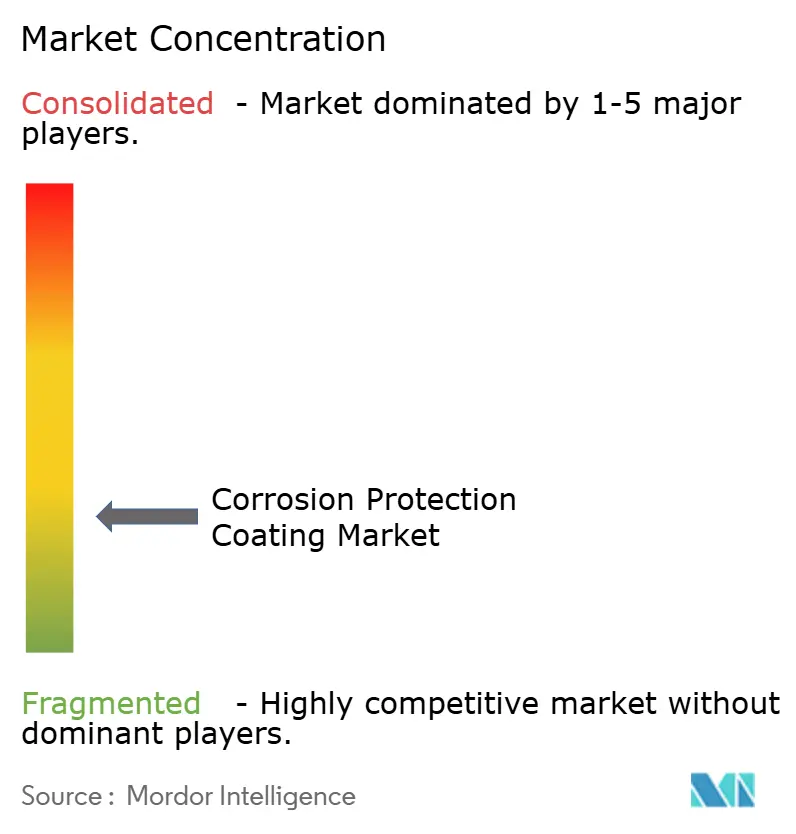
| Market Concentration | Low |
Major Players *Disclaimer: Major Players sorted in no particular order Image © Mordor Intelligence. Reuse requires attribution under CC BY 4.0. | |
Corrosion Protection Coating Market Analysis by Mordor Intelligence
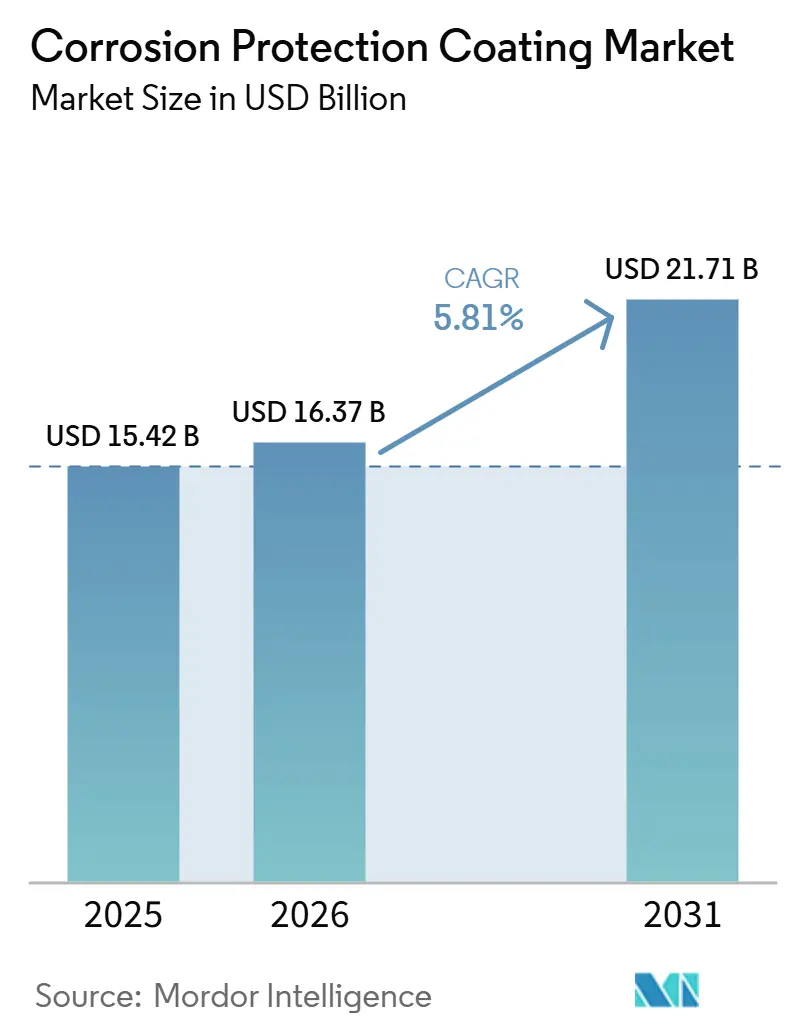
The Corrosion Protection Coating Market size was estimated at USD 15.42 billion in 2025 and is projected to grow from USD 16.37 billion in 2026 to USD 21.71 billion by 2031, at a CAGR of 5.81% during the forecast period (2026-2031). The corrosion protection coating market is supported by the rehabilitation of aging steel and concrete assets in North America, Europe, and East Asia. Demand extends to offshore wind and hydrogen projects, where new assets require durable first-coat systems. Buyers place greater weight on surface preparation, recoating intervals, and downtime costs when selecting coating systems. This favors higher-performance formulations where lifecycle requirements justify a higher initial material cost. Competition is intensifying among large suppliers, while regional formulators retain opportunities where local qualifications and technical service are important.
Key Report Takeaways
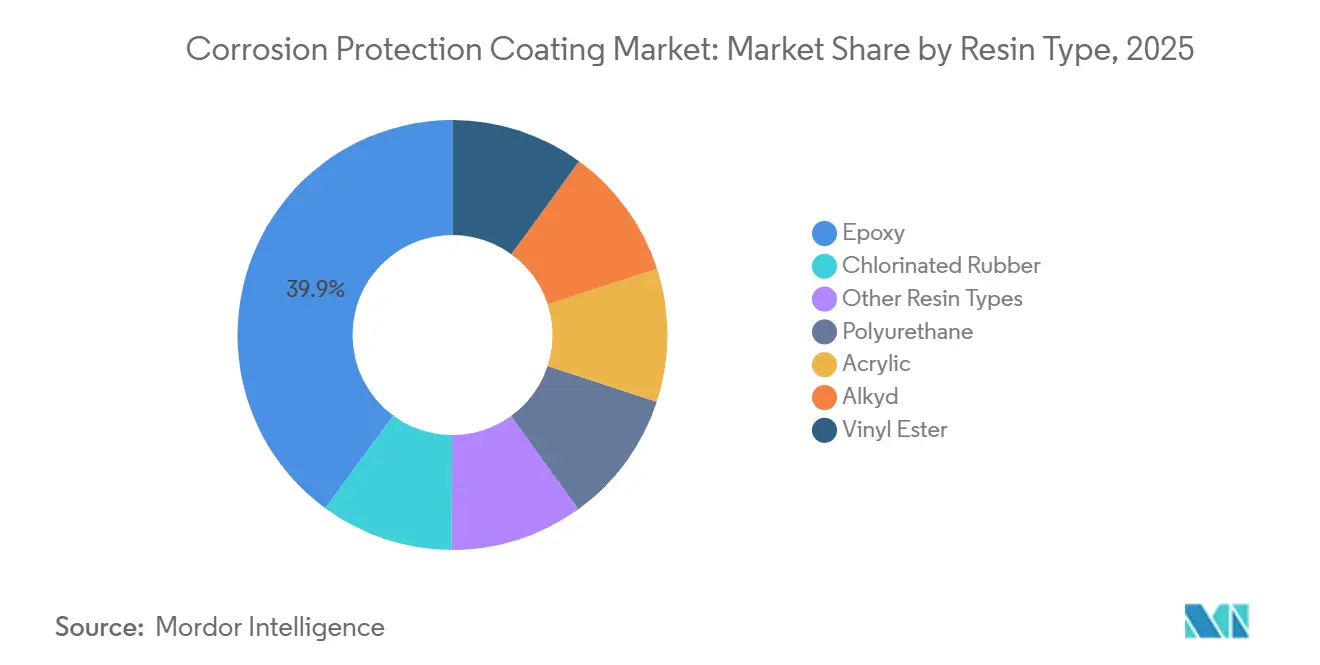
- By resin type, epoxy held 39.92% of the corrosion protection coating market share in 2025, while vinyl ester is projected to grow at a 6.73% CAGR through 2031.
- By technology, solvent-based coatings accounted for 47.83% of the corrosion protection coating market share in 2025, while water-based coatings are forecast to expand at a 6.65% CAGR through 2031.
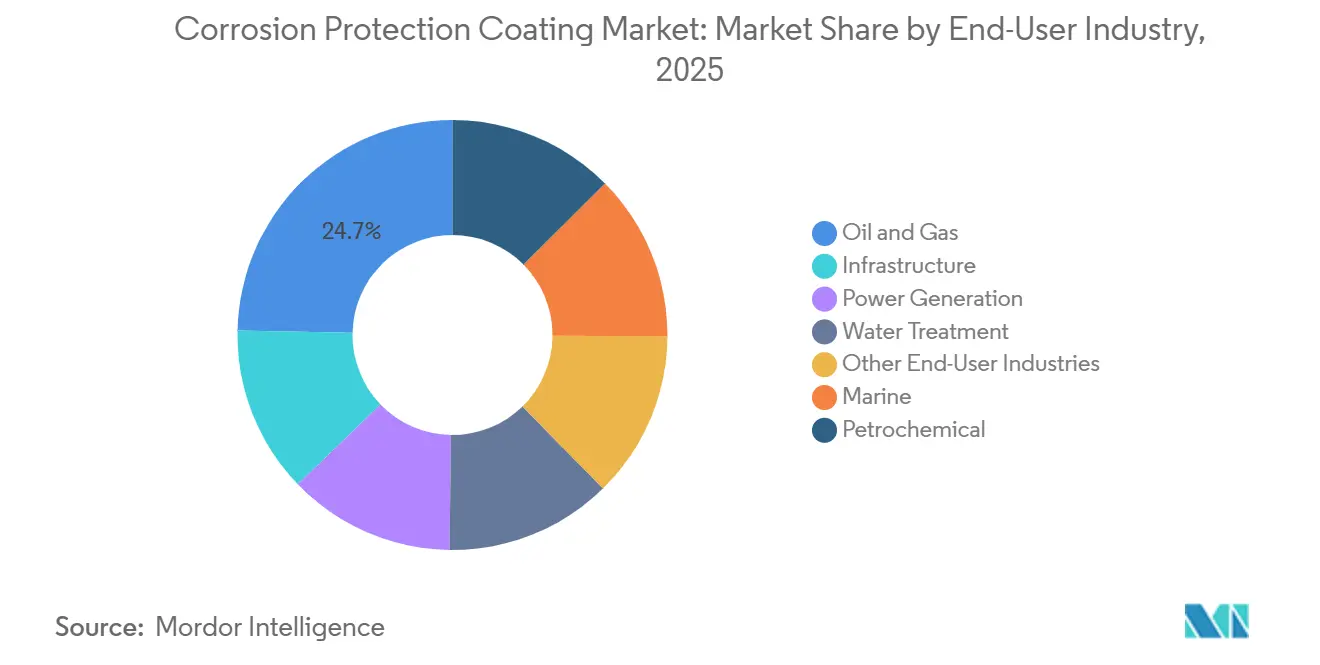
- By end-user industry, oil and gas accounted for 24.66% of revenue in 2025, while infrastructure is forecast to grow at a 6.58% CAGR through 2031.
- By geography, Asia-Pacific accounted for 42.71% revenue share in 2025 and is expected to grow at a 6.32% CAGR through 2031.
Note: Market size and forecast figures in this report are generated using Mordor Intelligence’s proprietary estimation framework, updated with the latest available data and insights as of January 2026.
Market Trends and Insights
Drivers Impact Analysis of Corrosion Protection Coating Market*
| Drivers | (~) % Impact on CAGR Forecast | Geographic Relevance | Impact Timeline |
|---|---|---|---|
| Increasing Infrastructure Rehabilitation and Maintenance Activities | +1.8% | Global, concentrated in North America, Europe, and East Asia | Medium term (2-4 years) |
| Offshore Wind, Marine, and Coastal Infrastructure Expansion | +1.4% | Asia-Pacific core, with spillover to the North Sea and US Gulf Coast | Long term (≥ 4 years) |
| Low-Volatile Organic Compound (VOC) and Water-Based Coating Adoption | +0.9% | North America and Europe, with early momentum in the Asia-Pacific | Medium term (2-4 years) |
| Smart Coatings and Predictive Asset Monitoring Advances | +0.6% | Global, led by Europe and North America | Long term (≥ 4 years) |
| Corrosion Protection Needs in Battery, Hydrogen, and Clean Energy Infrastructure | +0.7% | Asia-Pacific and the European Union | Long term (≥ 4 years) |
| Source: Mordor Intelligence | |||
Increasing Investments in Infrastructure Rehabilitation and Maintenance Activities
Infrastructure rehabilitation remains a reliable driver of demand for corrosion protection coatings across several regions. Bridge, water treatment, port, airport, and road upgrades require protective systems under project specifications. Recoating programs create recurring demand because bridge steel and pipeline networks require maintenance after their initial construction. Existing structures also require more complex surface preparation, containment, and environmental controls than new assets. These conditions can encourage the use of high-build epoxy primers and polyurethane topcoats, which help limit future shutdown risk. Southeast Asia and the Gulf Cooperation Council also add first-coat demand through ongoing infrastructure development.
Expansion of Offshore Wind, Marine, and Coastal Infrastructure Driving Demand for Protective Coatings
Offshore wind is expanding the corrosion protection coating market in a demanding marine application. Global offshore wind capacity reached 57 GW in 2025 and is expected to exceed 120 GW by 2030. Monopiles, transition pieces, and inter-array cabling need systems designed for 25-year exposure in immersion and atmospheric conditions. These requirements support premium zinc, epoxy, and polyurethane systems, which command a 30% to 40% premium over standard atmospheric specifications. North Sea projects installed during the mid-2010s are approaching major maintenance cycles, adding aftermarket demand beyond new construction. DNV-ST-0437 requirements for erosion-resistant blade protection favor suppliers with qualified specialist products.
Rising Adoption of Low-VOC and Water-Based Coating Technologies to Meet Environmental Regulations
Environmental regulations are supporting a shift toward water-based and high-solids products in the corrosion protection coating market. The U.S. Environmental Protection Agency finalized amendments to the aerosol-coating Volatile Organic Compound (VOC) rule on January 17, 2025, with a compliance date of January 17, 2027. The European Commission updated the EU Ecolabel criteria for paints and varnishes in February 2026, introducing lower VOC and semi-volatile organic compound limits that remain in effect through December 2032[1]European Commission, “A Fresh Coat: EU Ecolabel Levels Up for Paints & Varnishes,” European Commission Environment News, europa.eu.. Suppliers that meet both EU Ecolabel and California Air Resources Board requirements are better positioned for public infrastructure tenders. PPG Industries, Inc. introduced its AQUACRON WSP waterborne shop primer series for structural steel in 2026, emphasizing rapid curing and resistance to water exposure. The product demonstrates that waterborne systems can address practical application concerns in some structural-steel settings.
Advancements in Smart Coatings and Predictive Asset Monitoring Technologies
Smart coatings may create a higher-value segment of the corrosion protection coating market as industrial deployment advances. Research published in June 2026 described Fe₃O₄-based epoxy coatings with self-healing and self-warning functions on steel substrates. These functions enable visual identification of damage before corrosion begins. If verified, service life improves by 20% to 30%, and asset owners may place greater value on premium systems than on regular cycle-based recoating. Coating-integrated nanosensors could also enable continuous condition monitoring without the need for external instruments. These technologies are progressing through pilot-scale work in energy and infrastructure applications.
Restraints Impact Analysis of Corrosion Protection Coating Market*
| Restraints | (~) % Impact on CAGR Forecast | Geographic Relevance | Impact Timeline |
|---|---|---|---|
| High Surface Preparation and Application Costs | -0.8% | Global, most acute in North America and Europe | Short term (≤ 2 years) |
| Raw Material Price Volatility for Epoxy Resins and Solvents | -0.7% | Global, amplified in Europe by upstream capacity losses | Medium term (2-4 years) |
| Lengthy Qualification and Approval Processes in Critical Applications | -0.5% | Global, particularly for offshore and oil and gas projects | Long term (≥ 4 years) |
| Source: Mordor Intelligence | |||
High Surface Preparation and Application Costs for Protective Coating Systems
Surface preparation can account for 40% to 60% of the total cost of complex industrial and offshore rehabilitation work before the first coat is applied[2]AMPP, “Technology Update No. 9: Guidelines for Developing a Coating Cost Estimating System,” AMPP, ampp.org.. Blast cleaning, containment, environmental compliance, and access equipment increase the overall cost of installed protective systems. This challenge is more pronounced when old coatings must be removed during limited operating shutdowns. Rising field labor costs in North America and Europe make shop-applied systems more attractive where asset design permits their use. Waterborne shop primers can reduce some field sandblasting requirements for new steel, but they do not change the cost structure of existing asset rehabilitation. Smaller operators may defer recoating when compliant systems exceed their short-term budgets, increasing the need for later repairs or replacements.
Volatility in Raw Material Prices, Including Epoxy Resins and Solvents
Feedstock volatility remains a constraint for the corrosion protection coating market, as epoxy resins and solvents are exposed to global petrochemical conditions. Supply interruptions and changing freight costs can affect margins on fixed-price contracts for infrastructure and oil-and-gas customers. European buyers face additional procurement pressure when local upstream capacity is reduced, and supply must be sourced from Asia. Geopolitical disruptions affecting Middle Eastern petrochemical flows can lead to periodic increases in key intermediate costs. Suppliers with internal resin production or long-term offtake agreements have a cost advantage over companies that rely on spot purchases. Qualification requirements under NORSOK M-501, the IMO Performance Standard for Protective Coatings (PSPC), and project-specific oil and gas standards present an additional obstacle, as the approval process can take longer than typical procurement cycles.
*Our forecasts treat driver/restraint impacts as directional, not additive. The impact forecasts reflect baseline growth, mix effects, and variable interactions.
Corrosion Protection Coating Market Segment Analysis
By Resin Type:
Epoxy Anchors Demand While Vinyl Ester Leads Premium GrowthEpoxy held 39.92% of the corrosion protection coating market share in 2025, supported by its use across a wide range of corrosion categories. It is established in ISO 12944- and NORSOK M-501-approved system libraries, from C3 atmospheric exposure to C5-M offshore settings. Polyurethane typically serves as a topcoat over epoxy primers, providing ultraviolet resistance and improved surface finish performance. This combination supports premium multi-coat specifications in marine and infrastructure projects. Acrylic and alkyd products retain meaningful use in lower-demand C2 and C3 applications, where price has greater influence. Their use is common in general construction and light industrial maintenance.
Vinyl ester is forecast to record a 6.73% CAGR through 2031, the fastest rate among resin types. The corrosion protection coating market for vinyl ester benefits from applications involving chemical immersion beyond the typical operating range of epoxy coatings. Flue gas desulfurization equipment, acid containment, and desalination assets are important use cases. Research published in 2026 found that formulated epoxy can provide hydrogen-barrier protection at 10 MPa, while vinyl ester performs better under combined hydrogen and moisture exposure. This performance difference may influence coating specifications for hydrogen storage and transport assets. Chlorinated rubber remains a niche marine primer option, while silicone and fluoropolymer products are gaining use in extreme-temperature and corrosion-under-insulation settings.



By Technology:
Water-Based Products Gain Ground as Solvent-Based Systems Retain Field AdvantagesSolvent-based systems held 47.83% of the corrosion protection coating market share in 2025. Their position reflects advantages in cold weather, humid coastal areas, and maintenance settings with difficult dew-point control. These products deliver dependable cure speed, adhesion, and film formation under demanding field conditions. This performance explains why the shift away from solvent-based products in offshore and marine work is slower than in shop-applied structural steel. Powder coatings remain relevant in controlled factory applications. Fusion-bonded epoxy is used on pipeline segments, while electrostatic application can reduce material waste in the general industry.
Water-based coatings are forecast to grow at a 6.65% CAGR through 2031. Regulatory changes in the United States and Europe are narrowing the range of applications in which solvent-based products are preferred. Dual compliance with California and EU environmental requirements can provide access to public tenders that treat certification as a qualification condition. High-solid and solvent-free products are also receiving reformulation investment. These formats help suppliers reduce volatile organic compound (VOC) content while preserving familiar application characteristics. They provide a practical route for users who need compliance but remain cautious about changes in field performance.
By End-User Industry:
Oil and Gas Leads While Infrastructure Posts Faster GrowthOil and gas accounted for 24.66% of the corrosion protection coating market size in 2025. Asset integrity work across upstream and midstream networks sustains demand, alongside offshore activity in the Middle-East and Southeast Asia. Petrochemical plants require systems that withstand chemical splashes, high temperatures, and corrosion under insulation. Coatings qualified for corrosion-under-insulation protection can command stronger pricing and support long supplier relationships. Marine demand is linked to seaborne trade and International Maritime Organization requirements that connect hull performance with fuel efficiency. Water treatment is a smaller segment but provides recurring work, while NSF/ANSI 61 requirements for potable water contact limit the pool of qualified suppliers.
Infrastructure is projected to expand at a 6.58% CAGR through 2031. Government-backed work on bridges, tunnels, water treatment facilities, and transit systems is converting deferred maintenance into contracted coating demand. Battery gigafactories and electrolyzer manufacturing create additional demand for systems used in electrolyte-exposed settings. AkzoNobel supplied specialized protective systems for the Songyuan Hydrogen Energy Industrial Park in China in 2026, using Interbond 2340UPC for piping and ammonia tanks and Interseal 670HS for hydrogen storage spheres. Power generation combines conventional thermal maintenance with offshore wind projects that require 25-year systems for towers, nacelles, and substations.
Geography Analysis
APAC Corrosion Protection Coating Market
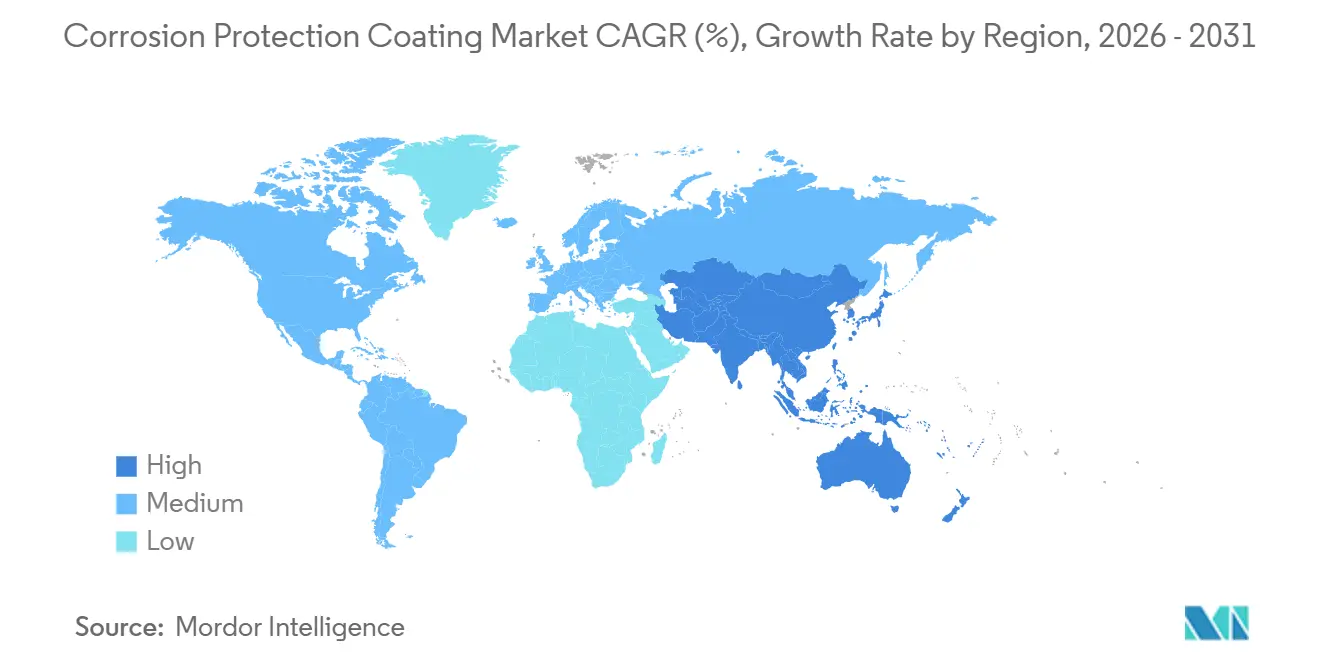
Asia-Pacific accounted for 42.71% of the corrosion protection coating market in 2025 and is projected to grow at a CAGR of 6.32% through 2031. China represented more than 56% of regional consumption, driven by shipbuilding, offshore wind, Liquefied Natural Gas (LNG) terminals, and petrochemical complexes. Green hydrogen development is adding to existing marine and oil-and-gas demand. South Korea and Japan contribute through commercial shipbuilding and demand for hull, ballast tank, and superstructure coating systems. India adds volume through infrastructure investment and expanding petrochemical capacity, with specifications shifting toward higher-performance products.
North America and Europe Corrosion Protection Coating Market
North America and Europe have distinct but stable demand bases. Infrastructure disbursements in the United States support maintenance work on bridges, waterways, and water assets, while refinery and pipeline turnaround activity drives demand for industrial coatings. The European Union's renewable energy targets for 2030 are concentrating demand on offshore wind projects in the North and Baltic Seas. In 2025, Hempel introduced Avantguard 750 Pro for corrosion protection applications. Germany, the United Kingdom, France, and Italy remain key locations for industrial maintenance work.
MEA and South America Corrosion Protection Coating Market
South America, the Middle-East, and Africa hold smaller shares of the corrosion protection coating market. Brazil and Argentina benefit from pipeline rehabilitation and offshore pre-salt development, with asset integrity work requiring immersion-zone and corrosion-under-insulation systems. Saudi Arabia's Vision 2030 program and petrochemical expansion across the Gulf Cooperation Council support demand for high-temperature, chemical-resistant systems. South Africa and other sub-Saharan countries generate demand through mining infrastructure, ports, and water treatment projects. These markets are increasingly adopting first-coat specifications aligned with international standards.

Competitive Landscape
The corrosion protection coating market is fragmented. AkzoNobel and Axalta announced an all-share merger proposal, subject to a vote at an Extraordinary General Meeting on August 5, 2026. The transaction is expected to close in late 2026 or early 2027 if approved. The combined company would have USD 17 billion in annual revenue and an enterprise value of USD 25 billion. The proposed combination would bring together Axalta's refinish business with AkzoNobel's marine, protective, and Interpon powder-coating activities. Nippon Paint and Sherwin-Williams ended their joint acquisition pursuit of AkzoNobel in June 2026.
Marine and protective coatings attract strategic interest due to their technical requirements and favorable pricing compared with decorative products. Research into smart coatings indicates a competitive opportunity for companies that can fund long development programs. A 2026 study on self-healing and self-warning epoxy illustrates this direction. Companies that can translate these functions into qualified industrial systems may develop differentiated product offerings. Hydrogen infrastructure is another early-stage area where barrier-coating specifications are still being defined, leaving room for suppliers that develop products for atomic hydrogen permeation under pressure.
Carboline, Tnemec, and Teknos hold specialized positions in chemical linings, water infrastructure, and northern European industrial maintenance, respectively. Their application expertise and localized technical support can be difficult for larger suppliers to replicate on individual projects. ISO 12944 and project-specific offshore standards act as entry barriers for new suppliers, and broad approval portfolios can therefore protect established vendors in critical applications. Regional companies can still compete when they manage local qualification processes efficiently. The corrosion protection coating market remains open to regional formulators where service responsiveness and local approvals outweigh global scale.
Corrosion Protection Coating Industry Leaders
Akzo Nobel N.V.
PPG Industries, Inc.
Jotun
The Sherwin-Williams Company
Kansai Paint Co.,Ltd.
- *Disclaimer: Major Players sorted in no particular order
Corrosion Protection Coating Market Companies Covered in this Report
- Akzo Nobel N.V.
- Ashland Inc.
- Asian Paints Limited
- Axalta Coating Systems Ltd.
- Berger Paints India Limited
- Carboline Company
- Hempel A/S
- Jotun
- Kansai Paint Co.,Ltd.
- KCC Corporation
- Nippon Paint Holdings Co., Ltd.
- PPG Industries, Inc.
- RPM International Inc.
- Sika AG
- Teknos Group
- The Sherwin-Williams Company
- Tnemec
- Wacker Chemie AG

Recent Industry Developments in Corrosion Protection Coating Market
- May 2026: PPG Industries launched PPG SELEMIX 7-140 2K high-solids acrylic topcoat across the EMEA region, targeting industrial applications such as agricultural equipment and construction machinery that require long-term corrosion protection in harsh operating environments.
- May 2026: AkzoNobel completed the scope of corrosion protection coatings for the Songyuan Hydrogen Energy Industrial Park in China, an integrated green hydrogen, ammonia, and methanol project developed by China Energy Engineering Group. Systems deployed included Interbond 2340UPC for Corrosion Under Insulation (CUI) protection on critical piping and ammonia tanks, and Interseal 670HS for hydrogen storage spheres.


Global Corrosion Protection Coating Market Report Scope
Corrosion protection coatings are specialized surface treatments applied to metal and concrete to prevent rust and other forms of environmental degradation. They act as protective barriers or sacrificial agents, blocking moisture, oxygen, and chemicals from reaching the substrate. They are essential for industrial pipelines, marine equipment, and household fixtures.
The corrosion protection coating market is segmented by resin type, technology, end-user industry, and geography. By resin type, the market is segmented into epoxy, polyurethane, acrylic, alkyd, vinyl ester, chlorinated rubber, and other resin types. By technology, the market is segmented into water-based, solvent-based, powder coatings, and other technologies. By end-user industry, the market is segmented into marine, oil and gas, petrochemical, infrastructure, power generation, water treatment, and other end-user industries. The report also covers market size and forecasts for corrosion protection coating across 16 countries in major regions. The market sizes and forecasts are provided in terms of value (USD).
| Epoxy |
| Polyurethane |
| Acrylic |
| Alkyd |
| Vinyl Ester |
| Chlorinated Rubber |
| Other Resin Types |
| Water-Based |
| Solvent-Based |
| Powder Coatings |
| Other Technologies |
| Marine |
| Oil and Gas |
| Petrochemical |
| Infrastructure |
| Power Generation |
| Water Treatment |
| Other End-User Industries |
| Asia-Pacific | China |
| India | |
| Japan | |
| South Korea | |
| Rest of Asia-Pacific | |
| North America | United States |
| Canada | |
| Mexico | |
| Europe | Germany |
| United Kingdom | |
| France | |
| Italy | |
| Russia | |
| Rest of Europe | |
| South America | Brazil |
| Argentina | |
| Rest of South America | |
| Middle-East and Africa | Saudi Arabia |
| South Africa | |
| Rest of Middle-East and Africa |
| By Resin Type | Epoxy | |
| Polyurethane | ||
| Acrylic | ||
| Alkyd | ||
| Vinyl Ester | ||
| Chlorinated Rubber | ||
| Other Resin Types | ||
| By Technology | Water-Based | |
| Solvent-Based | ||
| Powder Coatings | ||
| Other Technologies | ||
| By End-User Industry | Marine | |
| Oil and Gas | ||
| Petrochemical | ||
| Infrastructure | ||
| Power Generation | ||
| Water Treatment | ||
| Other End-User Industries | ||
| By Geography | Asia-Pacific | China |
| India | ||
| Japan | ||
| South Korea | ||
| Rest of Asia-Pacific | ||
| North America | United States | |
| Canada | ||
| Mexico | ||
| Europe | Germany | |
| United Kingdom | ||
| France | ||
| Italy | ||
| Russia | ||
| Rest of Europe | ||
| South America | Brazil | |
| Argentina | ||
| Rest of South America | ||
| Middle-East and Africa | Saudi Arabia | |
| South Africa | ||
| Rest of Middle-East and Africa | ||


Key Questions Answered in the Report
What is current market size of Corrosion Protection Coating Market?
The Corrosion Protection Coating Market size was estimated at USD 15.42 billion in 2025 and is projected to grow from USD 16.37 billion in 2026 to USD 21.71 billion by 2031, at a CAGR of 5.81% during the forecast period (2026-2031).
Which resin type leads corrosion protection coatings?
Epoxy led with 39.92% revenue share in 2025 because it served a wide range of corrosion conditions.
Which coating technology is growing fastest?
Water-based products are projected to grow at 6.65% CAGR through 2031 as VOC requirements tighten.
Which end-user segment is expanding fastest?
Infrastructure is forecast to grow at a 6.58% CAGR through 2031, supported by repair and maintenance programs.
Page last updated on:





