
Corporate Legal E-Billing Software Market Size and Share
Market Overview
| Study Period | 2020 - 2031 |
|---|---|
| Market Size (2026) | USD 1.97 Billion |
| Market Size (2031) | USD 3.44 Billion |
| Growth Rate (2026 - 2031) | 11.79% CAGR |
| Fastest Growing Market | Asia-Pacific |
| Largest Market | North America |
| Market Concentration | Medium |
Major Players *Disclaimer: Major Players sorted in no particular order Image © Mordor Intelligence. Reuse requires attribution under CC BY 4.0. | |
Corporate Legal E-Billing Software Market Analysis by Mordor Intelligence
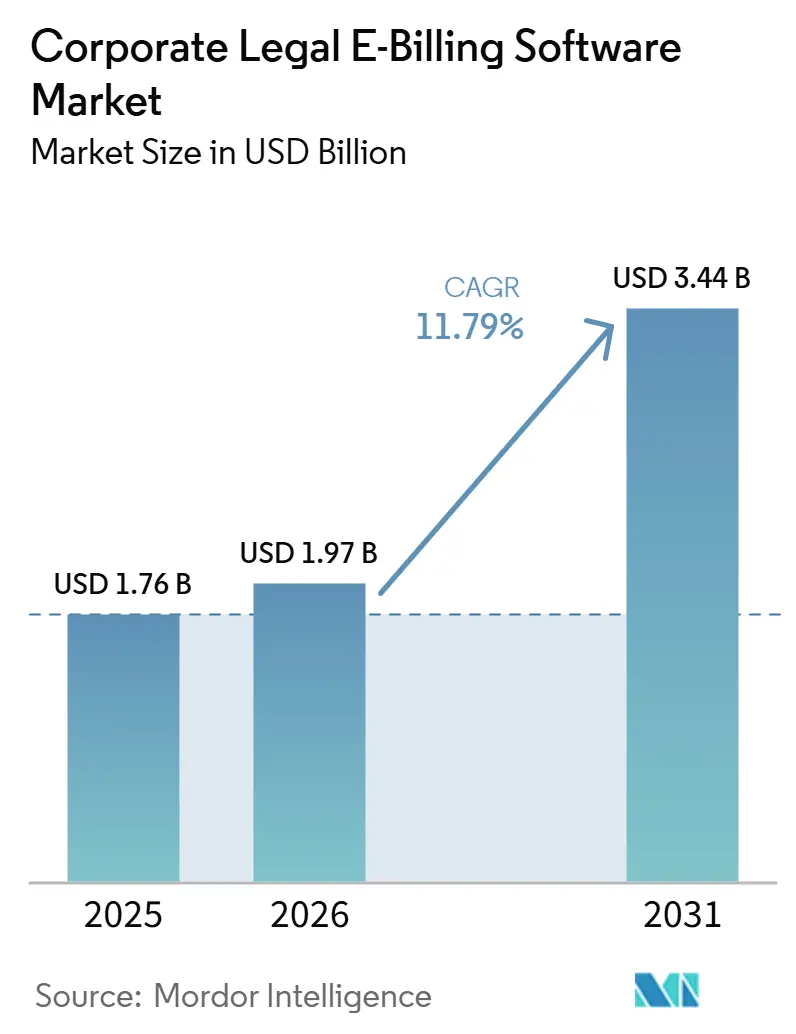
The corporate legal e-billing software market size is expected to increase from USD 1.76 billion in 2025 to USD 1.97 billion in 2026 and reach USD 3.44 billion by 2031, growing at a CAGR of 11.79% over 2026-2031. Rising outside-counsel fees and closer financial oversight are making invoice controls a core legal operations requirement. Corporate departments are seeking clearer records of rates, budgets, accruals, and law firm performance before invoices move to accounts payable. Cloud platforms are becoming the preferred delivery model because they connect legal, finance, and procurement workflows without maintaining separate local systems. Vendors are responding with AI-supported review, structured invoice intake, and data connections that support wider enterprise reporting. Consolidation is also reshaping buyer choices, as established legal technology providers add specialized spend-management capabilities and seek broader coverage of mid-sized legal departments.
Key Report Takeaways
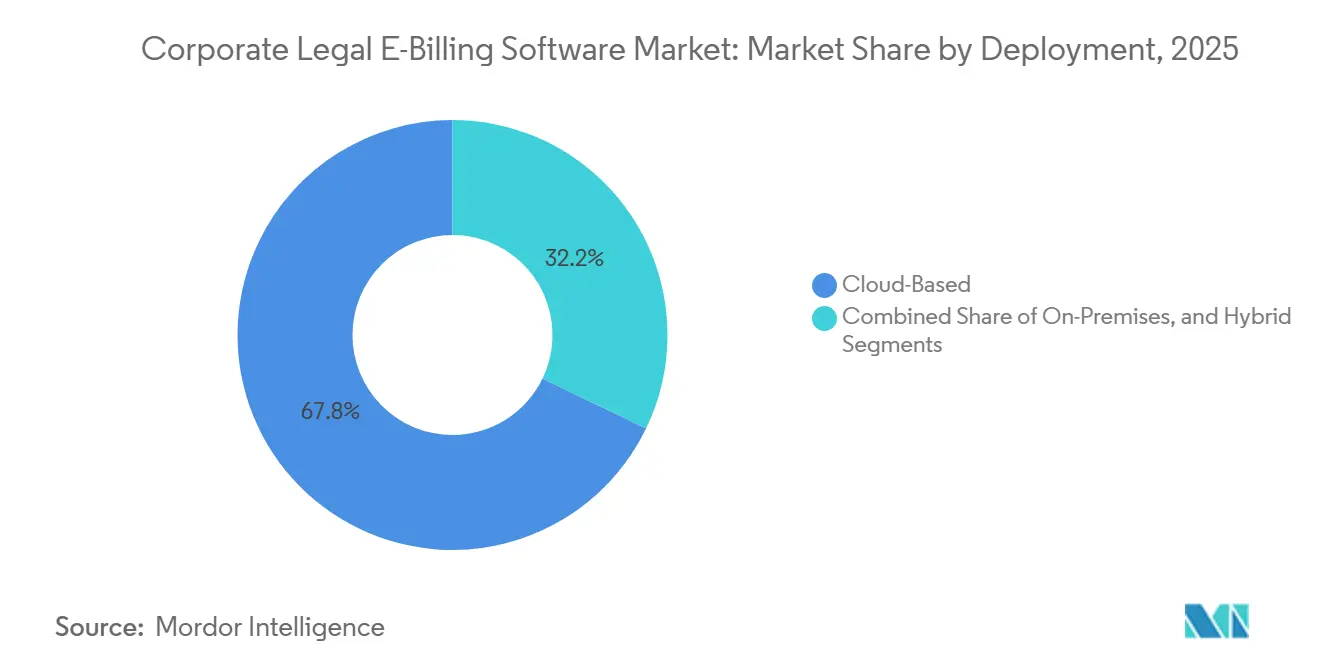
- By deployment, cloud-based platforms held 67.83% of the corporate legal e-billing software market share in 2025, while hybrid deployment is projected to expand at a CAGR of 13.76% through 2031.
- By organization size, large enterprises held 71.26% of the market share in 2025, while SMEs are projected to expand at a CAGR of 12.98% through 2031.
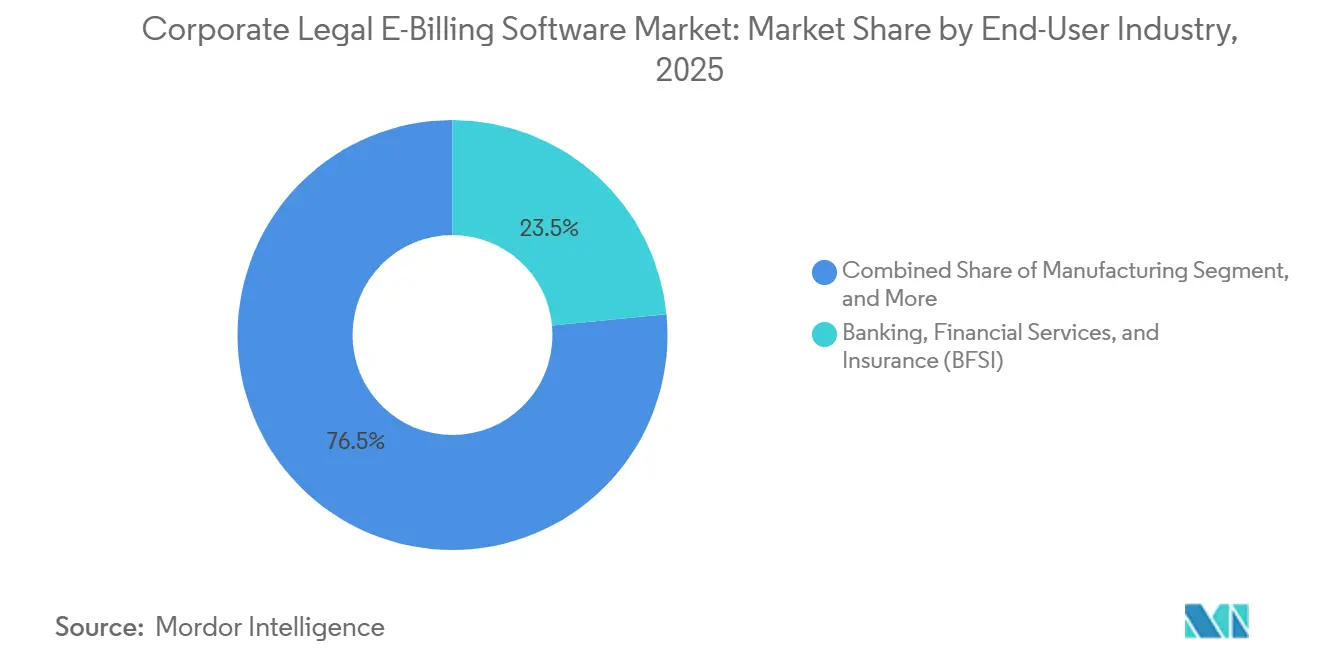
- By end-user industry, BFSI held 23.47% of the market share in 2025, while the healthcare and life sciences industry was projected to expand at a 14.46% CAGR through 2031 in the corporate legal e-billing software market.
- By geography, North America held 42.26% share in the corporate legal e-billing software market in 2025, while Asia-Pacific is projected to grow at an 15.83% CAGR through 2031.
Note: Market size and forecast figures in this report are generated using Mordor Intelligence’s proprietary estimation framework, updated with the latest available data and insights as of January 2026.
Global Corporate Legal E-Billing Software Market Trends and Insights
Drivers Impact Analysis*
| DRIVER | (~) % IMPACT ON CAGR FORECAST | GEOGRAPHIC RELEVANCE | IMPACT TIMELINE |
|---|---|---|---|
| Corporate CFO Mandates for Outside-Counsel Cost Transparency | +3.0% | Global, strongest in North America and Western Europe | Medium term (2-4 years) |
| AI-Based Line-Item Review and Anomaly Detection | +2.5% | Global, with advanced adoption in North America | Medium term (2-4 years) |
| Migration from PDF and Email Invoices to LEDES and Structured Data | +2.0% | Global, with early concentration in North America and Europe | Short term (≤ 2 years) |
| Expansion of Alternative Fee Arrangements and Budget Governance | +1.5% | North America and Europe, with emerging use in Asia-Pacific and the Middle East | Long term (≥ 4 years) |
| Real-Time Accrual, Reserve, and Forecasting Requirements | +1.0% | Global, particularly public companies in North America and Europe | Medium term (2-4 years) |
| Embedded Legal Spend Benchmarking Across Global Matter Portfolios | +0.8% | North America and Europe, with expansion into Asia-Pacific, the Middle East, and Africa | Long term (≥ 4 years) |
| Source: Mordor Intelligence | |||
Corporate CFO Mandates for Outside-Counsel Cost Transparency
Outside-counsel cost control has moved from an administrative task to a finance priority for many corporate legal departments. The corporate legal e-billing software market benefits when CFOs require reliable invoice data before approving law firm panels or annual budgets. Outside-counsel billing rates increased by 9.6% in 2025, increasing pressure to identify rate changes, staffing patterns, and budget variance earlier in a matter lifecycle. Big Law received 51.2% of corporate outside-counsel spending in the 2025 invoice data reviewed by CounselLink, which makes supplier-level visibility important for negotiations.[1]LexisNexis CounselLink, “CounselLink 2026 Trends Report,” LexisNexis CounselLink, ln-counsellink.lexisnexis.com Median total legal spending fell to 0.43% of company revenue in 2026 from 0.53% in 2025, while the number of employees supported per lawyer increased, reinforcing the need for automation in lean departments.[2]Association of Corporate Counsel, “2026 ACC Law Department Management Benchmarking Report,” Association of Corporate Counsel, acc.com These conditions favor systems that turn invoice review into a consistent financial control rather than a manual approval process. The corporate legal e-billing software market is, therefore, closely linked to the quality of legal and finance data sharing.
AI-Based Line-Item Review and Anomaly Detection
AI is changing bill review from a check against fixed billing rules into a process that can identify exceptions, compare patterns, and direct reviewers to higher-risk entries. This shift supports demand in the corporate legal e-billing software market because large invoice volumes are difficult to review consistently with staff alone. Mitratech reported that its ARIES Non-LEDES Invoice Capture processed millions of dollars in legal spend and can reduce manual administrative time by up to 80%. Vendor-level analysis is becoming more important because a company’s top 10 law firms received 64.4% of external legal spending in Brightflag’s 2026 benchmark data. An AI-supported review can expose duplicated work, inefficient staffing, and entries that do not meet billing guidelines before payment is released. Onit introduced Unity e-Billing and Spend Agent in 2025 to automate invoice review and provide spend analysis within the same legal operations environment.
Migration From PDF and Email Invoices to LEDES and Structured Data
Structured data is becoming more important as corporate legal teams want billing information that can move directly into validation, budgeting, and reporting workflows. The corporate legal e-billing software market gains from this transition because standardized invoices reduce manual rekeying and make invoice-level analysis more dependable. The LEDES Oversight Committee released XML formats 2.1.5 and 2.2.2 in April 2026 and directed e-billing systems to replace versions 2.1.4 and 2.2.1. Older LEDES 1998B files and unstructured submissions will continue to coexist with newer XML formats, leaving a clear role for optical character recognition and non-LEDES capture tools. France requires large enterprises and medium-sized companies to receive structured electronic invoices from September 1, 2026, thereby supporting the wider adoption of systems that can manage structured billing records. The 2024 LEDES Error Codes Version 2 also provided a shared error framework that can improve communication between law firm billing systems and corporate review platforms.
Expansion of Alternative Fee Arrangements and Budget Governance
Alternative fee arrangements require billing controls that go beyond checking hourly rates and timekeeper rules. Fixed fees, capped fees, and blended rates need milestone tracking, budget monitoring, and early warnings when a matter exceeds agreed limits. This need creates a product opportunity for the corporate legal e-billing software market, particularly where legal departments want to connect pricing decisions with ongoing matter management. PERSUIT reported that double-digit rate increases now extend beyond the upper end of the outside-counsel market, which makes annual rate negotiations less adequate as a cost-control tool. AI use at law firms may reduce the time needed for work previously billed by the hour, increasing commercial pressure for pricing models based on outcomes rather than time recorded. Platforms that track fee caps, phased budgets, and milestone payments can help corporate clients capture these changes while maintaining clear approval records. This capability widens the role of the corporate legal e-billing software market in outside-counsel pricing decisions.
Restraints Impact Analysis*
| RESTRAINT | (~) % IMPACT ON CAGR FORECAST | GEOGRAPHIC RELEVANCE | IMPACT TIMELINE |
|---|---|---|---|
| Data Sovereignty and Privilege-Preservation Requirements | -1.5% | Global, particularly Europe, healthcare-intensive U.S. markets, and cross-border matters | Medium term (2-4 years) |
| Fragmented Billing Taxonomies and Non-LEDES Supplier Behavior | -1.2% | Global, with greater friction in Asia-Pacific and South America | Short term (≤ 2 years) |
| Long Change-Management Cycles Across Legal and Finance Stakeholders | -0.9% | Global, especially large enterprises with established on-premises ERP systems | Medium term (2-4 years) |
| Explainability, Hallucination, and Liability Concerns in AI Bill Review | -0.7% | Global, most visible in BFSI and healthcare | Long term (≥ 4 years) |
| Source: Mordor Intelligence | |||
Data Sovereignty and Privilege-Preservation Requirements
Legal invoice records combine sensitive financial details with information that may be protected by attorney-client privilege. These requirements can slow adoption in the corporate legal e-billing software market when companies need local storage, restricted access, and detailed audit records before moving billing data to a cloud platform. GDPR rules on cross-border transfers add compliance work for systems that combine data from EU and non-EU matters. The U.S. Department of Health and Human Services proposed updates to the HIPAA Security Rule in January 2025 that would require regulated entities to address AI tools within formal risk analysis and risk-management processes. Healthcare legal teams, therefore, need to assess AI review tools against healthcare security controls, not only general enterprise technology standards. Data residency options, access controls, audit trails, and privacy-by-design practices have become baseline procurement requirements in regulated settings. These safeguards remain central to the corporate legal e-billing software market, where sensitive matter data crosses borders.
Fragmented Billing Taxonomies and Non-LEDES Supplier Behavior
Automated review works best when law firms submit complete and consistently coded invoice data. The corporate legal e-billing software market faces friction because many firms still use legacy practice-management systems or submit invoices that require manual interpretation. Non-LEDES files, vague narratives, and incomplete UTBMS task codes limit the depth of spend analysis and slow validation. LEDES Error Codes Version 2 was designed to improve shared reporting of validation problems, but full adoption still depends on coordination among law firms, billing-system vendors, and corporate buyers. AI-based document capture can help convert unstructured invoices, but it does not remove the underlying need for better billing discipline. The issue is particularly relevant where LEDES use remains limited and corporate legal teams manage diverse networks of local law firms.
*Our forecasts treat driver/restraint impacts as directional, not additive. The impact forecasts reflect baseline growth, mix effects, and variable interactions.
Segment Analysis
By Deployment: Cloud Platforms Lead While Hybrid Adoption Gains Ground
Cloud-based systems held 67.83% of the corporate legal e-billing software market share in 2025. This position reflects demand for software that connects legal teams with enterprise resource planning, accounts payable, and enterprise legal management systems in real time. Brightflag, Onit SimpleLegal, and LexisNexis CounselLink+ have developed cloud-first offerings that support ongoing updates, application programming interfaces, and data-driven reporting. These capabilities can give corporate legal departments a common view of spending across matters, firms, and jurisdictions. Cloud delivery also allows vendors to improve AI features without requiring each client to maintain separate infrastructure. The legal e-billing software industry, therefore, continues to shift toward platforms that can fit into wider finance and procurement workflows.
On-premises systems remain relevant for organizations that have strict internal requirements for data location, security, or local integration. BFSI, healthcare, and government users can retain these systems where shared cloud infrastructure does not meet their policy requirements. Hybrid deployment is projected to grow at a CAGR of 13.76% from 2026 to 2031, the highest rate among deployment options. Hybrid models allow organizations to retain established ERP and accounts payable environments while adding cloud-based legal operations capabilities. Wolters Kluwer’s TyMetrix 360° connects its SaaS capabilities with Microsoft Power BI and Outlook, reflecting the integration needs of complex enterprise environments. Brightflag’s 2026 connector for compatible AI workspaces also shows how cloud systems are being positioned as part of broader enterprise data and AI environments.



By Organization Size: Large Enterprises Retain Scale While SMEs Accelerate
Large enterprises accounted for 71.26% of the market share in 2025. Organizations with large external legal budgets have the strongest financial reason to automate review, enforce billing guidelines, and monitor multi-jurisdictional matter costs. Their requirements often include multi-currency invoice processing, legal hold links, accrual reporting, and detailed vendor scorecards. These needs favor integrated enterprise legal management platforms with established implementation and support capabilities. Mitratech reported in February 2026 that it served more than 8,000 organizations, including 65% of the Fortune 100, showing the depth of incumbent presence in this customer group. Switching costs remain high when e-billing data is connected to finance, matter management, and law firm panel processes.
SMEs are projected to grow at a CAGR of 12.98% from 2026 to 2031. Cloud delivery and simpler onboarding are reducing the implementation burden that previously kept many mid-sized legal departments reliant on spreadsheets and email approvals. Wolters Kluwer reported that Brightflag delivered strong double-digit revenue growth after its June 2025 acquisition, supporting the demand case for its mid-market focus.[3]Wolters Kluwer Legal Software, “Benchmarkstudie 2025: Digitalisierung der Rechtsabteilung,” Wolters Kluwer Legal Software, presseportal.de. Lean teams are looking for practical tools that apply billing rules, produce accruals, and flag exceptions without requiring a full enterprise legal management rollout. Onit’s AI-native Unity platform is designed around this need for accessible, connected spend workflows. Providers that can shorten implementation periods while maintaining finance-grade controls are better placed to serve this group. The corporate legal e-billing software market is becoming more accessible when these functions are delivered without a lengthy enterprise project.
By End-User Industry: BFSI Holds the Largest Position While Healthcare Expands Fastest
BFSI held 23.47% of the market share in 2025. Financial institutions manage regulatory matters, litigation, transactions, and outside-counsel panels across multiple jurisdictions, creating a sustained need for disciplined invoice review. Many were early users of UTBMS codes and LEDES submissions because their legal operations teams needed standardized records at scale. CounselLink reported that M&A and litigation matters have a high concentration of Big Law spending, which is relevant to the complex matter profiles often handled by BFSI clients. The sector also requires audit-ready documentation and controls that can support internal finance and risk functions. IT and telecommunications, manufacturing, energy and utilities, retail and consumer goods, government and public sector, and other users account for the remaining demand base.
The healthcare and life sciences industry is projected to expand at a CAGR of 14.46% from 2026 to 2031. Litigation, physician contracts, business associate agreements, and HIPAA-related obligations are encouraging healthcare legal teams to formalize external spend governance. The proposed HIPAA Security Rule updates reinforce the need to assess AI tools through formal security and risk-management processes.[4]U.S. Department of Health and Human Services, “HIPAA Regulatory Initiatives,” U.S. Department of Health and Human Services, hhs.gov. This creates demand for platforms that preserve privilege, provide clear logs, and support matter-level budgets. Healthcare adoption remains less mature than BFSI adoption in many organizations, which leaves room for platform conversion during the forecast period. Growing in-house legal functions in Australia, India, and Singapore add a further regional dimension to this demand.
Geography Analysis
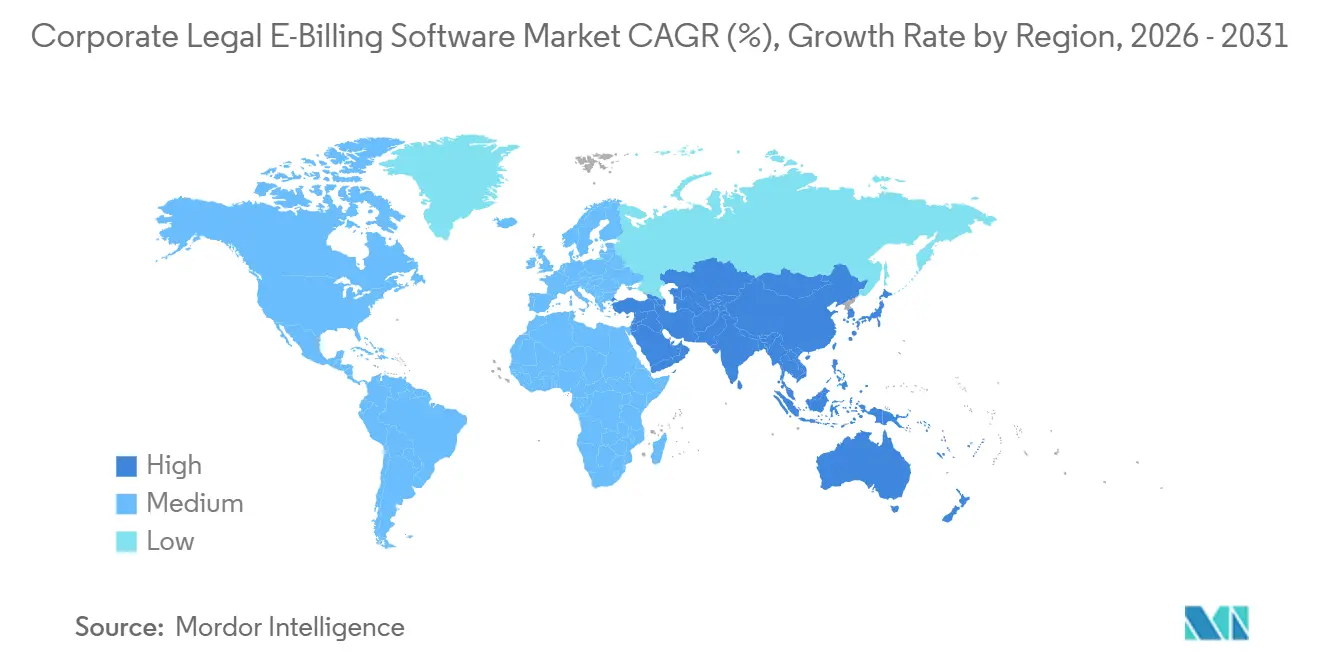
North America held 42.26% of the corporate legal e-billing software market share in 2025. The region has a high concentration of large corporate legal departments, established legal operations teams, and mature outside-counsel procurement practices. Median legal spending accounted for 0.43% of company revenue in 2026, while each lawyer supported a median of 1,323 employees, underscoring the value of systems that provide spend visibility and workflow automation. The United States remains the principal demand center because enterprise legal departments commonly connect e-billing with finance controls and law firm panel management. Canada and Mexico offer related opportunities as domestic companies formalize legal operations and multinational organizations seek a consolidated view of cross-border matters.
Europe is the second-largest regional market and is shaped by compliance requirements as well as corporate technology investment. France requires large enterprises and medium-sized companies to receive structured electronic invoices from September 1, 2026, which supports the adoption of tools that can handle standardized legal service billing. Wolters Kluwer found that 60% of surveyed legal professionals in Europe and the United States used AI solutions in early 2025, while the share spending more than EUR 50,000 (USD 57,024) annually on technology rose from 11% in 2024 to 16% in 2025. The United Kingdom, Germany, and France remain central to adoption. Germany had nearly 300 active legal technology companies in 2025, indicating a broad local technology ecosystem. The EU AI Act will require many operators to provide transparency, human oversight, and documentation from August 2026, strengthening demand for review systems with auditable AI controls.
Asia-Pacific is projected to be the fastest-growing geography at a CAGR of 15.83% from 2026 to 2031. India, Singapore, Australia, and China are expanding their in-house legal functions as regulatory and CFO attention to legal costs increases. Active generative AI use among in-house counsel increased from 23% to 52% in the 2025-2026 ACC and Everlaw report, underscoring the need for systems to govern AI-assisted legal work. Singapore and Australia have the most mature formal spend-management practices in the region. South America remains earlier in adoption, with Brazil and Argentina supported by multinationals that use global e-billing platforms for cross-border portfolios. The Middle East and Africa remain the smallest regional group, although the United Arab Emirates and Saudi Arabia are creating new demand through large government and infrastructure mandates. This broadens the corporate legal e-billing software market beyond its traditional North American enterprise base.

Competitive Landscape
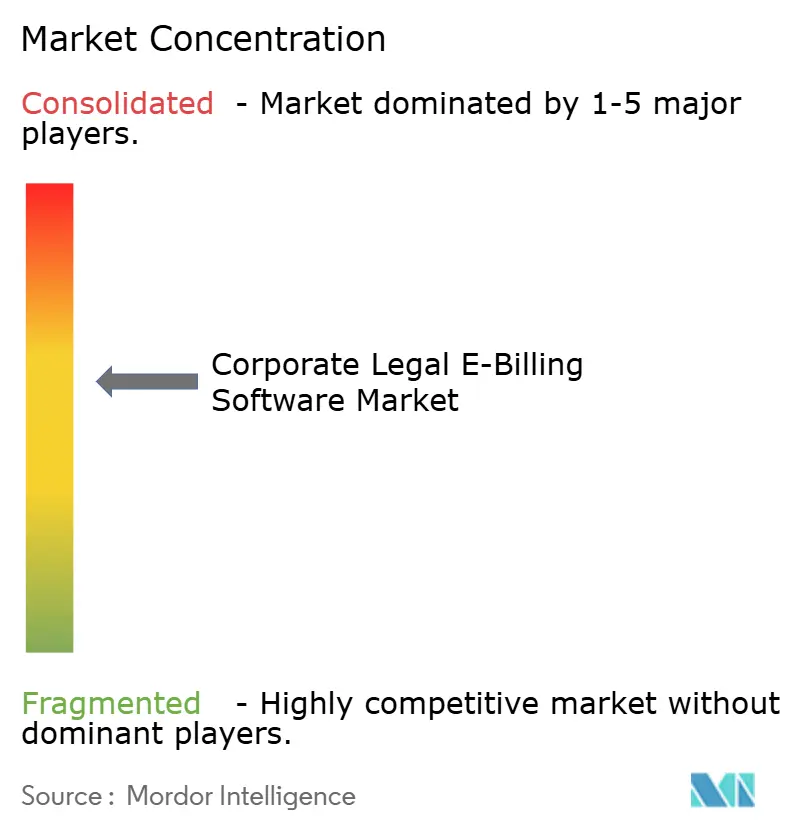
The corporate legal e-billing software market has moderate concentration, with Thomson Reuters, Wolters Kluwer, Mitratech, and Onit serving many large enterprise buyers. These providers combine e-billing with matter management, analytics, workflow tools, and links to finance systems. Their installed bases create a practical advantage because changing systems can affect billing rules, invoice history, law firm onboarding, and internal approval processes. Wolters Kluwer completed the acquisition of Brightflag for EUR 425 million (USD 482 million) in June 2025, adding an AI-focused spend platform with strong mid-market relevance. The corporate legal e-billing software market is also seeing buyers compare vendors on AI review quality, reporting transparency, and the ease of connecting to existing enterprise applications. These factors favor established providers but leave room for focused specialists where implementation speed is important.
Mitratech expanded its ARIES AI Ecosystem with HR Compliance Intelligence in July 2026, extending its unified AI governance approach beyond core legal operations. Onit launched Unity ELM in March 2026, bringing matter management, AI-supported invoice review, and conversational spend analysis into its AI-native platform.[5]Onit, Inc., “Onit’s AI-Native ELM: Revolutionizing Legal Matter and Spend,” Onit, Inc., onit.com. Intapp made Celeste generally available in July 2026 as an agentic AI platform for multi-step professional services workflows. These releases show that vendors are moving from isolated AI features toward more connected workflow automation. The corporate legal e-billing software market will increasingly require explainable outputs and clear human oversight where invoice decisions affect privileged or regulated information. Product depth alone will not determine vendor selection if legal and finance teams cannot verify the basis for an automated recommendation.
PERSUIT acquired Apperio in May 2025, combining legal sourcing capabilities with AI-enabled spend analysis and real-time work-in-progress visibility. This transaction reinforced the move toward platforms that support the process from outside-counsel selection through invoice approval. Smaller vendors, including BillieAI, LegalBillReview.com, and Legal Spend Solutions Group, compete with focused offerings for invoice review accuracy and faster deployment. Their opportunity lies with departments that want practical AI support without replacing an entire enterprise legal management system. Important gaps remain in pre-invoice compliance, analysis of alternative fee arrangements, and readable audit trails for AI decisions. The legal e-billing software industry is likely to continue balancing demand for integrated platforms with focused tools that solve specific billing and governance problems.
Corporate Legal E-Billing Software Industry Leaders
Thomson Reuters Corporation
Wolters Kluwer N.V.
Mitratech Holdings, Inc.
Onit, Inc.
LexisNexis CounselLink+ (RELX PLC)
- *Disclaimer: Major Players sorted in no particular order

Recent Industry Developments
- July 2026: Intapp, Inc. made Celeste generally available, describing the platform as an agentic AI solution that autonomously executes multi-step legal operations workflows, including pricing, intake, conflicts clearance, and business development, through a playbook-based model with no-code customization for professional firms. The release marked a material shift from AI-assisted to AI-autonomous legal operations management.
- July 2026: Mitratech expanded its ARIES AI Ecosystem with HR Compliance Intelligence Solutions, extending the embedded AI governance layer from legal operations into HR risk and compliance functions on a unified platform architecture, broadening its addressable market beyond core e-billing and outside-counsel management.
- May 2026: Onit launched Unity RFP, embedding the full request-for-proposal lifecycle for legal vendor sourcing directly into its AI-native Unity platform, enabling corporate legal teams to source, compete, and engage outside counsel within the same system used to manage legal spend and billing workflows. General availability across the Onit customer base is targeted for Q3 2026.
- August 2025: Onit launched Unity e-Billing, Spend Agent, and CounselMatch as the first full release of its AI-native Unity framework, enabling AI-first invoice review, automated outside-counsel recommendations, and redesigned budget management for corporate legal departments on an integrated platform.


Global Corporate Legal E-Billing Software Market Report Scope
The Corporate Legal E-Billing Software Market refers to technology platforms that help corporate legal departments and law firms automate the submission, validation, review, and management of legal invoices. These platforms use structured invoice formats, AI-driven anomaly detection, and integrated spend analytics to streamline outside counsel billing, improve cost transparency, and support compliance with regulatory and data protection requirements. They also integrate legal spend governance into broader finance and procurement workflows, enabling organizations to manage legal operations through a data-driven, enterprise-grade financial management approach.
The Corporate Legal e-Billing Software Market Report is Segmented by Deployment (Cloud-Based, On-Premises, and Hybrid), Organization Size (Large Enterprises, and Small and Medium Enterprises), End User Industry (Banking, Financial Services, and Insurance (BFSI), Healthcare and Life Sciences, IT and Telecommunication, Manufacturing, Energy and Utilities, Retail and Consumer Goods, Government and Public Sector, and Other End-User Industries), and Geography (North America, South America, Europe, Asia-Pacific, and Middle East and Africa). The Market Forecasts are Provided in Terms of Value (USD).
| Cloud-Based |
| On-Premises |
| Hybrid |
| Large Enterprises |
| Small and Medium Enterprises |
| Banking, Financial Services, and Insurance (BFSI) |
| Healthcare and Life Sciences |
| IT and Telecommunication |
| Manufacturing |
| Energy and Utilities |
| Retail and Consumer Goods |
| Government and Public Sector |
| Other End-User Industries |
| North America | United States | |
| Canada | ||
| Mexico | ||
| South America | Brazil | |
| Argentina | ||
| Rest of South America | ||
| Europe | United Kingdom | |
| Germany | ||
| France | ||
| Italy | ||
| Spain | ||
| Russia | ||
| Rest of Europe | ||
| Asia-Pacific | China | |
| India | ||
| Japan | ||
| Australia | ||
| Singapore | ||
| South Korea | ||
| Rest of Asia-Pacific | ||
| Middle East and Africa | Middle East | United Arab Emirates |
| Saudi Arabia | ||
| Turkey | ||
| Rest of Middle East | ||
| Africa | South Africa | |
| Egypt | ||
| Rest of Africa | ||
| By Deployment | Cloud-Based | ||
| On-Premises | |||
| Hybrid | |||
| By Organization Size | Large Enterprises | ||
| Small and Medium Enterprises | |||
| By End-User Industry | Banking, Financial Services, and Insurance (BFSI) | ||
| Healthcare and Life Sciences | |||
| IT and Telecommunication | |||
| Manufacturing | |||
| Energy and Utilities | |||
| Retail and Consumer Goods | |||
| Government and Public Sector | |||
| Other End-User Industries | |||
| By Geography | North America | United States | |
| Canada | |||
| Mexico | |||
| South America | Brazil | ||
| Argentina | |||
| Rest of South America | |||
| Europe | United Kingdom | ||
| Germany | |||
| France | |||
| Italy | |||
| Spain | |||
| Russia | |||
| Rest of Europe | |||
| Asia-Pacific | China | ||
| India | |||
| Japan | |||
| Australia | |||
| Singapore | |||
| South Korea | |||
| Rest of Asia-Pacific | |||
| Middle East and Africa | Middle East | United Arab Emirates | |
| Saudi Arabia | |||
| Turkey | |||
| Rest of Middle East | |||
| Africa | South Africa | ||
| Egypt | |||
| Rest of Africa | |||


Key Questions Answered in the Report
What is the legal corporate e-billing software market size?
The corporate legal e-billing software market was USD 1.76 billion in 2025, and USD 1.97 billion in 2026 and is forecast to reach USD 3.44 billion by 2031, at an 11.79% CAGR.
Why are corporate legal departments adopting e-billing platforms?
Companies use these platforms to review outside-counsel invoices, enforce billing guidelines, manage matter budgets, and improve visibility for legal and finance teams.
Which deployment model leads legal e-billing software adoption?
Cloud-based deployment led with 67.83% share in 2025 because it supports real-time connections with legal, finance, and accounts payable systems.
Which organizations are adopting legal e-billing software fastest?
SMEs are projected to expand at a 12.98% CAGR through 2031 as cloud tools reduce implementation barriers for smaller legal teams.
Which end-user sector is growing fastest?
Healthcare and life sciences is projected to grow at a 14.46% CAGR through 2031 because of litigation, compliance, and data-handling requirements.
Which region will grow fastest through 2031?
Asia-Pacific is projected to grow at a 15.83% CAGR as in-house legal functions and formal spend-management practices expand.
Page last updated on:






