
Conversational Marketing Software Market Size and Share
Market Overview
| Study Period | 2020 - 2031 |
|---|---|
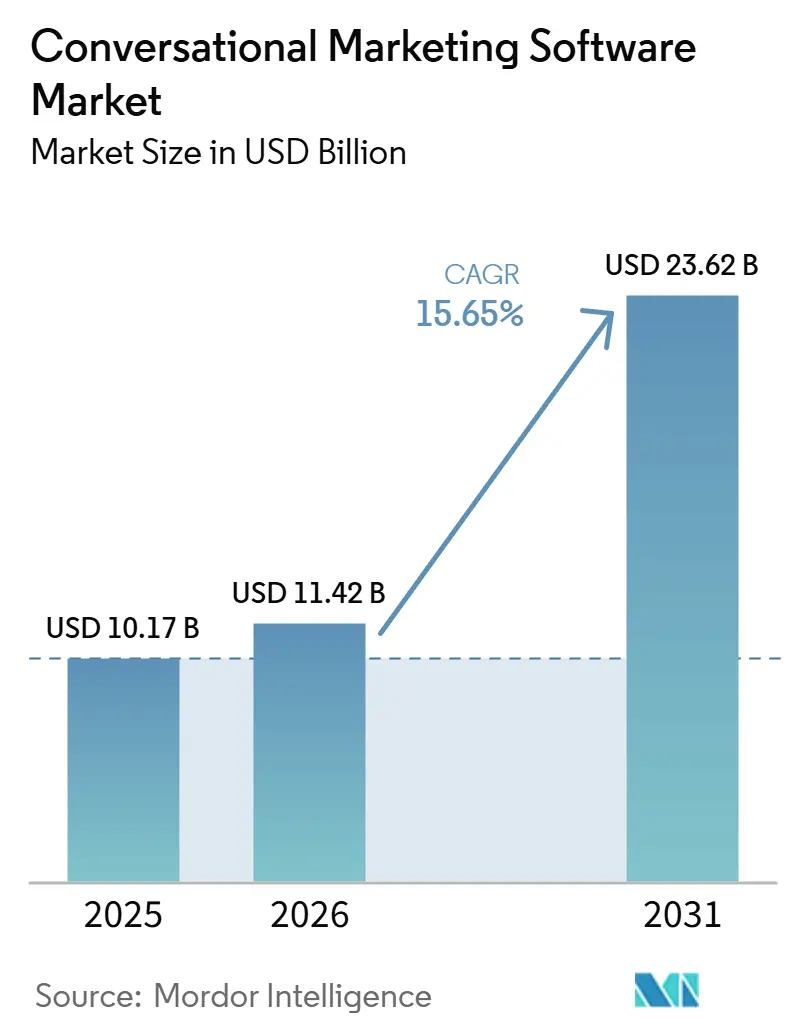
| Market Size (2026) | USD 11.42 Billion |
| Market Size (2031) | USD 23.62 Billion |
| Growth Rate (2026 - 2031) | 15.65 % |
| Fastest Growing Market | Asia-Pacific |
| Largest Market | North America |
| Market Concentration | Low |
Major Players *Disclaimer: Major Players sorted in no particular order Image © Mordor Intelligence. Reuse requires attribution under CC BY 4.0. | |
Conversational Marketing Software Market Analysis by Mordor Intelligence
The Conversational Marketing Software Market size was valued at USD 10.17 billion in 2025 and estimated to grow from USD 11.76 billion in 2026 to reach USD 23.62 billion by 2031, at a CAGR of 15.65% during the forecast period (2026-2031). Buyers increasingly expect software to recognize intent during a live interaction and tailor the next response without waiting for a campaign cycle. This is shifting vendor priorities toward tools that connect conversation data with customer records, sales workflows, and messaging channels. Larger buyers are consolidating platforms around established customer relationship management systems, while smaller businesses are gaining access through no-code products and lower inference costs. Privacy requirements, consent controls, and system integration needs are raising the cost and time required to deploy the technology in regulated settings. These conditions favor providers that can combine automation, governance, and practical integration support without making customer teams rebuild their existing systems.
Key Report Takeaways
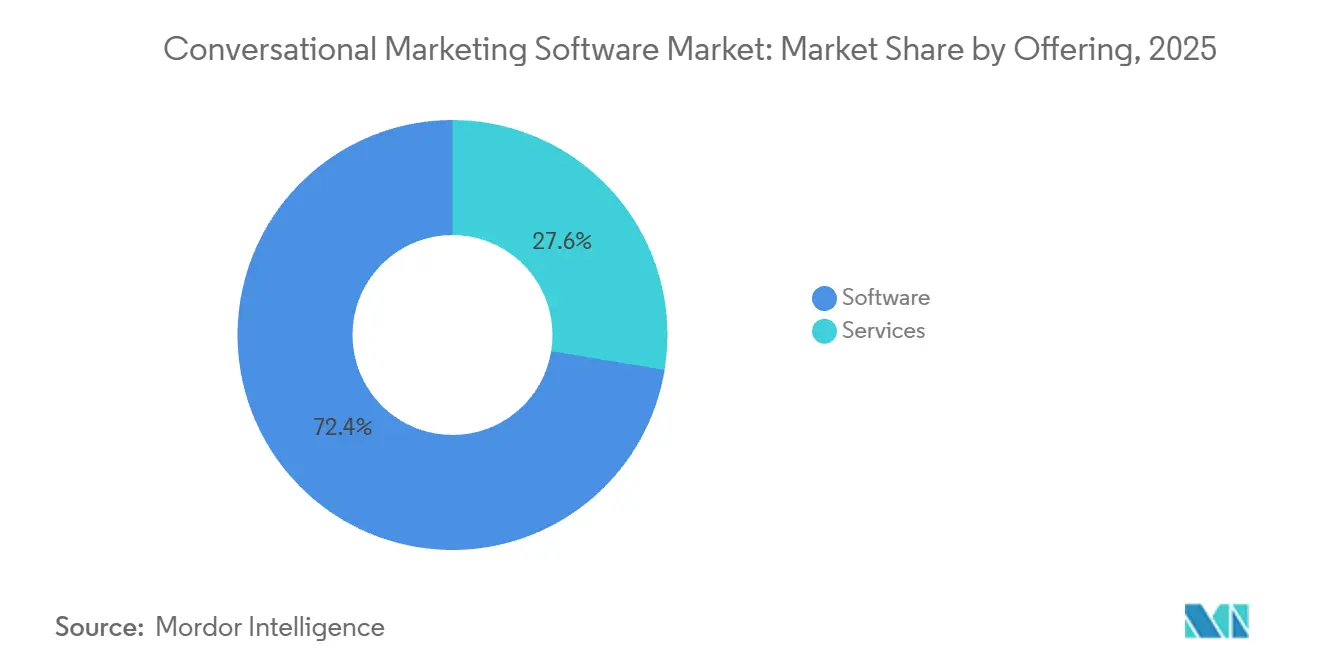
- By offering, software held a 72.41% share in the Conversational Marketing Software Market in 2025, while services is projected to expand at a 16.82% CAGR through 2031.
- By deployment model, cloud held a 68.19% share in the Conversational Marketing Software Market in 2025, while hybrid deployment is projected to expand at a 16.34% CAGR through 2031.
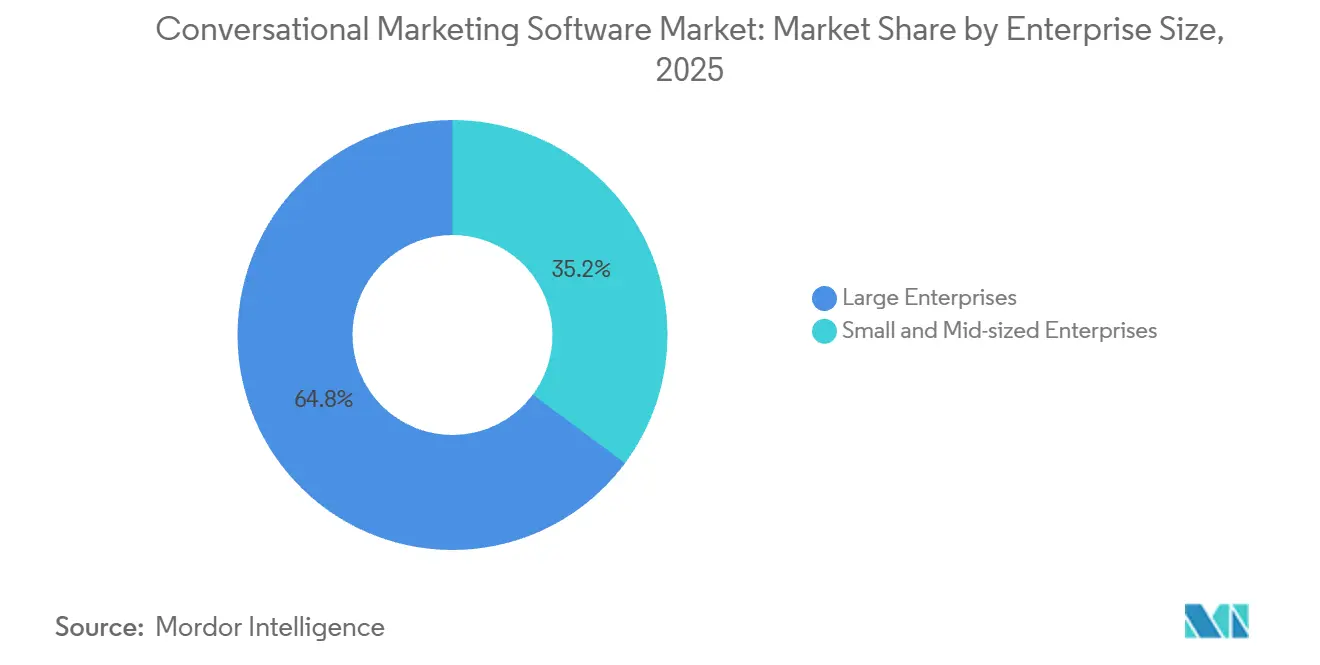
- By enterprise size, large enterprises held 64.83% share in 2025, while small and mid-sized enterprises are projected to expand at a 16.71% CAGR through 2031.
- By end user, retail and e-commerce held 24.36% share in Conversational Marketing Software Market 2025, while healthcare and life sciences is projected to expand at a 16.48% CAGR through 2031.
- By geography, North America held 37.63% share in 2025, while Asia-Pacific is projected to expand at a 16.85% CAGR through 2031.
Note: Market size and forecast figures in this report are generated using Mordor Intelligence’s proprietary estimation framework, updated with the latest available data and insights as of January 2026.
Global Conversational Marketing Software Market Trends and Insights
Drivers Impact Analysis*
| Driver | (~) % Impact on CAGR Forecast | Geographic Relevance | Impact Timeline |
|---|---|---|---|
| Real-Time Personalized Customer Engagement | +3.2% | Global, concentrated in North America and Europe | Short term (≤ 2 years) |
| AI-Powered Lead Qualification and Conversion | +2.8% | North America and Europe, expanding to Asia-Pacific | Short term (≤ 2 years) |
| Omnichannel Messaging Adoption | +2.2% | Asia-Pacific core, expanding to South America and Middle East and Africa | Medium term (2-4 years) |
| Generative AI and Multilingual Conversation Expansion | +1.9% | Asia-Pacific and Middle East, with uptake in Europe | Medium term (2-4 years) |
| API-Based Revenue Operations Integration | +1.5% | North America and Europe | Medium term (2-4 years) |
| Lower Inference Costs Enabling Mid-Market Adoption | +1.1% | Global, with acceleration in South America and Asia-Pacific | Long term (≥ 4 years) |
| Source: Mordor Intelligence | |||
Real-Time Personalized Customer Engagement
Generic outreach is becoming less effective when buyers can move between product pages, messages, and sales conversations within minutes. The Conversational Marketing Software Market benefits when a platform identifies the purpose of a live visit and changes the conversation accordingly. Customer teams can use these interactions to offer relevant product information, route a request, or suggest a next step before a prospect leaves the channel. This makes the value of conversational tools less dependent on scheduled campaigns and more dependent on daily customer activity. Providers that work with live session data can become more closely embedded in revenue and service processes. Their role also expands when customers use the same platform for acquisition, support, and retention work.
AI-Powered Lead Qualification and Conversion
Automated qualification gives sales teams a way to respond to inbound interest without expanding their sales development staff at the same pace. Conversational software can collect basic requirements, identify buyer intent, schedule meetings, and direct a lead to the appropriate team. This can reduce delays during high-volume periods, especially when interest arrives outside standard business hours. Fin reported that its customer agent handled more than 2 million customer resolutions each week, showing the scale at which specialized agents can operate in customer-facing workflows. The commercial value depends on whether providers can connect conversations to a qualified pipeline and completed sales activity. Vendors that show this connection can compete on business outcomes rather than only on reduced manual work.[1]Intercom, “Introducing the Fin API Platform,” Intercom Blog, intercom.com
Omnichannel Messaging Adoption
The growth of WhatsApp, Instagram Direct, SMS, RCS, and web chat is expanding the number of places where buyers expect an immediate response. The Conversational Marketing Software Market, therefore, depends on tools that can preserve context as a customer moves across channels. Meta reported that more than 220 million businesses globally used WhatsApp Business products, underscoring the importance of business messaging as a customer engagement channel. Channel coverage is especially important for smaller companies that cannot maintain separate teams for each messaging service. Platforms with prebuilt business messaging connections can lower implementation work and make customer histories more useful. In India and other fast-growing markets, these benefits are tied to the need to store and manage customer information in ways that meet local requirements.[2]Meta Platforms, Inc., “Investor Events and Presentations,” Meta Investor Relations, investor.atmeta.com
Generative AI and Multilingual Conversation Expansion
Generative AI can support conversations across multiple languages without requiring a separate rule-based script for every language and scenario. This is important in Asia-Pacific, where customer interactions often span Mandarin, Hindi, Bahasa Indonesia, Japanese, and other languages. A platform that handles regional language differences can serve more customers from a single operating model. The Conversational Marketing Software Market also benefits when a conversation remains useful even if a customer changes languages within the same session. European requirements for transparency, documentation, data governance, and human oversight make multilingual functions more valuable when they are supported by controls. Regulation (EU) 2024/1689 established the EU AI Act framework, which makes governance features an important part of vendor selection for certain uses.[3]European Parliament and Council of the European Union, “Regulation (EU) 2024/1689,” EUR-Lex, eur-lex.europa.eu
Restraints Impact Analysis*
| Restraint | (~) % Impact on CAGR Forecast | Geographic Relevance | Impact Timeline |
|---|---|---|---|
| Data Privacy and Consent Management Complexity | -2.4% | Europe and North America, expanding to Asia-Pacific | Short term (≤ 2 years) |
| Legacy-System Integration and Data-Silo Friction | -2.0% | Global, concentrated in North America and Europe | Medium term (2-4 years) |
| Hallucination, Brand-Safety, and Misrouting Risk | -1.5% | Global | Medium term (2-4 years) |
| Escalating LLM Inference and Human-Handoff Costs | -1.1% | North America and Europe | Long term (≥ 4 years) |
| Source: Mordor Intelligence | |||
Data Privacy and Consent Management Complexity
Personalized conversations require access to customer histories, behavioral signals, and session information, which creates a direct need for clear consent and data controls. Organizations must explain how they use information, restrict collection to appropriate purposes, and support customers' rights over their data. These duties become harder when platforms retain conversation histories or use them to improve automated responses. The European Data Protection Board stated that organizations need a careful assessment of data protection issues when developing and using AI models. GDPR penalties can reach EUR 20 million (USD 22.6 million) or 4% of global annual revenue, whichever is higher. This risk can lengthen procurement reviews and favor providers that can show detailed governance processes.[4]European Data Protection Board, “Opinion 28/2024 on Certain Data Protection Aspects Related to the Processing of Personal Data in the Context of AI Models,” European Data Protection Board, edpb.europa.eu
Legacy-System Integration and Data-Silo Friction
Conversational tools need timely access to customer relationship management histories, inventory records, product data, and service information to provide useful answers. Many organizations still operate systems that exchange information in batches or use interfaces that were not designed for real-time requests. The resulting gaps can cause an agent to provide incomplete information or require a handoff to an employee. The Conversational Marketing Software Market experiences slower deployments when customers must build custom integrations before a platform can deliver full value. Established vendors have an advantage when they provide tested integrations with the systems buyers already use. The constraint also creates demand for implementation services, even though it increases the time and cost of initial adoption.
*Our forecasts treat driver/restraint impacts as directional, not additive. The impact forecasts reflect baseline growth, mix effects, and variable interactions.
Segment Analysis
By Offering: Software Holds the Largest Position While Services Expands Faster
Software accounted for 72.41% of the conversational marketing software market share in 2025. Buyers favor recurring software subscriptions because they can extend automation without matching increases in staff. The software layer supports agent creation, conversation management, channel connections, and customer-interaction review. Fin launched its API Platform in July 2026, giving developers and enterprises access to its conversational AI capabilities through an API.
Services are projected to expand at a 16.82% CAGR through 2031, faster than the Conversational Marketing Software Market. The segment covers implementation, configuration, model evaluation, prompt work, and human-handoff design. It remains important because a software purchase alone does not adequately prepare employees, clarify ownership of operations, or redesign customer processes. ISO/IEC 42001:2023 provides an AI management system framework for organizations seeking structured governance.


By Deployment Model: Cloud Remains the Core Model While Hybrid Meets Governance Needs
Cloud deployment held 68.19% share in 2025. It supports scalable computing, faster updates, and a common administrative environment for changing customer demand. LivePerson’s Google Cloud Marketplace availability in 2025 showed how marketplace distribution can simplify procurement for existing cloud users. Cloud remains the practical default where customer security and data residency policies permit it.
Hybrid deployment is projected to expand at a 16.34% CAGR through 2031. It allows regulated organizations to retain selected data, controls, or systems while using cloud capacity for other functions. This approach is relevant to financial services, health care, government, and customers with operations across different jurisdictions. On-premises deployment remains necessary for some defense, critical infrastructure, and air-gapped environments, but it has higher ownership costs and slower refresh cycles.
By Enterprise Size: Large Enterprises Provide Revenue Depth While SMEs Add Growth
Large enterprises held 64.83% share of the Conversational Marketing Software Market in 2025. They can support multi-year contracts, complex integrations, tailored configurations, and formal controls for access, escalation, and performance review. Their scale makes it easier to justify automation that reduces repetitive service and lead-qualification work. These requirements favor providers with mature integration frameworks and administrative capabilities.
Small and mid-sized enterprises are projected to expand at a 16.71% CAGR through 2031. No-code tools and lower inference costs allow smaller teams to manage lead capture, common questions, and follow-up without extensive development resources. Botpress introduced a USD 150/month Plus plan in May 2026 and launched Desk, an AI helpdesk product. The segment creates volume growth, although lower entry pricing and broad product choice can pressure average selling prices.
By End Users: Retail and E-commerce Leads While Health Care and Life Sciences Grows Fastest
Retail and e-commerce accounted for 24.36% share in 2025. Retailers use conversational tools for product discovery, delivery, returns, cart recovery, and post-purchase support. Zoovu acquired XGEN AI in May 2026 to combine search, recommendations, personalization, guided selling, configuration, and conversational AI in an ecommerce product discovery engine. Accuracy remains critical because incorrect product availability, pricing, or policy information can weaken customer trust.
The health care and life sciences industry are projected to expand at a 16.48% CAGR through 2031. Workforce shortages and demand for digital access support for use cases such as appointment scheduling, patient outreach, and administrative routing. Sensitive information requires strong controls for data use, record access, escalation, and the limits of automated responses. BFSI, information technology and telecommunications, automotive and transportation, travel and hospitality, energy and utilities, and industrial manufacturing each use the technology for distinct customer, supplier, or scheduling workflows.
Geography Analysis
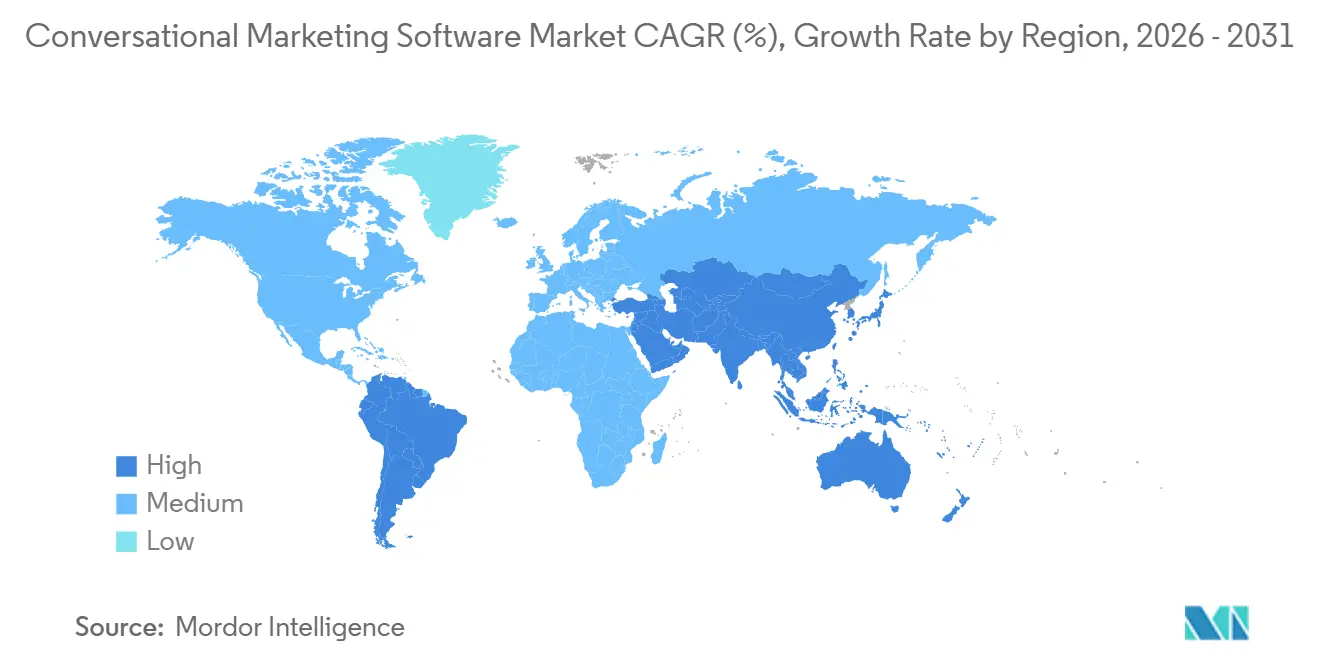
North America held 37.63% of the conversational marketing software market share in 2025. The region benefits from a dense base of business-to-business software vendors and an established customer relationship management infrastructure. Existing Salesforce, HubSpot, and Marketo environments can reduce integration work. Salesforce signed a definitive agreement in June 2026 to acquire Fin, indicating the growing role of conversational agents within customer relationship management platforms. The United States remains the main source of regional demand, while Canada is developing as privacy standards encourage local cloud capabilities.
Asia-Pacific is projected to expand at a 16.85% CAGR through 2031. WhatsApp, Line, WeChat, KakaoTalk, and Zalo create a fragmented messaging environment, underscoring the value of coordinated customer interactions. Mobile-first behavior and e-commerce expansion support conversational commerce across the region. India adds demand through its large digital customer base and evolving customer data management requirements. China, Japan, and South Korea remain important investment centers, while Indonesia, Vietnam, Thailand, the Philippines, and Malaysia offer further messaging-led growth opportunities.
Europe is a significant revenue base, led by Germany, the United Kingdom, and France. GDPR and the EU AI Act increase scrutiny of transparency, data minimization, and human oversight. The Conversational Marketing Software Market must meet these expectations to compete for regulated European accounts. The European Data Protection Board has highlighted data protection issues related to AI models, including the need for appropriate safeguards. South America offers emerging potential through Brazil and Argentina, while Saudi Arabia, the United Arab Emirates, Nigeria, and South Africa support earlier-stage demand in Middle East and Africa.

Competitive Landscape
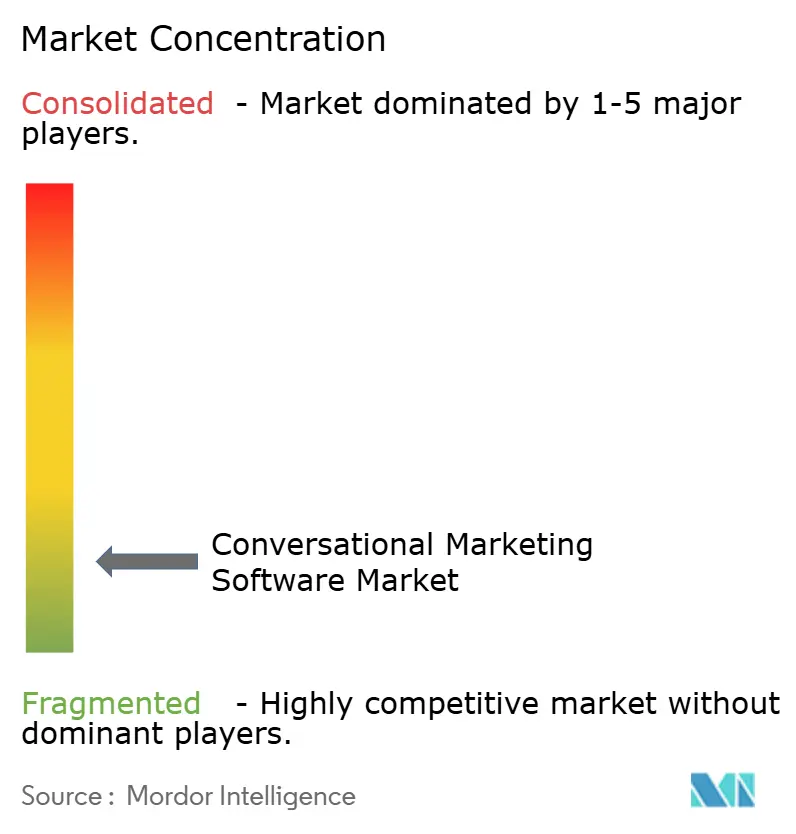
The Conversational Marketing Software Market is fragmented, with no provider holding a controlling share. The field includes enterprise platforms such as Fin, LivePerson, and Qualified, messaging automation providers such as Manychat, Tidio, Chatfuel, and Botpress, and specialists such as Conversica and Zoovu. Competitors differentiate through their target customer, channel coverage, industry focus, and depth of integration. Salesforce’s planned acquisition of Fin demonstrates the platform-consolidation approach. It would place a conversational AI product more directly within a broad customer relationship management ecosystem.
Vertical specialization is another central strategy. Zoovu’s acquisition of XGEN AI combined product discovery, search, recommendations, personalization, guided selling, and conversational functions for enterprise commerce users. This approach can support higher relevance for customers with complex product data and buying journeys. Mid-market health care, energy and utilities, and government remain areas where purpose-built offerings may address less mature adoption. Providers are also developing systems that route requests to different models or workflows to improve reliability and manage costs.
Quality assurance is becoming a more visible basis for competition. LivePerson highlighted its Conversation Simulator environment for testing agents with synthetic customer behavior after being named a Leader in the Aragon Research Globe for Agent Platforms 2026. Testing, escalation, governance, and integration capability can help vendors meet enterprise review requirements. No-code providers compete by reducing the effort required for smaller teams to adopt basic automation. Partnerships, acquisitions, marketplace distribution, and industry-specific design will continue to shape vendor positions. Market concentration score: 1, because the market remains highly fragmented and no leading provider holds a controlling share.
Conversational Marketing Software Industry Leaders
Intercom
Manychat, Inc.
LivePerson, Inc.
iAdvize
Qualified.com, Inc.
- *Disclaimer: Major Players sorted in no particular order

Recent Industry Developments
- July 2026: Fin (formerly Intercom) launched the Fin API Platform, offering third-party developers and enterprise builders access to its proprietary Apex CX model and core conversational AI capabilities via API, with contracts starting at USD 250K per year. The launch positions Fin as both a direct SaaS vendor and an AI infrastructure layer for enterprises building proprietary agent applications, significantly expanding its total addressable market.
- June 2026: Salesforce signed a definitive agreement to acquire Fin (formerly Intercom), integrating a conversational AI agent platform with approximately USD 400M ARR into the Salesforce ecosystem. If completed, this would rank among the most consequential consolidations in the conversational marketing software sector, accelerating the shift toward CRM-native conversational AI.
- June 2026: Fin launched the proprietary Fin Apex vertical model for customer service AI, claiming performance that exceeds GPT-5.4 and Opus 4.5 on CX-specific benchmarks. This is the first purpose-built vertical model from a conversational marketing software vendor at commercial scale, establishing a new technical differentiation benchmark for the category.
- May 2026: Zoovu acquired XGEN AI, a leader in ecommerce search, merchandising, and recommendations, to create a unified AI-native product discovery engine covering search, recommendations, personalization, guided selling, configuration, and conversational AI for enterprise retailers and manufacturers. Financial terms were not disclosed.


Global Conversational Marketing Software Market Report Scope
The conversational marketing software market refers to the ecosystem of software solutions and services designed to facilitate real-time, one-to-one interactions between businesses and their customers through automated, dialogue-driven channels. This includes AI-powered chatbots, live chat applications, voice assistants, and messaging platform integrations that engage prospects and customers directly within their buying journey. Deployed across cloud, hybrid, and on-premises models, these solutions cater to organizations of all sizes across diverse industries such as retail, BFSI, IT, and travel. By shifting away from traditional, passive marketing funnels to dynamic, two-way conversations, conversational marketing software enables businesses to instantly qualify leads, provide personalized product recommendations, route complex queries to human agents, and deliver 24/7 customer support, ultimately accelerating sales cycles, improving customer satisfaction, and driving higher conversion rates.
The Conversational Marketing Software Market Report is Segmented by Offering, (Software, and Services), Deployment Model, (Cloud, Hybrid, and On-Premises), Enterprise Size, (Large Enterprises, and Small and Mid-sized Enterprises), End Users, (IT and Telecommunication, BFSI, Automotive and Transportation, Healthcare and Life Sciences, Energy and Utilities, Industrial Manufacturing, Retail and E-commerce, Travel and Hospitality, and Other End Users), and Geography, (North America, South America, Europe, Asia-Pacific, and Middle East and Africa). The Market Forecasts are Provided in Terms of Value (USD).
| Software |
| Services |
| Cloud |
| Hybrid |
| On-Premises |
| Large Enterprises |
| Small and Mid-sized Enterprises |
| IT and Telecommunication |
| BFSI |
| Automotive and Transportation |
| Healthcare and Life Sciences |
| Energy and Utilities |
| Industrial Manufacturing |
| Retail and E-commerce |
| Travel and Hospitality |
| Other End Users |
| North America | United States | |
| Canada | ||
| Mexico | ||
| South America | Brazil | |
| Argentina | ||
| Rest of South America | ||
| Europe | Germany | |
| United Kingdom | ||
| France | ||
| Russia | ||
| Spain | ||
| Rest of Europe | ||
| Asia-Pacific | China | |
| Japan | ||
| India | ||
| South Korea | ||
| Southeast Asia | ||
| Rest of Asia-Pacific | ||
| Middle East and Africa | Middle East | Saudi Arabia |
| United Arab Emirates | ||
| Rest of Middle East | ||
| Africa | South Africa | |
| Nigeria | ||
| Rest of Africa | ||
| By Offering | Software | ||
| Services | |||
| By Deployment Model | Cloud | ||
| Hybrid | |||
| On-Premises | |||
| By Enterprise Size | Large Enterprises | ||
| Small and Mid-sized Enterprises | |||
| By End Users | IT and Telecommunication | ||
| BFSI | |||
| Automotive and Transportation | |||
| Healthcare and Life Sciences | |||
| Energy and Utilities | |||
| Industrial Manufacturing | |||
| Retail and E-commerce | |||
| Travel and Hospitality | |||
| Other End Users | |||
| By Geography | North America | United States | |
| Canada | |||
| Mexico | |||
| South America | Brazil | ||
| Argentina | |||
| Rest of South America | |||
| Europe | Germany | ||
| United Kingdom | |||
| France | |||
| Russia | |||
| Spain | |||
| Rest of Europe | |||
| Asia-Pacific | China | ||
| Japan | |||
| India | |||
| South Korea | |||
| Southeast Asia | |||
| Rest of Asia-Pacific | |||
| Middle East and Africa | Middle East | Saudi Arabia | |
| United Arab Emirates | |||
| Rest of Middle East | |||
| Africa | South Africa | ||
| Nigeria | |||
| Rest of Africa | |||


Key Questions Answered in the Report
What is the size of the Conversational Marketing Software Market?
The Conversational Marketing Software Market is estimated at USD 11.76 billion in 2026 and is projected to reach USD 23.62 billion by 2031 at a 15.65% CAGR. The forecast reflects broader use of personalized engagement, automated qualification, and connected customer conversations.
What is driving demand for conversational marketing software?
Real-time personalization, automated lead qualification, and broader business messaging use are increasing adoption across customer-facing teams. Buyers also seek tools that maintain context while customers move between web, mobile, and messaging channels. The strongest fit is usually a platform that connects customer history, current intent, and a defined route to a sales or service employee when automation cannot resolve the request.
Which deployment model is used most widely?
Cloud held 68.19% share in 2025 because it supports scalable processing and faster product updates. It remains the practical choice where security and data residency policies allow customer information to be managed in a cloud environment.
Which customer group is growing fastest?
Small and mid-sized enterprises are projected to expand at a 16.71% CAGR through 2031 as no-code tools and lower inference costs improve access. These buyers can adopt common lead capture, follow-up, and customer response functions without extensive technical teams.
Which end user has the largest share?
Retail and e-commerce held 24.36% share in 2025, supported by use cases in product discovery, customer engagement, and post-purchase support. Providers increasingly link these conversations with search, recommendations, and guided selling functions.
Which region is expanding fastest?
Asia-Pacific is projected to grow at a 16.85% CAGR through 2031, supported by mobile-first commerce and a diverse business messaging environment. Language diversity and fragmented messaging services make coordinated customer engagement especially useful in the region.
Page last updated on:


 Your data is secure and never sold or shared.


