
Content Distribution Market Size and Share
Market Overview
| Study Period | 2020 - 2031 |
|---|---|
| Market Size (2026) | USD 122.38 Billion |
| Market Size (2031) | USD 169.41 Billion |
| Growth Rate (2026 - 2031) | 6.72 % |
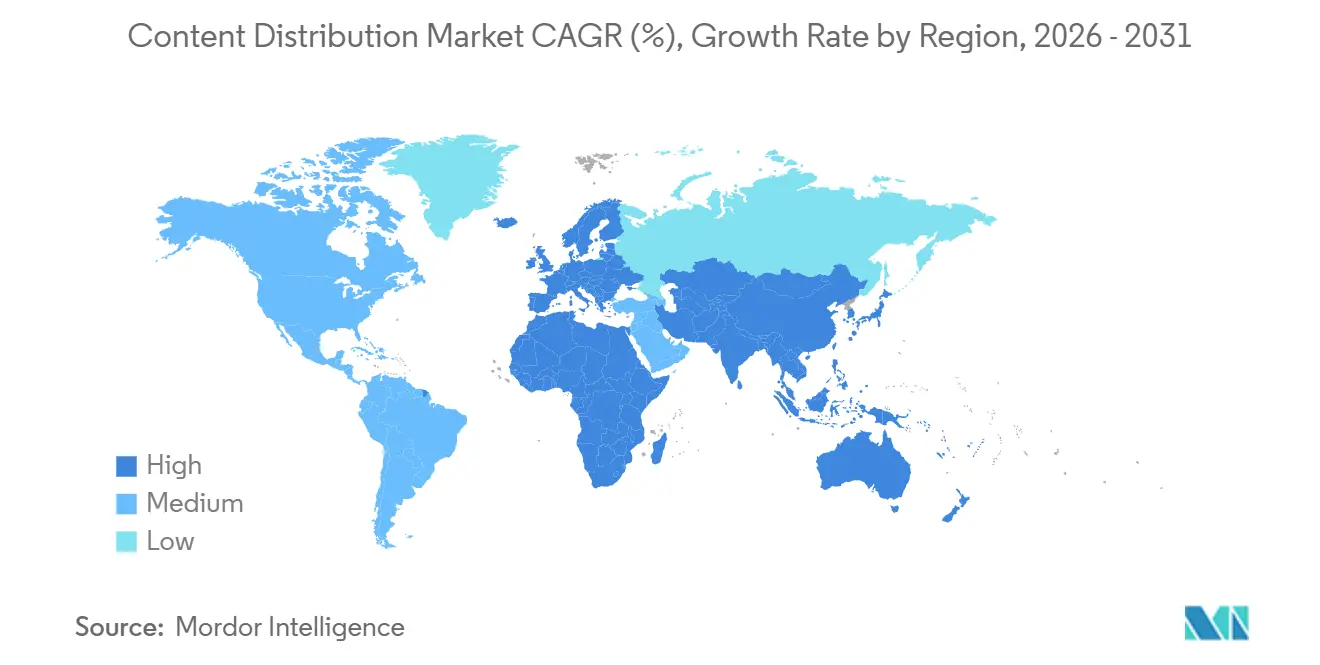
| Fastest Growing Market | Asia-Pacific |
| Largest Market | North America |
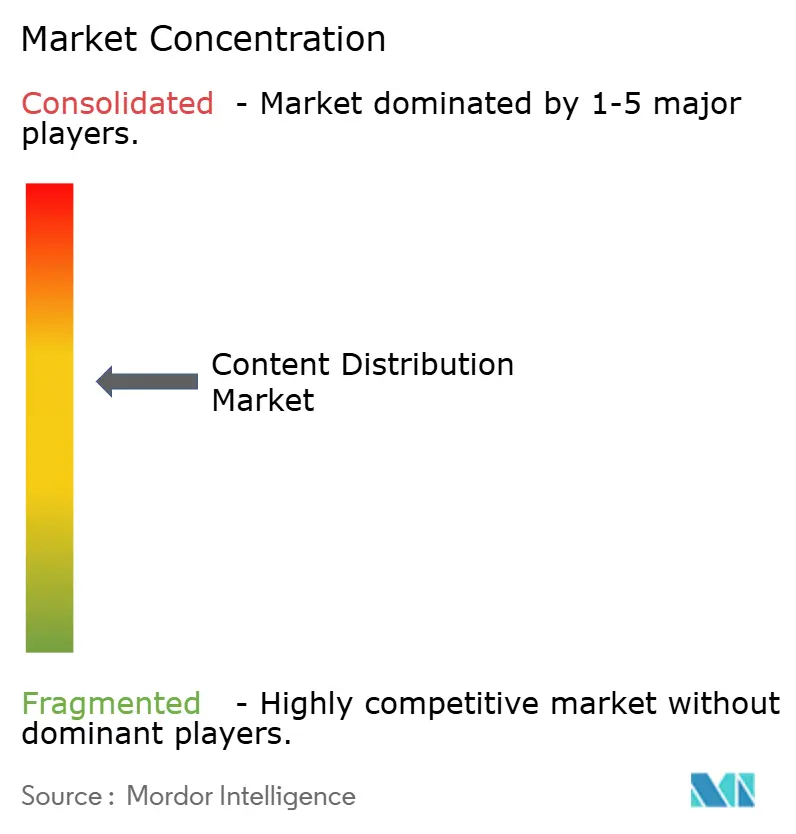
| Market Concentration | Medium |
Major Players *Disclaimer: Major Players sorted in no particular order Image © Mordor Intelligence. Reuse requires attribution under CC BY 4.0. | |
Content Distribution Market Analysis by Mordor Intelligence
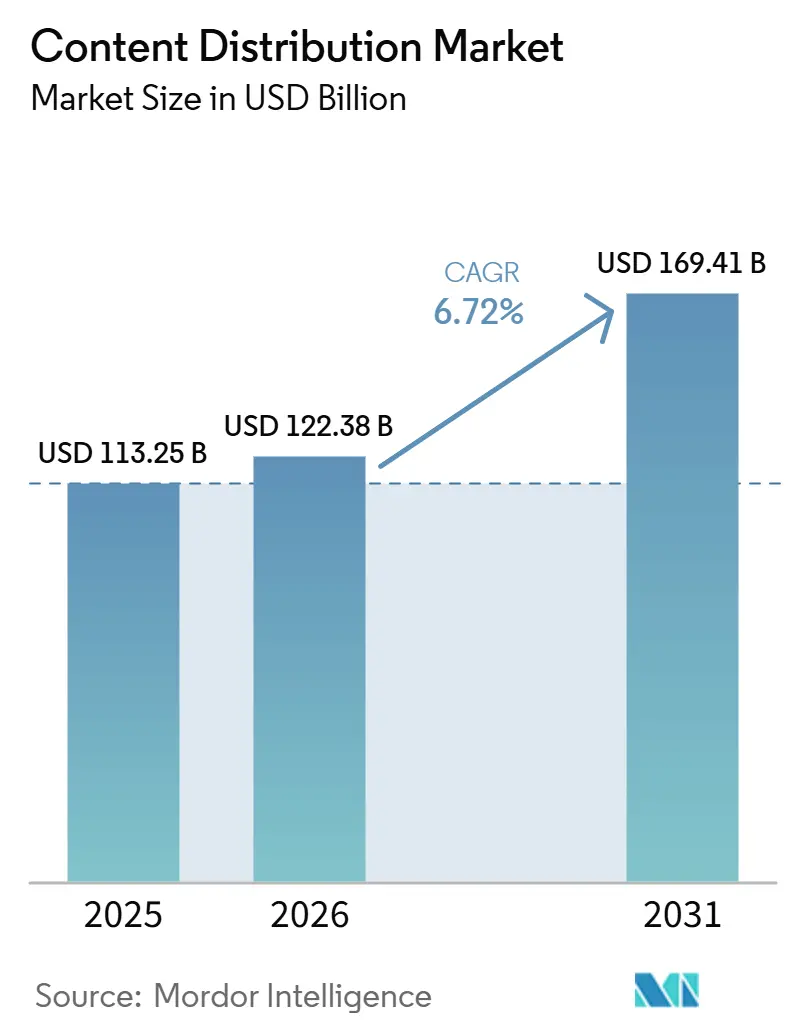
The content distribution market size is projected to be USD 113.25 billion in 2025, USD 122.38 billion in 2026, and reach USD 169.41 billion by 2031, growing at a CAGR of 6.72% from 2026 to 2031. The market is expanding as ad-supported streaming, subscription video, and connected TV continue to shift value away from the older broadcast chain and toward platforms that can monetize audiences across more than one screen. Rights packaging is also changing, with studios and distributors placing more value on global windows, catalog reuse, and licensing structures that extend revenue beyond a single release cycle. Cloud-native delivery, AI-assisted localization, and better metadata control are improving speed, reducing manual workflow friction, and widening the number of territories that can be served profitably. Competitive pressure is rising because large players are using acquisitions and major licensing agreements to combine premium content, distribution reach, and audience data under tighter control. At the same time, subscriber fatigue, piracy, territorial rights complexity, and higher content delivery costs are pushing the content distribution market toward greater scale and deeper integration.
Key Report Takeaways
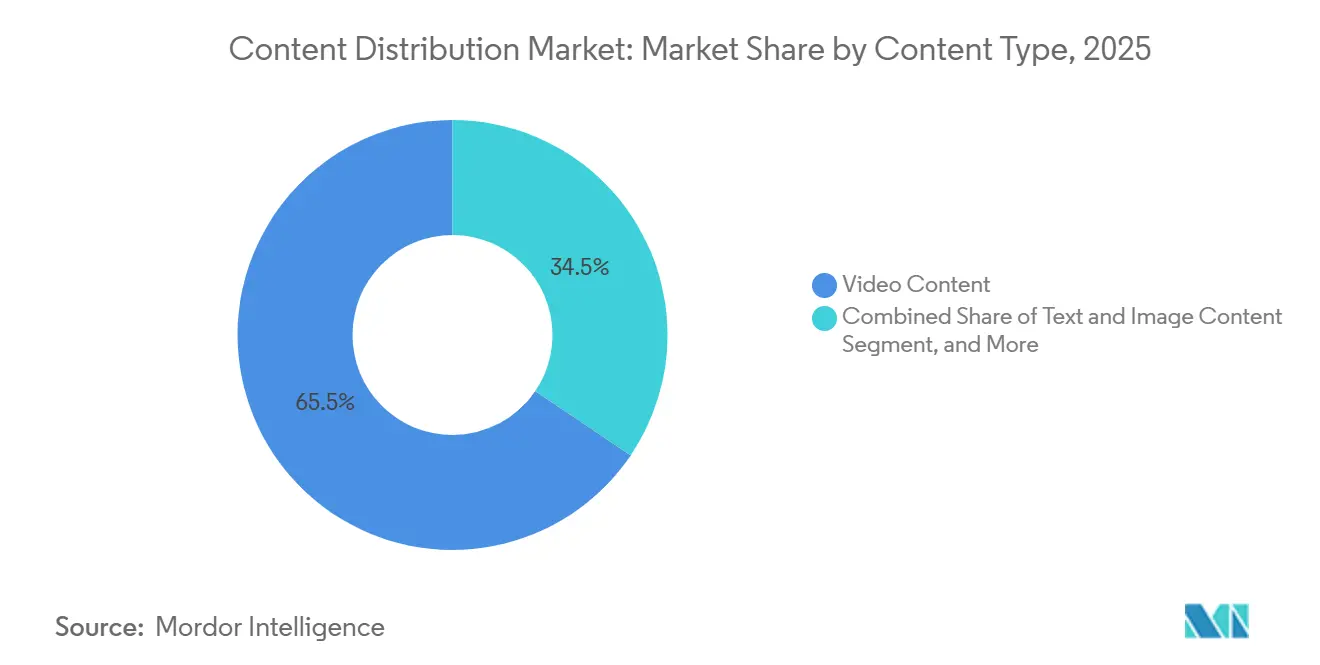
- By content type, video content accounted for 65.54% of the content distribution market share in 2025 and is projected to expand at a 7.78% CAGR through 2031.
- By distribution channel, broadcaster and cable networks accounted for 34.68% of revenue in 2025, while streaming platforms are projected to expand at a 7.46% CAGR through 2031.
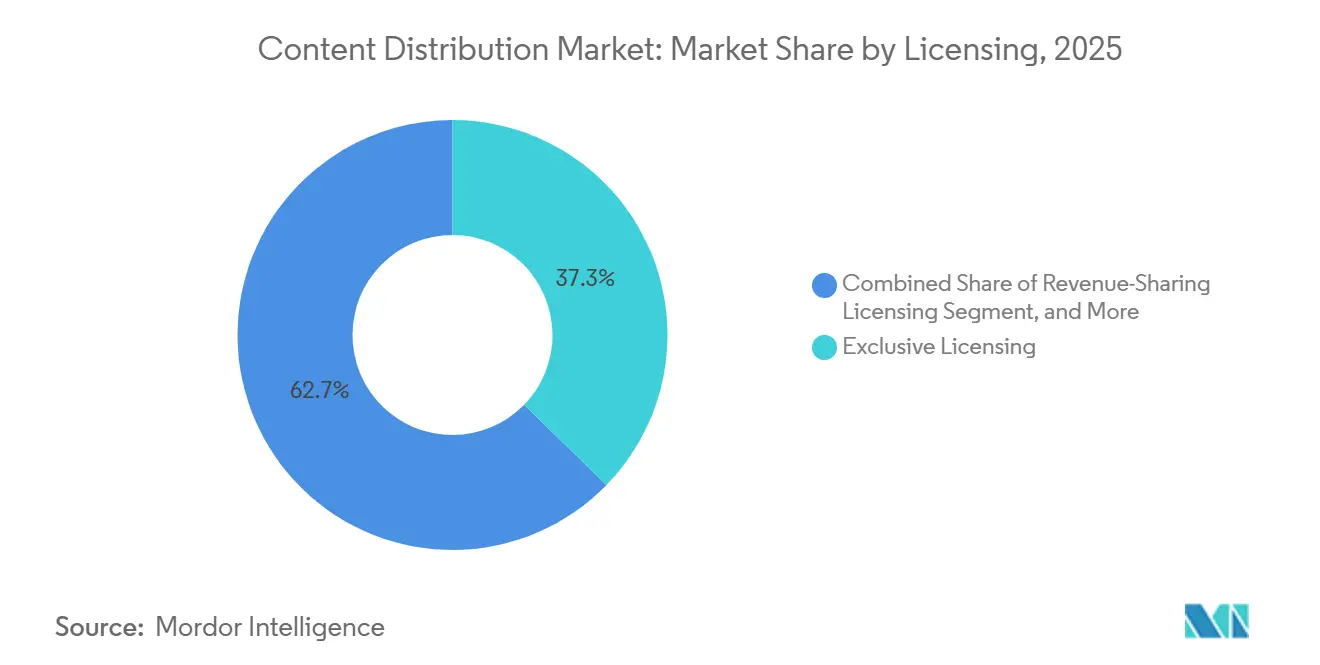
- By licensing type, exclusive licensing accounted for 37.28% of revenue in 2025, while revenue-sharing licensing is projected to expand at a 7.63% CAGR through 2031.
- By geography, North America held 38.61% of the content distribution market share in 2025, while Asia-Pacific is projected to grow at a 8.12% CAGR through 2031.
Note: Market size and forecast figures in this report are generated using Mordor Intelligence’s proprietary estimation framework, updated with the latest available data and insights as of January 2026.
Market Trends and Insights
Drivers Impact Analysis of Content Distribution Market*
| Driver | (~) % Impact on CAGR Forecast | Geographic Relevance | Impact Timeline |
|---|---|---|---|
| Rising OTT and CTV Content Monetization | +2.0% | Global, the highest concentration in North America and the Asia-Pacific | Short term (≤ 2 years) |
| Accelerating Multi-Platform Rights Packaging | +1.4% | Global, with core gains in North America, Europe, and Asia-Pacific | Medium term (2-4 years) |
| Cloud-Native Distribution Workflow Adoption | +1.1% | North America and Europe core, and spill over to the Asia-Pacific and the Middle East | Medium term (2-4 years) |
| AI-Assisted Localization and Versioning | +0.9% | Global, with early adoption in North America and APAC core markets | Medium term (2-4 years) |
| First-Party Audience Data Demand From Advertisers | +0.7% | North America and Europe primarily, expanding to the Asia-Pacific | Short term (≤ 2 years) |
| Live and Near-Live Content Expansion | +0.5% | Global, with peaks in North America, Europe, and South Asia | Short term (≤ 2 years) |
| Source: Mordor Intelligence | |||
Rising OTT and CTV Content Monetization
Ad-supported streaming and connected TV are changing investment priorities in the content distribution market because distributors now evaluate content by audience yield as much as by headline reach. The April 2026 partnership between The CW Network and Roku clearly showed this shift, as next-day streaming access to CW entertainment programming will extend the network's reach to more than half of U.S. broadband households through The Roku Channel. Amagi reported in 2026 that FAST viewing rose 21%, which supports stronger monetization for catalog video and scheduled streaming environments that can carry repeatable ad inventory.[1]Amagi Media Labs, “Amagi Delivers 30% Revenue Growth in FY26, Adjusted EBITDA Rises 6x to INR 156 Cr and PAT Turns Positive at INR 72 Cr,” Amagi Newsroom, amagi.com This shift is increasing the value of premium live content, library assets, and broad catalog access, as the same title can now earn across subscription, AVOD, and FAST windows. The content distribution market is, therefore, rewarding operators that can connect inventory scale, platform reach, and audience data into a single commercial stack.
Accelerating Multi-Platform Rights Packaging
Rights packaging across film, television, and digital outlets is shortening the older sequential windowing model in the content distribution market. Netflix's January 2026 global Pay-1 agreement with Sony Pictures Entertainment demonstrated how distributors with worldwide reach can secure premium, multi-year access to theatrical titles and expand control over release timing across markets. As rights move across streaming, broadcast, and ad-supported channels simultaneously, distributors face greater overlap in territorial, format, and timing conditions. Vubiquity's September 2025 Catalog Intelligence update addressed this need by linking rights data, asset availability, and title metadata in a single interface, enabling studios and content owners to validate distribution readiness more quickly. The content distribution market benefits from this shift because operators that clear rights more quickly can expand commercial windows and monetize catalog assets more efficiently.
Cloud-Native Distribution Workflow Adoption
Cloud-native delivery is becoming a competitive requirement in the content distribution market, as broadcasters and streamers increasingly seek a single workflow for live, linear, and on-demand distribution. Reuters and AWS demonstrated this convergence in 2025 with their cloud-native TAMS pipeline, which moved live and near-live video through the broadcast chain in seconds and won the Broadcast Tech Innovation Award for best innovative use of cloud. Harmonic announced in April 2026 that DIRECTV was transforming its U.S. direct-to-home video platform with Harmonic's VOS Media Software, demonstrating how cloud-native playout-to-delivery models are reducing operating costs while maintaining scale. These changes matter because they reduce duplicated storage, shrink manual handoffs, and improve the speed of versioning across channels and territories. The content distribution market is likely to keep favoring vendors that can support broadcast-grade reliability in flexible cloud environments.
AI-Assisted Localization and Versioning
AI-assisted localization is expanding the addressable reach of the content distribution market by enabling more language versions to be produced at a lower unit cost and faster. Lionbridge's June 2025 launch of the Content Remix App demonstrated how media companies can generate original multilingual content across more than 70 languages and several distribution channels in a single workflow. This matters most in smaller language markets, where manual dubbing and subtitling pipelines have often limited the commercial release of otherwise viable titles. Amagi's FY2026 results reported 30% revenue growth and EBITDA rising 6x to INR 156 crore (USD 18.6 million), which reflected the scaling of AI-enabled FAST and cloud-based channel operations across more than 300 distributors in over 40 countries. The content distribution market is gaining from this shift because better localization supports broader release footprints without requiring the same fixed cost base in every territory.
Restraints Impact Analysis of Content Distribution Market*
| Restraint | (~) % Impact on CAGR Forecast | Geographic Relevance | Impact Timeline |
|---|---|---|---|
| Subscription Fatigue and Platform Fragmentation | -1.6% | Global, sharpest in North America and Europe | Short term (≤ 2 years) |
| Rights Clearance Complexity Across Territories | -1.2% | Global, most acute in Europe, Asia-Pacific, and South America | Medium term (2-4 years) |
| Piracy and Unauthorized Redistribution | -0.8% | Global, the highest losses in Asia-Pacific and Europe | Medium term (2-4 years) |
| Rising Content Delivery and Cloud Egress Costs | -0.5% | Global, most impactful for mid-tier distributors in North America and Europe | Long term (≥ 4 years) |
| Source: Mordor Intelligence | |||
Subscription Fatigue and Platform Fragmentation
Subscriber fatigue is reducing pricing power in the content distribution market because households now face a wide set of paid and ad-supported viewing options. Netflix's December 2025 agreement to acquire Warner Bros. Discovery showed how scale, library depth, and premium intellectual property are becoming more important as standalone services work harder to retain viewers over longer periods. The January 2026 Netflix and Sony Pictures Entertainment agreement reflected the same pressure, as exclusive film windows are still being used to improve retention and support stronger platform positioning. Fox's June 2026 agreement to acquire Roku also showed that distributors are increasingly relying on platform reach and audience data, rather than subscription growth alone, to protect monetization. This restraint is likely to keep pushing the content distribution market toward bundles, ad-supported tiers, and broader platform ecosystems rather than narrow, standalone offers.
Rights Clearance Complexity Across Territories
Cross-territory rights clearance continues to slow global release timing in the content distribution market. The Netflix and Sony Pictures Entertainment Pay-1 arrangement will roll out gradually as territory rights open, with full worldwide availability expected by early 2029, underscoring how long multi-market clearance can take, even for a major global package. This complexity raises legal review time, metadata management effort, and contract administration across streaming, broadcast, and FAST channels. Distributors without automated rights systems face higher operating friction and slower launch windows, which weakens their ability to capture audience demand at the most valuable release moment. The content distribution market, therefore, favors larger operators that can manage compliance, rights tracking, and territory sequencing at a global scale.
*Our forecasts treat driver/restraint impacts as directional, not additive. The impact forecasts reflect baseline growth, mix effects, and variable interactions.
Content Distribution Market Segment Analysis
By Content Type:
Video's Scale Masks A Deeper Audio OpportunityVideo held 65.54% of the content distribution market share in 2025, which kept it at the center of monetization, rights negotiation, and premium inventory planning. Video remains the most attractive format for many distributors because live events, premium series, and broad catalog libraries can be monetized across subscription and ad-supported windows with strong reuse value. Amagi said FAST viewing rose 21% in 2026, improving the monetization outlook for catalog video across scheduled streaming environments. This keeps older libraries commercially relevant at a time when original production costs remain high, and platforms need steadier returns from existing assets.
Audio presents a different opportunity in the content distribution market because listening fits commuting, exercise, and other background moments that video does not. Luminate reported that global on-demand audio streams grew 9.8% in the first half of 2026, while ex-U.S. on-demand audio song streams increased 11.8%.[2]Luminate, “The Key Engagement and Consumption Trends That Shaped Music, TV and Film in H1 2026,” Luminate 2026 Midyear Report, luminatedata.com That pace suggests the audio layer of the content distribution industry still has room for broader monetization through music, podcasts, and spoken-word formats. Text-and-image formats also retain durable value in news syndication, sports data, and e-book delivery, where licensing structures are usually more stable than premium video bidding cycles.



By Distribution Channel:
Broadcaster Networks Hold Value as Streaming AcceleratesBroadcaster and cable networks accounted for 34.68% of the content distribution market in 2025, maintaining their leading position across distribution channels. Their position remains durable because live news and sports still benefit from scheduled, simultaneous mass delivery and familiar advertising structures. The content distribution market is still shifting toward streaming, with streaming platforms projected to grow at a 7.46% CAGR from 2026 to 2031. The CW Network's April 2026 partnership with Roku showed how this shift is unfolding, with next-day streaming of CW entertainment programming set to reach more than half of U.S. broadband households through The Roku Channel.
Telecom operators are becoming more relevant in the content distribution market as 5G infrastructure improves video delivery and carriers use subscriber billing relationships to package media access. Social and digital platforms are also reshaping short-form distribution, where discovery increasingly depends on algorithmic visibility rather than traditional channel control. Fox's June 2026 agreement to acquire Roku showed how content owners are pairing distribution platforms with first-party audience data to strengthen connected TV reach and ad monetization. This convergence is raising the value of channels that can link programming, distribution, and monetization in one operating model across the content distribution market.
By Licensing:
Exclusive Models Anchor Revenue While Sharing Gains GroundExclusive licensing held a 37.28% share in 2025, indicating that scarcity still supports subscriber retention in the content distribution market. The January 2026 Netflix and Sony Pictures Entertainment Pay-1 agreement reinforced that premium film rights still command high value when platforms want stronger retention and a deeper release slate. Exclusive structures remain especially important for first-window films, original series, and live sports. This keeps premium rights at the center of negotiations even as distributors widen monetization across paid and ad-supported services.
Revenue-sharing licensing is projected to grow at a 7.63% CAGR from 2026 to 2031, indicating that studios want greater upside participation when titles perform well after release. The content distribution industry is moving in this direction because catalog titles can earn revenue across AVOD, FAST, and international streaming windows. Vubiquity's September 2025 platform update reflected this change by enabling studios to validate rights, asset readiness, and metadata faster across multiple distribution endpoints. Partnership licensing is also gaining traction in FAST distribution, where Amagi said its cloud-native platform delivered more than 9,000 channels across more than 300 distributors in over 40 countries in FY2026.
Geography Analysis
North America Content Distribution Market
North America accounted for 38.61% of the global content distribution market in 2025, making it the region with the largest revenue base. The region remains central because it combines major studio ownership, high streaming penetration, and the deepest connected TV advertising ecosystem. Netflix's December 2025 agreement to acquire Warner Bros. Discovery at an enterprise value of USD 82.7 billion showed how scale, premium IP, and direct distribution are being drawn into fewer hands.[3]Netflix, “Netflix to Acquire Warner Bros.,” Netflix Official Newsroom, about.netflix.com The United States also remains a major testing ground for cloud-native broadcast delivery, as Reuters and AWS demonstrated with their award-winning TAMS-based pipeline in 2025. Canada and Mexico add depth to the regional picture, as language requirements, local content needs, and improvements in broadband continue to support investment across the content distribution market.
APAC Content Distribution Market
Asia-Pacific is projected to grow at an 8.12% CAGR through 2031, making it the fastest-expanding regional segment in the content distribution market. Growth is being supported by India's expansion of direct-to-consumer streaming, China's domestic platform investment, and South Korea's export-led content pipeline. India's Ministry of Information and Broadcasting said a 2025 joint study estimated current-year revenue losses of USD 1.2 billion from video piracy, or 10% of the legal video sector, which showed that demand is rising even where licensed monetization still leaks. The Asia Video Industry Association said content protection is now central to platform economics because piracy weakens the revenue needed to fund local-language programming. South Korea's webtoon and drama exports are also widening the regional rights universe, which supports both exclusive and revenue-sharing structures across the content distribution market.
EMEA and South America Content Distribution Market
Europe presents a more mature profile in the content distribution market, with legacy pay-TV pressure partly offset by ad-supported streaming and licensing to global platforms. VAUNET reported in May 2026 that illegal live TV streaming caused total economic losses of EUR 2.4 billion (USD 2.6 billion) in Germany in 2025, including direct media company losses of EUR 1.5 billion (USD 1.63 billion), which shows how piracy still distorts licensed distribution economics. South America is expanding through mobile-first streaming adoption in Brazil and Argentina, although piracy still limits full revenue capture across parts of the region. Middle East and Africa remain earlier-stage markets, yet media liberalization in Saudi Arabia, advanced digital infrastructure in the United Arab Emirates, and a larger creator economy in Nigeria are widening future opportunities in the content distribution market.

Competitive Landscape
The content distribution market is moderately concentrated at the platform layer, but it remains more fragmented across delivery technology, metadata, localization, and workflow services. Consolidation is accelerating because large media groups want tighter control over content, audience data, and monetization. Fox's June 2026 agreement to acquire Roku for USD 22 billion brought together premium rights, a connected TV operating system, and access to more than 100 million streaming households. Netflix's December 2025 plan to acquire Warner Bros. Discovery followed the same logic by uniting studio assets, HBO, and global streaming distribution under one structure. These deals show that competitive advantage in the content distribution market is moving toward combined ownership of IP, platform reach, and user data.
Technology suppliers are competing on workflow efficiency, cloud architecture, and support for monetization rather than on delivery alone. Reuters and AWS showed this shift in 2025 with a cloud-native TAMS pipeline that moved live and near-live video through the broadcast chain in seconds. Harmonic announced in April 2026 that DIRECTV was transforming its direct-to-home video platform with Harmonic's VOS Media Software, highlighting the push toward cloud-native playout-to-delivery workflows.[4]Harmonic Inc., “Harmonic Enables DIRECTV to Reimagine Nationwide DTH Service,” Harmonic Press Release, harmonicinc.com Akamai also expanded the infrastructure side of the content distribution market with AI Grid orchestration across 4,400 edge locations in 2026, which linked delivery scale with distributed inference capabilities. This part of the content distribution market remains open because broadcasters, streamers, and telecom operators still use mixed technology stacks that few vendors can standardize end to end.
Mid-tier players are relying more on targeted acquisitions and partnerships than on transformational deals. Brightcove's July 2025 transition under Bending Spoons, followed by a new AI-powered engagement vision, showed how private capital is treating video infrastructure as a platform for faster product development and deeper analytics. Kaltura's March 2026 agreement to acquire PathFactory also pointed to a broader move toward combining video delivery with AI-driven personalization and content intelligence. As a result, the content distribution market is likely to keep consolidating at the premium end while remaining operationally diverse across encoding, localization, playout, and channel management layers.
Content Distribution Industry Leaders
Amazon.com, Inc.
The Walt Disney Company
Netflix, Inc.
Warner Bros. Discovery, Inc.
Comcast Corporation
- *Disclaimer: Major Players sorted in no particular order
Content Distribution Market Companies Covered in this Report
- Amazon.com, Inc.
- The Walt Disney Company
- Netflix, Inc.
- Warner Bros. Discovery, Inc.
- Comcast Corporation
- Paramount Global
- Roku, Inc.
- Apple Inc.
- Alphabet Inc.
- Akamai Technologies, Inc.
- Kaltura, Inc.
- Brightcove Inc.
- Vimeo, Inc.
- Bitmovin Inc.
- Muvi LLC
- Amagi Media Labs Pvt. Ltd.

Recent Industry Developments in Content Distribution Market
- April 2026: The CW Network and Roku announced a partnership launching in Fall 2026 to bring CW entertainment programming, including scripted series and WWE NXT highlights, to The Roku Channel for next-day streaming, expanding CW's reach to more than half of US broadband households.
- March 2026: Roku announced new content licensing deals with Sony Pictures, Warner Bros. Discovery, and Disney Entertainment, adding titles to The Roku Channel's library and deepening content relationships that expand the platform's AVOD inventory ahead of its pending Fox acquisition.
- March 2026: Harmonic introduced Spectrum X Plus, a next-generation media server with double the channel density of previous generations, significantly lowering the total cost per channel for broadcast delivery and supporting hybrid on-premises and cloud deployment with Harmonic's VOS360 Media SaaS.
- February 2026: Cineverse Technology Group partnered with Revry for its Matchpoint platform, enabling automated content management and delivery across more than 135 platforms and distribution models, managing more than 116,000 concurrent streams daily and saving more than 121,000 operational hours per month.


Global Content Distribution Market Report Scope
The content distribution market covers the solutions, platforms, networks, and services used to deliver digital content, including video, audio, images, applications, documents, and other media, to end users across multiple channels and devices. The scope of the report includes the analysis of content distribution methods, deployment models, end-user industries, and regional trends, along with key market drivers, restraints, opportunities, and competitive developments during the study period.
The Content Distribution Market Report is Segmented by Content Type (Video Content, Audio Content, Text and Image Content, and Other Content Types), Distribution Channel (Streaming Platforms, Broadcaster and Cable Networks, Telecom Operators, Social Media and Digital Platforms, and Other Distribution Channels), Licensing (Exclusive Licensing, Non-Exclusive Licensing, Partnership Licensing, Revenue-Sharing Licensing, and Other Licensings), and Geography (North America, South America, Europe, Asia-Pacific, Middle East, and Africa). The Market Forecasts are Provided in Terms of Value (USD).
| Video Content |
| Audio Content |
| Text and Image Content |
| Other Content Types |
| Streaming Platforms |
| Broadcaster and Cable Networks |
| Telecom Operators |
| Social Media and Digital Platforms |
| Other Distribution Channels |
| Exclusive Licensing |
| Non-Exclusive Licensing |
| Partnership Licensing |
| Revenue-Sharing Licensing |
| Other Licensings |
| North America | United States |
| Canada | |
| Mexico | |
| South America | Brazil |
| Argentina | |
| Chile | |
| Rest of South America | |
| Europe | Germany |
| United Kingdom | |
| France | |
| Italy | |
| Spain | |
| Rest of Europe | |
| Asia-Pacific | China |
| Japan | |
| India | |
| South Korea | |
| Australia | |
| Rest of Asia-Pacific | |
| Middle East | Saudi Arabia |
| United Arab Emirates | |
| Qatar | |
| Rest of Middle East | |
| Africa | South Africa |
| Egypt | |
| Nigeria | |
| Rest of Africa |
| By Content Type | Video Content | |
| Audio Content | ||
| Text and Image Content | ||
| Other Content Types | ||
| By Distribution Channel | Streaming Platforms | |
| Broadcaster and Cable Networks | ||
| Telecom Operators | ||
| Social Media and Digital Platforms | ||
| Other Distribution Channels | ||
| By Licensing | Exclusive Licensing | |
| Non-Exclusive Licensing | ||
| Partnership Licensing | ||
| Revenue-Sharing Licensing | ||
| Other Licensings | ||
| By Geography | North America | United States |
| Canada | ||
| Mexico | ||
| South America | Brazil | |
| Argentina | ||
| Chile | ||
| Rest of South America | ||
| Europe | Germany | |
| United Kingdom | ||
| France | ||
| Italy | ||
| Spain | ||
| Rest of Europe | ||
| Asia-Pacific | China | |
| Japan | ||
| India | ||
| South Korea | ||
| Australia | ||
| Rest of Asia-Pacific | ||
| Middle East | Saudi Arabia | |
| United Arab Emirates | ||
| Qatar | ||
| Rest of Middle East | ||
| Africa | South Africa | |
| Egypt | ||
| Nigeria | ||
| Rest of Africa | ||


Key Questions Answered in the Report
What is the current size and forecast outlook for content distribution?
The content distribution market stood at USD 113.25 billion in 2025, rose to USD 122.38 billion in 2026, and is forecast to reach USD 169.41 billion by 2031 at a 6.72% CAGR.
Which channel is growing fastest in this space?
Streaming platforms are the fastest-growing channel, with a projected 7.46% CAGR through 2031, even though broadcaster and cable networks still led with 34.68% share in 2025.
Why does video remain the leading content type?
Video held 65.54% share in 2025 because it supports premium advertising, subscription retention, live programming, and repeat monetization across FAST, AVOD, and subscription windows.
Which licensing model is gaining the most momentum?
Revenue-sharing licensing is projected to grow at a 7.63% CAGR through 2031 as studios seek more upside from titles that perform well across multiple digital windows.
Which region offers the strongest growth opportunity?
Asia-Pacific shows the strongest expansion outlook, with an 8.12% CAGR through 2031, supported by streaming growth in India, platform investment in China, and export momentum from South Korea.
Why is competition tightening among major distributors?
Large players are combining premium content, platform reach, and first-party data through acquisitions and long-term licensing deals, which raises pressure on mid-tier operators to partner, specialize, or consolidate.
Page last updated on:





