
Market Overview
| Study Period | 2020 - 2031 |
|---|---|
| Forecast Data Period | 2026 - 2031 |
| Base Year Market Size (2025) | USD 3.17 Billion |
| Market Size (2026) | USD 3.30 Billion |
| Market Size (2031) | USD 4.04 Billion |
| Growth Rate (2026 - 2031) | 4.13 % |
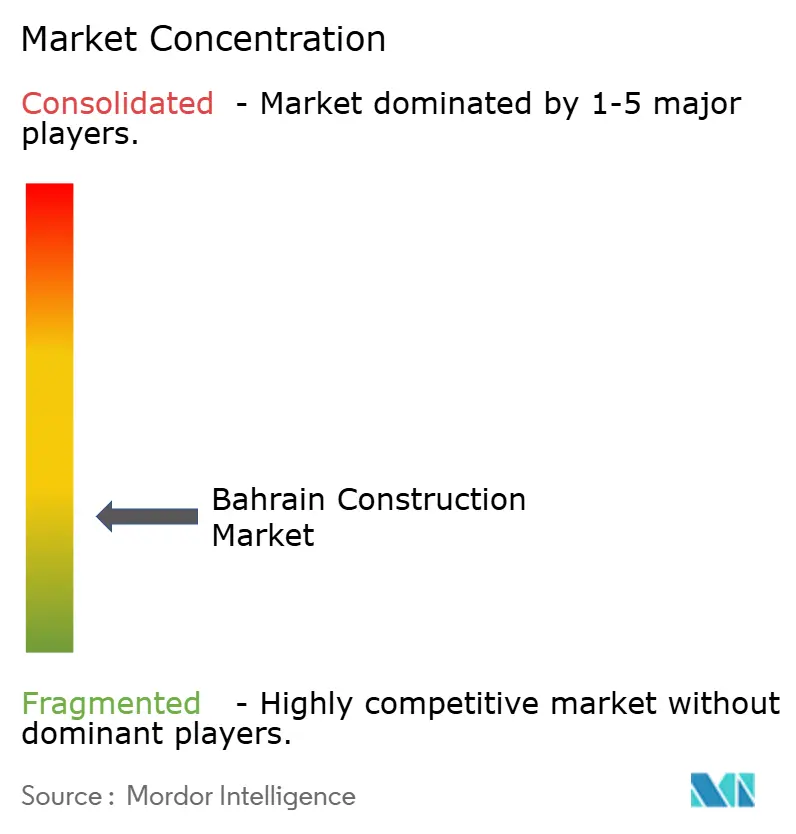
| Market Concentration | Low |
Major Players *Disclaimer: Major Players sorted in no particular order Image © Mordor Intelligence. Reuse requires attribution under CC BY 4.0. | |
Bahrain Construction Market Analysis by Mordor Intelligence
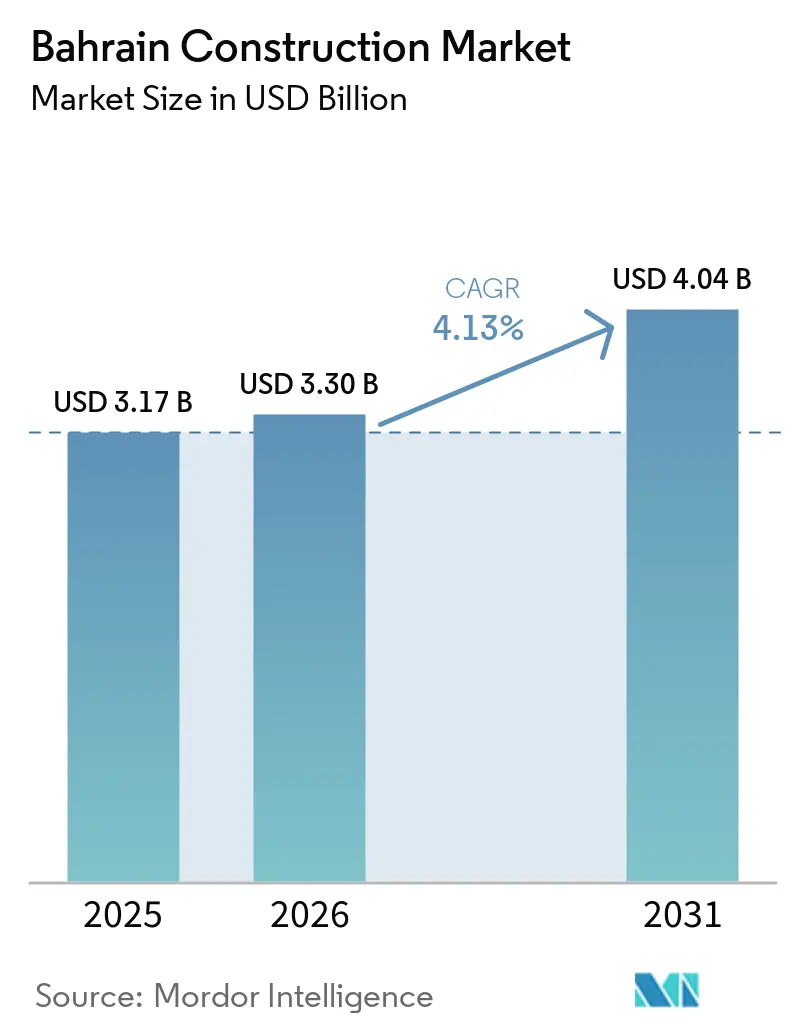
The Bahrain Construction market size is expected to grow from USD 3.17 billion in 2025 to USD 3.3 billion in 2026 and is forecast to reach USD 4.04 billion by 2031 at 4.13% CAGR over 2026-2031. This steady expansion is anchored in Vision 2030, which channels public-private capital into large infrastructure corridors while maintaining fiscal discipline. Government-backed outlays for the USD 2 billion metro system, the USD 3.5 billion King Hamad Causeway, and a USD 30 billion multi-year infrastructure pipeline keep order books healthy even as material costs and skilled-labor shortages squeeze contractor margins. Rising green-building mandates, modular construction pilots, and digital-twin rollouts indicate that technology adoption is moving from proof-of-concept to mainstream application. These shifts position the Bahrain construction market as a regional test bed for advanced project-delivery methods, offering foreign contractors a gateway to the wider GCC.
Key Report Takeaways
- By sector, infrastructure led with 37.42% of Bahrain's construction market share in 2025, while residential projects are forecast to post the fastest 5.98% CAGR through 2031.
- By construction type, new-build activity accounted for 59.88% of the Bahrain construction market in 2025, whereas renovation is projected to expand at a 5.12% CAGR over the same period.
- By construction method, conventional on-site techniques held 91.67% of 2025 revenue; prefabricated and modular solutions are advancing at a 6.52% CAGR to 2031.
- By investment source, public funding secured 67.05% of 2025 spending, but private-sector flows are climbing at a 5.79% CAGR as PPP rules mature.
- By geography, Manama commanded 34.10% of 2025 activity, while Muharraq is poised for the quickest expansion at a 5.72% CAGR through 2031.
Note: Market size and forecast figures in this report are generated using Mordor Intelligence’s proprietary estimation framework, updated with the latest available data and insights as of 2026.
Bahrain Construction Market Trends and Insights
Drivers Impact Analysis*
| Driver | (~) % Impact on CAGR Forecast | Geographic Relevance | Impact Timeline |
|---|---|---|---|
| Increased investment in infrastructure | +1.2% | National, concentrated in Manama and Muharraq | Long term (≥ 4 years) |
| Housing demand under Vision 2030 | +1.0% | National, with emphasis on Northern Governorate | Long term (≥ 4 years) |
| Focus on green buildings | +0.8% | National, with early adoption in commercial districts | Medium term (2-4 years) |
| Bahrain Metro PPP pipeline | +0.6% | Manama-Muharraq corridor | Medium term (2-4 years) |
| Liberalised free-hold laws for expatriates | +0.4% | Designated investment zones | Short term (≤ 2 years) |
| Digital-twin adoption cuts project delays | +0.2% | Major infrastructure projects nationwide | Medium term (2-4 years) |
| Source: Mordor Intelligence | |||


Increased Investment in Infrastructure
A USD 30 billion portfolio earmarked through 2030 is transforming Bahrain from a maintenance-focused builder into a network-centric economy. Flagship projects such as the USD 2 billion metro and the USD 7 billion BAPCO refinery upgrade demonstrate how long-dated PPP concessions can mobilize global contractors while shielding the treasury. Construction subsidies, sovereign guarantees, and streamlined tender rules shorten financial close and keep bid volumes high. Downstream, the surge lifts demand for steel fabrication, rail systems, and specialized engineering, creating a multiplier across the Bahrain construction market. With transport, energy, and digital grids moving in lockstep, infrastructure investment is strengthening the Bahrain transportation infrastructure construction industry and will remain the backbone of new contract awards over the next decade.
Housing Demand Under Vision 2030
The state plans to deliver 40,000 new dwellings by 2030, responding to population growth toward 2.3 million and chronic waiting lists for subsidized homes. Mixed-income master plans near planned metro stops improve land-use efficiency and support transit-oriented growth. PPP-financed communities like Al Madina Al Shamaliya signal how private capital can meet social targets without straining the budget. Liberalized foreign-ownership rules extend demand to long-term expatriates, broadening the buyer pool. These factors lift the residential slice of the Bahrain construction market and diversify revenue away from cyclical commercial towers.
Focus on Green Buildings
Mandatory LEED-aligned guidelines now apply to all public projects, turning sustainability from a niche add-on into a baseline specification. Developers weigh higher upfront costs against lower life-cycle energy bills and stronger tenant appeal, especially from multinationals with ESG mandates. Solar PV integration, water-saving fixtures, and recycled aggregates are becoming standard clauses in design briefs. Financial sweeteners—such as fast-track permits and reduced utility fees—further accelerate adoption. As a result, the Bahrain construction market is carving out a green-certified segment that attracts equipment suppliers and consultants specializing in low-carbon design[1]Ministry of Municipalities Affairs, “National Green-Building Guidelines,” municipality.gov.bh.
Bahrain Metro PPP Pipeline
The 35-year concession covering design, build, finance, operate, and maintain sets a new benchmark for risk allocation in the GCC. Automated trains, elevated viaducts, and integrated ticketing require specialist know-how, favoring consortia that blend civil works with rolling-stock technology. Successful delivery will cut road congestion and anchor new real-estate clusters around station nodes. Spin-off contracts for depots, utilities, and transit-oriented developments offer additional upside to contractors. The metro, therefore, links mobility gains with construction growth, reinforcing the Bahrain construction market’s momentum.
Restraints Impact Analysis*
| Restraint | (~) % Impact on CAGR Forecast | Geographic Relevance | Impact Timeline |
|---|---|---|---|
| High construction-material costs | -0.9% | National, with acute impact on large projects | Short term (≤ 2 years) |
| Skilled-labour shortages | -0.7% | National, particularly affecting specialized trades | Medium term (2-4 years) |
| Rising public-debt limits capital spending | -0.5% | National government projects | Long term (≥ 4 years) |
| Slow BIM uptake among SME contractors | -0.3% | National, concentrated among smaller contractors | Medium term (2-4 years) |
| Source: Mordor Intelligence | |||
High Construction-Material Costs
Global steel and cement volatility has inflated tender prices by up to 20%, eroding contractor margins and prompting renegotiation of fixed-price deals. Bahrain’s heavy reliance on imports magnifies currency and freight swings despite local aluminum smelter capacity. To hedge risk, builders adopt escalation clauses, bulk-buying pools, and early procurement strategies. Authorities have eased customs processes for essential inputs, yet price uncertainty still deters smaller firms from bidding on large packages. If volatility persists, the Bahrain construction market could see project postponements until cost curves stabilize.
Skilled-Labour Shortages
Bahrainization quotas cap foreign labor at 70%, tightening access to experienced tradespeople just as mega-projects ramp up. Domestic training pipelines have yet to produce sufficient crane operators, welders, and MEP technicians, forcing contractors to recruit costlier specialists from abroad. A compulsory end-of-service fund adds to payroll expenses, further squeezing budgets. Companies respond by digitizing site workflows and piloting modular fabrication to cut labor intensity. Unless vocational programs pivot toward construction skills, the Bahrain construction market may face timeline slippage and higher delivery risk[2]Labour Market Regulatory Authority, “Expatriate Workforce Statistics 2024,” lmra.bh.
*Our forecasts treat driver/restraint impacts as directional, not additive. The impact forecasts reflect baseline growth, mix effects, and variable interactions.
Segment Analysis
By Sector: Infrastructure Retains the Lead While Housing Accelerates
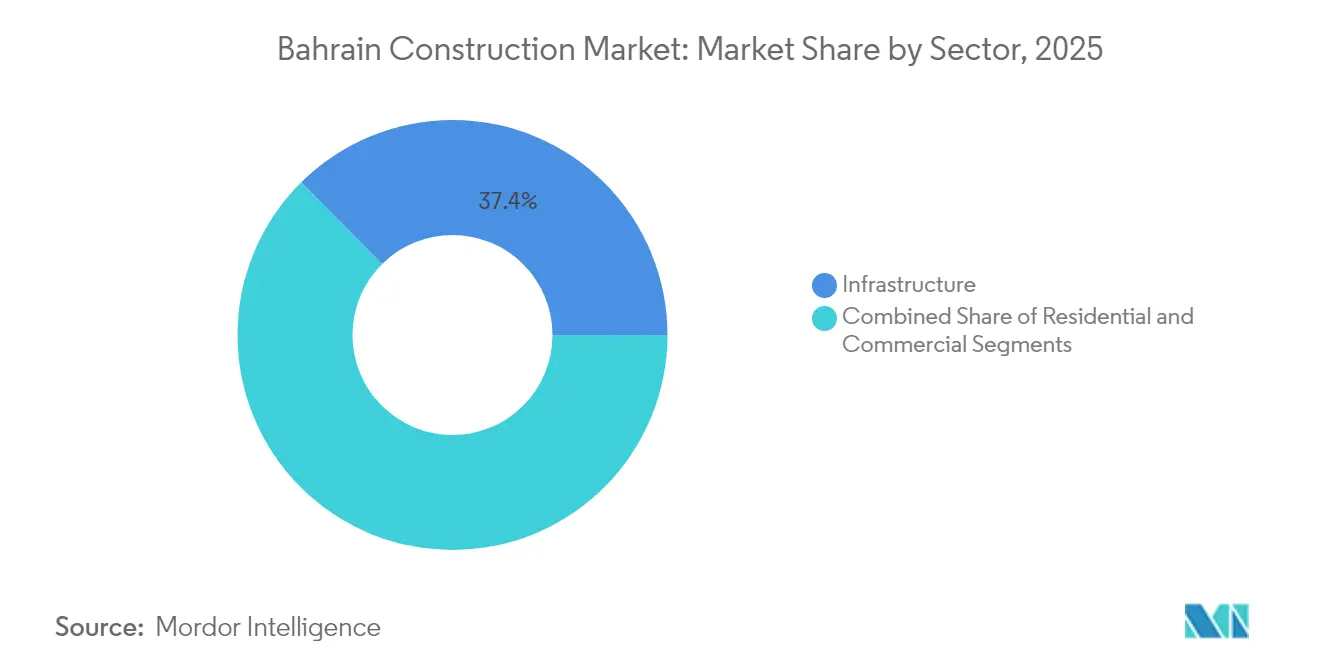
Infrastructure contributed 37.42% of Bahrain's construction market revenue in 2025, underscoring its status as the kingdom’s primary growth engine. The residential slice, though smaller, is forecast to record a 5.98% CAGR through 2031, lifted by social-housing quotas and expatriate demand. Mega-links such as the metro and King Hamad Causeway dominate order books and channel procurement toward heavy-civil specialists. Meanwhile, commercial and industrial projects circle financial districts and free-trade zones, supporting diversification beyond oil. Vision 2030’s blended financing model keeps the pipeline robust even under fiscal ceilings.
Developers in Manama Bay are coupling mixed-use towers with green-building certifications to secure premium leases, while industrial players cluster near Khalifa Bin Salman Port to leverage logistics synergies. On the housing front, bundled PPPs offer off-balance-sheet solutions that align with budget rules. These dynamics ensure that both core civil works and vertical construction contribute meaningfully to the Bahrain construction market.


By Construction Type: New-Build Dominance Meets Growing Retrofit Demand
New developments captured 59.88% of 2025 turnover, reflecting the kingdom’s expansionary phase. Yet renovation is climbing at a 5.12% CAGR as aging stock faces code upgrades and energy-efficiency retrofits. Building-permit data show sustained momentum, with more than 2,600 approvals issued in Q1 2025. Government schemes offering low-interest retrofit loans and expedited green-certification pathways encourage owners to modernize. For contractors, retrofit jobs provide cash-flow smoothing between large greenfield wins.
Digital-twin models shorten survey cycles and improve cost forecasting for refurbishment packages, a capability now migrating from megaprojects to mid-rise apartments. This blended workload broadens revenue streams across the Bahrain construction market and supports the growth of specialist subcontractors focused on MEP upgrades, façade recladding, and structural reinforcement.
By Construction Method: Conventional Techniques Still Dominate but Modular Gains Traction
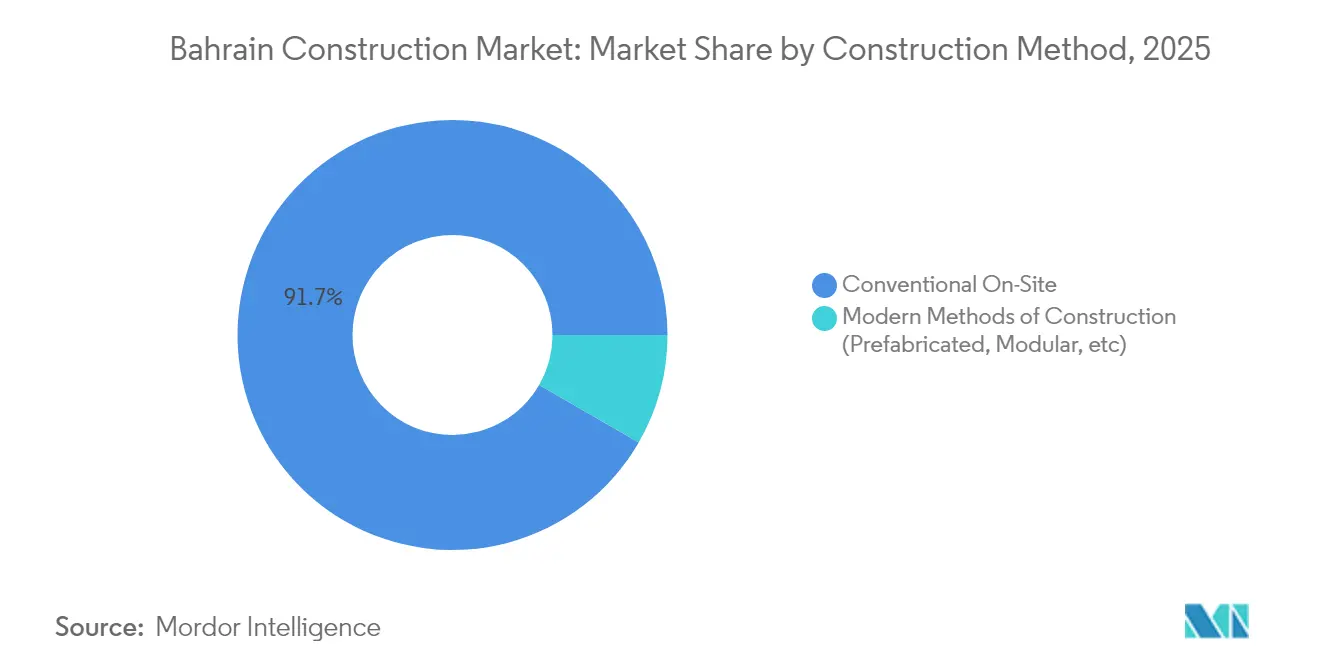
Traditional on-site building accounted for 91.67% of the 2025 value, mirroring entrenched contractor practices and regulatory familiarity. Prefabricated and modular systems, however, are registering a 6.52% CAGR, driven by labor scarcity and schedule compression. Early adopters in affordable-housing PPPs report 15% faster delivery and lower rework, bolstering the business case. Elevated metro corridors and airport expansions also tap modular steel assemblies for speed and safety advantages.
Government bodies now pilot factory-inspected components for social-housing pilots, signaling official support for industrialized construction. As supply chains mature and design codes adapt, modular penetration is expected to widen, diversifying delivery options within the Bahrain construction market.
By Investment Source: Public Funds Lead but Private Capital Is Catching Up
State spending delivered 67.05% of 2025 contracts, reflecting sovereign backing for transport, housing, and energy infrastructure. Private inflows are progressing at a 5.79% CAGR, enabled by 100% foreign-ownership rules and streamlined licensing. A USD 17 billion investment package unveiled with U.S. partners illustrates rising overseas appetite for Bahraini projects. Commercial landlords are also capitalizing on 7% gross rental yields, among the region’s highest, to finance office and hospitality builds.
PPP frameworks allocate construction risk to private consortia while offering availability-based returns, a structure now proven on the LNG terminal and being replicated for the metro. These models diversify funding channels and reduce reliance on the treasury, broadening the Bahrain construction market’s appeal to institutional investors.
Geography Analysis
Manama maintained 34.10% of 2025 spending, anchored by its role as the financial nucleus and by continuous upgrades to arterial roads and public-realm spaces. Projects such as the USD 107.42 million Al Fateh Highway expansion and the World Aquatics Centre highlight the city’s ability to attract sector-diverse capital. High-rise approvals around Bahrain Bay signal that prime land scarcity is channeling demand into vertical mixed-use formats. Regulatory bodies are fast-tracking permits for developments linked to metro station areas, aligning transport corridors with real-estate uplift and sustaining the Bahrain construction market in the capital.
Muharraq, though smaller, is projected to log a 5.72% CAGR to 2031, propelled by airport-adjacent logistics parks and first-phase metro stations. Residential schemes aim to capture unmet demand from aviation and tourism workers, while commercial parcels near waterfront promenades cater to SME tenants. The municipal council’s zoning revisions, which earmark transit-oriented districts for higher plot ratios, are catalyzing land trades and attracting master developers. This momentum positions Muharraq as the fastest-growing pocket within the Bahrain construction market.
Outside the northern corridor, the Southern and Central governorates host industrial estates, petrochemical expansions, and new social-housing clusters. UPDA’s land-use map shows residential footprints at 11.92% and nature reserves at 33.14%, underscoring the balancing act between growth and conservation. Public-private housing in Al Madina Al Shamaliya directs population spread away from the dense north, easing infrastructure load. Together, these regional strategies distribute construction opportunities across the kingdom and ensure that the Bahrain construction market is not overly reliant on a single urban center.
Regulatory Landscape
Bahrain construction activity operates under centralized permitting and multi-agency technical clearances, with the Benayat building permit portal positioned as the mandatory route for permit issuance across residential, commercial, industrial, and investment projects. Zoning and construction controls are administered by the Urban Planning and Development Authority (UPDA), including requirements embedded in ministerial decisions such as Decision No. (93) of 2023 that guide where and how development can proceed.
Quality and compliance frameworks are anchored by national references and sector regulators. The Ministry of Works publishes Standard Specifications for Construction Works (2019 edition), used across infrastructure and civil engineering procurement. The Real Estate Regulatory Authority (RERA) regulates developer and intermediary conduct through licensing requirements, including escrow account obligations for developers and additional controls for off-plan activity. In February 2026, the Survey and Land Registration Bureau updated its official laws database (4 February 2026) to reflect amendments relevant to spatial information governance and real estate registration, reinforcing the compliance layer that sits alongside permitting and planning.
Value Chain Analysis
Bahrain's construction value chain is shaped by government-led project origination and centralized procurement, followed by private delivery through main contractors and specialist subcontractors. On the public side, ministries and agencies package large transport, housing, and industrial works and route tenders through the Bahrain Tender Board, while permitting and technical approvals are coordinated through Benayat and consolidated under the Unified Guidebook of Building Permit Regulations. This spans interfaces with bodies such as the Ministry of Works and the Electricity and Water Authority (EWA).
Delivery models increasingly combine design, financing, and execution, particularly in housing. The Government Land Development Program (GLDP) uses a design, finance, build, market, and sell (DFBMS) structure that brings developers, contractors, and financiers into a single chain, evidenced by MoHUP receiving commercial proposals in June 2026 for the 2,500-unit Madinat Khalifa project. Upstream inputs include imported construction materials and internationally sourced equipment and utility components (such as high-voltage substations and cables), tying project schedules to logistics and supplier lead times. Downstream handover depends on completion of enabling infrastructure in line with UPDA mechanisms that link subdivision utilization to infrastructure readiness.
Competitive Landscape
A mid-range concentration typifies the Bahrain construction market, where local champions such as Nass Corporation and Haji Hassan Group leverage government relationships to secure civil packages, while global majors like Larsen & Toubro and Parsons target tech-heavy megaprojects. Tender frameworks prioritize track record in PPP delivery, sustainability compliance, and digital capability, steering awards toward firms with integrated design-build-operate offerings. Joint ventures blend indigenous knowledge with international best practice, mitigating execution risk on complex builds.
Technology has become a decisive battleground. Top-tier contractors deploy AI-assisted scheduling, drone site surveys, and IoT safety gear to trim overheads and win extension options. Smaller firms lag in BIM uptake, partly due to capital constraints, but government e-tender portals now require digital deliverables, nudging adoption. Sustainability credentials also sway bid evaluations; recycled-aggregate quotas and solar-ready roofing are increasingly embedded in specifications. These criteria raise entry barriers and intensify competition within the Bahrain construction market.
Strategic moves in 2024-2025 include Larsen & Toubro’s cross-country gas pipeline EPC win, which broadens its regional footprint, and Alba’s supply agreements that lock in aluminum for local curtain-wall fabricators. In parallel, Bahrain-based developers formed alliances with Gulf pension funds to seed mixed-use districts near forthcoming metro stops. Such alignments concentrate specialized skills and deep balance sheets, signaling that consortium-based models will dominate the next wave of awards.
Bahrain Construction Industry Leaders
Nass Corporation
Haji Hassan Group
Almoayyed Contracting Group
Cebarco Bahrain
Six Construct
- *Disclaimer: Major Players sorted in no particular order

Market Opportunities and Future Outlook
Opportunity is most concentrated where the project pipeline is moving into procurement and award, creating near-term whitespace for contractors, designers, and suppliers with relevant delivery experience. Large public works packages and structured financing remain visible anchors: in June 2026, Bahrain signed financing agreements with the Islamic Development Bank for the King Faisal Highway Development Project (USD 180 million) and the Salman Industrial City Expansion Project (USD 330 million), supporting road, utilities, and industrial enabling works. In March 2026, the Ministry of Works awarded the Busaiteen Link signature bridge contract (BHD 69.6 million) to a joint venture, reinforcing demand for complex marine and bridge engineering capabilities and for specialist supply chains, including steel, precast, bearings, and MEP systems.
Housing programs using GLDP and broader ministry pipelines create scope for industrialized delivery methods, program management, and local partnerships that satisfy participation requirements. In June 2026, MoHUP received bids for the Madinat Khalifa housing development under GLDP, with local developers and contractors submitting commercial proposals. Progress updates across major housing schemes, such as Muharraq City reaching 73% completion and Sitra Phase 2 reaching 90% completion as cited in 2026 ministry announcements, keep subcontracting demand active in finishes, MEP, and infrastructure tie-ins. On the non-residential side, May 2026 prequalification for the Bahrain International Sports City Stadium signaled opportunities for joint ventures that combine Bahraini Category AA (or Saudi Class A) contractors with specialized international stadium and venue expertise, expanding the addressable market for firms with complex-structure, crowd-management, and integrated systems delivery credentials.
Recent Industry Developments
- July 2026: Arabian Gulf University signed major contracts for the USD 260 million King Abdullah Bin Abdulaziz Medical City project near Durrat Al Bahrain, involving multiple contractors and suppliers including Al Salam Projects Company, Kontra, MAR Global, and Al Yousif Building Materials Company. The award cluster signals a shift from planning into execution for a large healthcare complex and pulls demand through the construction supply chain for specialist building systems, medical-grade MEP, and fit-out packages.
- June 2025: The Bahrain government announced a USD 17 billion investment accord with U.S. firms spanning aviation, technology, and industrial assets. The breadth of the package supports multi-sector project origination and creates a pipeline of enabling works, site development, and supporting infrastructure that feeds into contractor order books.
- March 2024: Larsen & Toubro won two 56-inch onshore gas pipeline EPC packages, described as the companys largest Middle East EPC order at the time. The win reinforced competitive intensity for large energy and utilities packages in Bahrain and the wider GCC, while increasing demand for specialized pipeline construction capacity, welding, and project controls.


Research Methodology Framework and Report Scope
Market Definition and Coverage
This market measures the total value of construction work delivered in Bahrain across major building and infrastructure activity, stated in current US dollars for the given year, and counted when on-ground construction execution takes place.
Scope exclusions: It excludes real estate transactions, pure land sales, and non-construction services such as routine facilities management and standalone design-only consulting.
Segmentation Overview
- By Sector
- Residential
- Apartments/Condominiums
- Villas/Landed Houses
- Commercial
- Office
- Retail
- Industrial and Logistics
- Others
- Infrastructure
- Transportation Infrastructure (Roadways, Railways, Airways, others)
- Energy & Utilities
- Others
- Residential
- By Construction Type
- New Construction
- Renovation
- By Construction Method
- Conventional On-Site
- Modern Methods of Construction (Prefabricated, Modular, etc)
- By Investment Source
- Public
- Private
- By Geography
- Manama
- Muharraq
- Rest of Bahrain
Data Sources, Market Sizing, and Validation
Desk Research
Desk research was used to build the fact base around Bahrain's construction activity, project pipeline visibility, and the macro context that typically shifts annual spend. We referenced public sources such as national statistics releases, central bank and ministry publications, and official budget and tender announcements to understand how investment is flowing into construction.
To keep assumptions grounded, we also reviewed customs and trade statistics where relevant for construction-linked imports, plus association and chamber updates that track contractor activity and materials availability. Company annual reports, investor presentations, and reliable press coverage were used to cross-check project starts, award timelines, and major capacity additions. For company-level financials and to scan disclosed project awards efficiently, we relied on paid subscriptions for company intelligence and for news and financials, then filtered these inputs through the desk findings. These examples are illustrative only, and many other public and paid sources were also used during data collection, validation, and clarification.
Primary Interviews and Surveys
Primary work focused on validating what portion of announced projects typically converts into executed construction value each year, and how pricing and scheduling are behaving across major project categories. We spoke with a mix of owners, developers, contractors, consultants, and distributors across Bahrain so the model could be corrected for delays, re-scoping, and procurement shifts that are not always visible in public releases.
Distribution of primary research fieldwork respondents
| Company type | Respondent position |
|---|---|
| Top tier: 27% | CXOs: 12% |
| Mid tier: 58% | Functional/Unit leaders: 30% |
| Smaller Players: 15% | Managers: 58% |
Market-Sizing & Forecasting
Sizing starts with a top-down build where planned and ongoing construction activity is reconstructed from public budgets, tender awards, and project pipeline movement, then converted into annual executed value using stage-wise progress and timing assumptions. Once the total is formed, we check it with selective bottom-up approximations, including sampled project cost benchmarks, sampled volume multiplied by typical unit costs for repeatable work types, and supplier and channel checks that help flag over-counting.
The model is driven by inputs that are easy to explain and re-check, including government capital spend signals, tender award values and award-to-start lags, project mix shifts between building and infrastructure, construction cost and labor pressure indicators, and the share of renovation versus new work where billing pace changes. Where bottom-up checks are thin for niche work, gaps are handled using conservative proxy ratios tied to similar project types, then corrected through expert feedback.
For forecasting, we primarily use scenario analysis supported by a simple multivariate regression check, since the market can swing based on project starts, public investment cadence, and cost inflation. Assumptions are stress-tested with interview feedback on execution constraints and the expected award pipeline before final growth paths are locked.
Data Validation & Update Cycle
Outputs are validated through multiple checks so obvious inconsistencies can be caught early, including growth rates that do not match tender signals, cost trends, or known project timing. We re-check outliers by returning to source documents, comparing against independent indicators, and then re-contacting experts when a variance looks too large to explain with normal schedule slippage.
Before sign-off, the model is reviewed in steps so inputs, calculations, and narrative interpretation align, and so unit economics and implied volumes remain realistic. The report is refreshed annually, and interim updates are made when material events occur such as large award announcements, major delays, or policy shifts. Right before delivery, a final pass is completed so clients receive the latest view based on the newest available information.
Mordor Intelligence's Bahrain Construction Sector Market Size Compared Against Other Published Estimates
Published market values for Bahrain's construction sector can look different across sources, even when the topic name appears the same. The main reasons are usually what gets counted as construction value, which year is treated as the base, and how future pricing and project timing are assumed.
A common gap driver is whether estimates track executed construction value versus announced pipeline, and whether they treat inflation, currency timing, and schedule slippage consistently. Another difference is segment coverage, since some sources may fold related real estate activity or broader engineering services into the number, while others stay close to on-site construction delivery. The spread is also influenced by refresh cadence, because fast-moving tender updates can change the near-term starting point.
Benchmark comparison
| Source | Market Size | Gaps in Research Methodology |
|---|---|---|
| Mordor Intelligence | USD 3.17 B (2025) | |
| Industry Publisher A | USD 3.40 B (2025) | Uses a broader spend view that can lean more on forecasted project value for 2025, which may not fully net out execution delays and mid-scope reductions. |
| Industry Publisher B | USD 3.30 B (2024) | Anchors on a 2024 base year and a different forecast window, and the inflation and currency timing used to translate local project costs into USD can shift the reported value. |
Looking across the figures, most of the variance traces back to timing and what is treated as delivered work versus pipeline value, plus how cost escalation is carried through the base year. By keeping the model tied to annual execution signals like awards-to-start timing and project progress adjustments, the estimate stays repeatable and avoids double counting, a choice applied by Mordor Intelligence.


Key Questions Answered in the Report
How large is the Bahrain construction market in 2026?
It is valued at USD 3.3 billion and is forecast to reach USD 4.04 billion by 2031, growing at a 4.13% CAGR.
Which sector contributes the most to ongoing projects?
Infrastructure holds 37.42% of 2025 spending, led by the metro, causeway, and refinery upgrades.
Where is construction activity expanding the fastest geographically?
Muharraq is projected to log a 5.72% CAGR to 2031, supported by airport expansion and metro connectivity.
What is driving residential construction demand?
Government commitments to deliver 40,000 units and relaxed expatriate ownership rules are lifting housing orders.
How are rising material costs being managed?
Contractors use price-escalation clauses, early bulk procurement, and modular methods to hedge cost swings.
What role do PPPs play in new contracts?
Public-private partnerships finance large projects like the metro, shifting construction risk while ensuring long-term service delivery.
Page last updated on:


 Your data is secure and never sold or shared.


