
Conformal Coating AOI Systems Market Size and Share
Market Overview
| Study Period | 2020 - 2031 |
|---|---|
| Market Size (2026) | USD 136.63 Million |
| Market Size (2031) | USD 207.43 Million |
| Growth Rate (2026 - 2031) | 8.71 % |
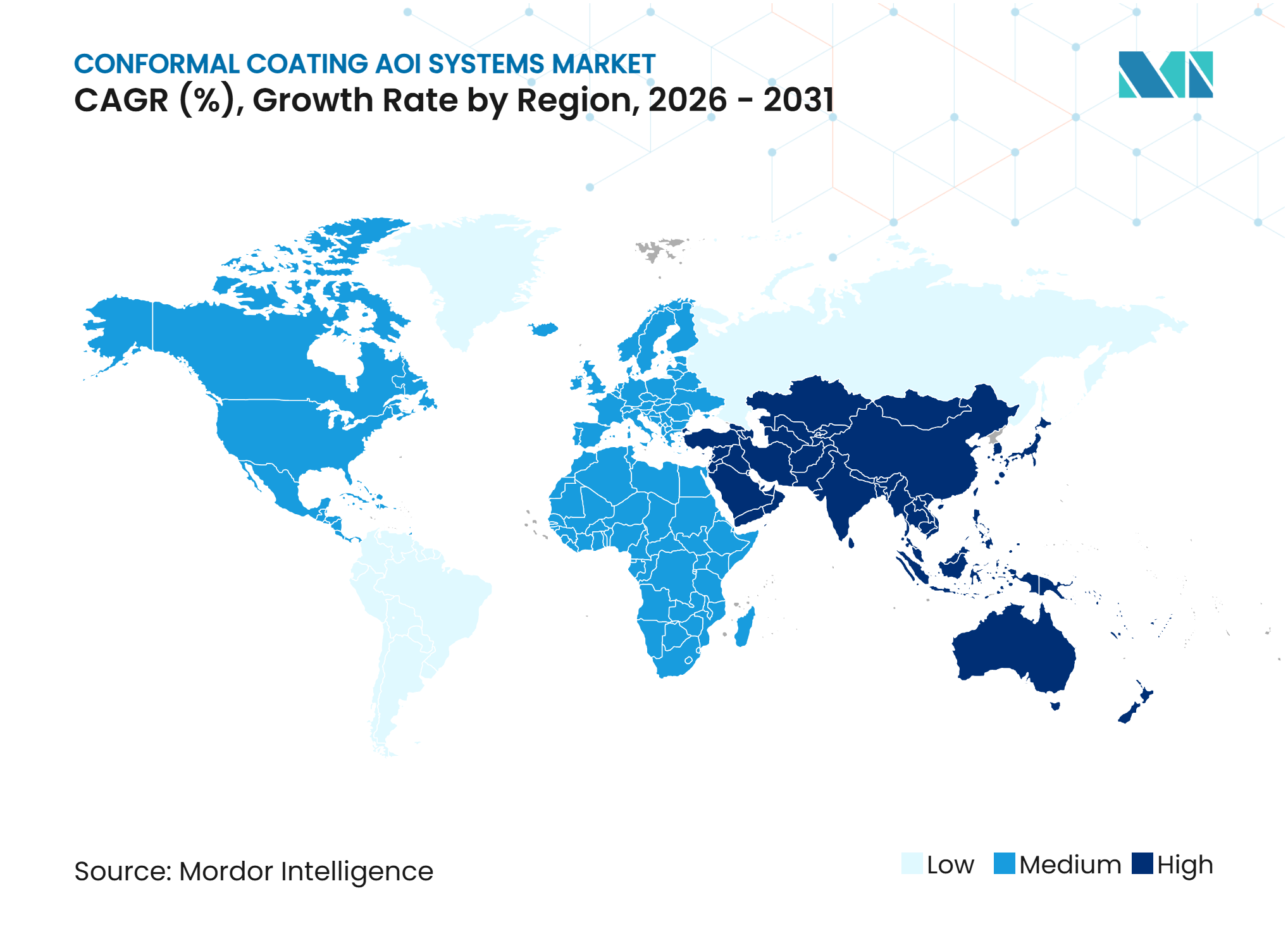
| Fastest Growing Market | Asia-Pacific |
| Largest Market | Asia-Pacific |
| Market Concentration | Medium |
Major Players *Disclaimer: Major Players sorted in no particular order Image © Mordor Intelligence. Reuse requires attribution under CC BY 4.0. | |
Conformal Coating AOI Systems Market Analysis by Mordor Intelligence
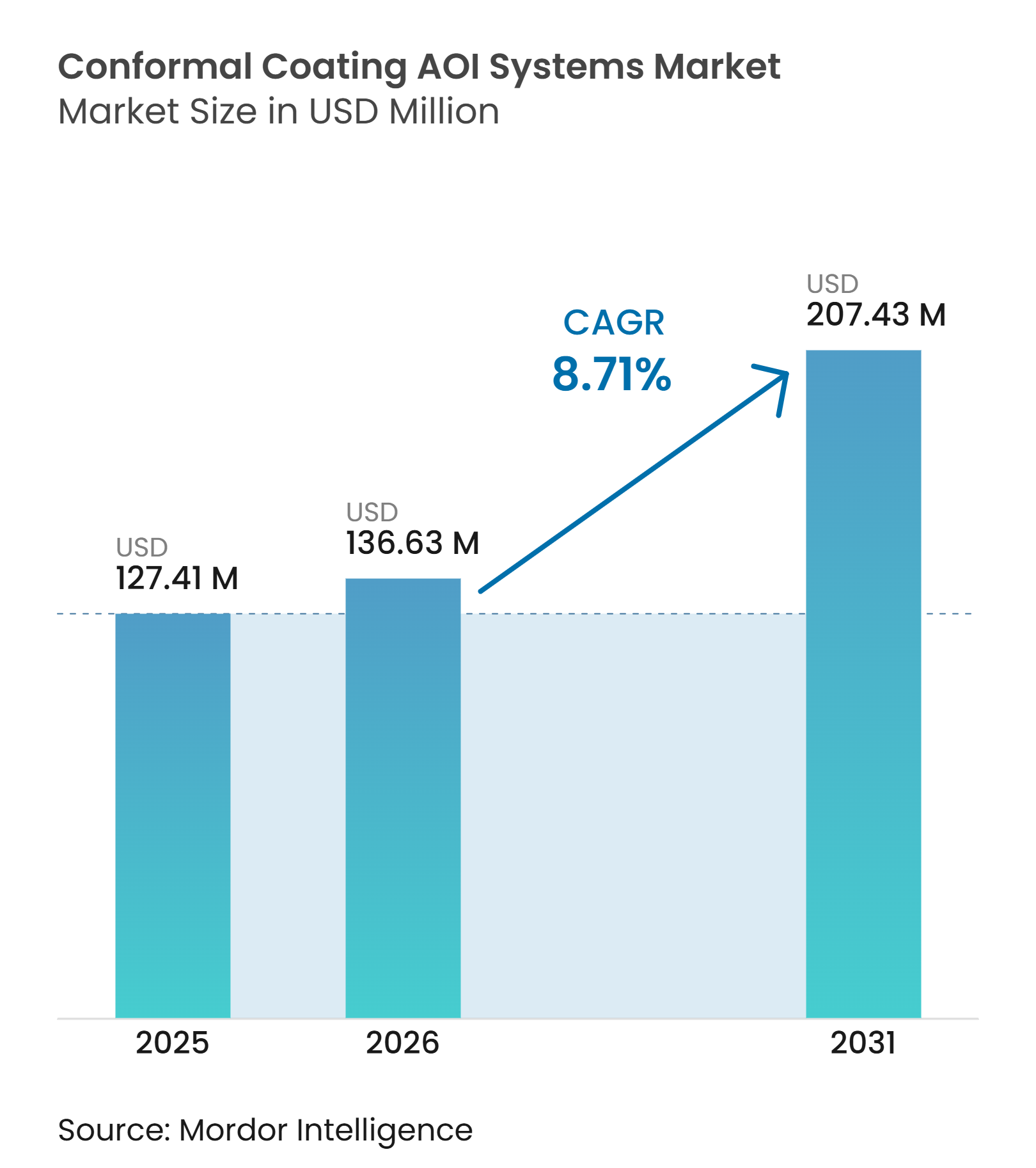
The conformal coating AOI systems market size was valued at USD 127.41 million in 2025 and is estimated to expand from USD 136.63 million in 2026 to reach USD 207.43 million by 2031, at a CAGR of 8.71% during the forecast period 2026-2031. Electronics producers are placing more boards in electric vehicles, aircraft systems, and medical equipment, where coating faults can lead to corrosion, dendritic growth, or electrical shorting. This changes automated inspection from a final quality check into a production control requirement. Inline platforms can provide full board-level coverage records at line speed, while manual ultraviolet checks depend on an operator’s judgment and do not create comparable records. Suppliers are responding through 3D sensing, faster programming, and integrated process data. Demand is also widening where silicone and hybrid coatings are used in hotter operating environments and where dense double-sided boards require coverage verification on both surfaces.
Key Report Takeaways
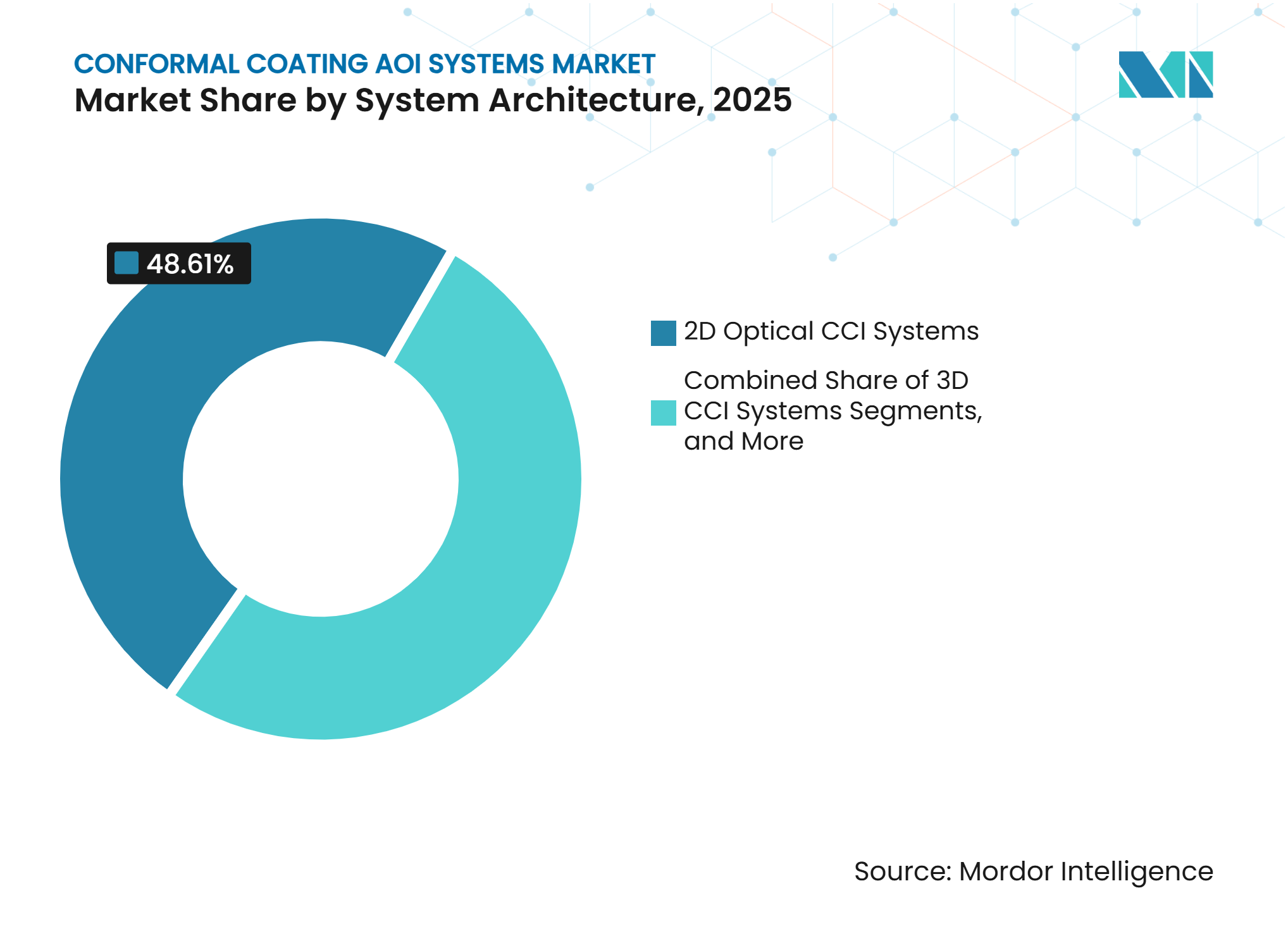
- By system architecture, 2D optical CCI systems held 48.61% of the conformal coating AOI systems market revenue share in 2025, while 3D CCI systems are projected to expand at a 10.87% CAGR through 2031.
- By component, hardware commanded 63.47% of the conformal coating AOI systems market revenue share in 2025, while software is projected to expand at an 11.79% CAGR through 203
- By deployment and integration, inline coating-line-integrated systems held 46.83% share in 2025 and are projected to expand at a 10.67% CAGR through 2031.
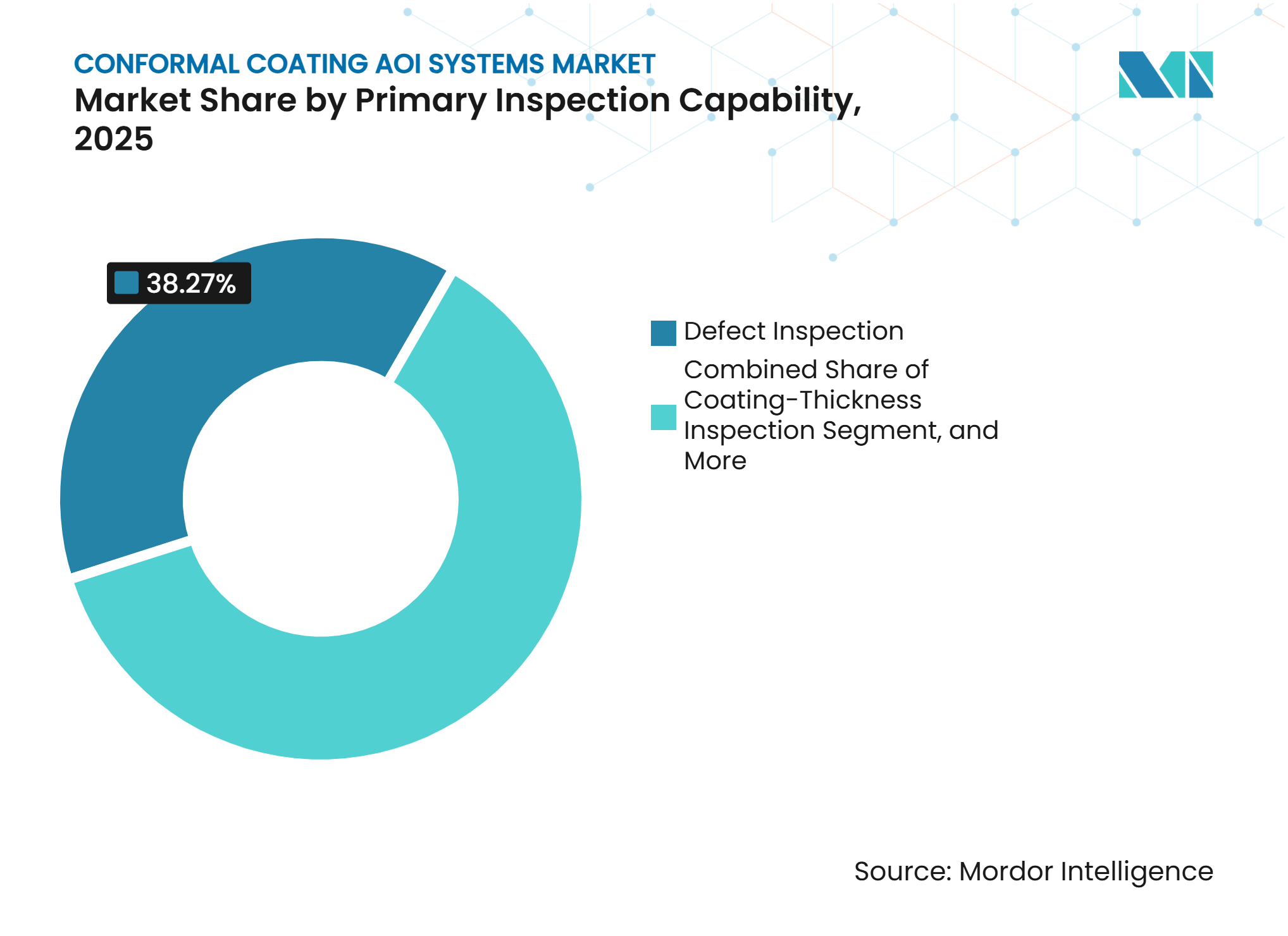
- By primary inspection capability, defect inspection held 38.27% share in 2025, while coating-thickness inspection is projected to expand at an 11.43% CAGR through 2031.
- By end-user industry, automotive held 24.73% share in 2025, while aerospace and defense are projected to expand at a 10.93% CAGR through 2031.
- By geography, Asia-Pacific held 45.37% share in 2025 and is projected to expand at a 10.17% CAGR through 2031.
Note: Market size and forecast figures in this report are generated using Mordor Intelligence’s proprietary estimation framework, updated with the latest available data and insights as of January 2026.
Market Trends and Insights
Drivers Impact Analysis of Conformal Coating AOI Systems Market*
| Driver | (~) % Impact on CAGR Forecast | Geographic Relevance | Impact Timeline |
|---|---|---|---|
| Electronics Miniaturization and Higher Board Density | +2.2% | Global, with highest intensity in Asia-Pacific, China, South Korea, and Japan | Short term (≤ 2 years) |
| Automotive Electrification and Advanced Vehicle Electronics | +1.9% | North America, Europe, and Asia-Pacific, including the China EV supply chain | Medium term (2-4 years) |
| Stricter Reliability and Traceability Requirements | +1.5% | North America and Europe, with expanding relevance in Asia-Pacific | Medium term (2-4 years) |
| Migration From Manual UV Checks to Inline Automated Inspection | +1.3% | Global, with accelerating adoption in South America and Southeast Asia | Short term (≤ 2 years) |
| Inspection of Silicone and Thin-Film Coatings Under Variable UV Fluorescence | +0.9% | North America and Europe, especially premium automotive and aerospace accounts | Medium term (2-4 years) |
| Demand for Double-Sided and Connector-Level Coverage Verification | +0.7% | Global, with early gains in Japan, Germany, and South Korea | Long term (≥ 4 years) |
| Source: Mordor Intelligence | |||
Electronics Miniaturization and Higher Board Density
Component miniaturization is making conformal coating inspection an engineering-critical production step. Smaller trace clearances can turn a limited coating defect into a bridge between adjacent conductive surfaces. IPC-2226 HDI design rules cited in the source material place microvias in the 75-150 µm range and support component pitches below 0402 geometries. The insulating performance of the coating allows designers to use tighter clearances, so coating quality affects both electrical performance and environmental protection. Koh Young’s KSMART platform links 3D coating inspection data from Neptune DPI systems with SPI and AOI equipment. This arrangement supports process adjustments when coating issues appear, rather than treating inspection as an isolated check.
Higher board density also raises the need to manage false calls around reflective solder joints, tall components, and shadowed areas. A system that produces excessive false calls can slow the same production line it is meant to protect. The conformal coating AOI systems market, therefore, favors inspection tools that combine reliable detection with production-speed operation. Dense layouts increase the value of data that identifies repeatable application issues before boards move further through manufacturing. The need is especially relevant in high-density interconnect products that use small features and closely placed components. The resulting demand is not limited to a single end market because compact electronics are used across several equipment categories.
Automotive Electrification and Advanced Vehicle Electronics
Electric vehicles and advanced driver-assistance systems have made coating inspection a required production gate at many automotive Tier-1 electronics lines. Inverter modules, battery management systems, and ADAS processing modules are increasingly used in under-hood and battery-proximate locations. The source material identifies continuous operating temperatures of 150°C to 160°C in these settings. Acrylic and polyurethane coatings can be eliminated on thermal grounds under these conditions, shifting use toward silicone and hybrid materials. Those materials have different optical properties and require inspection methods that do not rely only on ultraviolet fluorescence.
IATF 16949 production settings require documented coating conformance at the board level. Coating voids in ECU power modules can also create warranty exposure for vehicle manufacturers and suppliers. These conditions make inline inspection easier to justify as a quality investment. The conformal coating AOI systems market is supported by the increasing use of 800V vehicle platforms, which raises both insulation requirements and verification demands. Automotive customers also need consistent inspection across complex and high-volume PCB variants. This requirement supports dedicated coating inspection platforms rather than general-purpose AOI systems equipped with ultraviolet options.
Stricter Reliability and Traceability Requirements
Reliability rules are increasing the value of records linking inspection results to individual boards. IPC-A-610 Revision J, issued in 2024, requires coating transparency to allow inspection of underlying solder joints. IPC-CC-830C defines material qualification criteria and traceability information that purchasing teams may need to record as part of a contract. These provisions increase the need for consistent evidence of coating condition. Automated optical systems using calibrated ultraviolet lighting can create repeatable records for Class 3 assemblies.[1]
Avionics flight controls, military electronics, and medical implantables require closer workmanship control than many general electronics products. Manual ultraviolet-lamp inspection may be performed by trained staff, but results can vary by operator. That variability is difficult to reconcile with auditable traceability requirements. NASA-STD-8739.1B requires photographic documentation and examination before and after cure for relevant mission hardware.[2] The requirement is particularly relevant in North America and Europe, where customer quality agreements can exceed baseline IPC conditions.
Migration From Manual UV Checks to Inline Automated Inspection
The move from handheld ultraviolet lamps to automated inline inspection supports stronger throughput control and fewer defect escapes. Manual checks can produce different classifications among operators handling the same lot. They also do not provide a board-level data record that can feed smart-factory systems. The original material identified classification inconsistencies of up to 30% between operators. Inline inspection reduces dependence on subjective visual judgment and places the check within the coating process. The conformal coating AOI systems market benefits when manufacturers need inspection results immediately after application.
The highest-value inspection window can occur when a coating is wet or only partly cured. This permits verification after application and before ultraviolet cure, a step that manual workflows cannot deliver in the same way. Full-surface thickness measurement from 2 µm and programming times of 3-30 minutes were described for an inline system introduced in 2025. Manufacturers can use manufacturing execution system connections to provide real-time statistical process control feedback. These functions generate data to support process optimization and warranty defense. The shift also reduces the setup barrier that previously restricted automated inspection on short-run products.
Restraints Impact Analysis of Conformal Coating AOI Systems Market*
| Restraint | (~) % Impact on CAGR Forecast | Geographic Relevance | Impact Timeline |
|---|---|---|---|
| High Capital Cost and Inline Integration Complexity | -1.8% | Global, most acute in South America and Southeast Asia cost-sensitive EMS operations | Short term (≤ 2 years) |
| Programming Burden for High-Mix and Short-Life-Cycle Boards | -1.4% | Global, most pronounced in North America and Europe contract electronics manufacturing | Medium term (2-4 years) |
| Optical Variability Across Coating Chemistries and Surface Finishes | -1.0% | Global, with greatest impact where silicone or thin-film chemistries are prevalent | Medium term (2-4 years) |
| Inconsistent Coating Plans and Limited Defect-Labeling Standards | -0.7% | Global, most pronounced where IPC adoption is less mature | Long term (≥ 4 years) |
| Source: Mordor Intelligence | |||
High Capital Cost and Inline Integration Complexity
Fully equipped 3D coating inspection systems require significant capital spending compared with manual and semi-automated alternatives. Thickness sensors, angled-view cameras, and manufacturing-execution-system modules increase the cost of a complete platform. This can limit uptake among small and mid-sized electronics manufacturing services providers. A running coating line may also need precise conveyor-height alignment and support for SMEMA or Hermes protocols. Electrical and compressed-air upgrades can add time and cost before equipment enters production.
Multi-product operations can face a more complex validation task because a single platform must accommodate different board sizes, component clearances up to 120 mm, and coating chemistries. Qualification work before production release can be substantial. Coating operators and quality teams may also need revised responsibilities to operate an inline system effectively. Suppliers are addressing some issues through modular equipment and remote commissioning support. Even so, the combined capital and integration burden remains a central restraint for cost-sensitive EMS sites in South America and Southeast Asia. The conformal coating AOI systems market must therefore show clear operational value for these buyers.
Programming Burden for High-Mix and Short-Life-Cycle Boards
Consumer electronics and communications products can have life cycles of 6-12 months. Frequent product changes require new inspection recipes and the retirement of old ones. A program for a complex board must define coated areas, exclusions, component clearances, and defect thresholds. This work can require hours of iterative testing, even for experienced technicians. The engineering effort may appear disproportionate to the underlying coating-defect rate. This reduces the appeal of automation where product mix changes often.
The lack of standard defect labels creates another practical obstacle. Terms such as orange-peel, splatter, and insufficient coverage are not always used consistently across programs, sites, or suppliers. That limits direct comparison of inspection outcomes. Smart Debug software was introduced in 2025 to adjust tolerances using production measurement data. AI-assisted tools from Viscom and ViTrox also seek to reduce recipe work through component recognition and CAD-less programming. Human validation remains necessary before a program is released to production.
*Our forecasts treat driver/restraint impacts as directional, not additive. The impact forecasts reflect baseline growth, mix effects, and variable interactions.
Conformal Coating AOI Systems Market Segment Analysis
By System Architecture:
2D Optical Platforms Lead While 3D Adoption Advances2D optical CCI systems held 48.61% of the conformal coating AOI systems market revenue share in 2025. Their position reflects a large installed base of ultraviolet fluorescence platforms used during the automotive electronics expansion in the mid-2010s. These systems have lower acquisition costs than more complex alternatives. They can also be integrated into existing surface-mount technology lines with less disruption. Acrylic coatings commonly used in consumer electronics and standard industrial applications fluoresce reliably at 365 nm. This supports continued use of 2D equipment in applications where coverage confirmation is sufficient. Hybrid 2D and 3D CCI systems combine coverage mapping with z-axis information for geometry checks. They are used in aerospace accounts that need dimensional documentation without the throughput demands of full volumetric scanning.
3D CCI systems are projected to expand at a 10.87% CAGR through 2031. Their adoption is tied to the growing use of silicone and hybrid chemistries in electric-vehicle and aerospace applications. Structured light, laser interferometry, and Koh Young’s LIFT technology can measure thickness without depending on ultraviolet fluorescence intensity. Silicone coatings can produce weak and inconsistent fluorescence, which limits the use of conventional 2D methods. The conformal coating AOI systems market size for 3D systems is therefore driven more by functional inspection needs than by a preference for premium features. Height maps and thickness distribution data can also provide feedback to coating applicators. That feedback supports closed-loop process control that 2D systems cannot provide. This allows production teams to compare application outcomes across boards with a common dimensional reference. The conformal coating AOI systems market is consequently moving toward measurement methods that are suitable for demanding coating materials.



By Component:
Hardware Anchors Revenue While Software Differentiates SuppliersHardware commanded 63.47% share of the conformal coating AOI systems market in 2025. This category includes optical modules, ultraviolet LED arrays, cameras, conveyor mechanisms, and thickness-sensing heads. Coating inspection equipment requires specialized optical and mechanical work. Ultraviolet LED power control, angled-view camera calibration, and sensor integration are important hardware requirements. These features are harder to standardize quickly than general-purpose inspection elements. Hardware, therefore, remains the main revenue base for system suppliers. Services form the third component group and include installation, calibration, recipe support, and maintenance contracts. Customers with large installed bases increasingly seek ongoing performance support rather than single service visits.
Software is projected to expand at an 11.79% CAGR through 2031. AI-assisted programming, automated defect classification, and manufacturing execution system analytics are central areas of competition. Viscom introduced vAI ProVision at Productronica 2025 to generate functional 3D AOI and CCI programs with limited operator input. Faster program creation has become a purchase consideration alongside detection sensitivity. Suppliers that reduce false calls and shorten recipe qualification can maintain customer relationships beyond hardware refresh cycles. Software can consequently become a separate differentiator rather than only a bundled system feature. This also creates a route for software-overlay providers that do not manufacture inspection equipment. Better software can help technicians apply consistent inspection criteria across changing product programs. The conformal coating AOI systems market is therefore placing more value on programming workflows that reduce engineering effort.
By Deployment and Integration:
Coating-Line-Integrated Systems Set the Production StandardInline coating-line-integrated systems held 46.83% share in 2025 and are projected to expand at a 10.67% CAGR through 2031. This format is replacing offline and standalone options as manufacturers redesign lines for continuous throughput and connected data flow. These systems are installed immediately after the coating applicator. They can inspect wet or partly cured coatings before boards enter an ultraviolet cure oven. Standalone and offline systems cannot access this point in the same way without disrupting the process. This ability makes integration valuable in situations where immediate corrective action is critical. The format, therefore, combines the leading position with the fastest projected expansion within deployment choices.
Inline standalone systems are added to surface-mount technology lines but are not mechanically connected to the coating applicator. They offer an intermediate approach for EMS providers who are improving existing layouts without rebuilding the full coating line. Offline and benchtop systems are well-suited for engineering validation and first-article checks under IPC-CC-830C. Their lower throughput limits their role in volume production. They still support coating-chemistry qualification before a program moves to the line. Dual-sided simultaneous inspection can remove the need to flip dip-coated boards. This can reduce cycle time for thick boards and assemblies with through-hole components. The conformal coating AOI systems market continues to require each deployment format because manufacturing sites have different line configurations. The choice depends on whether the customer needs immediate process feedback, flexible line changes, or laboratory validation.
By Primary Inspection Capability:
Defect Inspection Leads While Thickness Verification Gains UseDefect inspection accounted for the largest share, at 38.27%, in 2025. It covers the detection of voids, bubbles, splatter, orange-peel texture, scratches, and keep-out-area violations. These defects are closely related to IPC-A-610 acceptance conditions. Coverage and presence inspection confirm that the coating is present in the planned areas. It remains relevant for high-volume consumer products where dimensional verification is not required. Multi-function CCI systems combine defect detection, coverage mapping, and thickness measurement in one pass. Aerospace and defense customers use these systems when a single inspection record is needed for production documentation.
Coating-thickness inspection is projected to expand at an 11.43% CAGR through 2031. IPC-CC-830C specifies minimum dry-film thicknesses from 25 µm to 210 µm, depending on coating chemistry. Ultraviolet fluorescence intensity can indicate thickness only where process conditions are tightly controlled. Viscosity, application speed, and tracer concentration can weaken this relationship in production. The conformal coating AOI systems market size for thickness verification is supported by inspection methods that operate independently of fluorescence. OCT-based systems, interferometric platforms, and LIFT-based measurement are differentiated by measurement independence. This shifts competition from image resolution alone toward repeatable thickness verification. It also gives customers a clearer basis for reviewing thickness results across changing materials and applications. The conformal coating AOI systems market increasingly requires repeatable measurements in which dimensional compliance is central to the application.

By End-User Industry:
Automotive Provides Volume While Aerospace and Defense Raises RequirementsAutomotive held 24.73% share in 2025. Demand came from coated ECUs, battery management systems, and ADAS control boards produced by Tier-1 suppliers. These suppliers operate under IATF 16949 quality systems and must manage high board volumes. Consumer electronics also form a separate demand group that includes smartphones, wearables, and Internet of Things sensors. Producers in this group are placing greater emphasis on moisture-related field failures associated with selective coating gaps. Industrial users apply CCI systems to factory automation controls, power-conversion equipment, and motor drives. Long equipment lifecycles increase the costs of field replacement and support inspection.
Aerospace and defense is projected to expand at a 10.93% CAGR through 2031. Many defense programs still use MIL-I-46058C as a qualification reference, with IPC-CC-830C used as an accepted commercial equivalent. Per-board traceability requirements cannot be served at volume through manual ultraviolet inspection. Medical equipment, including diagnostic systems, infusion pumps, and wearable monitors, can also require Class 3 artistry. Marine and energy applications include offshore inverters and renewable-energy electronics that are subject to salt-fog exposure. Communications and networking users are extending the use of coatings to outdoor 5G radio assemblies, where moisture ingress affects reliability. Aerospace accounts are also evaluating hyperspectral and multispectral methods to verify the presence of coatings and their cure state. These applications favor detailed records because a coating result is part of a wider reliability requirement. The conformal coating AOI systems market serves diverse end-user needs with varying levels of inspection capability.
Geography Analysis
Asia-Pacific held 45.37% of the conformal coating AOI systems market revenue share in 2025 and is projected to expand at a 10.17% CAGR through 2031. China’s electronics assembly base and expanding electric vehicle supply chain support concentrated demand for inline inspection at Tier-1 automotive PCB sites. South Korea contributes precision component production, and Japan adds rigorous quality-management requirements. Vietnam, Thailand, and Malaysia are emerging electronics hubs that contribute to regional demand. India is building PCB assembly capacity through the Production Linked Incentive scheme. Export-focused automotive-grade assembly programs are beginning to adopt inline coating inspection.
Chinese suppliers, including MagicRay, Xinnuo Electronic, and JUTZE Intelligence Technology, compete in cost-sensitive mid-tier applications. MIRTEC, ViTrox, UniEye, and Koh Young target premium export customers with 3D platforms and AI-supported programming. Koh Young’s presence at Productronica India 2026 reflects supplier attention to emerging sub-regional demand.[3] Europe is the second-largest regional market. Germany, the Czech Republic, and Poland contribute to automotive demand, while the United Kingdom, France, and Germany support aerospace demand. German Tier-1 suppliers have a mature installed base and are focused on 3D measurement and AI-assisted recipe-management upgrades.
Viscom’s H1 2026 new orders increased 30.2% to EUR 55,715 thousand (USD 61.3 million). Its order book increased 62.2% year over year to EUR 37,963 thousand (USD 41.8 million). North America is supported by the United States defense-electronics production and its associated documentation requirements. Canada adds aerospace demand for high-accuracy systems with traceability functions. Mexico is generating demand from Tier-1 suppliers serving North American electric vehicle programs. South America remains at an earlier stage, with Brazil’s Manaus Free Trade Zone supporting initial automotive-grade demand. The Middle East and Africa remain small but stable, led by defense modernization, telecommunications investment, and industrial electronics activity.
Competitive Landscape
Market Concentration
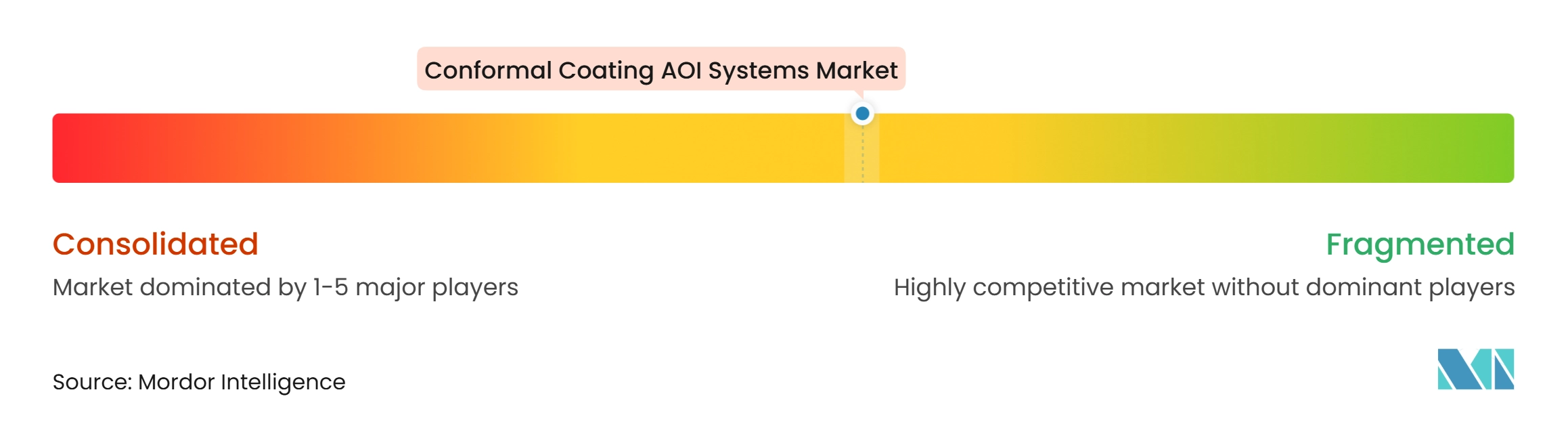
The conformal coating AOI systems market has a moderately fragmented competitive structure. Suppliers are increasingly differentiating through software intelligence rather than optical hardware alone. Viscom SE and GÖPEL electronic have established positions in precision automotive and aerospace accounts. Their metrology accuracy and alignment with standards support customer confidence in safety-critical production. Korean and Southeast Asian vendors compete in mid-tier applications with 3D sensor platforms and AI-based programming. The gap in programming capability is narrowing as suppliers focus on the same recipe-creation constraint. The market does not have a single supplier with a decisive position across every end-user category.
Viscom introduced vAI ProVision at Productronica 2025. The tool generates ready-to-run 3D AOI and AXI programs with limited operator input, which addresses high-mix and new-product-introduction workloads. Koh Young showcased the Neptune C+ platform at IPC APEX EXPO 2026. The platform uses LIFT technology for non-destructive 3D measurement of conformal coatings and dispensed materials. ViTrox introduced V510Ai R, V510Ai ST, and V510Ai DST systems in August 2025, adding AI Smart Programming, Generative AI 3D simulation, and CAD-less recipe creation. These moves show that suppliers are trying to shorten setup time while extending inspection capabilities.
Ultra-thin film and silicone verification remain areas where conventional 2D ultraviolet platforms face technical limitations. Multi-function inline systems that combine coating checks with final-assembly verification can also reduce floor-space use and equipment spending for EMS providers. ViTrox’s V510Ai R combines coating and final assembly inspection in a single robotic system. Koh Young’s LIFT approach focuses on transparent materials that are difficult to measure through ultraviolet fluorescence alone. Software specialists using deep-learning defect classification may present another competitive path without producing dedicated hardware. Product and software introductions by major suppliers from 2025 through September 2026 indicate sustained investment across the field.
Conformal Coating AOI Systems Industry Leaders
-
Viscom AG
-
GÖPEL electronic GmbH
-
MIRTEC CO., LTD.
-
Pemtron Corporation
-
PARMI Co., Ltd.
- *Disclaimer: Major Players sorted in no particular order
Conformal Coating AOI Systems Market Companies Covered in this Report
- Viscom AG
- GÖPEL electronic GmbH
- PARMI Co., Ltd.
- Pemtron Corporation
- MIRTEC CO., LTD.
- ViTrox Corporation Berhad
- Saki Corporation
- Test Research, Inc.
- Seica S.p.A.
- Koh Young Technology Inc.
- CyberOptics Corporation
- Machine Vision Products, Inc.
- Axxon-Mycronic
- UniEye AB
- JUTZE Intelligence Technology Co., Ltd.
- MEK Europe BV
- MagicRay Technology Co., Ltd.
- Xinnuo Electronic Technology Co., Ltd.
- ALeader Tech Co., Ltd.
- MAKER-RAY Technology
Recent Industry Developments in Conformal Coating AOI Systems Market
- July 2026: Viscom SE disclosed in its H1 2026 interim report that new orders rose 30.2% to EUR 55,715 thousand (USD 61.3 million), with the order book expanding 62.2% year on year to EUR 37,963 thousand (USD 41.8 million). The company cited battery-cell inline CT inspection as a key driver of orders and confirmed its full-year 2026 forecast. AI-powered software solutions, including vAI ProVision and the vConnect digital platform, were positioned as long-term growth vectors.
- March 2026: Koh Young showcased the Neptune C+ True 3D inspection platform at IPC APEX EXPO 2026. The platform demonstrated non-destructive, high-resolution 3D measurement of conformal coatings and dispensed materials through LIFT technology. It identified bubbles, cracks, and thickness deviations on transparent materials without dependence on ultraviolet fluorescence.
- March 2026: Viscom SE presented vAI ProVision and the iX7059 PCB Inspection XL at IPC APEX EXPO 2026. vAI ProVision automatically generates AOI inspection programs and reduces setup time for high-mix and EMS settings. The iX7059 XL extends 3D X-ray inspection to assemblies up to 200 kg and 2 meters long.
- April 2025: ViTrox launched the V510Ai R Smart Robotic Vision System, V510Ai ST, and V510Ai DST Smart 3D AOI systems from Penang, Malaysia. The systems added AI Smart Programming, Generative AI 3D simulation, and CAD-less 5-minute recipe creation. The V510Ai DST received the 2025 NPI Award from Circuit Assembly.
Global Conformal Coating AOI Systems Market Report Scope
The Conformal Coating Automated Optical Inspection (AOI) Systems Market, also referred to as the Conformal Coating Inspection (CCI) systems market, comprises the revenues generated from the sale of vision-based inspection systems, and their associated software and services, that are purpose-built or configured to verify the quality of conformal coatings applied to printed circuit board assemblies (PCBAs) and other electronic assemblies. For this study, a conformal coating AOI system is defined as an automated or semi-automated machine-vision platform that uses optical illumination to detect, measure, and classify coating attributes on coated assemblies without physical contact, and that renders an automated pass/fail or measurement verdict against a defined process specification.
The Conformal Coating AOI Systems Market Report is Segmented by System Architecture (2D Optical CCI Systems, 3D CCI Systems, and Hybrid 2D/3D CCI Systems), Component (Hardware, Software, and Services), Deployment and Integration (Inline Standalone Systems, Inline Coating-Line-Integrated Systems, and Offline/Benchtop Systems), Primary Inspection Capability (Coverage/Presence Inspection, Defect Inspection, Coating-Thickness Inspection, and Multi-Function CCI Systems), End-User Industry (Automotive, Consumer Electronics, Aerospace and Defense, Industrial, Medical, Marine and Energy, Communications and Networking, and Other End-User Industries), and Geography (North America, South America, Europe, Asia-Pacific, and Middle East and Africa). The Market Forecasts are Provided in Terms of Value (USD).
Segmentation Overview
| 2D Optical CCI Systems |
| 3D CCI Systems |
| Hybrid 2D/3D CCI Systems |
| Hardware |
| Software |
| Services |
| Inline Standalone Systems |
| Inline Coating-Line-Integrated Systems |
| Offline/Benchtop Systems |
| Coverage/Presence Inspection |
| Defect Inspection |
| Coating-Thickness Inspection |
| Multi-Function CCI Systems |
| Automotive |
| Consumer Electronics |
| Aerospace and Defense |
| Industrial |
| Medical |
| Marine and Energy |
| Communications & Networking |
| Other End-User Industries |
| North America | United States | |
| Canada | ||
| Mexico | ||
| South America | Brazil | |
| Argentina | ||
| Rest of South America | ||
| Europe | Germany | |
| United Kingdom | ||
| France | ||
| Italy | ||
| Spain | ||
| Rest of Europe | ||
| Asia-Pacific | China | |
| Japan | ||
| India | ||
| South Korea | ||
| ASEAN | ||
| Rest of Asia-Pacific | ||
| Middle East and Africa | Middle East | Saudi Arabia |
| United Arab Emirates | ||
| Turkey | ||
| Rest of the Middle East | ||
| Africa | South Africa | |
| Nigeria | ||
| Rest of Africa | ||
| By System Architecture | 2D Optical CCI Systems | ||
| 3D CCI Systems | |||
| Hybrid 2D/3D CCI Systems | |||
| By Component | Hardware | ||
| Software | |||
| Services | |||
| By Deployment and Integration | Inline Standalone Systems | ||
| Inline Coating-Line-Integrated Systems | |||
| Offline/Benchtop Systems | |||
| By Primary Inspection Capability | Coverage/Presence Inspection | ||
| Defect Inspection | |||
| Coating-Thickness Inspection | |||
| Multi-Function CCI Systems | |||
| By End-User Industry | Automotive | ||
| Consumer Electronics | |||
| Aerospace and Defense | |||
| Industrial | |||
| Medical | |||
| Marine and Energy | |||
| Communications & Networking | |||
| Other End-User Industries | |||
| By Geography | North America | United States | |
| Canada | |||
| Mexico | |||
| South America | Brazil | ||
| Argentina | |||
| Rest of South America | |||
| Europe | Germany | ||
| United Kingdom | |||
| France | |||
| Italy | |||
| Spain | |||
| Rest of Europe | |||
| Asia-Pacific | China | ||
| Japan | |||
| India | |||
| South Korea | |||
| ASEAN | |||
| Rest of Asia-Pacific | |||
| Middle East and Africa | Middle East | Saudi Arabia | |
| United Arab Emirates | |||
| Turkey | |||
| Rest of the Middle East | |||
| Africa | South Africa | ||
| Nigeria | |||
| Rest of Africa | |||
Key Questions Answered in the Report
What is the size of the conformal coating AOI systems market?
The conformal coating AOI systems market was valued at USD 127.41 million in 2025, is estimated at USD 136.63 million in 2026, and is forecast to reach USD 207.43 million by 2031. The forecast represents an 8.71% CAGR for 2026-2031. The estimate is expressed in USD and covers hardware, software, and services used for conformal-coating inspection.
What is driving demand for conformal coating inspection systems?
Higher board density, vehicle electrification, reliability requirements, and the move from manual ultraviolet checks to inline inspection are supporting demand. Silicone and hybrid coating use also increases the need for measurement methods independent of fluorescence. The same needs apply where dense double-sided boards require verification across both surfaces.
Which system architecture is expanding fastest?
3D CCI systems are projected to expand at a 10.87% CAGR through 2031 because they can verify thickness without depending on ultraviolet fluorescence. Their output can also support process feedback for coating applicators. This is relevant for transparent silicone, hybrid, and thin-film materials that conventional 2D methods may not assess reliably.
Which component is expanding fastest?
Software is projected to expand at an 11.79% CAGR through 2031 as suppliers invest in AI-assisted programming and defect classification. Faster recipe generation can reduce workload on high-mix production lines. Software functions also include connected analytics and support the more consistent handling of inspection decisions.
Which end-user sector has the largest share?
Automotive held 24.73% share in 2025, supported by coated ECUs, battery management systems, and ADAS control boards. Aerospace and defense is projected to expand at a 10.93% CAGR through 2031. Automotive sites need documented board-level conformance, while aerospace and defense programs have demanding traceability expectations.
Which region leads demand?
Asia-Pacific held 45.37% share in 2025 and is projected to expand at a 10.17% CAGR through 2031. China, South Korea, Japan, and Southeast Asian manufacturing centers support regional demand for the conformal coating AOI systems market. India also represents an emerging demand location as local PCB assembly capacity expands.