
Confidential Computing Software Market Size and Share
Market Overview
| Study Period | 2020 - 2031 |
|---|---|
| Market Size (2026) | USD 3.91 Billion |
| Market Size (2031) | USD 11.42 Billion |
| Growth Rate (2026 - 2031) | 23.91 % |
| Fastest Growing Market | Asia-Pacific |
| Largest Market | North America |
| Market Concentration | Medium |
Major Players *Disclaimer: Major Players sorted in no particular order Image © Mordor Intelligence. Reuse requires attribution under CC BY 4.0. | |
Confidential Computing Software Market Analysis by Mordor Intelligence
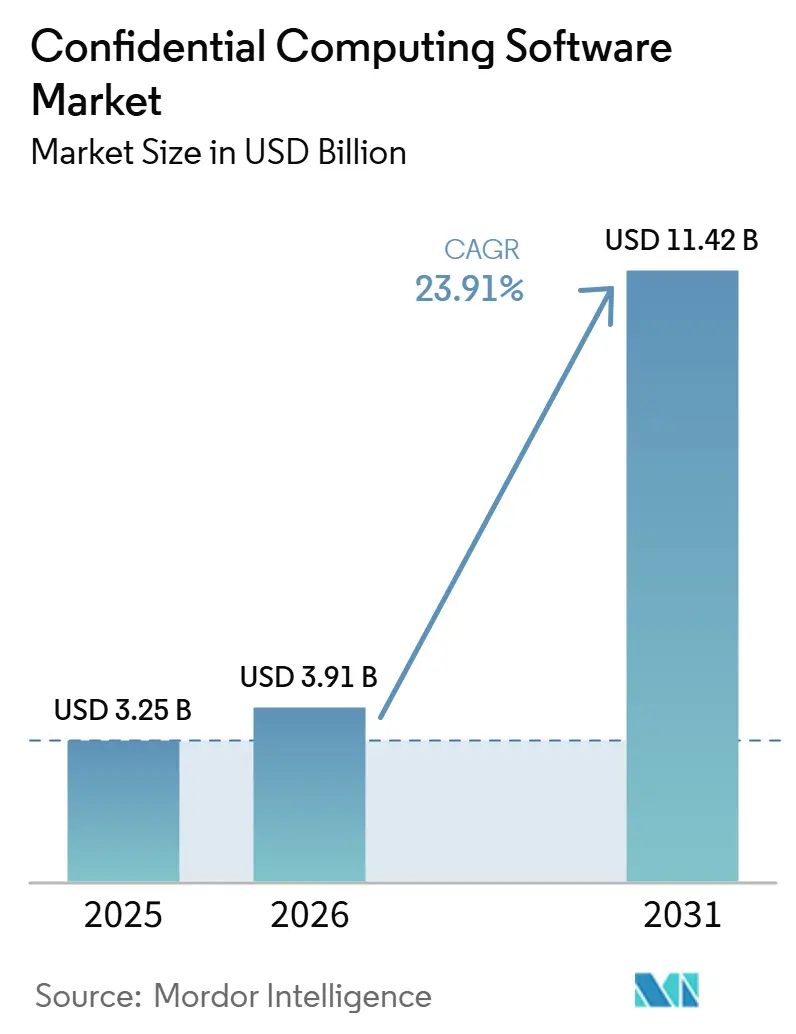
The Confidential Computing Software Market size was valued at USD 3.25 billion in 2025 and estimated to grow from USD 3.91 billion in 2026 to reach USD 11.42 billion by 2031, at a CAGR of 23.91% during the forecast period (2026-2031). Growth reflects the need to protect sensitive data while CPUs and GPUs process it, a need that encryption at rest and in transit does not address. Buyers are looking for platforms that manage enclaves, containers, and remote attestation without forcing them to redesign core applications. Regulatory expectations, cloud adoption, and the expansion of AI workloads are making data-in-use protection a more direct procurement consideration. Suppliers are combining managed infrastructure with policy tools and workload-specific software, while open-source projects are reducing lock-in at the runtime layer. The Confidential Computing Software Market also faces implementation, skills, and interoperability constraints that can slow production rollouts and delay the conversion of technical trials into repeatable operating environments.
Key Report Takeaways
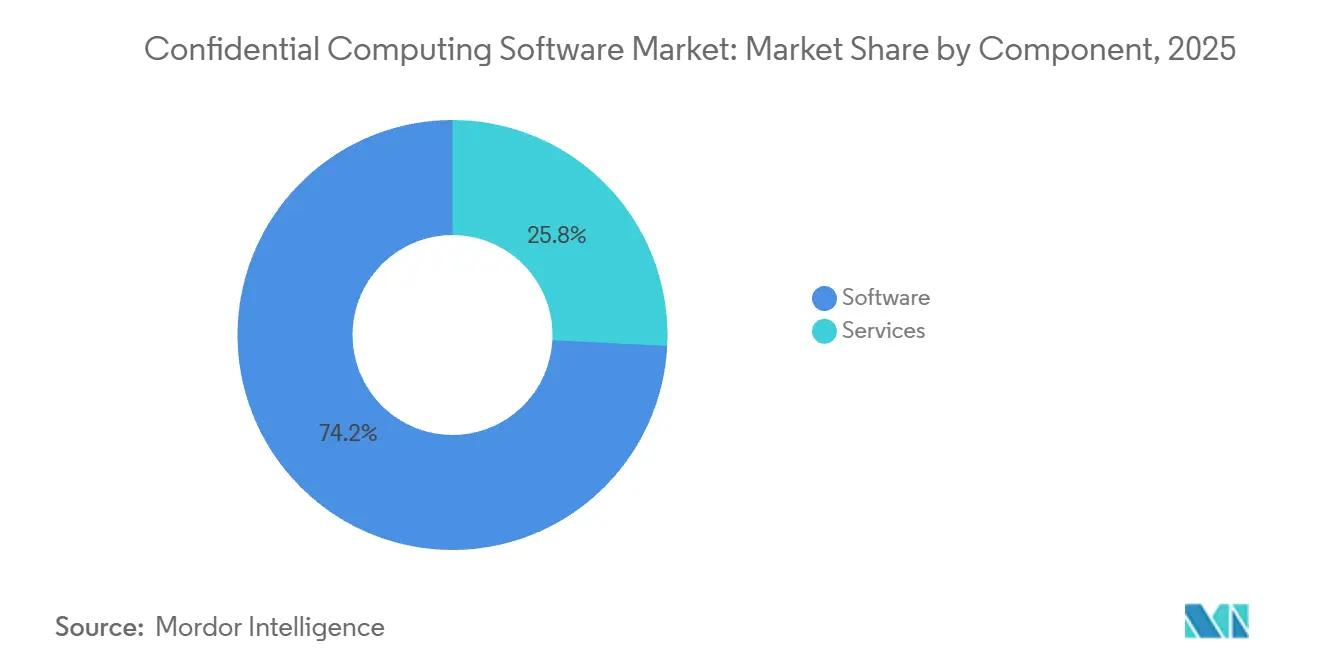
- By component, software accounted for 74.18% of revenue share in the Confidential Computing Software Market 2025, while services are projected to expand at a 25.82% CAGR through 2031.
- By deployment model, cloud accounted for 68.41% revenue share in the Confidential Computing Software Market 2025, while hybrid deployments are projected to expand at a 24.63% CAGR through 2031.
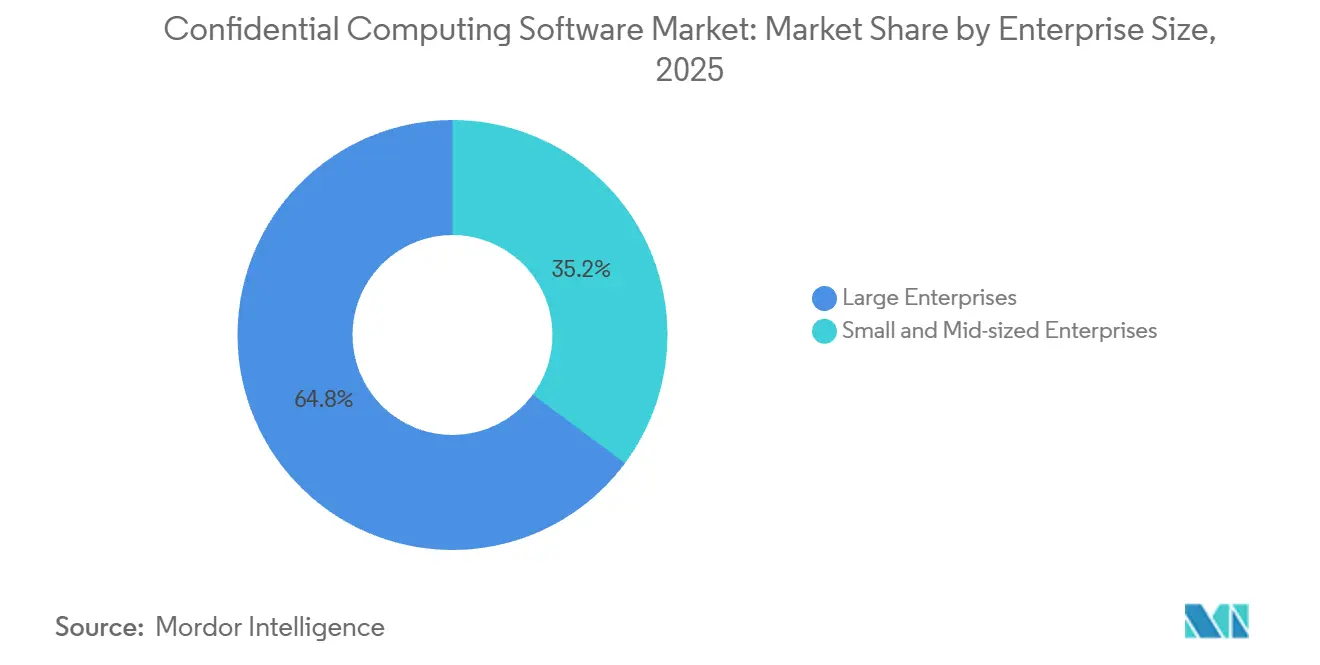
- By enterprise size, large enterprises accounted for 64.83% of revenue share in 2025, while small and mid-sized enterprises are projected to expand at a 25.14% CAGR through 2031.
- By end user, IT and telecommunications accounted for 24.36% of revenue share in the Confidential Computing Software Market 2025, while healthcare and life sciences are projected to expand at a 24.91% CAGR through 2031.
- By geography, North America held 34.62% revenue share in 2025, while Asia-Pacific is projected to expand at a 25.73% CAGR through 2031.
Note: Market size and forecast figures in this report are generated using Mordor Intelligence’s proprietary estimation framework, updated with the latest available data and insights as of January 2026.
Global Confidential Computing Software Market Trends and Insights
Drivers Impact Analysis*
| Driver | (~) % Impact on CAGR Forecast | Geographic Relevance | Impact Timeline |
|---|---|---|---|
| Regulatory Requirements for Data-in-Use Protection | +4.2% | Global, concentrated impact in North America and Europe | Medium term (2-4 years) |
| Expansion of Cloud and Hybrid-Cloud Workloads | +3.8% | Global | Short term (≤ 2 years) |
| Rising Cybersecurity Threats Against Sensitive Workloads | +3.5% | Global, strongest in North America and Europe | Short term (≤ 2 years) |
| Confidential AI Adoption for Sensitive Models and Data | +3.2% | North America, Europe, China | Medium term (2-4 years) |
| Cross-Domain Data Collaboration Without Data Disclosure | +2.7% | Europe, North America, Asia-Pacific | Medium term (2-4 years) |
| Remote Attestation as an Enterprise Procurement Requirement | +2.1% | North America and Europe | Short term (≤ 2 years) |
| Source: Mordor Intelligence | |||
Regulatory Requirements for Data-in-Use Protection
Regulatory requirements are creating a durable source of demand for the Confidential Computing Software Market. The EU AI Act (Regulation 2024/1689) has been in effect since August 2024 and requires safeguards for personal data processed by high-risk AI systems.[1]European Union, “Regulation (EU) 2024/1689,” Official Journal of the European Union, eur-lex.europa.eu DORA became applicable in January 2025 and has increased attention on ICT risk management within financial services. Sweden's data protection authority concluded in May 2026 that trusted execution environments can serve as a safeguard under GDPR Article 32 when controllers retain control of attestation verification and encryption keys. This position came from an operational deployment involving Volvo Group, Ericsson, and CanaryBit. It moves attestation key control from an engineering detail to a governance issue for regulated organizations.[2]Confidential Computing Consortium, “Sweden’s Data Protection Authority Issues Landmark GDPR Guidance on Trusted Execution Environments,” Confidential Computing Consortium, confidentialcomputing.io
Expansion of Cloud and Hybrid-Cloud Workloads
The movement of sensitive workloads into cloud and hybrid environments is widening the use case for the Confidential Computing Software Market. Data is available in plaintext while a processor uses it, leaving a gap that conventional storage and network encryption do not close. Cloud providers have added confidential virtual machines and confidential containers to their standard compute catalogs, reducing activation to a configuration choice for compatible instances. Microsoft made AMD SEV-SNP confidential VMs generally available for Azure Government in February 2026, extending hardware-enforced protection to U.S. government workloads across classification levels.[3]Microsoft Azure Government, “Announcing General Availability of Azure Confidential Computing Virtual Machines for U.S. Government Environments,” Microsoft, devblogs.microsoft.com Google Cloud also confirmed confidential GKE nodes on G4 machine series with NVIDIA RTX PRO 6000 Blackwell Server Edition GPUs in 2026. These offerings make confidential AI and data processing more accessible through existing cloud operating models.
Rising Cybersecurity Threats Against Sensitive Workloads
Security concerns are changing how buyers assess the Confidential Computing Software Market. Research published in 2024 and 2025 documented attacks, including BadRAM and TEE. Fail, and Battering Ram, showing that trusted execution environments require careful implementation and risk management. These findings are particularly important when attackers can gain physical access to hardware. Software-layer enclave protections still address many remote and privileged software attack paths, which supports continued demand for attestation and policy management. Enterprises are increasingly asking for machine-verifiable evidence that an approved workload ran in an approved environment. Suppliers that provide interoperable attestation chains are therefore better placed in procurement processes than vendors offering enclave support alone.
Confidential AI Adoption for Sensitive Models and Data
Confidential AI is extending the Confidential Computing Software Market beyond traditional security budgets. It allows organizations to run model inference and fine-tuning in attested execution environments that protect both model weights and customer data. This can support collaboration between organizations that cannot share their proprietary models or sensitive input data. Fortanix launched a Confidential AI offering powered by NVIDIA Confidential Computing in March 2026 for enterprise AI factory environments. Opaque Systems released OPAQUE 3.0 in July 2026 with Confidential MCP, and the Agent Manifest open standard for attested AI agent identity. These capabilities support evidence collection on agent behavior, access, and policy enforcement.[4]Opaque Systems, “OPAQUE 3.0 Brings Verifiable Trust to AI Agents with Governance and Confidential MCP,” Opaque Systems, opaque.co
Restraints Impact Analysis*
| Restraint | (~) % Impact on CAGR Forecast | Geographic Relevance | Impact Timeline |
|---|---|---|---|
| High Implementation and Integration Costs | -2.8% | Global, most acute for SMEs in Asia-Pacific and South America | Short term (≤ 2 years) |
| Shortage of Confidential-Computing and Cryptography Skills | -2.2% | Global, most acute in Asia-Pacific and Middle East and Africa | Long term (≥ 4 years) |
| Fragmented Attestation and Trust-Policy Ecosystems | -1.9% | Global | Medium term (2-4 years) |
| Performance Overhead and Exposure to TEE-Specific Attacks | -1.4% | Global | Medium term (2-4 years) |
| Source: Mordor Intelligence | |||
High Implementation and Integration Costs
Implementation costs can limit adoption in the Confidential Computing Software Market, especially for organizations with limited technology budgets. Production deployments require compatible AMD SEV-SNP, Intel TDX, or NVIDIA Confidential Computing hardware. They also require application changes, attestation pipeline configuration, and integration with existing identity and key-management systems. Cloud confidential virtual machines reduce the burden of hardware procurement but do not remove retrofitting and attestation integration costs. Large enterprises can often justify these expenses based on compliance requirements and high-value workloads. Smaller organizations may delay deployment when hybrid architectures add on-premises and cloud integration costs.
Shortage of Confidential-Computing and Cryptography Skills
The shortage of specialized skills remains a structural constraint for the Confidential Computing Software Market. Engineers need knowledge of trusted execution hardware, cryptographic attestation, enclave-aware development, and confidential Kubernetes operations. This combination is not yet widely covered by established certifications or university programs. The supply challenge is most acute in Asia-Pacific and the Middle East and Africa, where cybersecurity talent pools can be less deep. Vendor-led training can develop practitioners, but it may tie their knowledge to a specific technology ecosystem. Wider adoption will depend on more portable training and certification paths that can grow the practitioner base.
*Our forecasts treat driver/restraint impacts as directional, not additive. The impact forecasts reflect baseline growth, mix effects, and variable interactions.
Segment Analysis
By Component: Software Anchors Revenue, Services Respond to Complexity
Software held 74.18% of revenue in 2025. Enterprises use enclave management platforms, confidential virtual machine software, and remote attestation tools to extend protection across current cloud and on-premises environments. These products can support deployment without a complete application redesign. Confidential AI software and confidential container software are receiving greater investment as organizations protect Kubernetes workloads and GPU-based inference. Enclave management and remote attestation software remain important recurring revenue categories because they support core operating requirements. The Confidential Computing Software Market size for services is projected to grow at a 25.82% CAGR from 2026 to 2031.
Services grow faster because multi-vendor TEE environments often require external support for implementation, integration, monitoring, and policy management within the Confidential Computing Software Market. Red Hat made Confidential Containers on bare metal generally available in 2026, bringing hardware-backed memory encryption and attestation to on-premises Kubernetes environments and expanding the serviceable use case for hybrid deployments. Fortanix also joined the Cisco Secure AI Factory, alongside the NVIDIA ecosystem, in March 2026. This placed confidential AI capabilities within a broader enterprise infrastructure offer.


By Deployment Model: Cloud Leads, Hybrid Gains Strategic Importance
Cloud captured 68.41% of revenue in 2025. Microsoft, Google Cloud, and Amazon Web Services have built confidential capabilities into their compute services, reducing the need for customers to operate compatible TEE hardware. On-premises deployments continue to matter for air-gapped, classified, and highly sensitive manufacturing workloads. Microsoft’s February 2026 Azure Government release showed that government requirements can also be served through cloud-adjacent infrastructure. Red Hat’s bare-metal support provides organizations with another option when they need greater separation from a cloud operator.
Hybrid deployments are projected to expand at a 24.63% CAGR between 2026 and 2031. Financial services, healthcare, and government organizations need local control for some workloads but cloud-scale capacity for analytics, AI inference, and disaster recovery. Hybrid architectures place the most sensitive processing on local TEE nodes while using confidential cloud virtual machines for additional capacity. Shared attestation policies can connect those environments under a common control model. The Confidential Computing Software Market is also gaining from Fortanix and NTT DATA’s February 2026 partnership for sovereign AI factory deployments in India.
By Enterprise Size: Large Enterprises Drive Revenue, SMEs Support Growth
Large enterprises accounted for 64.83% of revenue in 2025. They have the engineering teams and compliance budgets needed to operate trusted execution environments, and financial institutions, global technology companies, and defense contractors are key users because they handle high-value data and face clear risk requirements. Healthcare providers and pharmaceutical companies also use these systems for federated research involving clinical and genomic data. The Confidential Computing Software Market has therefore developed its initial revenue base around buyers with established security and compliance functions. Hardware-enforced enclaves can turn attestation evidence into a repeatable governance artifact for healthcare security teams.
Small and mid-sized enterprises are projected to grow at a 25.14% CAGR between 2026 and 2031. Cloud instance pricing provides TEE protection through a per-instance premium rather than a separate hardware program. Managed offerings and pay-as-you-go attestation services can reduce deployment complexity. Healthcare, legal, fintech, and software-as-a-service businesses can use these services without building a complete security infrastructure internally. The Confidential Computing Software Market is supported because the EU AI Act imposes obligations based on AI system risk rather than solely on the size of its provider.
By End User: IT and Telecommunications Lead, Healthcare Gains Pace
IT and telecommunications accounted for 24.36% of revenue in 2025. The sector deploys the technology for its own network, cloud platform, and tenancy-isolation workloads. It also provides the infrastructure that enables other sectors to access TEE-enabled computing. Banking, financial services, and insurance are the second-largest end-user group, with uses in fraud analytics and confidential data collaboration. Automotive, retail, and industrial manufacturers use TEE isolation for telemetry, payment data, intellectual property, and production data.
Healthcare and life sciences are projected to expand at a 24.91% CAGR between 2026 and 2031. Healthcare organizations can use hardware-enforced enclaves to reduce the risk of administrator access in conventional cloud environments. A late-2025 academic framework described a confidential zero-trust approach for generative AI workloads on Google Cloud using hardware-attested TEEs. Medical institutions cannot freely pool patient data, which makes privacy-preserving collaboration important. The Confidential Computing Software Market has a role in supporting multi-institution research and diagnostic workflows.
Geography Analysis
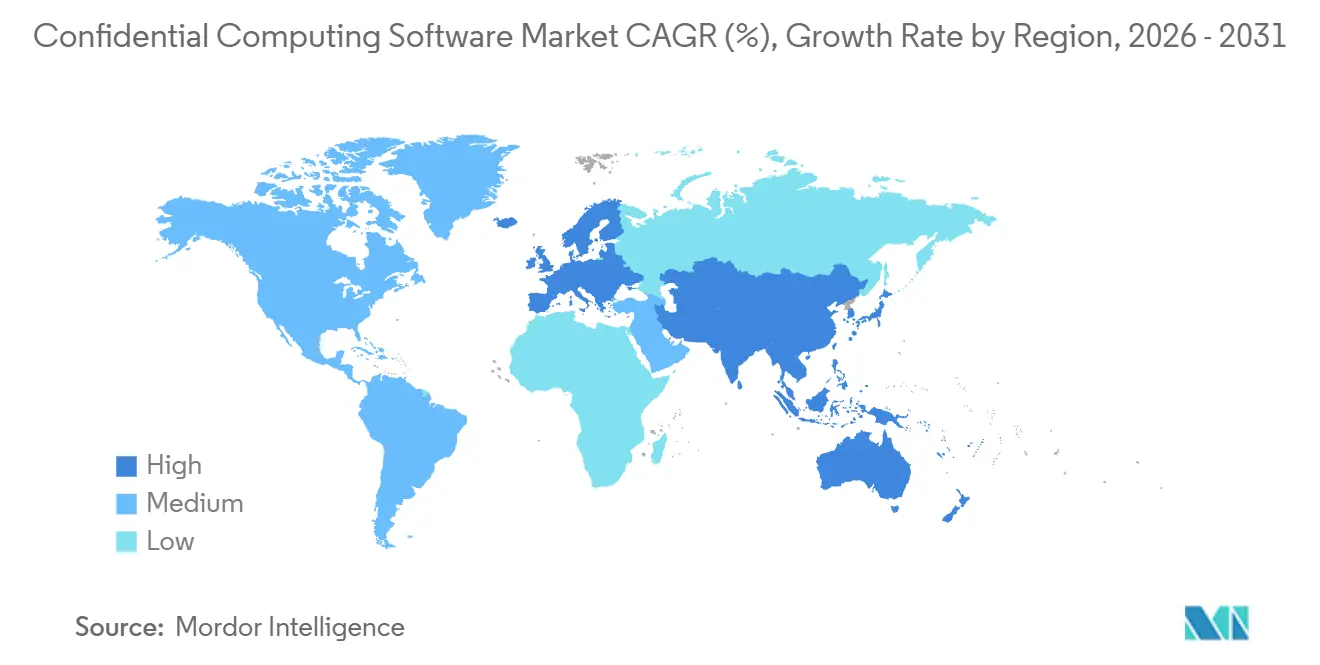
North America held 34.62% of the Confidential Computing Software Market share in 2025. The United States benefits from hyperscaler research and development, a large base of regulated enterprise buyers, and federal requirements for data-in-use protection. Microsoft expanded Azure Government confidential virtual machines across U.S. government classification levels in February 2026. This created a clearer procurement path for government users in FedRAMP-authorized environments. Canada also has cloud-adjacent financial services and healthcare organizations with data residency responsibilities.
Europe has a technically advanced buyer base, especially in Germany, the United Kingdom, and France. NIS2 obligations are encouraging investment among operators of essential services. The Swedish authority’s May 2026 GDPR position offers a practical basis for organizations evaluating TEEs as a technical safeguard. A January 2026 European Commission proposal seeks to align cybersecurity requirements more closely across member states.
Asia-Pacific is projected to expand at a 25.73% CAGR between 2026 and 2031. China issued GB/T 45230-2025 in January 2025, with implementation beginning in August 2025, providing a formal basis for domestic TEE procurement. India’s data sovereignty agenda is driving demand for secure AI infrastructure. The Fortanix and NTT DATA partnership for Indian AI factory deployments also serves the Confidential Computing Software Market. South America, the Middle East, and Africa remain early-stage regions, though Saudi Arabia, the UAE, Brazil, and Argentina show early demand in AI sovereignty, banking, fintech, and secure payment use cases.

Competitive Landscape
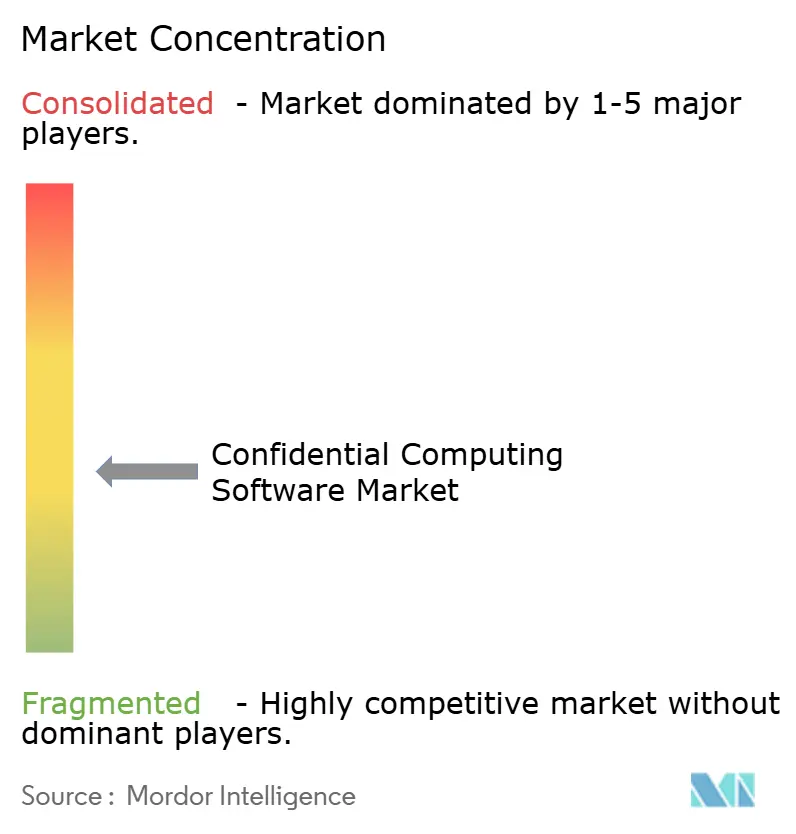
The Confidential Computing Software Market is moderately fragmented at the platform layer. Microsoft, Google, and Amazon Web Services control much of the infrastructure surface through managed confidential virtual machines and attestation services. Specialized vendors compete through policy management, enclave orchestration, and confidential AI tools. The hardware layer is more concentrated because silicon providers control TEE design and platform support. The Confidential Containers project became a CNCF incubating project in July 2026 with support from Microsoft, Intel, AMD, IBM, NVIDIA, Alibaba, and Red Hat.
Specialist providers are using partnerships and vertical focus rather than direct infrastructure competition. Fortanix has focused on AI factory deployments and data sovereignty through its integration with NVIDIA and partnerships with Cisco and NTT DATA. Its March 2026 offering protects model intellectual property and input data through hardware attestation. Opaque Systems acquired cryptographic AI technology from Abu Dhabi’s Technology Innovation Institute in May 2026, adding multiparty computation and fully homomorphic encryption. These actions show how vendors are extending beyond basic enclave deployment into governance and confidential AI workflows.
There remains room for providers that offer attestation policy templates for healthcare and industrial manufacturing. Lightweight tools for smaller cloud users may address cost and skills barriers. Post-quantum-ready enclave runtimes are another area of product development as organizations prepare for future cryptographic migration. The Confidential Computing Software Market industry remains competitive because runtime standardization does not eliminate differences in policy, integration, and workload support.
Confidential Computing Software Industry Leaders
Microsoft Corporation
Amazon Web Services, Inc.
Alphabet Inc.
Intel Corporation
International Business Machines Corporation
- *Disclaimer: Major Players sorted in no particular order

Recent Industry Developments
- July 2026: Confidential Containers became a CNCF incubating project, with backing from Microsoft Azure, Intel, AMD, IBM, NVIDIA, Alibaba, and Red Hat. The graduation signals broad open-source governance alignment on container-level TEE standardization and reduces vendor lock-in for Kubernetes-native confidential workloads across public cloud and on-premises deployments.
- July 2026: Opaque Systems released OPAQUE 3.0 with general availability in July 2026, introducing Confidential MCP, the first Model Context Protocol implementation secured through confidential computing, and the Agent Manifest open standard for verifiable AI agent identity. The platform enables enterprises to generate hardware-attested evidence of AI agent behavior, resource access, and governance policy enforcement, directly addressing EU AI Act Article 12 logging and auditability obligations.
- June 2026: Anjuna Security launched Anjuna Overwatch, described as the industry's first trusted control plane built on confidential computing to govern autonomous AI agent behavior, data access, compliance, and cost. The solution targets banking and government customers and builds on existing confidential computing partnerships in those verticals.
- March 2026: Opaque Systems acquired cryptographic AI technology from the Technology Innovation Institute, Abu Dhabi's applied research arm, following its USD 24 million Series B at a USD 300 million valuation. The acquisition adds multiparty computation and fully homomorphic encryption capabilities, extending OPAQUE's platform across training, fine-tuning, inference, and agent governance lifecycles with post-quantum cryptographic protections for enterprise and sovereign AI programs.


Global Confidential Computing Software Market Report Scope
The confidential computing software market refers to the ecosystem of software solutions and services that protect sensitive data while it is actively processed in memory. Unlike traditional cybersecurity measures that only protect data at rest and in transit, confidential computing software leverages hardware-based Trusted Execution Environments (TEEs) to isolate workloads and encrypt data in use, preventing unauthorized access from cloud providers, host operating systems, or malicious actors. This market includes specialized software for confidential virtual machines, confidential containers, enclave management, remote attestation to verify environment integrity, and confidential AI workloads. Deployed across cloud, hybrid, and on-premises environments, these solutions cater to organizations of varying sizes in highly regulated, data-sensitive industries such as BFSI, healthcare, and manufacturing. By ensuring absolute data privacy, maintaining computational integrity, and enabling secure multi-party collaboration without exposing raw data, confidential computing software empowers enterprises to unlock the full potential of sensitive datasets, distributed analytics, and AI models without compromising security or regulatory compliance.
The Confidential Computing Software Market Report is Segmented by Component (Software (Confidential Virtual Machine Software, Confidential Container Software, Enclave Management Software, Remote Attestation Software, and Confidential AI Software), and Services), Deployment Model (Cloud, Hybrid, and On-Premises), Enterprise Size (Large Enterprises, and Small and Mid-sized Enterprises), End Users (IT and Telecommunication, BFSI, Automotive and Transportation, Healthcare and Life Sciences, Retail and E-Commerce, Industrial Manufacturing, and Other End-Users), and Geography (North America, South America, Europe, Asia-Pacific, and Middle East and Africa). The Market Forecasts are Provided in Terms of Value (USD).
| Software | Confidential Virtual Machine Software |
| Confidential Container Software | |
| Enclave Management Software | |
| Remote Attestation Software | |
| Confidential AI Software | |
| Services |
| Cloud |
| Hybrid |
| On-Premises |
| Large Enterprises |
| Small and Mid-sized Enterprises |
| IT and Telecommunication |
| BFSI |
| Automotive and Transportation |
| Healthcare and Life Sciences |
| Retail and E-Commerce |
| Industrial Manufacturing |
| Other End Users |
| North America | United States | |
| Canada | ||
| Mexico | ||
| South America | Brazil | |
| Argentina | ||
| Rest of South America | ||
| Europe | Germany | |
| United Kingdom | ||
| France | ||
| Russia | ||
| Spain | ||
| Rest of Europe | ||
| Asia-Pacific | China | |
| Japan | ||
| India | ||
| South Korea | ||
| Southeast Asia | ||
| Rest of Asia-Pacific | ||
| Middle East and Africa | Middle East | Saudi Arabia |
| United Arab Emirates | ||
| Rest of Middle East | ||
| Africa | South Africa | |
| Nigeria | ||
| Rest of Africa | ||
| By Component | Software | Confidential Virtual Machine Software | |
| Confidential Container Software | |||
| Enclave Management Software | |||
| Remote Attestation Software | |||
| Confidential AI Software | |||
| Services | |||
| By Deployment Model | Cloud | ||
| Hybrid | |||
| On-Premises | |||
| By Enterprise Size | Large Enterprises | ||
| Small and Mid-sized Enterprises | |||
| By End Users | IT and Telecommunication | ||
| BFSI | |||
| Automotive and Transportation | |||
| Healthcare and Life Sciences | |||
| Retail and E-Commerce | |||
| Industrial Manufacturing | |||
| Other End Users | |||
| By Geography | North America | United States | |
| Canada | |||
| Mexico | |||
| South America | Brazil | ||
| Argentina | |||
| Rest of South America | |||
| Europe | Germany | ||
| United Kingdom | |||
| France | |||
| Russia | |||
| Spain | |||
| Rest of Europe | |||
| Asia-Pacific | China | ||
| Japan | |||
| India | |||
| South Korea | |||
| Southeast Asia | |||
| Rest of Asia-Pacific | |||
| Middle East and Africa | Middle East | Saudi Arabia | |
| United Arab Emirates | |||
| Rest of Middle East | |||
| Africa | South Africa | ||
| Nigeria | |||
| Rest of Africa | |||


Key Questions Answered in the Report
What is the Confidential Computing Software Market size?
The Confidential Computing Software Market is estimated at USD 3.91 billion in 2026 and is forecast to reach USD 11.42 billion by 2031, growing at a 23.91% CAGR.
What is driving demand for confidential computing software?
Demand is supported by data-in-use protection requirements, cloud and hybrid workloads, security concerns, and confidential AI deployment.
Which component leads confidential computing spending?
Software led with 74.18% revenue share in 2025, supported by enclave management, confidential virtual machines, and remote attestation tools.
Which deployment model is growing fastest?
Hybrid deployments are projected to grow at a 24.63% CAGR through 2031 as regulated organizations combine local control with cloud capacity.
Which end user is expected to grow fastest?
Healthcare and life sciences are projected to grow at a 24.91% CAGR through 2031 because of secure clinical, genomic, and AI research workflows.
Which region is projected to grow fastest?
Asia-Pacific is projected to expand at a 25.73% CAGR through 2031, supported by standards, data sovereignty initiatives, and secure AI infrastructure demand.
Page last updated on:


 Your data is secure and never sold or shared.


