
Concrete Sealers Market Size and Share
Market Overview
| Study Period | 2022 - 2032 |
|---|---|
| Market Size (2027) | USD 2.57 Billion |
| Market Size (2032) | USD 3.5 Billion |
| Growth Rate (2027 - 2032) | 6.38 % |
| Fastest Growing Market | Asia-Pacific |
| Largest Market | Asia-Pacific |
| Market Concentration | Medium |
Major Players *Disclaimer: Major Players sorted in no particular order Image © Mordor Intelligence. Reuse requires attribution under CC BY 4.0. | |
Concrete Sealers Market Analysis by Mordor Intelligence
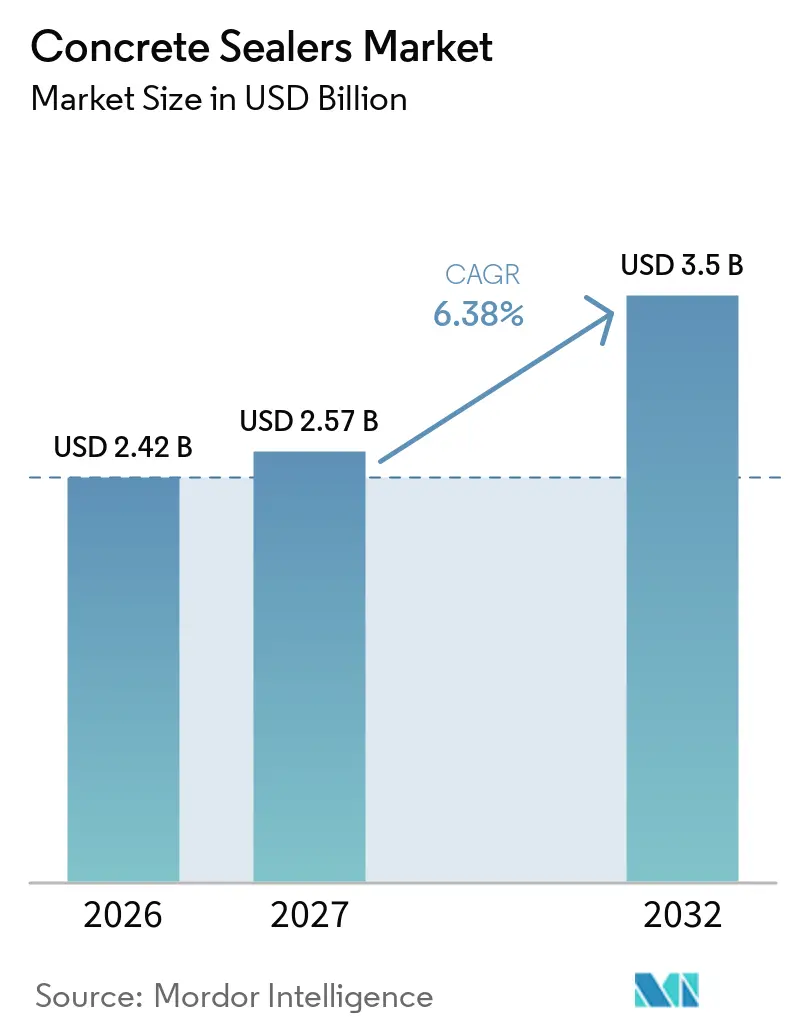
The Concrete Sealers Market size was valued at USD 2.42 billion in 2026 and is estimated to grow from USD 2.57 billion in 2027 to reach USD 3.50 billion by 2032, at a CAGR of 6.38% during the forecast period (2027-2032). The concrete sealers market benefits from recurring protection and maintenance needs across bridges, parking structures, industrial floors, and residential pavements. Moisture ingress, chloride penetration, abrasion, and thermal cycling can damage unprotected concrete, which supports demand for protective treatments. Maintenance and rehabilitation spending can remain active when new construction slows, since existing assets still require protection and repair. Water-based and other lower-emission formulations are becoming more important as product requirements and contractor preferences change. Suppliers are responding through formulation development, certification, technical support, and distribution investment.
Key Report Takeaways
- By type, water-based sealers held 52.11% of the concrete sealers market share in 2026 and are forecast to advance at a 6.74% CAGR through 2032.
- By function, penetrating sealers held 40.34% of the concrete sealers market share in 2026 and are forecast to advance at a 6.83% CAGR through 2032.
- By product chemistry, acrylic sealers held 27.83% of the concrete sealers market share in 2026, while silane and siloxane sealers are forecast to advance at a 6.91% CAGR through 2032.
- By application, commercial held 42.42% of the concrete sealers market share in 2026 and is forecast to advance at a 7.15% CAGR through 2032.
- By geography, Asia-Pacific held 45.38% of the concrete sealers market share in 2026 and is forecast to advance at a 7.09% CAGR through 2032.
Note: Market numbers in this report are based on Mordor Intelligence's proprietary estimation framework, which combines nine months of actuals with Q4 projections for base year 2026.
Market Trends and Insights
Drivers Impact Analysis of Concrete Sealers Market*
| Driver | (~) % Impact on CAGR Forecast | Geographic Relevance | Impact Timeline |
|---|---|---|---|
| Infrastructure Rehabilitation and Lifecycle Asset Preservation | +1.8% | Global, strongest in North America, Europe, and APAC | Long term (≥ 4 years) |
| Non-Residential Flooring and High-Traffic Surface Protection | +1.2% | Global, concentrated in North America and APAC | Medium term (2-4 years) |
| Low-VOC and Water-Based Formulation Adoption | +1.0% | North America & EU, extending to APAC | Medium term (2-4 years) |
| Decorative Concrete and Appearance-Retention Demand | +0.8% | North America, Europe, APAC urban centers | Short term (≤ 2 years) |
| Freeze-Thaw, Chloride and Moisture-Damage Mitigation | +0.6% | Northern Hemisphere temperate zones; coastal and marine structures globally | Long term (≥ 4 years) |
| Source: Mordor Intelligence | |||
Infrastructure Rehabilitation and Lifecycle Asset Preservation
Aging public assets are making concrete sealers a more regular part of asset preservation programs. The American Society of Civil Engineers reported that 6.8% of 623,218 U.S. bridges were in poor condition in 2025. It also identified a USD 373 billion 10-year funding gap and USD 191.3 billion in bridge rehabilitation needs. Penetrating silane and siloxane treatments can be specified with structural repairs because they help limit water and chloride exposure. This practice supports the concrete sealers market by connecting product demand to rehabilitation work rather than only to new construction. It also encourages public agencies to consider service life and maintenance needs when selecting protection systems.
Non-Residential Flooring and High-Traffic Surface Protection
Retailers, warehouse operators, and logistics facilities use sealed concrete where floors must tolerate traffic and frequent cleaning. BASF stated in February 2026 that grocery and large-format retail operators were increasingly specifying polished concrete systems for durability and maintenance performance. The concrete sealers market, therefore, gains demand from both new facilities and from existing floors that require renewal. Auto-scrubber cleaning, heavy carts, and forklift activity can increase the value of durable floor protection. RPM International Inc. reported USD 7.4 billion in consolidated net sales in fiscal 2025, with its Construction Products Group as an important business area. This operating base includes concrete protection products sold through The Euclid Chemical Company.
Low-VOC and Water-Based Formulation Adoption
Low-volatile organic compound (VOC) requirements are changing sealer formulation choices in several regions. Clark County, Nevada, set a 100 grams per liter VOC limit for concrete and masonry sealers under Architectural, Industrial, and Maintenance (AIM) Rule 130, effective December 31, 2025[1]. Green Seal GS-11, issued in March 2025, uses California Air Resources Board Suggested Control Measure limits as a certification reference. In March 2025, Sika AG and BASF introduced Baxxodur EC 151, an epoxy hardener designed for systems with up to 90% lower VOC emissions than conventional hardeners. The concrete sealers market is likely to favor manufacturers that can meet these requirements while preserving application and curing performance.
Decorative Concrete and Appearance-Retention Demand
Decorative concrete requires protective finishes that preserve visual depth, texture, and surface appearance. LKAB Minerals reported a preference among architects and commercial specifiers for mineral-based and natural-finish decorative concrete in February 2026. Such surfaces can require clear and non-yellowing sealers to maintain their intended appearance. The Euclid Chemical Company noted that water-based stains and sealers can support indoor air quality objectives in institutional and municipal projects. Retail and hospitality projects also use decorative systems with metallic flake or quartz aggregate to obtain a finished appearance without natural stone. This use case broadens demand for clear topical sealers in refurbishment work.
Restraints Impact Analysis of Concrete Sealers Market*
| Restraint | (~) % Impact on CAGR Forecast | Geographic Relevance | Impact Timeline |
|---|---|---|---|
| Volatile Resin, Silane and Additive Input Costs | -1.5% | Global, most acute in Europe and Asia-Pacific | Short term (≤ 2 years) |
| VOC Compliance and Reformulation Burden | -1.2% | North America & EU, with spillover to APAC | Medium term (2-4 years) |
| Surface-Preparation and Applicator Skill Sensitivity | -0.7% | Global, most acute in emerging markets | Long term (≥ 4 years) |
| Source: Mordor Intelligence | |||
Volatile Resin, Silane and Additive Input Costs
Concrete sealer production relies on acrylic resins, silanes, siloxanes, and specialty additives. The costs of these materials can change with petrochemical feedstock conditions and silicon supply availability. This volatility can reduce manufacturer margins when suppliers cannot fully pass higher costs to customers. Smaller manufacturers may face more pressure if they lack long-term supply agreements or a broad purchasing scale. The concrete sealers market can also experience product range rationalization during periods of higher input costs. That response can shift sales toward lower-priced products even when project volumes remain stable.
VOC Compliance and Reformulation Burden
VOC requirements can create added cost and time for manufacturers that sell across several jurisdictions. The U.S. Environmental Protection Agency regulates VOC emissions for consumer and commercial products under 40 CFR Part 59[2]. State and local requirements can also require product registers and formulations that meet different thresholds. LATICRETE International, Inc. announced per- and polyfluoroalkyl substances (PFAS)-free reformulations for four STONETECH sealer lines in March 2026. Such changes show the continuing need to update chemistry as product specifications evolve. Development, validation, and inventory transitions can create near-term pressure for suppliers in the concrete sealers market.
*Our forecasts treat driver/restraint impacts as directional, not additive. The impact forecasts reflect baseline growth, mix effects, and variable interactions.
Concrete Sealers Market Segment Analysis
By Type:
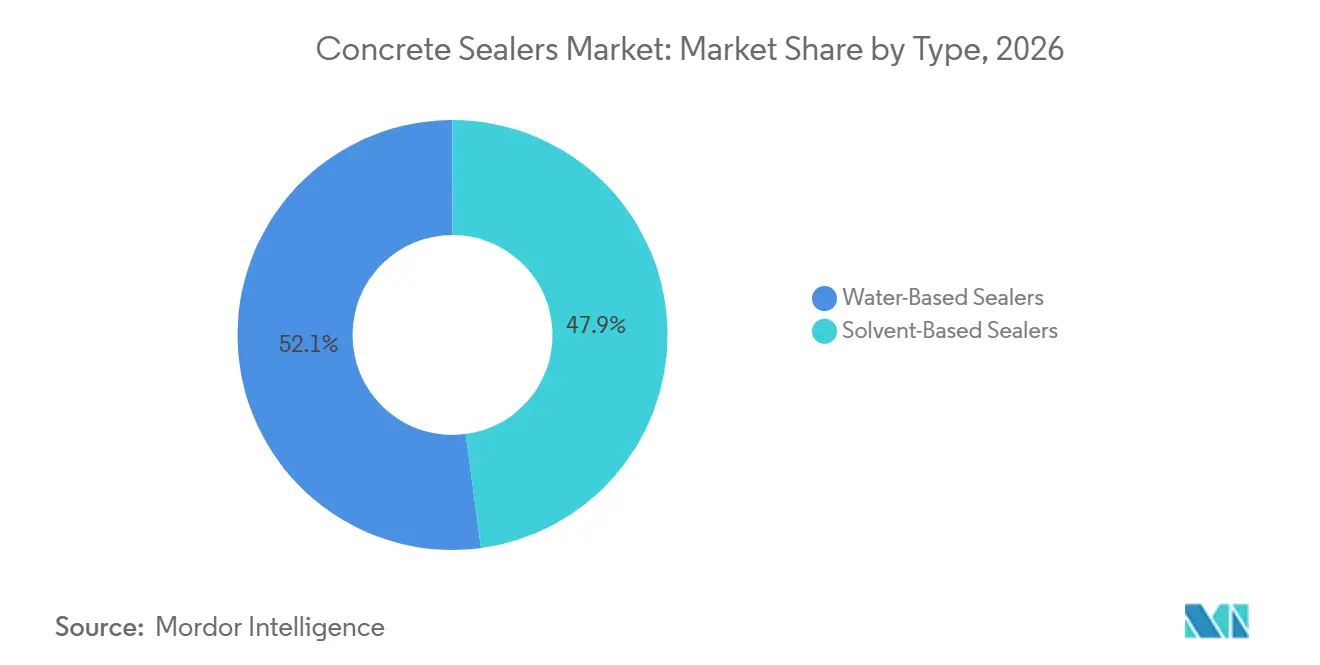
Water-Based Sealers Lead Both Scale and GrowthWater-based sealers held 52.11% of the concrete sealers market share in 2026 and are forecast to advance at a 6.74% CAGR through 2032. This leading position reflects a lasting change in product selection rather than a temporary shift. Lower-emission requirements support water-based formulations in commercial, institutional, and public projects. Contractor preferences also favor products that are easier to handle and clean up. The concrete sealers market size for water-based sealers is supported by these regulatory and practical benefits.
Solvent-based sealers continue to serve uses that require deep penetration on dense concrete and finishes with ultraviolet stability. They remain relevant in demanding outdoor settings where exposure conditions can be severe. However, the product development focus is moving toward solvent-free and hybrid alternatives. Wacker Chemie AG presented SILRES BS 6920, an alpha-silane binder for solvent-free concrete floor sealing, in March 2025. The product was presented alongside concrete protection technologies certified under EN 1504-2. As these systems become more widely available, solvent-based products may face a narrower set of performance-led uses.
By Function:
Penetrating Sealers Build Specification MomentumPenetrating sealers held 40.34% of the concrete sealers market share in 2026 and are projected to advance at a 6.83% CAGR through 2032. Their share and growth profile reflect use in transportation, parking, and other exposed assets. These products protect concrete by entering the substrate instead of relying only on a film at the surface. This characteristic is useful where freeze-thaw cycles, abrasion, and water exposure can damage surface coatings. The concrete sealers market size for penetrating systems is, therefore, closely tied to asset preservation requirements.
Transportation agencies often select silane and siloxane treatments because they can limit water and chloride entry while allowing vapor movement. The 2025 Frontiers in Materials study reported a 54.3% reduction in chloride migration coefficients for a silane-cement-based penetrant composite coating compared with untreated concrete. Topical sealers still have a role in decorative concrete and interiors where appearance and stain resistance are central requirements. Other functional products include hybrid systems that provide some penetration with surface hardening. Curecrete Distribution, Inc. operates in this area through lithium silicate-based densifiers. These products support dust resistance and floor durability in facilities with existing concrete slabs.
By Product Chemistry:
Acrylic Sealers Lead, While Silane and Siloxane Sealers ExpandAcrylic sealers held 27.83% of the concrete sealers market share in 2026. Their position is supported by decorative concrete, commercial floor, and residential uses that value ultraviolet stability and gloss control. Acrylic formulations can provide a practical option where visual finish and cost are important. Silane and siloxane sealers are projected to advance at a 6.91% CAGR through 2032. Their growth is linked to bridge decks, parking structures, and marine assets where chloride exclusion and vapor permeability are important.
Wacker Chemie AG offers SILRES products for concrete surface protection that are certified under EN 1504-2. Such credentials can matter in tenders where public agencies specify performance and compliance requirements. Silicate and siliconate sealers serve floor-hardening and dust-proofing needs through reactions with free calcium in concrete. Epoxy and polyurethane sealers are used in commercial and industrial settings that need stronger abrasion and chemical resistance. Mapei S.p.A. introduced Mapefloor Finish 56, a UV-resistant polyaspartic resin topcoat, in January 2026. The launch reflects continuing development of fast-curing, durable film-forming products for protected concrete floors.
By Application:
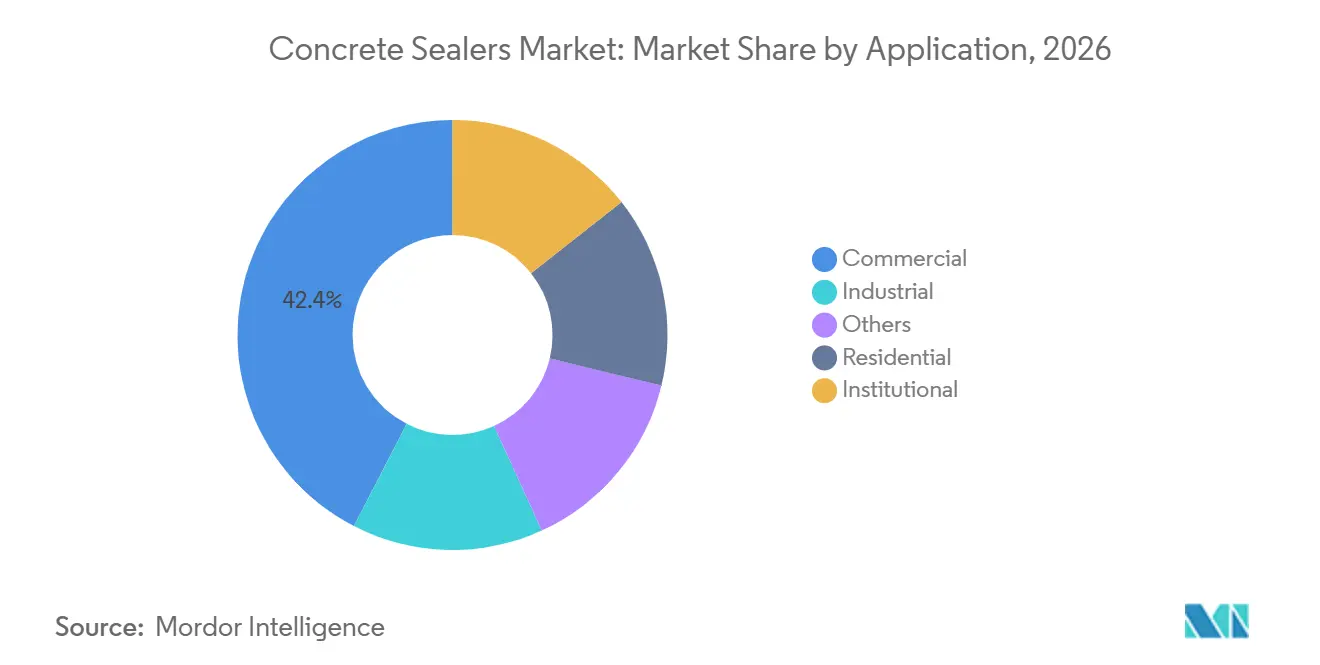
Commercial Leads Both Scale and GrowthThe commercial segment held 42.42% of the concrete sealers market share in 2026 and is projected to advance at a 7.15% CAGR through 2032. Retail renovation, logistics expansion, and institutional upgrades support this position. Sealed concrete is used where facilities need a durable floor that tolerates cleaning and repeated traffic. BASF described growing use of polished concrete systems by grocery and large-format retailers in February 2026. This change supports demand for systems that perform under food-acid exposure, cart traffic, and auto-scrubber cleaning.
Residential use remains important for driveways, garage floors, patios, and decorative interior surfaces. Demand in this area is more sensitive to consumer confidence and housing turnover than commercial or public projects. Industrial facilities select high-build epoxy or polyurethane systems where chemicals, heavy equipment, or processing conditions require stronger protection. These systems can carry higher unit values than standard acrylic or penetrating products. Institutional and infrastructure applications mainly use penetrating silane and siloxane products under lifecycle-cost frameworks. This range of uses helps the concrete sealers market serve both visual and protective performance needs.

Geography Analysis
APAC Concrete Sealers Market
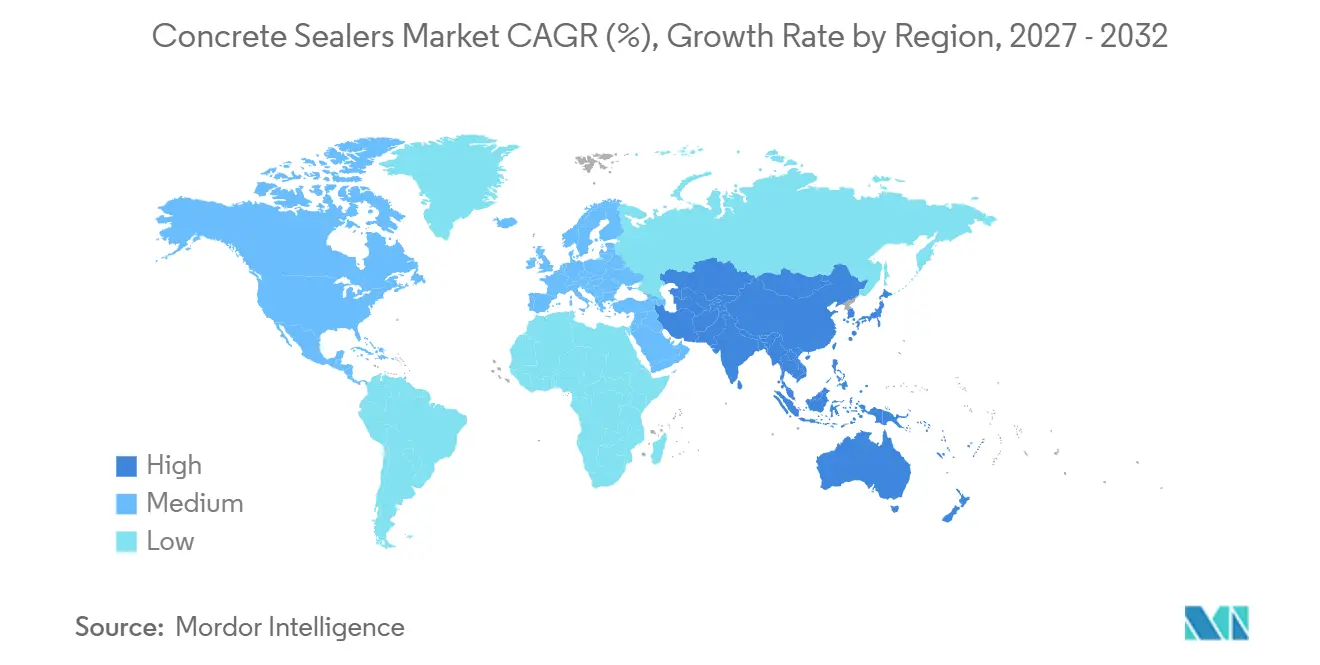
Asia-Pacific held 45.38% of the concrete sealers market share in 2026 and is projected to advance at a 7.09% CAGR through 2032. The region combines large construction activity with increasing rehabilitation needs and higher performance expectations for commercial floors. India, China, and the Association of Southeast Asian Nations (ASEAN) markets support demand through urban development and infrastructure work. China’s move toward construction quality can support greater use of penetrating products in transport infrastructure. Japan and South Korea provide demand from dense commercial real estate and established urban infrastructure.
The Americas and Europe Concrete Sealers Market
North America remains an important market because of infrastructure rehabilitation, a developed applicator network, and renovation activity in warehouses and retail properties. Public asset repair supports demand for penetrating treatments that help manage chloride and moisture exposure. Europe is shaped by rehabilitation programs and green-building renovation requirements. The Nordic countries need products that perform in frequent freeze-thaw conditions. These conditions increase the need for high-penetration silane and siloxane systems. South America is supported by industrial facilities and commercial development in Brazil and Argentina.
Argentina and MEA Concrete Sealers Market
BASF began local production of Acronal 1840 water-based acrylic dispersion in Argentina in February 2026. The product is intended for cementitious waterproofing systems and can reduce reliance on imported materials for regional formulators. The Middle East and Africa hold a smaller revenue position but have long-term potential in high-temperature, high-ultraviolet, and coastal environments. Gulf Cooperation Council (GCC) programs are creating infrastructure assets exposed to severe chloride conditions. These conditions support the use of premium penetrating sealers. South Africa contributes demand through commercial construction and mining facility maintenance, while wider urbanization supports gradual adoption across the region.
Competitive Landscape
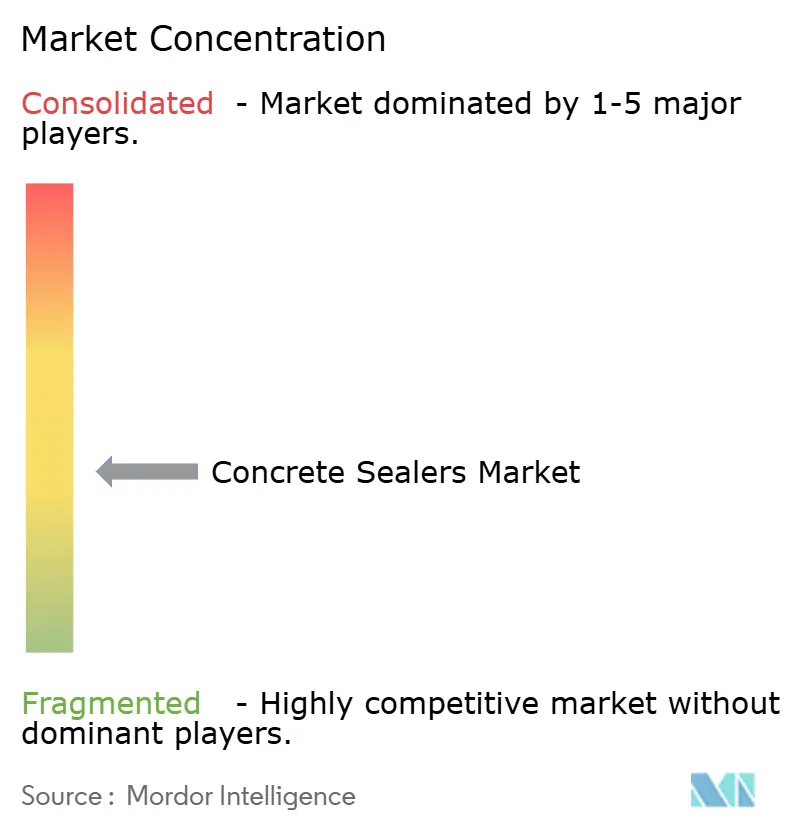
The concrete sealers market is moderately concentrated, with the top five players including Sika AG, BASF, RPM International Inc., PPG Industries Inc., and Mapei S.p.A. Sika AG, BASF, and RPM International Inc. compete through broad portfolios, product certifications, technical service, and manufacturing reach. Mapei S.p.A., W. R. Meadows, Inc., PPG Industries Inc., and The Sherwin-Williams Company maintain positions through contractor relationships and coating portfolios. These participants address different combinations of construction, decorative, flooring, and infrastructure applications.
Sika AG and BASF commercialized Baxxodur EC 151 in March 2025 for epoxy systems. The hardener is designed to enable flooring systems with up to 90% lower VOC emissions than conventional hardeners and to cure at temperatures as low as 5 °C. This product development addresses emissions requirements and practical installation needs. Wacker Chemie AG highlighted solvent-free binder technology and EN 1504-2-certified protection products in March 2025. These efforts show how suppliers use formulation development and certification to compete for technically demanding projects.
Specialist brands such as Foundation Armor and PROSOCO, INC. compete through professional channels, direct contractor access, and products designed for specific surfaces. The Euclid Chemical Company and Wacker Chemie AG differentiate through engineering-oriented products used in infrastructure and public procurement. LATICRETE International, Inc. introduced PFAS-free STONETECH sealer formulations in March 2026. The move may support access to institutional projects where product chemistry requirements are changing. Competition will continue to center on compliant chemistry, validated performance, application support, and access to professional distribution channels.
Concrete Sealers Industry Leaders
-
Sika AG
-
BASF
-
RPM International Inc.
-
PPG Industries Inc.
-
Mapei S.p.A.
- *Disclaimer: Major Players sorted in no particular order
Concrete Sealers Market Companies Covered in this Report
- Arkema
- BASF
- Curecrete Distribution, Inc.
- Evonik Industries AG
- Foundation Armor
- LATICRETE International, Inc.
- Mapei S.p.A.
- PPG Industries Inc.
- PROSOCO, INC.
- RPM International Inc.
- Sika AG
- The Euclid Chemical Company
- The Sherwin-Williams Company
- W. R. Meadows, Inc.
- Wacker Chemie AG
Recent Industry Developments in Concrete Sealers Market
- May 2026: BASF introduced Efka PX 4720, a high-silica matting agent for solvent-free UV coating formulations, at the American Coatings Show 2026. The product supports the concrete sealers market by enabling ultra-matte finishes in uv-cured concrete and industrial floor sealer topcoats, particularly in 100%-solids coating systems.
- March 2026: LATICRETE International, Inc. announced reformulated STONETECH sealer products, including BulletProof Sealer, Heavy Duty Sealer and Enhancer Pro Sealer, without intentionally added PFAS while maintaining water-based, low-VOC formulations. The reformulation supports the concrete sealers market by expanding options for stone and concrete surface protection that align with growing demand for lower-emission products and reduced use of potentially harmful chemicals.
Global Concrete Sealers Market Report Scope
Concrete sealers are protective coatings or treatments applied to concrete surfaces to reduce moisture penetration, chemical exposure, staining, and surface deterioration. They help improve the durability and service life of concrete in indoor and outdoor environments.
The Concrete Sealers Market is segmented by type, function, product chemistry, application, and geography. By type, the market is segmented into water-based sealers and solvent-based sealers. By function, the market is segmented into topical sealers, penetrating sealers, and others. By product chemistry, the market is segmented into silane and siloxane sealers, silicate and siliconate sealers, acrylic sealers, epoxy sealers, polyurethane sealers, and others. By application, the market is segmented into commercial, residential, industrial, institutional, and other applications. The report also covers the market size and forecasts for concrete sealers across 15 countries. For each segment, the market sizing and forecasts have been done on the basis of value (USD).
Segmentation Overview
| Water-Based Sealers |
| Solvent-Based Sealers |
| Topical Sealers |
| Penetrating Sealers |
| Others |
| Silane and Siloxane Sealers |
| Silicate and Siliconate Sealers |
| Acrylic Sealers |
| Epoxy Sealers |
| Polyurethane Sealers |
| Others |
| Commercial |
| Residential |
| Industrial |
| Institutional |
| Others |
| Asia-Pacific | China |
| India | |
| Japan | |
| South Korea | |
| ASEAN Countries | |
| Rest of Asia-Pacific | |
| North America | United States |
| Canada | |
| Mexico | |
| Europe | Germany |
| United Kingdom | |
| France | |
| Italy | |
| NORDIC Countries | |
| Rest of Europe | |
| South America | Brazil |
| Argentina | |
| Rest of South America | |
| Middle East and Africa | Saudi Arabia |
| South Africa | |
| Rest of Middle East and Africa |
| By Type | Water-Based Sealers | |
| Solvent-Based Sealers | ||
| By Function | Topical Sealers | |
| Penetrating Sealers | ||
| Others | ||
| By Product Chemistry | Silane and Siloxane Sealers | |
| Silicate and Siliconate Sealers | ||
| Acrylic Sealers | ||
| Epoxy Sealers | ||
| Polyurethane Sealers | ||
| Others | ||
| By Application | Commercial | |
| Residential | ||
| Industrial | ||
| Institutional | ||
| Others | ||
| By Geography | Asia-Pacific | China |
| India | ||
| Japan | ||
| South Korea | ||
| ASEAN Countries | ||
| Rest of Asia-Pacific | ||
| North America | United States | |
| Canada | ||
| Mexico | ||
| Europe | Germany | |
| United Kingdom | ||
| France | ||
| Italy | ||
| NORDIC Countries | ||
| Rest of Europe | ||
| South America | Brazil | |
| Argentina | ||
| Rest of South America | ||
| Middle East and Africa | Saudi Arabia | |
| South Africa | ||
| Rest of Middle East and Africa | ||
Key Questions Answered in the Report
What is the size of the concrete sealers market?
The concrete sealers market size was valued at USD 2.42 billion in 2026 and is estimated to grow from USD 2.57 billion in 2027 to reach USD 3.50 billion by 2032, at a CAGR of 6.38% during the forecast period (2027-2032).
What is driving demand for concrete sealers?
Infrastructure rehabilitation, high-traffic commercial flooring, lower-emission product adoption, decorative surfaces, and protection from moisture and chlorides support demand.
Which concrete sealer type held the largest share in 2026?
Water-based sealers held a 52.11% share in 2026, supported by lower-emission requirements and contractor handling preferences.
Which product chemistry is projected to advance fastest through 2032?
Silane and siloxane sealers are projected to advance at a 6.91% CAGR through 2032 because of their use in exposed infrastructure assets.