
Computer Vision-Assisted Manual Inspection Market Size and Share
Market Overview
| Study Period | 2020 - 2031 |
|---|---|
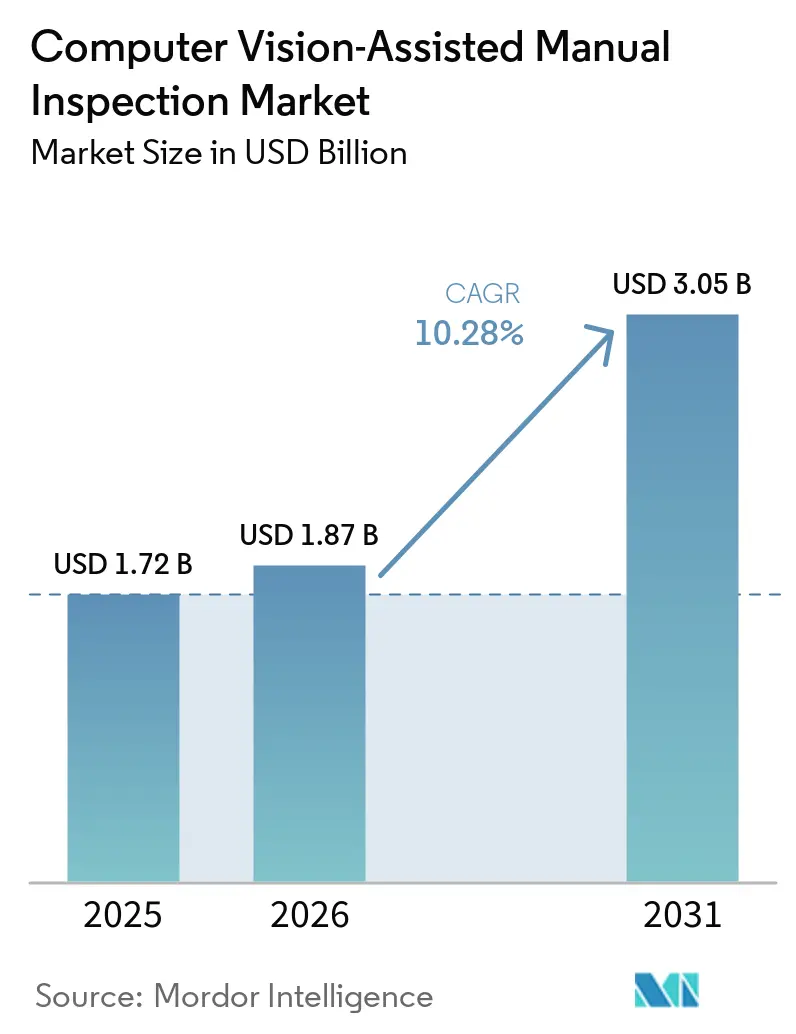
| Market Size (2026) | USD 1.87 Billion |
| Market Size (2031) | USD 3.05 Billion |
| Growth Rate (2026 - 2031) | 10.28 % |
| Fastest Growing Market | Middle East and Africa |
| Largest Market | Asia-Pacific |
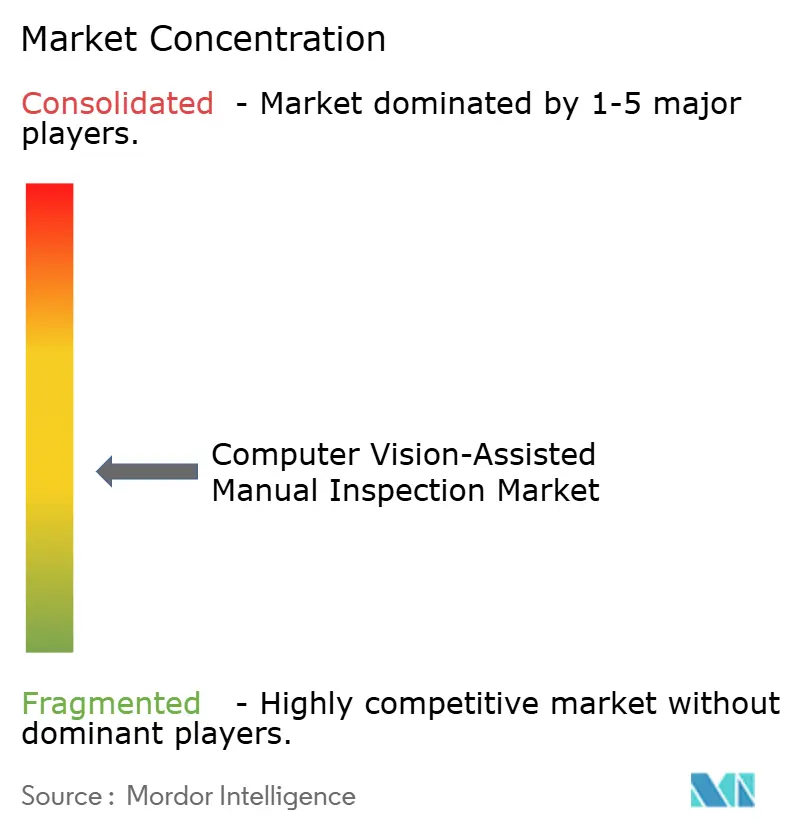
| Market Concentration | Medium |
Major Players
*Disclaimer: Major Players sorted in no particular order Image © Mordor Intelligence. Reuse requires attribution under CC BY 4.0. |
|
Computer Vision-Assisted Manual Inspection Market Analysis by Mordor Intelligence
The Computer Vision-Assisted Manual Inspection Market size is projected to be USD 1.72 billion in 2025, USD 1.87 billion in 2026, and reach USD 3.05 billion by 2031, expanding at a CAGR of 10.28% from 2026 to 2031. The Computer Vision-Assisted Manual Inspection Market is being supported by manufacturers that are moving quality checks from manual review toward AI-supported visual workflows. Electronics, automotive, food processing, and renewable energy plants need faster inspection while maintaining documented quality controls. Inspection records are also becoming useful production data because they can support yield management, process control, and product traceability. This shift creates an opening in the Computer Vision-Assisted Manual Inspection Market for suppliers that can combine cameras, computing equipment, software, and ongoing model support within practical deployment plans. The Computer Vision-Assisted Manual Inspection Market also faces a deployment gap because many manufacturing vision projects remain at the pilot stage, while model drift can add recurring service needs in variable production environments.
Key Report Takeaways
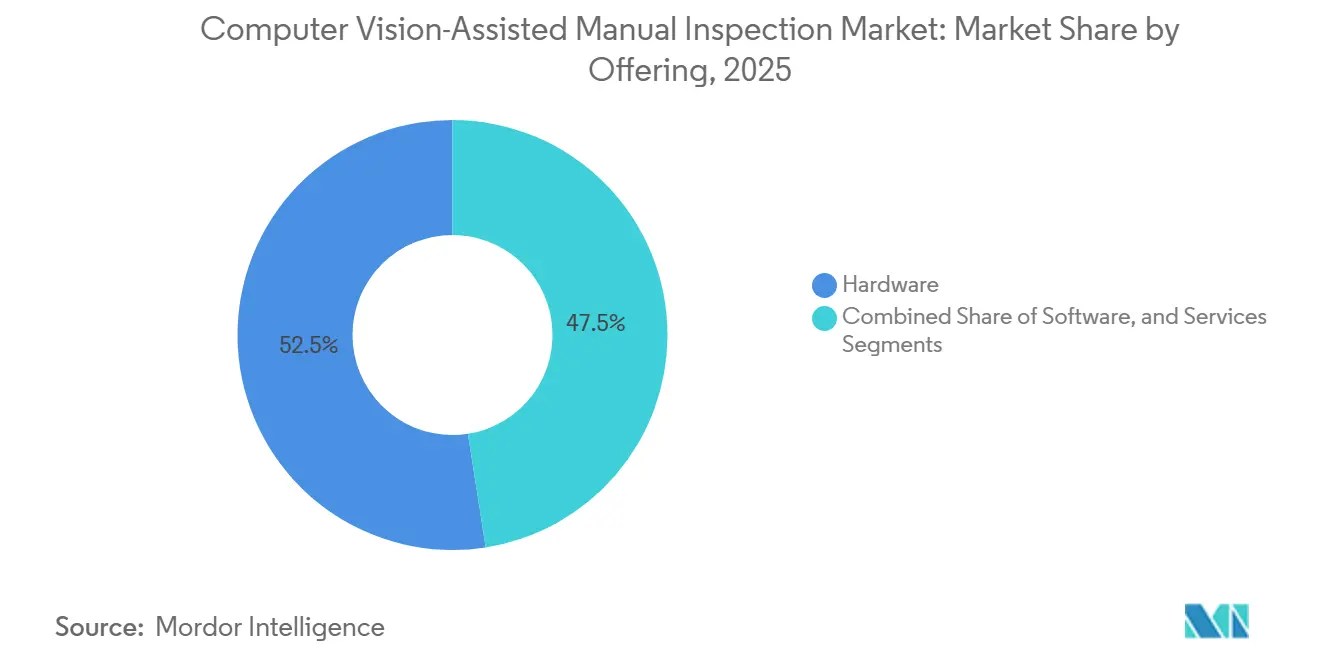
- By offering, hardware held 52.47% of the Computer Vision-Assisted Manual Inspection Market share in 2025, while services are projected to expand at a 12.17% CAGR through 2031.
- By inspection application, defect and anomaly detection accounted for 31.83% of the Computer Vision-Assisted Manual Inspection Market share in 2025, while human inspection assistance and decision support are projected to expand at a 13.83% CAGR through 2031.
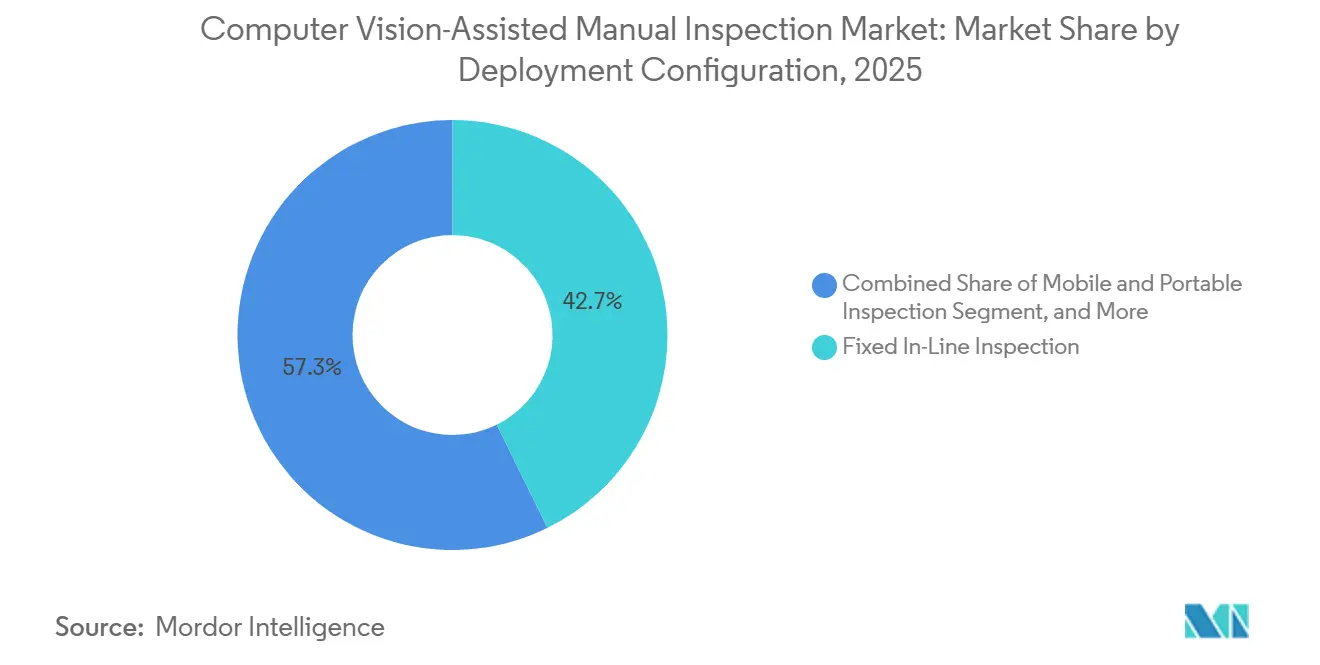
- By deployment configuration, fixed in-line inspection held 42.71% of the 2025 market, while mobile and portable inspection is projected to expand at a 13.67% CAGR through 2031.
- By end-user industry, electronics and semiconductors held 24.63% of the 2025 market, while solar panels and renewable energy equipment are projected to expand at a 13.91% CAGR through 2031.
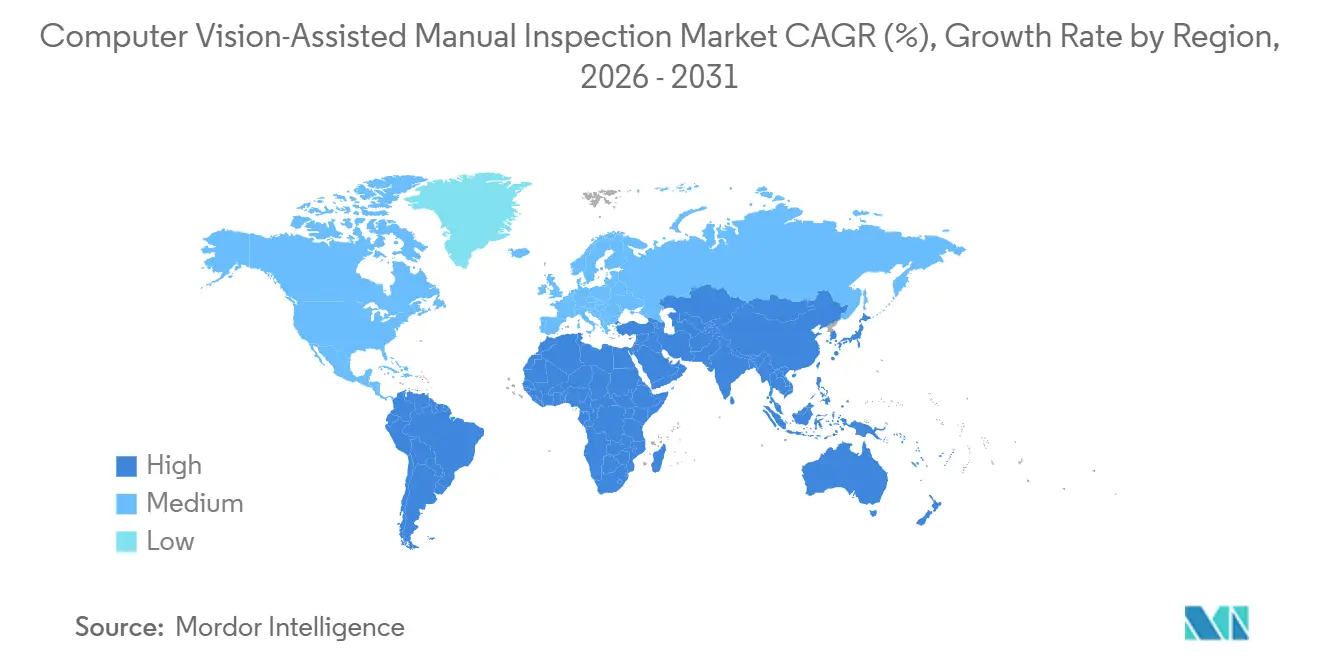
- By geography, Asia-Pacific accounted for 38.57% of the 2025 market, while the Middle East and Africa are projected to expand at a 12.73% CAGR through 2031.
Note: Market size and forecast figures in this report are generated using Mordor Intelligence’s proprietary estimation framework, updated with the latest available data and insights as of January 2026.
Global Computer Vision-Assisted Manual Inspection Market Trends and Insights
Drivers Impact Analysis*
| Driver | (~) % Impact on CAGR Forecast | Geographic Relevance | Impact Timeline |
|---|---|---|---|
| Demand For Automated Quality Assurance | +2.8% | Global | Short term (≤ 2 years) |
| AI-Enabled Defect Detection | +2.4% | Global, concentrated in Asia-Pacific and North America | Medium term (2-4 years) |
| Manual Inspection Labor Shortages | +2.0% | North America, Europe, and core Asia-Pacific markets | Short term (≤ 2 years) |
| High-Throughput Electronics And Semiconductor Production | +1.5% | China, South Korea, Japan, and Taiwan | Medium term (2-4 years) |
| Synthetic Defect Data And Few-Shot Learning | -1.0% | Global, with faster uptake in North America and Europe | Medium term (2-4 years) |
| Inspection Data For Yield And Traceability | +0.8% | Global, with regulatory relevance in Europe and North America | Long term (≥ 4 years) |
| Source: Mordor Intelligence | |||
Increasing Demand for Automated Quality Assurance
Automated quality assurance is becoming increasingly important as manufacturers seek to limit the costs and reputational damage associated with defects reaching customers. ETQ reported in 2025 that 75% of surveyed organizations had faced a product recall during the preceding 5 years, and 48% of those events cost between USD 10 million and USD 49.99 million. The survey also found that 33% of respondents had implemented AI in production, and 45% identified defect detection as an AI application. The Computer Vision-Assisted Manual Inspection Market benefits when operating systems capture images and results that can improve later model training. These image libraries can serve as a useful internal resource when plants exhibit recurring defect patterns. NIST’s 2025 manufacturing traceability framework links production records to supply chain auditability, thereby supporting investment in inspection systems for regulated production.[1] National Institute of Standards and Technology, “Supply Chain Traceability Manufacturing Meta-Framework,” National Institute of Standards and Technology, csrc.nist.gov
Expansion of AI-Enabled Defect Detection
The Computer Vision-Assisted Manual Inspection Market is expanding beyond rule-based pattern matching as vision models become easier to adapt to new defect types. NVIDIA reported that its NV-DINOv2 approach increased PCB defect classification accuracy from 93.84% to 98.51% through self-supervised learning on 1 million unlabeled images.[2]NVIDIA, “Optimizing Semiconductor Defect Classification With Generative AI and Vision Foundation Models,” NVIDIA Developer Blog, developer.nvidia.com The approach reduced the need for frequent manual annotation, thereby reducing engineering effort within the Computer Vision-Assisted Manual Inspection Market. Transfer learning may narrow the gap between established machine vision providers and newer suppliers that use strong base models. Research presented at CVPR 2026 described IMDD-1M, a dataset that covers 421 defect types across 63 manufacturing domains and can support broader industrial defect research. Hanul Semiconductor reported in September 2026 that its AI-powered six-sided MLCC inspection equipment inspected 13,000 units per minute with 98% defect-detection accuracy.[3]Ni et al., “Towards Open-Vocabulary Industrial Defect Understanding With a Large-Scale Multimodal Dataset,” CVPR 2026, openaccess.thecvf.com
Rising Labor Shortages in Manual Inspection
Labor shortages are limiting inspection coverage at manufacturers that still depend on human visual checks, which supports adoption in the Computer Vision-Assisted Manual Inspection Market. ETQ reported in 2025 that 70% of U.S. manufacturers experienced organizational effects due to labor shortages, and 88% linked those shortages to lower product quality. Inspection work can be affected by fatigue and differences between operators during high-volume production. The Computer Vision-Assisted Manual Inspection Market, therefore, offers a way to protect inspection coverage rather than simply reduce headcount. This framing can be more practical for plants where turnover has already created quality risks. AI-assisted decision support can help inspectors at the final visual check, where manual work remains common in otherwise automated plants.
Growth of High-Throughput Electronics and Semiconductor Manufacturing
High-throughput electronics and semiconductor production require inspection systems that can detect very small defects at speeds beyond manual review. Electronics and semiconductors accounted for 24.63% of the 2025 market, making the sector an important driver of demand for the Computer Vision-Assisted Manual Inspection Market. Smaller chip geometries and the demand for AI accelerators are increasing the number of defect categories in the Computer Vision-Assisted Manual Inspection Market that require specialized detection methods. This supports the use of focused detection modules alongside general machine vision platforms. KLA demonstrated at SEMICON Taiwan 2026 how advanced light sources can be used for AI-powered wafer inspection of latent defects in AI chips. These systems extend inspection beyond immediate defect identification and into reliability management across semiconductor supply chains.
Restraints Impact Analysis*
| Restraint | (~) % Impact on CAGR Forecast | Geographic Relevance | Impact Timeline |
|---|---|---|---|
| Initial System And Integration Costs | -1.8% | Global, especially mid-sized manufacturers | Short term (≤ 2 years) |
| Limited Validated Training Data | -1.2% | Global | Medium term (2-4 years) |
| Model Drift Across Product Mixes And Lighting | -0.8% | Global | Medium term (2-4 years) |
| Operator Trust And Accountability Gaps | -0.6% | Europe and North America | Long term (≥ 4 years) |
| Source: Mordor Intelligence | |||
High Initial System and Integration Costs
Initial system and integration costs remain a barrier for mid-sized manufacturers entering the Computer Vision-Assisted Manual Inspection Market with established manual workflows. Cameras, lighting, computing equipment, software, and engineering services can exceed the budget planned for legacy equipment replacement.[4]MDPI, "State of the Art in AI-Based Visual Inspection for Industrial Quality Control,” Electronics, mdpi.com Integration with manufacturing execution systems, enterprise systems, and programmable controllers can increase cost when results trigger line stops or reject actions. Vendor-specific application programming interfaces can also require custom middleware, delaying deployment. European buyers may face additional documentation, audit trail, and human-override requirements under the EU AI Act. Equipment-as-a-service and outcome-based contracts can reduce upfront exposure, but these models remain more common in large deployments.
Limited Availability of Validated Training Data
The Computer Vision-Assisted Manual Inspection Market is constrained when manufacturers lack labeled images that represent real production defects. A 2025 review found that models trained on benchmark datasets can underperform in operating plants because lighting, backgrounds, cameras, and defect types differ from controlled datasets. High-mix, low-volume facilities face a particular challenge because rare defects may not provide enough examples for training. Manufacturers also often treat defect imagery as proprietary information, limiting wider data-sharing arrangements. IMDD-1M offers a large research dataset, but site-level adaptation is still needed before production use in the Computer Vision-Assisted Manual Inspection Market. Synthetic defect generation can add training examples, but users must still validate that the resulting models do not increase false rejections in physical production.
*Our forecasts treat driver/restraint impacts as directional, not additive. The impact forecasts reflect baseline growth, mix effects, and variable interactions.
Segment Analysis
By Offering: Hardware Holds The Largest Position While Services Advance Faster
Hardware accounted for 52.47% of the Computer Vision-Assisted Manual Inspection Market in 2025. Industrial cameras, edge computing modules, 3D sensors, and lighting systems remain necessary when manufacturers retrofit lines for visual quality checks. Hardware suppliers remain central to early projects, particularly where imaging conditions must be engineered for a specific process. Software supports model-based inspection and system coordination. MVTec’s HALCON release in November 2025 added continual learning for classification, allowing users to add defect classes with fewer images.
Services are projected to expand at a 12.17% CAGR through 2031, the fastest rate among offering categories. The Computer Vision-Assisted Manual Inspection Industry is moving toward support arrangements that cover model development, monitoring, and retraining. Managed services can make ongoing performance management more predictable for operations teams. Cognex stated in May 2026 that more than 100 customers moved from pilots to multi-site rollouts during the OneVision beta period. The company also reported that the cloud-to-edge platform can reduce scaling costs by up to 50%.



By Inspection Application: Defect Detection Leads While Decision Support Expands Faster
Defect and anomaly detection held 31.83% of the 2025 market. The application remains essential because manufacturers need to prevent nonconforming products from reaching assemblers or end customers. Assembly and presence verification, measurement, and dimensional verification are established uses across automotive and electronics lines. Identification, labeling, and traceability verification are becoming increasingly important in food, beverage, and pharmaceutical operations. Surface classification, process monitoring, work-in-progress inspection, and other applications serve specialized requirements.
Human inspection assistance and decision support are projected to expand at a 13.83% CAGR through 2031. The Computer Vision-Assisted Manual Inspection Market is gaining from systems that help skilled operators make decisions rather than remove them from the process. Explainable AI and uncertainty tools can show the confidence behind an inspection recommendation. A 2025 AutomationXP paper found that uncertainty visualization improved trust calibration in human-AI quality-control interfaces. IBM Inspector Portable illustrates this direction through handheld visual inspections that run Core ML models on iOS or iPadOS devices.
By Deployment Configuration: Fixed In-Line Inspection Leads While Mobile Systems Reach New Sites
Fixed in-line inspection held 42.71% of the 2025 market. Dedicated stations are integrated into conveyors and material-handling systems where product movement and imaging conditions remain consistent. This configuration is the mature base of the Computer Vision-Assisted Manual Inspection Market because it supports repeatable inspection at set production speeds. Fixed at-line and offline, or batch, inspection serves pharmaceutical, aerospace, and food packaging processes with less continuous production. A 2026 review found that real-time deep learning methods, including YOLO variants, can support high-velocity quality control, although the most demanding applications may require accuracy-speed trade-offs.
Mobile and portable inspection is projected to expand at a 13.67% CAGR through 2031. Wireless scanning and mobile surface-measurement equipment allow inspection work in oil and gas facilities, outdoor solar installations, and multi-floor aerospace sites. Mobile systems broaden coverage by bringing imaging and analysis to the asset rather than bringing the asset to a line. ADNOC deployed Taurob autonomous inspection robots for hazardous-environment surveys in the UAE in May 2026. The company also announced work on a heavy-duty operator robot as part of the ARGOS Joint Industry Project, with expected operation by the end of 2026.
By End-User Industry: Electronics And Semiconductors Lead While Solar Equipment Expands Faster
Electronics and semiconductors held 24.63% of the 2025 market. Zero-defect requirements, process sensitivity, and high production volumes make automated inspection a functional requirement for many facilities. Automotive and electric vehicles, pharmaceuticals and medical devices, packaging and printing, metals, machinery, industrial equipment, glass, rubber, and plastics represent further areas of adoption. Aerospace and defense can justify higher system investment because of mission-critical quality requirements. Logistics and e-commerce use vision-based damage detection and barcode verification to limit returns and claims.
Solar panels and renewable energy equipment are projected to expand at a 13.91% CAGR through 2031. The Computer Vision-Assisted Manual Inspection Industry is supported by photovoltaic manufacturing lines that need defect screening beyond manual inspection capacity. A 2026 study reported 96.42% accuracy for a transfer-learning approach to detecting solar-panel surface defects using visible-spectrum images. Installed solar farms also create demand for mobile inspections that use thermal and multispectral imaging. An international research group reported in September 2026 that an autonomous drone system achieved F1 scores of 1.0 for hotspot detection.
Geography Analysis
Asia-Pacific accounted for 38.57% of the Computer Vision-Assisted Manual Inspection Market in 2025. China, South Korea, Japan, and India support demand by producing electronics, semiconductors, electric vehicle batteries, and advanced packaging. Japan revised its tariff relief catalog in July 2026 to include AI-recognition-enabled smart cameras used in manufacturing quality assurance. The relief sets a 0% import tariff through December 31, 2027, for products that comply with JIS B 8401-2025. Korea Alps reported in September 2026 that its AI vision rollout had reduced false defect rates from 5% toward a target below 0.33%.
North America and Europe were the second- and third-largest regional markets for the Computer Vision-Assisted Manual Inspection Market. North America benefits from AI engineering skills, startup activity, and investment in the reshoring of semiconductor and electric vehicle production. UnitX reported in 2026 that its systems inspect more than USD 15 billion in manufactured products annually across over 190 facilities. Europe is shaped by requirements for documented AI decisions, audit trails, and human oversight, and Germany is an important deployment center for Basler AG, MVTec Software GmbH, and SICK AG. Basler and Advantech formed a partnership in April 2026 to develop GMSL-based vision and robotics computing platforms for scalable deployments.
The Middle East and Africa are projected to expand at a 12.73% CAGR through 2031. Saudi Arabia’s Vision 2030 and the UAE’s Industry 4.0 initiative support manufacturing digitization and demand for inspection technologies. ADNOC’s robot deployment provides an energy-sector reference for mobile inspection use in the region. South America and Africa remain early-stage markets, where food, beverage, and packaging facilities are adopting entry-level systems to achieve export-grade quality certification.

Competitive Landscape
The Computer Vision-Assisted Manual Inspection Market is moderately fragmented. Cognex Corporation, Keyence Corporation, SICK AG, Basler AG, and MVTec Software GmbH compete through platform breadth, system integration, and AI model performance. UnitX, Inc., Landing AI, Inc., and Qualitas Technologies Pvt. Ltd. compete on deployment speed, lower training data needs, and outcome-based arrangements. Established suppliers are integrating edge computing to enable high-performance AI inspection in space-constrained, latency-sensitive production areas. Cognex launched the In-Sight 6900 Vision Controller with NVIDIA Jetson technology in April 2026.
Cognex launched the In-Sight 3900 Vision System with Qualcomm Dragonwing platforms in May 2026 for deterministic, real-time inspection at production line speeds. Mitsubishi Electric Corporation and Sony Semiconductor Solutions Corporation announced in July 2026 that they would establish Advanced Vision Solutions Co., Ltd. Mitsubishi Electric will hold 60% and Sony Semiconductor Solutions will hold 40% of the venture, which is scheduled to begin operating in October 2026. The venture combines edge AI image sensing with factory automation control for labor savings and uncrewed operations. Suppliers are seeking closer links between inspection results and factory systems to support yield analysis and corrective actions.
Daihatsu Motor and VRAIN Solution filed patent applications in Japan in 2025 covering AI recognition for scratches inside machined aluminum holes with a 0.1 mm tolerance. The filing shows how manufacturers can treat inspection algorithms as proprietary operating assets. LUCID Vision Labs released an open-source AI development toolkit for its Triton Smart camera in August 2026, lowering development barriers for integrators and smaller users. Larger suppliers are pursuing managed services and cloud-to-edge tools, leaving room for open development at the lower end and integrated platforms for large plants.
Computer Vision-Assisted Manual Inspection Industry Leaders
-
Cognex Corporation
-
Keyence Corporation
-
Teledyne DALSA, Inc.
-
OMRON Corporation
-
Basler AG
- *Disclaimer: Major Players sorted in no particular order

Recent Industry Developments
- September 2026: Hanul Semiconductor disclosed on September 1, 2026, that its AI-powered six-sided inspection equipment for multilayer ceramic capacitors, MLCCs, achieved 13,000 units per minute at 98% defect detection accuracy, up from 95%, with plans to extend the system to 15,000 units per minute by the end of 2026 and expand AI inspection coverage to additional MLCC post-processing equipment including complex measuring devices and indentation inspection systems.
- August 2026: LUCID Vision Labs, Inc. released an open-source AI development toolkit for its Triton Smart camera on August 26, 2026, enabling developers to create and deploy on-sensor inference AI models using Sony’s IMX501 intelligent vision sensor. The toolkit includes ready-to-use training samples for image classification with planned additions covering object detection and anomaly detection.
- July 2026: Mitsubishi Electric Corporation and Sony Semiconductor Solutions Corporation announced the formation of Advanced Vision Solutions Co., Ltd. on July 22, 2026, a joint venture in which Mitsubishi Electric holds 60% and Sony Semiconductor Solutions holds 40%. The venture is scheduled to begin operations in October 2026 and develop AI-powered vision sensor solutions for manufacturing applications.
- June 2026: UnitX, Inc. launched DeteX on June 15, 2026, and debuted it at Automate 2026 in Chicago from June 22-25. The 8-megapixel, IP54-rated edge device combines AI-powered defect inspection, dimensional measurement, OCR, classification, and counting in 1 unit.


Global Computer Vision-Assisted Manual Inspection Market Report Scope
Computer Vision-Assisted Manual Inspection refers to hybrid quality-control solutions that combine human visual judgment with real-time computer vision algorithms and augmented-reality interfaces to enhance inspector accuracy, reduce fatigue, and ensure consistent defect detection and process compliance in manufacturing environments.
The Computer Vision-Assisted Manual Inspection Market Report is Segmented by Offering (Hardware, Software, and Services), Inspection Application (Defect and Anomaly Detection, Assembly and Presence Verification, Measurement and Dimensional Verification, Identification, Label and Traceability Verification, Surface Classification and Grading, Process Monitoring and WIP Inspection, Human Inspection Assistance and Decision Support, and Other Applications), Deployment Configuration (Fixed In-Line Inspection, Fixed At-Line Inspection, Offline and Batch Inspection, and Mobile and Portable Inspection), End-User Industry (Electronics and Semiconductors, Automotive and Electric Vehicles, Pharmaceuticals and Medical Devices, Food and Beverage, Packaging and Printing, Metals, Machinery, and Industrial Equipment, Glass, Rubber, and Plastics, Aerospace and Defense, Solar Panels and Renewable Energy Equipment, Logistics and E-Commerce, and Other End-User Industries), and Geography (North America, South America, Europe, Asia-Pacific, Middle East and Africa). The Market Forecasts are Provided in Terms of Value (USD).
| Hardware |
| Software |
| Services |
| Defect and Anomaly Detection |
| Assembly and Presence Verification |
| Measurement and Dimensional Verification |
| Identification, Label and Traceability Verification |
| Human Inspection Assistance and Decision Support |
| Other Applications |
| Fixed In-Line Inspection |
| Fixed At-Line Inspection |
| OfflineandBatch Inspection |
| MobileandPortable Inspection |
| Electronics and Semiconductors |
| Automotive and Electric Vehicles |
| Pharmaceuticals and Medical Devices |
| Food and Beverage |
| Packaging and Printing |
| Solar Panels and Renewable Energy Equipment |
| Logistics and E-Commerce |
| Other End-User Industries |
| North America | United States | |
| Canada | ||
| Mexico | ||
| South America | Brazil | |
| Argentina | ||
| Rest of South America | ||
| Europe | Germany | |
| United Kingdom | ||
| France | ||
| Italy | ||
| Spain | ||
| Rest of Europe | ||
| Asia-Pacific | China | |
| Japan | ||
| India | ||
| South Korea | ||
| Rest of Asia-Pacific | ||
| Middle East and Africa | Middle East | Saudi Arabia |
| United Arab Emirates | ||
| Turkey | ||
| Rest of the Middle East | ||
| Africa | South Africa | |
| Nigeria | ||
| Rest of Africa | ||
| By Offering | Hardware | ||
| Software | |||
| Services | |||
| By Inspection Application | Defect and Anomaly Detection | ||
| Assembly and Presence Verification | |||
| Measurement and Dimensional Verification | |||
| Identification, Label and Traceability Verification | |||
| Human Inspection Assistance and Decision Support | |||
| Other Applications | |||
| By Deployment Configuration | Fixed In-Line Inspection | ||
| Fixed At-Line Inspection | |||
| OfflineandBatch Inspection | |||
| MobileandPortable Inspection | |||
| By End-User Industry | Electronics and Semiconductors | ||
| Automotive and Electric Vehicles | |||
| Pharmaceuticals and Medical Devices | |||
| Food and Beverage | |||
| Packaging and Printing | |||
| Solar Panels and Renewable Energy Equipment | |||
| Logistics and E-Commerce | |||
| Other End-User Industries | |||
| By Geography | North America | United States | |
| Canada | |||
| Mexico | |||
| South America | Brazil | ||
| Argentina | |||
| Rest of South America | |||
| Europe | Germany | ||
| United Kingdom | |||
| France | |||
| Italy | |||
| Spain | |||
| Rest of Europe | |||
| Asia-Pacific | China | ||
| Japan | |||
| India | |||
| South Korea | |||
| Rest of Asia-Pacific | |||
| Middle East and Africa | Middle East | Saudi Arabia | |
| United Arab Emirates | |||
| Turkey | |||
| Rest of the Middle East | |||
| Africa | South Africa | ||
| Nigeria | |||
| Rest of Africa | |||


Key Questions Answered in the Report
What is the Computer Vision-Assisted Manual Inspection Market size?
The Computer Vision-Assisted Manual Inspection Market is projected to be USD 1.87 billion in 2026 and USD 3.05 billion by 2031, at a 10.28% CAGR.
Which offering leads demand for computer vision-assisted manual inspection?
Hardware led with 52.47% of 2025 revenue because cameras, sensors, lighting, and edge computing are required for production deployments.
Which application is expanding fastest through 2031?
Human inspection assistance and decision support is projected to expand at a 13.83% CAGR through 2031.
Why are manufacturers adopting AI-supported visual inspection?
Manufacturers use these systems to improve defect detection, maintain inspection coverage during labor shortages, and create traceable production records.
Which region leads computer vision-assisted manual inspection adoption?
Asia-Pacific led with 38.57% of 2025 revenue, supported by its electronics and semiconductor manufacturing base.
Which end-user area has the fastest projected expansion?
Solar panels and renewable energy equipment is projected to expand at a 13.91% CAGR through 2031.
Page last updated on:


 Your data is secure and never sold or shared.


