
Composable Customer Data Platform Software Market Size and Share
Market Overview
| Study Period | 2020 - 2031 |
|---|---|
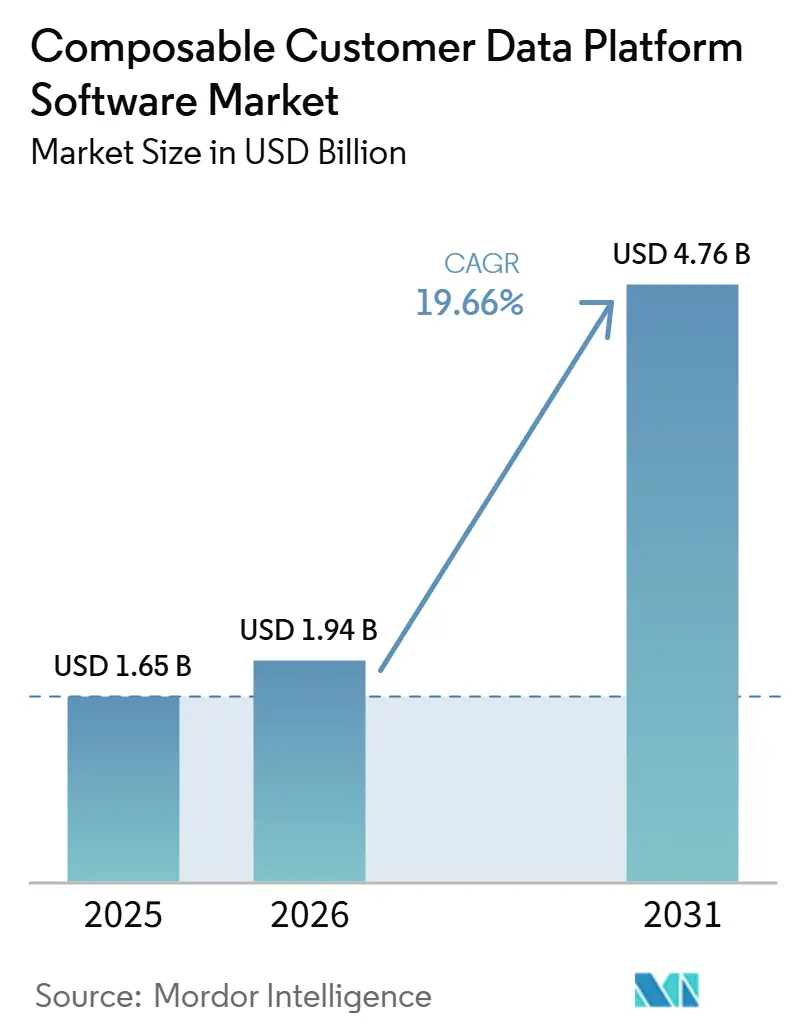
| Market Size (2026) | USD 1.94 Billion |
| Market Size (2031) | USD 4.76 Billion |
| Growth Rate (2026 - 2031) | 19.66% CAGR |
| Fastest Growing Market | Asia-Pacific |
| Largest Market | North America |
| Market Concentration | Medium |
Major Players *Disclaimer: Major Players sorted in no particular order Image © Mordor Intelligence. Reuse requires attribution under CC BY 4.0. | |
Composable Customer Data Platform Software Market Analysis by Mordor Intelligence
The Composable Customer Data Platform Software Market size is projected to expand from USD 1.65 billion in 2025 and USD 1.9 billion in 2026 to USD 4.76 billion by 2031, registering a CAGR of 19.66% between 2026 and 2031. Demand is moving toward architectures that keep customer data in the enterprise warehouse while making it available to marketing, sales, and service systems. AI-supported personalization is raising requirements for current identity data and rapid activation. Buyers also face more choices as large enterprise software providers add warehouse connections and specialists focus on activation and identity resolution. Regulation and data residency requirements are making governance a central purchasing factor, especially for organizations serving several regions. The Composable Customer Data Platform Software Market therefore offers room for vendors that can combine flexible deployment, clear controls, and practical implementation support.
Key Report Takeaways
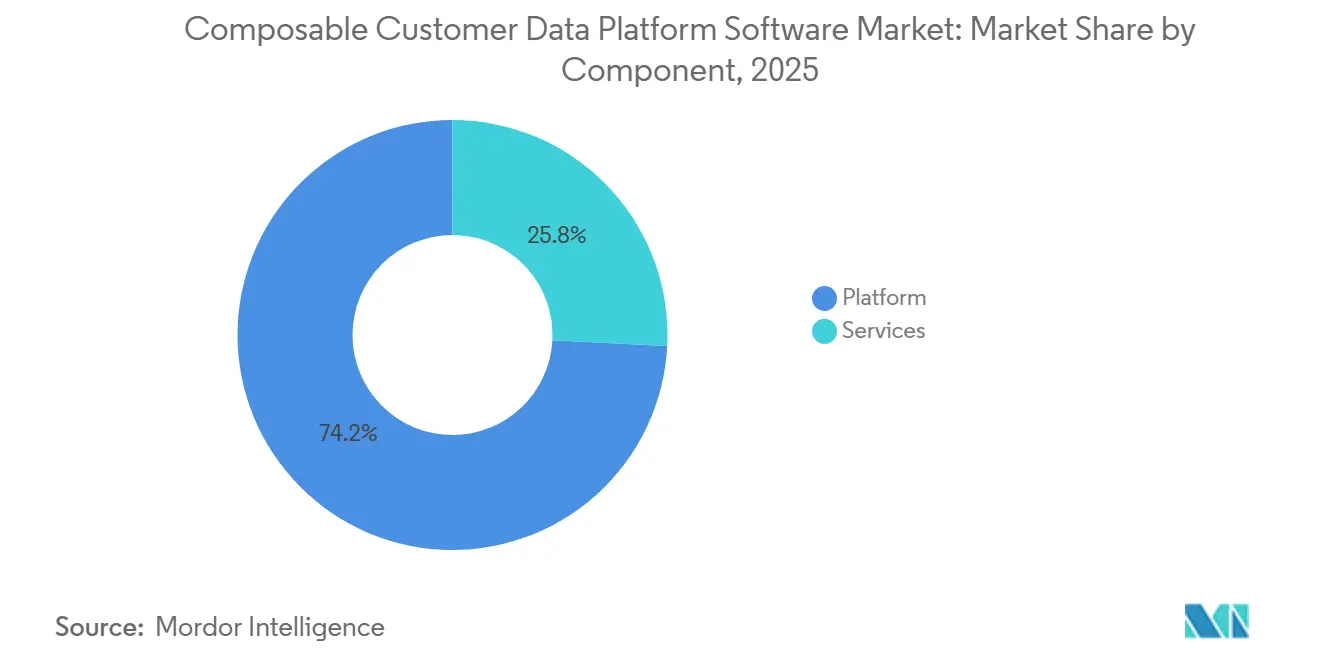
- By component, Platform held 74.18% of the Composable Customer Data Platform Software Market share in 2025, while Services is projected to expand at a 22.83% CAGR through 2031.
- By deployment mode, Cloud held 71.24% share in the Composable Customer Data Platform Software Market in 2025, while Hybrid is projected to expand at a 21.69% CAGR through 2031.
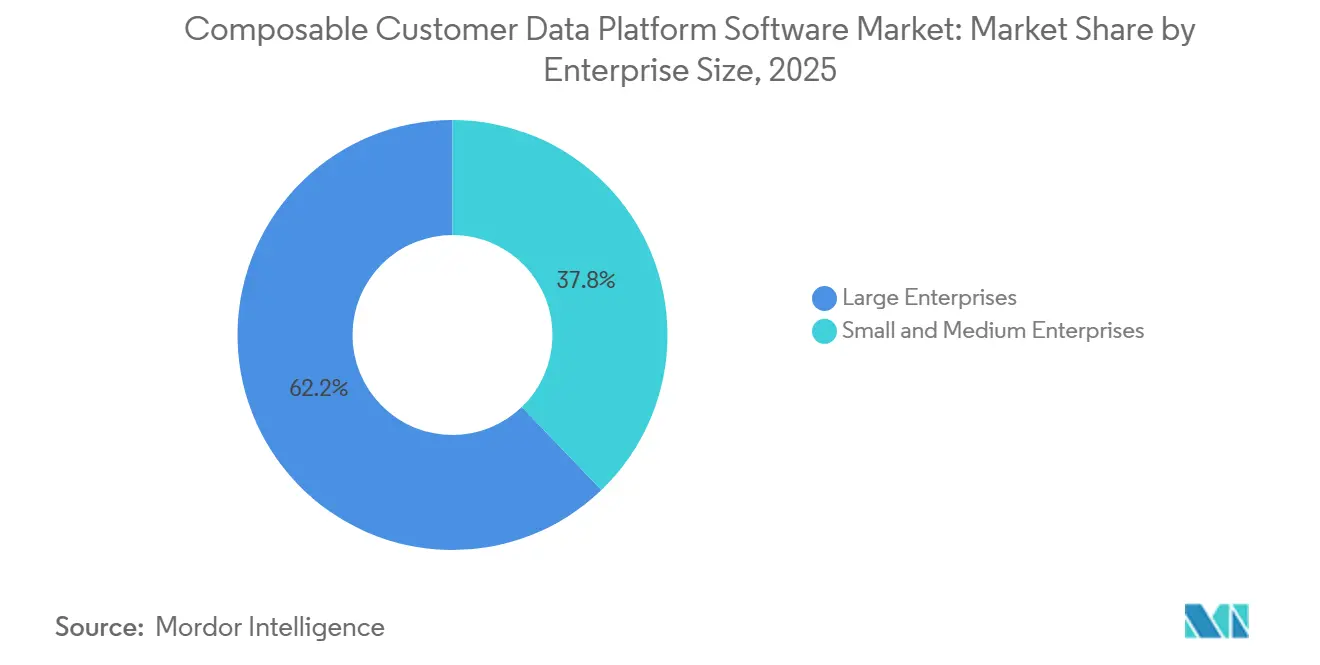
- By enterprise size, Large Enterprises held 62.18% share in 2025, while Small and Medium Enterprises are projected to expand at a 23.74% CAGR through 2031.
- By end user, Retail and E-Commerce held 24.86% share in 2025, while Healthcare and Life Sciences are projected to expand at a 21.42% CAGR through 2031.
- By geography, North America held a 34.62% share of the the Composable Customer Data Platform Software Market in 2025, while Asia-Pacific is projected to expand at a 24.19% CAGR through 2031.
Note: Market size and forecast figures in this report are generated using Mordor Intelligence’s proprietary estimation framework, updated with the latest available data and insights as of January 2026.
Global Composable Customer Data Platform Software Market Trends and Insights
Drivers Impact Analysis*
| Driver | (~) % Impact on CAGR Forecast | Geographic Relevance | Impact Timeline |
|---|---|---|---|
| AI-Powered Real-Time Personalization and Decisioning | +4.2% | Global, led by North America and Asia-Pacific | Short term (≤ 2 years) |
| Third-Party Cookie Deprecation and First-Party Data Urgency | +3.8% | Global, strongest in North America and Europe | Short term (≤ 2 years) |
| Rapid Shift to Composable Warehouse-Native Architectures | +3.5% | North America and Europe core, spillover to Asia-Pacific | Medium term (2-4 years) |
| Omnichannel Activation Across Marketing, Sales, and Service | +2.9% | Global | Medium term (2-4 years) |
| Regulatory Pressure for Data Minimization and Consent Control | +2.1% | Europe primary, spillover to Asia-Pacific and North America | Long term (≥ 4 years) |
| Retail Media and Customer Identity Orchestration Demand | +1.7% | North America and Europe, with early gains in Asia-Pacific | Medium term (2-4 years) |
| Source: Mordor Intelligence | |||
AI-Powered Real-Time Personalization and Decisioning
AI-supported personalization has become an important architectural requirement in evaluations of the Composable Customer Data Platform Software Market. Enterprises need a governed data layer that can bring together live customer signals and historical records. This foundation supports systems that select next actions and execute work across channels. Databricks launched CustomerLake in June 2026 as an agentic customer data platform within its lakehouse environment, combining customer data, identity resolution, audience building, campaign automation, and activation.[1]Databricks, “Databricks Enters the Marketing Industry With CustomerLake: Agentic Customer Data Platform,” Databricks Newsroom, databricks.com The release shows how cloud data providers are extending their products into customer data applications. This raises the importance of accurate identity resolution and current activation data for vendors competing in the Composable Customer Data Platform Software Market.
Third-Party Cookie Deprecation and First-Party Data Urgency
The loss of third-party signals continues to support investment in first-party customer data capabilities. Google paused full cookie deprecation in Chrome during 2025 and retained a user-choice approach, but this did not restore the former role of third-party identifiers. Safari and Firefox had already blocked third-party cookies by default. Adobe reported in 2024 that 60% of brands felt prepared for a cookieless environment, compared with 78% in 2022.[2]Adobe, “Adobe Study: Brands Make Progress Weaning Off Third-Party Cookies, Yet Feel Less Prepared Than Ever for a World Without Them,” Adobe Blog, adobe.com Customer data platforms can help companies connect consented first-party records and improve audience measurement. The Composable Customer Data Platform Software Market benefits when organizations treat identity and consent records as long-term operating assets rather than campaign inputs.
Rapid Shift to Composable Warehouse-Native Architectures
Warehouse-native designs are changing how enterprises assess customer data software. More than 25% of CDP vendors supported warehouse-centric deployment in January 2026.[3]Customer Data Alliance and CDP Institute, “Customer Data Platform Industry Update,” PRWeb, prweb.com The same update reported 7.8% employment growth for composable and warehouse-native vendors in the second half of 2025, compared with 1.3% for the wider industry. These designs reduce the need to maintain a separate persistent customer data store outside the enterprise warehouse. They can also keep governance closer to existing Snowflake, Databricks, or BigQuery environments. As a result, competition in the Composable Customer Data Platform Software Market is shifting toward activation functions, identity logic, and the usability of decisioning tools.
Omnichannel Activation Across Marketing, Sales, and Service
Companies are using composable platforms to make warehouse data available in more customer-facing systems. Buyers increasingly assess the time required to make a new audience or record useful information in a downstream destination. Hightouch introduced Content Assembly in February 2026 to help marketers create campaign materials from warehouse-resident assets and brand guidance. This type of product brings data activation closer to campaign execution. Effective activation still depends on recognizing the same customer across web, mobile, stores, service channels, and media platforms. The Composable Customer Data Platform Software Market is driven by the need to manage interactions from a shared, governed customer record.
Restraints Impact Analysis*
| Restraint | (~) % Impact on CAGR Forecast | Geographic Relevance | Impact Timeline |
|---|---|---|---|
| High Integration Complexity Across Warehouse, CRM, and Activation Layers | -3.2% | Global | Short term (≤ 2 years) |
| Data Privacy and Cross-Border Governance Constraints | -2.4% | Europe and Asia-Pacific core, spillover to North America | Medium term (2-4 years) |
| Vendor Lock-In Concerns With Proprietary Identity and Activation Stacks | -1.8% | Global, strongest in North America and Europe | Medium term (2-4 years) |
| Shortage of Composable CDP Implementation and Reverse-ETL Talent | -1.5% | Global | Long term (≥ 4 years) |
| Source: Mordor Intelligence | |||
High Integration Complexity Across Warehouse, CRM, and Activation Layers
Composable deployments can require coordination across warehouses, CRM systems, identity rules, access controls, and activation tools. A typical enterprise implementation may involve 5 to 10 vendor layers, which adds work that packaged deployments can avoid. This is a meaningful constraint for mid-market companies with limited data engineering resources. Organizations must also define ownership for schemas, service levels, and identity logic before production use. The EU AI Act is fully applicable from August 2, 2026, and it adds governance requirements for relevant AI systems that process personal data. This can lengthen the review process for European deployments in the Composable Customer Data Platform Software Market.[4]European Commission, “AI Act: Shaping Europe’s Digital Future,” European Commission Digital Strategy, european-commission.europa.eu
Data Privacy and Cross-Border Governance Constraints
Global deployments must account for different requirements on localization, consent, and notification. India’s Digital Personal Data Protection Act, China’s Personal Information Protection Law, and the EU General Data Protection Regulation each create distinct compliance needs. The EU AI Act also requires transparency for certain AI-driven customer interactions from August 2026. These obligations can require separate regional configurations and detailed technical records. They increase the practical effort required to operate a single global customer activation model. The Composable Customer Data Platform Software Market will need deployment patterns that help companies apply local controls without losing access to timely activation.
*Our forecasts treat driver/restraint impacts as directional, not additive. The impact forecasts reflect baseline growth, mix effects, and variable interactions.
Segment Analysis
By Component: Platform Software Remains the Core Spending Area
Platform accounted for 74.18% of the Composable Customer Data Platform Software Market share in 2025, as enterprises favored software that combined core customer data functions. Buyers use these platforms to manage identity resolution, segmentation, activation, and governance in a connected operating layer. A unified platform can reduce the effort required to move records between separate point products across the customer technology stack. It also provides shared controls when several teams use the same customer profiles for different business purposes, including campaign planning, service outreach, loyalty activity, and customer recovery. This shared operating view can reduce conflicting definitions of the same customer across departments and make it easier to establish accountability for permissions. Amperity introduced its Customer Data Agent in January 2026 to build live segments and journeys from unified profiles, demonstrating how platform capabilities incorporate AI-supported workflows.
Services are projected to record a 22.83% CAGR in the Composable Customer Data Platform Software Market size through 2031, because deployments require ongoing technical and governance work. Customers need help configuring reverse ETL, maintaining identity models, setting access rules, and updating data schemas as their source systems change. That work can be difficult for internal teams, particularly when warehouses, CRM tools, and several activation applications are used together. The service opportunity is therefore tied to a limited supply of people with warehouse-native implementation experience across Snowflake, Databricks, and BigQuery environments. Providers that combine practical implementation support with clear handover processes can address a persistent operational need rather than a one-time software installation. They can also assist when a buyer adds destinations, changes consent policies, or revises the rules used to connect records. This makes services important throughout the life of a composable implementation, not just at launch.


By Deployment Mode: Hybrid Models Address Governance Needs
Cloud deployment accounted for 71.24% of revenue in 2025, driven by the need to process high volumes of customer events and connect multiple data services. Cloud infrastructure can make customer records available to marketing, sales, and service systems without relying on separate local installations for each function. Warehouse-native providers also use shared infrastructure to reduce delays between data ingestion, audience creation, and downstream activation. This model is especially useful when organizations need customer information to remain available as behavior changes across digital channels. The Composable Customer Data Platform Software Market continues to depend on cloud deployments as the main foundation for scalable customer data management. For buyers, this option can bring customer data work closer to existing analytics and application environments. It can also simplify the use of shared records for teams operating across multiple regions or brands.
Hybrid deployment is projected to grow at a 21.69% CAGR through 2031, as regulated organizations retain controlled data environments while using cloud-scale activation functions. On-premise systems remain relevant for government and financial services users where sovereignty rules restrict how personally identifiable information is stored. Hybrid architectures can use controlled connectors to exchange approved information between environments, avoiding treating a single location as the entire operating model. This approach helps organizations apply local requirements without abandoning timely customer data use across approved channels. It gives vendors a way to serve accounts that cannot adopt a fully cloud-based model, while preserving the governance advantages of composable design. The model is particularly relevant when operational teams need cloud activation but legal or security teams require more direct control over selected records. It therefore expands the set of organizations that can consider composable customer data software.
By Enterprise Size: Small and Medium Enterprises Extend Adoption
Large Enterprises accounted for 62.18% of the Composable Customer Data Platform Software Market share in 2025, reflecting their established cloud warehouses, data teams, and governance structures. These organizations can integrate customer data tools with existing CRM, commerce, loyalty, and service systems across large operating environments. Their scale makes the value of shared customer identities and common activation controls more visible across business functions. Amperity identified Alaska Airlines, DICK’s Sporting Goods, and Wyndham Hotels and Resorts as brands leveraging its capabilities for loyalty personalization and customer recovery. Large companies are likely to remain important customers because they can govern multi-vendor implementations and operate broader customer data use cases. Their existing technology investment also makes it practical to connect customer data activities with analytics, commerce, and service operations. This supports continued platform spending even as the buyer base broadens to smaller organizations and use cases become more interconnected across functions.
Small and Medium Enterprises are projected to expand at a 23.74% CAGR through 2031, supported by pricing and connector options that lower adoption barriers. Consumption-based pricing reduces the initial commitment compared with traditional large software licenses, while pre-built connections can limit integration effort. HubSpot, Mailchimp, Stripe, and Zendesk connectors are relevant because these tools are already common among smaller organizations. Privacy obligations add another reason to centralize consented data, even when organizations have fewer specialized technical resources. Vendors that provide clear onboarding, common connectors, and usable governance tools can benefit as this part of the Composable Customer Data Platform Software Market develops. Smaller buyers are more likely to value configurations that deliver a clear operational outcome without a lengthy technical project. This places greater importance on product guidance, connector reliability, and support that helps non-specialists use customer data responsibly.
By End User: Retail Leads While Healthcare Expands Quickly
Retail and E-Commerce accounted for 24.86% of revenue in 2025, as retailers need timely first-party data activation for retail media, loyalty, and stock-keeping unit-level attribution. A consistent identity across stores, websites, applications, and media channels helps limit fragmented audience definitions and disconnected campaign measurement. Unlimitail selected Snowflake Data Clean Rooms for privacy-focused audience activation across its European retail media network, illustrating the need for warehouse-based controls in retail media operations. Frequent customer interactions make this sector a leading adoption area for the Composable Customer Data Platform Software Market. The software can support retail teams that need shared customer records across several selling and communication channels. It can also help teams use the same consented identity rules when managing loyalty communications, retail media audiences, and service interactions. This is valuable when a customer moves between physical stores, branded applications, online shopping, and external media destinations.
Healthcare and Life Sciences are projected to grow at a 21.42% CAGR through 2031, as organizations manage patient data within the boundaries of HIPAA Business Associate Agreements. Interoperability requirements using Fast Healthcare Interoperability Resources (FHIR) application programming interfaces also increase the need for data quality and secure access. Customer data capabilities can help connect permitted records while supporting compliant communication and service workflows. BFSI uses identity orchestration for cross-sell and fraud prevention, while IT and Telecommunication use lifecycle information to reduce churn. Industrial Manufacturing, Media and Entertainment, Government and Administration, Energy and Utilities, and Education and Research Institutions remain early-stage users due to specialized governance needs and longer procurement cycles. These sectors may need more tailored data models, controlled deployment patterns, or additional review before adopting broad activation programs. Their needs still create longer-term opportunities as vendors improve vertical support and implementation methods.
Geography Analysis
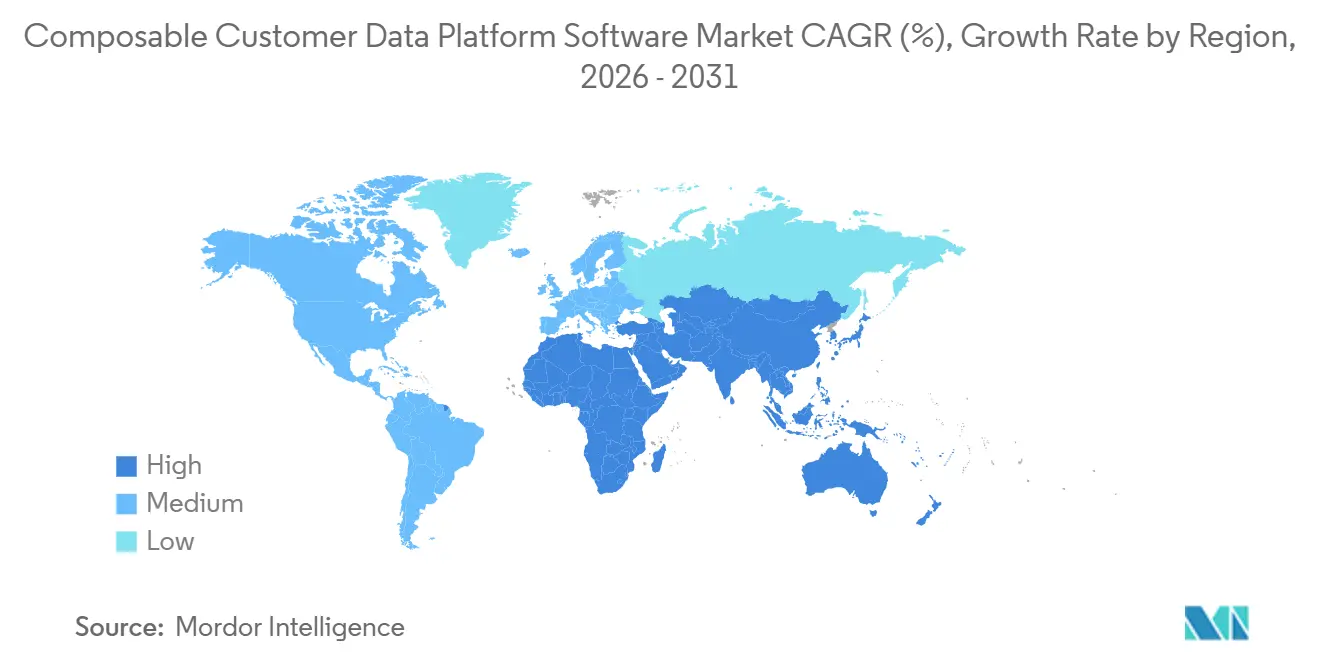
North America held 34.62% of the Composable Customer Data Platform Software Market share in 2025, supported by mature cloud warehouse use and deep enterprise technology budgets. The region also has a high concentration of platform providers and composable specialists, which gives buyers a broad set of architectural options. Competition includes large software companies adding customer data features, as well as specialists focused on warehouse-based identity resolution and activation. Canada follows the United States adoption pattern with financial services and retail as important use areas. This environment makes North America the principal commercial base for both enterprise platform incumbents and newer warehouse-native vendors.
Europe is the second-largest regional revenue contributor and has a demanding regulatory setting for customer data processing. GDPR supports the need for centralized consent management and governed records across customer-facing activities. The EU AI Act entered into force on August 1, 2024, and will be fully applicable from August 2, 2026, adding documentation and oversight requirements for relevant AI-supported deployments. Germany, the United Kingdom, and France are the regional anchors, while Spain and the Rest of Europe are developing as cloud infrastructure deepens. South America, led by Brazil, is developing from a smaller base as privacy-driven investment grows in financial services and retail.
Asia-Pacific is projected to grow at a 24.19% CAGR through 2031, supported by mobile-first commerce in India, Indonesia, and Southeast Asia. These markets generate large customer event volumes that require timely data processing and activation. China’s Personal Information Protection Law and India’s Digital Personal Data Protection Act require localized deployment approaches, increasing complexity and creating demand for regional configurations. Salesforce made Data 360 and Agentforce available on the AWS India Marketplace in June 2026, supporting local access and procurement. The Middle East and Africa remains earlier-stage, although the United Arab Emirates and Saudi Arabia lead regional activity in financial services and government digital transformation.

Competitive Landscape
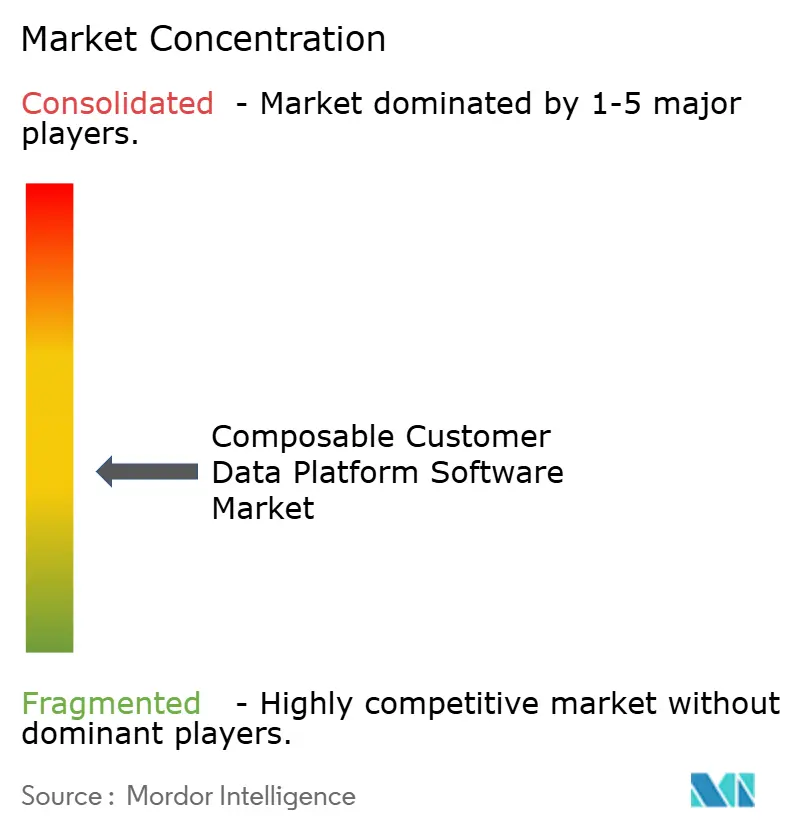
The Composable Customer Data Platform Software Market is moderately fragmented, with enterprise platform incumbents and pure-play specialists competing through different strengths. Salesforce, Adobe, Oracle, and SAP benefit from existing enterprise agreements and the ability to embed customer data functions into broader software environments. This can affect procurement decisions even when buyers are comparing different data architectures. Salesforce Data Cloud supports zero-copy data sharing with Snowflake, while Adobe expanded Real-Time CDP Collaboration to Australia and New Zealand in May 2025. These moves show how established providers are strengthening warehouse connectivity to retain customers facing composable alternatives.
Hightouch, RudderStack, Amperity, Tealium, and BlueConic form a specialist group that emphasizes warehouse-native operation, identity resolution, and activation. Their approach aims to use the customer’s existing warehouse rather than moving profiles to a separate, proprietary data layer. Hightouch introduced Golden Record to apply survivorship logic to identity resolution within the warehouse. Amperity expanded real-time customer context and AI assistant capabilities in May 2026, reinforcing the importance of current profiles in decisioning workflows. Vendors must demonstrate effective governance and identity controls without creating opaque data processes that customers cannot easily manage.
Consolidation has altered the competitive map since late 2024. Uniphore acquired ActionIQ and Infoworks in December 2024 and integrated the acquired capabilities into its enterprise AI offering. Fivetran acquired Census in October 2025, and Rokt acquired mParticle for commerce and retail media activation. Opportunities remain in the small and medium enterprise segment and in regulated verticals, where pricing, onboarding, and specialized data controls remain uneven. In the Composable Customer Data Platform Software Market, those gaps favor suppliers that can translate flexible architecture into a manageable operating model for buyers. The Composable Customer Data Platform Software Market also rewards providers that can show how their identity, activation, and privacy controls work in the customer’s existing data environment, rather than asking customers to accept a separate layer with unclear ownership.
Composable Customer Data Platform Software Industry Leaders
Salesforce, Inc.
Adobe Inc.
Oracle Corporation
Twilio Inc.
Treasure Data, Inc.
- *Disclaimer: Major Players sorted in no particular order

Recent Industry Developments
- June 2026: Databricks launched CustomerLake, an agentic CDP natively embedded in the Databricks Lakehouse, consolidating customer data, identity resolution, audience building, campaign automation, and activation into a single AI-native foundation. The platform entered private preview with HP, Circle K, AB InBev, and Getnet by Santander, marking Databricks' first direct entry into the marketing technology sector.
- May 2026: Amperity unveiled real-time customer context and AI assistant capabilities at Amplify 2026, including site personalization and cart abandonment solutions that recognize customers instantly, convert anonymous visitors to known profiles in-session, and trigger recovery journeys at the moment of abandonment.
- February 2026: Hightouch launched Content Assembly, an AI agent-powered tool that enables marketers to generate on-brand campaign materials from existing warehouse-resident creative assets and brand guidelines, eliminating manual creative production cycles from the campaign workflow.
- January 2026: Amperity introduced the Customer Data Agent, the first enterprise AI agent designed to move from question to activation in minutes by building live segments and journeys from unified profiles, and simultaneously launched Audience Monetization, enabling brands to generate high-margin revenue from first-party customer data through second-party advertiser partnerships.


Global Composable Customer Data Platform Software Market Report Scope
The composable customer data platform (CDP) software market comprises an ecosystem of modular software solutions and associated services that enable organizations to assemble a customized, best-of-breed customer data infrastructure. Unlike traditional monolithic CDPs, which require data extraction and ingestion into a proprietary system, composable CDPs operate natively on an organization's existing cloud data warehouse or data lake. This approach combines specialized, interoperable components such as data ingestion, identity resolution, data transformation, and audience activation without creating redundant data silos or requiring data movement. Deployed in the cloud, on-premises, or in hybrid models, these solutions cater to organizations of all sizes across diverse industries, including retail, BFSI, healthcare, and IT. By leveraging a composable architecture, businesses can maintain full ownership and control of their first-party data, scale their data capabilities flexibly, reduce the total cost of ownership, and execute highly personalized marketing campaigns with greater agility, security, and data governance.
The Composable Customer Data Platform Software Market Report is Segmented by Component (Platform, and Services), Deployment Mode (Cloud, On-Premise, and Hybrid), Enterprise Size (Large Enterprises, and Small and Medium Enterprises), End User (IT and Telecommunication, BFSI, Healthcare and Life Sciences, Retail and E-Commerce, Industrial Manufacturing, Education and Research Institutions, Media and Entertainment, Government and Administration, Energy and Utilities, and Other End-User Industries), and Geography (North America, South America, Europe, Asia-Pacific, and Middle East and Africa). The Market Forecasts are Provided in Terms of Value (USD).
| Platform |
| Services |
| Cloud |
| On-Premise |
| Hybrid |
| Large Enterprises |
| Small and Medium Enterprises |
| IT and Telecommunication |
| BFSI |
| Healthcare and Life Sciences |
| Retail and E-Commerce |
| Industrial Manufacturing |
| Education and Research Institutions |
| Media and Entertainment |
| Government and administration |
| Energy and Utilities |
| Other end-user industries |
| North America | United States | |
| Canada | ||
| Mexico | ||
| South America | Brazil | |
| Argentina | ||
| Rest of South America | ||
| Europe | Germany | |
| United Kingdom | ||
| France | ||
| Russia | ||
| Spain | ||
| Rest of Europe | ||
| Asia-Pacific | China | |
| Japan | ||
| India | ||
| South Korea | ||
| Southeast Asia | ||
| Rest of Asia-Pacific | ||
| Middle East and Africa | Middle East | Saudi Arabia |
| United Arab Emirates | ||
| Rest of Middle East | ||
| Africa | South Africa | |
| Nigeria | ||
| Rest of Africa | ||
| By Component | Platform | ||
| Services | |||
| By Deployment Mode | Cloud | ||
| On-Premise | |||
| Hybrid | |||
| By Enterprise Size | Large Enterprises | ||
| Small and Medium Enterprises | |||
| By End User | IT and Telecommunication | ||
| BFSI | |||
| Healthcare and Life Sciences | |||
| Retail and E-Commerce | |||
| Industrial Manufacturing | |||
| Education and Research Institutions | |||
| Media and Entertainment | |||
| Government and administration | |||
| Energy and Utilities | |||
| Other end-user industries | |||
| By Geography | North America | United States | |
| Canada | |||
| Mexico | |||
| South America | Brazil | ||
| Argentina | |||
| Rest of South America | |||
| Europe | Germany | ||
| United Kingdom | |||
| France | |||
| Russia | |||
| Spain | |||
| Rest of Europe | |||
| Asia-Pacific | China | ||
| Japan | |||
| India | |||
| South Korea | |||
| Southeast Asia | |||
| Rest of Asia-Pacific | |||
| Middle East and Africa | Middle East | Saudi Arabia | |
| United Arab Emirates | |||
| Rest of Middle East | |||
| Africa | South Africa | ||
| Nigeria | |||
| Rest of Africa | |||


Key Questions Answered in the Report
What is the size of the Composable Customer Data Platform Software Market?
The Composable Customer Data Platform Software Market is projected to grow from USD 1.9 billion in 2026 to USD 4.76 billion by 2031 at a 19.66% CAGR.
What is driving demand for composable customer data platform software?
First-party data management, AI-supported personalization, warehouse-native architecture, and omnichannel activation are supporting adoption.
Which component leads revenue?
Platform led with a 74.18% share in 2025, while Services is projected to grow at a 22.83% CAGR through 2031.
Which deployment model is growing fastest?
Hybrid deployment is projected to grow at a 21.69% CAGR through 2031 as regulated users balance residency requirements with cloud activation.
Which end-user sector has the largest share?
Retail and E-Commerce led with a 24.86% share in 2025 because it needs timely identity resolution across loyalty, commerce, and retail media operations.
Which region is growing fastest?
Asia-Pacific is projected to expand at a 24.19% CAGR through 2031, supported by mobile-first commerce and localized data deployment needs.
Page last updated on:






