
Competitive Intelligence Services Market Size and Share
Market Overview
| Study Period | 2020 - 2031 |
|---|---|
| Market Size (2026) | USD 9.71 Billion |
| Market Size (2031) | USD 16.64 Billion |
| Growth Rate (2026 - 2031) | 11.37 % |
| Fastest Growing Market | Asia-Pacific |
| Largest Market | North America |
| Market Concentration | Low |
Major Players *Disclaimer: Major Players sorted in no particular order Image © Mordor Intelligence. Reuse requires attribution under CC BY 4.0. | |
Competitive Intelligence Services Market Analysis by Mordor Intelligence
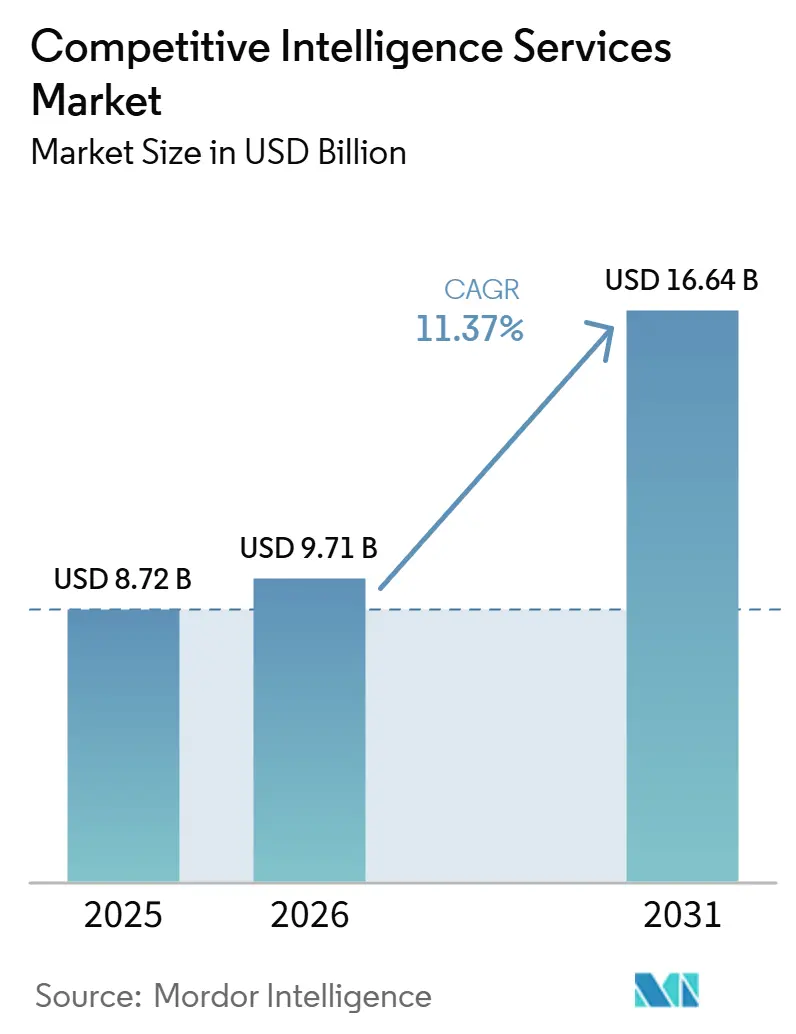
The Competitive Intelligence Services Market size is projected to expand from USD 8.72 billion in 2025 and USD 9.71 billion in 2026 to USD 16.64 billion by 2031, registering a CAGR of 11.37% between 2026 and 2031. Growth reflects the wider use of AI-supported research processes, which have reduced the effort required for ongoing competitor monitoring. Intelligence outputs are also moving from periodic strategy reviews into sales, product, and revenue operations decisions. This shift increases the value of services that deliver relevant signals within established work systems. Vendors are therefore seeking to pair data coverage with reliable synthesis, workflow integration, and advisory support as basic tracking becomes easier to automate.
Key Report Takeaways
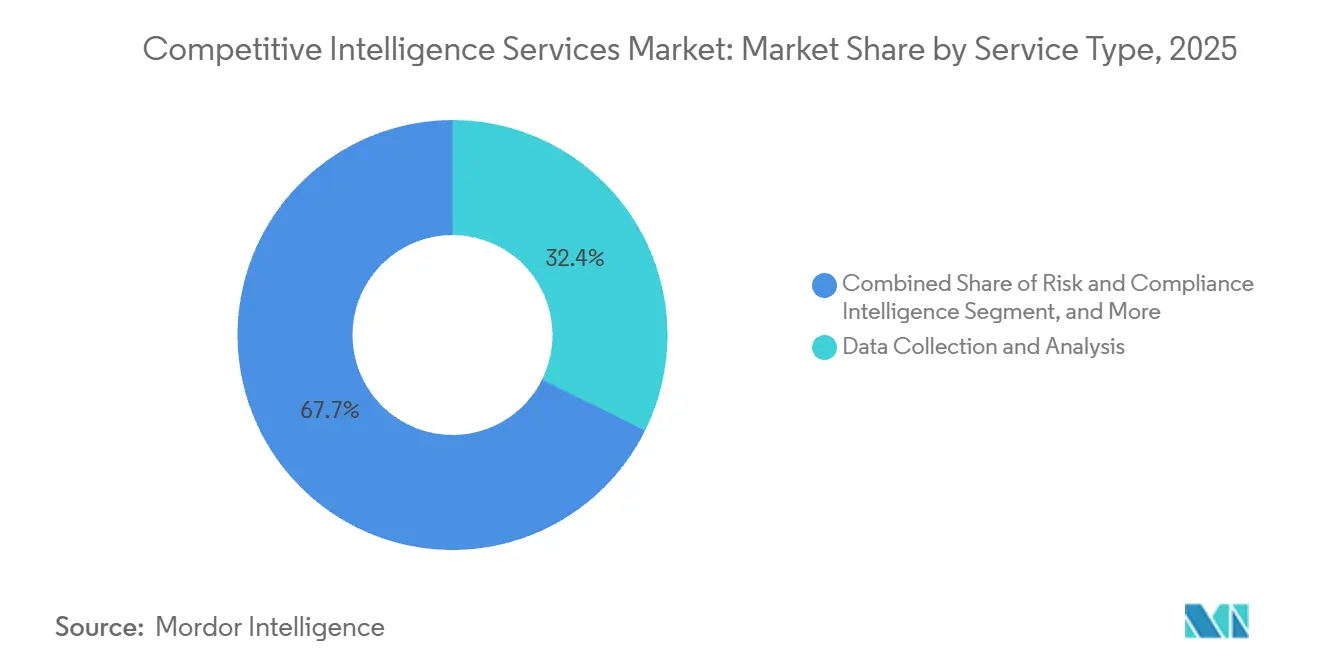
- By service type, Data Collection and Analysis held 32.35% of the Competitive Intelligence Services Market share in 2025, while Risk and Compliance Intelligence is projected to expand at a 14.16% CAGR through 2031.
- By deployment mode, cloud-based deployment held 58.62% of the Competitive Intelligence Services Market share in 2025, while hybrid deployment is projected to expand at a 15.22% CAGR through 2031.
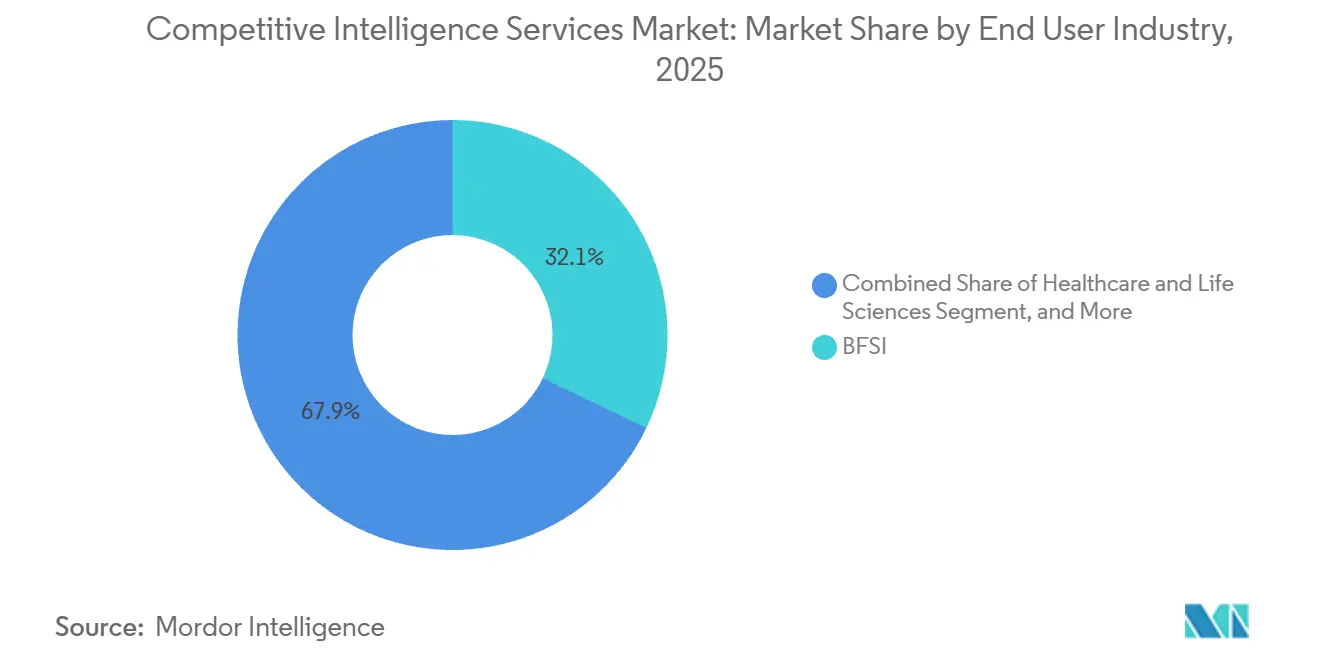
- By end user, BFSI held 32.12% revenue share in 2025, while Healthcare and Life Sciences are projected to expand at a 14.51% CAGR through 2031.
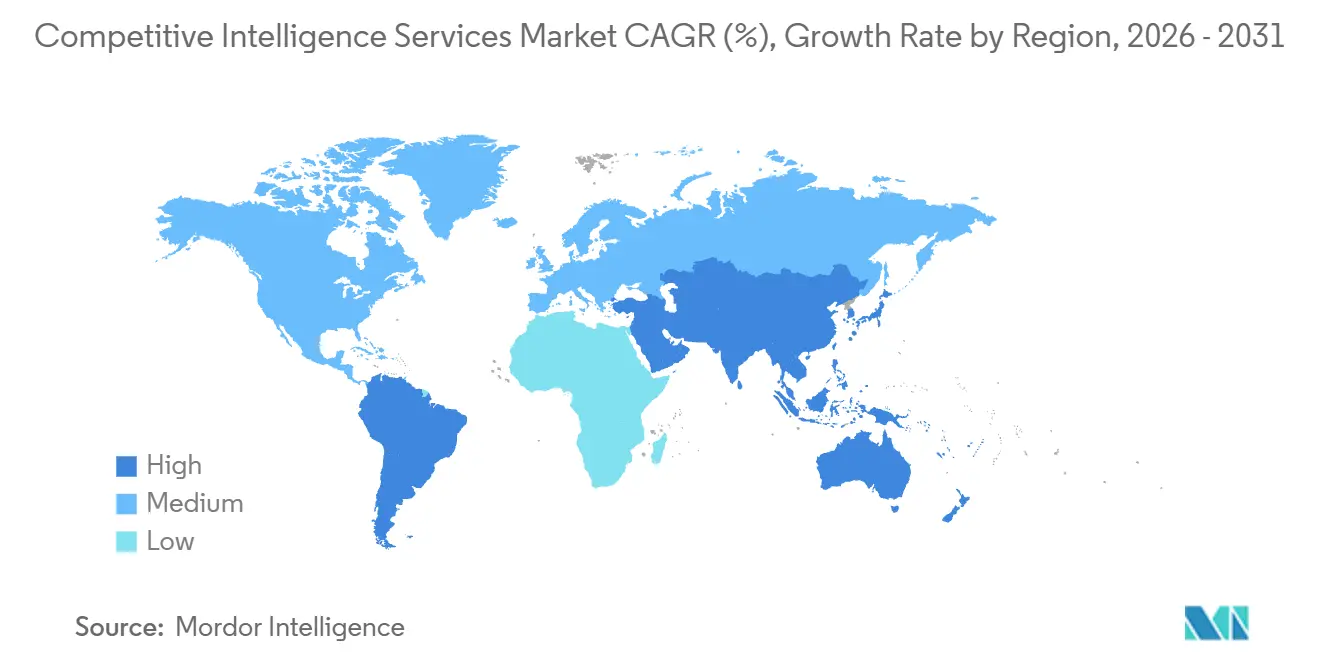
- By geography, North America held 36.38% revenue share in 2025, while Asia-Pacific is projected to expand at a 13.81% CAGR through 2031.
Note: Market size and forecast figures in this report are generated using Mordor Intelligence’s proprietary estimation framework, updated with the latest available data and insights as of January 2026.
Market Trends and Insights
Drivers Impact Analysis of Competitive Intelligence Services Market*
| Driver | (~) % Impact on CAGR Forecast | Geographic Relevance | Impact Timeline |
|---|---|---|---|
| Real-Time Competitor Monitoring Demand | +2.5% | Global, with the highest concentration in North America and Europe | Short term (≤ 2 years) |
| AI-Powered Intelligence Workflows | +2.3% | Global, with faster adoption in North America and Asia-Pacific | Short term (≤ 2 years) |
| Cross-Functional Use Across Sales, Product, and Strategy | +1.5% | Global, particularly North America and Western Europe | Medium term (2-4 years) |
| Regulated-Industry and Risk-Linked Intelligence Needs | +1.3% | North America and Europe, with spillover to Asia-Pacific | Medium term (2-4 years) |
| Hybrid Continuous Intelligence Models | +0.9% | Global, strongest among large enterprises across regions | Medium term (2-4 years) |
| Dark Data and Internal Knowledge Graph Use | +0.6% | North America and Europe, with early adoption in Asia-Pacific | Long term (≥ 4 years) |
| Source: Mordor Intelligence | |||
Rising Demand for Real-Time Competitor Monitoring
Organizations have moved from periodic competitor reviews toward continuous monitoring that responds to product, pricing, leadership, and messaging signals. Formal competitive intelligence programs can tie research activity more closely to sales outcomes, executive priorities, and the responses required from specific teams. This makes the business case more practical by enabling teams to connect a competitor change to a deal, account, product decision, or customer conversation. The Competitive Intelligence Services Market benefits when alerts are delivered in customer relationship management systems and other tools used by sales teams during active work. This delivery model can also reduce the delay between a market event and a response from the employee responsible for a customer or product decision. Crayon’s 2026 report linked structured program maturity and executive sponsorship with stronger competitive outcomes, supporting the case for repeatable monitoring processes.[1]Crayon, “The 2026 State of Competitive Intelligence,” Crayon, crayon.co.
Expansion of AI-Powered Intelligence Workflows
Generative AI and autonomous agent designs are changing how services collect, review, classify, and summarize large volumes of information from different sources. The Competitive Intelligence Services Market is moving toward systems that can complete multi-step research, compare findings, and update outputs as new events occur. AlphaSense reported surpassing USD 600 million in annual recurring revenue in June 2026, following the launch of SuperAnalyst for continuous research workflows.[2]AlphaSense, “AlphaSense Raises USD 350M at USD 7.5B Valuation and Surpasses USD 600M in Annual Recurring Revenue,” AlphaSense, alpha-sense.com. The company also reported a USD 350 million funding round at a USD 7.5 billion valuation, indicating continued investment in enterprise research tools. Accenture announced a strategic investment and partnership with AlphaSense in June 2026 to bring agentic intelligence workflows to enterprises. Providers still need defensible content libraries, careful source selection, and strong data controls because basic monitoring functions can be copied more easily than trusted source coverage.
Cross-Functional Adoption Across Sales, Product, and Strategy Teams
Use of competitive intelligence is broadening beyond specialist research teams into sales, product marketing, revenue operations, and related customer-facing roles. This expands the number of teams that can use a shared platform and increases the importance of integrations that do not interrupt normal work. The Competitive Intelligence Services Market gains traction when insights are embedded in tools for account planning, deal reviews, coaching, forecasting, and product discussions. Klue introduced Compete Agent in 2026 to provide competitive deal intelligence within existing selling workflows and also released an AI-First Win-Loss Suite.[3]Klue, “Klue Launches Compete Agent to Redefine Competitive Intelligence for Modern GTM Teams,” Klue, klue.com. Klue acquired Ignition in September 2025 to expand its coverage across customer research, competitive strategy, and product marketing. Broader use can increase account value and retention when outputs are assigned to clear decisions, shared with relevant teams, and reviewed as part of regular operating routines.
Rising Need for Regulated-Industry and Risk-Linked Intelligence
Pharmaceutical, financial services, and healthcare organizations are increasingly using competitive intelligence to support risk management and routine commercial oversight. These organizations need timely visibility into competitor actions, regulatory developments, pipeline changes, and information that could affect commercial decisions. The Competitive Intelligence Services Market can benefit because these needs are more closely tied to operating requirements and control processes than discretionary planning projects. The European Data Protection Board adopted final guidelines on web scraping in the context of generative AI in July 2026, setting out how the GDPR applies to the processing of personal data in these activities. The guidelines make data sourcing, minimization, transparency, and appropriate review important design considerations for providers serving regulated users. Services that combine competitive monitoring with auditable processes can be more useful to organizations that need evidence for internal controls, documented decisions, and accountable oversight.[4]European Data Protection Board, “EDPB Adopts Guidelines 03/2026 on Web Scraping in the Context of Generative AI,” European Data Protection Board, edpb.europa.eu.
Restraints Impact Analysis of Competitive Intelligence Services Market*
| Restraint | (~) % Impact on CAGR Forecast | Geographic Relevance | Impact Timeline |
|---|---|---|---|
| Data Privacy, Consent, and Ethical Scrutiny | -2.0% | Global, strongest in Europe, with significant spillover to North America and Asia-Pacific | Short term (≤ 2 years) |
| High Total Cost of Ownership and Shelfware Risk | -1.5% | Global, most acute in mid-market segments | Short term (≤ 2 years) |
| Verification Burden in Generative AI Workflows | -1.0% | Global, with higher impact in regulated industries | Medium term (2-4 years) |
| Fragmented Buying Centers and Weak Intelligence Governance | -0.7% | Global, with greater prevalence in mid-market and small and medium-sized business segments | Medium term (2-4 years) |
| Source: Mordor Intelligence | |||
Data Privacy, Consent, and Ethical Scrutiny
Web scraping remains an important data collection method, but it is under closer scrutiny from regulators in major regions where personal data protection laws apply. The final 2026 European Data Protection Board guidelines address automated scraping for generative AI and outline the GDPR conditions that apply when personal data is involved. Providers must consider lawful basis, data minimization, transparency, and the treatment of sensitive data in their collection processes. These requirements add legal, operational, and engineering work, especially for smaller companies without large compliance teams or formal data governance functions. The Competitive Intelligence Services Market faces uneven effects because larger platforms can absorb more of these fixed costs and document their processes more consistently. Their ability to maintain documented sourcing practices can strengthen their position with enterprise buyers that need reliable data controls.
High Total Cost of Ownership and Shelfware Risk
The cost of an enterprise platform can extend beyond subscription charges to data licenses, integrations, training, internal change work, and staff time. This burden is especially difficult for mid-market organizations that lack a dedicated competitive intelligence owner or a defined operating process. A platform may see lower use when its outputs are not connected to named business decisions, established review meetings, and regular workflows. The Competitive Intelligence Services Market can face weaker renewal rates when customers buy broad capabilities but use only a limited part of them. In 2026, purpose-built tools may offer a lower-cost option for individual workflows than broad platforms bought during earlier AI adoption. Vendors can address this challenge through onboarding, relevant use-case templates, customer support, and clear measures of practical value for each participating team.
*Our forecasts treat driver/restraint impacts as directional, not additive. The impact forecasts reflect baseline growth, mix effects, and variable interactions.
Competitive Intelligence Services Market Segment Analysis
By Service Type:
Risk-Linked Services Reshape the Revenue MixData Collection and Analysis accounted for 32.35% of the Competitive Intelligence Services Market in 2025, as it provides the information used for subsequent monitoring, visualization, advisory, and compliance work. It remains the foundation for services that collect market signals and make them available to decision makers. Market Monitoring and Alerts is an established category because users increasingly expect timely updates rather than occasional reports. Reporting and Visualization also remain important because teams need findings in formats that support internal communication. These core functions support steady demand as enterprises seek a consistent view of competitors across sales, product, and strategy activities.
Risk and Compliance Intelligence is projected to record a 14.16% CAGR from 2026 to 2031, the fastest growth among the listed service types. Pharmaceutical, financial services, and energy organizations are moving more intelligence work from discretionary research to recurring risk monitoring. Sales Enablement and Win-Loss Intelligence is also developing as platforms connect competitor information to customer relationship management deal stages, battlecards, and post-deal reviews. Strategy Development and Advisory remains relevant for large enterprises and management consulting support, even where automated services grow faster. Other services, including digital traffic and search engine optimization intelligence, company and deal intelligence, and unified monitoring platforms, reflect the combination of formerly separate intelligence activities into shared systems.



By Deployment Mode:
Cloud Leads as Hybrid Gains Enterprise GroundCloud-based deployment accounted for 58.62% of the Competitive Intelligence Services Market in 2025, reflecting demand for flexible systems that integrate with customer relationship management, sales enablement, and collaboration tools. Cloud delivery enables continuous data ingestion from external sources and scales computing resources for AI-supported research. This makes it well-suited for real-time monitoring and frequent updates. The Competitive Intelligence Services Market continues to rely on cloud systems where organizations prioritize broad access and rapid deployment. Its role is reinforced when intelligence needs to reach users across multiple functions and locations.
Hybrid deployment is projected to expand at a 15.22% CAGR from 2026 to 2031 as regulated organizations seek cloud-based speed while retaining control of sensitive information. Banking, government contracting, and life sciences organizations may need to keep internal win-loss data, proprietary research, and customer feedback in protected environments. Hybrid designs can combine those internal assets with external market signals in a single operating model. On-premises deployment retains a role where data sovereignty rules or internal policies restrict external processing. Data localization requirements in countries such as Germany and India can also encourage vendors to offer regional deployment options.
By End User:
BFSI Anchors While Healthcare and Life Sciences SurgesBFSI accounted for 32.12% of total revenue in 2025, supported by long-standing demand for regulatory and competitive information across banking, insurance, asset management, and capital markets. Financial institutions use these services to compare pricing, monitor fintech entrants, track regulatory changes, and review potential acquisition targets. The range of uses can support high platform utilization and larger customer contracts, as the same intelligence can inform multiple functions. Competitive intelligence also helps organizations respond to changes in products, customer propositions, and market positioning. This broad need keeps BFSI at the center of adoption across the Competitive Intelligence Services Market.
Healthcare and Life Sciences are projected to grow at a 14.51% CAGR from 2026 to 2031, making it the fastest-growing end-user category. Pharmaceutical and biotechnology organizations need regular visibility into competitor pipelines, product positioning, and regulatory developments. Retail and E-commerce uses are shaped by pricing intelligence, assortment monitoring, and digital shelf analysis. Media and Entertainment and Consumer Goods users focus more on brand and sentiment intelligence, competitor creative activity, and product launches. Travel and Hospitality remains a smaller but important category where pricing intelligence and online travel agency performance monitoring support day-to-day operations.
Geography Analysis
North America Competitive Intelligence Services Market
North America accounted for 36.38% of the Competitive Intelligence Services Market in 2025 and remained the largest regional contributor. The region has a high concentration of technology, financial services, and software-as-a-service companies with mature commercial operations. Many organizations in these sectors treat competitive intelligence as an input to revenue operations, product planning, and deal cycles rather than as a separate research exercise. This supports spending on platforms that can link market signals to sales and product decisions, while giving users a clearer view of competitor actions. The region also has a large base of enterprise buyers that can support integration with established customer relationship management and collaboration systems.
Europe and APAC Competitive Intelligence Services Market
Europe was the second-largest regional market, led by Germany, the United Kingdom, and France. The GDPR and EU AI Act have increased the need for data sourcing practices, transparent controls, and audit trails that can withstand regulatory review. This can support the adoption of purpose-built services with stronger governance features, particularly for organizations with sensitive data and formal compliance obligations. European organizations also use intelligence in connection with strategic planning processes, which can support recurring research requirements. Asia-Pacific is projected to grow at a 13.81% CAGR from 2026 to 2031, the fastest regional rate in the Competitive Intelligence Services Market. China remained the largest Asia-Pacific country market in 2025, while India and Southeast Asia are gaining demand as mid-market organizations adopt software-as-a-service tools for the first time.
South America and MEA Competitive Intelligence Services Market
South America is developing as a regional opportunity, with Brazil and Argentina serving as major centers for financial services and retail adoption. The Competitive Intelligence Services Market is supported by the broader use of cloud tools as fintech competition increases and businesses need timely external information. The Middle East and Africa remain smaller contributors but are developing through enterprise digitization, foreign investment, multinational expansion, and domestic fintech activity. The UAE and Saudi Arabia support Middle East demand through digital transformation and the growth of technological and financial services. South Africa, Egypt, and Nigeria lead African development as competitive monitoring becomes more relevant to expanding local and multinational businesses.

Competitive Landscape
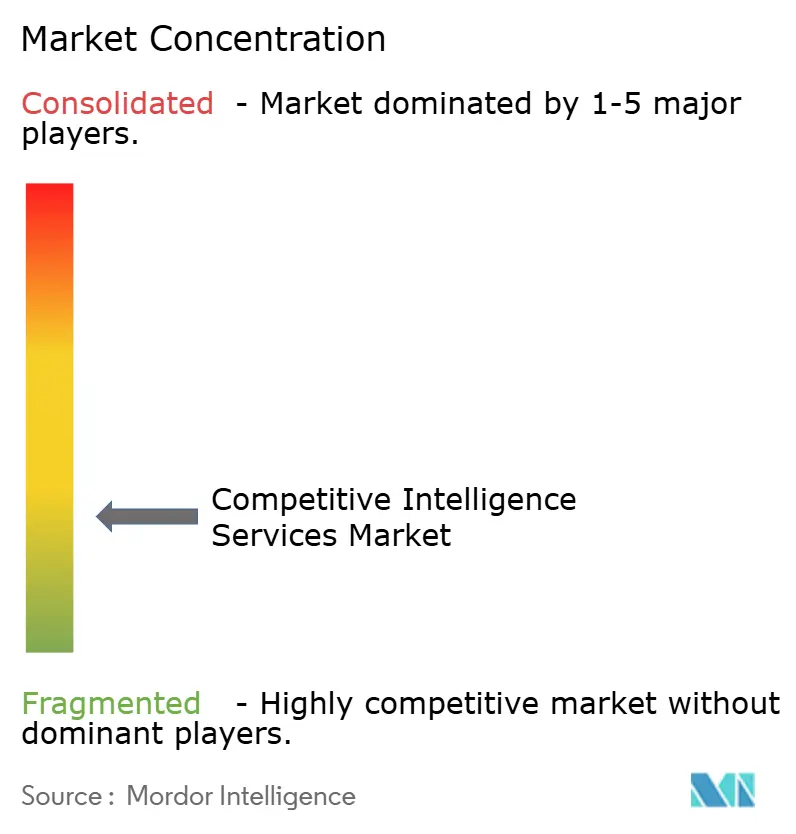
The Competitive Intelligence Services Market is fragmented, with large enterprise platforms operating alongside specialized tools for defined use cases and customer groups. AlphaSense, Meltwater, Similarweb, and S&P Global compete through content coverage, AI-supported synthesis, and the breadth of their integrations. Crayon, Klue, and Contify focus more directly on sales enablement, battlecards, and product marketing workflows. The distinction reflects a buyer's choice between broad intelligence coverage and focused operational support. It also leaves room for providers to combine reliable external data with practical delivery within the systems employees use every day.
AlphaSense reported a USD 350 million funding round and the launch of SuperAnalyst in June 2026, strengthening its support for continuous financial and strategic research. Klue expanded its product marketing and competitive intelligence coverage through its September 2025 acquisition of Ignition. Meltwater released an update to its GenAI Lens product in May 2026, adding AI-supported reporting and recommendations on how brands and products appear across major large language models. These moves show how providers are extending intelligence products into workflows that support research, reporting, and follow-up action. This approach can make competitive intelligence more useful when it informs customer relationship management, product planning, and executive reporting systems, rather than remaining in separate research repositories.
AI-native providers are also putting pressure on legacy platforms by offering continuous monitoring, automated research briefs, and faster access to routine competitive updates. This competition encourages established vendors to improve AI product capabilities, data coverage, and workflow connections. Buyers still need credible data, verifiable outputs, clear ownership, and integration with specific decisions to derive practical value from a platform. The Competitive Intelligence Services Market has no disclosed combined share for its leading companies, so a market concentration score cannot be assigned from the supplied information.
Competitive Intelligence Services Industry Leaders
AlphaSense, Inc.
Similarweb Ltd.
Semrush Holdings, Inc.
Crayon AS
Klue Labs Inc.
- *Disclaimer: Major Players sorted in no particular order
Competitive Intelligence Services Market Companies Covered in this Report
- AlphaSense, Inc.
- Similarweb Ltd.
- Crayon AS
- Klue Labs Inc.
- Contify
- Comintelli AB
- Cision Ltd.
- Meltwater N.V.
- Semrush Holdings, Inc.
- Sprout Social, Inc.
- Cipher / Knowledge360
- Quid
- Fuld + Company, LLC
- Proactive Worldwide, LLC
- Evalueserve Ltd.
- CB Insights, Inc.
- Crunchbase, Inc.
- Valona Intelligence
- ZoomInfo Technologies LLC
- S&P Global Inc.

Recent Industry Developments in Competitive Intelligence Services Market
- May 2026: Meltwater released its 2026 Mid-Year Product Update, introducing new AI-powered reporting and recommendations within its GenAI Lens product, an industry-first solution that tracks how brands and products are represented across major large language models. The update allows teams to actively shape how their brand appears in AI-generated responses.
- March 2026: CB Insights announced a partnership with Perplexity, enabling Perplexity Max and Pro users to access and cite CB Insights research reports directly within AI-powered responses. The partnership extends CB Insights' predictive intelligence on private companies into AI assistant workflows and also offers a deeper MCP or API integration for CB Insights subscribers.
- September 2025: Klue acquired Ignition, an agentic AI platform for product marketers covering customer research, competitive strategy, product roadmapping, launch planning, and voice-of-customer insights. The acquisition accelerates Klue's development of AI-driven Compete and Win-Loss products, extending its platform from sales enablement into the full product marketing lifecycle.
- September 2025: Crayon launched the first competitive intelligence Model Context Protocol server, enabling CI data and battlecard content to be accessed programmatically by AI agents, LLM-based tools, and custom enterprise applications, a development that positioned CI platform APIs as connective tissue within enterprise AI stacks.


Global Competitive Intelligence Services Market Report Scope
The competitive intelligence services market comprises professional services that gather, analyze, and interpret data on competitors, market trends, and industry dynamics. These services, delivered via cloud, hybrid, or on-premises models, encompass data collection, strategic advisory, risk monitoring, and sales enablement to help organizations across industries make informed, proactive business decisions and gain a competitive advantage.
The Competitive Intelligence Services Market Report is Segmented by Service Type (Data Collection and Analysis, Market Monitoring and Alerts, Reporting and Visualization, Strategy Development and Advisory, Risk and Compliance Intelligence, Sales Enablement and Win-Loss Intelligence, and Other Service Types (Competitive and Market Monitoring Platforms, Digital, Traffic, SEO, and Marketing Competitive Intelligence, Media, Social, Consumer, and Brand Intelligence, and Company, Financial, Private Market, and Deal Intelligence)), Deployment Mode (Cloud-Based, Hybrid, and On-Premises), End User Industry (BFSI, Retail and E-commerce, Media and Entertainment, Healthcare and Life Sciences, Travel and Hospitality, Consumer Goods, and Other End User Industries (Education, Automotive, and IT and Telecom amongst Others)), and Geography (North America, South America, Europe, Asia-Pacific, Middle East, and Africa). The Market Forecasts are Provided in Terms of Value (USD).
| Data Collection and Analysis |
| Market Monitoring and Alerts |
| Reporting and Visualization |
| Strategy Development and Advisory |
| Risk and Compliance Intelligence |
| Sales Enablement and Win-Loss Intelligence |
| Other Service Types (Competitive and Market Monitoring Platforms, Digital, Traffic, SEO, and Marketing Competitive Intelligence, Media, Social, Consumer, and Brand Intelligence, and Company, Financial, Private Market, and Deal Intelligence) |
| Cloud-Based |
| Hybrid |
| On-Premises |
| BFSI |
| Retail and E-commerce |
| Media and Entertainment |
| Healthcare and Life Sciences |
| Travel and Hospitality |
| Consumer Goods |
| Other End User Industries (Education, Automotive, and IT and Telecom amongst Others) |
| North America | United States |
| Canada | |
| Mexico | |
| South America | Brazil |
| Argentina | |
| Chile | |
| Rest of South America | |
| Europe | Germany |
| United Kingdom | |
| France | |
| Italy | |
| Spain | |
| Rest of Europe | |
| Asia-Pacific | China |
| Japan | |
| India | |
| South Korea | |
| Australia | |
| Rest of Asia-Pacific | |
| Middle East | United Arab Emirates |
| Saudi Arabia | |
| Qatar | |
| Rest of Middle East | |
| Africa | South Africa |
| Egypt | |
| Nigeria | |
| Rest of Africa |
| By Service Type | Data Collection and Analysis | |
| Market Monitoring and Alerts | ||
| Reporting and Visualization | ||
| Strategy Development and Advisory | ||
| Risk and Compliance Intelligence | ||
| Sales Enablement and Win-Loss Intelligence | ||
| Other Service Types (Competitive and Market Monitoring Platforms, Digital, Traffic, SEO, and Marketing Competitive Intelligence, Media, Social, Consumer, and Brand Intelligence, and Company, Financial, Private Market, and Deal Intelligence) | ||
| By Deployment Mode | Cloud-Based | |
| Hybrid | ||
| On-Premises | ||
| By End User Industry | BFSI | |
| Retail and E-commerce | ||
| Media and Entertainment | ||
| Healthcare and Life Sciences | ||
| Travel and Hospitality | ||
| Consumer Goods | ||
| Other End User Industries (Education, Automotive, and IT and Telecom amongst Others) | ||
| By Geography | North America | United States |
| Canada | ||
| Mexico | ||
| South America | Brazil | |
| Argentina | ||
| Chile | ||
| Rest of South America | ||
| Europe | Germany | |
| United Kingdom | ||
| France | ||
| Italy | ||
| Spain | ||
| Rest of Europe | ||
| Asia-Pacific | China | |
| Japan | ||
| India | ||
| South Korea | ||
| Australia | ||
| Rest of Asia-Pacific | ||
| Middle East | United Arab Emirates | |
| Saudi Arabia | ||
| Qatar | ||
| Rest of Middle East | ||
| Africa | South Africa | |
| Egypt | ||
| Nigeria | ||
| Rest of Africa | ||


Key Questions Answered in the Report
What is the size of the Competitive Intelligence Services Market?
The Competitive Intelligence Services Market stood at USD 9.71 billion in 2026 and is projected to reach USD 16.64 billion by 2031 at an 11.37% CAGR.
What is driving demand for competitive intelligence services?
Demand is supported by continuous competitor monitoring, AI-supported research, and wider use by sales, product, strategy, and risk teams.
Which service type has the largest share?
Data Collection and Analysis held the largest service-type share at 32.35% in 2025.
Which deployment model is growing fastest?
Hybrid deployment is projected to grow at a 15.22% CAGR from 2026 to 2031 as regulated users seek both speed and data control.
Which end-user sector is expanding fastest?
Healthcare and Life Sciences is projected to grow at a 14.51% CAGR from 2026 to 2031.
Which region is projected to grow fastest?
Asia-Pacific is projected to expand at a 13.81% CAGR from 2026 to 2031.
Page last updated on:





