
Commercial Vacuum Cleaner Market Size and Share
Market Overview
| Study Period | 2021 - 2031 |
|---|---|
| Market Size (2026) | USD 7.32 Billion |
| Market Size (2031) | USD 9.60 Billion |
| Growth Rate (2026 - 2031) | 5.56 % |
| Fastest Growing Market | Asia-Pacific |
| Largest Market | North America |
| Market Concentration | Medium |
Major Players *Disclaimer: Major Players sorted in no particular order Image © Mordor Intelligence. Reuse requires attribution under CC BY 4.0. | |
Commercial Vacuum Cleaner Market Analysis by Mordor Intelligence
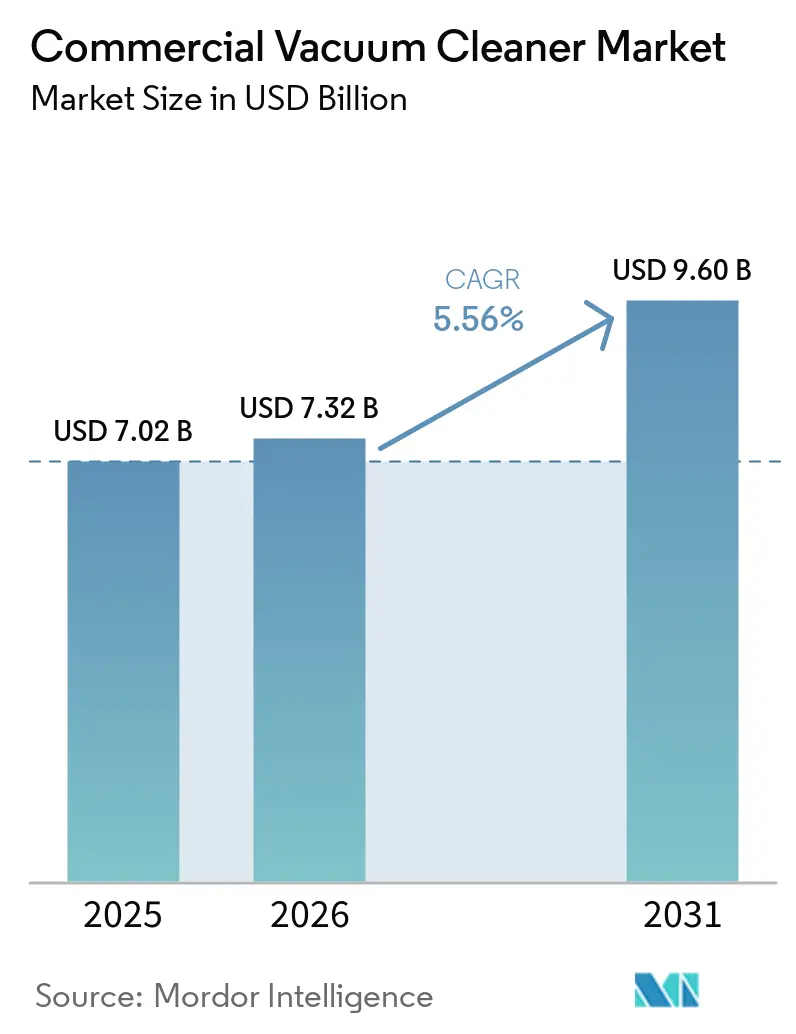
The commercial vacuum cleaner market size is expected to increase from USD 7.02 billion in 2025 to USD 7.32 billion in 2026 and reach USD 9.60 billion by 2031, growing at a CAGR of 5.56% over 2026-2031. The commercial vacuum cleaner market is moving toward equipment that can support automation, stronger filtration, and cordless use in busy facilities. Contract cleaning providers are becoming more important buyers because they manage equipment across several client sites and need consistent service support. Demand also reflects tighter expectations for indoor air quality in offices, health care settings, and public buildings. Manufacturers are responding through robotic products, shared battery systems, digital ordering tools, and higher-filtration models. Consolidation among established suppliers and the expansion of Chinese robotics companies are increasing pressure on mid-sized suppliers.
Key Report Takeaways
- By product type, upright vacuum cleaners held 34.26% of the commercial vacuum cleaner market share in 2025, while robotic vacuum cleaners are forecast to grow at a 6.65% CAGR through 2031.
- By cord type, corded equipment accounted for 56.85% of the value in 2025, while cordless equipment is projected to grow at a 6.15% CAGR through 2031.
- By end-user, cleaning service providers held 23.54% of value in 2025, while commercial offices are projected to grow at a 6.77% CAGR through 2031.
- By distribution channel, direct sales and B2B channels held 48.24% of value in 2025, while online channels are forecast to grow at a 6.14% CAGR through 2031.
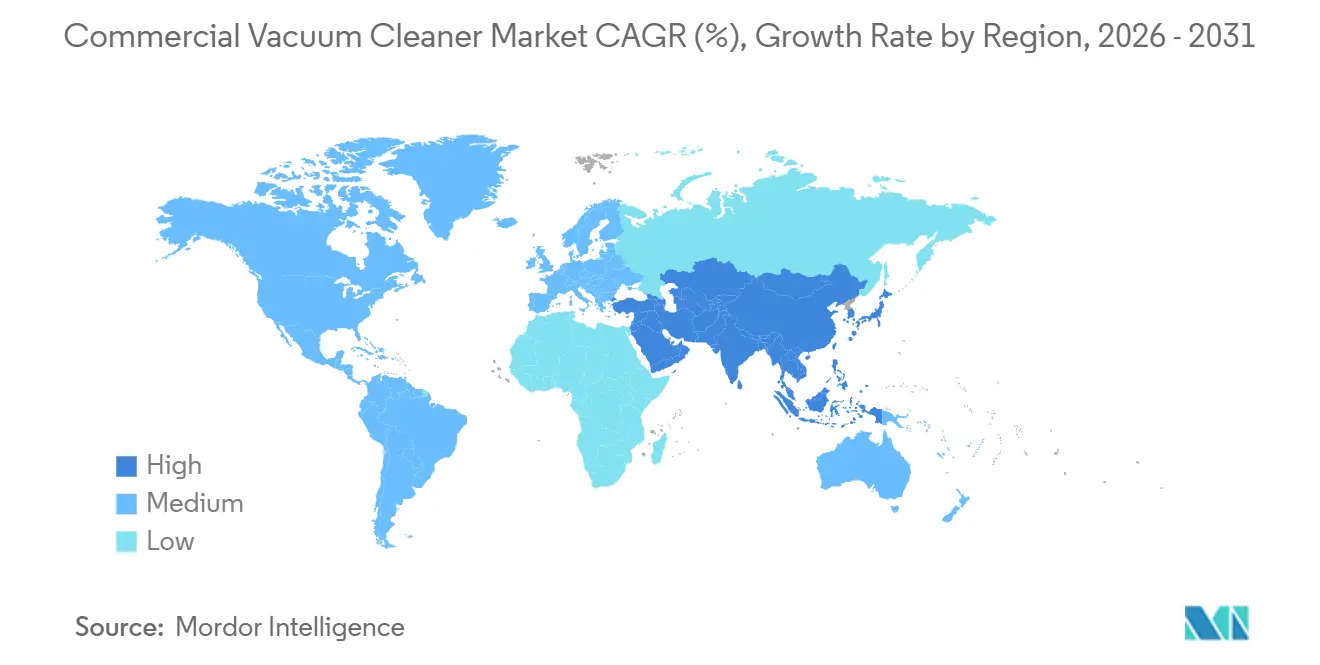
- By geography, North America held 33.16% of the value in 2025, while Asia-Pacific is projected to grow at a 6.23% CAGR through 2031.
Note: Market size and forecast figures in this report are generated using Mordor Intelligence’s proprietary estimation framework, updated with the latest available data and insights as of January 2026.
Market Trends and Insights
Drivers Impact Analysis of Commercial Vacuum Cleaner Market*
| Driver | (~) % Impact on CAGR Forecast | Geographic Relevance | Impact Timeline |
|---|---|---|---|
| Expansion of Contract Cleaning Services | +1.4% | Global, led by North America and Europe | Short term (≤ 2 years) |
| Stricter Commercial Hygiene and Indoor Air Quality Requirements | +0.9% | Global, especially North America and the EU | Medium term (2-4 years) |
| Growth of Commercial Infrastructure in Emerging Economies | +0.8% | Asia-Pacific core, with spillover to the Middle East and Africa | Long term (≥ 4 years) |
| B2B E-Commerce Adoption for Cleaning Equipment Procurement | +0.5% | North America and the EU | Short term (≤ 2 years) |
| Autonomous Cleaning for Labor-Constrained Facilities | +1.0% | North America, Europe, and Japan | Medium term (2-4 years) |
| HEPA Filtration Demand From High-Compliance Facilities | +0.6% | Global, led by North America and the Asia-Pacific | Medium term (2-4 years) |
| Source: Mordor Intelligence | |||
Expansion of Contract Cleaning Services
Contract cleaning services are a central demand channel for the commercial vacuum cleaner market. Large building service contractors buy equipment for several sites, which favors standardized fleets and serviceable products. Their multi-site contracts make replacement planning more predictable than one-time purchases by individual facilities. These providers need equipment that can move between offices, government locations, health care sites, and hospitality properties. They also need suppliers that can support maintenance, consumables, and replacement units across their service areas. Direct sales, distributor support, and B2B ordering systems, therefore, remain important to the commercial vacuum cleaner market.
Stricter Commercial Hygiene and Indoor Air Quality Requirements
Indoor air quality requirements are changing how commercial buyers assess filtration and cleaning performance. Health Canada recommends vacuum systems with HEPA filters for office buildings and states that HEPA filters remove at least 99.97% of particles at or above 0.3 microns[1]. ASHRAE Standard 62.1 provides ventilation requirements for nonresidential buildings, while Standard 241 addresses infection-risk management in occupied spaces. These expectations affect specifications in offices, health care facilities, life sciences sites, data centers, and government buildings. Buyers are placing greater value on certified filtration, lower noise, and equipment suitable for cleaning during occupied hours. The commercial vacuum cleaner market benefits when filtration becomes part of a facility’s operating standard rather than an optional feature.
Autonomous Cleaning for Labor-Constrained Facilities
Labor shortages are encouraging facility managers to consider autonomous cleaning equipment. In 2025, 61% of the United States janitorial companies identified labor shortages as a major obstacle to growth. Robot fleets help teams cover larger areas and perform routine work more consistently. Brain Corp reported more than 50,000 deployed BrainOS-powered commercial robots and more than 5.3 million autonomous operating hours in the first half of 2026[2]. This scale shows that automation is serving daily cleaning operations rather than isolated demonstrations. The commercial vacuum cleaner market gains when autonomous products help contractors maintain service levels with limited staffing.
HEPA Filtration Demand From High-Compliance Facilities
Healthcare facilities, pharmaceutical manufacturing sites, and educational institutions represent a procurement tier where HEPA filtration is a mandatory requirement rather than a premium feature. This tier is growing faster than the broader commercial market. ASHRAE Standard 241-2024 for infection risk management supports HEPA-level air cleaning in occupied spaces as part of engineered indoor air quality strategies. ISO 29463 provides the testing and labeling framework for HEPA-rated vacuum filters and influences procurement specifications in regulated environments. Since the pandemic, facilities management teams outside the healthcare sector have adopted hospital-grade cleaning protocols across life sciences campuses, data centers, and government facilities. This trend has expanded the addressable HEPA vacuum market beyond its traditional healthcare and pharmaceutical base. Kärcher launched the T-Range dry vacuum range in January 2025 with HEPA H14 filtration, 52 dB(A) noise performance, and 45% recycled material content. The range serves daytime cleaning requirements in high-compliance hospitality and office environments[3]. Nilfisk launched the VP25 robotic vacuum in December 2025 with two-dimensional and three-dimensional LiDAR technology. The product reflects the growing use of HEPA-capable robotic vacuum platforms in high-compliance institutional environments.
Restraints Impact Analysis of Commercial Vacuum Cleaner Market*
| Restraint | (~) % Impact on CAGR Forecast | Geographic Relevance | Impact Timeline |
|---|---|---|---|
| High Upfront Cost of Professional-Grade Equipment | -0.7% | Global, most acute in Asia-Pacific, the Middle East and Africa, and South America | Short term (≤ 2 years) |
| Availability of Traditional Cleaning Alternatives | -0.4% | Asia-Pacific, South America, the Middle East, and Africa | Long term (≥ 4 years) |
| Battery Replacement and End-of-Life Management Complexity | -0.5% | Global, especially Asia-Pacific, the Middle East, and Africa | Medium term (2-4 years) |
| Interoperability Gaps Across Robotic Cleaning Fleets | -0.3% | Global | Medium term (2-4 years) |
| Source: Mordor Intelligence | |||
High Upfront Cost of Professional-Grade Equipment
Professional equipment can require a substantial initial outlay, especially for robotic and HEPA-filtered units. This limits adoption by smaller cleaning contractors and independent operators with limited access to equipment finance. Traditional cleaning tools remain a lower-cost alternative in several emerging markets. Nexaro’s case study identifies operating savings from autonomous vacuum deployment, but buyers must fund the equipment before realizing those benefits. Larger operators can spread this cost across multi-site contracts, while smaller firms often cannot. This gap keeps premium equipment from reaching its full potential in the commercial vacuum cleaner market.
Battery Replacement and End-of-Life Management Complexity
Cordless fleets require buyers to manage battery replacement, charging, storage, and disposal. Numatic’s NX300 platform is rated for up to 2,500 charge cycles and carries a 3-year warranty, showing that battery performance information can support purchasing decisions[4]. Comparable information is not consistently available across brands, which makes fleet comparisons difficult. The issue is more complex where battery recycling systems are limited or where a contractor operates several brands. Different robot platforms can also create interoperability challenges in fleet management. These issues may slow the change from corded to cordless equipment in intensive cleaning applications.
*Our forecasts treat driver/restraint impacts as directional, not additive. The impact forecasts reflect baseline growth, mix effects, and variable interactions.
Commercial Vacuum Cleaner Market Segment Analysis
By Product Type:
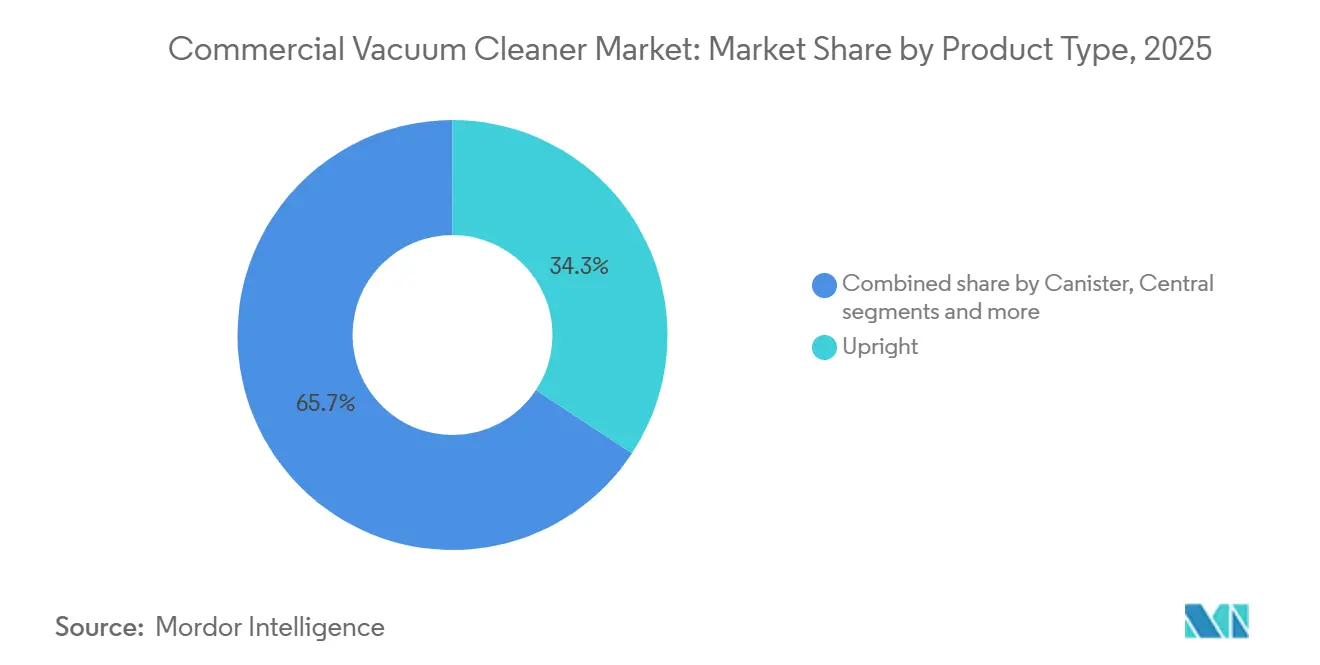
Robotic Growth Is Changing an Upright-Led CategoryUpright vacuum cleaners held 34.26% of the value in 2025, giving them the leading position in the commercial vacuum cleaner market. Their established role reflects dependable pickup performance on carpeted surfaces in hotels, large offices, and education facilities. Robotic vacuum cleaners are forecast to grow at a 6.65% CAGR through 2031. BrainOS-powered commercial robots exceeded 50,000 deployed units globally in the first half of 2026 and recorded more than 5.3 million autonomous operating hours. The International Federation of Robotics reported that professional cleaning robot sales rose 34% in 2024 to more than 25,000 units worldwide. These deployments show that robots are moving beyond limited trials in large facilities.
Canister vacuum cleaners remain important in mixed-surface settings such as health care and retail locations. Nilfisk launched its VP300 and VP400 compact canister vacuum cleaners in 2025 for users who need flexibility in congested areas. Drum and wet-and-dry products continue to serve industrial sites that handle both liquid and solid debris. Handheld units support spot cleaning in transportation and hospitality locations. Tennant introduced the X16 SWEEP in April 2026 for complex industrial settings such as warehouses, logistics centers, and light manufacturing sites. The product illustrates how autonomous formats are moving into demanding operating environments. The commercial vacuum cleaner market is therefore retaining conventional formats while adding automation for specialized use cases.

By Cord Type:
Cordless Equipment Is Reducing the Runtime GapCorded equipment represented 56.85% of the value in 2025 and remained the largest cord type in the commercial vacuum cleaner market. Its position reflects uninterrupted runtime and stable suction in airports, retail centers, and industrial facilities. Cordless equipment is projected to grow at a 6.15% CAGR through 2031. Numatic’s NX300 36V commercial battery platform provides up to 80 minutes of runtime. Dyson’s V15 Detect Pro for commercial use provides up to 120 minutes when used with dual click-in batteries and includes HEPA H13 filtration. These specifications show why cordless models are becoming more viable for routine professional work.
Cordless models can reduce trip hazards in hospitals, schools, shopping centers, and other occupied spaces. They can also help teams clean during the day without moving cords through public areas. The TASKI AERO 8 FLEXX combines cordless operation with a 52 dB motor and HEPA H13 filtration. Kärcher’s T-Range offers corded and battery-powered models for hospitality, facilities management, and office cleaning. The commercial vacuum cleaner market still relies on corded units for long shifts, but cordless options are gaining where safety, noise, and mobility matter. Battery replacement and end-of-life management remain key limits on wider adoption.
By End-User:
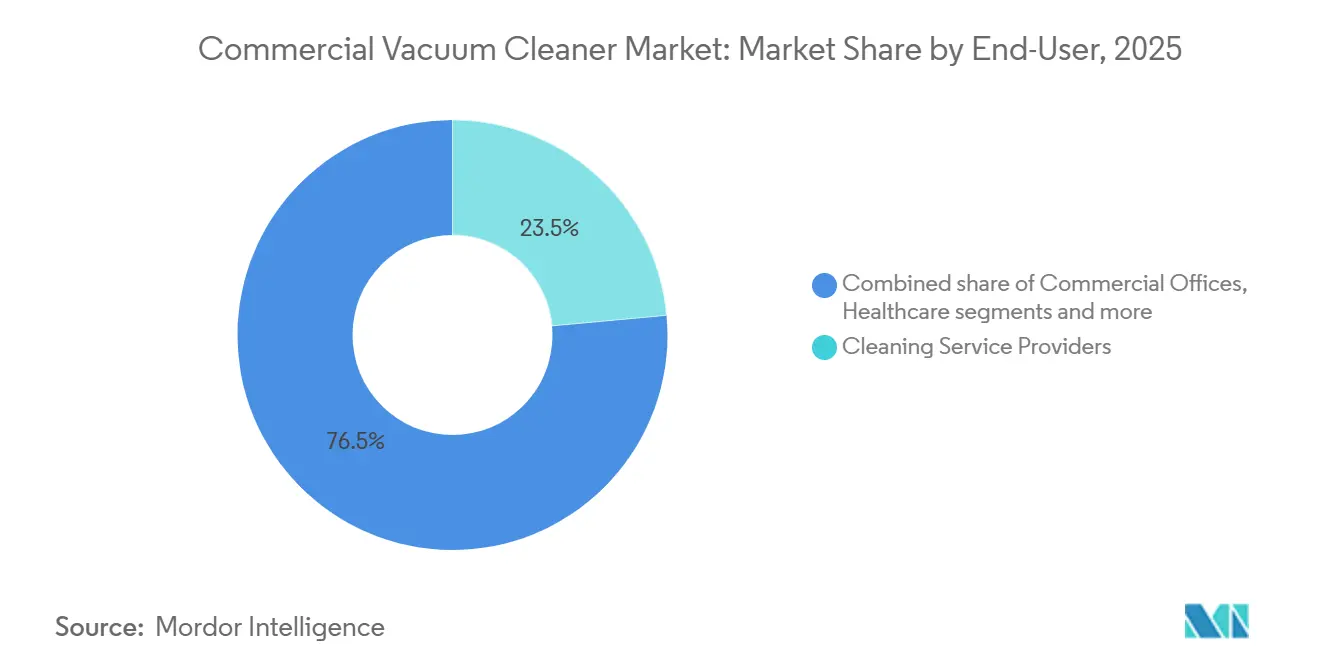
Commercial Offices Support Higher-Specification DemandCleaning service providers held 23.54% of the commercial vacuum cleaner market share in 2025. They aggregate demand across multiple customer contracts and commonly negotiate equipment, maintenance, and service arrangements at scale. Commercial offices are forecast to grow at a 6.77% CAGR through 2031. Office upgrades increasingly include indoor air quality measures that support higher-filtration cleaning equipment. Cleaning providers need versatile products that can handle carpets, hard floors, confined areas, and changing hygiene requirements across their client base. This mix supports demand for equipment with reliable performance, simple maintenance, and flexible deployment.
Hospitality remains an important end-user category because housekeeping quality affects guest experience. Health care facilities require high-filtration equipment and can use autonomous products to free staff for disinfection work. Educational institutions, retail locations, industrial sites, transport hubs, and public buildings each have distinct cleaning routines. Warehouses and logistics centers need equipment for continuous or heavy debris collection, while schools often need low-noise daytime cleaning. Airports and rail stations are potential users of autonomous products during off-peak periods. The commercial vacuum cleaner market serves these settings through a mix of upright, canister, wet-and-dry, cordless, and robotic equipment. Buyers’ preference depends on cleaning frequency, floor material, staffing, and compliance needs.
By Distribution Channel:
Digital Ordering Changes the Buying ProcessDirect sales and B2B channels accounted for 48.24% of value in 2025. Large contractors and institutional buyers use these channels to secure volume pricing, service support, and tailored specifications. Online channels are expected to grow at a 6.14% CAGR through 2031. Kärcher’s professional digital platform allows customers to manage orders and buy accessories online. This makes the commercial vacuum cleaner market easier to access for repeat purchases and standardized product lines. Digital tools also provide buyers with order visibility and a more direct way to manage consumables.
Distributors and dealers remain relevant for mid-sized contractors that need credit terms, product demonstrations, and repair support. Specialty stores continue to serve small businesses that need help selecting equipment. Online ordering does not fully replace distributors because many customers still need local service and technical guidance. Instead, distributors are adding digital portals to retain accounts that prefer online ordering. The commercial vacuum cleaner market is combining direct relationships with digital transactions rather than moving to a single channel. This approach gives manufacturers a way to support large contracts while reaching smaller repeat buyers. It also places greater importance on product information, spare parts availability, and post-sale service.
Geography Analysis
North America Commercial Vacuum Cleaner Market
North America held 33.16% of the value in 2025 and was the largest regional part of the commercial vacuum cleaner market. Large building service contractors operate standardized fleets across commercial facilities under service-level agreements. The United States requirements and guidance on ventilation and indoor air quality support demand for equipment with stronger filtration. Health Canada recommends HEPA-filter vacuuming systems for office buildings. Mexico also adds demand as manufacturing and nearshoring activity expand its commercial building base.
Europe Commercial Vacuum Cleaner Market
Europe remains an important region for professional cleaning equipment, automation, and sustainability specifications. Freudenberg Home and Cleaning Solutions completed its takeover of Nilfisk in April 2026, bringing Nilfisk into Freudenberg as a standalone brand. The transaction may increase competitive pressure on European suppliers that have smaller research and development resources. Germany, the United Kingdom, and Austria have active demand from logistics, hospitals, airports, and hospitality facilities. The region also has mature buyers who are more likely to evaluate energy use, recycled content, filtration, and equipment durability. This creates favorable conditions for premium and automated equipment.
APAC and MEA Commercial Vacuum Cleaner Market
Asia-Pacific is forecast to grow at a 6.23% CAGR through 2031, making it the fastest-growing geography in the commercial vacuum cleaner market. Commercial development in India, mainland China, South Korea, Japan, Australia, and Southeast Asia is enlarging the installed base of offices and institutional buildings. China is both an end market and a manufacturing center for commercial cleaning robots, and Gausium operates in more than 70 countries. Japan and South Korea are premium upgrade markets with developed facility management services. Singapore, Malaysia, Vietnam, and Indonesia are building their contract-cleaning ecosystems. The Middle East and Africa add demand through commercial, hospitality, and airport projects, although pricing and financing constraints can delay uptake of premium equipment.
Competitive Landscape
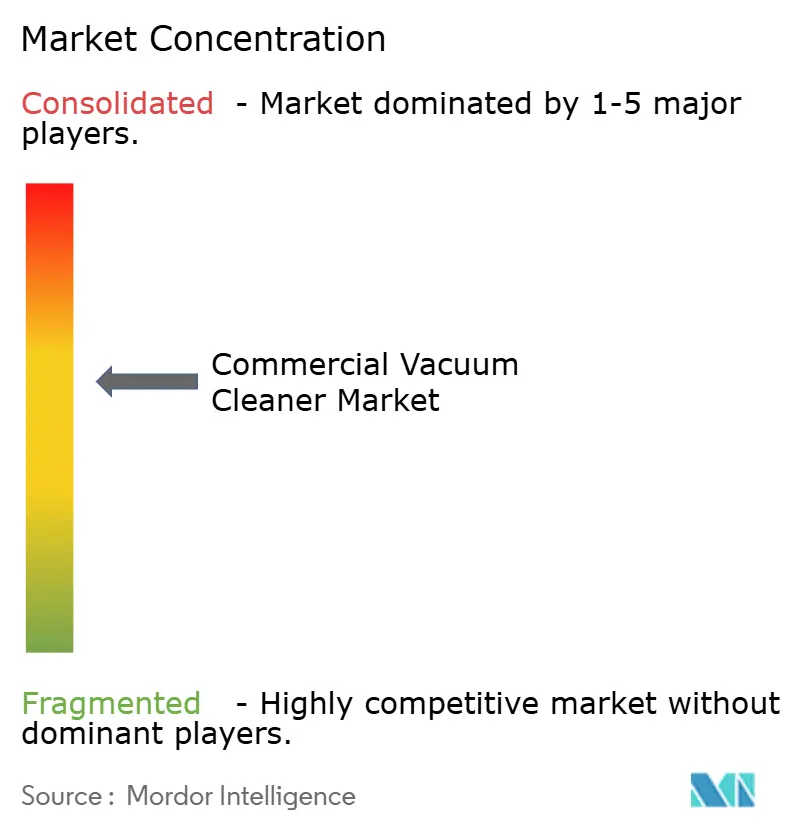
The commercial vacuum cleaner market is moderately consolidated, with Alfred Kärcher, Tennant Company, Nilfisk, Hako, and Techtronic Industries among the established suppliers. These companies compete with regional specialists and robotics entrants in individual product categories. Freudenberg completed its Nilfisk acquisition in April 2026 after acquiring more than 90% of Nilfisk’s share capital. Nilfisk recorded USD 1,171.96 million (EUR 996.30 million) of revenue in 2025 and operates in more than 100 countries. The combined business gives Freudenberg greater scale in the professional cleaning equipment category. This could increase price and specification pressure on suppliers with less scale.
Tennant is expanding its autonomous equipment portfolio. The company has stated a target of USD 250 million in autonomous robotics revenue by 2028. Its X16 SWEEP, launched in April 2026, uses Brain Corp technology for autonomous route generation in industrial environments. Kärcher launched the T-Range in January 2025 with HEPA 14 filtration, 52 dB(A) noise performance, and 45% recycled material content. Numatic’s NX300 network uses a shared battery platform across compatible professional equipment. These moves show how product platforms and recurring accessory needs are becoming more important to established suppliers.
Chinese robotics companies are also expanding into North American and European markets. Gausium was ranked first globally in commercial cleaning robot shipments and revenue in IDC’s 2025 tracker, according to the company’s July 2026 announcement. Its growing presence is intensifying competition in the autonomous cleaning equipment segment. Independent cleaning contractors remain a challenging customer group, as many autonomous cleaning products continue to carry relatively high upfront costs. The EU Machinery Regulation 2023/1230 will apply from January 2027, introducing updated safety requirements for autonomous commercial cleaning robots. The commercial vacuum cleaner market concentration score is rated at 6 out of 10, reflecting the substantial combined market positions of leading suppliers, while regional specialists and robotics entrants continue to drive competition across various segments.
Commercial Vacuum Cleaner Industry Leaders
-
Alfred Kärcher SE & Co. KG
-
Tennant Company
-
Nilfisk A/S
-
Hako GmbH
-
Techtronic Industries Company Limited
- *Disclaimer: Major Players sorted in no particular order
Commercial Vacuum Cleaner Market Companies Covered in this Report
- Alfred Kärcher SE & Co. KG
- Tennant Company
- Nilfisk A/S
- Hako GmbH
- Techtronic Industries Company Limited
- Numatic International Limited
- Makita Corporation
- Dyson Limited
- Tacony Corporation
- BISSELL Group
- ProTeam, Inc.
- SEBO America, LLC
- Pacvac Pty Ltd
- SPRiNTUS GmbH
- Solenis LLC
- Diversey Holdings LTD
- Comac S.p.A.
- IPC
- Ghibli and Wirbel S.p.A.
- Roots Multiclean Limited
Recent Industry Developments in Commercial Vacuum Cleaner Market
- June 2026: Pudu Robotics and regional distributor Robobee AG finalized a strategic partnership with Denner. Denner is a Migros Group subsidiary and a discount supermarket chain in Switzerland. The partnership covers the deployment of 200 PUDU CC1 4-in-1 commercial cleaning robots across the Denner store network. Deployment began in fall 2025. The agreement ranks among the largest single commitments for commercial cleaning robots in European retail.
- April 2026: Tennant Company unveiled the X16 SWEEP autonomous robotic industrial sweeper for complex environments such as warehouses, logistics centers, and light manufacturing facilities. Brain Corp BrainOS® with SelfPath™ artificial intelligence technology powers the sweeper. The product became available for purchase on April 7, 2026. It is the first product from Tennant Company’s autonomous robotics organization.
- April 2026: Freudenberg Home and Cleaning Solutions completed a voluntary public takeover of Nilfisk. The company acquired more than 90% of Nilfisk's share capital following regulatory approvals from multiple jurisdictions, including the European Commission. Nilfisk generated revenue of EUR 996.30 million in 2025 and operates in more than 100 countries. Nilfisk will be delisted and integrated into the Freudenberg Group as a standalone brand.
- April 2026: Pudu Robotics announced a strategic partnership with Gom Schoonhouden B.V. at Interclean Amsterdam 2026. Gom Schoonhouden B.V. is a professional cleaning service provider in the Netherlands. The agreement covers the first European deployment of the AI-native PUDU BG1 large scrubber-dryer robot. The deployment indicates increased adoption of AI-native autonomous cleaning infrastructure among European commercial cleaning service providers.
Global Commercial Vacuum Cleaner Market Report Scope
Commercial vacuum cleaners are heavy-duty cleaning appliances engineered to maintain hygiene, cleanliness, and air quality across demanding, high-traffic professional and industrial environments. Designed with high-capacity motors, superior filtration systems, and robust durability compared to residential units, these machines cater to large-scale daily sanitation requirements. The commercial vacuum cleaner market is segmented by product type, cord type, end-user, distribution channel, and geography. By product type, the market is segmented into upright, canister, central, drum, wet and dry, handheld, and robotic. By cord type, the market is segmented into corded and cordless. By end-user, the market is segmented into commercial offices, hospitality (hotels, restaurants & cafés), healthcare facilities, educational institutions, retail & shopping centers, industrial & manufacturing facilities, transportation & logistics, government & public buildings, cleaning service providers, and other commercial end users. By distribution channel, the market is segmented into direct sales / B2B, distributors & dealers, specialty stores, online, and other distribution channels. By geography, the market is segmented into North America, South America, Europe, Asia-Pacific, and the Middle East & Africa. The report offers the market size in value terms in USD for all the above-mentioned segments.
Segmentation Overview
| Upright |
| Canister |
| Central |
| Drum |
| Wet and Dry |
| Handheld |
| Robotic |
| Corded |
| Cordless |
| Commercial Offices |
| Hospitality (Hotels, Restaurants & Cafés) |
| Healthcare Facilities |
| Educational Institutions |
| Retail & Shopping Centers |
| Industrial & Manufacturing Facilities |
| Transportation & Logistics |
| Government & Public Buildings |
| Cleaning Service Providers |
| Other Commercial End Users |
| Direct Sales / B2B |
| Distributors & Dealers |
| Specialty Stores |
| Online |
| Other Distribution Channels |
| North America | Canada |
| United States | |
| Mexico | |
| South America | Brazil |
| Peru | |
| Chile | |
| Argentina | |
| Rest of South America | |
| Europe | United Kingdom |
| Germany | |
| France | |
| Spain | |
| Italy | |
| BENELUX (Belgium, Netherlands, and Luxembourg) | |
| NORDICS (Denmark, Finland, Iceland, Norway, and Sweden) | |
| Rest of Europe | |
| Asia-Pacific | India |
| China | |
| Japan | |
| Australia | |
| South Korea | |
| South East Asia (Singapore, Malaysia, Thailand, Indonesia, Vietnam, and the Philippines) | |
| Rest of Asia-Pacific | |
| Middle East and Africa | United Arab Emirates |
| Saudi Arabia | |
| South Africa | |
| Nigeria | |
| Rest of the Middle East and Africa |
| By Product Type | Upright | |
| Canister | ||
| Central | ||
| Drum | ||
| Wet and Dry | ||
| Handheld | ||
| Robotic | ||
| By Cord Type | Corded | |
| Cordless | ||
| By End-User | Commercial Offices | |
| Hospitality (Hotels, Restaurants & Cafés) | ||
| Healthcare Facilities | ||
| Educational Institutions | ||
| Retail & Shopping Centers | ||
| Industrial & Manufacturing Facilities | ||
| Transportation & Logistics | ||
| Government & Public Buildings | ||
| Cleaning Service Providers | ||
| Other Commercial End Users | ||
| By Distribution Channel | Direct Sales / B2B | |
| Distributors & Dealers | ||
| Specialty Stores | ||
| Online | ||
| Other Distribution Channels | ||
| By Geography | North America | Canada |
| United States | ||
| Mexico | ||
| South America | Brazil | |
| Peru | ||
| Chile | ||
| Argentina | ||
| Rest of South America | ||
| Europe | United Kingdom | |
| Germany | ||
| France | ||
| Spain | ||
| Italy | ||
| BENELUX (Belgium, Netherlands, and Luxembourg) | ||
| NORDICS (Denmark, Finland, Iceland, Norway, and Sweden) | ||
| Rest of Europe | ||
| Asia-Pacific | India | |
| China | ||
| Japan | ||
| Australia | ||
| South Korea | ||
| South East Asia (Singapore, Malaysia, Thailand, Indonesia, Vietnam, and the Philippines) | ||
| Rest of Asia-Pacific | ||
| Middle East and Africa | United Arab Emirates | |
| Saudi Arabia | ||
| South Africa | ||
| Nigeria | ||
| Rest of the Middle East and Africa | ||
Key Questions Answered in the Report
Which commercial vacuum cleaner product type is growing fastest?
Robotic vacuum cleaners are forecast to grow at a 6.65% CAGR through 2031. Higher deployment by facility operators reflects demand for consistent cleaning when labor availability is limited.
Why are cordless commercial vacuum cleaners gaining adoption?
Cordless products improve mobility and reduce trip hazards during daytime cleaning. Battery platforms with longer runtimes and HEPA filtration help them address more professional cleaning tasks.
Which end user has the fastest growth through 2031?
Commercial offices are forecast to grow at a 6.77% CAGR through 2031. Office upgrades that address indoor air quality are supporting demand for higher-filtration equipment.
Which region is growing fastest for commercial vacuum cleaners?
Asia-Pacific is forecast to grow at a 6.23% CAGR through 2031. Demand is linked to the growth of offices, institutional facilities, facility management services, and commercial cleaning robotics.
What limits the adoption of robotic cleaning equipment?
High upfront equipment costs, battery management requirements, and interoperability gaps can delay adoption. These constraints are most important for smaller contractors and regions with limited financing or recycling systems.