
Commercial Laundry Appliances Market Size and Share
Market Overview
| Study Period | 2021 - 2031 |
|---|---|
| Market Size (2026) | USD 9.92 Billion |
| Market Size (2031) | USD 13.17 Billion |
| Growth Rate (2026 - 2031) | 5.82 % |
| Fastest Growing Market | Asia-Pacific |
| Largest Market | North America |
| Market Concentration | Medium |
Major Players *Disclaimer: Major Players sorted in no particular order Image © Mordor Intelligence. Reuse requires attribution under CC BY 4.0. | |
Commercial Laundry Appliances Market Analysis by Mordor Intelligence
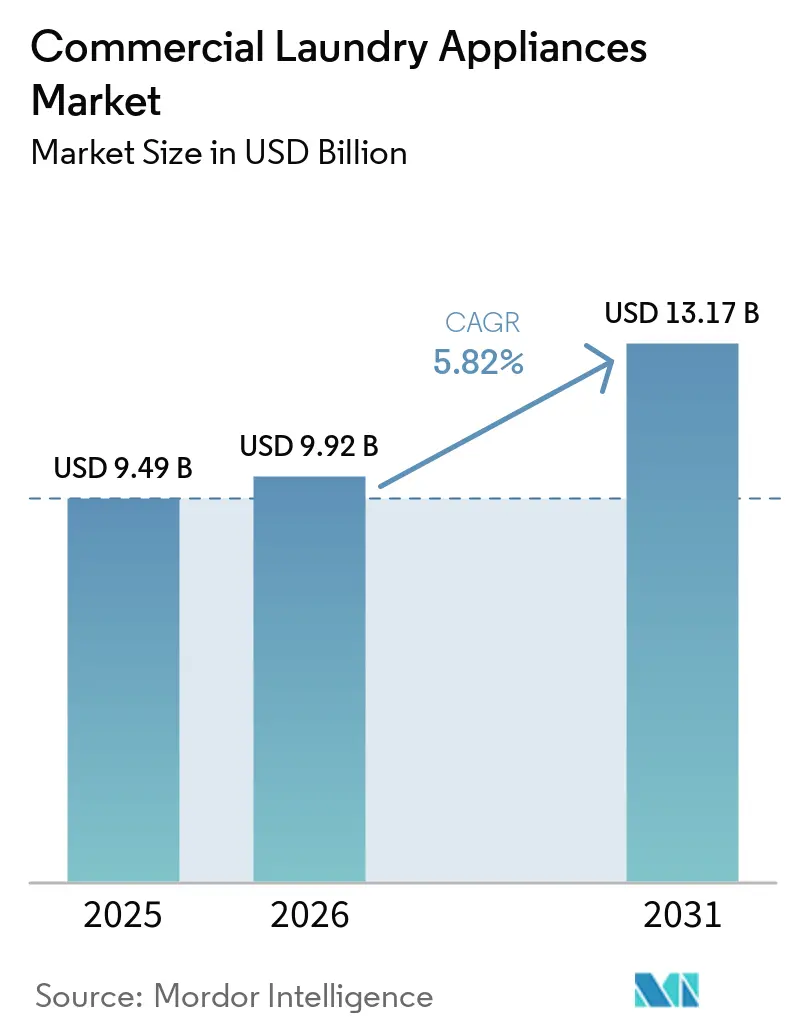
The commercial laundry appliances market size was valued at USD 9.49 billion in 2025 and is estimated to grow from USD 9.92 billion in 2026 to reach USD 12.59 billion by 2031, at a CAGR of 5.8% during the forecast period (2026-2031). The commercial laundry appliances market benefits from essential linen processing needs in hospitality and healthcare, where machine uptime, hygiene controls, and dependable throughput remain central operating requirements. Replacement cycles are therefore less tied to discretionary spending than in many other equipment categories. Growth in outsourced linen services is shifting purchasing toward centralized facilities that require larger and more automated systems. Equipment suppliers are also competing through service coverage, connected platforms, and local access to replacement parts. Environmental rules covering energy use, microfiber capture, and PFAS-related wastewater concerns are adding compliance needs that support upgrades in the commercial laundry appliances market [1]New York State Senate, “Senate Bill 2025-S5605 Amendment A, Washing Machine Microfiber Filtration Act,” New York State Senate, nysenate.gov..
Key Report Takeaways
- By product type, washing technology held 56.3% of the commercial laundry appliances market share in 2025 and is projected to register a 6.4% CAGR through 2031.
- By capacity range, 15–30 kg equipment held 37.4% of revenue in 2025, while the 30–50 kg range is forecast to register a 7.1% CAGR through 2031.
- By end-user, hospitality held 32.8% of revenue in 2025, while healthcare is projected to register a 7.1% CAGR through 2031.
- By distribution channel, distributors and dealers held 66.6% of revenue in 2025, while direct sales are forecast to register a 6.7% CAGR through 2031.
- By geography, North America held 33.9% of revenue in 2025, while Asia-Pacific is forecast to register a 7.59% CAGR through 2031.
Note: Market size and forecast figures in this report are generated using Mordor Intelligence’s proprietary estimation framework, updated with the latest available data and insights as of January 2026.
Global Commercial Laundry Appliances Market Trends and Insights
Drivers Impact Analysis*
| Driver | (~) % Impact on CAGR Forecast | Geographic Relevance | Impact Timeline |
|---|---|---|---|
| Hospitality And Healthcare Linen Throughput Expansion | +1.6% | Global, with the highest intensity in the Asia-Pacific and the Middle East | Medium term (2-4 years) |
| Outsourcing And Centralized Laundry Adoption | +1.1% | Global, stronger in North America, Western Europe, and emerging Asia-Pacific markets | Medium term (2-4 years) |
| Energy, Water, And Labor Cost Optimization | +0.9% | Global, with regulatory reinforcement in the EU and North America | Short term (≤ 2 years) |
| Infection Control And Validated Disinfection Requirements | +0.8% | Global, with the highest relevance in North America and Europe | Medium term (2-4 years) |
| Connected Equipment And Predictive Service Monetization | +0.5% | Global, led by technology adoption in North America and Western Europe | Long term (≥ 4 years) |
| Microfiber And PFAS Filtration Retrofit Demand | +0.4% | Primarily North America and the EU, with early spillover to Asia-Pacific | Long term (≥ 4 years) |
| Source: Mordor Intelligence | |||
Hospitality And Healthcare Linen Throughput Expansion
Hotels, resorts, and healthcare facilities create a distinct but steady demand for the commercial laundry appliances market. Hotels and resorts generate 3-6 kg of linen per occupied room each night. Properties handling more than 500 kg each day often operate machines intensively, which can shorten replacement cycles to 5-7 years from a standard 10-year operating life. Healthcare facilities need dependable linen availability, separation between soiled and clean linen, and records showing that disinfection cycles were completed. Hospital linen outsourcing can reduce total linen-management spending by 18-27%, which encourages centralized operators to invest in suitable processing equipment [2]Textile Rental Services Association, “Hospital Linen And Laundry Outsourcing Data,” Textile Rental Services Association, trsa.org.. Patient encounters rather than bed counts shape healthcare linen volumes, so facilities can find that older capacity plans no longer meet their actual needs.
Energy, Water, And Labor Cost Optimization
Higher and less predictable operating costs have made efficiency an important purchase consideration in the commercial laundry appliances market. Modern tunnel washers and flatwork ironing systems can process up to 2,000 kg per operating hour and need less labor than conventional batch setups. The EU Energy Efficiency Directive requires large energy users to complete independent energy audits from October 2026, which supports equipment reviews at industrial laundry facilities [3]European Parliament and Council, “Directive EU 2023/1791 On Energy Efficiency,” EUR-Lex, eur-lex.europa.eu.. Facility operators are increasingly comparing new equipment against their expected future utility contract costs rather than historical rates. This approach can bring forward approval for equipment that lowers water, energy, and labor use. It can also make purchasers more careful when projected savings depend on uncertain energy prices.
Connected Equipment And Predictive Service Monetization
Connected systems are becoming more relevant for multi-site operators in the commercial laundry appliances market. Girbau Sapphire, Electrolux Professional OnE Connected, FagorKonnect, and IPSO Connect provide dashboards, remote programming, maintenance alerts, and cycle records. These functions help healthcare operators oversee validated disinfection programs and track machine performance across facilities. Manufacturers and distributors can also use connectivity to add service subscriptions and multi-year maintenance contracts to equipment sales. EVI Industries reported that monthly field-service appointments rose from 1,000 across 2 business units in July 2024 to more than 8,500 across 27 units by June 2025. Better access to machine use and energy data can also give operators stronger information during service-contract negotiations.
Microfiber And PFAS Filtration Retrofit Demand
Microfiber and PFAS filtration rules are creating a new compliance consideration for the commercial laundry appliances market. New York requires new commercial washing machines offered for sale from January 2026 to include built-in or in-line microfiber filtration with a mesh size of 100 micrometers or finer. Washington State requires filtration for new commercial and industrial machines manufactured from July 1, 2028, and its legislation includes requirements for existing machines from July 1, 2034 [4]Washington State Legislature, “HB 2212, Microfiber Filtration For Commercial And Industrial Laundry Machines,” Washington State Legislature, leg.wa.gov.. Federal microfiber-filtration legislation has also been introduced in Congress. A 2025 journal article found that conventional activated-sludge treatment removed 42.1% of fiber-bound PFAS mass, compared with 67.8% for membrane bioreactor systems. These developments increase the value of filtration-capable configurations and retrofit solutions.
Restraints Impact Analysis*
| Restraint | (~) % Impact on CAGR Forecast | Geographic Relevance | Impact Timeline |
|---|---|---|---|
| High Installed Cost And Site Readiness Requirements | -1.4% | Global, with the highest impact in emerging markets with infrastructure gaps | Short term (≤ 2 years) |
| Utility, Chemical, And Maintenance Cost Volatility | -1% | Global, particularly Europe, and price-volatile developing markets | Short term (≤ 2 years) |
| Service Network Gaps And Downtime Risk | -0.7% | Secondary Asia-Pacific markets, Sub-Saharan Africa, and South America | Medium term (2-4 years) |
| Fragmented Procurement And Small Operator Financing Constraints | -0.5% | Global, concentrated in small and medium-sized operator segments | Short term (≤ 2 years) |
| Source: Mordor Intelligence | |||
High Installed Cost And Site Readiness Requirements
Capital requirements can limit adoption in the commercial laundry appliances market, especially among smaller operators. Utility connections, drainage, flooring, ventilation, and other site work can add 20-40% to quoted equipment costs. Healthcare barrier washers and tunnel systems can exceed USD 500,000 for mid-scale acquisition and commissioning. Smaller hospitals and independent hotels in developing markets may not have the budget or financing access for these systems. Equipment-as-a-service and rental financing remain less developed outside Western Europe and North America. This leaves larger hospital groups, hotel chains, and linen-rental firms better placed to buy premium equipment, while smaller purchasers often wait for stronger economic conditions or regulatory mandates.
Utility, Chemical, And Maintenance Cost Volatility
Energy, chemical, and maintenance expenses can delay replacement decisions in the commercial laundry appliances market. Buyers use expected payback periods to approve capital spending, and short-term energy pricing can make those calculations less certain. Healthcare-grade detergents and disinfectants have faced higher costs in Europe and North America since 2024 because of active-ingredient supply limits and higher logistics costs. Operators may postpone equipment purchases even when new machines would lower unit processing costs. EVI Industries reported price changes, supplier diversification, and shared-cost measures with original equipment manufacturers in response to higher input costs. Service-network gaps and limited financing add further risk for operators in developing regions and small-business segments.
*Our forecasts treat driver/restraint impacts as directional, not additive. The impact forecasts reflect baseline growth, mix effects, and variable interactions.
Segment Analysis
By Product Type: Washing Technology Leads Revenue And Growth
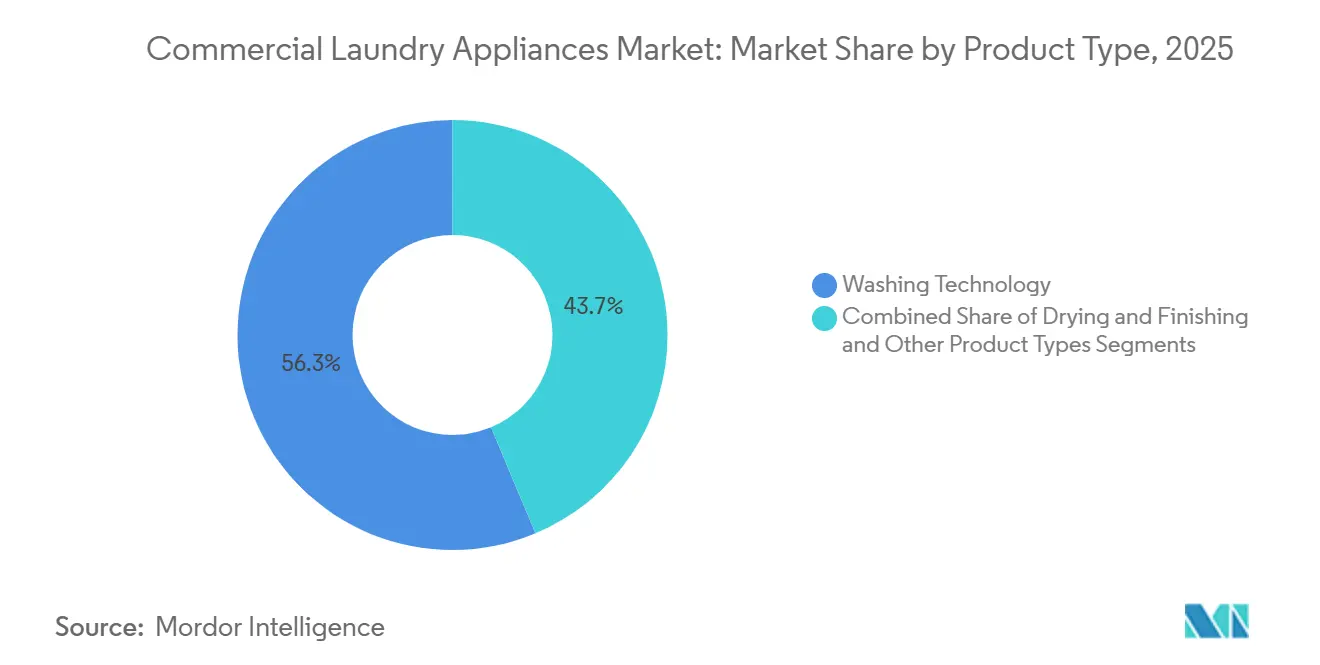
Washing technology accounted for 56.3% of the commercial laundry appliances market share in 2025 and is forecast to grow at a 6.4% CAGR through 2031. Washer-extractors support flexible batch processing in hospitality and smaller healthcare facilities. Barrier washers address cross-contamination controls in acute-care settings. Continuous batch washers, also known as tunnel washers, serve industrial sites processing large daily linen volumes. This combination gives washing technology a broad role across the commercial laundry appliances industry. Its growth reflects the direct link between washing outcomes, hygiene validation, and cleanliness standards.
Equipment suppliers are pairing washing systems with chemical dosing and water-reuse capabilities. These packages can increase the value of each installation for manufacturers and distributors. Drying and finishing equipment provides the rest of the product-type revenue in the commercial laundry appliances market. Industrial tumble dryers, flatwork ironers, and steam presses remain important for hotels and linen-rental operators handling bed linen and tablecloths. Alliance Laundry Systems expanded its ProCapture lint collection system in September 2026 to include the T55 stack tumbler and a 55 lb single tumbler. The expanded range covers 30 lb and 55 lb stacks and 30 lb, 55 lb, and 75 lb single machines for vended and on-premises laundries.



By Capacity Range: Medium Duty Holds The Core, Heavy Duty Grows Fastest
The 15-30 kg capacity range held 37.4% of revenue in 2025, making it the leading capacity segment in the commercial laundry appliances market. Mid-scale hotels, regional hospitals, nursing homes, and self-service laundromats use it. This broad base makes it a core operating range for many commercial sites. Machines below 15 kg serve smaller professional settings. They also face greater competition from semi-professional residential equipment. Equipment above 50 kg serves the largest industrial plants and hospitality operations, where throughput and processing cost per kilogram are key purchase measures.
The 30-50 kg range is projected to expand at a 7.1% CAGR through 2031. Centralized outsourced laundries are consolidating work from several hospital and hotel accounts, which favors this capacity range. Large campus operators are also replacing smaller batch setups with higher-capacity machines. Heavy-duty systems commonly have average selling prices 2-4 times those of medium-duty equipment. They can also produce higher parts revenue and longer service-contract periods. The Catrion NEOM industrial laundry in Saudi Arabia was commissioned in February 2026 with a capacity of 130,000 kg of laundry per day using Kannegiesser, Jensen, and Foltex systems. This project shows the scale of demand that hospitality infrastructure programs can create for large-format equipment.
By End-User: Hospitality Holds Volume, Healthcare Advances Fastest
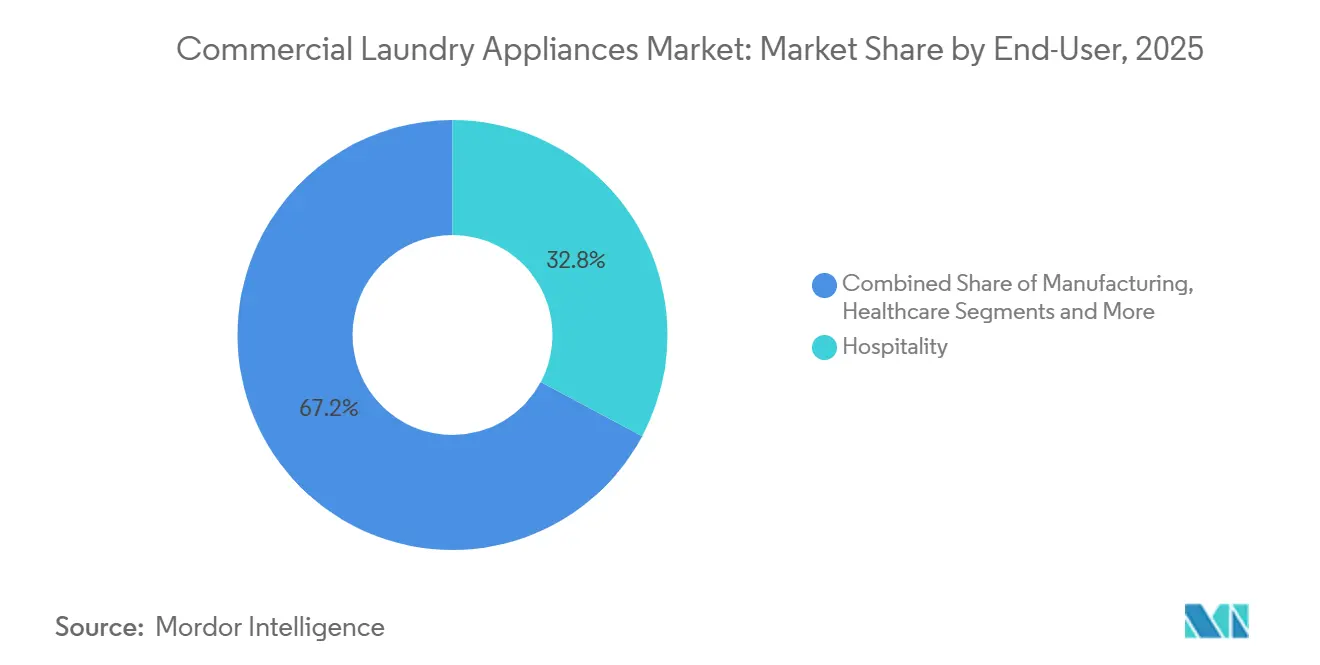
Hospitality held 32.8% of revenue in 2025 and remained the largest end-user group in the commercial laundry appliances market. Existing installations require periodic replacement, while new property development supports additional equipment demand. Asia-Pacific, the Middle East, and Latin America remain important areas for hotel development. Healthcare is forecast to record the highest end-user CAGR at 7.1% through 2031. Hospital capacity growth, linen outsourcing, and stronger disinfection requirements support its equipment purchases. These requirements favor barrier washers over conventional batch machines in certain applications.
Providers that move from in-house operations to contracted linen services have recorded 18-27% lower total linen-management expenditure. Centralized providers, therefore, need high-capacity equipment and often require barrier-washer capability. Specialized laundry providers are also investing in connected systems to compete on throughput and cycle records. Manufacturing, tourism, care facilities, public-sector users, and protective-clothing services account for the remaining demand. Automotive and industrial workwear remain linked to production activity. The end-user mix is moving toward applications where hygiene compliance must be measured and documented, supporting suppliers with data-enabled systems.
By Distribution Channel: Dealers Retain Scale, Direct Sales Gains Ground
Distributors and dealers held 66.6% of revenue in 2025, which reflects their importance to the commercial laundry appliances market. Operators need trained technicians, local spare parts stock, and rapid responses to equipment failures. Regional dealer networks can often provide these services more effectively than centralized sales organizations. Direct sales are forecast to grow at a 6.7% CAGR through 2031. Large hospital groups and hotel chains are building direct purchasing relationships with original equipment manufacturers. These buyers seek to reduce intermediary margins on fleet-scale orders.
EVI Industries integrated 31 distribution and service businesses in North America and planned a 24/7 e-commerce platform for fiscal 2026. This model combines local distribution capability with more direct digital access. Original equipment manufacturers can also retain a direct relationship through proprietary connected platforms, even when dealers sell hardware. Software updates and service subscriptions can be renewed directly with the manufacturer. Dealers continue to earn on hardware sales, while manufacturers develop recurring service and software revenue. This arrangement is to change the traditional channel role in the commercial laundry appliances market.
Geography Analysis
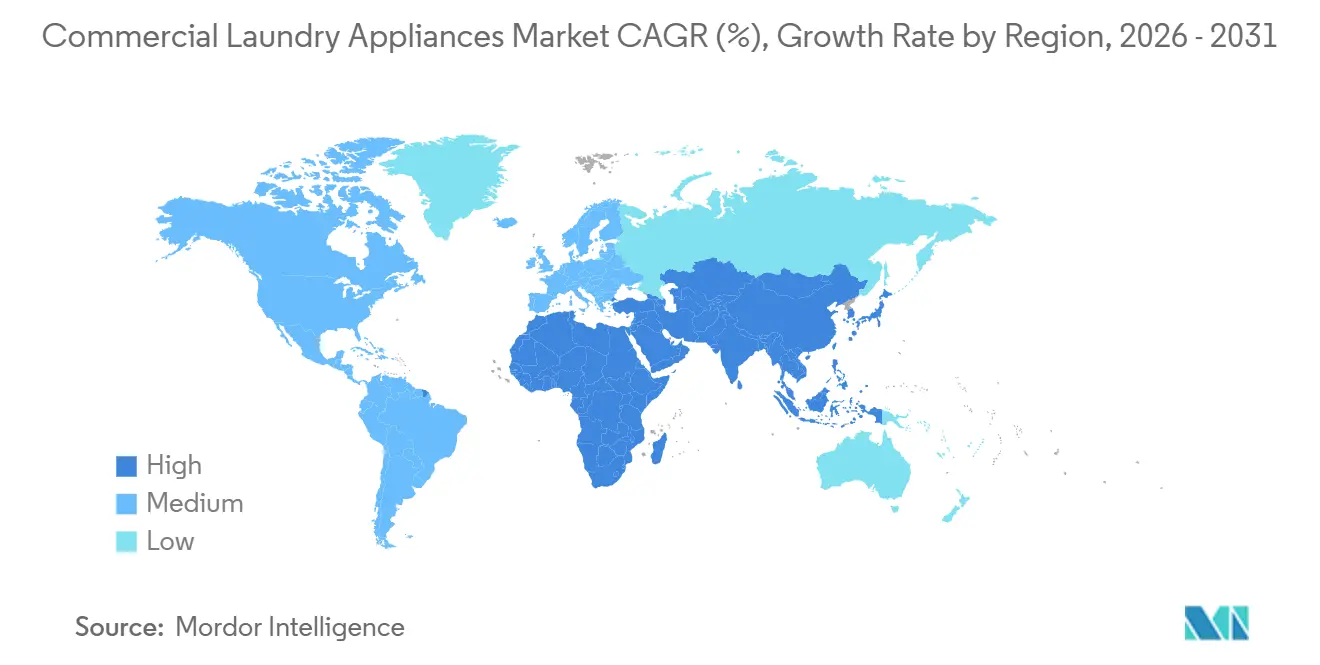
North America held 33.9% of revenue in 2025 and was the largest regional part of the commercial laundry appliances market. The region has a large installed base across healthcare networks, hotel chains, multi-housing properties, and institutional laundries. Healthcare laundry operations follow detailed hygiene procedures, which support replacement demand for compliant systems. State microfiber filtration requirements also create new equipment and retrofit needs. Canada provides mature healthcare and hospitality replacement demand. Mexico benefits from tourism development and wider use of outsourced laundry services in branded hotels.
Europe ranked second by revenue, with Germany, the United Kingdom, and France contributing a large share of regional sales. Energy-efficiency obligations and the EU ecodesign framework support equipment upgrades in the commercial laundry appliances market. Elis reported new flat-linen contract wins in France, Germany, and Mexico in its 2025 full-year results. It also opened its third cleanroom laundry in Germany.
Asia-Pacific is projected to grow at a 7.6% CAGR through 2031 and is the fastest-growing regional commercial laundry appliances market. India is targeting more than 100,000 new branded hotel rooms by 2030, while China aims to add 1,000 hospital facilities by 2030. Southeast Asian markets, including Vietnam, Indonesia, Thailand, and the Philippines, are building first-generation institutional laundry capacity. Alliance Laundry Systems expanded its 27,000 sq m Chonburi manufacturing facility in Thailand and launched the STAR Lab in June 2026. The Middle East and Africa offer large project opportunities through Saudi and UAE hospitality and healthcare investment, while Africa has a low installed base. South America is expanding at a moderate pace, led by Brazil, Chile, and Argentina, where outsourced services and hospitality activity are advancing.

Competitive Landscape
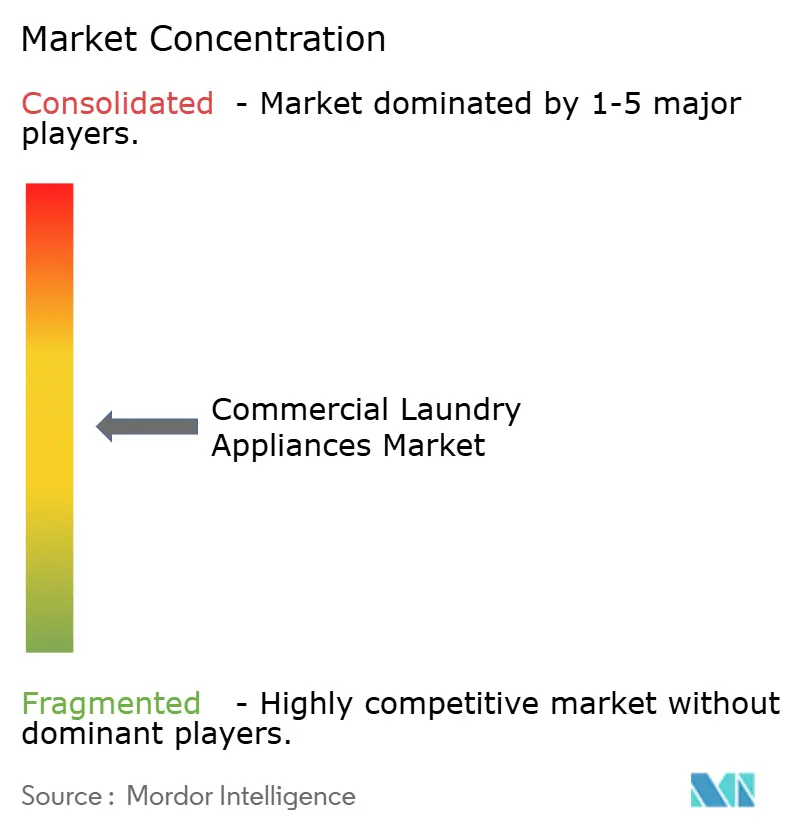
The commercial laundry appliances market has moderate concentration, with the top 3 players collectively holding 40% of revenue. Alliance Laundry Systems, Electrolux Professional Group, JENSEN-GROUP, Herbert Kannegiesser, and Pellerin Milnor compete through throughput design, hygiene performance, and connected equipment. Jiangsu Sea-Lion Machinery and Shanghai Sailstar Machinery serve parts of Asia-Pacific and develop markets through pricing and local manufacturing. A broad group of regional specialists and distributor-aligned brands remains active across products, capacities, and geographies. Local service proximity and parts availability can matter more to institutional buyers than product specifications. This keeps distributor networks important to competitive positioning.
EVI Industries completed the acquisition of Girbau North America for USD 43 million in April 2025 and renamed the business Continental Laundry Solutions. The acquisition added USD 50 million in annual net revenue and extended master-distributor coverage to more than 80 independent dealers in North America. EVI stated that this was its 30th and largest acquisition. Companies also use connected platforms to maintain relationships after the original equipment sale. Electrolux Professional OnE Connected provides a unified monitoring portal for multi-site equipment management. Girbau expanded Sapphire functions for its Genius Series washers in December 2025, including remote editing, reports, and software updates.
Smaller hospitals and independent hotels in the Asia-Pacific and Africa have limited access to sustainable equipment financing. Equipment-as-a-service offerings could address this purchasing constraint. Modular and space-efficient systems also address the needs between semi-professional products and full industrial systems. Gas-free plant designs and heat-pump-compatible drying systems are becoming more relevant where operators seek lower-carbon operations. LG launched its Professional Laundry lineup in 2025 with the LaundryCrew application and an Open API for building-management system integration. These moves show how service coverage, financing, software, and equipment design can shape competition in the commercial laundry appliances market.
Commercial Laundry Appliances Industry Leaders
Alliance Laundry Systems LLC
Electrolux Professional Group
JENSEN-GROUP
Herbert Kannegiesser GmbH
Girbau Group
- *Disclaimer: Major Players sorted in no particular order

Recent Industry Developments
- September 2026: Alliance Laundry Systems extended its ProCapture lint collection system to a full-store solution with the addition of the T55 stack tumbler, the largest stack unit in the industry at 2 × 55 lb pockets, and a single 55 lb tumbler, completing a product line that now covers 30 lb and 55 lb stacks and 30, 55, and 75 lb singles for vended and on-premises laundries. The extension addresses a documented operational pain point across full-store lint management, expanding the addressable retrofit market for distributors.
- June 2026: Alliance Laundry Systems expanded its 27,000 sq m manufacturing facility in Chonburi, Thailand, and launched the STAR Lab, its first regional product R&D laboratory, to develop and validate next-generation commercial laundry equipment for Asia-Pacific markets. The facility produces equipment across all 5 ALS brands, incorporates rooftop solar generation and water-recycling systems in its testing laboratories, and is designed to support 150 countries through regional distributors.
- February 2026: WSP Systems completed delivery and commissioning of the Catrion NEOM industrial laundry in Saudi Arabia. The facility has a capacity for 130,000 kg of laundry and 37,000 garments per day, with Kannegiesser, Jensen, and Foltex as primary equipment suppliers. The project included 64 shipping containers of equipment, 2,200 m of bag-rail system rails, and 223 conveyor belts.
- April 2025: EVI Industries completed the acquisition of Girbau North America, Inc. for USD 43 million in cash and renamed the entity Continental Laundry Solutions. The acquisition added USD 50 million in annual net revenue and extended master-distributor coverage across more than 80 independent dealer customers in North America.


Global Commercial Laundry Appliances Market Report Scope
| Washing Technology | Industrial Washers-Extractors |
| Barrier Washers | |
| Tunnel Washers (Continuous Batch Washers) | |
| Washer-Dryer Combos | |
| Drying and Finishing | Industrial Tumble Dryers |
| Flatwork Ironers and Finishing Equipment | |
| Steam Press Machines | |
| Other Product Types |
| Below 15 kg (Light Duty) |
| 15 – 30 kg (Medium Duty) |
| 30 – 50 kg (Heavy Duty) |
| Above 50 kg (Extra-Heavy Duty) |
| Manufacturing |
| Hospitality |
| Healthcare |
| Specialized Laundry Service Providers |
| Other End Users (Tourism, Care, Public Sector, Dye Factories, Professional, Working, and Protective Clothing Trade, Cruises/Cruise Ships) |
| Direct Sales |
| Distributors and Dealers |
| North America | Canada |
| United States | |
| Mexico | |
| South America | Brazil |
| Peru | |
| Chile | |
| Argentina | |
| Rest of South America | |
| Europe | United Kingdom |
| Germany | |
| France | |
| Spain | |
| Italy | |
| BENELUX (Belgium, Netherlands, and Luxembourg) | |
| NORDICS (Denmark, Finland, Iceland, Norway, and Sweden) | |
| Rest of Europe | |
| Asia-Pacific | India |
| China | |
| Japan | |
| Australia | |
| South Korea | |
| South East Asia (Singapore, Malaysia, Thailand, Indonesia, Vietnam, and the Philippines) | |
| Rest of Asia-Pacific | |
| Middle East and Africa | United Arab Emirates |
| Saudi Arabia | |
| South Africa | |
| Nigeria | |
| Rest of the Middle East and Africa |
| By Product Type | Washing Technology | Industrial Washers-Extractors |
| Barrier Washers | ||
| Tunnel Washers (Continuous Batch Washers) | ||
| Washer-Dryer Combos | ||
| Drying and Finishing | Industrial Tumble Dryers | |
| Flatwork Ironers and Finishing Equipment | ||
| Steam Press Machines | ||
| Other Product Types | ||
| By Capacity Range | Below 15 kg (Light Duty) | |
| 15 – 30 kg (Medium Duty) | ||
| 30 – 50 kg (Heavy Duty) | ||
| Above 50 kg (Extra-Heavy Duty) | ||
| By End-User | Manufacturing | |
| Hospitality | ||
| Healthcare | ||
| Specialized Laundry Service Providers | ||
| Other End Users (Tourism, Care, Public Sector, Dye Factories, Professional, Working, and Protective Clothing Trade, Cruises/Cruise Ships) | ||
| By Distribution Channel | Direct Sales | |
| Distributors and Dealers | ||
| By Region | North America | Canada |
| United States | ||
| Mexico | ||
| South America | Brazil | |
| Peru | ||
| Chile | ||
| Argentina | ||
| Rest of South America | ||
| Europe | United Kingdom | |
| Germany | ||
| France | ||
| Spain | ||
| Italy | ||
| BENELUX (Belgium, Netherlands, and Luxembourg) | ||
| NORDICS (Denmark, Finland, Iceland, Norway, and Sweden) | ||
| Rest of Europe | ||
| Asia-Pacific | India | |
| China | ||
| Japan | ||
| Australia | ||
| South Korea | ||
| South East Asia (Singapore, Malaysia, Thailand, Indonesia, Vietnam, and the Philippines) | ||
| Rest of Asia-Pacific | ||
| Middle East and Africa | United Arab Emirates | |
| Saudi Arabia | ||
| South Africa | ||
| Nigeria | ||
| Rest of the Middle East and Africa | ||


Key Questions Answered in the Report
What is the projected value of commercial laundry appliances in 2031?
The sector is forecast to reach USD 12.59 billion by 2031, expanding at a 5.8% CAGR from 2026.
Which product category leads commercial laundry equipment demand?
Washing technology led with 56.3% of revenue in 2025 and is projected to grow at a 6.4% CAGR through 2031.
Which capacity range is growing the fastest?
The 30-50 kg heavy-duty range is forecast to grow at a 7.1% CAGR through 2031 as centralized laundries process larger volumes.
Why are healthcare facilities purchasing more professional laundry systems?
Hospital capacity additions, linen outsourcing, validated disinfection needs, and demand for cycle documentation support healthcare growth.
Which region will grow fastest through 2031?
Asia-Pacific is projected to grow at a 7.6% CAGR, supported by hotel, hospital, and institutional infrastructure development.
How do microfiber filtration rules affect commercial washing equipment?
New York requires filtration for new commercial machines offered for sale from January 2026, and Washington State has future requirements for new and existing equipment.
Page last updated on:


 Your data is secure and never sold or shared.


