
Commercial Aircraft Maintenance, Repair, and Overhaul Market Size and Share
Market Overview
| Study Period | 2019 - 2031 |
|---|---|
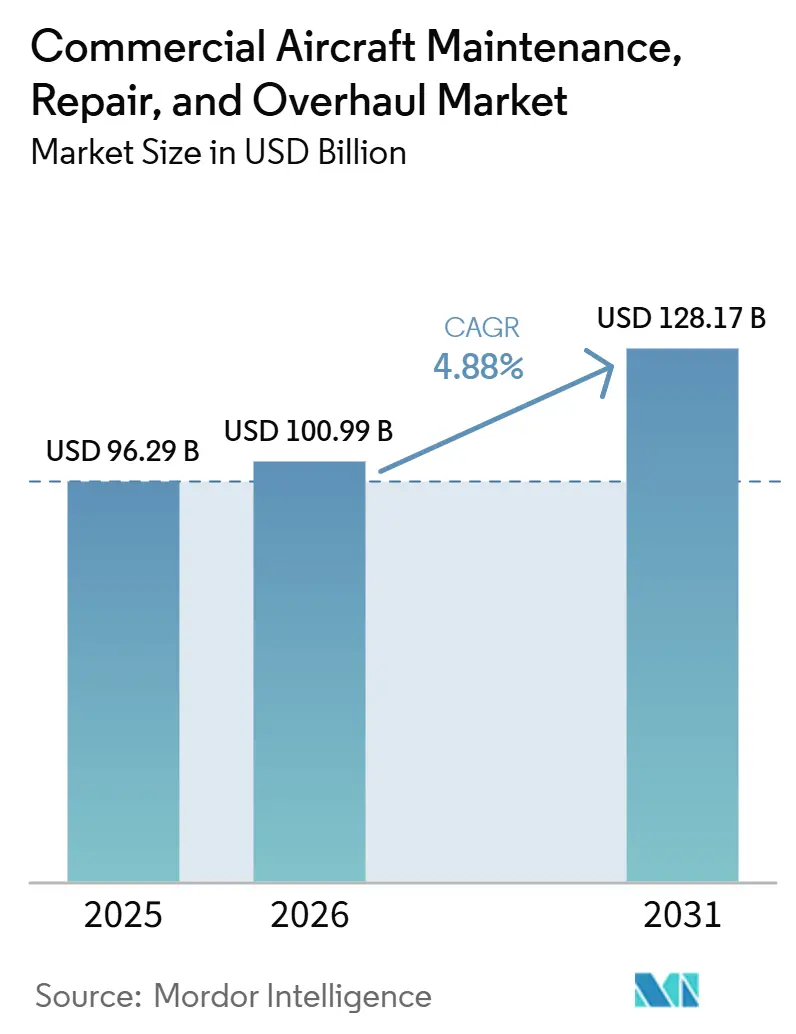
| Market Size (2026) | USD 100.99 Billion |
| Market Size (2031) | USD 128.17 Billion |
| Growth Rate (2026 - 2031) | 4.88 % |
| Fastest Growing Market | Asia-Pacific |
| Largest Market | North America |
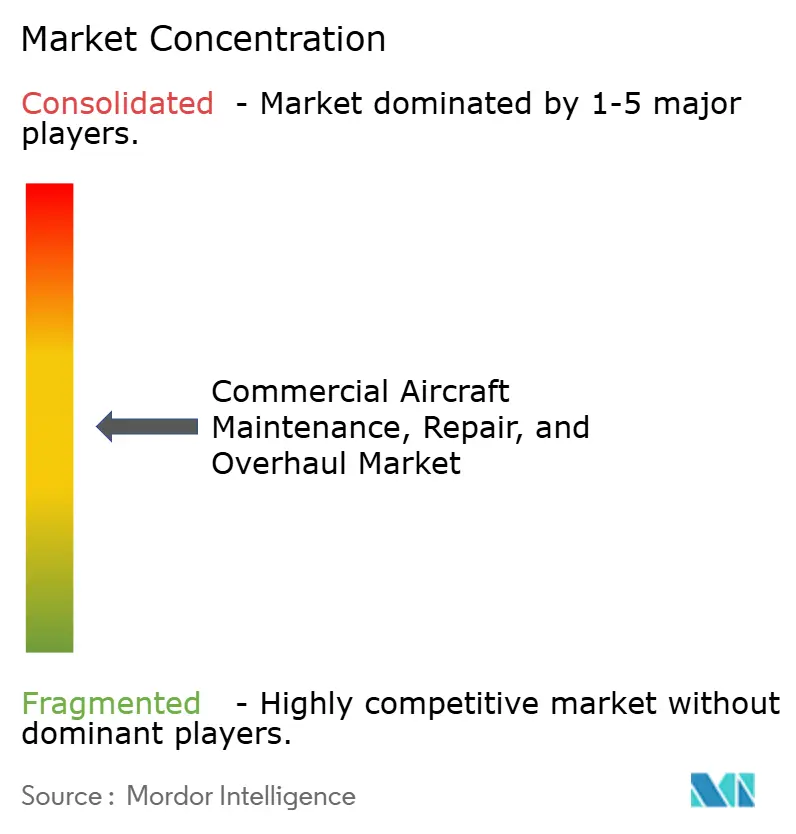
| Market Concentration | Medium |
Major Players *Disclaimer: Major Players sorted in no particular order Image © Mordor Intelligence. Reuse requires attribution under CC BY 4.0. | |
Commercial Aircraft Maintenance, Repair, and Overhaul Market Analysis by Mordor Intelligence
The commercial aircraft maintenance, repair, and overhaul market size is expected to grow from USD 96.29 billion in 2025 to USD 100.99 billion in 2026, and is forecast to reach USD 128.17 billion by 2031, at a 4.88% CAGR over 2026-2031. Fleet operators continued to extend asset lives, so heavy checks and engine shop visits remained the dominant spending categories. Growing investment by original equipment manufacturers (OEMs) in global service networks and airlines’ focus on rapid aircraft-turn capability added structural demand for digital line-maintenance solutions. Consolidation among independent providers accelerated because scale is essential for supply-chain resilience and data-driven services. At the same time, technician shortages and engine-shop bottlenecks limited near-term capacity expansion despite solid traffic recovery.
Key Report Takeaways
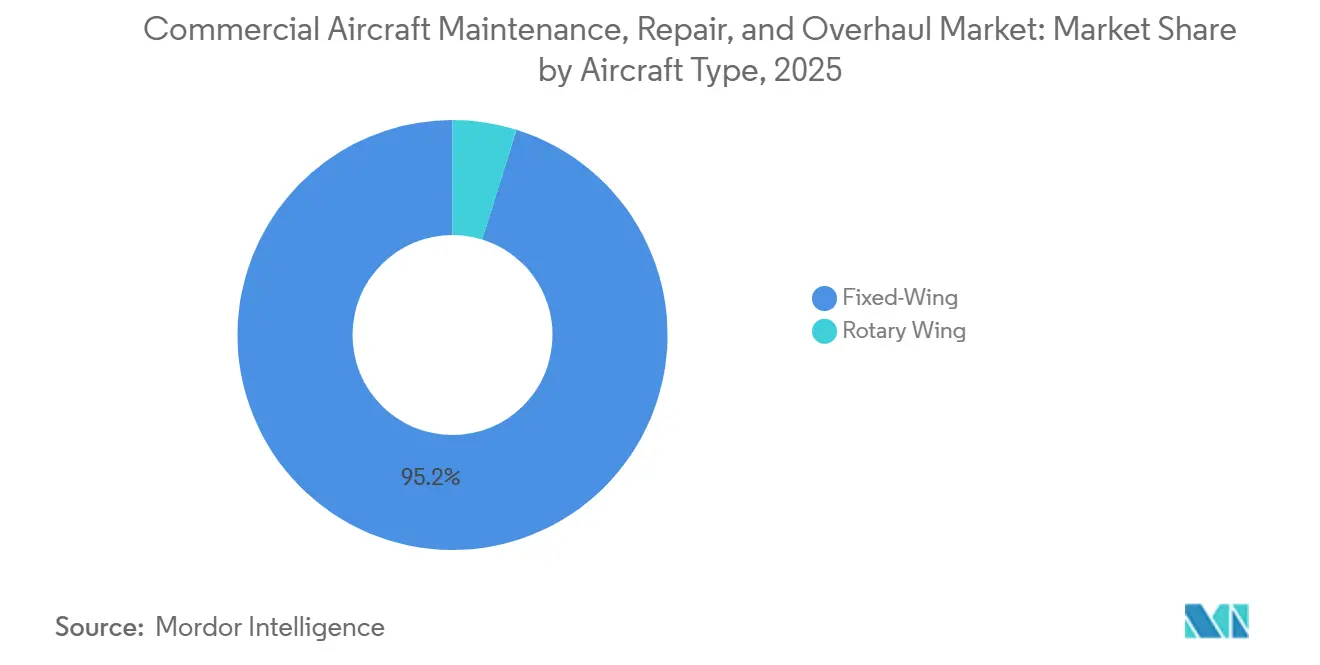
- By aircraft type, fixed-wing platforms accounted for 95.18% of the commercial aircraft maintenance, repair, and overhaul market in 2025; rotary-wing platforms are forecast to grow at a 5.70% CAGR through 2031.
- By MRO type, engine overhaul led with 46.12% of the commercial aircraft maintenance, repair, and overhaul market share in 2025, while line maintenance is projected to grow at a 5.62% CAGR through 2031.
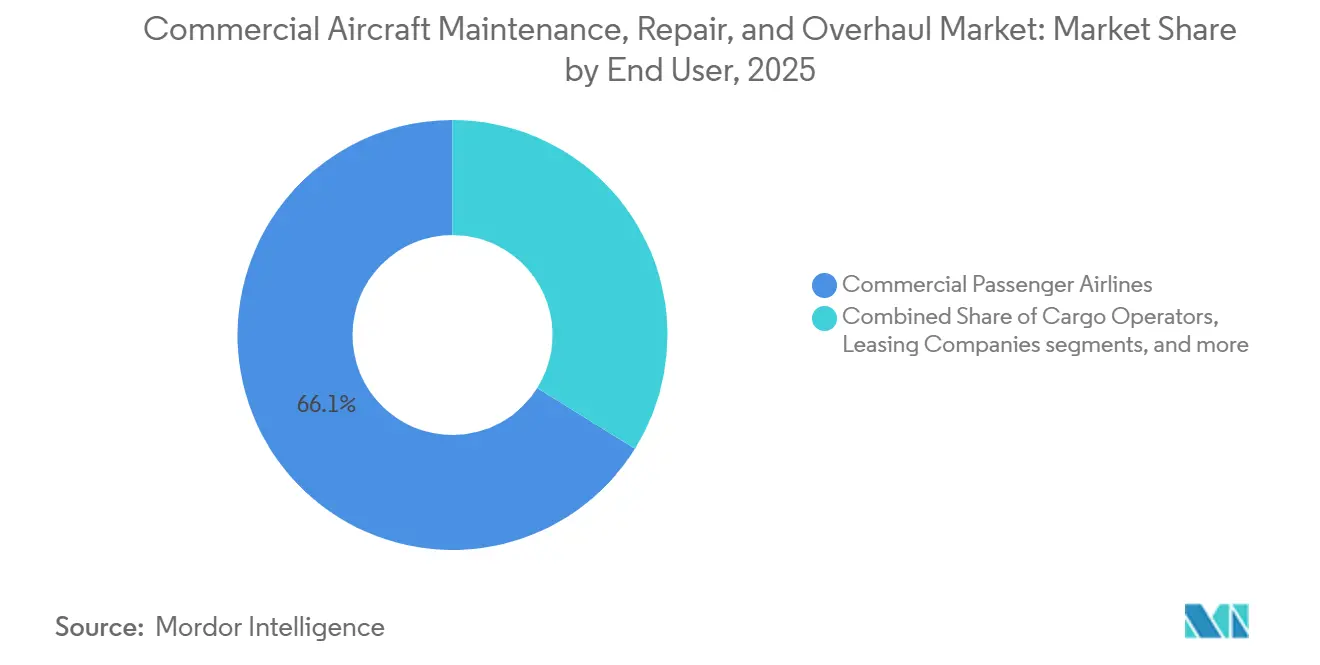
- By end user, commercial passenger airlines held a 66.12% revenue share in 2025, whereas charter operators are projected to grow at a 5.22% CAGR through 2031.
- By service-provider type, independent third-party maintenance, repair, and overhauls commanded 48.75% of revenue in 2025, yet OEM-affiliated facilities are forecast to grow at a 5.18% CAGR through 2031.
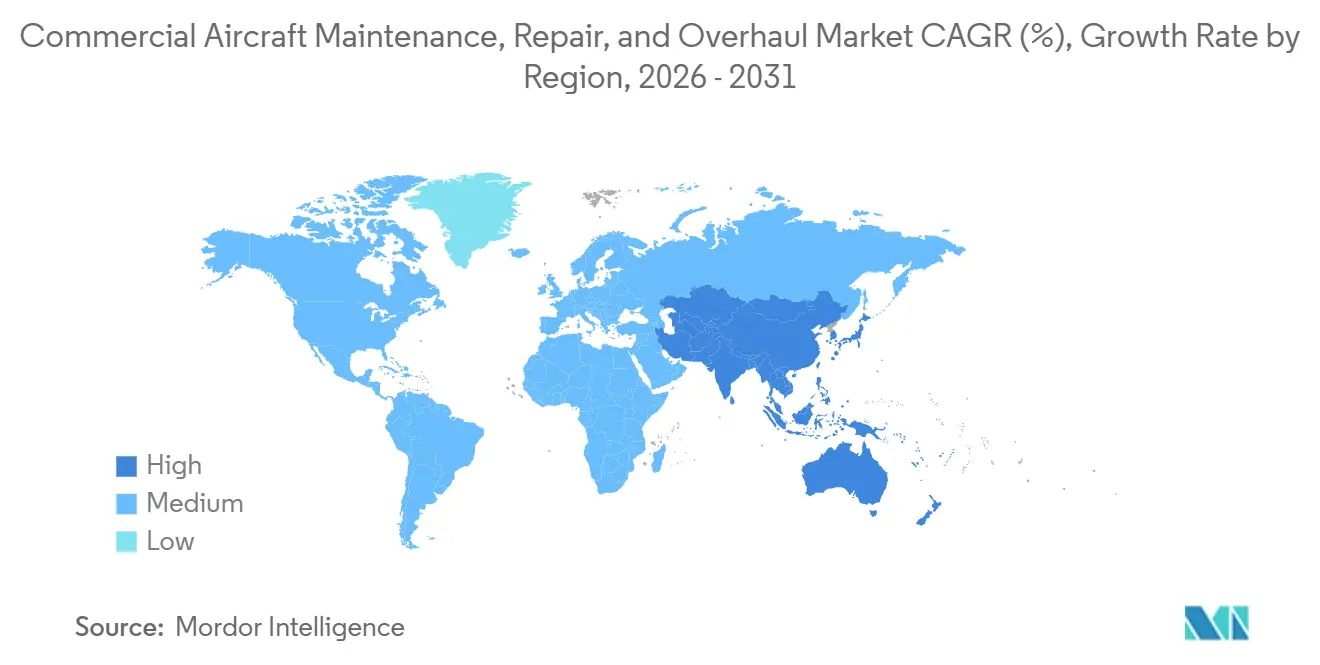
- By region, North America accounted for 38.60% of 2025 revenue, while Asia-Pacific is forecast to grow at a 6.01% CAGR through 2031, supported by pro-maintenance, repair, and overhaul policy incentives.
Note: Market size and forecast figures in this report are generated using Mordor Intelligence’s proprietary estimation framework, updated with the latest available data and insights as of January 2026.
Global Commercial Aircraft Maintenance, Repair, and Overhaul Market Trends and Insights
Drivers Impact Analysis*
| Driver | (~) % Impact on CAGR Forecast | Geographic Relevance | Impact Timeline |
|---|---|---|---|
| Aging global fleet necessitating heavy checks | +1.5% | Global, concentrated in North America and Western Europe | Long term (≥ 4 years) |
| Surging narrowbody utilization post-COVID | +1.0% | Middle East, Asia-Pacific, North America | Medium term (2-4 years) |
| OEM aftermarket strategy expansion | +0.7% | Global, strongest in North America and Asia-Pacific | Medium term (2-4 years) |
| AI-driven predictive maintenance adoption | +0.7% | Global, led by North America and Asia-Pacific | Medium term (2-4 years) |
| Regional government incentives for indigenous MRO | +0.5% | Asia-Pacific, Middle East and Africa, South America, Europe | Long term (≥ 4 years) |
| Used-serviceable-material (USM) supply chain formalization | +0.5% | Global, early gains in North America and Western Europe | Short term (≤ 2 years) |
| Source: Mordor Intelligence | |||
Aging Global Fleet Necessitating Heavy Checks
Older aircraft are staying in service longer, which is increasing the amount of deep structural work required during heavy maintenance visits. Aviation Week reported in 2026 that mature B777 fleets were drawing greater attention to structural life limits, which points to rising demand for inspection and repair work during major checks.[1] Ryanair also said its aging B737-800 fleet was shaping a heavy maintenance strategy, which pushed the airline to expand internal capability while still using selected outsourcing support. This matters because older aircraft not only increase the number of visits; they also make each visit more labor-intensive and less predictable. For MRO providers, this shifts capacity planning toward more complex structural work, longer turnaround times, and tighter slot management.
Surging Narrowbody Utilization post-COVID
Narrowbody aircraft are carrying a larger share of traffic recovery, and higher daily use is bringing maintenance events forward across major fleets. Aviation Week reported that narrowbody flight cycles in the Middle East were 30% above 2019 levels in 2025, up 5% year over year from 2024. Boeing mentioned in its 2025 Commercial Market Outlook that average daily block hours for single-aisle aircraft were 15% above pre-pandemic norms, which was enough to move scheduled C-check timing forward by 12 to 18 months across many fleets.[2] In the US, United Airlines is regarded as a high-pressure case after the carrier expanded its in-service fleet by around 100 aircraft while keeping similar cycles per tail through Q1 2026. This is making narrowbody maintenance demand more structural than cyclical, which supports longer-term commitments to hangar space, labor, and parts support in the commercial aircraft maintenance, repair, and overhaul market.
AI-Driven Predictive Maintenance Adoption
Predictive maintenance is becoming more practical in airline operations as carriers seek fewer disruptions and more efficient use of maintenance resources. In 2026, Azul used machine learning (ML) in maintenance planning to predict and prevent 150 events per month, generating around USD 6 million in weekly operational gains. That example shows that the business case is no longer limited to the largest global carriers, as planning tools can improve slot utilization and reduce operational losses at the airline level. The broader effect is that maintenance teams can shift more attention from reactive troubleshooting to earlier intervention and better schedule control. As adoption spreads, providers that can combine data handling, diagnostics, and execution discipline are likely to secure a stronger position in the commercial aircraft maintenance, repair, and overhaul market.
Regional Government Incentives for Indigenous MRO
Government policy is becoming a direct factor in where MRO capacity gets built, especially in regions that want to keep aviation spending and technical employment within their own borders.[3] Assam's MRO Policy 2025 offers incentives equal to 2% of export revenue, showing how regional authorities are using targeted support to attract maintenance activity from nearby ASEAN and BIMSTEC markets. Measures like this lower the effective cost of establishing facilities and can influence where airlines and third-party providers place future capacity. In Europe, the Junta de Andalucía approved a EUR 290 million (around USD 315 million) engine repair complex in Sevilla for Ryanair in March 2026, showing that public support is also being used to compete for higher-value engine work. Over time, these policies can strengthen local MRO ecosystems because new facilities also pull in tooling, training, and supplier activity around the main operation.
Restraints Impact Analysis*
| Restraint | (~) % Impact on CAGR Forecast | Geographic Relevance | Impact Timeline |
|---|---|---|---|
| Acute shortage of licensed A&P technicians | -1.4% | North America and Western Europe most acutely, increasingly global | Long term (≥ 4 years) |
| Persistent engine shop visit capacity crunch | -0.9% | Global, worst in Asia-Pacific and North America | Medium term (2-4 years) |
| Tier-2 component supply chain volatility | -0.5% | Global | Short term (≤ 2 years) |
| OEM price escalation on spare parts | -0.5% | Global | Medium term (2-4 years) |
| Source: Mordor Intelligence | |||
Acute Shortage of Licensed A&P Technicians
The labor shortage remains a structural limit on how much demand the commercial aircraft maintenance, repair, and overhaul market can actually serve, even when workloads remain strong. The ATEC 2025 Pipeline Report said the commercial air transport segment was 10% short of demand for certificated mechanics in 2025. That gap is expected to narrow to 7% by 2035, but it would still leave the sector short by around 10,000 mechanics. The same report showed that AMTS enrollment rose 9% in 2024, while the instructor workforce remained flat, leaving around one-third of training seats unfilled. This means the bottleneck is not only hiring but also the training pipeline, educator capacity, and the speed at which new technicians can move into productive shop roles.
Persistent Engine Shop Visit Capacity Crunch
Engine maintenance remains the sharpest capacity bottleneck in the sector, especially for newer narrowbody platforms that are entering heavy shop cycles faster than expected. IATA reported that 648 GTF-powered aircraft were grounded in March 2025 while awaiting shop visits, accounting for 28% of the total GTF fleet. The same study said turnaround times had stretched to 300 days against a normal inspection benchmark of 120 days. IATA also projected annual LEAP shop visit demand would rise above 5,000 by 2040, while GTF visits would move from around 1,000 in 2025 to more than 2,000 over the same period. This gap is pushing airlines and lessors toward longer-term maintenance arrangements and making independent capacity harder to secure across parts of the commercial aircraft maintenance, repair, and overhaul market.
*Our forecasts treat driver/restraint impacts as directional, not additive. The impact forecasts reflect baseline growth, mix effects, and variable interactions.
Segment Analysis
By Aircraft Type: Fixed-Wing Dominates, Rotary Niche Grows
Fixed-wing fleets accounted for 95.18% of revenue in 2025 and continue to anchor demand owing to the scale of commercial jet operations. Narrowbody aircraft drive a sizable portion of the commercial aircraft maintenance, repair, and overhaul market, with utilization patterns increasing task card frequency across airframe and component lines. Widebody heavy checks remained steady because long-haul traffic recovery continued at a measured pace.
Rotary-wing maintenance, repair, and overhaul is expected to expand at a faster 5.70% CAGR through 2031, recording the highest growth rate within the market. Demand for rotary-wing aircraft is lower but resilient, driven by defense modernization programs and offshore energy operations that require highly available helicopters. Specialized rotor-blade overhaul capabilities, strict airworthiness requirements, and government budget visibility support stable margins. Providers that have secured military contracts benefit from a predictable revenue stream that offsets cyclicality in the fixed-wing-dominated commercial aircraft maintenance, repair, and overhaul market.

By MRO Type: Engine Work Commands Investment
Engine overhaul accounted for 46.12% of 2025 revenue, underscoring the capital-intensive nature of powerplant maintenance in the aircraft maintenance, repair, and overhaul market. OEM-certified centers expanded tooling lines for LEAP and GTF variants, while independents specialized in mature engine families to retain competitiveness. The commercial aircraft maintenance, repair, and overhaul market size for engine work is expected to grow as shop-visit intervals settle into post-pandemic patterns.
Line maintenance is projected to register the highest CAGR of 5.62% due to quick-turn services that maximize operator revenue days. Tablet-based inspection apps and wearable head-up displays shortened routine checks, improving gate-time discipline. As airline schedules densified, providers with on-airport teams captured incremental share and reinforced the broader growth trajectory of the commercial aircraft maintenance, repair, and overhaul market.
By End User: Airline Scale Meets Charter Agility
Commercial passenger carriers comprised 66.12% of spending in 2025. Fleet-spanning maintenance programs and power-by-the-hour agreements allowed airlines to pool volume discounts and reduce unit costs, reinforcing their leadership in the commercial aircraft maintenance, repair, and overhaul market.
Charter operators, while smaller, are slated to grow at 5.22% CAGR. Business clients prize rapid return-to-service times and tailored cabin refurbishments, which yield higher labor per aircraft. Providers offering dedicated bays for mid-size jets attracted premium work scopes, diversifying revenue streams in the overall commercial aircraft maintenance, repair, and overhaul market.
By Service Provider Type: Independents Hold Scale, OEMs Gain Ground
Independent third-party shops retained 48.75% revenue in 2025 because flexible labor models and competitive pricing attracted cost-sensitive airlines. Several independents pursued consolidation; AAR’s USD 845 million acquisition of Triumph Group’s product support business broadened US and Asia component-repair capacity.
OEM-affiliated facilities are growing faster than the broader market, supported by proprietary tooling, technical data, and long-term service contracts. OEM-affiliated facilities are projected to hold the highest growth rate, advancing at a 5.18% CAGR. GE Aerospace's USD 267 million XEOS plant in Poland represents capacity expansion aligned with LEAP engine requirements. This integration has shifted high-value work away from independent providers, altering competitive dynamics across the commercial aircraft maintenance, repair, and overhaul market.
Geography Analysis
North America generated 38.60% of 2025 revenue from the region’s large active fleets and mature maintenance ecosystems. The major Atlanta, Dallas, and Miami hubs offered comprehensive engine, component, and heavy-check capabilities and efficient logistics. Recent investments, such as Pratt & Whitney’s agreement with Delta TechOps to lift GTF throughput by 30%, reinforced capacity. Strong certification standards and digital adoption sustained productivity growth, keeping the commercial aircraft maintenance, repair, and overhaul market competitive despite higher labor rates.
Asia-Pacific is projected to witness the fastest growth, at a 6.01% CAGR, as carriers expand their fleets and governments incentivize domestic maintenance. Singapore Aero Engine Services announced USD 242 million in new facilities, while Air India began work on a 35-acre campus in Bengaluru, expected to create 1,200 jobs. These expansions help retain regional spend that previously moved to Europe or the Middle East and raise Asia’s contribution to the commercial aircraft maintenance, repair, and overhaul market.
Europe remained a technology leader but faced cost pressure. Lufthansa Technik approved a multi-billion euro investment program that included a new heavy-maintenance site in Portugal to secure future widebody workload. Eastern European countries offered competitive labor costs, attracting engine-overhaul facilities such as XEOS in Poland. The Middle East used geographic connectivity to attract transit-related checks. South America developed niche component-repair clusters to support cargo fleets, helping ensure balanced development of the commercial aircraft maintenance, repair, and overhaul market worldwide.
Competitive Landscape
Competition stayed moderate but trended toward consolidation as scale became vital for digital investments and supply-chain leverage. Boeing’s USD 8.3 billion agreement to purchase Spirit AeroSystems aimed to control quality and synchronize production lines, indicating airframe OEM interest in tighter vertical integration. Independent leader AAR finalized several purchases that expanded component repair capacity and broadened its geographical reach.
Digital capability emerged as a key differentiator. Lufthansa Technik introduced its Digital Tech Ops Ecosystem with Avianca to roll out predictive maintenance analytics across mixed fleets. Safran boosted engine-health-monitoring tools alongside its global network expansion, while IFS’s acquisition of EmpowerMX strengthened cloud-based maintenance execution software.
Labor shortages and supply chain risks encouraged joint ventures that combine capital, technology, and location advantages. GE Aerospace partnered with Lufthansa Technik for the XEOS venture, tapping German engineering expertise and Polish cost competitiveness. West Star Aviation’s sale to Greenbriar Equity highlighted private-equity interest in specialized business-aviation MRO niches. Providers able to deliver integrated, tech-enabled services positioned themselves to win longer-term contracts and grow share in the commercial aircraft maintenance, repair, and overhaul market.
Commercial Aircraft Maintenance, Repair, and Overhaul Industry Leaders
-
Lufthansa Technik AG
-
AAR CORP.
-
Delta Air Lines, Inc.
-
Safran SA
-
Hong Kong Aircraft Engineering Company Limited
- *Disclaimer: Major Players sorted in no particular order
Recent Industry Developments
- July 2026: Air India signed a non-binding memorandum of understanding (MoU) with SIA Engineering Company to explore MRO collaboration in India. The partnership may include a future MRO joint venture, building on earlier component support and base maintenance agreements, with the aim of expanding local maintenance capacity for the Indian and regional aviation markets and addressing long-term growth requirements.
- April 2026: IAG and CFM International signed a LEAP Premier MRO license agreement covering LEAP-1A and LEAP-1B engines. Iberia Maintenance's La Muñoza facility near Madrid will serve as a European LEAP MRO hub, with initial LEAP operations scheduled to begin in the first quarter of 2027.
- January 2026: Air Premia and Lufthansa Technik Shenzhen signed a ten-year agreement covering airframe-related component maintenance for Air Premia's nine B787-9 aircraft. The contract includes MRO, modification, spare support, lease, and exchange services for components such as cowls, thrust reversers, radomes, nozzles, and flight controls.
Global Commercial Aircraft Maintenance, Repair, and Overhaul Market Report Scope
Commercial aircraft maintenance, repair, and overhaul encompasses the inspection, servicing, repair, overhaul, modification, and restoration activities required to keep commercial aircraft airworthy, operational, and compliant with regulatory standards. The market includes line maintenance, airframe maintenance, engine overhaul, and component repair services for fixed-wing and rotary-wing commercial aircraft.
The commercial aircraft maintenance, repair, and overhaul market is segmented by aircraft type, MRO type, end user, service provider type, and geography. By aircraft type, the market is segmented into fixed-wing aircraft and rotary-wing aircraft. By MRO type, the market is segmented into airframe maintenance, engine overhaul, component repair and overhaul, and line maintenance. By end user, the market is segmented into commercial passenger airlines, cargo operators, leasing companies, and charter operators. By service provider type, the market is segmented into airline-affiliated, independent third-party, and OEM-affiliated MROs. The report also covers the market sizes and forecasts for the commercial aircraft maintenance, repair, and overhaul market in major countries across different regions. For each segment, the market size is provided in terms of value (USD).
| Fixed-Wing | Narrowbody Aircraft |
| Widebody Aircraft | |
| Regional Transport Aircraft | |
| Rotary Wing |
| Airframe Maintenance |
| Engine Overhaul |
| Component Repair and Overhaul |
| Line Maintenance |
| Commercial Passenger Airlines |
| Cargo Operators |
| Leasing Companies |
| Charter Operators |
| Airline-Affiliated MROs |
| Independent Third-Party MROs |
| OEM-Affiliated MROs |
| North America | United States | |
| Canada | ||
| Mexico | ||
| Europe | Germany | |
| United Kingdom | ||
| France | ||
| Italy | ||
| Russia | ||
| Rest of Europe | ||
| Asia-Pacific | China | |
| India | ||
| Japan | ||
| South Korea | ||
| Australia | ||
| Rest of Asia-Pacific | ||
| South America | Brazil | |
| Rest of South America | ||
| Middle East and Africa | Middle East | United Arab Emirates |
| Saudi Arabia | ||
| Turkey | ||
| Rest of Middle East | ||
| Africa | South Africa | |
| Rest of Africa | ||
| By Aircraft Type | Fixed-Wing | Narrowbody Aircraft | |
| Widebody Aircraft | |||
| Regional Transport Aircraft | |||
| Rotary Wing | |||
| By MRO Type | Airframe Maintenance | ||
| Engine Overhaul | |||
| Component Repair and Overhaul | |||
| Line Maintenance | |||
| By End User | Commercial Passenger Airlines | ||
| Cargo Operators | |||
| Leasing Companies | |||
| Charter Operators | |||
| By Service Provider Type | Airline-Affiliated MROs | ||
| Independent Third-Party MROs | |||
| OEM-Affiliated MROs | |||
| By Geography | North America | United States | |
| Canada | |||
| Mexico | |||
| Europe | Germany | ||
| United Kingdom | |||
| France | |||
| Italy | |||
| Russia | |||
| Rest of Europe | |||
| Asia-Pacific | China | ||
| India | |||
| Japan | |||
| South Korea | |||
| Australia | |||
| Rest of Asia-Pacific | |||
| South America | Brazil | ||
| Rest of South America | |||
| Middle East and Africa | Middle East | United Arab Emirates | |
| Saudi Arabia | |||
| Turkey | |||
| Rest of Middle East | |||
| Africa | South Africa | ||
| Rest of Africa | |||
Key Questions Answered in the Report
What is the current size of the commercial aircraft maintenance, repair, and overhaul market?
The commercial aircraft maintenance, repair, and overhaul market size is expected to grow from USD 96.29 billion in 2025 to USD 100.99 billion in 2026, and is forecast to reach USD 128.17 billion by 2031, at a 4.88% CAGR over 2026-2031.
Which commercial aircrat MRO segment generates the most revenue?
Engine overhaul leads, capturing 46.12% of 2025 revenue, largely due to the complexity and cost of modern powerplants.
Which region is growing fastest in commercial aircraft maintenance?
Asia-Pacific shows the highest forecast CAGR of 6.01% through 2031, supported by government incentives and rising fleet counts.
How are OEMs changing the competitive landscape?
OEMs are investing billions to expand branded service networks, leveraging proprietary data and tooling to win long-term maintenance contracts.
What is the biggest challenge facing MRO providers today?
A shortage of licensed technicians and limited engine shop capacity are the most immediate constraints, prolonging turnaround times and pushing costs higher.
Why is line maintenance expected to grow quickly?
Airlines need rapid aircraft-turn capability to maximize daily utilization, so demand for on-airport, technology-enabled line maintenance is rising faster than other categories.