
Commercial Aircraft Cabin Lighting Market Size and Share
Market Overview
| Study Period | 2019 - 2031 |
|---|---|
| Market Size (2026) | USD 1.27 Billion |
| Market Size (2031) | USD 1.74 Billion |
| Growth Rate (2026 - 2031) | 6.50 % |
| Fastest Growing Market | Europe |
| Largest Market | Asia-Pacific |
| Market Concentration | Medium |
Major Players *Disclaimer: Major Players sorted in no particular order Image © Mordor Intelligence. Reuse requires attribution under CC BY 4.0. | |
Commercial Aircraft Cabin Lighting Market Analysis by Mordor Intelligence
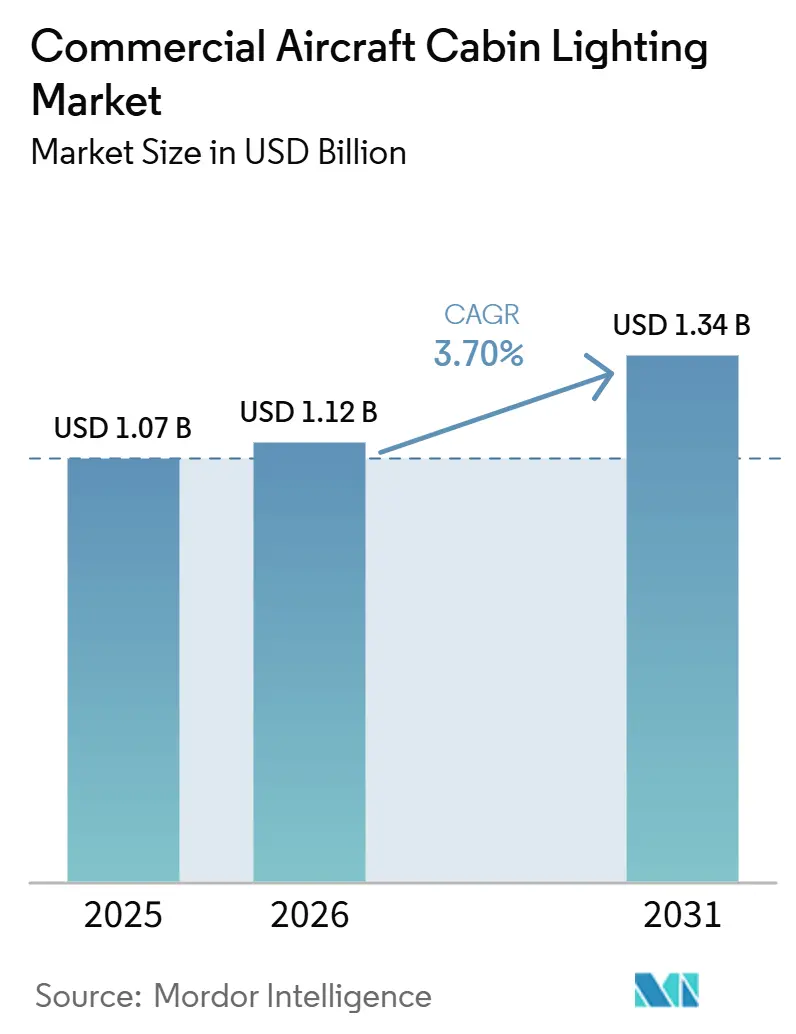
The commercial aircraft cabin lighting market size was valued at USD 1.20 billion in 2025, and is forecast to grow from USD 1.27 billion in 2026 to USD 1.74 billion by 2031, at a 6.50% CAGR over 2026-2031. The market is increasingly shaped by the shift from standalone lighting products to integrated cabin lighting architectures, in which illumination is designed alongside passenger service units, cabin controls, and broader interior systems. Airlines are placing greater emphasis on configurable lighting scenes that differentiate boarding, dining, rest, and arrival phases, making lighting an important element of cabin branding and passenger experience. Retrofit opportunities are also expanding as operators refresh aircraft interiors without full fleet replacement. At the supplier level, certification capability, aircraft platform coverage, and established OEM relationships create high barriers to entry. At the same time, specialists compete through photoluminescent systems, modular retrofit products, and customizable lighting solutions.
Key Report Takeaways
- By aircraft type, narrowbody aircraft led with 59.85% of the commercial aircraft cabin lighting market share in 2025, while narrowbody aircraft are forecast to expand at a 7.25% CAGR through 2031.
- By light type, ceiling and wall lights accounted for 48.10% share of the commercial aircraft cabin lighting market size in 2025. Floor-path lighting strips are projected to grow at a 7.41% CAGR through 2031.
- By cabin class, economy installations accounted for 52.20% of 2025 revenue, whereas premium economy is forecast to grow at a 7.55% CAGR through 2031.
- By end user, OEM held a 65.75% share in 2025, while the aftermarket is projected to grow at a 7.50% CAGR through 2031.
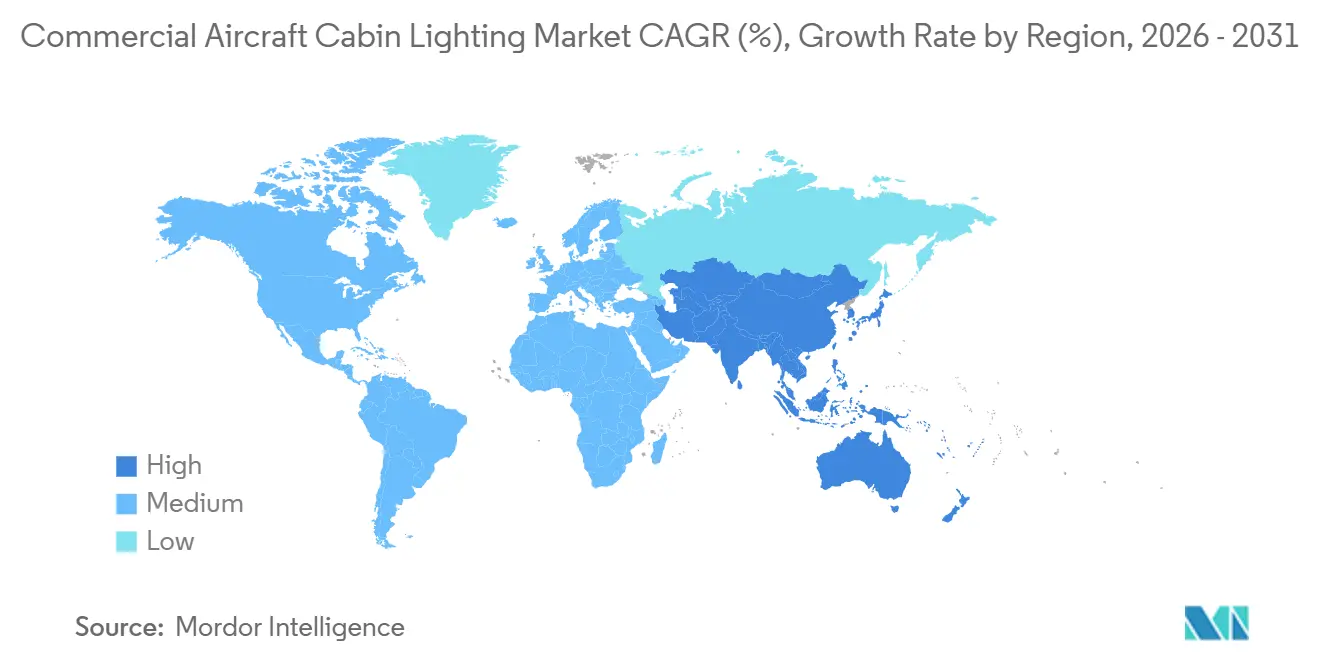
- By geography, Asia-Pacific accounted for 31.50% of 2025 revenue; Europe is forecast to grow at a 7.25% CAGR through 2031.
Note: Market size and forecast figures in this report are generated using Mordor Intelligence’s proprietary estimation framework, updated with the latest available data and insights as of January 2026.
Market Trends and Insights
Drivers Impact Analysis of Commercial Aircraft Cabin Lighting Market*
| Driver | (~) % Impact on CAGR Forecast | Geographic Relevance | Impact Timeline |
|---|---|---|---|
| Accelerated narrowbody fleet expansion among LCCs | +0.8% | Asia-Pacific, Middle East, global spill-over | Medium term (2-4 years) |
| Retrofit wave toward LED mood-lighting for cabin refresh | +0.6% | North America, Europe, selective Middle East | Short term (≤ 2 years) |
| Shift from fluorescent to energy-efficient, RoHS-compliant LEDs | +0.5% | Europe, North America, Asia-Pacific | Long term (≥ 4 years) |
| IoT-enabled smart lights enabling predictive maintenance | +0.4% | North America, Europe, selective Asia-Pacific | Medium term (2-4 years) |
| Airline ESG targets favoring ultra-light photoluminescent floor paths | +0.3% | Europe, North America, global carriers with net-zero pledges | Long term (≥ 4 years) |
| Government stimulus for airport infrastructure upgrades post-COVID | +0.2% | US, European Union, select Asia-Pacific markets | Short term (≤ 2 years) |
| Source: Mordor Intelligence | |||
Accelerated Narrowbody Fleet Expansion Among LCCs
LCCs and fast-growing airlines continue to expand their narrowbody fleets, supporting demand for linefit cabin lighting. In July 2026, flynas confirmed an additional 20 A321neo aircraft, bringing its total confirmed Airbus orders to 235; its fleet reached 68 by August 2026, including 62 A320neos.[1] IndiGo's fleet reached 441 aircraft by March 2026, including 177 A320neos and 172 A321neos. In July 2026, it signed an MoU covering engines for 510 future A320neo Family aircraft. The broader production pipeline remains strong: Airbus reported an A320 Family backlog of 7,577 aircraft at the end of August 2026 and targets producing 70–75 A320 Family aircraft per month by the end of 2027. This large delivery pipeline supports long-term demand for reading, ceiling, and wall, signage, lavatory, and floor-path lighting installed on new narrowbody aircraft.
Retrofit Wave Toward LED Mood Lighting for Cabin Refresh
Airlines are upgrading older aircraft with LED mood lighting to improve cabin appearance without requiring major changes to existing cabin infrastructure. STG Aerospace's liTeMood system, now part of Heads Up Technologies, is designed as a plug-and-play replacement for existing commercial aircraft lighting and can be installed on an A320 in about 6 hours without changes to the aircraft's wiring or control systems.[2] Turkish Airlines selected liTeMood for its B737-800 retrofit program, with installation taking less than eight hours, helping bring older cabins closer in appearance to aircraft equipped with newer lighting systems. Retrofit lighting is also increasingly focused on passenger comfort, with Diehl offering human-centric lighting that adjusts illumination based on flight phase and time of day to support passengers' circadian rhythms. At the same time, large airline refurbishment programs are expanding the addressable aftermarket: Emirates' ongoing program covers 219 A380 and B777 aircraft, with 76 already refurbished as of November 2025, and the next 111 aircraft scheduled for upgrades beginning in 2026. Growing investment in existing fleets supports demand for aftermarket cabin lighting, alongside new-aircraft linefit installations.
Shift from Fluorescent to Energy-Efficient, RoHS-Compliant LEDs
Tightening restrictions on mercury-containing lamps are accelerating the transition to LED-based cabin lighting. In Europe, exemptions for several categories of fluorescent lamps under the RoHS framework have expired. At the same time, the revised EU Mercury Regulation further restricts the manufacture, import, and export of specified mercury-containing lamps. Although these regulations do not directly require airlines to replace all fluorescent cabin lights, they are reducing the long-term availability of legacy mercury-based lighting technologies across the supply chain. This is prompting aircraft operators, OEMs, and cabin-system suppliers to adopt mercury-free LED alternatives during new aircraft production, scheduled cabin refurbishment, and lighting-system replacement programs.
IoT-Enabled Smart Lights Enabling Predictive Maintenance
The growing use of connected cabin systems is enabling airlines to monitor cabin equipment and identify maintenance needs earlier. Diehl Aviation's CANSAS™ platform digitally connects and monitors cabin functions, including lighting, using a high-speed data network, wireless sensors, and centralized system monitoring. The platform supports predictive health management, and its connectivity capabilities can transmit information about defective equipment and maintenance requirements, enabling replacement parts to be prepared before the aircraft reaches its destination. Diehl's smart cabin development also covers connected components, including LED lighting, with structured cabin data helping maintenance teams identify faults and their causes more quickly. Airbus is pursuing a similar approach through its connected cabin architecture, which links cabin elements into a common data environment and is designed to support predictive maintenance analytics through Skywise. In 2026, Airbus further expanded Skywise's predictive maintenance capabilities, with Fleet Performance+ using real-time monitoring and aircraft data to improve troubleshooting and maintenance planning. As lighting becomes part of the wider connected cabin ecosystem, digital monitoring can support faster fault identification and more planned maintenance of cabin systems.
Restraints Impact Analysis of Commercial Aircraft Cabin Lighting Market*
| Restraint | (~) % Impact on CAGR Forecast | Geographic Relevance | Impact Timeline |
|---|---|---|---|
| Persistent widebody production backlog and delivery delays | -0.4% | North America, Europe, global spill-over | Medium term (2-4 years) |
| Lengthy STC certification cycles for novel lighting systems | -0.3% | Global, stricter in North America and Europe | Long term (≥ 4 years) |
| Supply-chain tightness for high-CRI LED chips and driver ICs | -0.3% | Asia-Pacific semiconductor hubs, global users | Short term (≤ 2 years) |
| Capital reallocation toward IFEC/connectivity over lighting | -0.2% | North America, Europe, selective Middle East carriers | Medium term (2-4 years) |
| Source: Mordor Intelligence | |||
Persistent Widebody Production Backlog and Delivery Delays
Ongoing aerospace supply chain constraints can delay aircraft production and, in turn, shift demand for linefit cabin lighting to later delivery periods. Airbus stated that supply chain constraints created a disconnect between aircraft production and deliveries during 2025, while A320 panel-quality issues also affected deliveries toward the end of the year.[3] The company delivered 793 commercial aircraft in 2025 but continues to manage supply chain shortages, including Pratt & Whitney engines, as it ramps up production. Airbus has also integrated former Spirit AeroSystems operations supporting the A350, A220, and A320 families to strengthen supply continuity and support future production increases. Boeing is similarly focused on stabilizing production, with the B787 program transitioning toward eight aircraft per month following its acquisition of Spirit AeroSystems in December 2025. Because cabin lighting systems are installed as part of new aircraft production, slower or uneven aircraft deliveries can defer OEM linefit demand for reading, ceiling, wall, signage, lavatory, and floor-path lighting. However, the large existing commercial fleet continues to provide a separate aftermarket and retrofit demand base, partially reducing suppliers' dependence on new aircraft production.
Lengthy STC Certification Cycles for Novel Lighting Systems
Introducing new or modified cabin lighting systems can involve lengthy certification and compliance processes, particularly when the installation represents a major change to an aircraft's approved type design. Under the FAA process, an STC applicant must establish the applicable certification basis, submit technical data, and demonstrate compliance through required design evaluations, conformity inspections, ground tests, flight tests, and functional and reliability testing before an STC can be issued. These requirements can increase development time and certification costs for suppliers introducing new reading, ceiling, wall, signage, or floor-path lighting solutions. For products intended for multiple markets, additional validation may also be required. FAA-approved STCs submitted for EASA validation, for example, must follow the FAA-EASA Technical Implementation Procedures (TIP) and include the required application and technical data package. However, regulatory cooperation has reduced some duplication. Under the current FAA-EASA framework, qualifying Basic STCs can be accepted by EASA without further technical review once the FAA approval and complete documentation have been submitted. Despite this streamlining, certification requirements remain a significant barrier, as new cabin lighting designs must demonstrate compliance before they can be widely introduced into commercial aircraft fleets.
*Our forecasts treat driver/restraint impacts as directional, not additive. The impact forecasts reflect baseline growth, mix effects, and variable interactions.
Commercial Aircraft Cabin Lighting Market Segment Analysis
By Aircraft Type:
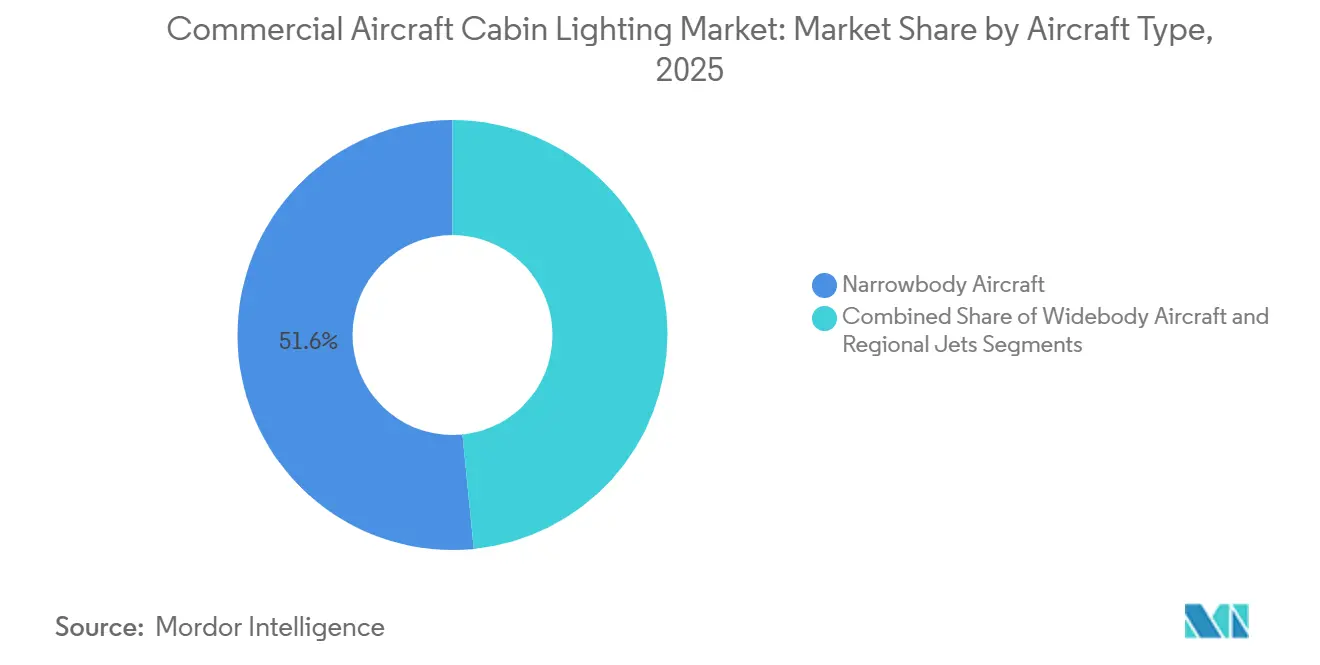
Narrowbody Leads and Records the Fastest GrowthNarrowbody aircraft accounted for 59.85% of the commercial aircraft cabin lighting market in 2025, supported by the significantly higher production volume and installed base of single-aisle aircraft. Airbus delivered 607 A320 Family aircraft in 2025, representing more than three-quarters of its total commercial aircraft deliveries, and continues to target A320 Family production of 70–75 aircraft per month by the end of 2027. Cabin lighting suppliers are also addressing the large installed base of narrowbody aircraft through retrofit solutions. Heads Up Technologies' liTeMood provides configurable LED cabin lighting for the A320 Family and can be installed on an A320 in around six hours without changes to existing aircraft wiring or control systems. High new-aircraft volumes combined with a large retrofit base support narrowbody leadership in cabin lighting demand.
Narrowbody aircraft are also projected to record the fastest growth at a 7.25% CAGR during 2026–2031, supported by continued production ramp-ups and large order backlogs. Airbus had an A320 Family backlog of 7,577 aircraft at the end of August 2026, providing a substantial pipeline for future demand for linefit cabin equipment. Boeing is similarly increasing B737 production, with its 2026 production ramp supporting higher single-aisle deliveries as the company works through its backlog. At the same time, retrofit solutions such as full-color LED mood lighting allow airlines to modernize existing narrowbody cabins without major structural modifications. The combination of rising aircraft production and continued cabin upgrades is expected to increase demand for reading, ceiling, and wall signage, lavatory, and floor-path lighting across narrowbody fleets.

By Light Type:
Ceiling and Wall Lights Lead; Floor-path Lighting Strips Grow FastestCeiling and wall lights accounted for 48.10% of the commercial aircraft cabin lighting market in 2025, reflecting their role as the primary source of illumination across passenger cabins. Newer systems are moving beyond basic white lighting toward programmable illumination that can change color, brightness, and lighting scenes during boarding, meal service, rest, and arrival. Diehl Aviation's cabin lighting portfolio includes direct and indirect LED lighting, dynamic color scenarios, and Human Centric Lighting, with illumination designed around different flight phases and times of day. SCHOTT similarly offers HelioJet Spectrum, which uses RGBW LED technology to provide homogeneous cabin illumination and individually configurable color scenarios. The increasing use of lighting in cabin design and passenger experience differentiation underscores the greater value of ceiling and wall fixtures.
Floor-path lighting strips are projected to grow the fastest at a 7.41% CAGR during 2026–2031, as airlines and aircraft manufacturers increasingly adopt photoluminescent systems that simplify emergency floor-path installations. Heads Up Technologies' saf-Tglo uses photoluminescent material that is charged by normal cabin lighting and requires no batteries, electrical power, or wiring to operate. The technology is installed on more than 10,000 aircraft worldwide and is available for both linefit and retrofit applications across multiple commercial aircraft platforms. Its newer SSUL-X system is designed as a direct replacement for earlier saf-Tglo installations and can reduce system weight by up to 20% compared with the previous SSUL version. The combination of passive operation, lower system weight, and simpler replacement is supporting wider adoption of floor-path lighting across commercial fleets.
By Cabin Class:
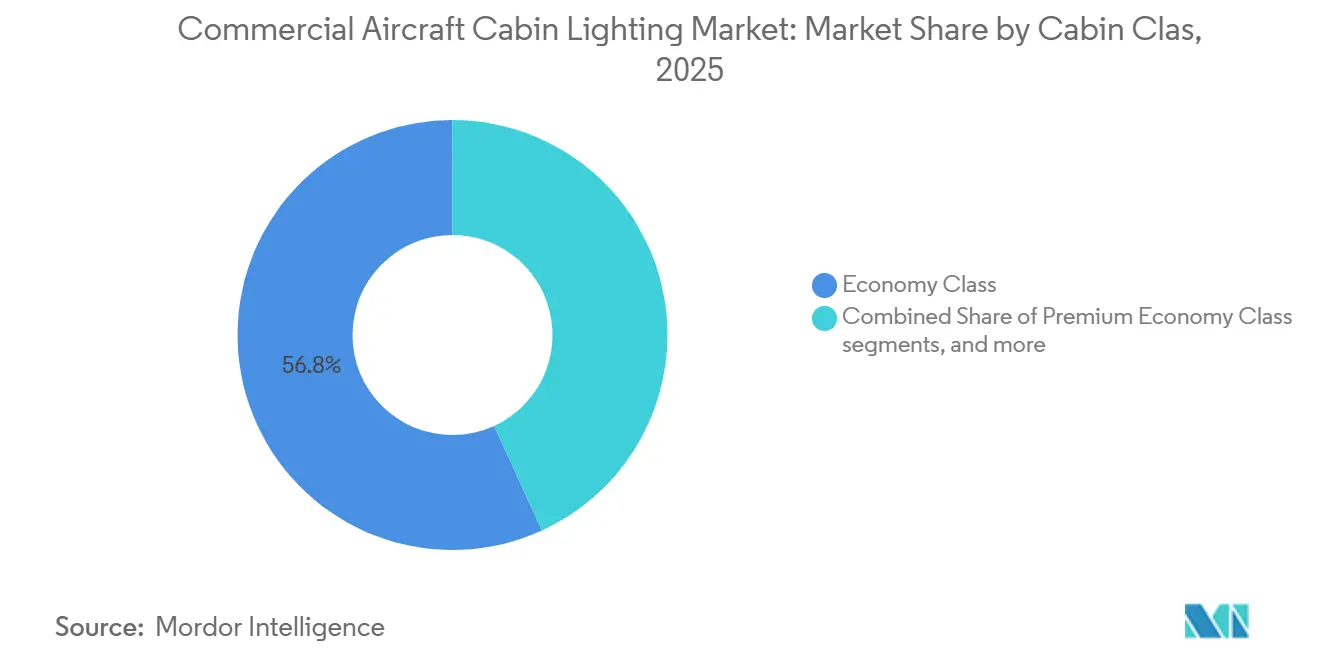
Premium Economy Retrofit Surge Outpaces Economy LinefitEconomy Class accounted for 52.20% of the commercial aircraft cabin lighting market in 2025, driven by its larger seat base and the use of cabin-wide lighting to improve comfort across high-density seating areas. For example, Emirates' latest A350 Economy cabin features ambient lighting designed to create a more relaxing environment, with 2026 Economy upgrades being introduced across the A350, A380, and B777 fleet. Airbus similarly uses customizable ambient lighting across the A350 cabin to simulate natural daylight changes and support passenger comfort on long-haul flights. The scale of Economy seating means cabin-wide lighting installations in this class continue to account for the largest share of lighting demand.
Premium Economy Class is projected to grow at the fastest rate, at a 7.55% CAGR during 2026–2031, as airlines expand this cabin across new aircraft and refurbished fleets while creating a more distinct premium environment. Emirates continued its Premium Economy rollout in 2026 across A350s and retrofitted B777s, including expansion to 10 additional cities announced in January and further deployment across its network during the year. The A350 combines the Premium Economy cabin with customized mood lighting, while the airline's latest aircraft provides enhanced ambient lighting across the cabin. By September 2026, Emirates had further upgraded its A350 Premium Economy product with a new electrically powered seat and full-height privacy divider. As Premium Economy expands between Economy and Business Class, greater emphasis on cabin differentiation and passenger comfort is supporting faster demand growth for lighting systems in this class.
By End User:
Aftermarket Gains as Fleet Age Extends Retrofit WindowsOEM accounted for 65.75% of the commercial aircraft cabin lighting market in 2025, supported by the integration of lighting systems during aircraft production and the continued scale-up of commercial aircraft assembly. Airbus delivered 793 commercial aircraft in 2025, including 607 A320 Family aircraft, and expanded its global production footprint to 10 A320 Family final assembly lines in 2026. By August 2026, Airbus had delivered another 475 aircraft, while its total commercial aircraft backlog remained above 9,000 units. This large production pipeline provides sustained linefit opportunities for lighting suppliers whose systems are qualified and integrated into new aircraft cabin configurations.
The aftermarket segment is projected to grow at the fastest rate, with a CAGR of 7.50% during 2026–2031, as airlines modernize existing cabins by installing lighting systems designed for faster installation and minimal aircraft modification. STG Aerospace's liTeMood, for example, is a plug-and-play LED retrofit system that requires no changes to existing aircraft wiring or control systems and can be installed on an A320 in around six hours. The system holds FAA and EASA certification covering the A320 Family, allowing operators to upgrade cabin lighting without replacing the underlying electrical architecture. Large fleet modernization programs provide a broader base for such upgrades; Emirates, for instance, has 111 A380 and B777 aircraft that were scheduled for its next retrofit phase in August 2026. Short installation timelines, certified retrofit solutions, and continued investment in older aircraft cabins are supporting faster aftermarket lighting demand.
Geography Analysis
APAC Commercial Aircraft Cabin Lighting Market
Asia-Pacific accounted for 31.50% of the commercial aircraft cabin lighting market in 2025, supported by expanding passenger fleets, cabin modernization programs, and the region's growing demand for new commercial aircraft. Airbus expects Asia-Pacific, including China and India, to require 19,560 new passenger aircraft over the next 20 years, representing 46% of global demand, while regional passenger traffic is forecast to grow by 4.4% annually. Air India is also progressing with a major cabin renewal program covering 26 legacy B787-8 aircraft, with the first fully retrofitted aircraft unveiled in April 2026 and the remaining aircraft scheduled for progressive retrofitting through mid-2027. The growing installed fleet and continued cabin upgrades are supporting demand for both linefit and replacement cabin lighting systems across the region.
Europe Commercial Aircraft Cabin Lighting Market
Europe is projected to record the fastest growth at a 7.25% CAGR during 2026–2031, supported by large fleet renewal programs and the introduction of new-generation cabin products. Lufthansa Group expects approximately 45 new aircraft deliveries in 2026 and had 219 aircraft on firm order at the end of 2025, covering the A220, A320neo Family, A350, B787-9, and B777-9. Lufthansa is simultaneously expanding its Allegris cabin, with 35 Allegris-equipped aircraft expected to be in service by the end of 2026, including A350-900s and B787-9s, followed by the A350-1000. Air France-KLM is also accelerating fleet renewal after receiving 50 new-generation aircraft in 2025, with further deliveries of A350, A321neo, A320neo, A220, and E195-E2 beginning in 2026. These programs are expanding the addressable base for factory-installed cabin lighting and future replacement demand across European fleets.
The Americas and MEA Commercial Aircraft Cabin Lighting Market
North America, the Middle East and Africa, and South America continue to offer opportunities through a mix of new aircraft deliveries and cabin refurbishment programs. In the Middle East, Emirates is moving into the next phase of its fleet modernization program, covering another 111 aircraft-60 A380s and 51 B777s-from August 2026, reflecting the scale of cabin refurbishment activity among the region's large long-haul operators. North America remains an important market due to its large commercial aircraft installed base and ongoing replacement of older cabins. At the same time, South America represents a smaller but developing opportunity as airlines renew and refurbish narrowbody and widebody fleets. Across these regions, demand for cabin lighting is increasingly tied to broader cabin renewal cycles rather than to lighting replacement as a standalone upgrade.
Competitive Landscape
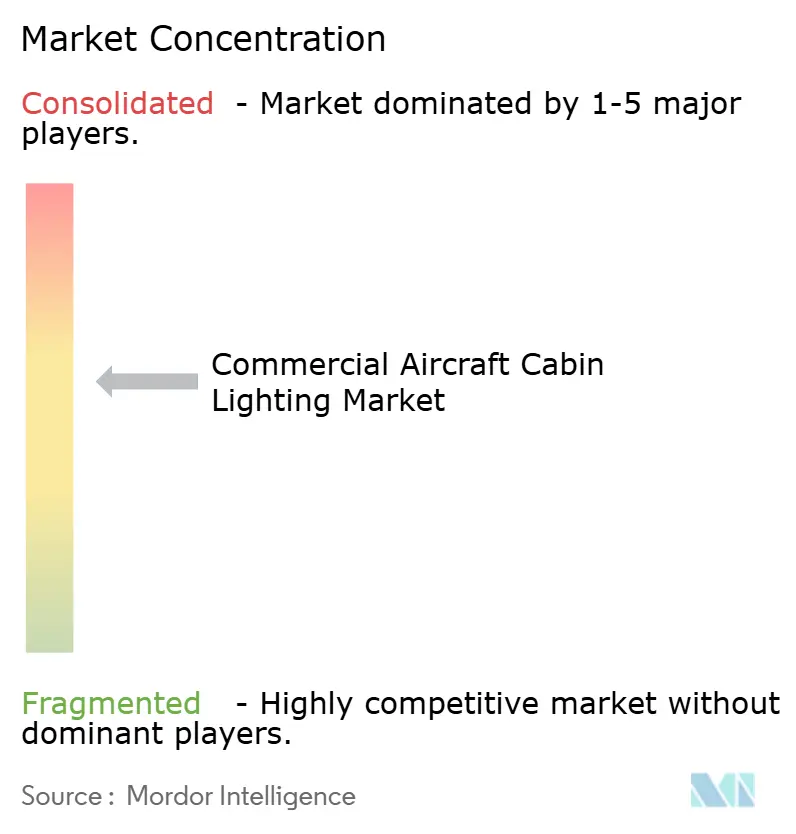
The commercial aircraft cabin lighting market is consolidated, with a small group of established aerospace suppliers holding strong positions across OEM linefit and certified retrofit programs. The major players are Collins Aerospace (RTX Corporation), Safran SA, Diehl Stiftung & Co. KG, Astronics Corporation, and SCHOTT AG. Their positions are supported by broad cabin portfolios, relationships with aircraft manufacturers, certified products, and the ability to integrate lighting with other cabin systems. Collins offers LED reading and dome lights for commercial aircraft. At the same time, Safran supplies reading, dome, and integrated passenger service unit (PSU) lighting, and serves as an OEM PSU supplier on aircraft, including the A220, A380, Embraer E2, and regional platforms.
Diehl Aviation and Astronics hold broad positions in the integrated cabin systems market. Diehl's CANSAS cabin management architecture connects cabin illumination with passenger signs, calls, galley, and lavatory functions through a common cabin network, reflecting the shift from standalone lighting toward digitally integrated cabin systems. Astronics offers ambient and human-centric lighting, reading lights, passenger information signs, emergency lighting, and PSUs, with certified linefit and retrofit products across major Airbus, Boeing, Bombardier, and Embraer platforms. Airbus has selected Astronics to supply PSUs for the A220, incorporating LED lighting, and its products support the Embraer E2 cabin and emergency lighting architecture. SCHOTT differentiates itself through specialized fiber-optic and cabin illumination technologies; its HelioFlex systems use remote LED sources and optical fibers for applications such as reading lights, aisle illumination, and cabin crew work areas.
Competition outside the major players is concentrated around specialized retrofit, emergency lighting, and customized cabin solutions. Heads Up Technologies strengthened its commercial aircraft lighting portfolio through its acquisition of STG Aerospace and now offers cabin lighting, photoluminescent signage, and saf-Tglo emergency floor-path marking. Its saf-Tglo system is installed on more than 10,000 aircraft, requires no electrical power source, and can be installed on a typical single-aisle aircraft in approximately one hour, demonstrating how smaller specialists compete through ease of retrofit and focused technologies. Competition is therefore shaped by two broad capabilities: established suppliers leverage extensive OEM relationships, certification experience, and integrated cabin portfolios, while specialized companies compete through lightweight products, retrofit flexibility, and differentiated lighting technologies.
Commercial Aircraft Cabin Lighting Industry Leaders
-
RTX Corporation
-
Diehl Stiftung & Co. KG
-
Astronics Corporation
-
SCHOTT AG
-
Safran S.A.
- *Disclaimer: Major Players sorted in no particular order
Commercial Aircraft Cabin Lighting Market Companies Covered in this Report
- RTX Corporation
- Safran S.A.
- Diehl Stiftung & Co. KG
- Astronics Corporation
- SCHOTT AG
- Luminator Technology Group, LLC
- Bruce Aerospace, Inc.
- Cobalt Aerospace Group
- S.E.L.A. Lighting Systems
- Soderberg Manufacturing Company, Inc.
- Prizm Aircraft Cabin Lighting
- Madelec Aero SAS
- Beadlight Ltd.
- Aveo Engineering Group, s.r.o.
- Heads Up Technologies, Inc.
Recent Industry Developments in Commercial Aircraft Cabin Lighting Market
- April 2026: Airbus announced plans to integrate the A350-1000 First Class Experience concept onboard the A350-1000. The concept features a 1-1-1 layout centered around a Master Suite for two passengers. The suite includes a double bed, a private lavatory and changing area, and a small bar. This offering is expected to create retrofit and linefit opportunities for airlines seeking to provide a premium experience to their First Class passengers.
- April 2026: SCHOTT and F/LIST introduced the SCHOTT Opal Terra premium aircraft reading-light series at Aircraft Interiors Expo 2026. The new product combines SCHOTT's modular Opal lighting technology with customizable natural-material surfaces, including wood and stone, allowing reading lights to integrate with premium seat and cabin-interior designs.
- January 2026: Air India introduced a new wellness-focused mood-lighting system on its first linefit B787-9. Developed with Tata Elxsi, the system includes 10 customized lighting scenes designed around circadian rhythms and different phases of long-haul travel.
Global Commercial Aircraft Cabin Lighting Market Report Scope
Cabin lighting systems create a comfortable atmosphere for passengers and crew members. The study includes lighting solutions for aircraft cabins.
The commercial aircraft cabin lighting market is segmented based on aircraft type, light type, cabin class, end user, and geography. By aircraft type, the market is segmented into narrowbody, widebody, and regional jets. By light type, the market is segmented into reading lights, ceiling and wall lights, signage lights, lavatory lights, and floor-path lighting strips. By cabin class, the market is segmented into first class, business class, premium economy class, and economy class. By end user, the market is segmented into OEM linefit and aftermarket/retrofit. The report also covers the market sizes and forecasts for the commercial aircraft cabin lighting market in major countries across different regions. For each segment, the market size is provided in terms of value (USD).
Segmentation Overview
| Narrowbody Aircraft |
| Widebody Aircraft |
| Regional Jets |
| Reading Lights |
| Ceiling and Wall Lights |
| Signage Lights |
| Lavatory Lights |
| Floor-path Lighting Strips |
| Economy Class |
| Premium Economy Class |
| Business Class |
| First Class |
| OEM Linefit |
| Aftermarket/Retrofit |
| North America | United States | |
| Canada | ||
| Mexico | ||
| Europe | United Kingdom | |
| France | ||
| Germany | ||
| Italy | ||
| Rest of Europe | ||
| Asia-Pacific | China | |
| Japan | ||
| India | ||
| South Korea | ||
| Rest of Asia-Pacific | ||
| South America | Brazil | |
| Rest of South America | ||
| Middle East and Africa | Middle East | United Arab Emirates |
| Saudi Arabia | ||
| Qatar | ||
| Rest of Middle East | ||
| Africa | South Africa | |
| Rest of Africa | ||
| By Aircraft Type | Narrowbody Aircraft | ||
| Widebody Aircraft | |||
| Regional Jets | |||
| By Light Type | Reading Lights | ||
| Ceiling and Wall Lights | |||
| Signage Lights | |||
| Lavatory Lights | |||
| Floor-path Lighting Strips | |||
| By Cabin Class | Economy Class | ||
| Premium Economy Class | |||
| Business Class | |||
| First Class | |||
| By End User | OEM Linefit | ||
| Aftermarket/Retrofit | |||
| By Geography | North America | United States | |
| Canada | |||
| Mexico | |||
| Europe | United Kingdom | ||
| France | |||
| Germany | |||
| Italy | |||
| Rest of Europe | |||
| Asia-Pacific | China | ||
| Japan | |||
| India | |||
| South Korea | |||
| Rest of Asia-Pacific | |||
| South America | Brazil | ||
| Rest of South America | |||
| Middle East and Africa | Middle East | United Arab Emirates | |
| Saudi Arabia | |||
| Qatar | |||
| Rest of Middle East | |||
| Africa | South Africa | ||
| Rest of Africa | |||
Key Questions Answered in the Report
How large will the commercial aircraft cabin lighting market be by 2031?
The commercial aircraft cabin lighting market size is expected to grow from USD 1.20 billion in 2025 to USD 1.27 billion in 2026, and is forecast to reach USD 1.74 billion by 2031, at a 6.50% CAGR over 2026-2031.
Which region shows the fastest growth in cabin lighting demand?
Europe is expected to post a 7.25% CAGR through 2031, driven by fleet renewal and cabin modernization programs across major European airlines.
What drives airlines to retrofit LED systems instead of full cabin overhauls?
LED mood lighting retrofits can reduce power consumption by up to 70% and can be installed in under six hours using existing aircraft wiring and connectors.
Why are photoluminescent floor-path strips gaining popularity?
Photoluminescent floor-path systems require no electrical power and offer a lighter alternative to conventional electrical emergency lighting systems.
How do IoT-enabled smart lights benefit maintenance operations?
IoT-enabled smart lights support maintenance by continuously monitoring system health, identifying faults early, and enabling predictive maintenance before failures occur.
Which factor most constrains near-term deliveries?
Supply chain and labor bottlenecks, including component shortages and skilled worker constraints, continue to affect commercial aircraft production and delivery schedules.