
Colombia Wire and Cable Market Size and Share
Market Overview
| Study Period | 2020 - 2031 |
|---|---|
| Forecast Data Period | 2026 - 2031 |
| Base Year Market Size (2025) | USD 444.11 Million |
| Market Size (2026) | USD 460.11 Million |
| Market Size (2031) | USD 590.23 Million |
| Growth Rate (2026 - 2031) | 5.11 % |
| Market Concentration | Medium |
Major Players *Disclaimer: Major Players sorted in no particular order Image © Mordor Intelligence. Reuse requires attribution under CC BY 4.0. | |
Colombia Wire and Cable Market Analysis by Mordor Intelligence
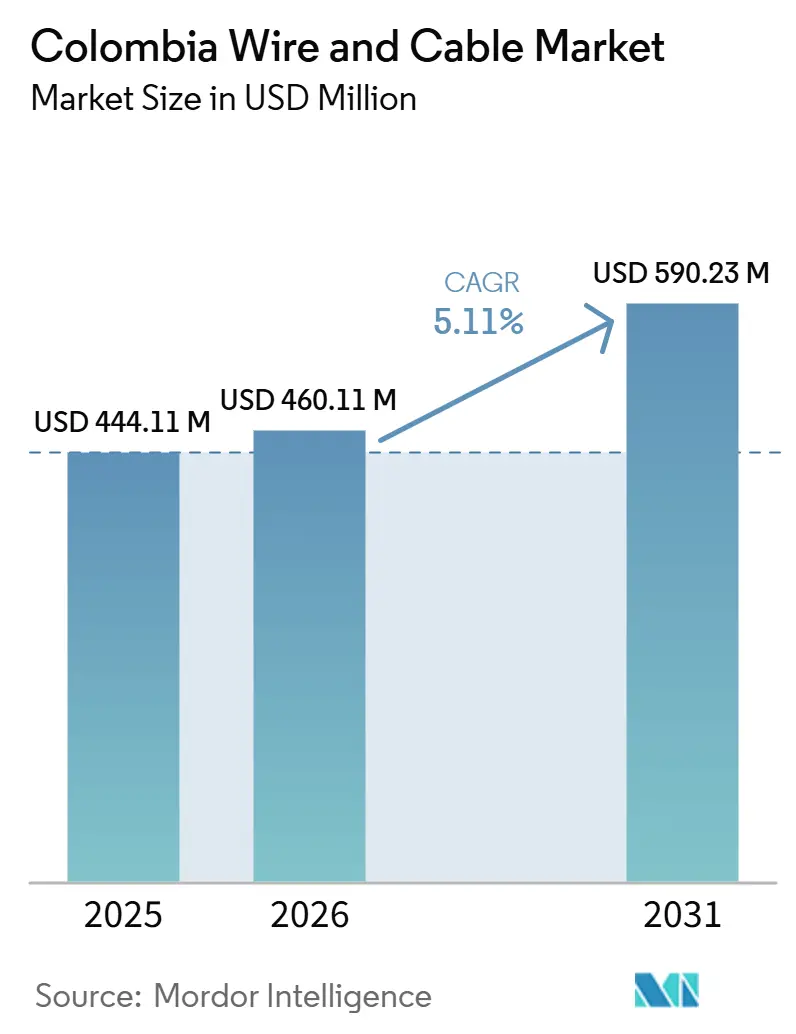
The Colombia wire and cable market size was valued at USD 444.11 million in 2025 and is estimated to grow from USD 460.11 million in 2026 to reach USD 590.23 million by 2031, at a CAGR of 5.11% during the forecast period 2026-2031. Grid investment needs, renewable interconnection, and urban power demand support the Colombia wire and cable market over the forecast period. Transmission constraints make new high-voltage projects more urgent and may concentrate cable orders when approvals are completed. Digital infrastructure adds a separate demand base through fiber networks, data centers, and submarine landing facilities. RETIE certification gives compliant producers a clearer position in utility, construction, and renewable procurement. Commodity prices, currency movements, and non-compliant imports remain the main pressures on margins and tender pricing.
Key Report Takeaways
- By voltage, low-voltage cables held 39.78% of the Colombia wire and cable market share in 2025, while extra- and high-voltage cables are projected to expand at a CAGR of 5.87% through 2031.
- By cable type, power cable accounted for 41.23% of the Colombia wire and cable market size in 2025, while fiber-optic cable is expected to grow at a CAGR of 6.98% through 2031.
- By conductor material, copper held 41.21% of the Colombia wire and cable market share in 2025, while aluminum is projected to expand at a CAGR of 5.98% through 2031.
- By installation, underground cable accounted for 38.77% share in 2025, while submarine cable is expected to grow at a CAGR of 6.18% through 2031.
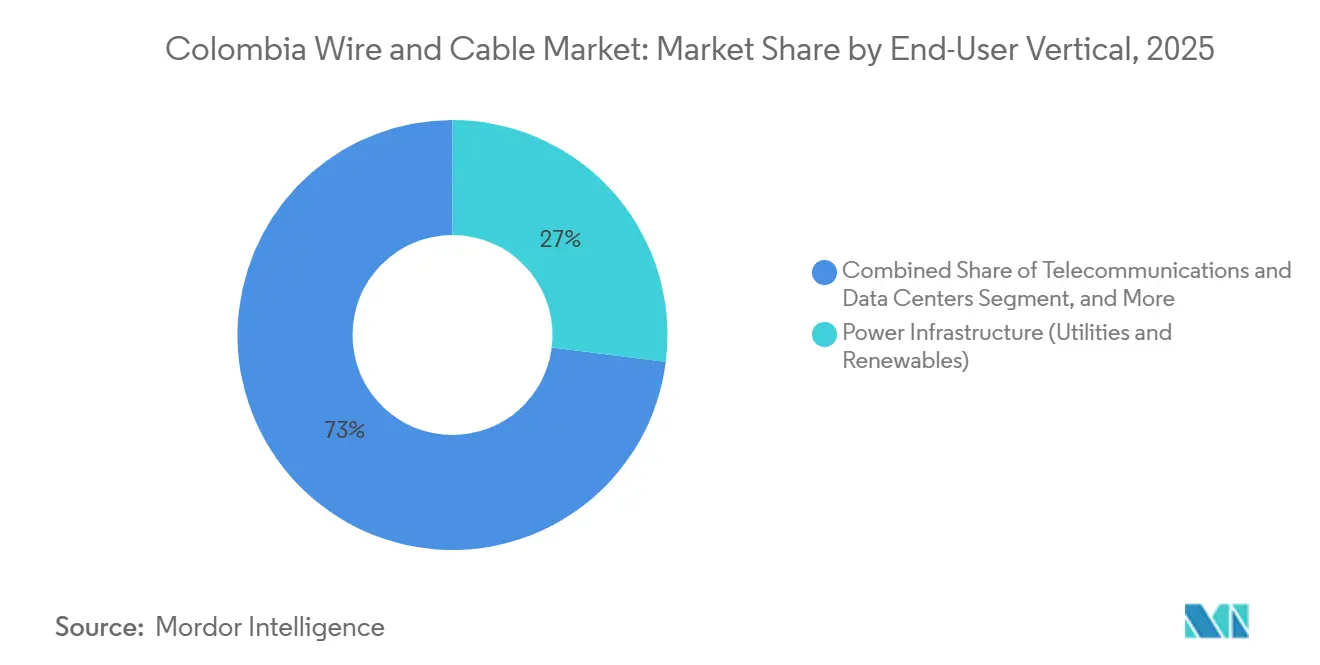
- By end-user vertical, power infrastructure held 26.98% share in 2025, while telecommunications and data centers are projected to expand at a CAGR of 7.21% through 2031.
- By insulation, insulated cable accounted for a 79.44% share in 2025 and is projected to expand at a CAGR of 5.88% through 2031 in the Colombia wire and cable market.
Note: Market size and forecast figures in this report are generated using Mordor Intelligence’s proprietary estimation framework, updated with the latest available data and insights as of January 2026.
Colombia Wire and Cable Market Trends and Insights
Drivers Impact Analysis*
| DRIVER | (~) % IMPACT ON CAGR FORECAST | GEOGRAPHIC RELEVANCE | IMPACT TIMELINE |
|---|---|---|---|
| Rising Electricity Transmission and Distribution Investment | +1.3% | National, with peak demand in Bogotá-Cundinamarca, the Caribbean Coast, and Antioquia | Medium term (2-4 years) |
| Renewable Generation Interconnection and Solar Cable Demand | +1.1% | Caribbean Coast and the Cundinamarca-Llanos belt | Medium term (2-4 years) |
| Fiber-Optic Broadband and Data Network Expansion | +0.9% | Urban and peri-urban corridors nationwide, with spillover into the Amazon and Pacific areas | Short term (≤ 2 years) |
| Rural Electrification and Grid Modernization Programs | +0.6% | Non-interconnected zones in Chocó, Vaupés, Vichada, Nariño, and the Pacific Coast | Long term (≥ 4 years) |
| Construction and Transport Infrastructure Development | +0.5% | National, with activity in Bogotá, the Cauca southwest corridor, and Catatumbo | Medium term (2-4 years) |
| Demand for Traceable RETIE-Compliant Cable Products | +0.3% | National, with the strongest compliance influence in Bogotá and secondary cities | Short term (≤ 2 years) |
| Source: Mordor Intelligence | |||
Rising Electricity Transmission and Distribution Investment
Colombia’s transmission system requires investment to reinforce the national interconnected system, improve reliability, and connect new generation capacity in areas where demand and supply are changing. The Transmission Expansion Plan 2025-2039 set out 10 strategic high-voltage works across Bogotá-Cundinamarca, Cauca, and Nariño, with planned operating dates through 2031.[1] The Colombia wire and cable market benefits because these projects require high-voltage conductors, control cable, substation connections, and related distribution infrastructure. Colombia’s grid planning identified 98 strategic works, and the completion of 44 of them could address 149 projected grid constraints through 2037.[2] Delays in environmental review, permitting, and community engagement can defer orders, but they can also shorten the procurement period once construction begins. The regulatory framework managed by UPME and CREG supports private participation by defining remuneration rules for long-lived transmission assets, providing the Colombian wire and cable market with clearer demand conditions for investments that require substantial planning, permitting, and construction before revenue can be earned.
Renewable Generation Interconnection and Solar Cable Demand
Solar development is increasing the need for collector systems, interconnection lines, inverter connections, and balance-of-system cable. The Colombia wire and cable market gains from solar projects that require medium-voltage feeders to aggregate output and high-voltage links to the national grid. The Colectora 500 kV line had reached 90% completion in July 2026 and is intended to connect 15 wind parks and 1 solar park in La Guajira to the national system. The project requires 3,000 km of conductor cable across 2 parallel 228 km circuits. Its earlier delays reflected permitting and consultation processes, including more than 235 prior-consultation proceedings. When the line enters service, generation projects awaiting grid access may increase procurement of collector, interconnection, and station cable, supporting the Colombia wire and cable market from the generating site through substations and the transmission connection needed to deliver power to customers.
Fiber-Optic Broadband and Data Network Expansion
Fiber deployment creates demand that is less tied to conventional construction and utility cycles and more closely linked to digital access targets and network investment. Fiber-to-the-home subscriptions increased more than 60-fold between 2014 and 2024, from 69,000 to 4.4 million, and fiber represented 48.2% of fixed broadband connections at the end of 2024.[3] The Colombia wire and cable market is supported by deployments in dense urban areas and new business districts, as well as expansion into underserved regions. The national connectivity strategy targets 12,272 km of new fiber routes and 3 million additional fixed-internet homes by 2035. Data centers need fiber trunks, power distribution cable, high-density internal cabling, and reliable connections between equipment rooms. These requirements create procurement channels that differ from traditional utility tenders and favor suppliers with expertise in network, installation, testing, and maintenance, including the ability to manage dense cable layouts, meet service continuity expectations, and support future expansion.
Rural Electrification and Grid Modernization Programs
Non-interconnected zones rely on public funding and long planning cycles, creating a distinct source of cable demand that is less affected by urban property activity. Colombia’s indicative coverage plan identified 470,340 users eligible for national-grid connection and 347,779 users who could be reached through hybrid solar microgrids or individual photovoltaic systems. The Colombia wire and cable market can benefit from distribution lines, photovoltaic cable, connection equipment, and replacement materials for decentralized systems. UPME opened a 2025 call for 2 transmission lines in Cauca and Nariño under the Misión Transmisión program.[4] These projects often use smaller-gauge aluminum conductors and photovoltaic-rated cable rather than the copper products common in urban installations. This mix supports faster aluminum demand in remote projects and extends opportunities beyond the largest power corridors. Although procurement decisions remain tied to public budgets, the pace of project execution, and the ability of local teams to install and maintain systems.
Restraints Impact Analysis*
| RESTRAINT | (~) % IMPACT ON CAGR FORECAST | GEOGRAPHIC RELEVANCE | IMPACT TIMELINE |
|---|---|---|---|
| Copper, Aluminum, and Peso-Driven Cost Volatility | -1.4% | National, with greater exposure at import-dependent Bogotá and Barranquilla hubs | Short term (≤ 2 years) |
| Low-Cost Asian Imports and Counterfeit Product Leakage | -0.9% | National, with concentration in Bogotá hardware districts and secondary-city channels | Medium term (2-4 years) |
| Permitting and Social Licensing Delays for Transmission Projects | -0.6% | Caribbean Coast, Cauca, and Nariño | Long term (≥ 4 years) |
| Limited Domestic Capacity for Extra-High-Voltage, Submarine, and Advanced Fiber Cable | -0.4% | National, with the greatest effect on extra-high-voltage and submarine requirements | Long term (≥ 4 years) |
| Source: Mordor Intelligence | |||
Copper, Aluminum, and Peso-Driven Cost Volatility
Raw material exposure remains a major issue for cable producers, distributors, project contractors, and their customers at the tender stage. Copper represents 60%-70% of the input cost for most power cables, while aluminum accounts for 20%-25% in overhead conductor applications. The Colombia wire and cable market faces pricing pressure when the costs of imported metals, insulation compounds, and specialized components increase. The Colombian peso also affects costs for product lines that rely on imported medium-voltage, high-voltage, and fiber components. Suppliers commonly revise price lists every 30-60 days and use LME-linked escalation clauses for large tenders. These practices protect suppliers from sharp changes in input costs but make fixed-price public contracts more difficult to award, budget, and manage, because buyers must account for price revisions during the period between project design, tender submission, contract approval, and delivery.
Low-Cost Asian Imports and Counterfeit Product Leakage
Non-certified imports pressure compliant domestic producers and can create electrical safety concerns for installers, contractors, and end users. A joint enforcement action involving Centelsa, Nexans, the SIC, and the National Police seized 1,800 rolls of counterfeit cable, containing more than 5 tons of copper, from distribution networks in Bogotá.[5] In December 2025, the SIC issued a major unfair-competition ruling against Nexans for counterfeit Centelsa products. RETIE 2024 broadened certification requirements to renewable components, while the transition period for legacy certifications ended in July 2025. Non-compliant products can still undercut legal domestic prices and limit investment capacity in specialty products, testing, and formal distribution. Stronger verification, traceability, and enforcement, therefore, remain important for producers serving formal channels, since the ability to demonstrate compliance can influence buyer confidence, reduce safety concerns, and protect investment in product testing and specialized manufacturing.
*Our forecasts treat driver/restraint impacts as directional, not additive. The impact forecasts reflect baseline growth, mix effects, and variable interactions.
Segment Analysis
By Voltage: Low-Voltage Wiring Anchors Volume, While Extra- and High-Voltage Cable Leads Growth
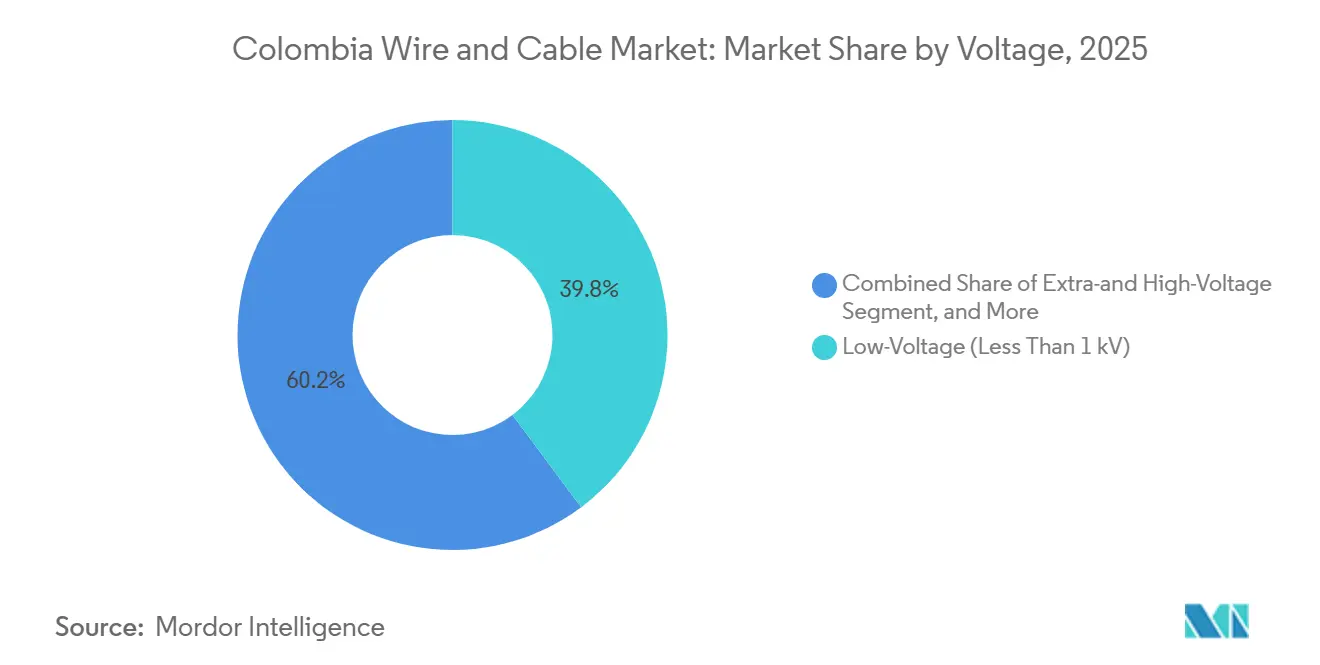
Low-voltage cable is expected to account for 39.78% of total cable demand in 2025 in the Colombia wire and cable market. Residential and commercial building wiring, industrial installations, and solar balance-of-system applications form the broadest customer base for this category, with purchases spread across developers, contractors, utilities, and facility owners. This demand base gives low-voltage products a consistent role in the Colombia wire and cable market, as new projects and maintenance work require these installations. RETIE requirements support the use of certified wiring products in formal construction and utility applications. Builders, contractors, and distribution utilities use these products across projects of various sizes, making demand for replacements and new installations less dependent on a limited number of large contracts.
Extra- and high-voltage cable is projected to expand at a CAGR of 5.87% through 2031. Transmission reinforcement and renewable clusters in La Guajira, Córdoba, and Cundinamarca support this category, as grid connections in these regions depend on new long-distance infrastructure. UPME’s modernization planning indicates that transmission projects create pipeline-based demand rather than demand tied to short construction cycles. The Colectora 500 kV project illustrates the scale of demand generated by a single transmission scheme, requiring 3,000 km of conductor cable for its two circuits. Domestic capabilities are more established in low- and medium-voltage products than in highly specialized high-voltage products, where strict design, testing, accessory, and installation requirements can narrow the available supplier base.

By Cable Type: Power Cable Leads, While Fiber-Optic Cable Enters a Multi-Year Growth Phase
Power cable is expected to account for 41.23% of overall cable demand in 2025 in the Colombia wire and cable market. Distribution infrastructure, construction wiring, and renewable collector projects support its leading position, as all these activities require dependable electrical connections across a range of voltages. The category includes products used to connect generation assets, distribute electricity, wire facilities, and maintain established networks. Its demand is therefore spread across utilities, property development, transport projects, industrial users, and public infrastructure. RETIE certification limits substitution by products that cannot meet formal safety and performance requirements, supporting suppliers that provide verified documentation and consistent quality.
Fiber-optic cable is projected to grow at a CAGR of 6.98% through 2031. Household broadband demand, enterprise connectivity, data-network investment, and public efforts to expand high-quality access beyond major cities support fiber expansion. The OECD recorded 4.4 million fiber-to-the-home subscriptions in Colombia at the end of 2024. Signal and control cables continue to serve the automation, instrumentation, refining, mining, and process industries, where reliable data and control-signal transmission are essential. Coaxial and data cables are gradually being replaced as operators shift from hybrid fiber-coaxial networks to fiber access, while remote network deployments require specialized riverine, outdoor-rated, and armored products.
By Conductor Material: Copper Leads Share, While Aluminum Gains on Project Economics
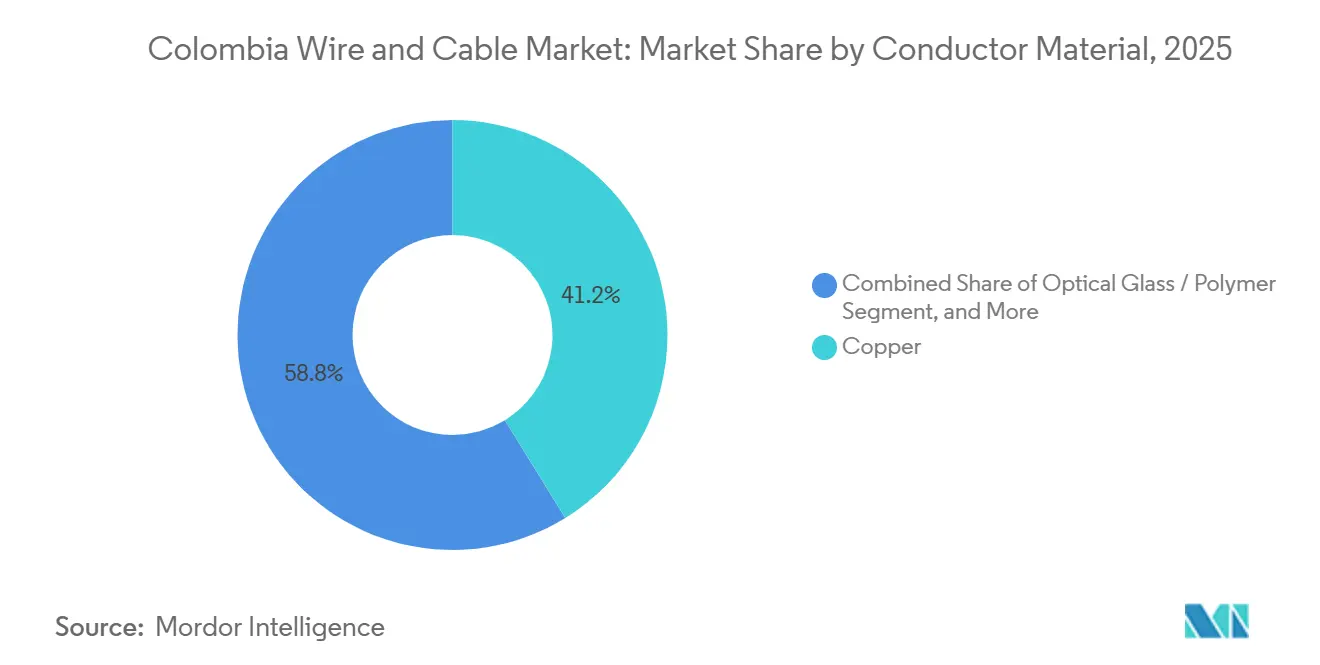
Copper is expected to account for 41.21% of conductor-material demand in 2025 in the Colombia wire and cable market. It remains the principal conductor for low-voltage building wire, data infrastructure, and urban distribution systems, where installers and specifiers understand its electrical properties and established installation methods. Its higher conductivity can reduce conduit requirements and support compact installations in dense urban settings, where available space and routing constraints matter. Copper also remains important where technical specifications prioritize electrical performance, reliability, and proven installation practices. Its cost exposure makes the category sensitive to international metal prices and currency movements, which can affect supplier quotations and contract terms.
Aluminum is expected to grow at a CAGR of 5.98% through 2031. Project developers use it in overhead transmission, solar balance-of-system applications, and rural electrification, where weight, transport conditions, and material cost influence project decisions. Remote-grid programs often require smaller-gauge aluminum and photovoltaic-rated cable for distribution and decentralized generation. This application mix gives aluminum a clear role in the energy transition and rural access programs, especially where long spans and lower installed weight are useful. Optical glass and polymer conductors are linked to fiber network growth, including 5G densification and cable landing activity, while conductor selection in residential wiring remains a compliance and safety issue.
By Installation: Underground Cable Dominates Volume, While Submarine Cable Marks the Fastest Growth
Underground cable is expected to account for 38.77% of the installation segment in 2025. Urban grid densification and the preference for buried feeders in road, metro, and urban corridor projects support this position, especially where cities need reliable systems that do not occupy additional surface space. Underground installation also serves commercial districts, data facilities, modern transport networks, and new development areas that require orderly utility corridors. Urban construction and utility upgrades reinforce demand for this installation method. Buried systems can require ducts, joints, accessories, installation services, careful civil works, and technical coordination in addition to the cable itself.
Submarine cable is expected to grow at a CAGR of 6.18% through 2031 in the Colombia wire and cable market, although it remains the smallest installation category. Barranquilla’s role as an international connectivity point supports demand for landing infrastructure, underground ducting, last-mile fiber, and resilient power connections around landing facilities. The category also requires specialized power systems, armored cable, civil works, and careful interface management near landing stations. Local installers may benefit even when international suppliers provide the submarine system itself, because inland routes and site infrastructure use local installation resources. The Colombia wire and cable market also benefits from related transport projects that require traction cable, station systems, and electrified rail power supply.
By End-User Vertical: Power Infrastructure Anchors Demand, While Telecommunications and Data Centers Drive Growth
Power infrastructure, including utilities and renewables, is expected to account for 26.98% of end-user demand in 2025 in the Colombia wire and cable market. Utility procurement involves long cycles, high volumes, technical standards, operating rules, and the need to preserve service reliability. These factors give the segment a stable role across budget periods and project schedules, even when individual projects face delays. Renewable projects add collector cable, interconnection systems, and balance-of-system products to the utility demand base. The Colectora project shows how large renewable interconnection projects can require substantial conductor volumes.
Telecommunications and data centers are projected to expand at a CAGR of 7.21% through 2031. Fiber-to-the-home rollout, submarine landing infrastructure, and data-center development support this higher growth rate, particularly where customers require reliable, high-capacity connections. Fiber represented 48.2% of fixed broadband connections at the end of 2024, close to the OECD average of 47%. Residential and commercial construction remains important for low-voltage demand, despite weaker housing sales in early 2025. Oil, gas, petrochemicals, and manufacturing maintain demand for armored, oil-resistant, and control cables that can operate in demanding production environments.
By Insulation: Insulated Cable Commands the Market Through Its Broad Application Base
Insulated cable accounted for a 79.44% share in 2025 and is projected to expand at a CAGR of 5.88% through 2031 in the Colombia wire and cable market. Its applications range from residential THHN and THWN-2 conductors to XLPE-insulated medium-voltage products used by utilities, industrial facilities, and commercial buildings. The category reflects the broad need for dielectric protection in buildings, infrastructure, and power systems, where operational safety remains central to product selection. RETIE 2024 strengthened the framework governing insulation materials and imported insulated cable. The expiration of the legacy-certification transition period in July 2025 will direct formal procurement toward valid certified products.
Non-insulated cable serves a more specialized role in bare aluminum overhead distribution and transmission ground-wire applications. Demand for this category is closely tied to grid expansion in rural and regional corridors, where overhead systems remain practical and cost-sensitive. Bio-based insulation is an emerging product area in Colombia. Procables’ Exzhellent Green uses sugarcane-derived insulation, a halogen-free formulation, and RETIE compliance. This product targets green-building and low-carbon infrastructure procurement, where buyers increasingly consider materials, safety performance, certification records, and product suitability for specified applications.
Geography Analysis
The Andean highland corridor, centered on Bogotá-Cundinamarca, Antioquia, and the Eje Cafetero, is expected to hold the largest sub-national demand base in 2025. Bogotá combines dense commercial construction, data infrastructure, urban transport electrification, and a large business base that requires reliable internal power and communications systems. These activities support demand for low-voltage building wire, fiber cable, power distribution systems, specialized control products, and related installation services. Medellín and Antioquia see demand from utilities, industrial activity, and grid-modernization projects, while the broader Andean corridor benefits from its population concentration and formal procurement. Centelsa by Nexans operates production facilities in Yumbo and Bucaramanga, serving the Andean core and selected neighboring export channels.
The Caribbean Coast is the fastest-changing geographical demand area, as it combines renewable generation, ports, and international connectivity. The Colectora 500 kV line is designed to connect 1,050 MW from renewable parks in La Guajira and requires 3,000 km of conductor cable. As a result, La Guajira, Cesar, and Córdoba form an important corridor for high-voltage and collector cables, with project timing linked to transmission progress and the outcomes of local consultations. Barranquilla supports cable demand through submarine landing facilities, fiber routes, power infrastructure, associated ducting, and planned substations and transmission lines across the Caribbean interior.
The Pacific Coast, Orinoquía, and Amazon regions provide distinct but complementary demand profiles. The Misión Transmisión program prioritized Cauca and Nariño for two transmission lines. Orinoquía and the Llanos Orientales require armored, oil-resistant, and control cable for upstream energy operations, including systems designed to withstand demanding operating conditions. Amazon connectivity projects require outdoor-rated, ultraviolet-resistant, and rodent-protected fiber products. These specialized requirements may favor international suppliers when domestic production does not meet project specifications.
Competitive Landscape
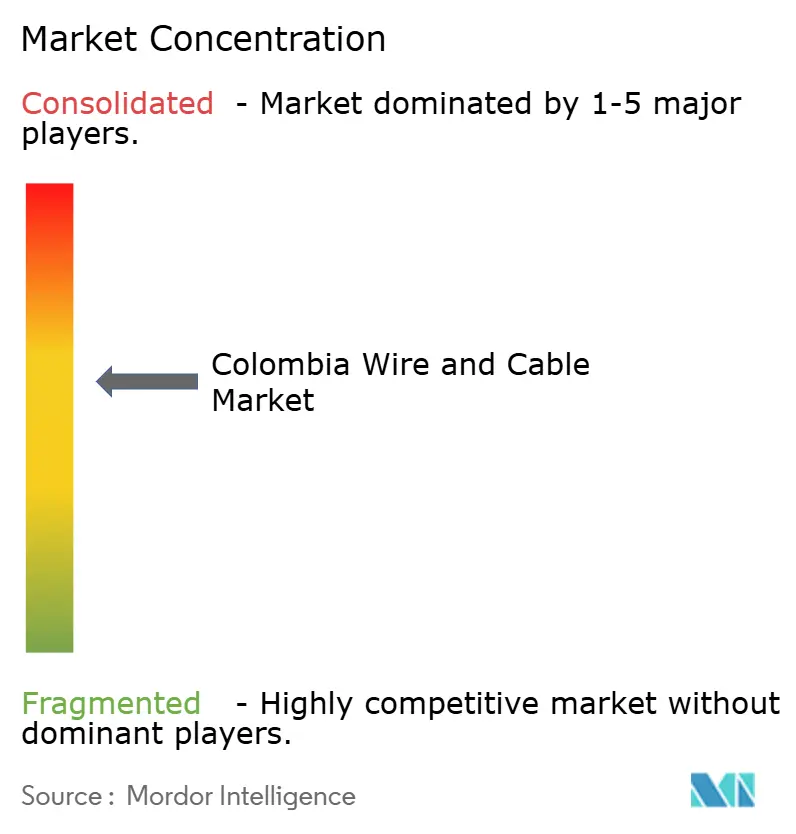
The Colombia wire and cable market has a moderately concentrated domestic manufacturing structure. Centelsa by Nexans and Procables, a Prysmian brand, collectively account for an estimated 40%-50% of local production capacity. Both companies use RETIE compliance, product quality, traceability, technical support, and established distribution relationships to compete against non-certified imports. Centelsa’s product certificate CP25_AA00023 covers a range of THHN, XLPE, and specialized cable products through October 2030. Procables maintains ISO 9001:2015 certification through the current cycle, which ends in November 2026.
Centelsa by Nexans is expected to launch authentication capability in the Nexans App in 2025 to help customers verify product authenticity. The move addresses counterfeit activity and strengthens the company’s service position beyond cable supply, especially for distributors and installers that require confidence in product origin. Procables is expected to launch Exzhellent Green in June 2025, adding a bio-based, SGS-certified option for projects with sustainability criteria. Centelsa by Nexans is also expected to supply cable infrastructure for a 358 MW photovoltaic project in Antioquia and Caldas in October 2025. This project demonstrates the company’s ability to serve solar-specific cable requirements and deliver products for large renewable developments.
Cablecol, Conalcables, Cables de Colombia, Electrocables, and Fomac serve specific voltage, application, and regional niches. Furukawa Electric Colombia and Electrol Fibra Óptica focus on fiber connectivity, as internet service providers and data users expand procurement. Belden, Corning, and OFS Fitel serve the country mainly through distributors and project-specific supply agreements for specialty industrial, fiber-optic, and signal products. Domestic production remains limited in extra-high-voltage and submarine cables.
Colombia Wire and Cable Industry Leaders
-
Nexans Colombia S.A.S.
-
Prysmian Colombia S.A.S.
-
Belden Inc.
-
Southwire Company, LLC
-
Corning Incorporated
- *Disclaimer: Major Players sorted in no particular order
Recent Industry Developments
- July 2026: Colombia's Ministry of Mines and Energy confirmed the Colectora 500 kV transmission project reached 90% completion. The line, developed by Grupo Energía Bogotá across 228 km in La Guajira and Cesar, will connect approximately 1,050 MW from 15 wind parks and 1 solar park to the SIN, requiring 3,000 km of conductor cable for final installation.
- June 2026: Colombia adopted the Transmission Expansion Plan 2025-2039 via Resolución 40287 on June 23, 2026, setting out 10 strategic high-voltage transmission projects to reinforce the SIN in Bogotá-Cundinamarca, Cauca, and Nariño, with operational entry dates through December 31, 2031.
- March 2026: ETB committed USD 70 million to fiber-optic network expansion, deepening its FTTH deployment and transitioning away from its legacy copper infrastructure in Bogotá.
- February 2026: EPM outlined plans for a USD 300 million grid modernization in Colombia, targeting improvements in distribution reliability across its service territory in Antioquia.
Colombia Wire and Cable Market Report Scope
The Colombia Wire and Cable Market Report is Segmented by Voltage (Extra-and High-Voltage [Greater Than 35 kV], Medium-Voltage [1-35 kV], and Low-Voltage [Less Than 1 kV]), Cable Type (Power Cable, Fiber-Optic Cable, Signal and Control Cable, and Coaxial and Data Cable), Conductor Material (Copper, Aluminum, and Optical Glass / Polymer), Installation (Overhead, Underground, and Submarine), End-User Vertical (Residential Construction, Commercial Construction, Power Infrastructure, Telecommunications and Data Centers, Oil and Gas and Petrochemicals, Automotive and Mobility, and Industrial Manufacturing), and Insulation (Insulated, and Non-Insulated). The Market Forecasts are Provided in Terms of Value (USD).
| Extra- and High-Voltage (Greater Than 35 kV) |
| Medium-Voltage (1-35 kV) |
| Low-Voltage (Less Than 1 kV) |
| Power Cable |
| Fiber-Optic Cable |
| Signal and Control Cable |
| Coaxial and Data Cable |
| Copper |
| Aluminum |
| Optical Glass / Polymer |
| Overhead |
| Underground |
| Submarine |
| Residential Construction |
| Commercial Construction |
| Power Infrastructure (Utilities and Renewables) |
| Telecommunications and Data Centers |
| Oil and Gas and Petrochemicals |
| Automotive and Mobility |
| Industrial Manufacturing |
| Insulated |
| Non-Insulated |
| By Voltage | Extra- and High-Voltage (Greater Than 35 kV) |
| Medium-Voltage (1-35 kV) | |
| Low-Voltage (Less Than 1 kV) | |
| By Cable Type | Power Cable |
| Fiber-Optic Cable | |
| Signal and Control Cable | |
| Coaxial and Data Cable | |
| By Conductor Material | Copper |
| Aluminum | |
| Optical Glass / Polymer | |
| By Installation | Overhead |
| Underground | |
| Submarine | |
| By End-User Vertical | Residential Construction |
| Commercial Construction | |
| Power Infrastructure (Utilities and Renewables) | |
| Telecommunications and Data Centers | |
| Oil and Gas and Petrochemicals | |
| Automotive and Mobility | |
| Industrial Manufacturing | |
| By Insulation | Insulated |
| Non-Insulated |
Key Questions Answered in the Report
What is the Colombia wire and cable market size?
The Colombia wire and cable market size is estimated at USD 460.11 million in 2026 and is forecast to reach USD 590.23 million by 2031, at a CAGR of 5.11%. The outlook reflects demand from power networks, construction, renewable projects, and digital infrastructure.
What is driving wire and cable demand in Colombia?
Transmission investment, renewable interconnection, fiber deployment, and urban infrastructure projects are the main sources of demand. Publicly supported rural electrification also broadens demand for distribution and photovoltaic cables.
Which voltage category leads cable sales in Colombia?
Low-voltage cable led with 39.78% share in 2025, supported by construction, distribution, and solar balance-of-system applications. It serves many project types, supporting recurring demand for installation and replacement work.
Which cable type is expected to grow the fastest through 2031?
Fiber-optic cable is projected to grow at a CAGR of 6.98%, supported by fiber-to-the-home expansion and data-network investment. This demand is supported by both urban connectivity and expansion into less-served areas.
Why is RETIE certification important for cable suppliers?
RETIE requires compliant certified products for many formal electrical installations, helping buyers assess product safety, quality, and traceability. The rules also make documentation important for suppliers seeking utility, construction, and renewable contracts.
Which end-user group is growing fastest in Colombia?
Telecommunications and data centers are projected to grow at a CAGR of 7.21% through 2031, supported by fiber networks and digital infrastructure. These users require both network cable and dependable internal power distribution systems.