
Colombia Fixed Wireless Access Market Size and Share
Market Overview
| Study Period | 2020 - 2031 |
|---|---|
| Forecast Data Period | 2026 - 2031 |
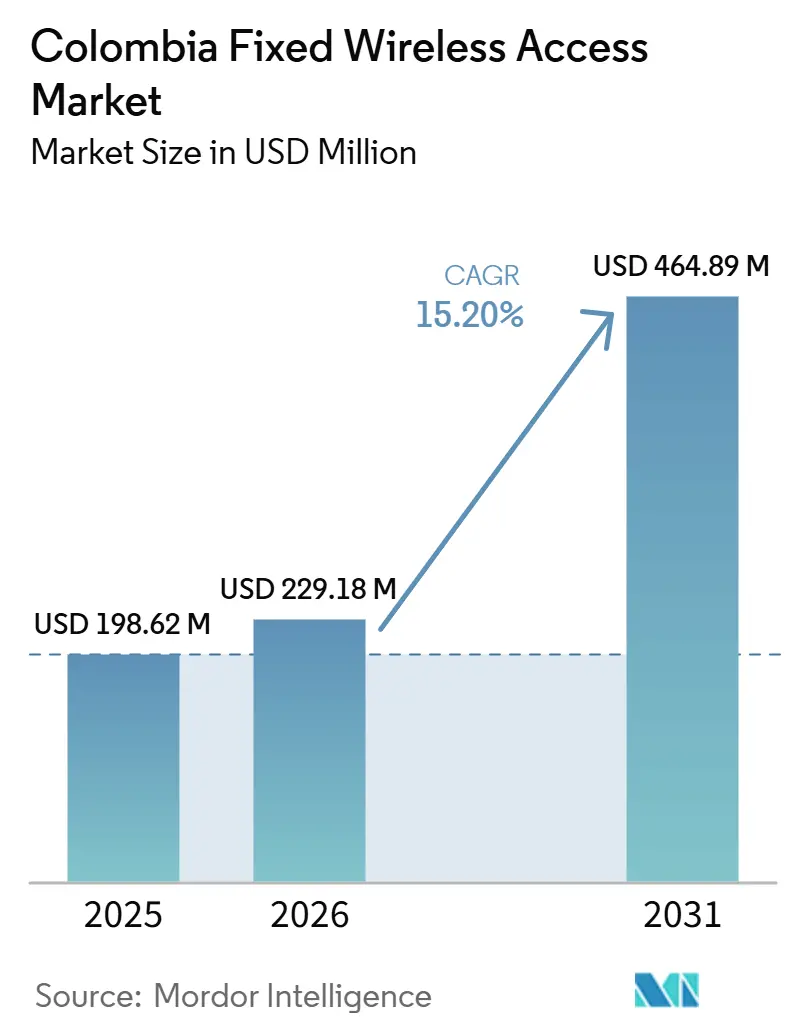
| Base Year Market Size (2025) | USD 198.62 Million |
| Market Size (2026) | USD 229.18 Million |
| Market Size (2031) | USD 464.89 Million |
| Growth Rate (2026 - 2031) | 15.20 % |
| Market Concentration | Medium |
Major Players *Disclaimer: Major Players sorted in no particular order Image © Mordor Intelligence. Reuse requires attribution under CC BY 4.0. | |
Colombia Fixed Wireless Access Market Analysis by Mordor Intelligence
The Colombia Fixed Wireless Access Market size is projected to expand from USD 198.62 million in 2025 and USD 229.18 million in 2026 to USD 464.89 million by 2031, registering a CAGR of 15.20% from 2026 to 2031. The market has been expanding as the country continues to face a significant broadband access gap. Fixed broadband penetration remained limited in 2024, while fixed wireless access accounted for only a small share of total fixed broadband subscriptions. The addressable base remained substantial, as many households lacked internet access, and a significant share of rural households remained unconnected. This gap made fixed wireless access a practical substitute in areas where fiber deployment economics remained weak. The Colombia fixed wireless access market also benefited from 5G rollout activity, turning spectrum holdings into deployable home and business broadband capacity across the largest cities. Competitive pressure increased after Millicom consolidated Coltel, while smaller operators and local wireless providers continued to serve selective urban fringe and rural use cases. The main limits on faster expansion came from ongoing fiber buildouts in major cities, sector levies and spectrum-related capital demands, and uneven operator readiness outside Claro’s network footprint.
Key Report Takeaways
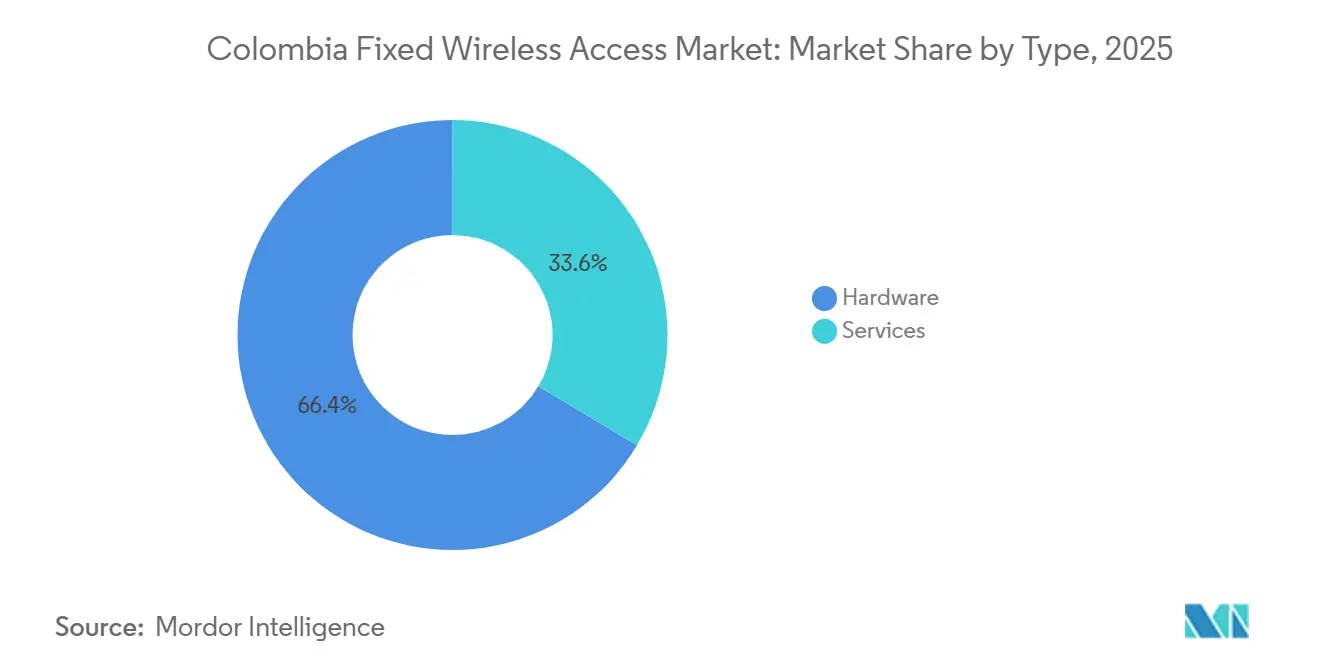
- By type, hardware held 66.42% of revenue share in the Colombia fixed wireless access market in 2025, while services are projected to expand at a 15.86% CAGR through 2031.
- By application, residential accounted for 73.18% of revenue share in the Colombia fixed wireless access market in 2025, while the government and public safety segment is projected to expand at a 16.21% CAGR through 2031.
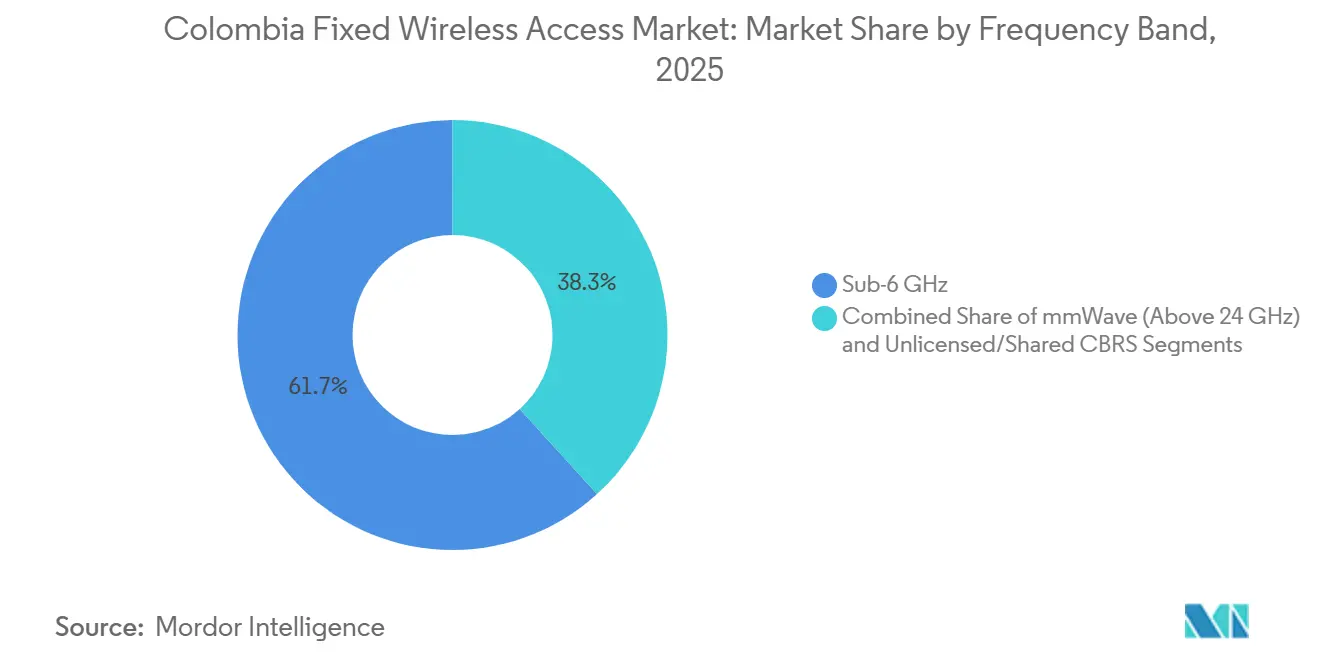
- By frequency band, sub-6 GHz held 61.74% of revenue share in the Colombia fixed wireless access market in 2025, while mmWave (above 24 GHz) is projected to expand at a 16.38% CAGR through 2031.
- By deployment mode, indoor CPE captured 69.36% of revenue share in the Colombia fixed wireless access market in 2025, while self-install window-mount CPE is projected to expand at a 16.62% CAGR through 2031.
Note: Market size and forecast figures in this report are generated using Mordor Intelligence’s proprietary estimation framework, updated with the latest available data and insights as of January 2026.
Colombia Fixed Wireless Access Market Trends and Insights
Drivers Impact Analysis*
| Driver | (~) % Impact on CAGR Forecast | Geographic Relevance | Impact Timeline |
|---|---|---|---|
| Rising 5G Coverage in Major Colombian Cities | +4.5% | Bogotá, Medellín, Cali, Barranquilla, Cartagena, Bucaramanga | Short term (≤ 2 years) |
| Fiber Gap in Secondary Cities and Semi-Urban Areas | +3.2% | National, with concentration in Pereira, Manizales, Ibagué, Montería | Medium term (2-4 years) |
| Affordable Self-Install FWA For Fast Broadband Activation | +2.8% | National, with early gains in Bogotá and secondary urban centers | Short term (≤ 2 years) |
| Fixed and Mobile Convergence in Carrier Bundles | +2.0% | Bogotá, Cali, Medellín, Barranquilla | Medium term (2-4 years) |
| Spectrum Refarming and Mid-Band Capacity Expansion | +1.5% | National, with core gains in Bogotá and Medellín | Medium term (2-4 years) |
| Enterprise Backup Connectivity and SD-WAN Use Cases | +1.0% | Bogotá enterprise corridor and Medellín industrial zones | Long term (≥ 4 years) |
| Source: Mordor Intelligence | |||
Rising 5G Coverage in Major Colombian Cities
Colombia’s 5G rollout passed an important operational threshold once commercial fixed wireless access became available in the largest cities, giving operators a practical route into home broadband without waiting for full fiber buildout. Nokia said Claro launched the country’s first commercial 5G FWA service in June 2024 and activated more than 1,000 5G sites across Bogotá, Medellín, Cali, Barranquilla, Cartagena, and Bucaramanga within four months of receiving its license.[1]Nokia, “Nokia y Claro Despliegan la Red 5G Más Grande de Colombia,” Nokia, nokia.com That buildout mattered because the same radio network used for mobile broadband could also support fixed wireless customer premises equipment, which lowered the incremental capital hurdle for new household connections. As 5G coverage expanded in high-density urban areas, the Colombia fixed wireless access market gained a scalable path to reach apartments, small offices, and outer-city neighborhoods, with shorter time-to-activation than fiber. Nokia’s indoor and outdoor deployment support also reduced the need for operators to treat residential and business FWA as separate network opportunities, which improved launch economics across the Colombia fixed wireless access market.
Fiber Gap in Secondary Cities and Semi-Urban Areas
The Colombia fixed wireless access market also drew support from a durable fiber gap outside the largest urban cores, where deployment economics remained less favorable for trench-heavy last-mile expansion. In cities such as Pereira, Manizales, Montería, and Florencia, subscriber density was sufficient for wireless economics, yet not strong enough to guarantee rapid fiber trenching at scale. MinTIC’s Remanentes 003 de 2025 program targeted 17,503 homes in Cauca, Chocó, and Nariño, demonstrating that underserved areas still require multiple access models rather than a fiber-only solution. That kept the Colombia fixed wireless access market relevant not only as a stopgap solution, but also as a medium-term access layer for cities and peri-urban belts that remained commercially underserved. The same structure also reduced the chance that fiber expansion in Bogotá or Medellín would fully close the opportunity set elsewhere, because access inequality remained dispersed across many secondary territories.
Affordable Self-Install FWA for Fast Broadband Activation
Self-install equipment has been strengthening the Colombian fixed wireless access market by reducing dependence on technician visits, truck rolls, and on-site structural modifications. That mattered in a market where service activation speed often determined whether an operator could convert a mobile household into a broadband customer before a fiber alternative arrived. Nokia’s 2024 rollout with Claro covered both indoor and outdoor 5G FWA scenarios, which showed that operators already had a working model for flexible home installation across different building types. Ericsson said 57% of global FWA service providers were already offering speed-based tariff plans by April 2026, supporting a commercial structure in which easy installation and service-tier pricing work together.[2]Ericsson, “Fixed Wireless Access Outlook,” Ericsson Mobility Report, ericsson.com In Colombia, that combination favored quick activation in apartment-heavy districts and in outer urban zones where field technician availability remained uneven. As more operators expanded their 5G footprints, the Colombian fixed wireless access market was likely to gain further traction from plug-and-play offers that made broadband onboarding feel closer to mobile device activation than to civil works.
Fixed and Mobile Convergence in Carrier Bundles
Converged bundles have become more important in the Colombian fixed wireless access market because operators needed fresh ways to protect revenue after a long period of mobile price pressure. The OECD said mobile ARPU in Colombia fell from USD 8.6 in 2014 to USD 3.4 in 2024, which left operators with a strong incentive to increase wallet share through multi-service packaging. FWA fit that strategy well because it provided carriers with a fixed access layer in areas where fiber was absent, delayed, or too expensive to justify in the short term. Previsora’s 2026 SD-WAN procurement required redundant WAN links, which showed that business users also valued diversified access paths rather than single-network dependence. After Millicom completed its full Coltel consolidation in April 2026, the combined entity had a larger subscriber base, broader infrastructure reach, and greater scope to cross-sell fixed and mobile products.[3]Millicom, “Millicom (Tigo) Strengthens Its Position in Colombia Following the Successful Acquisition of the Government Stake in Coltel,” GlobeNewswire, globenewswire.com That strengthened the bundle logic in the Colombian fixed wireless access market, especially for households that already had mobile services with a carrier but still lacked fiber at home.
Restraints Impact Analysis*
| Restraint | (~) % Impact on CAGR Forecast | Geographic Relevance | Impact Timeline |
|---|---|---|---|
| High Spectrum Fees and Coverage Obligations | -2.8% | National, with regulatory influence concentrated in spectrum-intensive bands | Medium term (2-4 years) |
| Uneven Rural Backhaul and Transport Economics | -1.8% | Pacific coast, Amazon, Orinoquía, Chocó, Guajira | Long term (≥ 4 years) |
| Fiber Expansion and Price Competition Compressing FWA Monetization | -1.5% | Bogotá, Medellín, Cali, Barranquilla | Short term (≤ 2 years) |
| Local Permitting, Taxation, and Deployment Friction | -0.8% | National, with acute impact in smaller municipalities | Medium term (2-4 years) |
| Source: Mordor Intelligence | |||
High Spectrum Fees and Coverage Obligations
High spectrum costs and related compliance demands continued to limit how fast the Colombian fixed wireless access market could scale beyond early coverage zones. The OECD said Colombia could face a 270 MHz spectrum gap by 2028 if assignment procedures were not reformed, indicating that access growth still depended on tighter policy and a better capital balance. The same review noted a 1.9% sector contribution to FUTIC and a 4% value-added tax on mobile services, both of which reduced cash available for network investment. Coverage obligations attached to licenses could offset a large share of fee liabilities, but they still required operators to direct capital toward mandated buildout instead of purely commercial FWA expansion. That made rollout discipline more complex for the Colombian fixed wireless access market, because capital had to satisfy both regulatory commitments and service growth priorities. Even with the 2026-2029 spectrum policy roadmap pointing toward more flexible management, near-term relief for operator economics still appeared limited in the Colombian fixed wireless access market.
Uneven Rural Backhaul and Transport Economics
Transport economics remained a major barrier for the Colombian fixed wireless access market in remote regions, where access nodes could be installed faster than middle-mile networks could be funded. MinTIC said COP 3.3 trillion (USD 800 million) had been invested between 2023 and 2026 to close historic connectivity gaps, with rural schools, health centers, and local government facilities among the main priorities.[4]Ministerio de Tecnologías de la Información y las Comunicaciones, “MinTIC Ha Cerrado Brechas Históricas de Conectividad en Colombia con Inversión de 3.3 Billones,” Caracol Radio, caracol.com.co DNP also outlined a new fiber project for Amazonas and Putumayo, which showed that the state recognized backhaul as a bottleneck rather than just a last-mile problem. Those projects should improve network depth over time, but the Colombian fixed wireless access market still faced uneven commercial returns across Chocó, Guajira, the Amazon basin, and the Orinoquía until transport density improved. In practice, that meant wireless access could still be the fastest connection method in rural Colombia, while also remaining one of the hardest business cases to scale profitably.
*Our forecasts treat driver/restraint impacts as directional, not additive. The impact forecasts reflect baseline growth, mix effects, and variable interactions.
Segment Analysis
By Type: Hardware Anchors Revenue as Services Scale Alongside 5G
Hardware held 66.42% of the Colombian fixed wireless access market share in 2025, reflecting a rollout phase in which customer premises equipment and access units still generated most of the value. The early shape of the Colombian fixed wireless access market remained deployment-heavy because every new 5G home broadband activation required physical equipment at the network edge and at the customer location. Nokia’s 2024 launch with Claro covered both indoor and outdoor 5G FWA scenarios, which supported demand for multiple device formats across apartment, office, and perimeter-site use cases. Indoor units fit well with dense urban housing, while outdoor equipment remained more relevant where signal strength and line-of-sight conditions were less predictable. Hardware leadership also aligned with the fact that Colombia was still building the installed base needed for later service monetization, rather than operating in a mature replacement cycle.
Services are projected to expand at a 15.86% CAGR through 2031, making them the fastest-growing segment of the Colombian fixed wireless access market. Ericsson said 57% of global FWA service providers were already offering speed-based tariff plans in April 2026, indicating that monetization was moving toward service quality and plan design rather than equipment margins alone. That change supported recurring revenue models built around installation support, customer management, service assurance, and bandwidth differentiation. It also created room for operators to layer fixed access into enterprise offers that included network monitoring and resilient connectivity options, especially where customers already valued redundant WAN paths. In the Colombian fixed wireless access industry, this shift suggested that long-term value would gradually shift away from one-time equipment sales toward managed access relationships. As operators widened their footprints, services were likely to become a larger share of revenue even if hardware continued to dominate near-term market billing.


By Application: Residential Demand Leads While Government Connectivity Accelerates
Residential accounted for 73.18% of the Colombian fixed wireless access market in 2025, indicating that current adoption was still centered on household broadband rather than institutional or industrial demand. In secondary cities and lower-income urban zones, FWA remained attractive because it could be activated without the long lead times often associated with neighborhood-level fiber expansion. The residential case also benefited from a market structure in which many municipalities still lacked strong broadband competition, slowing the pace of investment in alternative fixed access. That kept the Colombian fixed wireless access market closely tied to basic household inclusion goals and operator growth targets.
The government and public safety segment is projected to expand at a 16.21% CAGR through 2031, which made it the fastest-growing application in the report. Public demand strengthened because agencies in secondary and tertiary cities needed reliable links for digital service delivery, administrative connectivity, and backup communication capacity. Previsora’s 2026 SD-WAN procurement required geographically redundant WAN links, which highlighted how resilience had become a formal purchasing requirement in public-sector connectivity. MinTIC said COP 3.3 trillion (USD 800 million) had been directed between 2023 and 2026 toward rural schools, health centers, and local government facilities, many of which needed workable non-fiber solutions. This gave the Colombian fixed wireless access market a public-sector demand layer that was less dependent on consumer upgrade cycles and more closely aligned with national service coverage priorities. It also supported wider deployment in places where government institutions could act as anchor users before household adoption deepened.
By Frequency Band: Sub-6 GHz Leads While mmWave Supports Higher-Capacity Use Cases
Sub-6 GHz accounted for 61.74% of the Colombian fixed wireless access market in 2025, making it the leading frequency band for commercial deployment. The OECD said all four 5G licensees received 80 MHz blocks in the 3.5 GHz band during the 2023 auction, which established Sub-6 GHz as the shared base for wide-area 5G access in the country. That spectrum range suited the current stage of the Colombian fixed wireless access market because it offered a workable balance between coverage reach and usable throughput. It also aligned with residential deployments, where operators needed enough range to address neighborhoods economically without sacrificing the service quality expected from fixed broadband products. The band’s broad relevance meant it remained the practical backbone for urban, peri-urban, and many enterprise-oriented FWA launches.
mmWave is projected to expand at a 16.38% CAGR through 2031, even though its installed base remains smaller than that of Sub-6 GHz. Its role was more selective, as it suited dense business districts, campus environments, and premium throughput applications better than broad residential coverage. That gave the Colombian fixed wireless access market a path toward service segmentation, where some users prioritized capacity and low congestion over geographic reach. Unlicensed and shared spectrum also retained a place in industrial parks and among smaller providers that needed local flexibility without national-scale spectrum assets. Over time, this created a more layered frequency structure rather than a single-band market. In the Colombian fixed wireless access industry, that layering should help operators and local providers address both mass broadband access and targeted high-performance links without relying on one network design.

By Deployment Mode: Indoor CPE Dominates While Self-Install Gains Speed
Indoor CPE captured 69.36% of the Colombian fixed wireless access market in 2025, which made it the default deployment mode for current residential activity. This lead matched the housing profile of Bogotá and other large cities, where apartment living and building management rules often made indoor equipment the simplest option for subscribers. Nokia’s 2024 Claro launch explicitly covered indoor and outdoor 5G FWA scenarios, confirming that both formats were commercially relevant within the same network footprint. Indoor CPE worked especially well where operators wanted simple activation, lower site friction, and service packages suited to mass-market household use. Outdoor CPE remained important in secondary cities and peri-urban districts where longer links and more challenging propagation conditions made directional gain more valuable.
Self-install window-mount CPE is projected to expand at a 16.62% CAGR through 2031, which made it the fastest-growing deployment mode in the report. The appeal stemmed from faster activation and reduced reliance on field service, as operators could reduce truck rolls and avoid many site-specific installation steps. That operating model was particularly relevant in the Colombian fixed wireless access market because technician availability and local deployment friction were not consistent across urban, peri-urban, and semi-rural zones. It also suited rental-heavy neighborhoods, where subscribers often preferred equipment that could be installed quickly and removed with limited property intervention. As operator footprints expanded, self-install offered a way to improve scaling efficiency without matching subscriber growth with equal growth in field labor. The result was a deployment pattern that could widen access while also protecting operating discipline in the Colombian fixed wireless access market.
Geography Analysis
The Colombian fixed wireless access market was most advanced in the metropolitan corridor that included Bogotá, Medellín, Cali, Barranquilla, Bucaramanga, and Cartagena, where 5G-enabled deployment conditions were strongest. Nokia said Claro launched commercial 5G FWA in June 2024 and brought more than 1,000 5G sites online across these six major cities within four months of receiving its license. These urban centers offered the best early economics because they combined dense housing, greater service awareness, and a stronger ability to bundle mobile and fixed products. Bogotá also showed early demand for resilient enterprise connectivity, with Previsora’s 2026 procurement highlighting the need for redundant WAN paths in institutional environments. ETB’s 2025 partnership with ZTE to expand all-optical infrastructure across Bogotá through 2028 also suggested that the capital would remain the most active overlap zone between fiber deepening and wireless substitution.
Secondary cities and semi-urban belts formed the medium-term growth frontier for the Colombian fixed wireless access market because fiber competition remained thinner outside the top urban core. Cities such as Pereira, Manizales, Montería, Armenia, and Florencia carried a usable balance of population density and unmet demand, which kept wireless access commercially relevant. MinTIC’s Remanentes 003 de 2025 program targeted 17,503 homes in Cauca, Chocó, and Nariño, reinforcing the role of mixed technology deployment in areas that still lacked broad fixed-network depth. These locations also benefited from the presence of public institutions, schools, and health facilities that could support early traffic and demand stability before consumer penetration broadened.
Rural and remote regions across Chocó, Guajira, the Amazon basin, and the Orinoquía remained the longest-dated opportunity for the Colombian fixed wireless access market. MinTIC said COP 3.3 trillion (USD 800 million) had been invested between 2023 and 2026 to close connectivity gaps, with rural schools and underserved communities among the main priorities. DNP’s Amazonas and Putumayo fiber project showed that the state was trying to improve transport conditions, but the long execution timeline meant that wireless would remain the primary access method in many localities for years. Until backhaul density improves more evenly, geography will continue to shape the Colombian fixed wireless access market, with a clear split between fast-moving urban launches and slower, subsidy-linked rural expansion.
Competitive Landscape
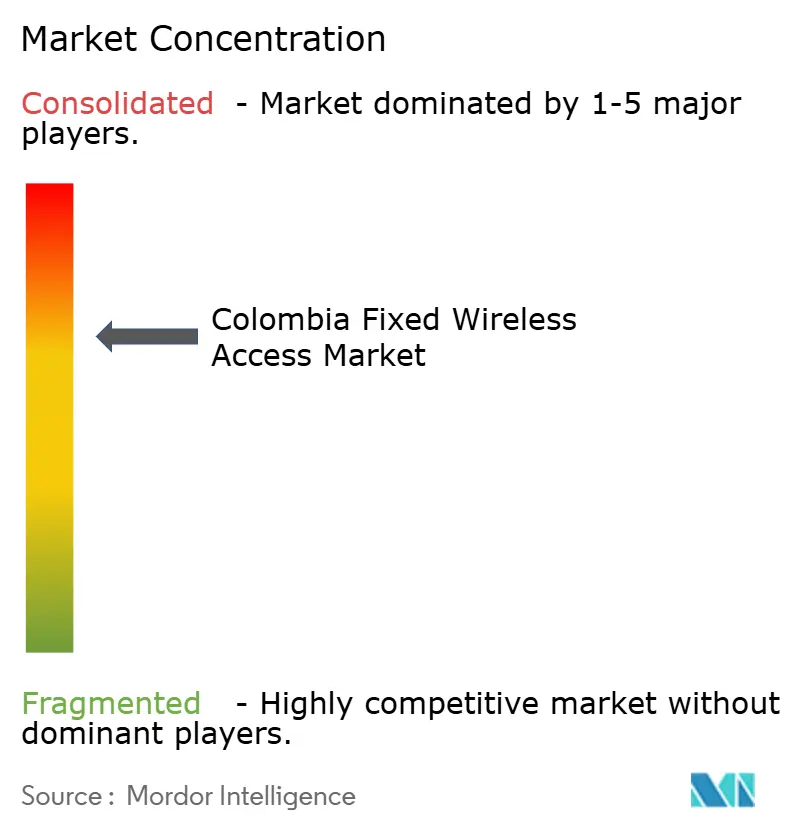
The Colombian fixed wireless access market operated within a telecom structure that had become more concentrated at the top while still leaving room for smaller providers in targeted areas. Millicom then deepened this concentration by completing the acquisition of Telefónica’s 67.5% stake in Coltel in February 2026 and the remaining 32.5% government stake in April 2026, creating a stronger, second-integrated operator. That left the Colombian fixed wireless access market with a more defined large-operator contest in major cities, while local WISPs and smaller access providers remained more active in secondary and rural pockets. The result was not a fully closed field, but a market in which spectrum ownership, urban site depth, and bundle capacity increasingly determined who could scale FWA quickly.
Claro remained the technology pace setter because it launched the first commercial 5G FWA service with Nokia and established a clear operating template for indoor and outdoor deployments. Millicom’s Coltel consolidation was the clearest strategic move by a challenger because it combined network infrastructure, spectrum assets, and a broader fixed-mobile customer base under a single structure. ETB also made a notable move with its 2025 partnership with ZTE, which aimed to extend all-optical coverage to 450,000 additional households in Bogotá by 2028. While that initiative centered on fiber, it still mattered to the Colombian fixed wireless access market because it reshaped where wireless would act as a substitute and where it would instead serve as a complementary access layer. These moves showed that competition was no longer only about subscriber acquisition, but also about where each player chose to place fiber, 5G, or both.
Equipment positioning followed a similar pattern, with vendors competing through network fit rather than only through unit volume. Nokia had the strongest visible role in the Colombian fixed wireless access market because of its direct link to Claro’s commercial 5G FWA launch and its support for indoor and outdoor use cases. ZTE’s relationship with ETB gave it a meaningful role in Bogotá’s broadband infrastructure buildout, even though the program focused on optical access rather than solely on wireless. The white-space opportunity remained in enterprise resilience, where redundant WAN demand, public-sector procurement, and bundle convergence could reward operators that offered complete connectivity solutions instead of standalone access links. This meant competitive advantage in the Colombian fixed wireless access market increasingly depended on how well carriers combined coverage, installation simplicity, and service packaging across different customer groups.
Colombia Fixed Wireless Access Industry Leaders
Telecall Colombia S.A.S.
Claro Colombia S.A.
MikroTik SIA
Sercomm Corporation
Colombia Móvil S.A. E.S.P. (Tigo Colombia)
- *Disclaimer: Major Players sorted in no particular order

Recent Industry Developments
- April 2026: Millicom (Tigo) acquired the remaining 32.5% equity stake in Coltel (formerly Movistar Colombia), held by La Nación, completing its full consolidation of the entity. The transaction positioned Millicom as the second-largest integrated telecoms operator in Colombia, with the investment capacity to accelerate 5G FWA alongside fiber rollouts across its inherited Movistar footprint.
- February 2026: Millicom successfully concluded the tender offer for Telefónica’s 67.5% controlling stake in Coltel (Movistar Colombia) for USD 214.4 million, formally initiating the Tigo-Movistar operational integration with SIC-mandated behavioral remedies to protect competition in both mobile and fixed broadband markets.


Colombia Fixed Wireless Access Market Report Scope
The Colombian fixed wireless access (FWA) market's revenue is generated through the sale of FWA hardware, including customer premises equipment (CPE) and access units, as well as recurring subscription fees, installation and activation services, managed connectivity services, maintenance, and network support provided by fixed wireless service providers operating across Sub-6 GHz, mmWave, and CBRS frequency bands.
The Colombian fixed wireless access market report is segmented by type (hardware and services), application (residential, commercial, industrial, and government and public safety), frequency band (Sub-6 GHz, mmWave (above 24 GHz), and unlicensed/shared CBRS), and deployment mode (indoor CPE, outdoor CPE, and self-install window-mount CPE). The market forecasts are provided in value (USD).
| Hardware | Consumer Premise Equipment (CPE) |
| Access Units (Femto and Picocells) | |
| Services |
| Residential |
| Commercial |
| Industrial |
| Government and Public Safety |
| Sub-6 GHz |
| mmWave (Above 24 GHz) |
| Unlicensed/Shared CBRS |
| Indoor CPE |
| Outdoor CPE |
| Self-Install Window-Mount CPE |
| By Type | Hardware | Consumer Premise Equipment (CPE) |
| Access Units (Femto and Picocells) | ||
| Services | ||
| By Application | Residential | |
| Commercial | ||
| Industrial | ||
| Government and Public Safety | ||
| By Frequency Band | Sub-6 GHz | |
| mmWave (Above 24 GHz) | ||
| Unlicensed/Shared CBRS | ||
| By Deployment Mode | Indoor CPE | |
| Outdoor CPE | ||
| Self-Install Window-Mount CPE |


Key Questions Answered in the Report
What is the current and forecast size of the Colombia fixed wireless access market?
The Colombia fixed wireless access market was valued at USD 198.62 million in 2025, stood at USD 229.18 million in 2026, and is forecast to reach USD 464.89 million by 2031 at a 15.20% CAGR.
What is driving fixed wireless access growth in Colombia?
Growth is being supported by the country's broadband gap, wider 5G rollout, and the need for faster home and institutional connectivity in places where fiber remains limited.
Which application leads demand in Colombia fixed wireless access?
Residential led demand with 73.18% of market revenue in 2025, reflecting the large number of households still outside the reach of strong fixed broadband alternatives.
Which segment is growing the fastest by application?
Government and public safety is projected to grow the fastest at a 16.21% CAGR through 2031, supported by public connectivity programs and demand for resilient links.
Why is Sub-6 GHz leading deployment in Colombia?
Sub-6 GHz held 61.74% of the market in 2025 because it offers the best mix of coverage and capacity for broad 5G FWA deployment across urban and semi-urban areas.
How is competition evolving in Colombia fixed wireless access?
Competition is becoming more concentrated around Claro and the combined Tigo-Movistar entity, while smaller providers continue to serve selective secondary city, enterprise, and rural opportunities.
Page last updated on:





