
Collaborative Care Models Market Size and Share
Market Overview
| Study Period | 2020 - 2031 |
|---|---|
| Market Size (2026) | USD 2.43 Billion |
| Market Size (2031) | USD 4.39 Billion |
| Growth Rate (2026 - 2031) | 12.54 % |
| Fastest Growing Market | Asia-Pacific |
| Largest Market | North America |
| Market Concentration | Medium |
Major Players *Disclaimer: Major Players sorted in no particular order Image © Mordor Intelligence. Reuse requires attribution under CC BY 4.0. | |
Collaborative Care Models Market Analysis by Mordor Intelligence
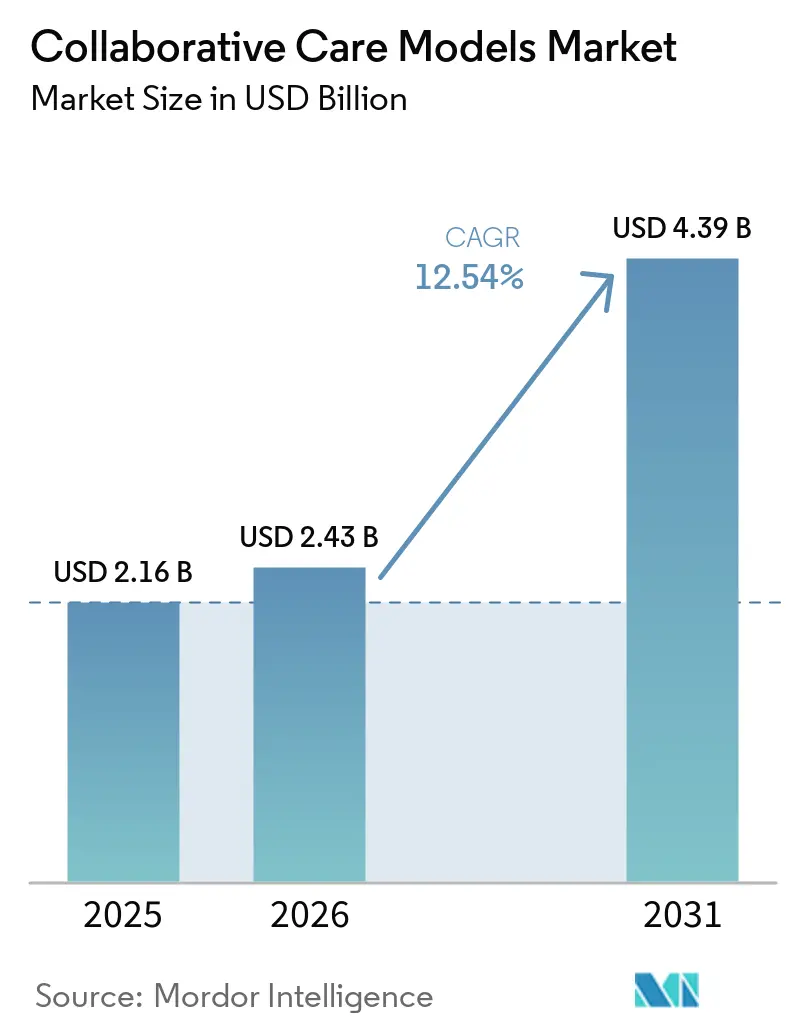
The Collaborative Care Models Market size is expected to grow from USD 2.16 billion in 2025 to USD 2.43 billion in 2026 and is forecast to reach USD 4.39 billion by 2031 at 12.54% CAGR over 2026-2031.
The Collaborative Care Models Market is expanding because primary care settings face behavioral health demand that specialist referral pathways cannot consistently meet. Structured team care links primary care physicians, behavioral health care managers, and psychiatric consultants through a shared patient registry. In June 2025, 45% of surveyed behavioral health providers were unavailable to treat new Medicare and Medicaid patients, and 1 in 4 available providers reported waits exceeding 30 days[1]. Payment reform, digital registries, and interoperability requirements are making the model more practical for health systems and smaller practices. Competition is also shifting as specialized vendors strengthen clinical, billing, and data capabilities while enterprise EHR providers bundle behavioral health functions into broader platforms.
Key Report Takeaways
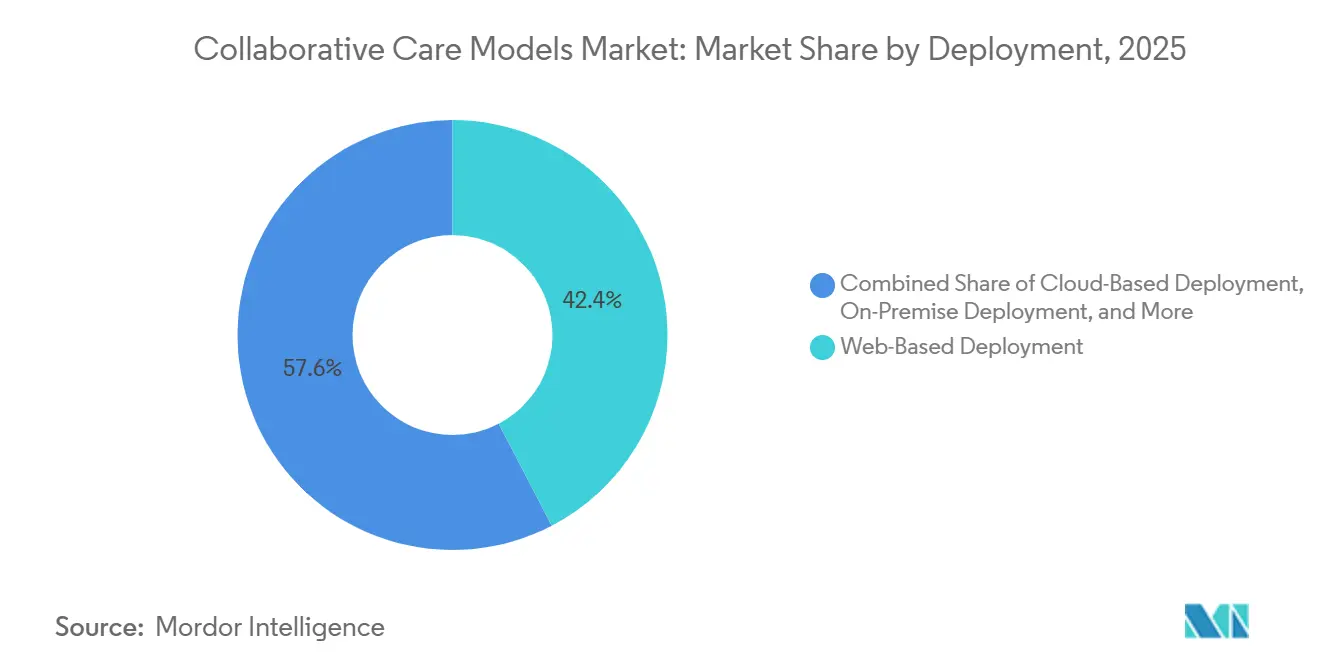
- By deployment, web-based platforms held 42.37% of the segment share in 2025, while cloud-based solutions are forecast to grow at a 14.76% CAGR through 2031.
- By application, population-based care held 39.87% of the segment share in 2025, while patient-centered team care is forecast to grow at a 13.97% CAGR through 2031.
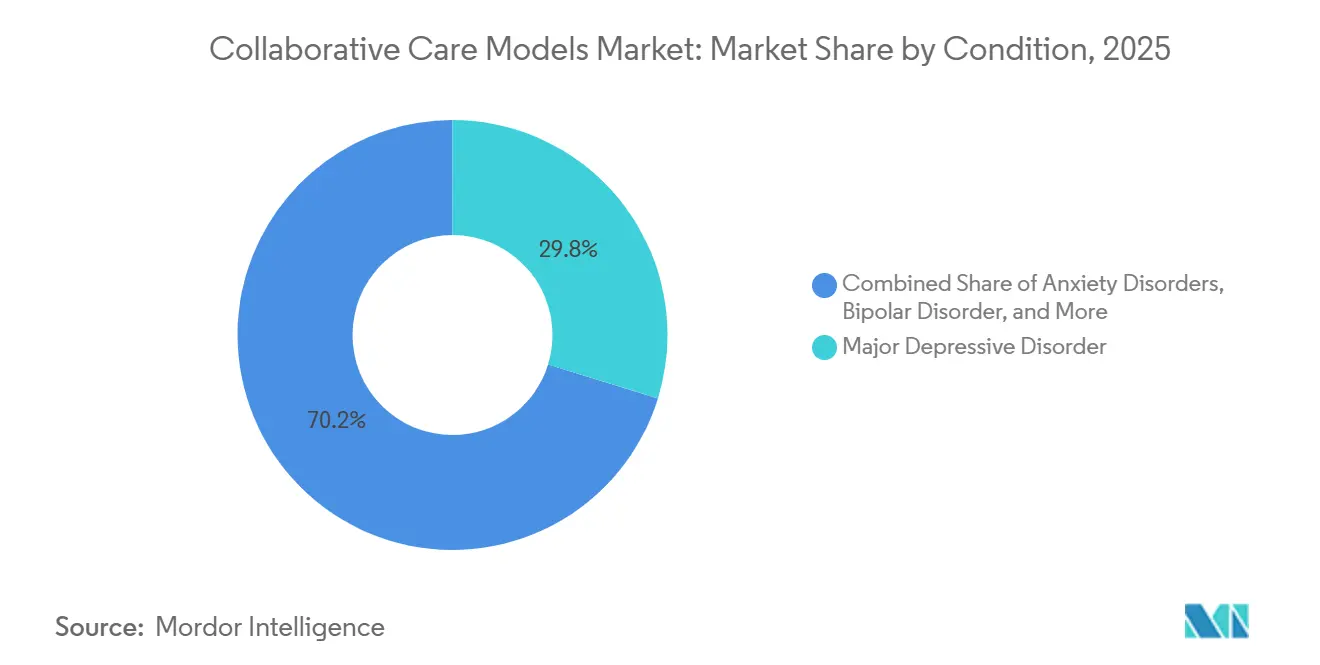
- By condition, major depressive disorder held 29.77% of the segment share in 2025, while anxiety disorders are forecast to grow at a 13.54% CAGR through 2031.
- By end user, hospitals and clinics accounted for 36.18% of the segment share in 2025, while ambulatory care centers are forecast to grow at a 14.12% CAGR through 2031.
- By geography, North America held 43.64% of the segment share in 2025, while Asia-Pacific is forecast to grow at a 15.32% CAGR through 2031.
Note: Market size and forecast figures in this report are generated using Mordor Intelligence’s proprietary estimation framework, updated with the latest available data and insights as of January 2026.
Market Trends and Insights
Drivers Impact Analysis of Collaborative Care Models Market*
| Driver | (~) % Impact on CAGR Forecast | Geographic Relevance | Impact Timeline |
|---|---|---|---|
| Rising Behavioral Health Burden in Primary Care | +2.5% | Global, concentrated in North America and Europe | Short term (≤ 2 years) |
| Expansion of Value-Based and Population Health Payment | +2.2% | North America and Asia-Pacific core, with spillover to Europe | Medium term (2-4 years) |
| Telehealth and Digital Registry Enablement | +2.0% | Global, with early adoption in North America and growth in Asia-Pacific and the Middle East and Africa | Short term (≤ 2 years) |
| Billing Workflow Automation Unlocking Care Activity | +1.6% | North America, centered on Medicare and Medicaid | Short term (≤ 2 years) |
| Growing Adoption of Integrated Care Delivery Models | +1.4% | North America and Europe | Medium term (2-4 years) |
| Increasing Government and Payer Support for Mental Health Integration | +1.2% | Global, with near-term activity in North America, China, and the United Kingdom | Medium term (2-4 years) |
| Source: Mordor Intelligence | |||
Rising Behavioral Health Burden in Primary Care
The Collaborative Care Models Market benefits from a growing gap between behavioral health demand and specialist availability. Primary care increasingly serves patients who may not reach a behavioral health specialist through conventional referral pathways. The HHS Office of Inspector General found in 2025 that 45% of surveyed providers could not accept new Medicare and Medicaid patients. A Shatterproof and Bowman Family Foundation report recorded a rise in commercially insured CoCM use from 12 to 317 patients per 100,000 eligible individuals between 2018 and 2024. The model allows a consulting psychiatrist to review a larger primary care caseload than direct referral care can support. This leaves providers, payers, and health systems with a substantial unmet population as depression, anxiety, and behavioral conditions linked to chronic disease require coordinated treatment.
Expansion of Value-Based and Population Health Payment
Value-based payment is changing how organizations evaluate behavioral health integration programs. CMS launched the Innovation in Behavioral Health model in 2024, and New York, Michigan, and South Carolina began their 7-year programs in January 2025. The model includes per-member-per-month and outcome-based payment components for participating specialty behavioral health providers. CMS also scheduled the ACCESS model to begin on July 5, 2026, with payment linked to improvements in depression and anxiety measures for Medicare beneficiaries. The Collaborative Care Models Market therefore favors platforms that support risk stratification, measurement, and payer reporting alongside care coordination. A 2026 perspective noted that behavioral health organizations need sequenced quality measure development before moving fully into value-based payment.
Telehealth and Digital Registry Enablement
Virtual psychiatric consultation is helping collaborative care programs operate in settings without a local consulting psychiatrist. A 2025 study of 4 rural South Carolina clinics found that telehealth supported program launch and patient outreach in communities with limited treatment access. The Collaborative Care Models Market also depends on registries that connect clinical activity with the EHR. In 2026, ASTP/ONC selected 9 pilot programs across 45 exchange partners in 9 states to test behavioral health data exchange using USCDI+ BH and an FHIR implementation guide.[2] Health systems are likely to favor platforms that synchronize patient status, registry activity, and documentation across care settings. This makes bidirectional data exchange more important than isolated telehealth functions because clinical teams need current information at the point of care.
Billing Workflow Automation Unlocking Previously Uncaptured Care Activity
Billing friction has limited the financial sustainability of collaborative care programs, especially in small and rural practices. Effective January 1, 2026, CMS replaced CPT codes 99492 through 99494 with HCPCS G0568 through G0570 for Medicare collaborative care billing. CMS also retired G0512, allowing FQHCs and RHCs to bill multiple CoCM codes during a calendar month under the 50%+1 rule. The change increases the practical value of systems that track time, maintain care logs, and identify documentation gaps before claims are submitted. The Collaborative Care Models Market can therefore gain new users among safety-net providers that had not achieved viable reimbursement under prior billing rules. Commercial payer policies may also move toward the revised federal structure, making billing support a durable purchasing consideration.
Restraints Impact Analysis of Collaborative Care Models Market*
| Inconsistent Payer Reimbursement and Billing Rules | -1.7% | North America, with state Medicaid differences and spillover to Europe and Asia-Pacific | Short term (≤ 2 years) |
| Shortage of Behavioral Health Professionals | -1.4% | Global, acute in rural North America, South Asia, and the Middle East and Africa | Long term (≥ 4 years) |
| Fragmented Clinical Data and Measurement Workflows | -1.1% | Global | Medium term (2-4 years) |
| High Implementation and Operating Costs for Care Coordination Infrastructure | -0.9% | North America and Europe | Medium term (2-4 years) |
| Source: Mordor Intelligence | |||
Inconsistent Payer Reimbursement and Billing Rules
State payer rules create adoption differences that often do not reflect local patient needs. In February 2026, Shatterproof and The Bowman Family Foundation reported that Medicaid agencies and most managed-care organizations in 14 states provided little or no CoCM reimbursement. The report also found that Medicaid coverage was the strongest predictor of overall adoption. Practices may face different payer rules for eligible clinicians, time thresholds, caseload review, and documentation. These requirements add administrative work that smaller practices may struggle to manage without dedicated billing resources. Vendors that incorporate payer-specific workflows can reduce implementation risk, but uneven reimbursement remains a barrier across the Collaborative Care Models Market.
Shortage of Behavioral Health Professionals
The behavioral health workforce shortage limits the capacity available to expand integrated care. HRSA projected in 2025 that the adequacy of adult psychiatrist supply would reach only 43% by 2037, while the adequacy of addiction counselor supply would reach 45%. The Milbank Memorial Fund reported in 2025 that 70% of rural counties had no practicing psychiatrist. California HCAI also projected shortages across behavioral health roles in all 58 counties. Collaborative care partially extends psychiatric reach through indirect consultation, but it still requires trained care managers and reliable clinical supervision. Variation in care manager training and limited standardization can disrupt care continuity and complicate program scale.
*Our forecasts treat driver/restraint impacts as directional, not additive. The impact forecasts reflect baseline growth, mix effects, and variable interactions.
Collaborative Care Models Market Segment Analysis
By Deployment:
Cloud-Based Solutions Grow as Web-Based Platforms Retain Their Installed BaseWeb-based platforms held 42.37% of the Collaborative Care Models Market share in 2025 because many registry and care management systems were adopted during the 2017 to 2022 billing code rollout. Within the Collaborative Care Models Market, their established workflows support continued use across health systems that have already trained staff and built operating procedures around them. Some legacy architectures, however, limit real-time EHR synchronization and broad analytics. Cloud-based deployment is forecast to grow at a 14.76% CAGR from 2026 to 2031. Health systems are selecting cloud platforms for multi-site registry access, API connectivity, and simpler updates across distributed clinical operations.
The need for FHIR-native connections and population-level reporting supports the Collaborative Care Models Market size for cloud-based deployment. NeuroFlow expanded its IntegrateBH solution in February 2026 by combining behavioral health risk identification, care management infrastructure, and measurement-based care capabilities. On-premise systems continue to serve organizations with data residency needs or established server environments. The other category includes AI-enabled platforms and third-party managed deployment services. These offerings appeal to practices that want operational support rather than self-managed infrastructure. The ASTP/ONC pilots may increase demand for platforms that can support structured behavioral health data exchange.

By Application:
Population-Based Care Leads While Patient-Centered Team Care ExpandsPopulation-based care held 39.87% of the segment share in 2025 because panel tracking supports depression screening measures and population health reporting. Within the Collaborative Care Models Market, it enables care teams to identify patients who need follow-up and monitor outcomes across a primary care panel. Patient-centered team care is forecast to grow at a 13.97% CAGR from 2026 to 2031. This model brings care managers, social workers, community health workers, primary care physicians, and psychiatric consultants into a more active coordination process. Measurement-based treatment is also gaining importance as PHQ-9 and GAD-7 reporting becomes linked to payment models.
Northwestern Medicine expanded collaborative behavioral health programming across 70 primary care clinics and 500 physicians, using Concert Health for virtual pediatric support.[3] The example shows how patient-centered care becomes an operating requirement as programs reach system scale. Evidence-based care applications embed treatment pathways into care manager workflows. Accountable care and care coordination functions serve organizations managing population health contracts. The Collaborative Care Models Market industry is therefore moving beyond passive registry monitoring toward systems that document patient progress and coordinate interventions. Standardized measurement workflows also support accredited facilities that need consistent clinical records.
By Condition:
Major Depressive Disorder Leads While Anxiety Disorders Increase Addressable VolumeMajor depressive disorder held 29.77% of the segment share in 2025 because the model was originally validated for depression treatment in primary care. Within the Collaborative Care Models Market, training programs, billing approaches, and quality measures commonly use PHQ-9 trajectories as a core outcome. A 2026 systematic review reported depression response rates between 30% and 58% across 21 real-world studies that met Medicare CoCM component definitions. The same review found remission rates between 19% and 44%. Anxiety disorders are forecast to grow at a 13.54% CAGR from 2026 to 2031 as outcome programs include GAD-7 measures and providers identify unmet anxiety treatment needs.
The Collaborative Care Models Market size for anxiety-focused programs is supported by the CMS ACCESS model, which uses depression and anxiety outcomes in reimbursement. Bipolar disorder, PTSD, and substance use disorders remain smaller but important condition areas. A 2026 perspective on collaborative care for opioid use disorder with PTSD and depression found challenges in adapting care manager roles and treatment planning for complex populations. Vendors will need broader protocol libraries if they are to support these needs consistently. The other category includes ADHD and OCD, and can expand as state coverage definitions add eligible conditions.
By End User:
Hospitals and Clinics Lead While Ambulatory Centers Expand FasterHospitals and clinics accounted for 36.18% of the segment share in 2025 because they have larger primary care panels and established behavioral health services. Within the Collaborative Care Models Market, they also have the billing, staffing, and reporting capabilities needed to operate complex programs. Ambulatory care centers are forecast to grow at a 14.12% CAGR from 2026 to 2031. Independent physician groups and regional multispecialty practices can use outside vendors for psychiatric consultation and registry services. This reduces the need to create a hospital-level behavioral health operation before beginning a program.
In October 2025, evolvedMD and HonorHealth reported full CoCM adoption across 32 HonorHealth Medical Group primary care locations. The case study reported PHQ-9 remission and response rates of 29% among 1,093 patients with severe depression and GAD-7 rates of 27% among 2,807 patients with severe anxiety. In June 2026, evolvedMD expanded services into Massachusetts through HealthyU ambulatory clinics. Rehabilitation centers are emerging users of substance use protocols. FQHCs, RHCs, community mental health centers, academic institutes, and accountable care organizations can gain greater viability after the 2026 billing reform.
Geography Analysis
North America Collaborative Care Models Market
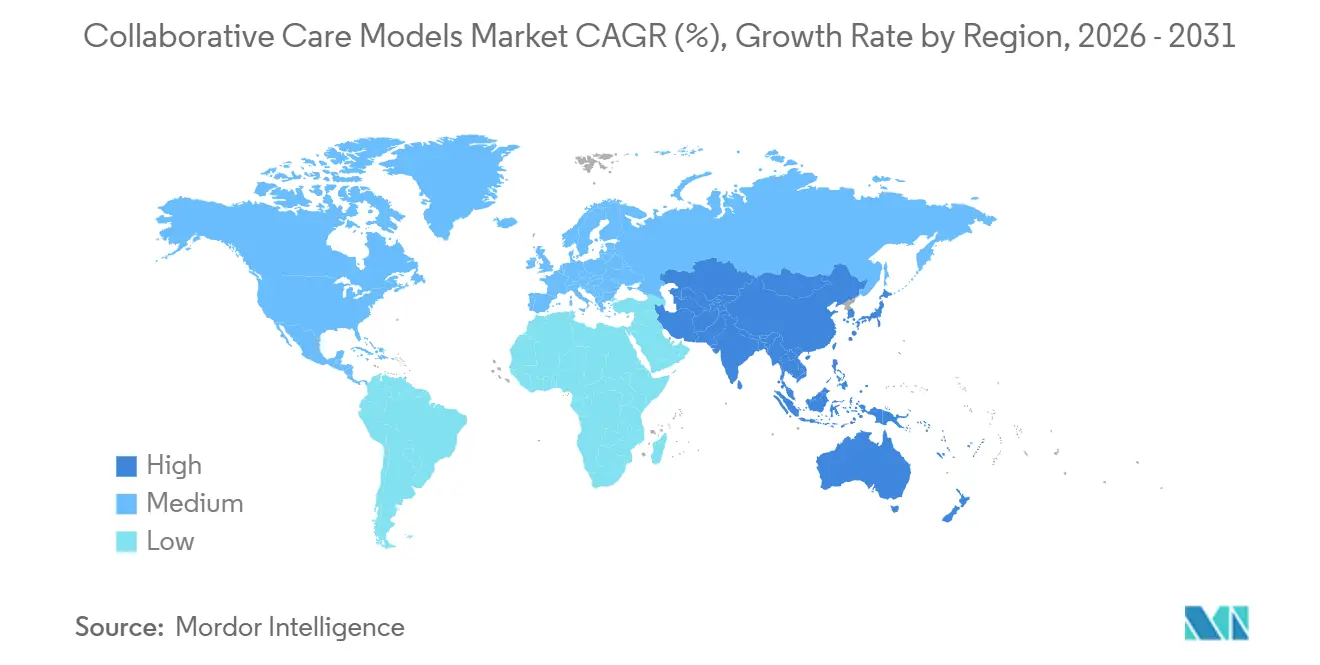
North America held 43.64% of the Collaborative Care Models Market share in 2025, supported by established reimbursement rules, implementation resources, and a developed vendor base. Within the Collaborative Care Models Market, the United States accounts for most regional adoption because CMS has standardized billing pathways, and health systems have accumulated operational experience. The AIMS Center protocol has also provided a widely used clinical model for primary care integration. Canada is developing programs through provincial primary care and mental health frameworks, although it lacks a direct federal CoCM billing equivalent. Mexico remains at an early stage, with activity concentrated in urban academic settings and clinical exchange relationships.
Europe Collaborative Care Models Market
Europe has a varied primary care structure that limits consistent deployment across the region. National payment rules and local care organizations shape the Collaborative Care Models Market in Europe. The German COMET study found that collaborative and stepped care produced mean outpatient mental health service costs EUR 685 higher per patient than usual treatment, with virtually identical 12-month QALY outcomes.[4] The study also showed that the model improved access to psychotherapists and psychiatrists by reducing referral friction. United Kingdom primary care network mental health teams showed strong adoption among core members, while external organizations had more variable uptake. France, Italy, Spain, Germany, and other countries are advancing community mental health integration through the IMPLEMENTAL initiative.
South America, APAC and MEA Collaborative Care Models Market
Asia-Pacific is forecast to grow at a 15.32% CAGR from 2026 to 2031, making it the fastest-growing regional component of the Collaborative Care Models Market. China announced a 2025 to 2027 plan to establish prefecture-level regional mental health centers and expand outpatient service availability. Japan has proposed community care arrangements that connect primary care physicians with psychogeriatric consultation. India has a large primary care base and a limited specialist supply, while South Korea has invested in digital health and mental health awareness. The Middle East and Africa and South America remain smaller markets, but WHO guidance on integrating mental health into primary care supports government interest across the GCC, Brazil, and South Africa.
Competitive Landscape
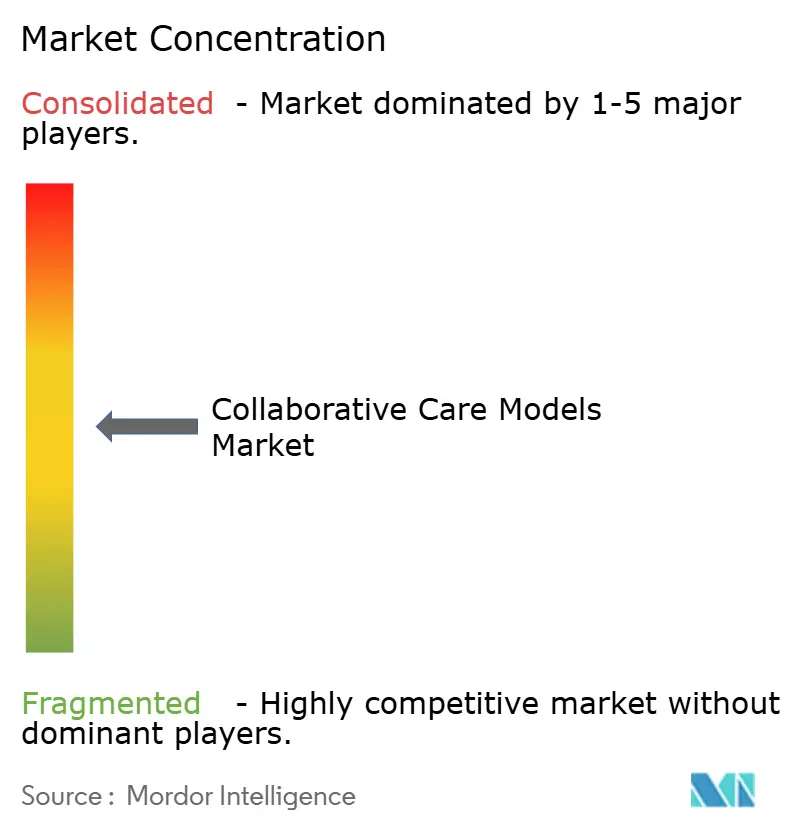
The Collaborative Care Models Market is moderately fragmented across registry software, care management services, virtual psychiatric consultation, and billing workflow tools. Within the Collaborative Care Models Market, no vendor dominates each functional layer, so health systems often combine products and services from several providers. This raises implementation requirements and increases the value of reliable integration. NeuroFlow, Concert Health, evolvedMD, Precise Behavioral, and CrossTx compete with different combinations of analytics, clinical support, and EHR connections. EHR providers, including Epic Systems, Oracle Health, and athenahealth, increase substitution pressure by incorporating behavioral health capabilities within enterprise systems.
NeuroFlow acquired Quartet Health in January 2025 and also acquired Intermountain Health’s Alluceo behavioral health analytics model. These transactions combined risk identification, care navigation, outcomes measurement, and payer relationships within one platform. In February 2026, NeuroFlow expanded IntegrateBH to connect risk identification, care management, and measurement-based care capabilities. Teladoc Health acquired UpLift in April 2025 for USD 30 million in cash, plus up to USD 15 million in contingent earnout. The transaction gave Teladoc access to a platform with covered-benefit relationships and an established mental health professional network.
White space in the Collaborative Care Models Market remains where AI-based risk identification, CoCM enrollment, care coordination, and compliant billing operate in one workflow. Many suppliers still provide these functions through separate products or integrations. Mid-market ambulatory groups and community health centers offer a clear opportunity because they need rapid implementation without hospital-scale infrastructure. The 2026 FQHC and RHC billing update improves the commercial case for these providers.
Collaborative Care Models Industry Leaders
-
Concert Health
-
EMPWR
-
evolvedMD
-
NeuroFlow
-
Precise Behavioral
- *Disclaimer: Major Players sorted in no particular order
Collaborative Care Models Market Companies Covered in this Report
- AIMS Center, University of Washington
- Allied Behavioral Health Integration
- American Well
- Athenahealth
- ChronicCareIQ
- Concert Health
- CrossTx
- eClinicalWorks
- EMPWR
- Epic Systems
- evolvedMD
- Magellan Healthcare
- NeuroFlow
- NextGen Healthcare
- Optum
- Oracle Health
- Precise Behavioral
- Teladoc Health
- Veradigm Inc.
- WellSky
Recent Industry Developments in Collaborative Care Models Market
- June 2026: evolvedMD expanded its CoCM services into the Northeast through an extension of its existing partnership with HealthyU, embedding behavioral health care managers in four ambulatory primary care clinics across Worcester, Sterling, Auburn, and Shrewsbury in Massachusetts, the company’s first market entry outside its established Arizona base, signaling the ambulatory expansion phase of the broader collaborative care model market.
- February 2026: NeuroFlow launched the expanded IntegrateBH solution, consolidating AI-powered behavioral health risk identification from physical health workflows, care management infrastructure, and measurement-based care capabilities into a single end-to-end behavioral health integration platform.
- October 2025: evolvedMD and HonorHealth released a 5-year case study documenting full system-wide CoCM adoption across all 32 HonorHealth Medical Group primary care locations, with PHQ-9 remission and response rates of 29% among 1,093 severe depression patients and GAD-7 rates of 27% among 2,807 severe anxiety patients.
- September 2025: Delaware’s Division of Substance Abuse and Mental Health officially rolled out DTRN360, a statewide behavioral health care coordination platform developed in partnership with Bamboo Health, connecting treatment providers, state agencies, and care teams through a unified digital platform.
Global Collaborative Care Models Market Report Scope
The collaborative care models market comprises healthcare services, technologies, and solutions that support the coordinated management of behavioral and physical health conditions through multidisciplinary care teams. The market includes care delivery frameworks that integrate primary care providers, behavioral health specialists, care managers, and other healthcare professionals to deliver structured, measurement-based, and evidence-based patient care. It also encompasses clinical, operational, and digital platforms that facilitate care coordination, patient monitoring, treatment optimization, and improved outcomes across diverse healthcare settings.
The collaborative care models market is segmented by deployment, condition, application, end user, and geography. By deployment, it is further divided into web-based deployment, cloud-based deployment, on-premise deployment, and others. By application, it is segmented into population-based care, patient-centered team care, measurement-based treatment, evidence-based care, and others. By condition, the market is segmented into major depressive disorder, anxiety disorders, bipolar disorder, substance use disorders, post-traumatic stress disorder, and others. By end user, the market is segmented into hospitals and clinics, ambulatory care centers, rehabilitation centers, academic and research institutes, and others. The geography segment is further divided into North America, Europe, Asia-Pacific, the Middle East and Africa, and South America. The report also covers the estimated market sizes and trends for 17 countries across major regions globally. The report offers the market size and forecasts in value (USD) for the above segments.
Segmentation Overview
| Web-Based Deployment |
| Cloud-Based Deployment |
| On-Premise Deployment |
| Others (AI-enabled Deployment platforms, Third-Party Managed Deployment Services, etc.) |
| Population-Based Care |
| Patient-Centered Team Care |
| Measurement-Based Treatment |
| Evidence-Based Care |
| Others (Accountable Care, Care Coordination Management, etc.) |
| Major Depressive Disorder |
| Anxiety Disorders |
| Bipolar Disorder |
| Substance Use Disorders |
| Post-Traumatic Stress Disorder |
| Others (ADHD, Obsessive-Compulsive Disorder, etc.) |
| Hospitals and Clinics |
| Ambulatory Care Centers |
| Rehabilitation Centers |
| Academic and Research Institutes |
| Others (Community Mental Health Centers, Accountable Care Organizations, etc.) |
| North America | United States |
| Canada | |
| Mexico | |
| Europe | Germany |
| United Kingdom | |
| France | |
| Italy | |
| Spain | |
| Rest of Europe | |
| Asia-Pacific | China |
| Japan | |
| India | |
| Australia | |
| South Korea | |
| Rest of Asia-Pacific | |
| Middle East and Africa | GCC |
| South Africa | |
| Rest of Middle East and Africa | |
| South America | Brazil |
| Argentina | |
| Rest of South America |
| By Deployment | Web-Based Deployment | |
| Cloud-Based Deployment | ||
| On-Premise Deployment | ||
| Others (AI-enabled Deployment platforms, Third-Party Managed Deployment Services, etc.) | ||
| By Application | Population-Based Care | |
| Patient-Centered Team Care | ||
| Measurement-Based Treatment | ||
| Evidence-Based Care | ||
| Others (Accountable Care, Care Coordination Management, etc.) | ||
| By Condition | Major Depressive Disorder | |
| Anxiety Disorders | ||
| Bipolar Disorder | ||
| Substance Use Disorders | ||
| Post-Traumatic Stress Disorder | ||
| Others (ADHD, Obsessive-Compulsive Disorder, etc.) | ||
| By End User | Hospitals and Clinics | |
| Ambulatory Care Centers | ||
| Rehabilitation Centers | ||
| Academic and Research Institutes | ||
| Others (Community Mental Health Centers, Accountable Care Organizations, etc.) | ||
| Segmentation by Geography | North America | United States |
| Canada | ||
| Mexico | ||
| Europe | Germany | |
| United Kingdom | ||
| France | ||
| Italy | ||
| Spain | ||
| Rest of Europe | ||
| Asia-Pacific | China | |
| Japan | ||
| India | ||
| Australia | ||
| South Korea | ||
| Rest of Asia-Pacific | ||
| Middle East and Africa | GCC | |
| South Africa | ||
| Rest of Middle East and Africa | ||
| South America | Brazil | |
| Argentina | ||
| Rest of South America | ||
Key Questions Answered in the Report
What is the projected growth rate for collaborative care models?
The Collaborative Care Models Market is projected to grow at a 12.54% CAGR from 2026 to 2031, reaching USD 4.39 billion by 2031. Growth reflects a need to extend behavioral health support through primary care settings.
Which deployment model leads collaborative care adoption?
Web-based platforms led with a 42.37% share in 2025, while cloud-based solutions are projected to grow faster at a 14.76% CAGR. Cloud systems can support multi-site access and more direct integration with health records.
Which condition has the greatest role in collaborative care programs?
Major depressive disorder led the condition segment with a 29.77% share in 2025, supported by established PHQ-9-based care pathways. Anxiety programs are expanding as outcome reporting increasingly includes GAD-7 measures.
Why are ambulatory care centers adopting collaborative care models?
They can access psychiatric consultation and registry infrastructure from vendors without building hospital-scale services internally. This approach can make structured behavioral health integration feasible for independent and regional practice groups.
Which region is growing fastest for collaborative care models?
Asia-Pacific is projected to grow at a 15.32% CAGR through 2031, supported by government-led mental health service expansion. China, Japan, India, and South Korea each provide distinct sources of regional demand.
What limits collaborative care program adoption?
Uneven payer rules, workforce shortages, fragmented data workflows, and care coordination costs can delay implementation and scale.