
Cocoa Processing Market Size and Share
Market Overview
| Study Period | 2022 - 2032 |
|---|---|
| Market Size (2027) | USD 16.23 Billion |
| Market Size (2032) | USD 21.86 Billion |
| Growth Rate (2027 - 2032) | 6.14 % |
| Fastest Growing Market | Asia-Pacific |
| Largest Market | Europe |
| Market Concentration | Medium |
Major Players *Disclaimer: Major Players sorted in no particular order Image © Mordor Intelligence. Reuse requires attribution under CC BY 4.0. | |
Cocoa Processing Market Analysis by Mordor Intelligence
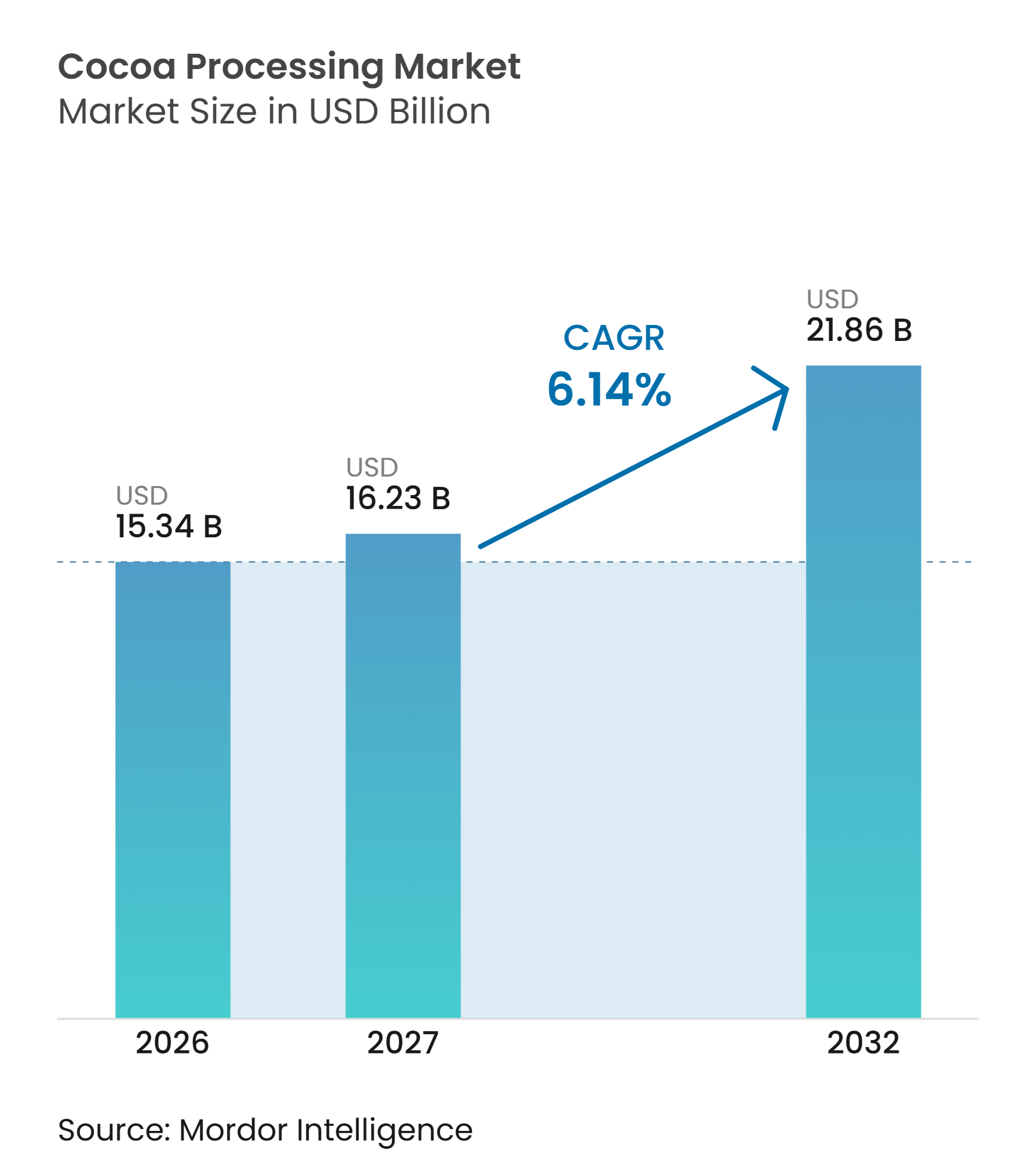
The cocoa processing market size was valued at USD 15.34 billion in 2026 and is estimated to grow from USD 16.23 billion in 2027 to reach USD 21.86 billion by 2032, at a CAGR of 6.14% during the forecast period (2027-2032). Growth depends on rising chocolate consumption in emerging economies, the broader use of cocoa ingredients in personal care and pharmaceutical applications, and investments in processing facilities across cocoa-producing countries. The cocoa processing market also faces an increasingly demanding procurement environment, as buyers seek traceable and deforestation-free supply chains. Processors that can manage price exposure, document sourcing, and serve higher-value applications are better positioned to capture demand as volumes recover.
Key Report Takeaways
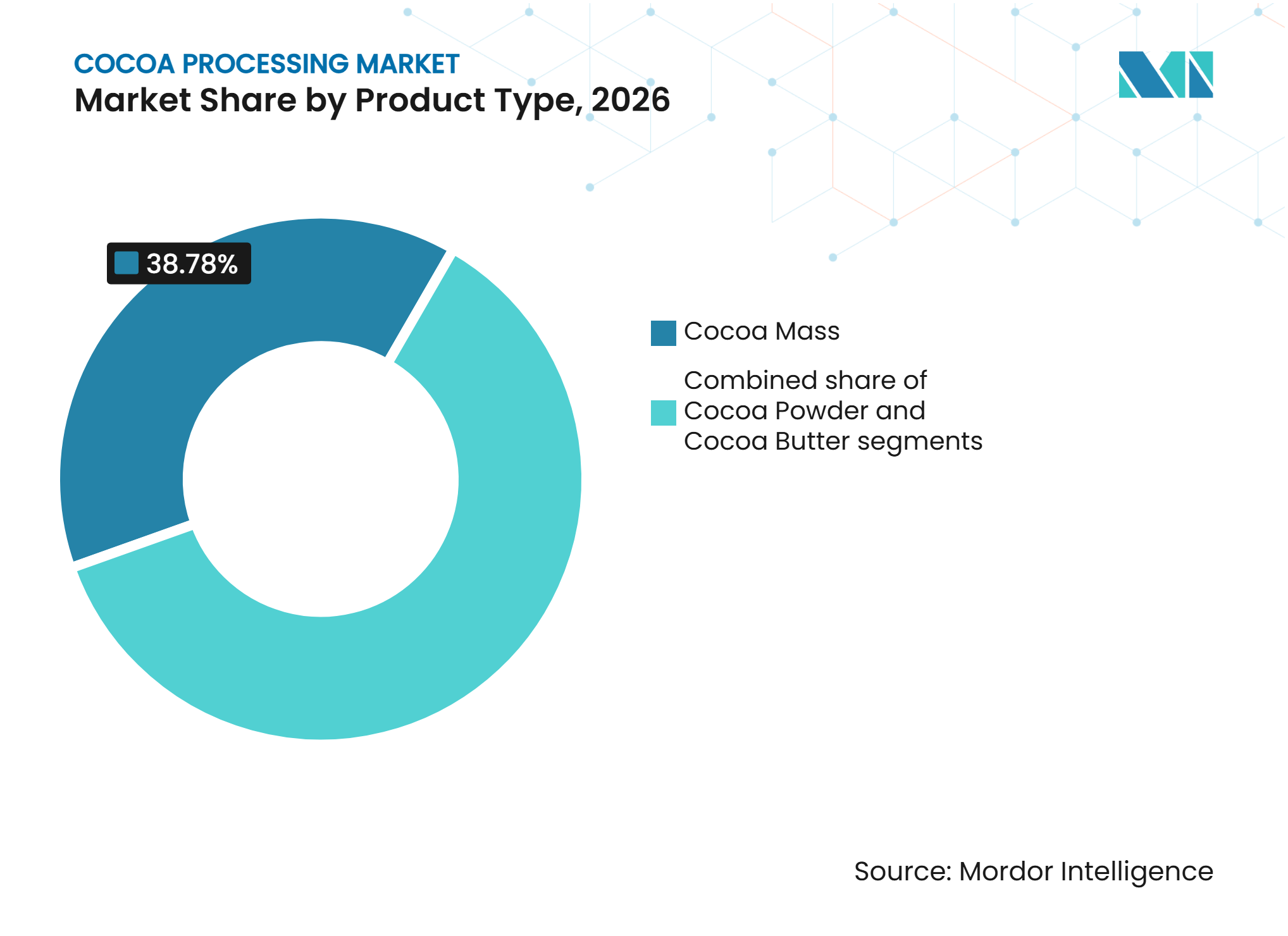
- By product type, cocoa mass held 38.78% of the cocoa processing market share in 2026, while cocoa powder is forecast to expand at a CAGR of 7.23% during 2027-2032.
- By bean type, forastero holds 72.16% of the market share in 2026, while trinitario is forecast to expand at a CAGR of 7.35% during 2027-2032.
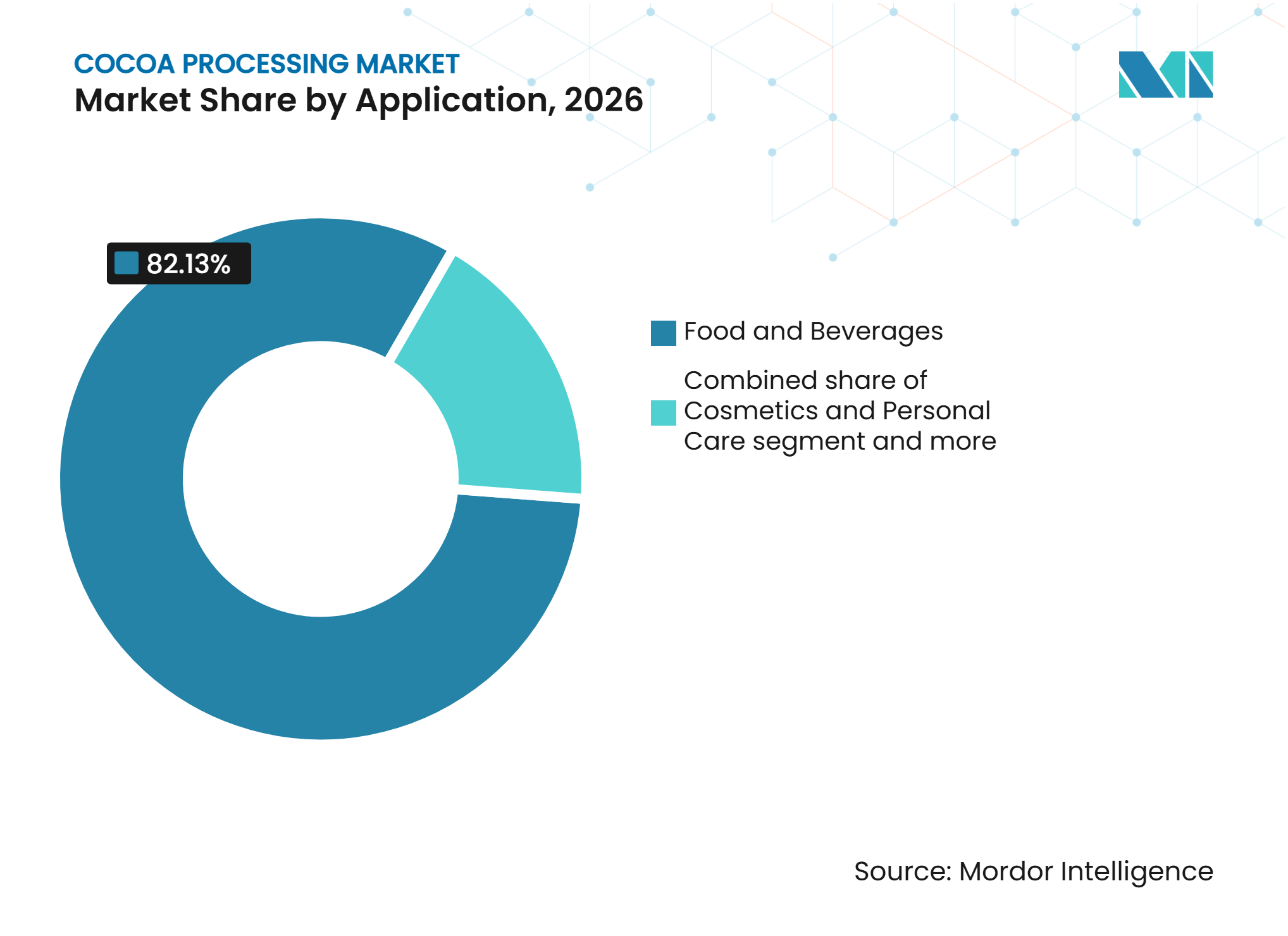
- By application, food and beverages held 82.13% of the market share in 2026, while cosmetics and personal care are forecast to expand at a CAGR of 7.51% during 2027-2032.
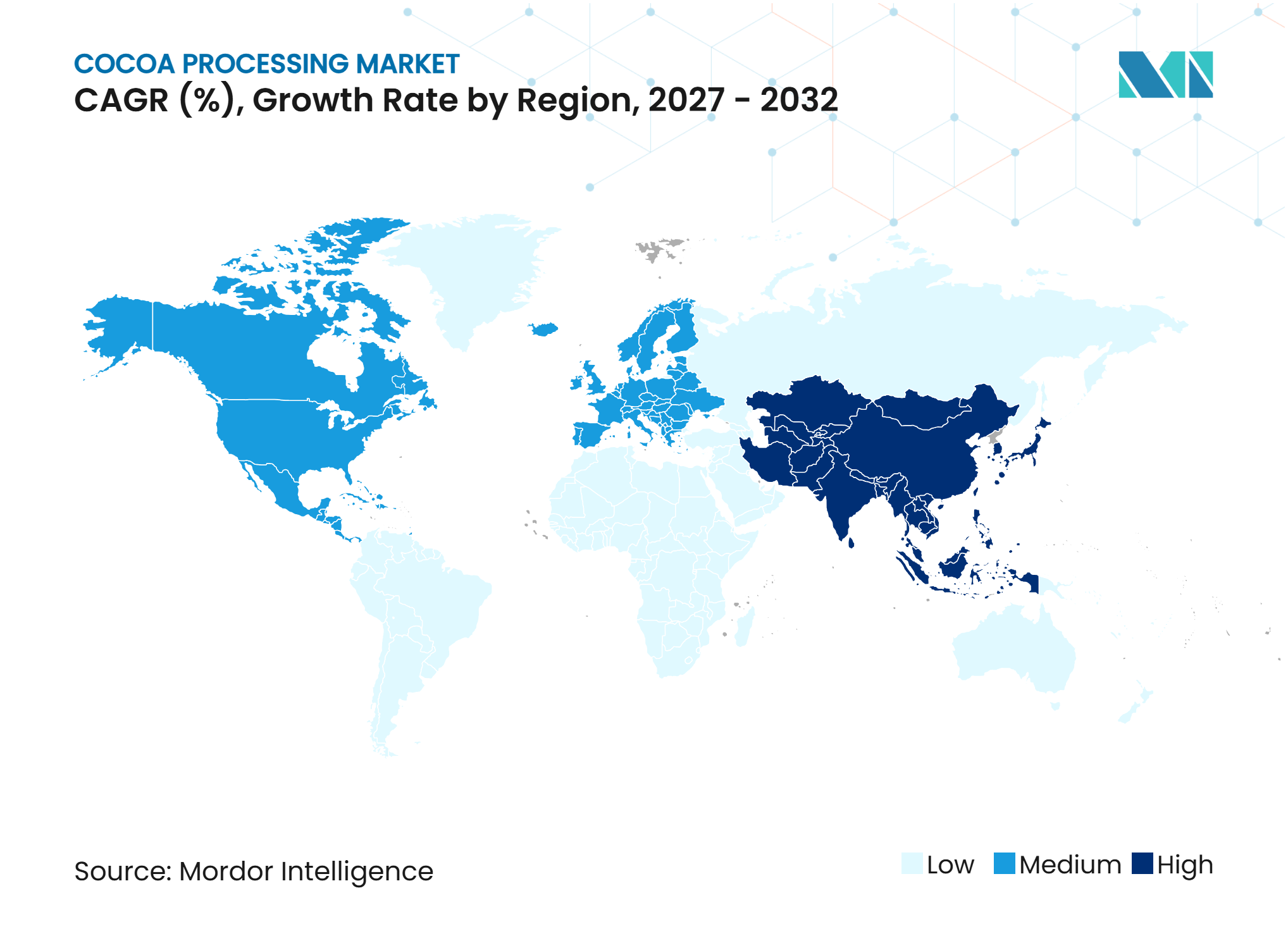
- By geography, Europe held 37.89% of the cocoa processing market share in 2026, while Asia-Pacific is forecast to be the fastest-growing region, expanding at a CAGR of 7.68% during 2027-2032.
Note: Market numbers in this report are based on Mordor Intelligence's proprietary estimation framework, which combines nine months of actuals with Q4 projections for base year 2026.
Market Trends and Insights
Drivers Impact Analysis of Cocoa Processing Market*
| Driver | (~) % Impact on CAGR Forecast | Geographic Relevance | Impact Timeline |
|---|---|---|---|
| Consumption of chocolate and chocolate-based confectionery | +2.0% | Global, with high intensity in Europe, North America, and Asia-Pacific | Long term (≥ 4 years) |
| Expansion of industrial bakery and packaged dessert manufacturing | +1.5% | Global, led by North America, Western Europe, and Southeast Asia | Medium term (2-4 years) |
| Rising demand for cocoa-based ready-to-drink beverages | +1.2% | Asia-Pacific, with spillover to North America and the Middle East and Africa | Medium term (2-4 years) |
| Expansion of cocoa butter applications in cosmetics and pharmaceuticals | +0.8% | Global, with faster adoption in Asia-Pacific and Western Europe | Long term (≥ 4 years) |
| Investment in domestic cocoa processing infrastructure | +0.9% | West Africa, with spillover to Southeast Asia | Medium term (2-4 years) |
| Demand for traceable and certified cocoa ingredients | +0.6% | Europe and North America | Medium term (2-4 years) |
| Source: Mordor Intelligence | |||
Consumption of Chocolate and Chocolate-Based Confectionery
Rising consumption of chocolate and chocolate-based confectionery products supports demand for processed cocoa ingredients, particularly cocoa mass, cocoa butter, and cocoa powder. Manufacturers use these ingredients to produce chocolate bars, pralines, filled chocolates, and confectionery coatings. According to the Australian Bureau of Statistics (ABS), chocolate consumption in Australia reached 16.4 grams per capita per day in 2024-25, an increase of 4.5%[1]. Chocolate also accounted for 10.8% of discretionary dietary energy available in 2024-25. The continued prominence of chocolate in consumer diets supports demand for processed cocoa ingredients among confectionery manufacturers.
Expansion of Industrial Bakery and Packaged Dessert Manufacturing
The expansion of industrial bakery and packaged dessert manufacturing drives demand for processed cocoa ingredients, particularly cocoa powder, cocoa mass, and cocoa butter. Manufacturers widely use these ingredients in cakes, cookies, brownies, pastries, chocolate fillings, and dessert coatings. Rising production of standardized packaged bakery products requires consistent cocoa ingredients to maintain flavor, color, and product quality across large-scale manufacturing operations. According to the Ministry of Food Processing Industries (MoFPI), Government of India, its April 2025 bakery sector profile identified biscuits, bread, cakes, pastries, and cookies as key components of the country’s food processing industry[2]. This industrial expansion increases commercial bakeries' and packaged dessert manufacturers' procurement of processed cocoa ingredients.
Rising Demand for Cocoa-Based Ready-to-Drink Beverages
Ready-to-drink cocoa beverages provide an additional outlet for cocoa powder. Their cocoa content is lower than that of dark chocolate, allowing beverage launches to increase demand without requiring the same level of raw cocoa bean input. Foodservice chains across Asia-Pacific and North America have expanded their iced cocoa beverage menus, increasing institutional demand for cocoa powder. Manufacturers in Asia-Pacific increasingly use Dutch-processed cocoa powder in instant beverages because it delivers a darker color and smoother taste profile. This product preference can reduce exposure to the higher price sensitivity observed in certain confectionery categories. Consequently, the cocoa processing market can address consumer demand through a broader customer mix across beverage, bakery, and confectionery applications.
Demand for Traceable and Certified Cocoa Ingredients
Rising demand for traceable and certified cocoa ingredients is prompting cocoa processors to strengthen sourcing transparency, supplier verification, and supply chain monitoring practices. Chocolate and food manufacturers increasingly prioritize cocoa mass, cocoa butter, and cocoa powder sourced through documented, responsible supply chains to meet regulatory requirements and sustainability commitments. In December 2025, the European Commission announced amendments to the European Union Deforestation Regulation (EUDR), while retaining cocoa and its derived products within the regulation’s scope[3]. The requirements emphasize traceability to production plots and due diligence to demonstrate deforestation-free sourcing. Consequently, cocoa processors supplying European markets will need to strengthen sourcing documentation, origin verification, and supply chain traceability systems, supporting demand for responsibly sourced cocoa ingredients.
Restraints Impact Analysis of Cocoa Processing Market*
| Restraint | (~) % Impact on CAGR Forecast | Geographic Relevance | Impact Timeline |
|---|---|---|---|
| Volatility in international cocoa bean prices | -1.5% | Global, with acute impact on European and Asian grinders | Short term (≤ 2 years) |
| Climate change and cocoa crop vulnerability | -1.0% | West Africa, with spillover to Indonesia | Long term (≥ 4 years) |
| Limited availability of skilled labor and technical expertise | -0.4% | Sub-Saharan Africa and Southeast Asia | Medium term (2-4 years) |
| Stringent food safety and quality compliance requirements | -0.3% | Europe and North America | Medium term (2-4 years) |
| Source: Mordor Intelligence | |||
Volatility in International Cocoa Bean Prices
Cocoa bean price volatility directly constrains processor margins and procurement decisions. Fluctuations in raw cocoa prices hinder processors’ ability to establish stable procurement budgets and maintain predictable production costs. In the cocoa processing market, processors must carefully balance forward purchases, inventory levels, and customer pricing when futures prices diverge from physical market conditions. This uncertainty increases working capital requirements and may delay production decisions for companies with limited risk management capabilities. Additionally, frequent price fluctuations heighten financial exposure related to inventory valuation, hedging activities, and procurement commitments, making it difficult for processors to maintain consistent operating margins and secure long-term supply agreements.
Climate Change and Cocoa Crop Vulnerability
Climate change and increasing weather variability pose significant challenges to cocoa production, creating uncertainty in raw material availability for cocoa processors. Cocoa cultivation is highly sensitive to temperature fluctuations, irregular rainfall, prolonged droughts, and excessive humidity, all of which can adversely affect flowering, pod development, and bean quality. Unfavorable climatic conditions can reduce crop yields, disrupt harvesting cycles, and increase pest and disease incidence across major cocoa-producing regions. These disruptions undermine the consistency of cocoa bean supplies and create procurement challenges for processing companies that rely on continuous raw material availability. In addition, variations in bean quality may require additional sorting, quality control measures, and processing adjustments, thereby increasing operational costs and complicating production planning for cocoa processors.
*Our forecasts treat driver/restraint impacts as directional, not additive. The impact forecasts reflect baseline growth, mix effects, and variable interactions.
Cocoa Processing Market Segment Analysis
By Product Type:
Cocoa Mass Holds the Largest Position While Cocoa Powder Gains UsesCocoa mass accounted for a 38.78% share in 2026. It remains a key intermediate product because it contains both cocoa fat and non-fat solids before separation into cocoa butter and cocoa cake. This role directly links cocoa mass to the production of standard and premium chocolate. Large chocolate manufacturers require a reliable supply of cocoa mass, as it serves as an upstream input for several finished cocoa ingredients. Cocoa powder is projected to grow at a CAGR of 7.23% through 2032, driven by demand from ready-to-drink beverages, bakery fillings, and nutritional products. This demand requires flexible production planning across cocoa mass, butter, and powder.
Cocoa butter is expanding beyond confectionery applications into personal care and pharmaceutical formulations. Cocoa processors can improve value capture by managing the cocoa butter and powder split according to demand from food and non-food customers. Its functional properties, including moisturizing characteristics and compatibility with topical formulations, make cocoa butter a valuable ingredient in skincare products, lip balms, and pharmaceutical preparations. Additionally, processors serving multiple end-use industries can diversify their customer base, reduce dependence on conventional chocolate manufacturing, and optimize the commercial utilization of cocoa-derived ingredients.



By Bean Type:
Forastero Supports Scale While Trinitario Supports Premium ProductsForastero accounted for a 72.16% share in 2026, supported by its high yield, resilience, and suitability for large-scale grinding. Its position is closely linked to West Africa, where the cocoa processing market depends on a substantial share of global bulk cocoa production. This concentration means that weather-related disruptions or supply issues in the region can affect a significant portion of processors’ input availability. Forastero remains essential for producing standardized, high-volume cocoa ingredients used in mainstream confectionery. Its relatively consistent supply characteristics also make it suitable for large-scale cocoa butter and cocoa powder production, supporting procurement by major industrial chocolate manufacturers.
Trinitario is projected to grow at a 7.35% CAGR through 2032, as fine-flavor chocolate manufacturers seek greater flavor complexity, creating distinct requirements for commodity-grade and specialty-grade beans. Vietnam’s Trinitario cocoa has attracted interest from chocolate brands seeking to process rare-flavor beans locally for high-end exports. Specialty processors can leverage price differentials to reduce their reliance on the bulk cocoa market. However, they require reliable post-harvest handling and traceable sourcing to maintain product quality. The cocoa processing industry can address premium demand by establishing direct relationships with farmers and origin-based suppliers. This also creates opportunities for processors to develop origin-specific cocoa mass and premium chocolate ingredients that command higher commercial value in specialty confectionery markets.
By Application:
Food and Beverages Remain the Largest While Personal Care ExpandsFood and beverages accounted for 82.13% of the cocoa processing market in 2026. Chocolate confectionery, bakery products, desserts, beverages, and dairy products generate most of the demand for cocoa ingredients within this application group. The segment offers processors a broad base of recurring customers, while ready-to-drink cocoa beverages represent a growth opportunity with lower raw material intensity. Bakery applications also require cocoa powder with consistent color, flavor, and processing performance. These applications enable processors to supply cocoa ingredients across a wide range of food formats.
The cosmetics and personal care segment is expected to grow at a CAGR of 7.51% through 2032. Cocoa butter’s hydrating and antioxidant properties support its use in facial and body care formulations. Its melting behavior at body temperature also makes it suitable for certain pharmaceutical delivery formats. In addition, nutraceuticals and cocoa-flavored nutritional products create additional opportunities for demand. This application mix provides processors with additional channels for cocoa butter and powder sales when confectionery demand weakens. The cocoa processing market becomes more resilient when companies serve food, beauty, and health-related customers while maintaining food safety controls.

Geography Analysis
Europe
Europe accounted for 37.89% of the market in 2026, supported by its industrial chocolate manufacturers, cocoa grinding plants, and established trade infrastructure. Amsterdam and the Zaanstreek remain critical links between global cocoa trade and the European cocoa processing market. The European Union Deforestation Regulation introduces compliance requirements that favor processors with plot-level sourcing data and established supply chain traceability systems. Furthermore, the presence of major cocoa processors, well-established ingredient distribution networks, and a strong downstream confectionery manufacturing base reinforces the region’s position as a leading center for cocoa processing and consumption.
Asia-Pacific
Asia-Pacific is projected to grow at a CAGR of 7.68% through 2032. The cocoa processing market in Asia-Pacific depends on import logistics, plant utilization, and proximity to growing demand in confectionery and personal care. Expanding chocolate manufacturing activities, rising consumption of cocoa-based beverages, and wider use of cocoa ingredients in bakery and dairy products are creating additional procurement opportunities for regional processors. Furthermore, investments in cocoa grinding facilities, particularly in major processing hubs such as Indonesia and Malaysia, are strengthening regional processing capabilities and improving access to cocoa-derived ingredients for domestic and international manufacturers.
North America, South America, and the Middle East and Africa
North America remains a significant center of cocoa processing and consumption, supported by established chocolate manufacturers, food processing companies, and demand for cocoa-based confectionery, bakery, and beverage products. South America is gaining importance as buyers increasingly seek origin-linked cocoa ingredients. Investments in processing, traceability, and infrastructure will determine which origin markets retain a larger share of cocoa value. Furthermore, improvements in local grinding capacity, logistics networks, and direct sourcing arrangements can strengthen regional supply chains, reduce reliance on imported processed cocoa ingredients, and create value-addition opportunities within cocoa-producing countries.
Competitive Landscape
Market Concentration
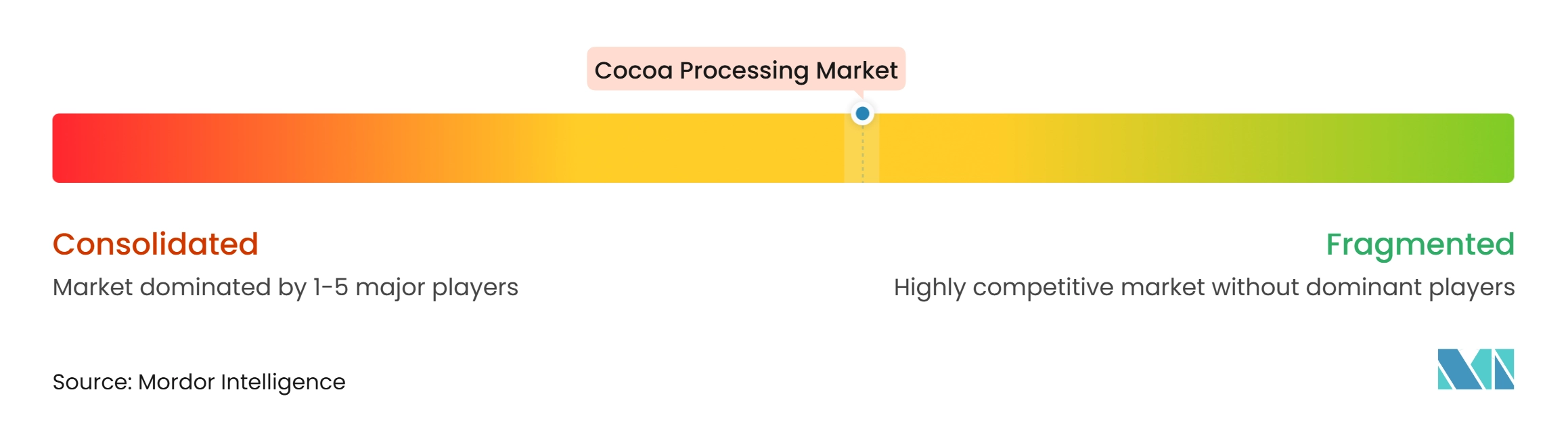
The cocoa processing market is moderately fragmented, with multinational grinders operating alongside mid-tier and origin-country processors. Barry Callebaut, Cargill, and Olam operate extensive industrial grinding networks. These companies maintain broad cocoa sourcing networks, processing facilities, and relationships with chocolate and food manufacturers across major markets. Their competitive positioning is supported by capabilities in cocoa grinding, ingredient manufacturing, product customization, and large-scale supply operations. Established procurement networks and long-term customer relationships also provide these players with advantages in maintaining consistent ingredient supplies.
Regional processors and specialized cocoa ingredient manufacturers, including Guan Chong Berhad, JB Foods Limited, Blommer Chocolate Company, Touton S.A., and Sucden, also influence the competitive landscape. These companies compete based on processing capacity, geographic sourcing advantages, product quality, and the supply of cocoa mass, cocoa butter, and cocoa powder to industrial customers. Investments in manufacturing infrastructure, sourcing diversification, and operational efficiency enable regional players to strengthen their positions against larger multinational processors.
Market participants increasingly focus on sustainable cocoa sourcing, supply chain traceability, processing efficiency, and customized ingredient solutions to strengthen their competitive positions. Companies also prioritize investments in manufacturing facilities, quality control systems, and responsible procurement practices to address evolving customer requirements and regulatory expectations. The ability to manage cocoa bean procurement costs, maintain consistent product specifications, and build long-term relationships with downstream manufacturers remains central to competitive success in the cocoa processing market.
Cocoa Processing Industry Leaders
-
Barry Callebaut AG
-
Cargill, Incorporated
-
Olam Group Limited
-
Guan Chong Berhad
-
ECOM Agroindustrial Corp. Limited
- *Disclaimer: Major Players sorted in no particular order
Cocoa Processing Market Companies Covered in this Report
- Barry Callebaut AG
- Cargill, Incorporated
- Olam Group Limited
- Guan Chong Berhad
- ECOM Agroindustrial Corp. Limited
- JB Foods Limited
- Fuji Oil Holdings Inc.
- Natra S.A.
- United Cocoa Processor, Inc.
- Blommer Chocolate Company
- Touton S.A.
- Indcresa S.A.
- Ecuakao Group Ltd.
- Puratos Group
- Sucden
- Cémoi Group
- Sucres et Denrées S.A.
- Mondelez International, Inc.
- Altinmarka
- Mars, Incorporated
Recent Industry Developments in Cocoa Processing Market
- August 2026: Guan Chong Fully Commissioned Phase 2 of Its Ivory Coast Expansion. Guan Chong expanded the second phase of its Ivory Coast expansion, increased its total cocoa grinding capacity to 395,000 metric tons per year.and
- March 2026: OFI launched three single-origin cocoa liquor products under its deZaan brand, sourced from Papua New Guinea, Uganda, and the Dominican Republic. The products featured customized roasting profiles and origin-specific flavor characteristics, targeting premium chocolate manufacturers seeking differentiated cocoa ingredients.
- December 2025: The International Finance Corporation (IFC) disclosed a proposed financing package for Guan Chong Berhad's cocoa processing operations in San Pedro, Côte d'Ivoire.
Global Cocoa Processing Market Report Scope
Cocoa processing refers to the conversion of harvested cocoa beans into commercially usable ingredients.
The cocoa processing market is segmented by product type, bean type, and application. By product type, the market is segmented into cocoa mass, cocoa powder, and cocoa butter. By bean type, the market is segmented into forastero, criollo, trinitario, and other types. By application, the market is segmented into food and beverages (chocolate and confectionery, bakery and desserts, beverages, dairy products, and other food and beverage applications), cosmetics and personal care, pharmaceuticals, and other applications. By geography, the market is segmented into North America, Europe, Asia-Pacific, South America, and the Middle East and Africa. The market forecasts are provided in terms of value (USD).
Segmentation Overview
| Cocoa Mass |
| Cocoa Powder |
| Cocoa Butter |
| Forastero |
| Criollo |
| Trinitario |
| Other Types |
| Food and Beverages | Chocolate and Confectionery |
| Bakery and Desserts | |
| Beverages | |
| Dairy Products | |
| Other Food and Beverages Applications | |
| Cosmetics and Personal Care | |
| Pharmaceuticals | |
| Other Applications |
| North America | United States |
| Canada | |
| Mexico | |
| Rest of North America | |
| Europe | Germany |
| United Kingdom | |
| Italy | |
| France | |
| Spain | |
| Poland | |
| Netherlands | |
| Rest of Europe | |
| Asia-Pacific | China |
| India | |
| Japan | |
| Australia | |
| Thailand | |
| Indonesia | |
| Rest of Asia-Pacific | |
| South America | Brazil |
| Argentina | |
| Chile | |
| Peru | |
| Rest of South America | |
| Middle East and Africa | South Africa |
| United Arab Emirates | |
| Saudi Arabia | |
| Turkey | |
| Egypt | |
| Rest of Middle East and Africa |
| By Product Type | Cocoa Mass | |
| Cocoa Powder | ||
| Cocoa Butter | ||
| By Bean Type | Forastero | |
| Criollo | ||
| Trinitario | ||
| Other Types | ||
| By Application | Food and Beverages | Chocolate and Confectionery |
| Bakery and Desserts | ||
| Beverages | ||
| Dairy Products | ||
| Other Food and Beverages Applications | ||
| Cosmetics and Personal Care | ||
| Pharmaceuticals | ||
| Other Applications | ||
| By Geography | North America | United States |
| Canada | ||
| Mexico | ||
| Rest of North America | ||
| Europe | Germany | |
| United Kingdom | ||
| Italy | ||
| France | ||
| Spain | ||
| Poland | ||
| Netherlands | ||
| Rest of Europe | ||
| Asia-Pacific | China | |
| India | ||
| Japan | ||
| Australia | ||
| Thailand | ||
| Indonesia | ||
| Rest of Asia-Pacific | ||
| South America | Brazil | |
| Argentina | ||
| Chile | ||
| Peru | ||
| Rest of South America | ||
| Middle East and Africa | South Africa | |
| United Arab Emirates | ||
| Saudi Arabia | ||
| Turkey | ||
| Egypt | ||
| Rest of Middle East and Africa | ||
Key Questions Answered in the Report
What is the current size and future growth outlook of the cocoa processing market?
The cocoa processing market was valued at USD 15.34 billion in 2026 and is estimated to reach USD 16.23 billion in 2027. The market is projected to grow to USD 21.86 billion by 2032, registering a CAGR of 6.14% during 2027-2032.
Which product type held the largest share of the cocoa processing market in 2026?
Cocoa mass was the largest product type segment in 2026, accounting for 38.78% of the cocoa processing market.
Which cocoa bean type dominated the cocoa processing market in 2026?
Forastero was the dominant bean type in 2026, accounting for 72.16% of the cocoa processing market.
Which application segment held the largest share of the cocoa processing market in 2026?
Food and beverages dominated the application segment in 2026, accounting for 82.13% of the cocoa processing market.
Which region dominated the cocoa processing market in 2026?
Europe held the largest regional share in 2026, accounting for 37.89% of the cocoa processing market.