
Cloud Manufacturing Market Size and Share
Market Overview
| Study Period | 2020 - 2031 |
|---|---|
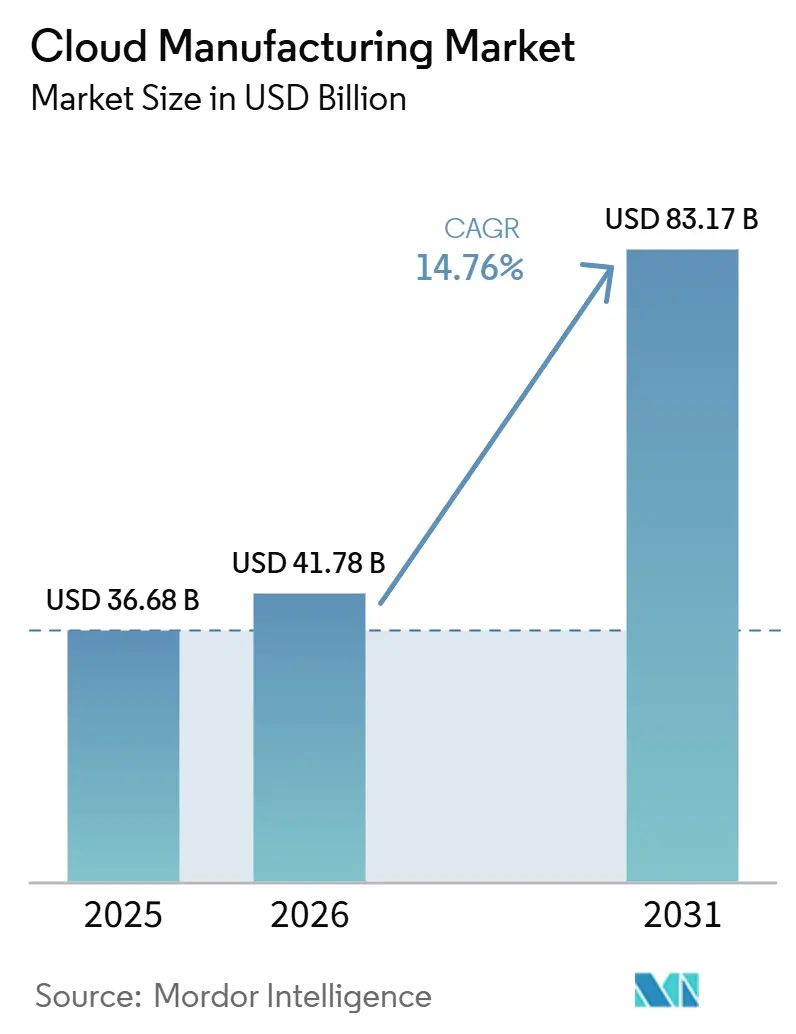
| Market Size (2026) | USD 41.78 Billion |
| Market Size (2031) | USD 83.17 Billion |
| Growth Rate (2026 - 2031) | 14.76% CAGR |
| Fastest Growing Market | Asia-Pacific |
| Largest Market | North America |
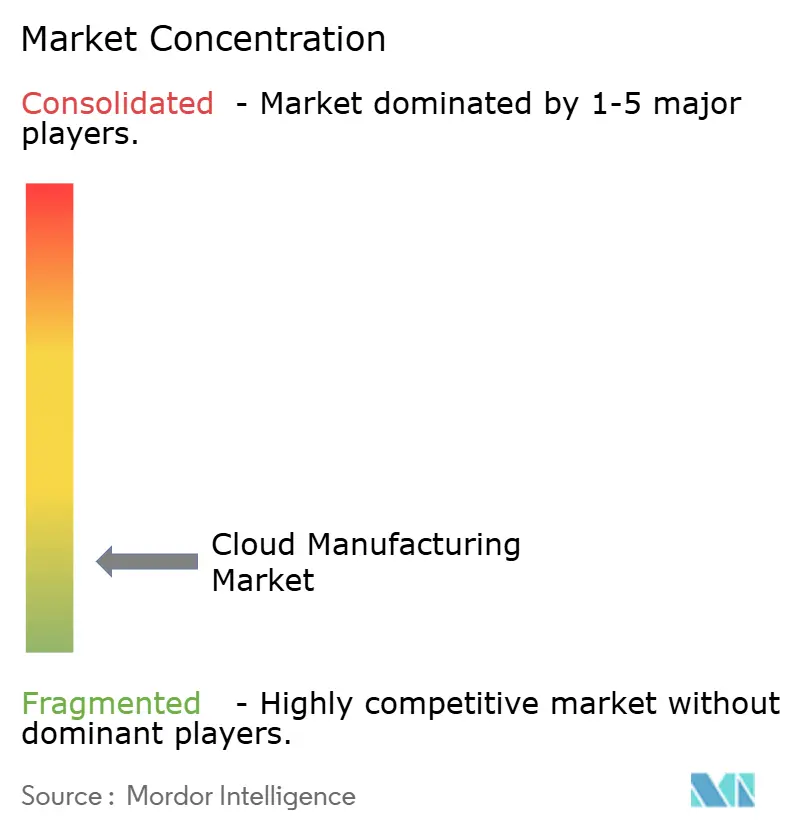
| Market Concentration | Low |
Major Players *Disclaimer: Major Players sorted in no particular order Image © Mordor Intelligence. Reuse requires attribution under CC BY 4.0. | |
Cloud Manufacturing Market Analysis by Mordor Intelligence
The cloud manufacturing market size stood at USD 36.68 billion in 2025 and is forecast to reach USD 83.17 billion by 2031, at a CAGR of 14.76% from 2026 to 2031. Growth is being shaped by a broad shift in manufacturing operations from plant-level, on-premise systems to cloud-hosted environments that can support production planning, quality control, and engineering collaboration across multiple sites. The financial case has also strengthened because subscription-led deployment reduces the cost of adding new plants compared with maintaining separate hardware and software stacks at each location. Demand is moving beyond basic digitization and toward connected operating models where analytics, AI tools, and traceability functions sit on the same data foundation. Regulation is widening the role of the cloud manufacturing market because sovereign cloud rules and digital product passport requirements are pushing manufacturers to keep production and lifecycle data accessible, structured, and compliant. At the same time, cyber risk and complex integration between legacy operational systems and modern enterprise platforms are raising the value of vendors that can combine software depth with implementation, security, and managed support.
Key Report Takeaways
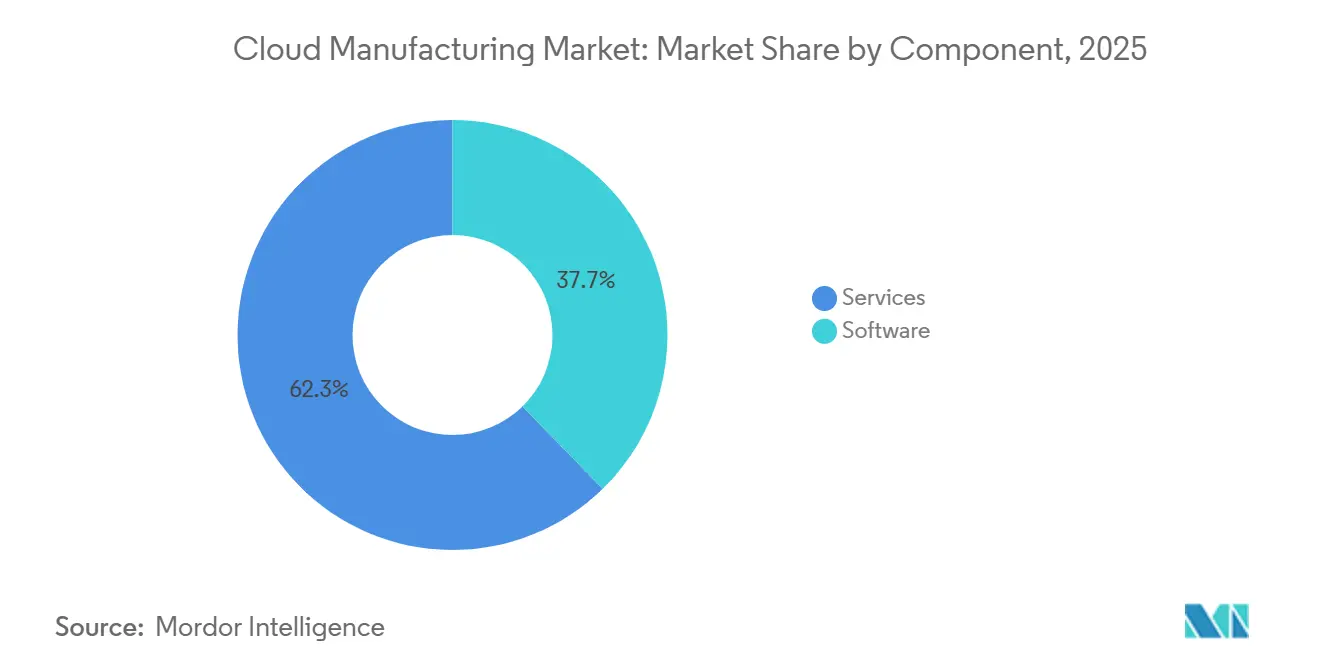
- By component, software held 37.68% of the cloud manufacturing market in 2025, while services are projected to expand at a 16.62% CAGR through 2031.
- By deployment model, public cloud accounted for 41.99% of the cloud manufacturing market in 2025, while hybrid cloud is projected to grow at a 17.34% CAGR through 2031.
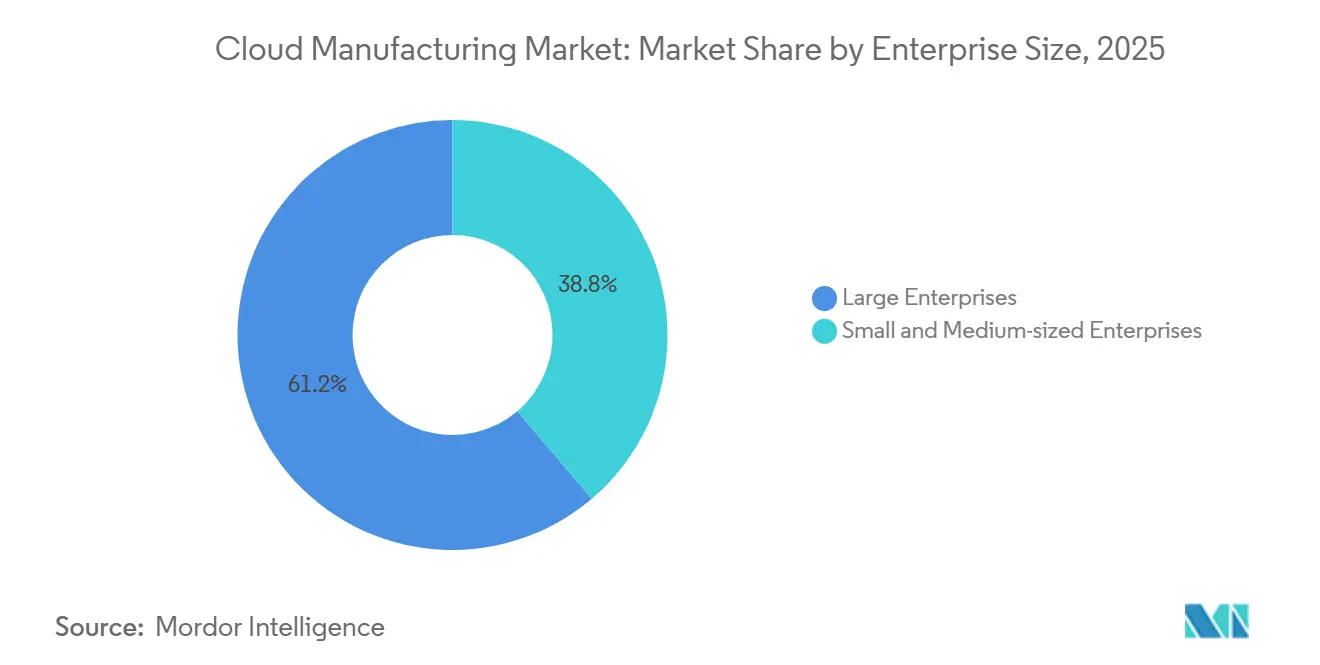
- By enterprise size, large enterprises held 61.22% of the cloud manufacturing market in 2025, while SMEs are projected to expand at a 16.56% CAGR through 2031.
- By end-user industry, automotive accounted for 27.78% of the cloud manufacturing market in 2025, while electronics and semiconductor is projected to advance at a 17.66% CAGR through 2031.
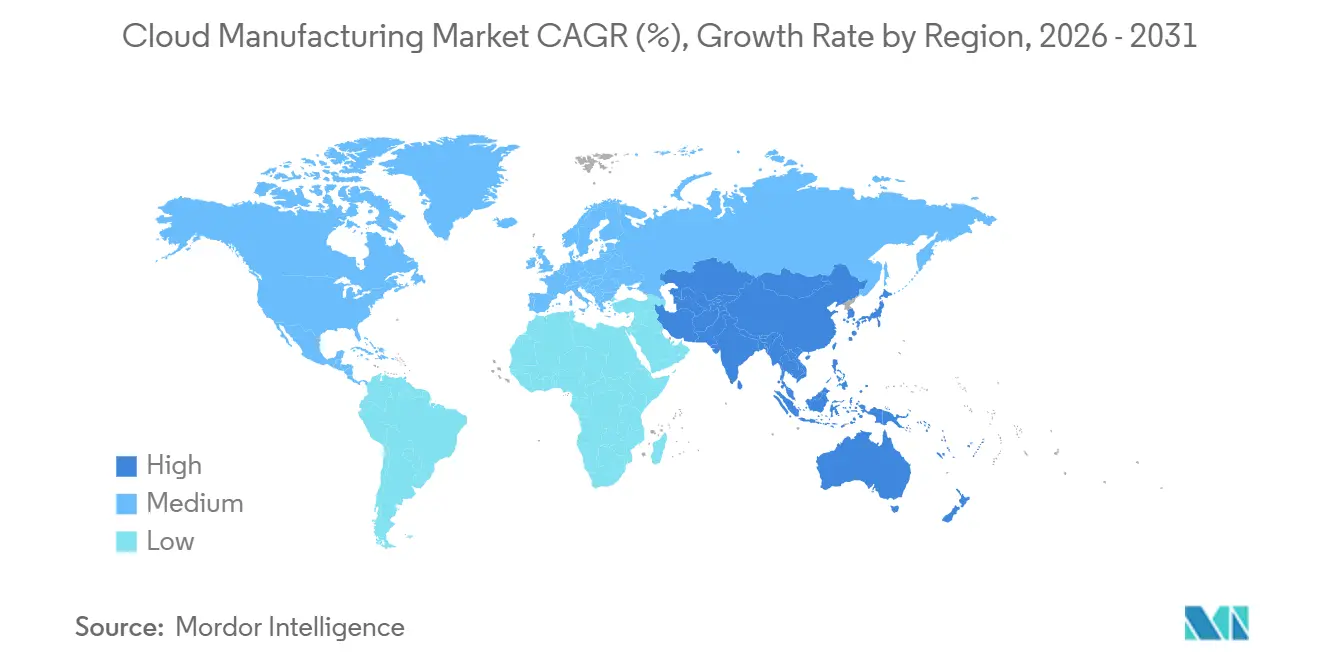
- By geography, North America held 35.77% of the cloud manufacturing market in 2025, while Asia-Pacific is projected to grow at a 16.28% CAGR through 2031.
Note: Market size and forecast figures in this report are generated using Mordor Intelligence’s proprietary estimation framework, updated with the latest available data and insights as of January 2026.
Global Cloud Manufacturing Market Trends and Insights
Drivers Impact Analysis*
| Driver | (~) % Impact on CAGR Forecast | Geographic Relevance | Impact Timeline |
|---|---|---|---|
| Smart Factory and Industry 4.0 Modernization | +4.2% | Global, with concentrated effect in North America, Europe, Germany, UK, and APAC core markets | Short term (≤ 2 years) |
| Industrial IoT Data Proliferation and Need for Scalable Analytics | +3.1% | Global, strongest in APAC and North America, spill-over to Middle East and Africa | Medium term (2-4 years) |
| Multi-Site Supply Chain Visibility and Production Orchestration Needs | +2.5% | Global, especially automotive and aerospace clusters in North America, Europe, and China | Short term (≤ 2 years) |
| Small and Medium-Sized Enterprise Adoption Through Lower Upfront SaaS Costs | +1.9% | APAC core, Europe, Germany, Italy SME belts, and North America | Medium term (2-4 years) |
| Sovereign and Edge-Cloud Architectures Expanding Cloud Use in Regulated Plants | +1.5% | Europe, EU bloc, North America, spill-over to Japan and South Korea | Medium term (2-4 years) |
| Product Passport and Carbon Traceability Demands Strengthening Digital Thread Adoption | +1.2% | EU primary, global export-market spill-over across chemicals, materials, and electronics | Long term (≥ 4 years) |
| Source: Mordor Intelligence | |||
Smart Factory And Industry 4.0 Modernization
Smart factory programs are creating one of the clearest demand foundations for the cloud manufacturing market because edge data collection alone does not solve planning, quality, or coordination gaps across plants. Deloitte reported in 2025 that 88% of U.S. manufacturers expected smart manufacturing investment to continue or increase over the following 2 years, with advanced production scheduling and quality management ranking among the main upgrade priorities. Bitkom found in September 2025 that 71% of German industrial companies already used concrete Industry 4.0 applications, while 96% viewed the technology as essential for international competitiveness, and 80% maintained or increased spending plans through 2025.[1]Bitkom, “Industrie 4.0 Bitkom-Studie 2025,” Bitkom, bitkom.org Once manufacturers embed production data models, quality schemas, and supplier workflows into a cloud-native platform, the cost of reversing that decision becomes high, which strengthens long-term retention in the cloud manufacturing market. Japan also reinforced this direction when NEDO updated its Smart Manufacturing Construction Guidelines in May 2025 and again in February 2026 to help manufacturers choose cloud-based digital solutions for operational transformation.[2]NEDO, “Smart Manufacturing Construction Guidelines, 2nd Edition,” NEDO, nedo.go.jp
Industrial IoT Data Proliferation And Need For Scalable Analytics
The cloud manufacturing market is also gaining from the rapid increase in connected industrial assets, because growing device volumes create data loads that are difficult to process economically in isolated plant systems. KPMG stated in March 2025 that IoT-connected devices were projected to reach 22.4 million units in 2026, up from 18 million in 2024, which reflects a sustained rise in machine connectivity and data generation. China’s MIIT reported that key industrial internet platforms had connected more than 89 million devices and equipment sets by the end of 2025, and its January 2026 action plan targeted more than 120 million connected industrial devices by 2028.[3]Ministry of Industry and Information Technology, “Industrial Internet Action Plan and Related Releases,” MIIT, miit.gov.cn That scale increases the need for shared data models, contextual analytics, and centralized processing, because raw machine signals without structure raise storage costs and slow decision cycles in the cloud manufacturing market Japan added in June 2025 that system integrators and cloud platform vendors accounted for more than 60% of factory operations partnerships across 26 major manufacturing economies, showing that data contextualization has become as important as data collection itself.
Multi-Site Supply Chain Visibility And Production Orchestration Needs
Multi-plant manufacturers are adopting the cloud manufacturing market model to coordinate production, logistics, and quality management across networks that are harder to manage through site-by-site software stacks. Volkswagen Group renewed its AWS factory cloud partnership for 5 years in August 2025, and its Digital Production Platform connected 43 of 114 production facilities, hosted more than 1,200 AI applications, and generated savings in the double-digit million-euro range through standardized IT rollouts and AI-supported quality control.[4]Volkswagen Group, “More Efficient, Smarter, More Resilient, Volkswagen Group Collaborates with AWS to Help Transform Production for the Age of AI,” Volkswagen Group, volkswagen-group.com Oracle and Microsoft also announced in October 2025 that Oracle Fusion Cloud Supply Chain and Manufacturing would connect with Microsoft Azure IoT Operations and Microsoft Fabric to deliver real-time intelligence between factory equipment and enterprise workflows. These moves show that manufacturers are no longer deploying cloud platforms only for internal efficiency, because many now need standardized digital interfaces for broader supplier and production ecosystems. As a result, vendors that can connect shop-floor systems with planning, logistics, and cross-enterprise data flows are improving their position in the cloud manufacturing market.
Small And Medium-Sized Enterprise Adoption Through Lower Upfront SaaS Costs
SME demand is widening the cloud manufacturing market because subscription pricing, shorter deployment cycles, and reduced internal infrastructure needs are lowering the barriers that once kept smaller plants on paper-based or desktop tools. A peer-reviewed study published in February 2026 showed that a multi-tenant, microservices-based cloud MES deployed on Microsoft Azure helped SMEs access OEE trends and downtime analytics with limited upfront capital spending compared with traditional on-premise systems. In Japan, Smart Craft raised cumulative funding of JPY 400 million (USD 2.7 million) in February 2026 to expand cloud MES adoption among SMEs still using paper-based and spreadsheet-led production management. T-Systems also noted in February 2026 that many manufacturing AI projects had remained stuck in pilot stages because compliant cloud environments were missing, which supports the case for turnkey solutions aimed at smaller industrial companies with limited internal digital capabilities. This is expanding the addressable base of the cloud manufacturing market beyond large enterprises and toward manufacturers that need ready-made tools, managed support, and faster time to value.
Restraints Impact Analysis*
| Restraint | (~) % Impact on CAGR Forecast | Geographic Relevance | Impact Timeline |
|---|---|---|---|
| Cybersecurity and Industrial Data Privacy Risks | -3.1% | Global, amplified in North America and Europe where breach reporting obligations and OT security frameworks, IEC 62443 and NIST SP 800-82, are enforced | Short term (≤ 2 years) |
| Legacy OT-IT Integration Complexity | -2.3% | Global, particularly acute in mature industrial markets with aging OT infrastructure, Germany, Japan, South Korea, and U.S. Midwest manufacturing belts | Medium term (2-4 years) |
| Data Sovereignty Rules Fragmenting Cross-Border Cloud Manufacturing Rollouts | -1.6% | Europe, GDPR, NIS2, and DORA, China, MLPS and Data Security Law, and emerging regulatory clusters in India and the Gulf | Medium term (2-4 years) |
| AI Workload Cost Inflation And Poor Data Pipeline Governance Eroding ROI | -1.1% | Global, disproportionate in large-enterprise deployments with fragmented OT data architectures | Short term (≤ 2 years) |
| Source: Mordor Intelligence | |||
Cybersecurity and Industrial Data Privacy Risks
Cybersecurity remains the main structural drag on the cloud manufacturing market because OT-linked incidents can interrupt production as well as compromise data. Verizon reported in 2025 that ransomware appeared in 47% of manufacturing breaches reviewed, while stolen credentials accounted for 34% of attack vectors, and espionage rose sharply as a breach motive in the sector. Google Cloud’s Office of the CISO stated in July 2025 that manufacturing is among the sectors most targeted by state-sponsored advanced persistent threats, and it warned that hybrid OT-cloud environments create new exposure if asset inventories and network segmentation are weak. KPMG also found in March 2025 that 77% of organizations viewed ransomware as the biggest concern in the OT environment, which helps explain why cloud migration decisions in the cloud manufacturing market often involve longer reviews and higher security spending. This does not stop adoption, but it raises the threshold for deployment and favors vendors that can combine cloud capability with industrial security controls.
Legacy OT-IT Integration Complexity
Legacy OT-IT complexity continues to slow the cloud manufacturing market because many factories still operate mixed generations of control systems, plant software, and enterprise tools that were never designed to share data easily. The input shows that data fragmentation across isolated production systems creates friction for cloud migration, especially in multi-plant environments with long equipment replacement cycles. Bitkom reported in September 2025 that 49% of German manufacturers still saw the country as a latecomer in Industry 4.0 adoption, which reflects how execution gaps persist even where digital manufacturing is widely recognized as strategic. NEDO’s updated guidelines in Japan also point to the same challenge, because they were designed to help manufacturers evaluate and structure digital transformation choices in operational environments that are not moving from a clean system base. The issue is not only technical, because IT teams often prioritize speed and central governance while OT teams prioritize stability and deterministic performance, and that mismatch can lengthen implementation cycles in the cloud manufacturing market.
*Our forecasts treat driver/restraint impacts as directional, not additive. The impact forecasts reflect baseline growth, mix effects, and variable interactions.
Segment Analysis
By Component: Services Growth Accelerates Behind Software's Installed Base
Software accounted for 37.68% of the cloud manufacturing market size in 2025, which made it the largest component by revenue. Manufacturing execution and operations management applications formed the main entry point because they replace aging plant-level MES installations and connect shop-floor activity with broader planning and compliance workflows. Cloud ERP and production planning tools are also gaining ground as manufacturers try to link financial planning cycles more directly with production execution data. SAP showed this direction in early 2026 when it launched AI-assisted production order release capabilities through Joule in SAP S/4HANA Cloud Public Edition, which brings AI deeper into routine manufacturing workflows. Product lifecycle and engineering collaboration tools, along with quality, traceability, analytics, AI, and digital twin applications, are broadening the functional role of software in the cloud manufacturing industry, especially in sectors that need stricter version control and auditability.
Services are projected to grow at a 16.62% CAGR from 2026 to 2031, making them the fastest-growing component in the cloud manufacturing market. The growth reflects how difficult it is to align cloud platforms with diverse OT estates that were built over long replacement cycles and often lack common data standards. Consulting and process redesign work usually starts the engagement because many manufacturers need operating-model decisions before they can finalize platform selection. Implementation and integration services then capture large project value, especially in multi-plant rollouts where data migration and interconnection span several legacy systems. Managed services are also gaining traction because Deloitte found in 2025 that 65-70% of U.S. manufacturers outsource roles in IT, OT, and data science due to hiring challenges, which gives vendors with service depth a stronger way to retain customers over time.


By Deployment Model: Hybrid Cloud Leads Future Demand
Public cloud held 41.99% of the cloud manufacturing market size in 2025, which kept it as the largest deployment model. Its appeal remains strongest in workloads where manufacturers want quick deployment, predictable subscription costs, and regular software updates without new internal infrastructure. That has been especially relevant for quality analytics, procurement planning, and supplier collaboration use cases where latency demands are lower than in real-time process control. Private cloud remains important in sectors such as defense, aerospace, and regulated life sciences, where data residency and intellectual property protection often outweigh the cost advantages of shared environments. These deployment choices show that the cloud manufacturing market is not moving in a single direction, because manufacturers are matching architecture to workload sensitivity rather than following a uniform migration path.
Hybrid cloud is projected to expand at a 17.34% CAGR from 2026 to 2031, making it the fastest-growing deployment model in the cloud manufacturing market. The model fits actual factory needs more closely because programmable logic controllers, SCADA, and distributed control environments still require local or private compute for low-latency operations, while analytics and AI training benefit from scalable cloud resources. Audi illustrated this model at industrial scale in January 2026 when its Edge Cloud 4 Production platform replaced more than 1,000 industrial PCs in German plants with a virtualized local cloud architecture that still fed analytics into centralized systems. A September 2025 analysis by Roland Berger and Aleph Alpha also argued that cloud-based model training combined with edge-based real-time control offered the most credible AI sovereignty setup for European manufacturers. That makes hybrid the practical middle ground for manufacturers that want cloud-level intelligence without giving up local control of production-critical environments.
By Enterprise Size: Large Enterprises Lead, SMEs Accelerating Rapidly
Large enterprises held 61.22% of the cloud manufacturing market share in 2025, which reflected their greater IT spending base, broader organizational capacity, and stronger need to standardize operations across plant networks. This group is the main buyer of complex cloud programs because multi-site production orchestration requires coordination between factories, suppliers, logistics systems, and enterprise planning tools. Volkswagen’s Digital Production Platform is a clear example, because by August 2025, it connected 43 factories across Europe, North America, and South America under a common production and AI framework. Large enterprises also generate much of the professional services revenue in the cloud manufacturing industry, since their OT estates, ERP diversity, and compliance requirements make implementations longer and broader. That gives scale vendors an advantage when they can bundle software, integration, and post-deployment support into one account relationship.
SMEs are projected to grow at a 16.56% CAGR from 2026 to 2031, which makes them the fastest-expanding enterprise segment in the cloud manufacturing market. The main shift is that cloud-native MES and related tools now give smaller manufacturers access to production visibility without the hardware and staffing burden that traditionally blocked adoption. The February 2026 AJIT-e Journal study showed that a cloud-based MES architecture could deliver downtime and performance visibility to SMEs with limited upfront spending and lower operational complexity than on-premise systems. In Japan, Smart Craft’s February 2026 funding round of JPY 400 million (USD 2.7 million) signaled investor confidence that SME manufacturers are moving away from paper-based and spreadsheet-led production management toward SaaS-led execution tools. Sovereign and compliant cloud offerings are also widening access for smaller industrial firms that need secure digital tools but do not have internal teams to build them from scratch.
By End-User Industry: Automotive Anchors Base, Electronics Driving Growth
Automotive accounted for 27.78% of the cloud manufacturing market size in 2025, which made it the largest end-user industry. The sector has adopted cloud-connected production platforms early because vehicle programs depend on synchronized design, production, supplier, and software update workflows across wide manufacturing networks. As vehicles become more software-defined, manufacturers need a digital thread that links engineering data with plant execution and post-production support. Toyota Motor North America showed this operating model when it deployed Google Cloud Vertex AI and BigQuery across 14 North American plants for predictive maintenance and real-time sensor analytics. Aerospace and defense, industrial machinery and equipment, consumer goods and food and beverage, chemicals and materials, energy and utilities, and medical devices all add breadth to the cloud manufacturing market because each brings its own mix of traceability, planning, and compliance requirements.
Electronics and semiconductor is projected to grow at a 17.66% CAGR from 2026 to 2031, which makes it the fastest-growing end-user segment in the cloud manufacturing market. Growth is tied to yield sensitivity, dense supplier networks, and short design cycles that require more continuous data exchange between design, process control, and quality systems. Cloud-based analytics, AI, and digital twin applications are becoming more relevant in this segment because they help connect tool performance data with process outcomes across highly complex fabrication and assembly steps. The European Commission’s 2025-2030 ESPR work plan identified digital product passports as a major policy direction, with electronics among the priority product categories that will require more structured lifecycle data. This means the cloud manufacturing market is serving not only efficiency goals in electronics, but also the data backbone needed for future product access and compliance.
Geography Analysis
North America held 35.77% of the cloud manufacturing market share in 2025, which kept it as the largest regional contributor. The United States led the region because large manufacturers had already built meaningful cloud adoption at the facility and network level, and Deloitte reported in 2025 that 57% of U.S. manufacturers used cloud computing in those settings. The region also benefits from a dense base of industrial software, automation, and cloud vendors that can support large-scale deployments across complex manufacturing networks. In the cloud manufacturing market, North American growth is increasingly tied to deeper platform use, including AI integration, digital twins, and managed services, rather than first-time migration alone.
Asia-Pacific is projected to expand at a 16.28% CAGR from 2026 to 2031, making it the fastest-growing regional segment in the cloud manufacturing market. China is the main volume engine because MIIT reported that key industrial internet platforms had connected more than 89 million devices by the end of 2025, and the January 2026 action plan targeted more than 120 million connected devices by 2028. That policy direction supports broader cloud adoption because scale, connectivity, and platform penetration are now being pushed through national industrial programs rather than left to isolated enterprise decisions. Japan adds a different layer of growth because NEDO updated its Smart Manufacturing Construction Guidelines in 2025 and 2026 to help manufacturers choose cloud-based solutions for operational transformation. Across Asia-Pacific, the cloud manufacturing market is therefore being shaped by both state-backed industrial policy and the operational demands of electronics, semiconductor, and export-led production systems.
Europe remained the second-largest region in the cloud manufacturing market, with Germany as the clearest center of activity. Bitkom reported in September 2025 that 71% of German industrial firms already used concrete Industry 4.0 applications, 96% saw these technologies as essential for international competitiveness, and 80% maintained or increased related spending plans through 2025. Data sovereignty is shaping demand more strongly in Europe than in many other regions, and T-Systems said in February 2026 that nearly 70% of AI manufacturing initiatives had remained in pilot stages because deployment on compliant platforms was unresolved. South America, the Middle East and Africa remain smaller in the cloud manufacturing market, but they are gradually benefiting from wider industrial digitalization programs and the expansion of cloud infrastructure footprints.

Competitive Landscape
The cloud manufacturing market remains fragmented at the application and platform layer, while infrastructure capacity is concentrated among a smaller set of major cloud providers. Competition comes from three groups, hyperscalers that provide compute and AI services, industrial automation vendors that bring cloud connectivity into plant equipment, and enterprise software vendors that extend ERP, PLM, and execution functions into cloud environments. This structure means that differentiation is moving away from basic software features and toward data models, AI capability, partner reach, and the ability to support complex rollouts across multiple plants. In the cloud manufacturing market, vendors that can bridge IT, OT, and enterprise process layers are gaining an advantage because customers increasingly want fewer integration gaps and stronger long-term support.
Recent strategic moves show how quickly the market is consolidating around broader suites and connected workflows. IFS completed its acquisition of Softeon in March 2026 to unify ERP and warehouse management capabilities under an Industrial AI-led supply chain platform. Siemens also invested USD 50 million in Xometry in May 2026, using an equity deal to embed AI-native manufacturability, pricing, sourcing, and execution intelligence into the Xcelerator ecosystem. ServiceNow strengthened AI-led quality management in February 2025 through its acquisition of Quality 360. SUSE followed a similar path in February 2026 when it acquired Losant to extend its edge stack into a broader industrial IoT offering. These transactions show that the cloud manufacturing market is rewarding vendors that can bundle analytics, execution, integration, and industrial data handling rather than compete as isolated point solutions.
White-space demand is still visible in vertical platforms and SME-focused managed offerings, especially where preconfigured data models or OT security support can shorten deployment time. Tulip gained further relevance in January 2026 when Mitsubishi Electric made a strategic equity investment, building on Tulip’s April 2025 collaboration with AWS around contextualized manufacturing data and frontline operations. Infor and AWS also announced industry-specific agentic AI agents for discrete and process manufacturing in April 2026, which showed how cloud providers and application vendors are now moving deeper into role-based industrial workflows. Vendors that remain limited to standalone quality management or document control tools face greater risk in the cloud manufacturing market, because broader platforms are absorbing those functions through acquisition and native integration.
Cloud Manufacturing Industry Leaders
Microsoft Corporation
SAP SE
Google LLC
Oracle Corporation
Alibaba Group Holding Limited
- *Disclaimer: Major Players sorted in no particular order

Recent Industry Developments
- May 2026: Siemens Aktiengesellschaft invested approximately USD 50 million in Xometry, Inc. through a stock purchase agreement, with plans to embed Xometry's AI-native manufacturability, pricing, sourcing, and execution intelligence directly into the Siemens Xcelerator software ecosystem. This creates a continuous digital thread from design decisions to delivered parts, combining Xometry's manufacturing marketplace with Siemens' design and supply chain tools.
- May 2026: Synergis Software launched Adept Cloud, a cloud-native SaaS engineering document management platform for asset-intensive industries including manufacturing, utilities, oil and gas, chemicals, and pharmaceuticals, featuring built-in AI capabilities and unlimited user pricing with no per-seat cost. The platform was recognized in G2's 2026 Best Software Awards as a Top 50 CAD and PLM Product.
- April 2026: Infor and Amazon Web Services announced industry-specific agentic AI agents built natively on AWS for discrete and process manufacturing, available through Infor Velocity Suite. Early adopter Xpress Boats reported a 98% improvement in process issue diagnosis speed and a 95% reduction in returns processing time following deployment.
- April 2026: IFS completed the acquisition of Softeon, creating IFS Softeon with unified ERP and warehouse management system capabilities powered by Industrial AI. The combined entity processes millions of orders monthly and manages warehouse operations across 30 countries for customers including Sony and UPS.


Global Cloud Manufacturing Market Report Scope
The Cloud Manufacturing Market refers to the use of cloud-based platforms, software, and services to manage and optimize manufacturing operations across the full production lifecycle. It includes solutions for production planning, execution, supply chain coordination, quality management, engineering collaboration, analytics, and digital twin deployment.
The Cloud Manufacturing Market Report is Segmented by Component (Software, and Services), Deployment Model (Public Cloud, Private Cloud, and Hybrid Cloud), Enterprise Size (Large Enterprises, and Small and Medium-Sized Enterprises), End-User Industry (Automotive, Aerospace and Defense, Electronics and Semiconductor, Industrial Machinery and Equipment, Medical Devices and Life Sciences, Consumer Goods and Food and Beverage, Chemicals and Materials, and Energy and Utilities), and Geography (North America, South America, Europe, Asia-Pacific, and Middle East and Africa). The Market Forecasts are Provided in Terms of Value (USD).
| Software | Manufacturing Execution and Operations Management Software |
| Cloud ERP and Production Planning Software | |
| Product Lifecycle and Engineering Collaboration Software | |
| Quality, Traceability and Compliance Software | |
| Analytics, AI and Digital Twin Software | |
| Services | Consulting and Process Redesign Services |
| Implementation and Integration Services | |
| Managed Services | |
| Support and Maintenance Services | |
| Training and Change Management Services |
| Public cloud |
| Private cloud |
| Hybrid cloud |
| Large enterprises |
| Small and medium-sized enterprises |
| Automotive |
| Aerospace and Defense |
| Electronics and Semiconductor |
| Industrial Machinery and Equipment |
| Medical Devices and Life Sciences |
| Consumer Goods and Food and Beverage |
| Chemicals and Materials |
| Energy and Utilities |
| Other End-User Industries |
| North America | United States |
| Canada | |
| Mexico | |
| South America | Brazil |
| Argentina | |
| Rest of South America | |
| Europe | Germany |
| United Kingdom | |
| France | |
| Italy | |
| Rest of Europe | |
| Asia-Pacific | China |
| Japan | |
| India | |
| South Korea | |
| Rest of Asia-Pacific | |
| Middle East and Africa | Saudi Arabia |
| United Arab Emirates | |
| Turkey | |
| South Africa | |
| Egypt | |
| Rest of Middle East and Africa |
| By Component | Software | Manufacturing Execution and Operations Management Software |
| Cloud ERP and Production Planning Software | ||
| Product Lifecycle and Engineering Collaboration Software | ||
| Quality, Traceability and Compliance Software | ||
| Analytics, AI and Digital Twin Software | ||
| Services | Consulting and Process Redesign Services | |
| Implementation and Integration Services | ||
| Managed Services | ||
| Support and Maintenance Services | ||
| Training and Change Management Services | ||
| By Deployment model | Public cloud | |
| Private cloud | ||
| Hybrid cloud | ||
| By Enterprise Size | Large enterprises | |
| Small and medium-sized enterprises | ||
| By End-User Industry | Automotive | |
| Aerospace and Defense | ||
| Electronics and Semiconductor | ||
| Industrial Machinery and Equipment | ||
| Medical Devices and Life Sciences | ||
| Consumer Goods and Food and Beverage | ||
| Chemicals and Materials | ||
| Energy and Utilities | ||
| Other End-User Industries | ||
| By Geography | North America | United States |
| Canada | ||
| Mexico | ||
| South America | Brazil | |
| Argentina | ||
| Rest of South America | ||
| Europe | Germany | |
| United Kingdom | ||
| France | ||
| Italy | ||
| Rest of Europe | ||
| Asia-Pacific | China | |
| Japan | ||
| India | ||
| South Korea | ||
| Rest of Asia-Pacific | ||
| Middle East and Africa | Saudi Arabia | |
| United Arab Emirates | ||
| Turkey | ||
| South Africa | ||
| Egypt | ||
| Rest of Middle East and Africa | ||


Key Questions Answered in the Report
What is the current and forecast value of cloud manufacturing?
The cloud manufacturing market stood at USD 36.68 billion in 2025 and is forecast to reach USD 83.17 billion by 2031, growing at a 14.76% CAGR from 2026 to 2031.
Which component is leading adoption in cloud manufacturing?
Software led revenue with 37.68% share in 2025, supported by MES, operations management, cloud ERP, quality, and digital twin applications.
Which deployment model is growing the fastest?
Hybrid cloud is projected to grow the fastest at a 17.34% CAGR through 2031 because manufacturers still need local control for production systems while using cloud resources for analytics and orchestration.
Why does North America lead while Asia-Pacific grows faster?
North America led with 35.77% share in 2025 because of early cloud adoption and a strong vendor base, while Asia-Pacific is growing faster at 16.28% CAGR due to industrial internet expansion and policy-led digital manufacturing programs.
Which end-user group is expanding fastest?
Electronics and semiconductor is projected to grow at a 17.66% CAGR through 2031, driven by yield analytics, supply chain complexity, and rising traceability requirements.
What is the biggest risk affecting adoption?
Cybersecurity remains the main risk because OT-connected cloud rollouts expand the attack surface and raise the cost, timing, and scrutiny of deployment decisions.
Page last updated on:






