
Clinical Trial Depot Services Market Size and Share
Market Overview
| Study Period | 2020 - 2031 |
|---|---|
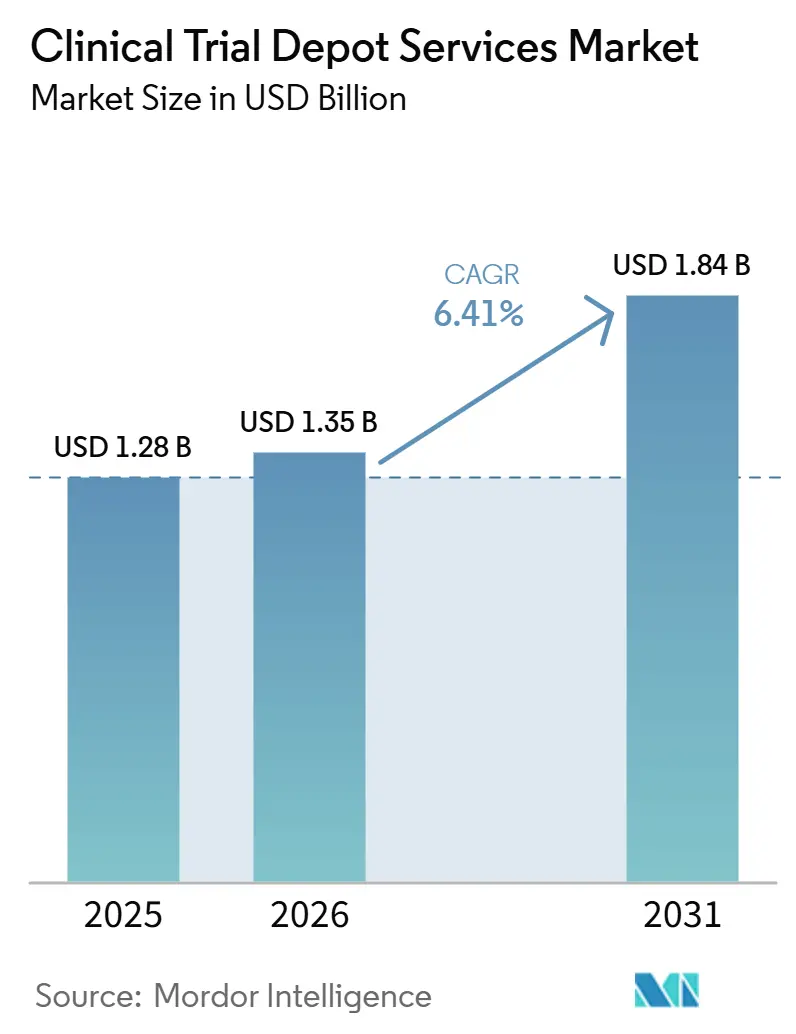
| Market Size (2026) | USD 1.35 Billion |
| Market Size (2031) | USD 1.84 Billion |
| Growth Rate (2026 - 2031) | 6.41 % |
| Fastest Growing Market | Asia-Pacific |
| Largest Market | North America |
| Market Concentration | Medium |
Major Players *Disclaimer: Major Players sorted in no particular order Image © Mordor Intelligence. Reuse requires attribution under CC BY 4.0. | |
Clinical Trial Depot Services Market Analysis by Mordor Intelligence
The clinical trial depot services market is projected to be USD 1.28 billion in 2025, USD 1.35 billion in 2026, and reach USD 1.84 billion by 2031, growing at a CAGR of 6.41% from 2026 to 2031. The clinical trial depot services market is being lifted by a larger mix of late-phase oncology, infectious disease, and rare disease studies that need broader geographic reach and longer active supply periods. Demand is also moving toward higher-specification depot infrastructure because biologics, mRNA products, and advanced therapy medicinal products require stricter temperature control, tighter chain-of-custody records, and more responsive resupply models. The shift toward decentralized and direct-to-patient trial formats is changing how sponsors and CROs use depot networks, with more value now tied to local stock positioning, faster replenishment, and stronger digital visibility across inventory and transport workflows. The clinical trial depot services market is also becoming more operationally selective because sponsors increasingly favor providers that can combine validated storage, quality systems, shipment monitoring, and IRT-linked inventory control within one service model. Growth is still constrained by cross-border regulatory differences and comparator drug shortages, both of which raise planning complexity, extend lead times, and increase the need for redundant country-level supply arrangements.
Key Report Takeaways
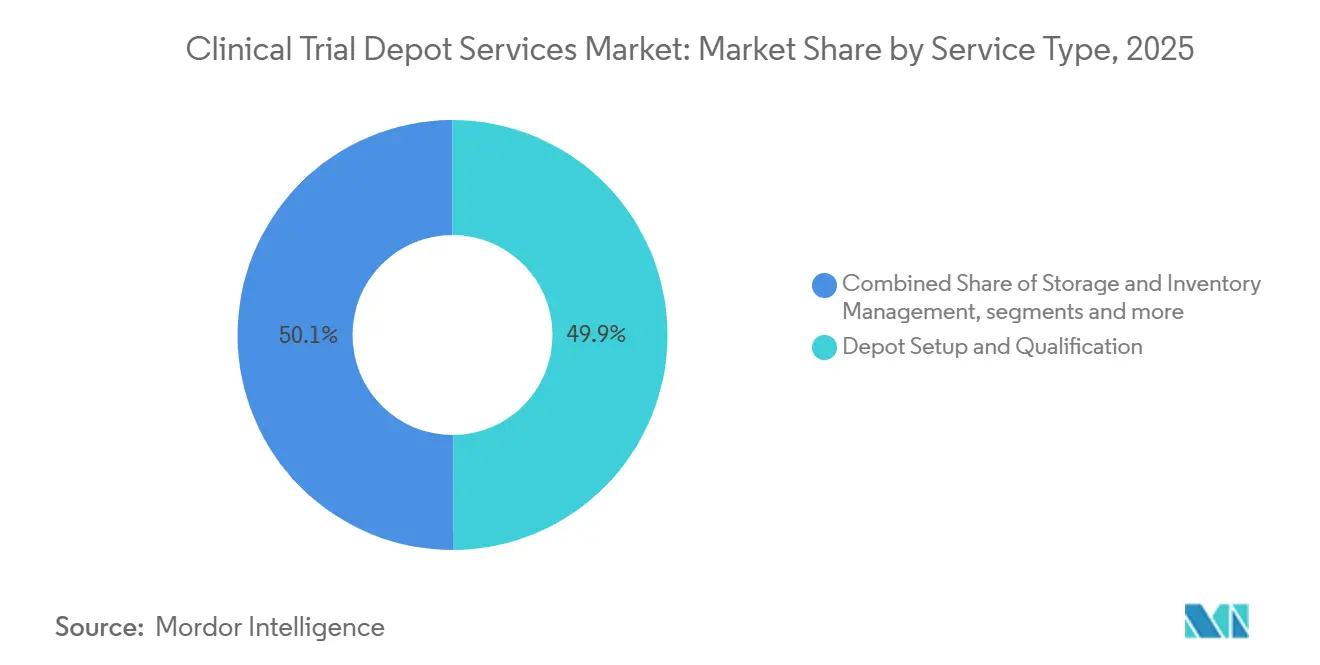
- By service type, depot setup and qualification held 49.86% of revenue in 2025, while storage and inventory management is projected to grow at a 7.12% CAGR through 2031.
- By clinical phase, phase II accounted for 45.74% of revenue in 2025, while phase III is forecasted to expand at a 7.84% CAGR through 2031.
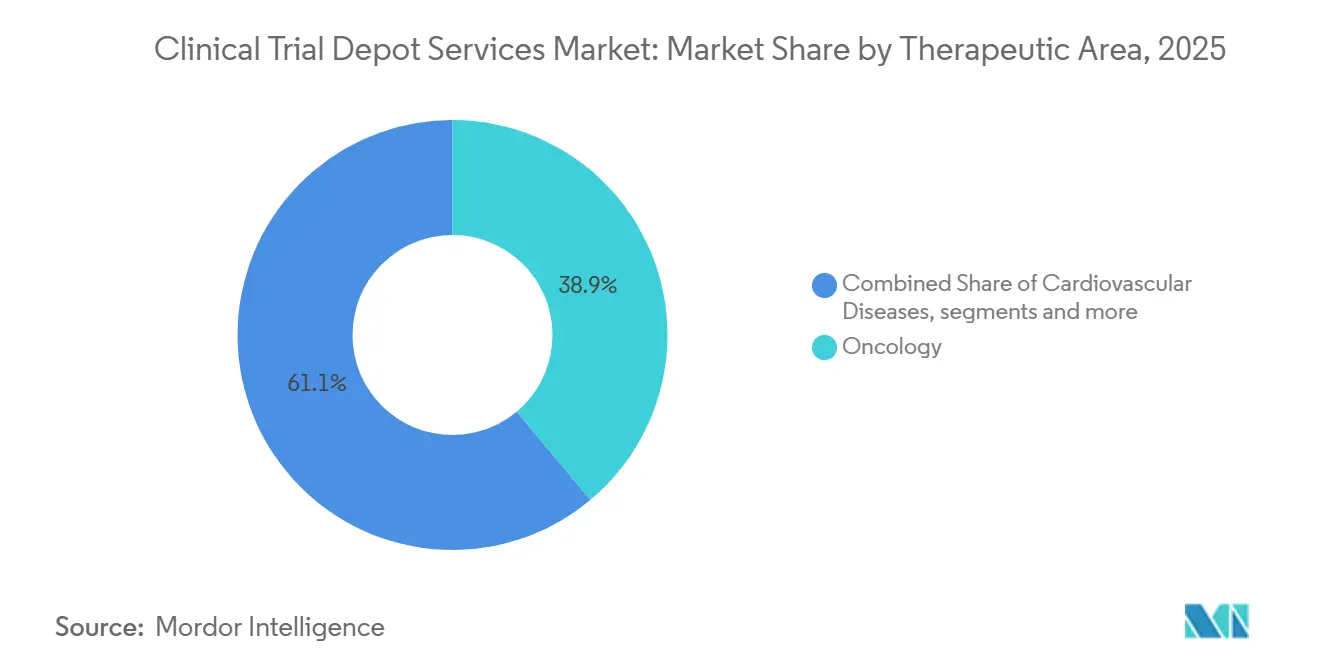
- By therapeutic area, oncology represented 38.92% of demand in 2025, while infectious diseases are projected to grow at an 8.26% CAGR through 2031.
- By end-user, pharmaceutical companies contributed 58.16% of revenue in 2025, while contract research organizations are projected to grow at an 8.77% CAGR through 2031.
- By geography, North America held 41.83% of revenue in 2025, while Asia-Pacific is projected to grow at a 9.33% CAGR through 2031.
Note: Market size and forecast figures in this report are generated using Mordor Intelligence’s proprietary estimation framework, updated with the latest available data and insights as of January 2026.
Global Clinical Trial Depot Services Market Trends and Insights
Drivers Impact Analysis*
| Driver | (~) % Impact on CAGR Forecast | Geographic Relevance | Impact Timeline |
|---|---|---|---|
| Decentralized and Direct-To-Patient Trial Execution | +1.8% | North America and Europe lead, with spillover to Asia-Pacific | Medium term (2-4 years) |
| Biologics and ATMP Cold-Chain Intensity | +1.5% | Global, with concentration in North America, Europe, and Asia-Pacific | Long term (≥ 4 years) |
| Global Phase II-III Trial Dispersion | +1.2% | Global, concentrated in North America and Europe | Medium term (2-4 years) |
| EU CTR Relabeling and QP-Release Pressure | +0.8% | EU and EEA member states | Short term (≤ 2 years) |
| Customs Valuation and IOR Complexity Favor Local Depots | +0.4% | Global, acute in cross-border US-Europe and Asia-Pacific-Europe lanes | Short term (≤ 2 years) |
| Protocol Amendments Increase Relabeling and Resupply Demand | +0.3% | Global | Short term (≤ 2 years) |
| Source: Mordor Intelligence | |||
Decentralized and Direct-To-Patient Trial Execution
The clinical trial depot services market is seeing a durable shift toward distributed inventory models because sponsors are placing stock closer to participants instead of relying only on regional hub depots. The RADIAL Trials@Home proof-of-concept trial documented 68 direct-to-patient investigational product shipments across 6 EU countries with a 94% success rate, which supports the practical use of central-depot-to-patient delivery even while showing that courier performance and local rules still shape execution limits.[1]Clinical Pharmacology & Therapeutics, “The Supply of Investigational Medicinal Product and Management of Study Materials for Decentralized Participants — Insights from the Trials@Home RADIAL Proof-of-Concept Trial,” PMC, pmc.ncbi.nlm.nih.gov For the clinical trial depot services market, this changes the service model from basic warehousing toward faster replenishment cycles, more visible participant-linked tracking, and closer coordination with home healthcare and e-pharmacy channels. U.S. sponsor adoption has also gained support from federal guidance that directly addresses decentralized clinical trials and conditions for shipping trial products to participants. The clinical trial depot services market therefore benefits even when site counts fall, because smaller delivery batches, more frequent shipments, and added safety stock usually raise depot activity per study. This pattern also strengthens the role of local depots in studies where treatment continuity matters more than centralized storage efficiency.
Biologics and ATMP Cold-Chain Intensity
The clinical trial depot services market is moving toward higher-value handling requirements as pipelines add more cell therapies, gene therapies, monoclonal antibodies, and mRNA-based investigational products. These products span storage ranges from 2°C to 8°C, to -80°C, and in some cases cryogenic conditions, which means depot operators need ultra-low temperature capacity, validated packaging, and continuous excursion monitoring. The ICH guideline endorsed in November 2025 raises the quality and clinical expectations for investigational advanced therapy medicinal products, which supports stricter operating requirements for depot providers serving those sponsors.[2]International Council for Harmonisation, “Guideline on Quality, Non-Clinical and Clinical Requirements for Investigational Advanced Therapy Medicinal Products in Clinical Trials,” ICH, database.ich.org In the clinical trial depot services market, autologous therapies create a tighter operating environment because same-day or next-day movement can leave little time for depot repositioning or contingency handling. That makes manufacturing-logistics proximity more important than broad network scale in parts of the market where therapy viability and treatment timing are closely linked. The result is a narrower set of qualified operators for advanced therapy work and a stronger premium for compliant, specialized infrastructure.
Global Phase II-III Trial Dispersion
The clinical trial depot services market continues to gain from the heavier supply needs attached to multi-country Phase II and Phase III programs. The infectious disease expansion to stronger trial activity across Asia-Pacific, which supports the need for more regional depots, more localized stock positioning, and more country-level import and documentation support. In the clinical trial depot services market, Phase III growth carries particular weight because those studies tend to run longer, enroll more patients, and require wider ancillary support, including packaging, comparator management, and IRT-linked control. Adaptive and platform study designs are also shortening setup windows because multiple arms can move in parallel instead of following older sequential patterns. This raises the value of depot providers that can launch synchronized operations across several countries without long customization cycles.
EU CTR Relabeling and QP-Release Pressure
The clinical trial depot services market in Europe is being reshaped by the full transition to the Clinical Trials Information System under Regulation No. 536/2014 from January 31, 2025.[3]European Commission, “Guidance for the Transition of Clinical Trials from the Clinical Trials Directive to the Clinical Trials Regulation,” European Commission, ec.europa.eu Faster central authorization can reduce administrative delay, but it also compresses the time available for pre-study setup, quality preparation, and inventory planning. That favors depot providers with modular and already validated infrastructure over operators that still depend on slower, study-specific build-out. The EFPIA review also documented that member-state interpretation still varies, which keeps labeling and documentation workflows more complex than a single harmonized system would suggest. In the clinical trial depot services market, this creates more value for multilingual labeling capacity, CTIS-aware documentation systems, and quality teams that can handle parallel country-specific requirements. Sponsors and CROs are therefore more likely to favor providers that can respond quickly without weakening compliance discipline.
Restraints Impact Analysis*
| Restraint | (~) % Impact on CAGR Forecast | Geographic Relevance | Impact Timeline |
|---|---|---|---|
| Cross-Border Regulatory Divergence and Customs Delays | -1.2% | Global, most acute in Asia-Pacific and Middle East and Africa | Long term (≥ 4 years) |
| Cold-Chain Capacity and Excursion Risk | -0.9% | Global, most acute in Asia-Pacific and South America | Medium term (2-4 years) |
| Comparator Shortages and Traceability Bottlenecks | -0.7% | Global, concentrated in North America and Europe | Medium term (2-4 years) |
| Investigational Site Storage and Staffing Limitations | -0.5% | Global, concentrated in North America and Europe | Short term (≤ 2 years) |
| Source: Mordor Intelligence | |||
Cross-Border Regulatory Divergence and Customs Delays
The clinical trial depot services market still faces a major brake from uneven national rules, customs practice, and importer obligations across multi-country supply chains. The European Commission recommendation on decentralized elements confirmed that direct-to-patient delivery from a depot in another EU member state does not comply with national provisions in Spain and Poland, which forces redundant depot arrangements even inside the single market. Outside Europe, the clinical trial depot services market is slowed by country-level variation in GDP expectations, customs classification, import licensing, and importer-of-record rules, especially across Asia-Pacific, the Middle East, Africa, and South America. These differences add cost without improving speed, and they can expose smaller sponsors to delays that lead to treatment interruptions or protocol deviations. The constraint is strongest where cross-border lanes are active but local regulatory execution remains fragmented. Depot operators with bonded infrastructure and mature local compliance support are better placed, but the cost of that capability also raises market entry barriers.
Comparator Shortages and Traceability Bottlenecks
The clinical trial depot services market is also constrained by comparator sourcing risk, especially in late-phase studies where validated continuity is a protocol requirement. ASHP reported 223 active drug shortages in the United States in its latest tracking, with oncology injectables and specialty products still prominent. HHS ASPE found that the median duration of U.S. injectable drug shortages was 4.6 years, which shows that supply disruption is not just episodic and must be planned into long-cycle depot operations. In the clinical trial depot services market, this means more secondary sourcing, higher purchase costs, tighter resupply cycles, and more pressure on traceability controls when substitute supply is sought. Providers that can plan dual sourcing and maintain pre-qualified alternatives are better insulated, but those capabilities add complexity and working capital demands.
*Our forecasts treat driver/restraint impacts as directional, not additive. The impact forecasts reflect baseline growth, mix effects, and variable interactions.
Segment Analysis
By Service Type: Quality Systems Hold the Base While Inventory Responsiveness Lifts Growth
Depot setup and qualification held 49.86% of revenue in 2025, which made it the largest service line in the clinical trial depot services market. That position reflects the fact that every program needs validated facilities, temperature mapping, standard operating procedures, staff qualification, and audit readiness before distribution can begin. These activities create a recurring revenue base because each new study and each new depot site requires formal preparation rather than only physical storage capacity. The clinical trial depot services industry therefore still depends on quality setup as the commercial entry point for most sponsor relationships. In practice, that gives established providers a durable advantage because once a sponsor has approved a depot quality system, the same operator is more likely to secure follow-on work across adjacent studies.
Storage and inventory management is projected to grow at a 7.12% CAGR through 2031, which makes it the fastest-growing service line in the clinical trial depot services market. The expansion reflects stricter cold-chain requirements for biologics and advanced therapies, and it also reflects the wider use of distributed stock positions in decentralized trial models. Real-time inventory visibility linked to IRT systems is becoming more important because sponsors want tighter safety-stock control across multiple depots at once. This part of the clinical trial depot services market is therefore shifting from static warehousing toward an operating model built around responsiveness, documentation precision, and more dynamic inventory control.



By Clinical Phase: Phase II Holds the Largest Base While Phase III Extends the Growth Path
Phase II represented 45.74% of revenue in 2025, which gave it the largest share in the clinical trial depot services market. The segment benefits from the cumulative volume of proof-of-concept and dose-finding studies that run at the same time across large pharma and biotech pipelines. These programs keep depot utilization stable because sponsors often manage several mid-stage assets together and need flexible storage, labeling, and packaging support across them. In the clinical trial depot services market, Phase II also supports consistent demand because sponsors have not yet narrowed their development focus to only a few pivotal assets.
Phase III is projected to grow at a 7.84% CAGR through 2031, and it is the faster-moving phase in the clinical trial depot services market. These contracts usually generate the highest revenue per study because patient cohorts are larger, active supply periods are longer, and distribution footprints are wider. Phase III also brings more need for comparator provision, broader secondary packaging scope, and tighter coordination across many investigator sites. The clinical trial depot services industry also has a smaller but strategically useful post-market niche because operators that can support movement from clinical supply into later commercial distribution may retain sponsor relationships beyond approval.
By Therapeutic Area: Oncology Leads Current Demand While Infectious Disease Expands Regional Pull
Oncology accounted for 38.92% of demand in 2025, which placed it at the center of the clinical trial depot services market. Its weight comes from the scale of global cancer drug development and from the practical difficulty of handling many oncology investigational products, which often need narrow temperature control, strong chain-of-custody records, and careful management of potent compounds. The clinical trial depot services market therefore remains closely tied to the operational profile of oncology pipelines, especially where multi-country enrollment and high-value products intersect.
Infectious diseases are projected to expand at an 8.26% CAGR through 2031, which makes them the fastest-growing therapeutic segment in the clinical trial depot services market. This growth to continued work on vaccines, antimicrobial resistance therapies, HIV programs, and tuberculosis studies, many of which retained momentum after the COVID-19 period. Respiratory and hematology programs are also supporting renewed activity as combination therapies involving biologics and cell therapies become more common. Metabolic and endocrine studies add steady demand as refrigerated products and dose-titration kits keep packaging and storage needs active across mid-stage pipelines.
By End-User: Pharmaceutical Companies Dominate Revenue While CROs Deepen Their Role
Pharmaceutical companies contributed 58.16% of revenue in 2025, making them the leading end-user group in the clinical trial depot services market. Their lead reflects broad multi-therapy portfolios and a high concentration of Phase II and Phase III studies that need multi-site coverage across several geographies at once. Large sponsors also tend to attach more ancillary services to depot contracts, which increases contract value through longer duration and broader scope. In end-user terms, pharmaceutical companies held 58.2% of the clinical trial depot services market in 2025 because they still account for the widest mix of programs and the deepest procurement budgets.
Contract research organizations are projected to grow at an 8.77% CAGR through 2031, which makes them the fastest-growing end-user group in the clinical trial depot services market. The trend reflects deeper outsourcing by sponsors and a stronger push by CROs to offer integrated clinical operations with supply chain support. Medical device sponsors form a narrower niche where depot providers may need both GMP discipline and ISO-linked quality alignment for combination products. Academic and government sponsors are more price sensitive, but they remain relevant because public health and investigator-led studies can later move into larger commercial development tracks.
Geography Analysis
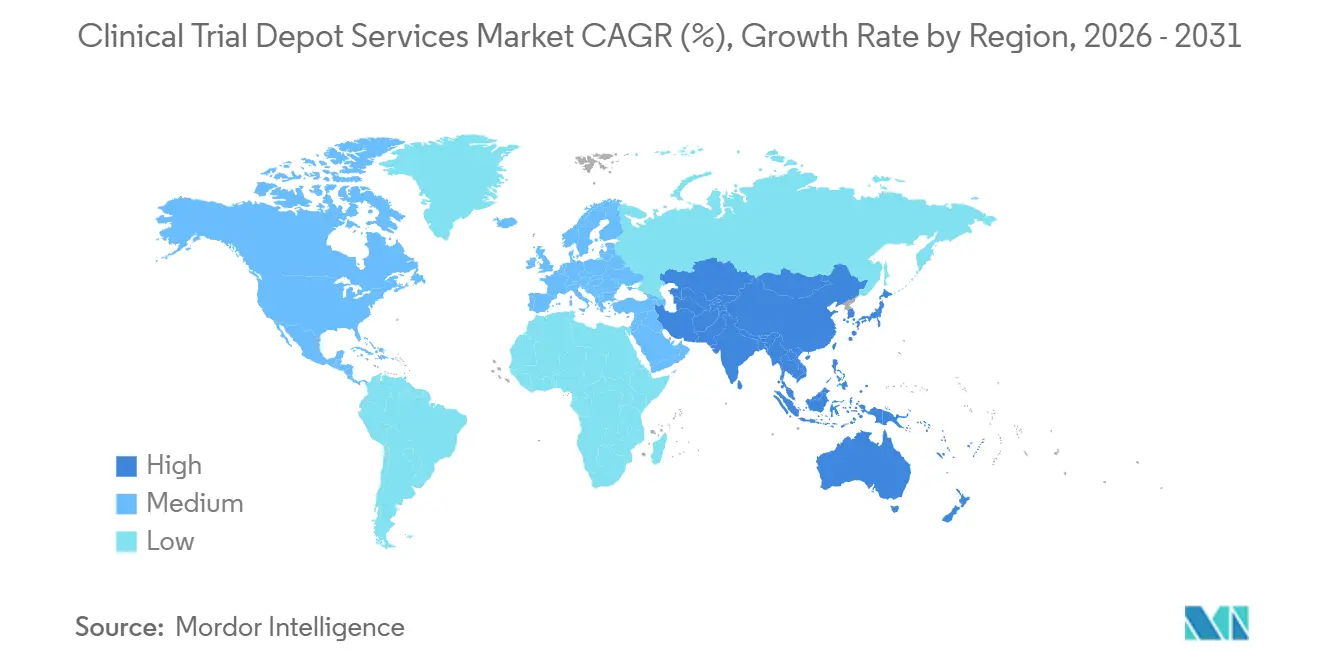
North America held 41.83% of revenue in 2025, which gave it the largest regional position in the clinical trial depot services market. The region benefits from the highest concentration of Phase II and Phase III oncology trials, a dense network of GMP-validated depots, and a regulatory environment that supports domestic storage and distribution depth. The United States remains the core of that system because it combines sponsor headquarters, CRO operating bases, and a broad spread of clinical research sites. Canada remains smaller, but it supports regional activity through its biosimilars pipeline and close alignment with U.S. GMP expectations.
Europe remains one of the most structurally important parts of the clinical trial depot services market even though a separate regional share figure. The region is moving through a consolidation phase because the EU Clinical Trials Regulation raises the value of CTIS-integrated quality systems and reduces the competitiveness of smaller local operators that cannot scale compliance effectively. The AFCROs 2026 Clinical Research Barometer showed weaker EU trial activity in 2025, including a decline in France from 2,402 trials in 2024 to 2,170 in 2025. Germany, the United Kingdom, France, Italy, and Spain remain the principal European depot markets by trial volume, and Spain retained a leading position in EU-based industry-sponsored trials.
Asia-Pacific is projected to grow at a 9.33% CAGR through 2031, which makes it the fastest-growing region in the clinical trial depot services market. The region benefits from China’s expanding domestic biotech activity, South Korea and Japan’s established research ecosystems, India’s growing CRO capacity, and Australia’s licensed depot network. Almac Group announced a multi-million-pound investment in Singapore in November 2025 to expand its local cold-chain and secondary packaging capability, which supports Singapore’s role as a regional supply hub. South America remains an emerging market for the clinical trial depot services market, while the Middle East and Africa are still at an early stage with initial momentum centered on healthcare modernization and government-backed clinical research activity.

Competitive Landscape
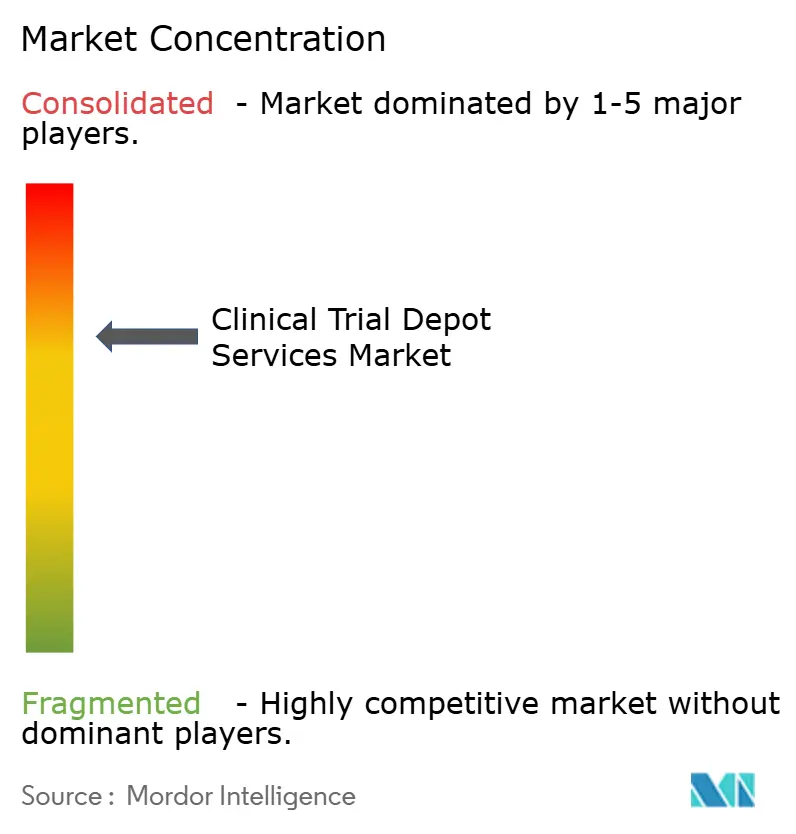
The clinical trial depot services market is moderately consolidated, with a limited group of global integrated providers competing for the largest multi-country and temperature-sensitive contracts. Scale still matters because sponsors value broad geographic networks, validated quality systems, and the ability to manage a single protocol across several regions without rebuilding the operating model each time. The clinical trial depot services market also has a larger set of regional specialists, but these players usually compete on local regulatory knowledge, cost position, or niche therapeutic handling instead of end-to-end global reach. This creates a two-layer structure where premium cross-border programs tend to concentrate among operators that can support both technical complexity and consistent quality execution.
The competitive center of gravity in the clinical trial depot services market is moving beyond storage footprint alone. Sponsors increasingly look for integrated views that connect depot inventory, IRT signals, shipment status, and temperature monitoring, because those tools reduce the risk of stockouts, waste, and treatment disruption. That shift raises switching costs once a provider is embedded, especially in Phase III studies and advanced therapy programs where documentation and timing are tightly controlled. Providers that can combine GDP discipline with digital coordination are therefore better positioned than those that still offer warehousing as a mostly standalone service. The market is also seeing a clear premium for operators that can support both site-based distribution and decentralized patient delivery within the same program.
Several strategic moves show how leading companies are building position in the clinical trial depot services market. FedEx formalized its focus through FedEx Life Sciences and highlighted nearly USD 10 billion in healthcare transportation revenue at the end of fiscal 2026, showing a clearer commercial push into healthcare and clinical logistics. Marken also consolidated its clinical logistics identity through the Marken, UPS Healthcare Precision Logistics structure, which reinforces its position in precision handling and global specialty distribution. Taken together, these moves show that the clinical trial depot services market is rewarding providers that pair compliance depth with network investment and more integrated operating platforms.
Clinical Trial Depot Services Industry Leaders
Thermo Fisher Scientific Inc.
Catalent, Inc.
Marken
Almac Group
Cencora, Inc.
- *Disclaimer: Major Players sorted in no particular order

Recent Industry Developments
- January 2026: A consortium of Pharma.Aero, Brussels Airport Company, Air Cargo Belgium, and the rest. The ATMP platform commenced test shipments under the Precision Therapy Logistics Gateway project, aiming to establish internationally recognized standards for time-and-temperature-sensitive cell and gene therapy logistics through a major European air cargo hub.
- November 2025: Almac Group announced a multi-million-pound investment in its Singapore facility, quadrupling 20°C storage capacity and expanding secondary cold-chain packaging capabilities to position Singapore as its Asia-Pacific regional hub.
- May 2025: DHL Group announced the transformation of its Florstadt Life Sciences campus near Frankfurt into a larger European pharmaceutical hub, expanding the campus to 100,000 square meters and more than 140,000 pallet positions with -70°C cell and gene therapy storage and GMP-compliant clean room processing.


Global Clinical Trial Depot Services Market Report Scope
As per the scope of the report, the clinical trial depot services market comprises services that support the storage, inventory management, packaging, labeling, and global distribution of investigational products and clinical trial materials to ensure efficient and compliant clinical trial operations.
The clinical trial depot services market is segmented by service type, clinical phase, therapeutic area, end-user, and geography. By service type, the market is segmented into depot setup and qualification, storage and inventory management, secondary packaging and labeling, site and patient distribution, returns, reconciliation, and destruction, and import, export, IOR, and QP support. By clinical phase, the market is segmented into BA/BE studies, phase I, phase II, phase III, and phase IV, and post-marketing. By therapeutic area, the market is segmented into oncology, cardiovascular diseases, CNS and mental disorders, infectious diseases, immunology, rare diseases, metabolic and endocrine disorders, respiratory diseases, hematology and blood disorders, and other therapeutic areas. By end-user, the market is segmented into pharmaceutical companies, biotechnology companies, contract research organizations, medical device sponsors, and academic, government, and nonprofit sponsors. By geography, the market is segmented into North America, Europe, Asia-Pacific, the Middle East and Africa, and South America. The report also covers the estimated market sizes and trends for 17 countries across major regions globally. The report offers values (USD) for all the above segments.
| Depot Setup and Qualification |
| Storage and Inventory Management |
| Secondary Packaging and Labeling |
| Site and Patient Distribution |
| Returns, Reconciliation, and Destruction |
| Import, Export, IOR, and QP Support |
| BA/BE Studies |
| Phase I |
| Phase II |
| Phase III |
| Phase IV and Post-Marketing |
| Oncology |
| Cardiovascular Diseases |
| CNS and Mental Disorders |
| Infectious Diseases |
| Immunology |
| Rare Diseases |
| Metabolic and Endocrine Disorders |
| Respiratory Diseases |
| Hematology and Blood Disorders |
| Other Therapeutic Areas |
| Pharmaceutical Companies |
| Biotechnology Companies |
| Contract Research Organizations |
| Medical Device Sponsors |
| Academic, Government, and Nonprofit Sponsors |
| North America | United States |
| Canada | |
| Mexico | |
| Europe | Germany |
| United Kingdom | |
| France | |
| Italy | |
| Spain | |
| Rest of Europe | |
| Asia-Pacific | China |
| Japan | |
| India | |
| Australia | |
| South Korea | |
| Rest of Asia-Pacific | |
| Middle East and Africa | GCC |
| South Africa | |
| Rest of Middle East and Africa | |
| South America | Brazil |
| Argentina | |
| Rest of South America |
| By Service Type | Depot Setup and Qualification | |
| Storage and Inventory Management | ||
| Secondary Packaging and Labeling | ||
| Site and Patient Distribution | ||
| Returns, Reconciliation, and Destruction | ||
| Import, Export, IOR, and QP Support | ||
| By Clinical Phase | BA/BE Studies | |
| Phase I | ||
| Phase II | ||
| Phase III | ||
| Phase IV and Post-Marketing | ||
| By Therapeutic Area | Oncology | |
| Cardiovascular Diseases | ||
| CNS and Mental Disorders | ||
| Infectious Diseases | ||
| Immunology | ||
| Rare Diseases | ||
| Metabolic and Endocrine Disorders | ||
| Respiratory Diseases | ||
| Hematology and Blood Disorders | ||
| Other Therapeutic Areas | ||
| By End-User | Pharmaceutical Companies | |
| Biotechnology Companies | ||
| Contract Research Organizations | ||
| Medical Device Sponsors | ||
| Academic, Government, and Nonprofit Sponsors | ||
| By Geography | North America | United States |
| Canada | ||
| Mexico | ||
| Europe | Germany | |
| United Kingdom | ||
| France | ||
| Italy | ||
| Spain | ||
| Rest of Europe | ||
| Asia-Pacific | China | |
| Japan | ||
| India | ||
| Australia | ||
| South Korea | ||
| Rest of Asia-Pacific | ||
| Middle East and Africa | GCC | |
| South Africa | ||
| Rest of Middle East and Africa | ||
| South America | Brazil | |
| Argentina | ||
| Rest of South America | ||


Key Questions Answered in the Report
How large is the clinical trial depot services space expected to become by 2031?
The clinical trial depot services market is expected to reach USD 1.28 billion in 2025, to USD 1.35 billion in 2026, and to reach USD 1.84 billion by 2031 at a 6.41% CAGR.
Which region leads clinical trial depot operations today?
North America led in 2025 with 41.83% of revenue because it combines high trial density, mature GMP-validated infrastructure, and strong sponsor and CRO presence.
Which region is growing the fastest for depot demand?
Asia-Pacific is projected to expand at a 9.33% CAGR through 2031, supported by stronger biotech activity, CRO growth, and rising regional clinical research capacity.
Which service area accounts for the most revenue?
Depot Setup and Qualification led with 49.86% of revenue in 2025 because validated quality systems remain the foundation of every investigational product distribution program.
Page last updated on:





