
Clarified Butter Market Size and Share
Market Overview
| Study Period | 2022 - 2032 |
|---|---|
| Market Size (2027) | USD 8.33 Billion |
| Market Size (2032) | USD 10.85 Billion |
| Growth Rate (2027 - 2032) | 5.44 % |
| Fastest Growing Market | North America |
| Largest Market | Asia-Pacific |
| Market Concentration | Medium |
Major Players *Disclaimer: Major Players sorted in no particular order Image © Mordor Intelligence. Reuse requires attribution under CC BY 4.0. | |
Clarified Butter Market Analysis by Mordor Intelligence
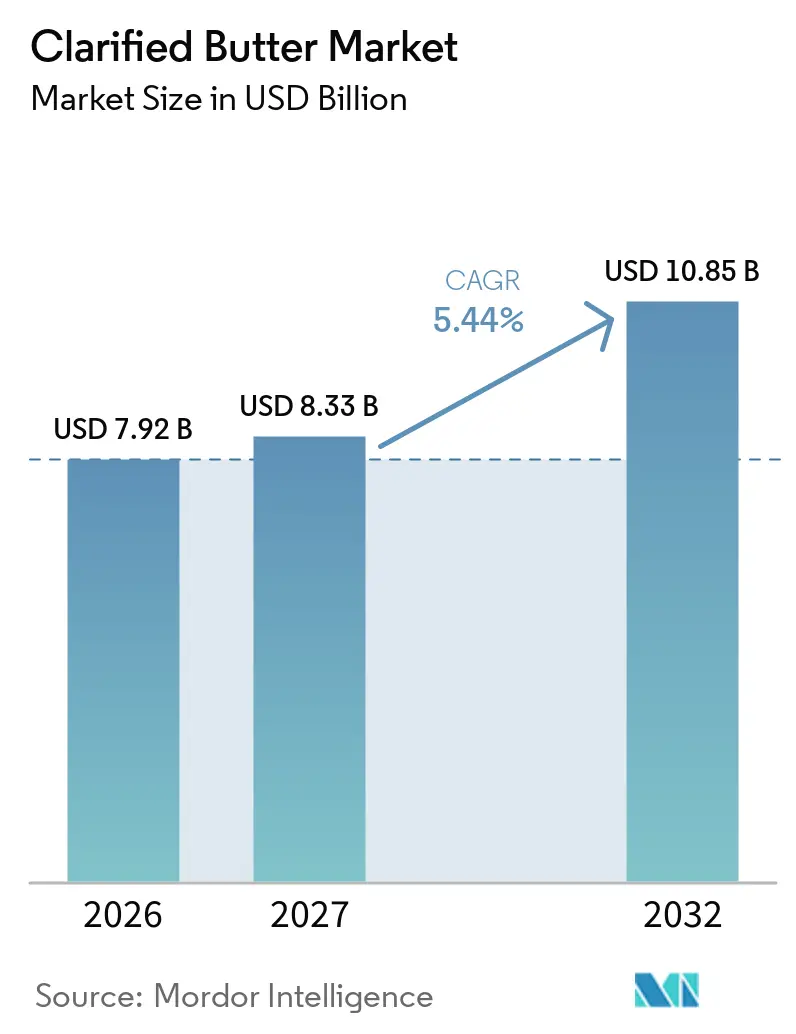
The clarified butter market size is expected to grow from USD 7.92 billion in 2026 to USD 8.33 billion in 2027, and is forecast to reach USD 10.85 billion by 2032 at a 5.44% CAGR over 2027-2032. The clarified butter market benefits from demand for cooking fats with simple ingredient lists, high heat stability, and established culinary applications. In South Asia, clarified butter remains important in household cooking, while its use in bakery, confectionery, and foodservice applications expands demand in other regions. Products positioned around organic sourcing, grass-fed milk, A2 milk, and regional provenance are creating premium options alongside standard cooking formats. Producers are balancing these opportunities with butterfat price fluctuations, plant-based alternatives, compliance requirements, and disruptions in dairy ingredient supply. The clarified butter market also gains from retail and foodservice exposure, which introduces products to consumers outside traditional ghee-buying households.
Key Report Takeaways
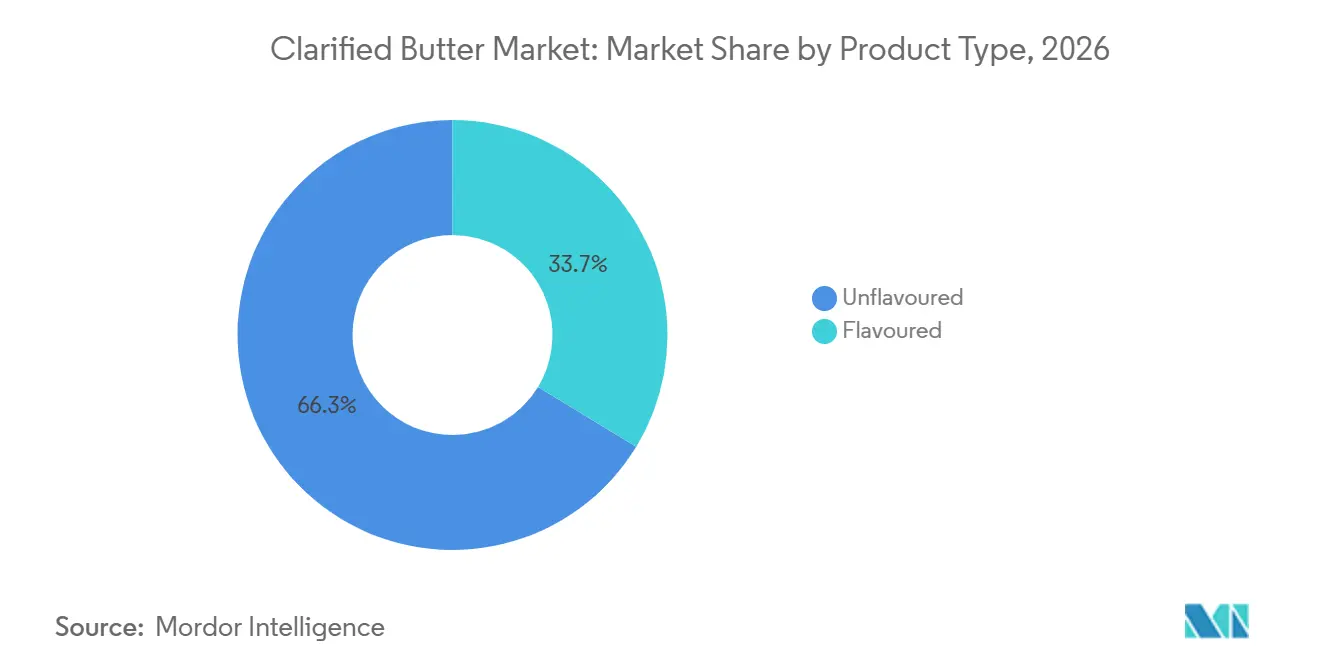
- By product type, unflavored led the clarified butter market, accounting for a 66.31% share in 2026, while flavored is projected to expand at a CAGR of 7.23% during 2027-2032.
- By source, cow’s milk accounted for a 55.52% share in 2026 and is projected to expand at a CAGR of 6.02% through 2032.
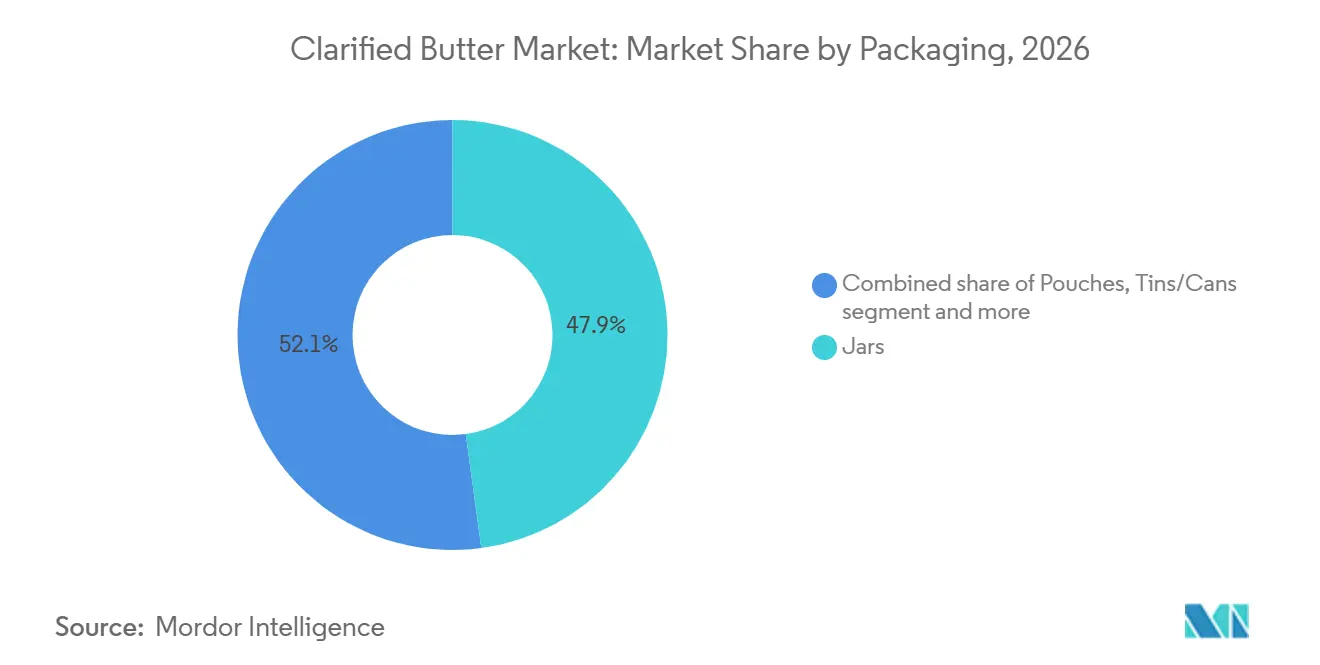
- By packaging, jars accounted for a 47.87% share in 2026, while pouches are projected to expand at a CAGR of 6.65% through 2032.
- By distribution channel, the off-trade accounted for a 68.18% share in 2026, while on-trade is projected to expand at a CAGR of 6.47% through 2032.
- By geography, Asia-Pacific led the global clarified butter market in 2026, accounting for a 55.78% share, while North America is projected to grow at a CAGR of 6.29% through 2032.
Note: Market numbers in this report are based on Mordor Intelligence's proprietary estimation framework, which combines nine months of actuals with Q4 projections for base year 2026.
Market Trends and Insights
Drivers Impact Analysis of Clarified Butter Market*
| Driver | (~) % Impact on CAGR Forecast | Geographic Relevance | Impact Timeline |
|---|---|---|---|
| Expanding ethnic food consumption and premium bakery use | +0.7% | Global, concentrated in North America and Europe diaspora markets | Medium term (2-4 years) |
| Preference for minimally processed and premium dairy ingredients | +0.6% | Global, with North America, Europe, and urban Asia-Pacific | Short term (≤ 2 years) |
| Demand for functional fats in health-focused diets | +0.6% | North America and Europe, growing in urban Asia-Pacific | Medium term (2-4 years) |
| Dairy fat processing and packaging innovation | +0.5% | Global, with early gains in India and New Zealand | Long term (≥ 4 years) |
| Increasing incorporation into premium bakery and confectionery formulations | +0.50% | Global, particularly Europe and North America | Medium term (2–4 years) |
| Growth of premium and organic dairy product portfolios | +0.40% | Global, particularly Europe and North America, with urban Asia-Pacific markets | Long term (≥ 4 years) |
| Source: Mordor Intelligence | |||
Expanding Ethnic Food Consumption and Premium Bakery Use
The expansion of commercial bakery production and specialty beverage outlets is creating opportunities for dairy-fat ingredients, including clarified butter. According to the United States Foreign Agricultural Service 2025, butter consumption in China is forecast to increase by 9%, partly driven by increased use in bakery production and the expansion of tea and coffee shops[1]. This trend underscores the potential for dairy fats in commercial food preparation, premium baked goods, and specialty foodservice applications. Clarified butter can benefit from these developments, as manufacturers and foodservice operators seek ingredients that offer rich dairy flavor, a high smoke point, and consistent cooking performance. As bakeries and international foodservice chains expand their product offerings, demand for differentiated dairy-fat ingredients may create additional growth opportunities for the global clarified butter market.
Preference for Minimally Processed and Premium Dairy Ingredients
The clarified butter market aligns with consumers who review ingredient lists before selecting dairy products. The International Dairy Deli Bakery Association, in February 2025, found that 41% of United States consumers associated less-processed dairy with the absence of artificial colors and flavors, while 36% considered recognizable ingredients an important criterion[2]. Clarified butter contains butterfat after processors remove milk solids and water, making the formulation easy to communicate on packaging. Organic, grass-fed, and A2 claims can increase the product’s retail value when brands clearly demonstrate traceability and heat performance. These attributes can also support flavored products, where the cooking experience and ingredient story appear together. However, manufacturers need reliable milk sourcing and documented traceability to protect premium positioning in specialty retail. This dynamic favors organized processors that can consistently meet quality, composition, packaging, and labeling requirements.
Demand for Functional Fats in Health-Focused Diets
The clarified butter market has gained relevance among consumers seeking functional benefits in everyday cooking fats. Keto and paleo consumers in North America and Europe adopted clarified butter early, while sports nutrition and gut-health messaging has broadened interest. International Flavors & Fragrances Inc. also identified holistic well-being as a major dairy innovation theme, as consumers increasingly focus on active health management. Products with grass-fed, A2, or single-origin claims can gain stronger visibility in health-focused retail, provided brands support these claims with evidence. The opportunity is strongest when health-focused positioning complements, rather than displaces, the product’s established culinary role.
Dairy Fat Processing and Packaging Innovation
Processing and packaging developments support the wider use of clarified butter in retail and foodservice. Processing methods can materially affect ghee’s fatty acid composition and volatile flavor compounds, supporting the premium appeal of traditional slow-cooking methods. Flexible packaging is gaining relevance as it reduces material weight and transport costs for dairy products. Multi-layer pouch laminates can address concerns that oxygen exposure may affect ghee quality in flexible packs. Lower packaging costs can help suppliers serve price-sensitive consumers while preserving practical margins. Glass jars can continue to support premium presentation where retail pricing and product visibility matter most.
Restraints Impact Analysis of Clarified Butter Market*
| Restraint | (~) % Impact on CAGR Forecast | Geographic Relevance | Impact Timeline |
|---|---|---|---|
| Volatility in raw material and butterfat prices | -0.4% | Global, with amplified effects in Europe, Asia Pacific, and Middle East and Africa | Short term (≤ 2 years) |
| Growing consumer shift toward plant-based fat alternatives | -0.2% | North America and Europe, with increasing relevance across Asia Pacific | Medium term (2–4 years) |
| Stringent dairy safety and export compliance requirements | -0.3% | Global, particularly for cross-border dairy trade involving Europe, North America, and Asia Pacific | Medium term (2–4 years) |
| Supply chain disruptions affecting dairy ingredient availability | -0.3% | Global, particularly dairy-import-dependent markets in Asia Pacific and Middle East and Africa | Short term (≤ 2 years) |
| Source: Mordor Intelligence | |||
Volatility in Raw Material and Butterfat Prices
Fluctuations in raw milk, cream, and butterfat prices create cost uncertainty for clarified butter manufacturers, as butterfat is the primary component of the finished product. According to the Food and Agricultural Outlook 2025–2034, published in July 2025, international dairy prices increased during the first half of 2025[3]. Butter prices reached a record high in June before declining in the second half of the year, as milk production exceeded expectations in major exporting countries. These price movements complicate procurement planning, inventory management, and pricing negotiations for manufacturers that depend on consistent dairy-fat supplies. Conversely, periods of excess dairy-fat supply can lower ingredient costs but introduce uncertainty in inventory valuation and contract pricing. This volatility makes it challenging for clarified butter manufacturers to maintain stable production costs and competitive pricing across international markets.
Growing Consumer Shift Toward Plant-Based Fat Alternatives
The increasing availability of plant-based fats and dairy-free substitutes is intensifying competitive pressure on the global clarified butter market. Consumers aiming to reduce animal-derived food consumption or diversify their fat intake may opt for alternatives such as olive oil, sunflower oil, canola oil, and plant-based butter substitutes. These products offer versatility in household cooking, baking, and food preparation, enabling them to compete with clarified butter across multiple applications. Additionally, dietary preferences for unsaturated fats may deter some health-conscious consumers from purchasing clarified butter regularly due to its high saturated fat content. For food manufacturers and foodservice operators, alternative fats also offer greater flexibility in product formulation and ingredient procurement.
*Our forecasts treat driver/restraint impacts as directional, not additive. The impact forecasts reflect baseline growth, mix effects, and variable interactions.
Clarified Butter Market Segment Analysis
By Product Type:
Unflavored Retains Scale, Flavored Gains ValueUnflavored clarified butter holds a 66.31% value share in 2026, giving it the largest position in the product mix. The segment serves households and institutional kitchens across Asia-Pacific, the Middle East, and South Asian diaspora communities. Repeat purchase patterns and festival-linked demand support stable sales in established markets. Large dairy cooperatives and organized retailers operate supply chains designed for this high-volume cooking use. Mixed and buffalo milk formats continue to play a role in South Asia, especially among institutional buyers that prioritize cost and fat consistency. A2 cow milk ghee typically commands the highest unit value in organized retail, as breed-specific and processing claims support premium pricing.
Flavored clarified butter is projected to register a 7.23% CAGR from 2027 to 2032, the fastest growth rate among product types. Product launches that combine a familiar cooking fat with distinct culinary flavors support the clarified butter market size for flavored products. 4th & Heart introduced Truffle Ghee at Whole Foods Market in September 2025 for USD 12.99, indicating the availability of flavored ghee in mainstream specialty retail. Market Delights introduced original and garlic-infused Bughee in April 2026 for North American home cooks seeking additive-free cooking fats. Traditional slow-cooking methods can reinforce artisanal value, as processing significantly affects flavor compounds. The segment can grow faster in value than in volume as premium formats expand across retail outlets.
By Source:
Cow Milk Holds the Broadest Value BaseCow milk clarified butter accounts for 55.52% of global value in 2026. India’s cooperative dairy system, along with manufacturing capacity in New Zealand, Ireland, and Australia, supports the segment’s large production base. In February 2025, Amul launched single-origin Gir cow A2 ghee in 250 g and 500 g formats, reflecting demand for breed provenance and bilona-method traceability. Packaged products that comply with composition, purity, and packaging standards may gain an advantage over unbranded loose ghee.
Cow milk products are forecast to register a 6.02% CAGR from 2027 to 2032. Buffalo milk ghee remains important in North India and Pakistan, where consumers prefer a granular texture for roti-based preparations. It also maintains meaningful volume in institutional channels. Mixed milk products serve foodservice buyers that prioritize stable fat content and cost over provenance. The clarified butter industry is shifting from unorganized supply toward branded and cooperative production across more locations. This shift may raise average selling prices as consumers find it easier to recognize quality signals. Cow milk products remain central to the market because premium variants can evolve without changing the category’s familiar role in households.
By Packaging:
Jars Support Premium Retail While Pouches Improve AccessJars account for 47.87% of packaging value in 2026. Glass provides a strong oxygen barrier and a premium appearance, allowing brands to support higher prices in specialty and natural food stores. This format remains important across Western retail channels and premium product ranges. Tins and cans cater to industrial and bulk foodservice customers, especially in the Middle East and South Asia. Their large formats and corrosion resistance address practical requirements in institutional purchasing. Bottles continue to play a smaller role in liquid clarified butter formats for commercial kitchens that require controlled portioning.
Pouches are forecast to grow at a CAGR of 6.65% from 2027 to 2032, making them the fastest-growing packaging format. The clarified butter market size for pouches benefits from lower material use, lighter transport loads, and lower packaging costs compared to glass or tinplate. Advanced pouch laminates can help maintain product quality by managing oxygen transmission. Pouches can also improve the accessibility of branded products in South and Southeast Asia, where retail price remains a key purchasing factor. Therefore, the category is likely to maintain two packaging paths: jars for premium retail and pouches for mass-market and institutional demand.

By Distribution Channel:
Off-Trade Retains the Largest Base While On-Trade AcceleratesOff-trade channels account for 68.18% of the market value in 2026. Hypermarkets, convenience stores, online retailers, and specialty grocery stores remain the primary purchasing channels for household customers. Subscription services and diaspora-focused e-commerce platforms are creating additional opportunities for online sales. Recipe-led digital marketing also helps premium brands communicate usage occasions to new buyers. The channel benefits as consumers look to recreate restaurant or meal-kit experiences at home. Its broad reach makes it essential for both established brands and premium new entrants.
On-trade channels are forecast to grow at a 6.47% CAGR through 2032. Restaurants, hotels, catering operators, cloud kitchens, and industrial food processors are increasing their use of clarified butter. Land O’Lakes positions its clarified butter for foodservice based on 99.6% butterfat purity and its ability to reduce daily clarifying work in commercial kitchens. Premium restaurants and cloud kitchens can use it as a menu ingredient in cuisines that depend on high-heat cooking. Bakery, confectionery, and snack producers can also create a steadier B2B demand base than household buying cycles. Foodservice use can introduce consumers to premium formats and strengthen subsequent retail demand. This relationship supports the clarified butter market across both household and professional kitchens.
Geography Analysis
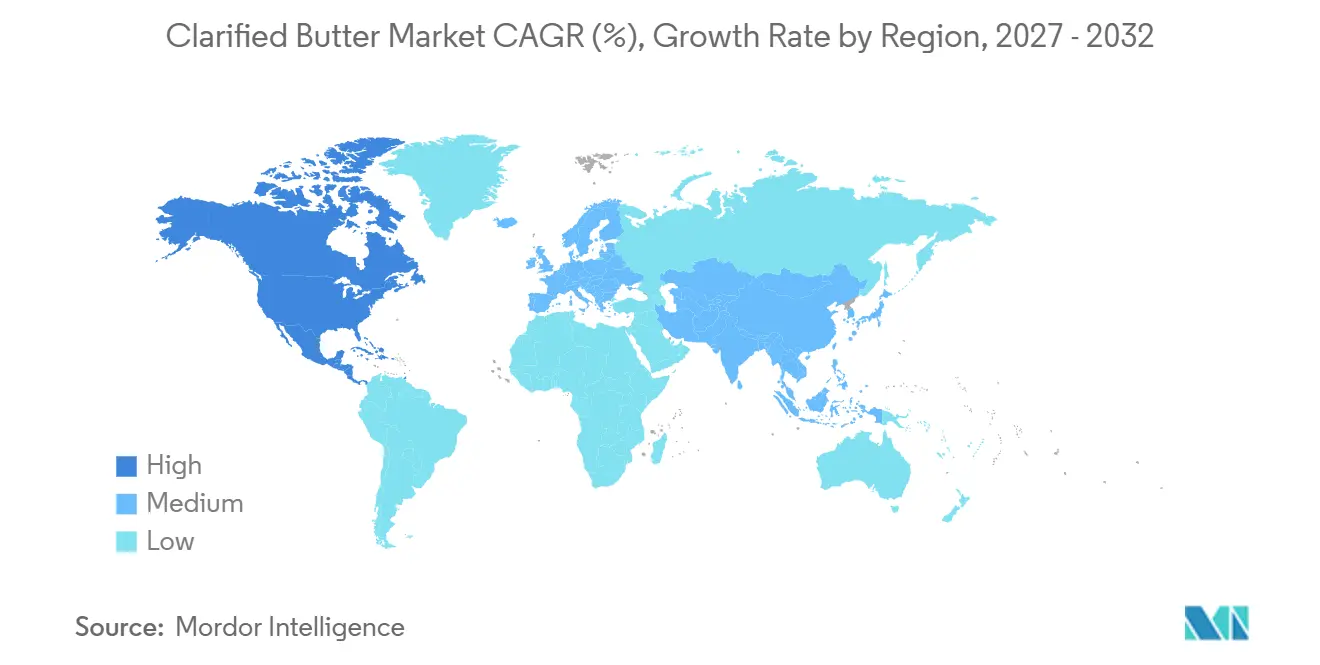
Asia-Pacific accounts for 55.78% of global value in 2026, making it the leading regional base. The clarified butter market share in the region reflects India’s position as a major producer and consumer of ghee. Australia is emerging as a premium production location, while South Korea and Indonesia are becoming import markets for branded products. Regional demand reflects a combination of established household consumption and rising health-focused retail demand.
Europe has lower per capita consumption than South Asia but offers scope for product adoption. The United Kingdom holds the largest value base in Europe, supported by its South Asian diaspora and rising health food consumption. Germany and France are developing markets for clean-label and organic dairy products, where ghee is expanding from ethnic stores into specialty retail. Kerrygold became the fastest-growing major butter brand in United Kingdom retail in 2025 and achieved USD 1 billion in U.S. retail sales for the first time.
North America is forecast to grow at a CAGR of 6.29% through 2032, making it the fastest-growing region. Mainstream grocery listings, meal-kit integration, and a more diverse consumer base support the clarified butter market in the region. This supply environment also supports competitive domestic raw material costs for processors. Middle East and Africa markets, especially countries, remain large traditional destinations for household and industrial use, while Saudi Arabia and the United Arab Emirates rank among India’s major ghee export destinations. South America remains an early-stage market, though urban health interest and keto-adjacent dietary patterns are creating incremental demand. These developments could support stronger volume growth later in the forecast period.
Competitive Landscape
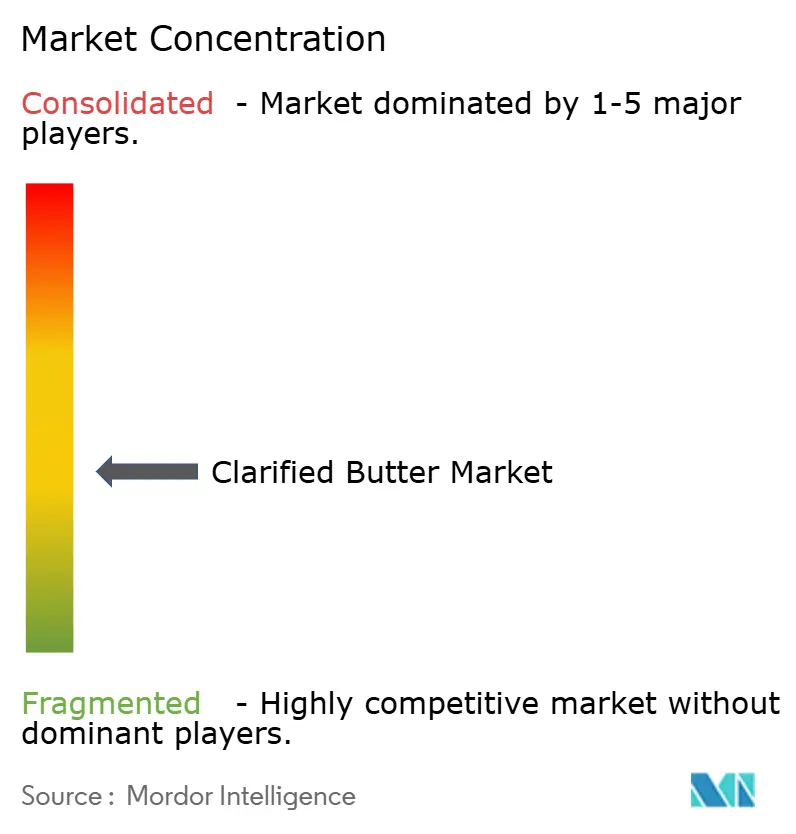
The clarified butter market remains moderately fragmented despite the presence of major cooperatives, FMCG companies, and specialist brands. Relevant participants include Amul, Patanjali Foods, Organic Valley, Britannia Industries, Land O’Lakes, 4th & Heart, Pure Indian Foods, and GRB Dairy Foods. Large cooperatives compete through sourcing scale, broad distribution networks, and diversified product portfolios. Meanwhile, specialist brands differentiate themselves through organic certifications, grass-fed positioning, premium formulations, and targeted marketing to health-conscious consumers.
Specialist brands typically focus on grass-fed sourcing, A2 claims, flavored products, and direct-to-consumer subscriptions. Patanjali Foods combines Ayurvedic positioning with distribution across more than 2 million retail outlets. The company projects a 46% year-over-year increase in ghee revenue in Q3 FY2026. This approach supports both scale and differentiated product positioning. Britannia Industries launched Sattvam Pure Cow Ghee in June 2026, marking an entry into branded premium clarified butter in India. Organic Valley also introduced an organic butter with olive oil in June 2026, expanding its premium dairy fat offering in the United States.
Industrial use remains an underdeveloped opportunity for the clarified butter market and for brands seeking larger, recurring orders. Clarified butter can support applications in laminated dough, chocolate tempering, and extended-heat cooking, but food manufacturers often choose palm oil or vegetable shortening due to cost considerations. The clarified butter industry can address this gap by communicating ingredient performance and clean-label value to food manufacturers. Kerrygold’s flavored butter extensions indicate that conventional dairy brands are also entering premium cooking-fat spaces.
Clarified Butter Industry Leaders
-
Dairy Farmers of America
-
Amul
-
Patanjali
-
Britannia Industries
-
Nestlé S.A.
- *Disclaimer: Major Players sorted in no particular order
Clarified Butter Market Companies Covered in this Report
- Amul
- Nestlé S.A.
- Dairy Farmers of America
- Britannia Industries
- Lactalis International
- Pure Indian Foods
- Patanjali
- Nanak Foods
- Organic Valley
- Ornua
- Glanbia
- Saputo Foodservice
- Land O Lakes, Inc
- Meadow Foods
- Grassland Dairy
- Corman
- Honor Foods
- Pleasant Hill Grain
- Carrington
- Plugra
Recent Industry Developments in Clarified Butter Market
- July 2026: Amul (GCMMF) inaugurated the INR 700 crore (USD 83 million) Bengal Dairy Project at Howrah Food Park, West Bengal. The facility has a processing capacity of 30 lakh liters of milk per day and includes a dedicated ghee manufacturing line with a capacity of 10 MT per day. The project represents the cooperative’s largest investment in eastern India and aims to strengthen its position in the domestic premium ghee market and international export markets.
- April 2026: Market Delights introduced Bughee, a 100% pure clarified cow butter product available in original and garlic-infused variants. The product targets North American home cooks seeking additive-free, high-performance cooking fats with premium pantry positioning.
- March 2026: Ornua launched Kerrygold Pure Irish Butter with Olive Oil across UK retailers. The four-ingredient product contains 60% grass-fed butter, 26% olive oil, water, and salt. A national marketing campaign supported the launch.
Global Clarified Butter Market Report Scope
Clarified butter is a dairy-based fat product made by heating butter to remove water and separate milk solids, producing golden, concentrated butterfat with improved shelf stability and a rich, nutty flavor.
The clarified butter market is segmented by product type, source, packaging, distribution channel, and geography. By product type, the market is segmented into flavored and unflavored. By source, the market is segmented into cow milk, buffalo milk, mixed milk, and others. By packaging, the market is segmented into jars, pouches, tins/cans, and bottles. By distribution channel, the market is segmented into on-trade and off-trade (hypermarkets/supermarkets, convenience/grocery stores, online retail channels, and other distribution channels). Based on geography, the market is classified into North America, Europe, South America, Asia-Pacific, and the Middle East and Africa. The market forecasts are provided in terms of value (USD).
Segmentation Overview
| Flavored |
| Unflavored |
| Cow Milk |
| Buffalo Milk |
| Mixed Milk |
| Others |
| Jars |
| Pouches |
| Tins/Cans |
| Bottles |
| On-Trade | |
| Off-Trade | Hypermarkets/Supermarkets |
| Convenience/Grocery Stores | |
| Online Retail Channel | |
| Other Distribution Channels |
| North America | United States |
| Canada | |
| Rest of North America | |
| Europe | Germany |
| United Kingdom | |
| Italy | |
| France | |
| Rest of Europe | |
| Asia-Pacific | India |
| Australia | |
| Indonesia | |
| South Korea | |
| Rest of Asia-Pacific | |
| South America | South America |
| Middle East and Africa | Saudi Arabia |
| United Arab Emirates | |
| Rest of Middle East and Africa |
| By Product Type | Flavored | |
| Unflavored | ||
| By Source | Cow Milk | |
| Buffalo Milk | ||
| Mixed Milk | ||
| Others | ||
| By Packaging | Jars | |
| Pouches | ||
| Tins/Cans | ||
| Bottles | ||
| By Distribution Channel | On-Trade | |
| Off-Trade | Hypermarkets/Supermarkets | |
| Convenience/Grocery Stores | ||
| Online Retail Channel | ||
| Other Distribution Channels | ||
| By Geography | North America | United States |
| Canada | ||
| Rest of North America | ||
| Europe | Germany | |
| United Kingdom | ||
| Italy | ||
| France | ||
| Rest of Europe | ||
| Asia-Pacific | India | |
| Australia | ||
| Indonesia | ||
| South Korea | ||
| Rest of Asia-Pacific | ||
| South America | South America | |
| Middle East and Africa | Saudi Arabia | |
| United Arab Emirates | ||
| Rest of Middle East and Africa | ||
Key Questions Answered in the Report
What is the current and future size of clarified butter market?
The clarified butter market was valued at USD 7.92 billion in 2026 and is estimated to reach USD 8.33 billion in 2027. The market is further projected to grow to USD 10.85 billion by 2032, registering a CAGR of 5.44% during 2027-2032.
Which product type segment held the largest share of the clarified butter market in 2026?
The unflavored segment dominated the market in 2026, accounting for 66.31% of total market revenue.
Which source segment accounted for the largest market share in 2026?
Cow milk-based clarified butter led the market with a 55.52% share in 2026.
Which packaging format dominated the clarified butter market in 2026?
Jars were the leading packaging format, capturing 47.87% of the global market share in 2026.
Which region led the clarified butter market in 2026?
Asia-Pacific was the largest regional market, holding 55.78% of the clarified butter market share in 2026.