
Cholesterol Management Devices Market Size and Share
Market Overview
| Study Period | 2020 - 2031 |
|---|---|
| Market Size (2026) | USD 2.68 Billion |
| Market Size (2031) | USD 3.97 Billion |
| Growth Rate (2026 - 2031) | 8.16 % |
| Fastest Growing Market | Asia-Pacific |
| Largest Market | North America |
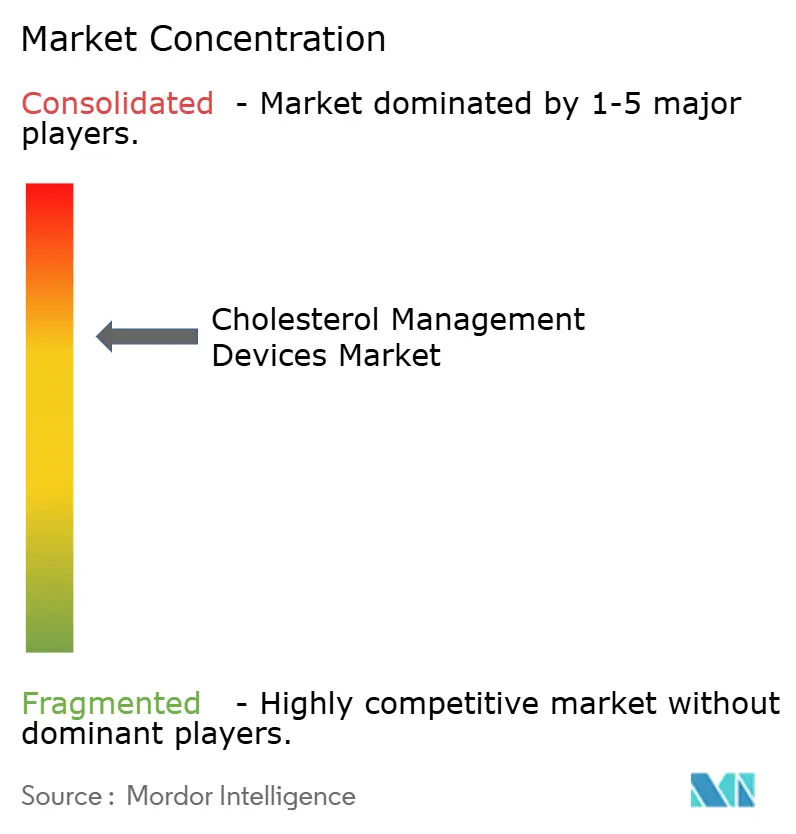
| Market Concentration | Medium |
Major Players *Disclaimer: Major Players sorted in no particular order Image © Mordor Intelligence. Reuse requires attribution under CC BY 4.0. | |
Cholesterol Management Devices Market Analysis by Mordor Intelligence
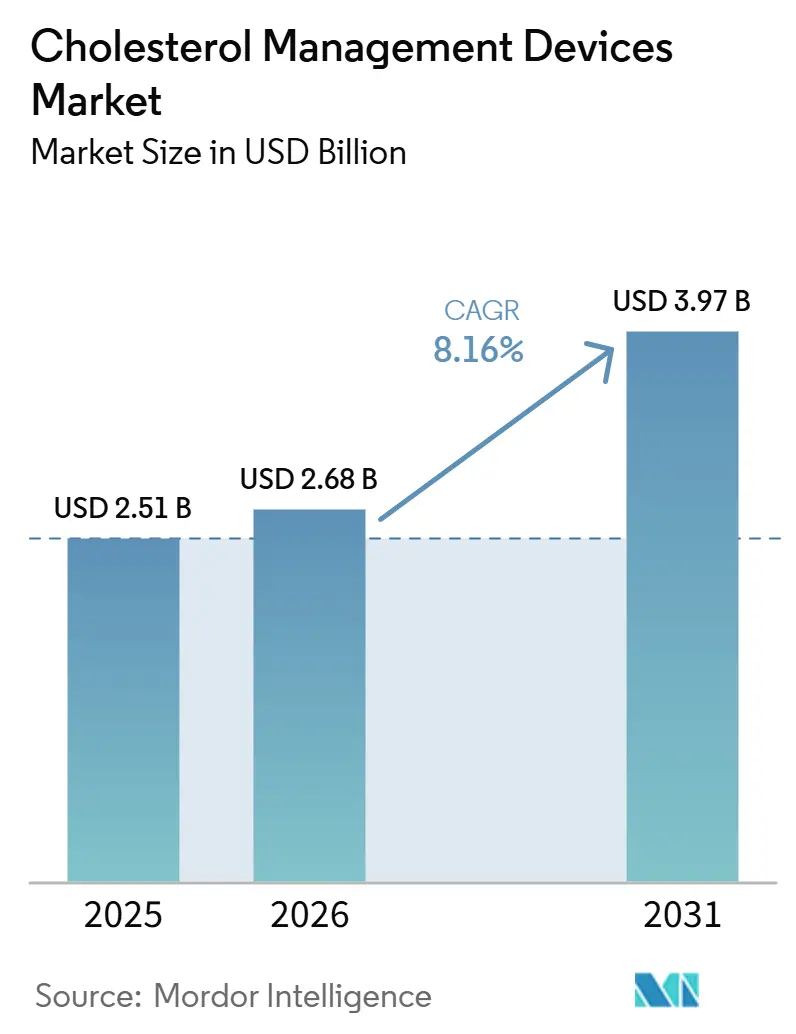
The cholesterol management devices market is projected to be USD 2.51 billion in 2025, USD 2.68 billion in 2026, and reach USD 3.97 billion by 2031, growing at a CAGR of 8.16% from 2026 to 2031. Demand remains tied to the rising burden of cardiovascular disease, with the Global Burden of Disease 2023 study reporting 19.2 million cardiovascular deaths in 2023 and identifying high LDL cholesterol as 1 of the leading modifiable contributors to cardiovascular disease related disability adjusted life years globally. Longer-range disease projections also support durable testing demand, as a 2025 peer reviewed study projected a 90% rise in cardiovascular prevalence and an increase in crude mortality from 20.5 million deaths in 2025 to 35.6 million by 2050, with high cholesterol among the major modifiable drivers. The 2026 ACC and AHA dyslipidemia guideline expands the testing pool further by recommending Lipoprotein(a) measurement at least once in adulthood and broader use of Apolipoprotein B in higher-risk groups, which increases the need for analyzers and test menus that go beyond standard lipid panels. The cholesterol management devices market also benefits from the shift toward decentralized testing, connected monitoring, and preventive care pathways that move cholesterol screening closer to primary care, outpatient settings, and the home. Reimbursement friction for non-laboratory tests and pricing pressure on consumables still weigh on the category, but guideline expansion, aging populations, and technology miniaturization continue to support steady growth in the cholesterol management devices market.
Key Report Takeaways
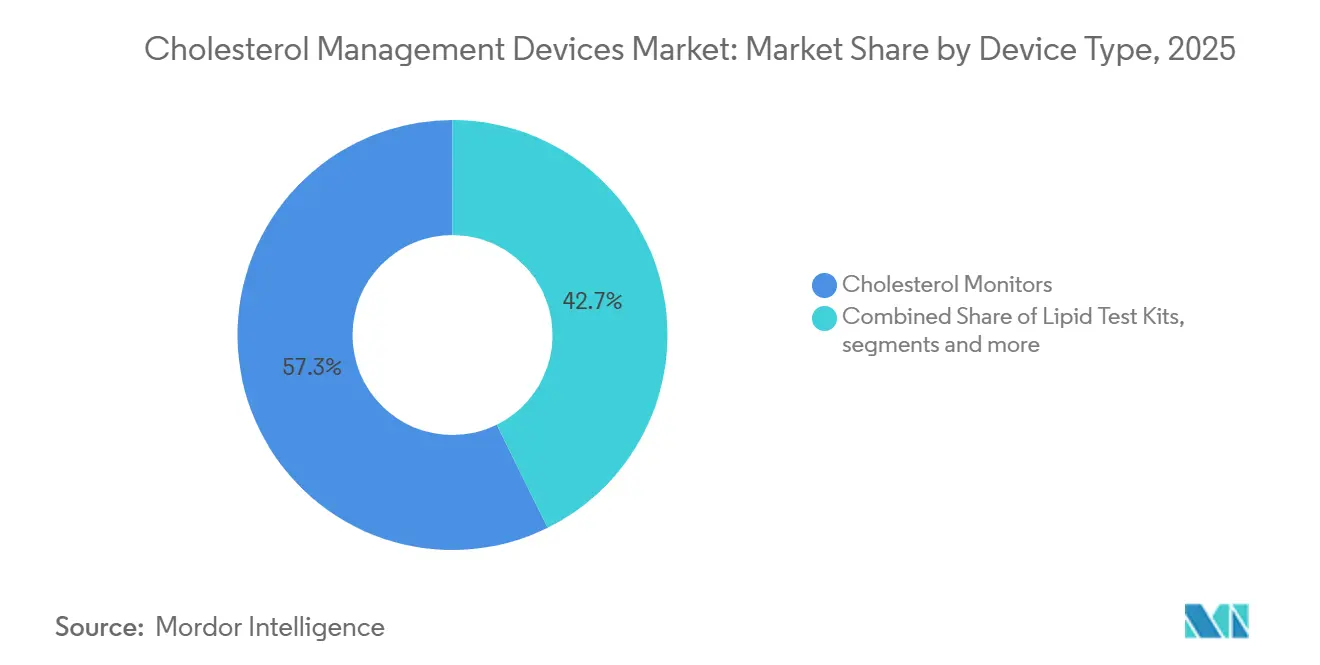
- By device type, cholesterol monitors led with 57.26% revenue share in 2025, while lipid test kits are projected to expand at an 8.75% CAGR through 2031.
- By technology, digital devices held 51.24% revenue share in 2025, while analog devices are forecasted to grow at a 9.21% CAGR through 2031.
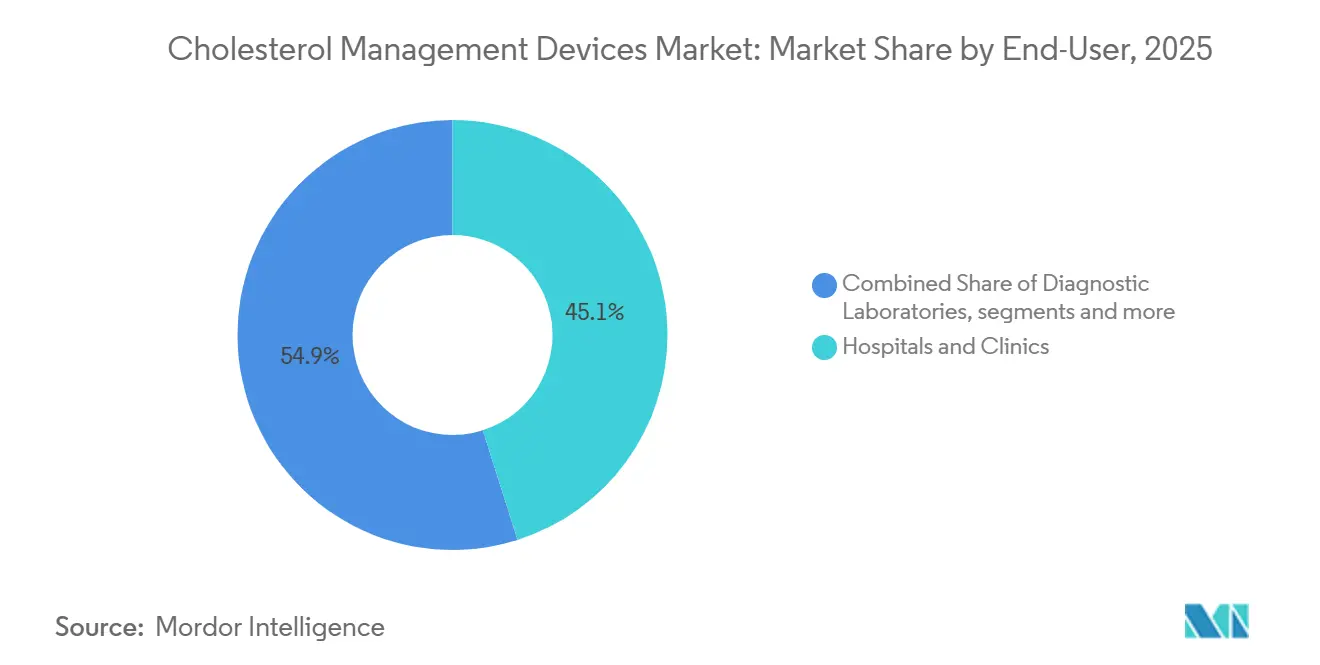
- By end-user, hospitals and clinics accounted for 45.13% of the cholesterol management devices market share in 2025, while home healthcare settings are projected to record the fastest growth at a 9.52% CAGR through 2031.
- By distribution channel, hospital pharmacies accounted for 44.22% of the cholesterol management devices market in 2025, while online retail and e-commerce are projected to grow at an 8.47% CAGR through 2031.
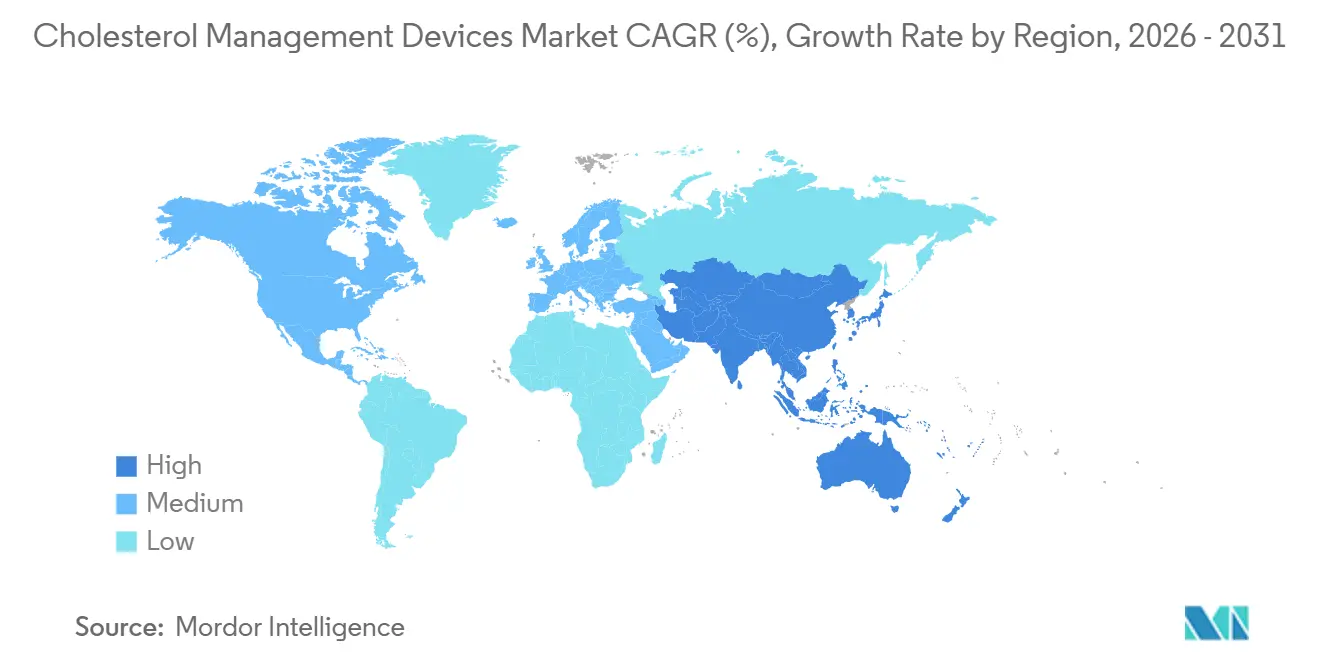
- By geography, North America held 46.51% revenue share in 2025, while Asia-Pacific is forecasted to grow at a 10.43% CAGR through 2031.
Note: Market size and forecast figures in this report are generated using Mordor Intelligence’s proprietary estimation framework, updated with the latest available data and insights as of January 2026.
Market Trends and Insights
Drivers Impact Analysis of Cholesterol Management Devices Market*
| Driver | (~) % Impact on CAGR Forecast | Geographic Relevance | Impact Timeline |
|---|---|---|---|
| Rising Cardiovascular Risk Screening Across Primary Care and Pharmacies | +2.2% | Global, most pronounced in North America and Europe | Long term (≥ 4 years) |
| Growth of Point-of-Care Lipid Testing in Outpatient and Home Settings | +1.6% | Global, with APAC core and spill-over to MEA | Medium term (2-4 years) |
| Expansion of Digital and Connected Cholesterol Monitoring Ecosystems | +1.4% | North America, Europe, APAC urban | Medium term (2-4 years) |
| Higher Adoption of Preventive Cardiometabolic Checkups in Aging Populations | +1.0% | Global, led by North America and EU | Long term (≥ 4 years) |
| Expansion of at-Home Self-Testing Through Subscription and Employer Health Programs | +0.8% | North America, Europe, China | Short term (≤ 2 years) |
| Demand for Multi-Analyte Cardiometabolic Panels that Bundle Cholesterol with HbA1c and Glucose | +0.6% | Global, concentrated in high-acuity markets | Medium term (2-4 years) |
| Source: Mordor Intelligence | |||
Rising Cardiovascular Risk Screening Across Primary Care and Pharmacies
The epidemiological pressure behind the cholesterol management devices market extends beyond headline mortality counts and now shapes routine screening policy in many care settings. The Global Burden of Disease 2023 study found that modifiable metabolic risk factors, including high LDL cholesterol, accounted for 67.3% of global cardiovascular disease related disability adjusted life years, which keeps cholesterol testing high on national prevention agendas HEALTHDATA.ORG. The 2026 ACC and AHA guideline also moves cardiovascular risk assessment earlier in life, reflecting the view that atherosclerotic risk builds over decades rather than appearing suddenly in older age JACC.ORG. As screening broadens across physician offices, community pharmacies, and preventive care programs, the cholesterol management devices market gains from a larger installed base requirement for analyzers, monitors, and recurring test supplies.
Growth of Point-of-Care Lipid Testing in Outpatient and Home Settings
Point of care lipid testing is moving beyond cardiology offices and has become more relevant in primary care, urgent care, and retail health settings. The main shift is that lipid panel delivery is becoming less dependent on central phlebotomy infrastructure, which allows more same day decision making during a patient visit. Faster result turnaround supports immediate medication adjustment, referral decisions, and follow-up planning, which improves the practical value of these systems for routine care. This makes the cholesterol management devices market more responsive to workflow needs in outpatient care, where speed and convenience often determine whether a test is used regularly. The same trend also supports home use in the cholesterol management devices market, especially where chronic disease management is moving away from episodic clinical visits toward ongoing monitoring between appointments.
Expansion of Digital and Connected Cholesterol Monitoring Ecosystems
Connectivity is changing cholesterol monitoring from a stand-alone measurement into part of a broader data and care management system. Wireless transfer, app-based result storage, and cloud connectivity make it easier for users and providers to track readings over time and integrate them with wider cardiometabolic records. A 2025 systematic review that covered 37 studies on non-invasive and wearable lipid monitoring found that several prototype approaches reported accuracy levels of 91% to 98%, while also noting that most of these technologies still need broader clinical validation before widespread use SPRINGER.COM. Researchers at the National University of Singapore and A*STAR also developed a wearable and stretchable hydrogel sensor that can detect skin surface biomarkers and transmit results wirelessly, showing how fast the underlying sensor platform is advancing. In the cholesterol management devices market, these connected systems are likely to supplement clinical grade testing first, while gradually widening use cases in consumer health, remote monitoring, and preventive screening.
Higher Adoption of Preventive Cardiometabolic Checkups in Aging Populations
Preventive cardiometabolic testing is becoming more routine as health systems face older populations and a wider chronic disease burden. The 2025 projection study on cardiovascular disease showed that global prevalence could rise by 90% by 2050, which gives the cholesterol management devices market a long demand runway that extends well beyond normal equipment replacement cycles. The same pressure supports more regular lipid testing in employer health checks, population screening programs, and chronic disease prevention pathways. It also raises the importance of devices that fit routine, repeat testing rather than one time acute diagnostics. As preventive protocols become more systematized, the cholesterol management devices market benefits from steadier demand across both institutional testing and consumer facing monitoring models.
Restraints Impact Analysis of Cholesterol Management Devices Market*
| Restraint | (~) % Impact on CAGR Forecast | Geographic Relevance | Impact Timeline |
|---|---|---|---|
| Reimbursement Friction for Non-Laboratory Cholesterol Testing | -1.5% | North America, payer driven, with spill-over to EU managed care | Short term (≤ 2 years) |
| Regulatory Validation Burden Across Multiparameter and Connected Devices | -0.9% | EU, US, Asia | Medium term (2-4 years) |
| Consumables Dependency and Pricing Pressure on Test Strips and Reagents | -0.6% | Global, concentrated in emerging markets | Long term (≥ 4 years) |
| Clinical Preference for Centralized Laboratory Reference Testing in Higher-Acuity Settings | -0.5% | EU, Japan, and parts of North America | Long term (≥ 4 years) |
| Source: Mordor Intelligence | |||
Reimbursement Friction for Non-Laboratory Cholesterol Testing
The reimbursement model for non-laboratory cholesterol testing remains a practical barrier, especially in the United States. UnitedHealthcare issued a September 2025 commercial reimbursement policy update that became effective on December 1, 2025 and tightened the conditions around routine laboratory testing across office, outpatient, and independent laboratory settings. In the cholesterol management devices market, this slows adoption of office based and point of care products because smaller manufacturers often lack the payer contracting strength that large laboratory service providers already have. It also limits how quickly testing can move from centralized laboratories into clinics, pharmacies, and home centered care pathways within the cholesterol management devices market.
Regulatory Validation Burden Across Multiparameter and Connected Devices
The cholesterol management devices market also faces a heavier validation burden as companies develop connected, multiparameter, and consumer oriented products. Manufacturers now have to manage evolving evidence requirements across several major jurisdictions at the same time, which raises development cost and extends launch timelines. The European Commission published amendment proposal 2025/0404 in December 2025 to simplify parts of the IVDR framework, but that process is still moving through adoption and does not remove the current need for substantial evidence generation. Companies that seek both FDA and European clearance must therefore plan around different review paths and documentation expectations, even when the core test principle is similar. In the cholesterol management devices market, this is especially challenging for firms that want to serve both professional users and self testing consumers with the same platform family.
*Our forecasts treat driver/restraint impacts as directional, not additive. The impact forecasts reflect baseline growth, mix effects, and variable interactions.
Cholesterol Management Devices Market Segment Analysis
By Device Type:
Integrated Cardiovascular Risk Drives Broad Device MixCholesterol monitors held 57.26% of device type revenue in 2025, which reflects how hypertension and dyslipidemia are often managed together in real clinical practice. Lipid test kits are expected to record the fastest growth at an 8.8% CAGR through 2031, supported by broader lipid testing recommendations and stronger demand for compact fingerstick based systems. Lipid test kits still are becoming more useful in pharmacy, retail health, and recurring home testing models.
Companies in the cholesterol management devices industry are therefore balancing capital device placement with repeat strip and reagent sales to improve lifetime customer value. Product lines that fit multi-analyte cardiometabolic workflows should remain better positioned, because cholesterol testing is increasingly ordered alongside glucose, HbA1c, and other risk markers rather than as an isolated measurement.



By Technology:
Analog Devices Outpace Legacy Form FactorsDigital devices accounted for 51.24% of technology revenue in 2025, which made digital hardware the main commercial standard across hospital, laboratory, and home care settings. That position reflects the wider availability of app connectivity, cloud transfer, and smartphone linked interfaces that help users store and review measurements. Analog devices are projected to expand at a 9.21% CAGR through 2031, which makes them the fastest growing part of the cholesterol management devices market within the technology split.
Even so, analog devices still matter in cost sensitive settings and in locations where digital connectivity remains less reliable. The cholesterol management devices market will likely see gradual share erosion for analog formats rather than an abrupt exit, because affordability and operational simplicity still matter in many use cases.
By End-User:
Home Healthcare Emerges as the Structural Growth VectorHospitals and clinics represented 45.13% of end user revenue in 2025, which kept institutional care as the largest demand center for the cholesterol management devices market. These settings continue to favor higher throughput systems, automation compatibility, and reliable reagent performance, especially where lipid testing is part of broader clinical chemistry workflows. Home healthcare settings are projected to grow at a 9.52% CAGR through 2031, which makes it the fastest moving end user segment in the cholesterol management devices market.
Diagnostic laboratories remain an important pillar because expanded requests for Lp(a) and ApoB testing require stronger analytical capability than many office settings currently have. Over time, the cholesterol management devices market should see a more balanced demand mix where institutional testing supports advanced biomarkers and home settings support routine follow-up and recurring use.
By Distribution Channel:
E-Commerce Structurally Reshapes the Consumer-Device Value ChainHospital pharmacies accounted for 44.22% of distribution channel revenue in 2025, which shows that institutional procurement still anchors the largest part of product movement in the cholesterol management devices market. Bulk purchasing, standardization, and supply continuity remain more important than unit pricing in that channel. Online retail and e-commerce are forecasted to grow at an 8.57% CAGR through 2031, which points to a clear shift in how consumer grade monitors and test kits reach end users. This channel is becoming more relevant as buyers compare device features, subscription terms, and refill pricing more directly than they do in traditional healthcare distribution.
Retail pharmacies still hold a useful middle position because they support both first time purchase and recurring consumable replenishment. Companies in the cholesterol management devices industry that build recurring replenishment and digital follow-up into the sales model should be better placed than those that rely only on one time hardware transactions.
Geography Analysis
North America Cholesterol Management Devices Market
North America held 46.51% of the cholesterol management devices market share in 2025, supported by mature healthcare infrastructure, high testing intensity, and broad access to diagnostic pathways. The 2026 ACC and AHA dyslipidemia guideline is a meaningful near-term catalyst in the United States because it makes Lp(a) testing a once in adulthood recommendation and expands the role of ApoB in risk assessment. Canada and Mexico contribute a smaller share, but urban cardiovascular programs continue to support broader diagnostic investment across the region.
Europe Cholesterol Management Devices Market
Europe remained the second largest regional segment in the cholesterol management devices market, with Germany, the United Kingdom, and France forming the main country level demand centers. The region still leans more heavily toward centralized laboratory medicine than decentralized point of care testing, which shapes product adoption patterns across hospitals and outpatient settings. IVDR related compliance demands are pushing manufacturers to spend more on evidence generation and portfolio prioritization, especially when they want wide European coverage. The European Commission’s December 2025 amendment proposal could simplify parts of that process by 2027, which would help the entry path for next generation connected cholesterol monitoring systems.
APAC, South America and MEA Cholesterol Management Devices Market
Asia-Pacific is projected to grow at a 10.43% CAGR through 2031, which makes it the fastest growing regional block in the cholesterol management devices market. India is described as the fastest growing country market in the region, supported by rising urban cardiovascular burden and expanding diagnostic capacity. Japan provides a stable base for routine lipid testing through established health check structures, while other Asian markets continue to build institutional and consumer testing capacity. South America and the Middle East and Africa remain earlier stage opportunities in the cholesterol management devices market, where urban demand is rising but affordability limits and infrastructure gaps still moderate adoption.

Competitive Landscape
The cholesterol management devices market is moderately consolidated at the top tier, with a limited group of multinational diagnostics companies competing through broad product portfolios, established installed bases, and recurring reagent relationships. Competition in this part of the market depends more on assay menu breadth, workflow integration, service support, and platform economics than on simple unit pricing alone. Below that group, the cholesterol management devices market becomes more fragmented, with regional and specialist players competing through cost positioning, narrower product focus, and faster response in selected niches. This creates a two speed structure where global incumbents hold the strongest institutional positions, while smaller manufacturers pursue opportunity in point of care, self testing, and lower cost delivery formats.
Platform consolidation is a major strategic pattern in 2026. Siemens Healthineers has announced plans to launch 30 new assays on its Atellica Solution and Atellica CI platforms in 2026, while also phasing out 20 legacy platforms by the end of 2030 as part of a portfolio simplification strategy. These moves show that leading companies are strengthening scale, menu depth, and laboratory efficiency at the same time rather than focusing on single product launches. In the cholesterol management devices market, that matters because routine lipid testing volumes remain large enough for throughput and operating economics to influence share retention.
The competitive field also continues to widen at the edge of the market, where point of care and connected formats are still developing. The cholesterol management devices market also leaves room for smaller companies that can address undersupplied needs in compact multi-analyte platforms, community health settings, and premium home monitoring. That said, reimbursement barriers and validation demands still favor companies with stronger regulatory resources, broader service networks, and the ability to spread development cost across larger portfolios.
Cholesterol Management Devices Industry Leaders
Abbott
Roche Diagnostics
Siemens Healthineers
PTS Diagnostics
Randox Laboratories
- *Disclaimer: Major Players sorted in no particular order
Cholesterol Management Devices Market Companies Covered in this Report
- Abbott Laboratories
- Acon Laboratories
- Arkray
- Bayer
- Beckton Dickinson
- Bioptik Technology
- Cardinal Health
- Danaher
- EKF Diagnostics
- Johnson & Johnson
- Koninklijke Philips
- Medtronic
- Nova Biomedical
- PTS Diagnostics
- Quest Diagnostics
- Randox Laboratories
- Roche
- Siemens Healthineers
- Sinocare
- Thermo Fisher Scientific

Recent Industry Developments in Cholesterol Management Devices Market
- March 2026: Roche received FDA 510(k) clearance for its cobas c 703 and cobas ISE neo analytical units on March 30, 2026. The cobas c 703 delivers up to 2,000 chemistry tests per hour and reduces per-test sample volume by 43% versus prior-generation systems. These additions expand Roche's cobas pro integrated solutions and strengthen its position in high-throughput clinical chemistry, including lipid panel testing at scale.
- December 2025: Truvian Health received FDA 510(k) clearance for its TruVerus Lipids panel on December 30, 2025, providing total cholesterol and triglycerides quantification from whole blood with calculated VLDL values using its TruVerus point-of-care analyzer. This clearance, which followed a 264-day review cycle, expands the compact POC clinical chemistry competitive set competing with established multi-analyte lipid analyzers.
- January 2025: Roche announced FDA 510(k) clearance for its Tina-quant Lipoprotein (a) Gen.2 Molarity assay on January 29, 2025, becoming the first FDA-cleared test in the United States to measure Lp(a) in nanomoles per liter. Elevated Lp(a) affects approximately 1 in 5 people globally, and the National Lipid Association recommends Lp(a) measurement at least once per adult lifetime. The assay will be available on Roche's broad chemistry system network in the United States.


Global Cholesterol Management Devices Market Report Scope
According to the report’s scope, the cholesterol management devices market refers to the global industry focused on the development, manufacturing, and commercialization of devices used to measure and monitor cholesterol and related lipid levels. These devices support early detection, routine monitoring, and management of dyslipidemia and cardiovascular risk in clinical and home-care settings.
The cholesterol management devices market is segmented into device type, technology, end-user, distribution channel, and geography. By device type, the market is segmented into cholesterol monitors, lipid test kits, and other device types. By technology, the market is segmented into digital devices and analog devices. By end-user, the market is segmented into hospitals and clinics, diagnostic laboratories, and home healthcare settings. By distribution channel, the market is segmented into hospital pharmacies, retail pharmacies, and online retail and e-commerce. By geography, the market is segmented into North America, Europe, Asia-Pacific, the Middle East and Africa, and South America. The report also covers the estimated market sizes and trends for 17 countries across major regions globally. The report offers values (USD) for all the above segments.
| Cholesterol Monitors |
| Lipid Test Kits |
| Other Device Types |
| Digital Devices |
| Analog Devices |
| Hospitals and Clinics |
| Diagnostic Laboratories |
| Home Healthcare Settings |
| Hospital Pharmacies |
| Retail Pharmacies |
| Online Retail and E-Commerce |
| North America | United States |
| Canada | |
| Mexico | |
| Europe | Germany |
| United Kingdom | |
| France | |
| Italy | |
| Spain | |
| Rest of Europe | |
| Asia-Pacific | China |
| Japan | |
| India | |
| Australia | |
| South Korea | |
| Rest of Asia-Pacific | |
| Middle East and Africa | GCC |
| South Africa | |
| Rest of Middle East and Africa | |
| South America | Brazil |
| Argentina | |
| Rest of South America |
| By Device Type | Cholesterol Monitors | |
| Lipid Test Kits | ||
| Other Device Types | ||
| By Technology | Digital Devices | |
| Analog Devices | ||
| By End-User | Hospitals and Clinics | |
| Diagnostic Laboratories | ||
| Home Healthcare Settings | ||
| By Distribution Channel | Hospital Pharmacies | |
| Retail Pharmacies | ||
| Online Retail and E-Commerce | ||
| By Geography | North America | United States |
| Canada | ||
| Mexico | ||
| Europe | Germany | |
| United Kingdom | ||
| France | ||
| Italy | ||
| Spain | ||
| Rest of Europe | ||
| Asia-Pacific | China | |
| Japan | ||
| India | ||
| Australia | ||
| South Korea | ||
| Rest of Asia-Pacific | ||
| Middle East and Africa | GCC | |
| South Africa | ||
| Rest of Middle East and Africa | ||
| South America | Brazil | |
| Argentina | ||
| Rest of South America | ||


Key Questions Answered in the Report
How large is the cholesterol management devices market in 2026?
The cholesterol management devices market stands at USD 2.51 billion in 2025 to USD 2.68 billion in 2026 and is projected to reach USD3.97 billion by 2031, growing at an 8.16% CAGR over 2026 to 2031.
Which product category leads current revenue?
Cholesterol monitors led device type revenue with a 57.26% share in 2025, reflecting the close link between hypertension management and lipid monitoring in cardiovascular care.
Which technology is expanding the fastest?
Analog devices are projected to grow at a 9.21% CAGR through 2031 as sensor design, wireless transfer, and non-invasive monitoring platforms continue to improve.
Which region is likely to expand the fastest through 2031?
Asia-Pacific is forecasted to grow at a 10.43% CAGR through 2031, supported by rising urban cardiovascular burden and continued expansion of diagnostic capacity.
Page last updated on:





