
China-Vietnam Cross-Border Logistics Market Size and Share
Market Overview
| Study Period | 2021 - 2032 |
|---|---|
| Forecast Data Period | 2027 - 2032 |
| Base Year Market Size (2026) | USD 4.68 Billion |
| Market Size (2027) | USD 5 Billion |
| Market Size (2032) | USD 6.90 Billion |
| Growth Rate (2027 - 2032) | 6.64 % |
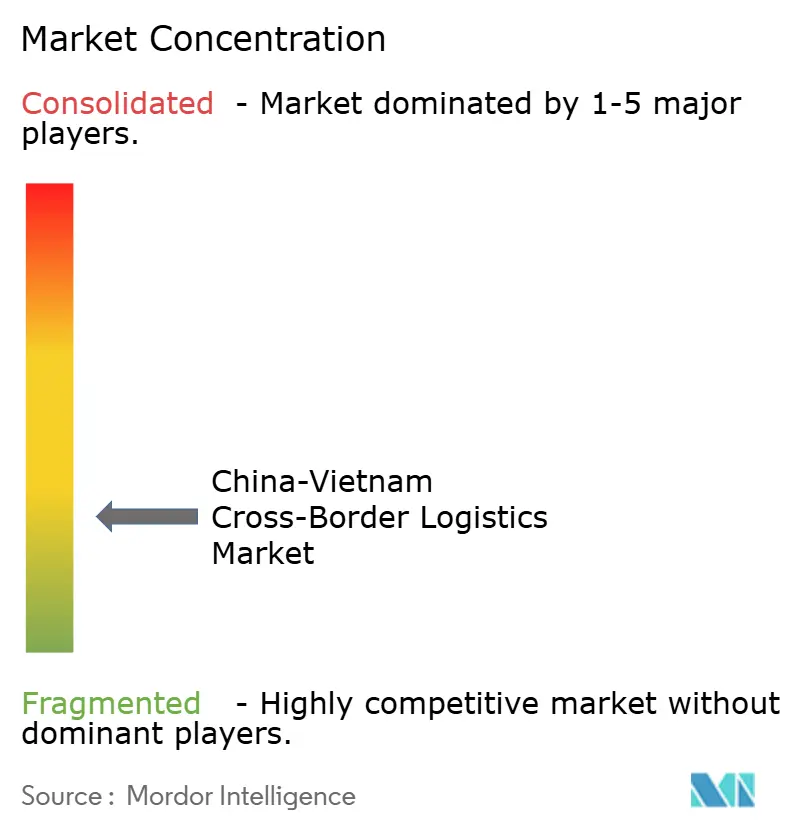
| Market Concentration | Low |
Major Players *Disclaimer: Major Players sorted in no particular order Image © Mordor Intelligence. Reuse requires attribution under CC BY 4.0. | |
China-Vietnam Cross-Border Logistics Market Analysis by Mordor Intelligence
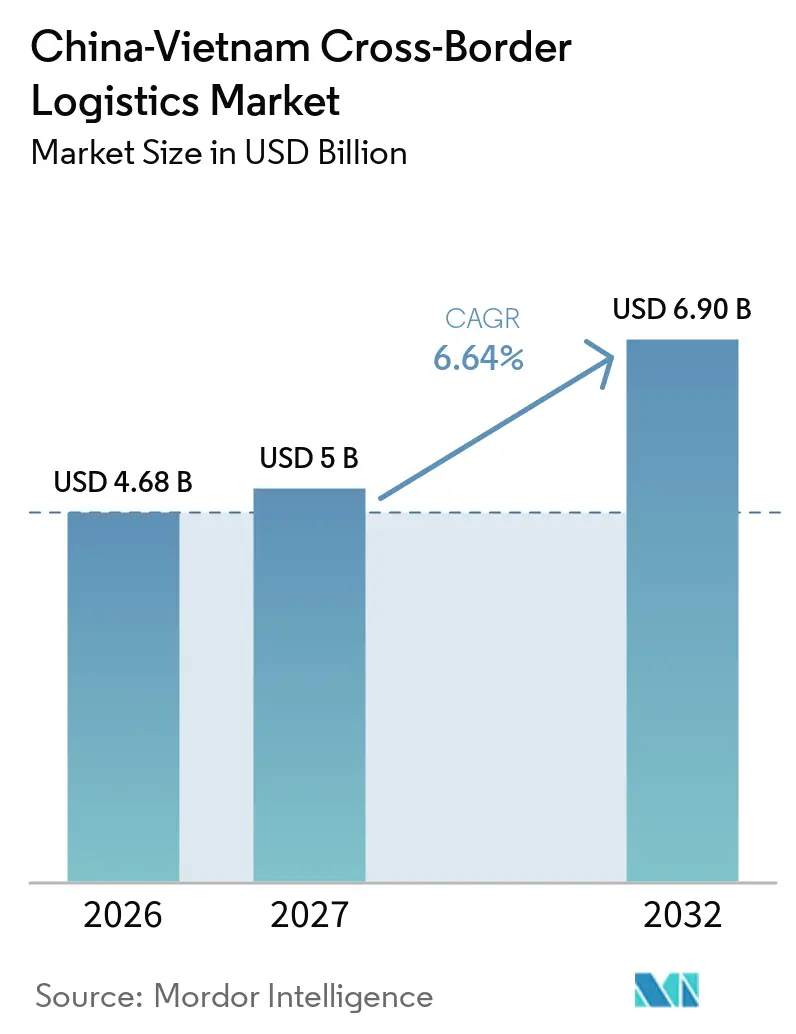
The China-Vietnam cross-border logistics market size is valued at USD 4.68 billion in 2026. It is estimated to grow from USD 5.00 billion in 2027 to reach USD 6.90 billion by 2032, at a CAGR of 6.64% during the forecast period (2027-2032).
The market is supported by the integration of Chinese supply networks with Vietnamese manufacturing facilities, growing cross-border e-commerce activity, and investment in transport and customs infrastructure. Manufacturers in Vietnam rely on Chinese machinery, components, and intermediate goods, creating recurring demand for road freight, rail transport, customs brokerage, and warehousing. Cross-border e-commerce is also increasing the movement of smaller consignments, raising demand for parcel sorting, bonded storage, fulfillment, and last-mile delivery. Agricultural products and seafood add requirements for temperature-controlled transport and timely customs processing. Infrastructure development and customs digitization are changing how goods move through the corridor. Direct trucking routes introduced in May 2025 under the Greater Mekong Subregion Cross-Border Transport Facilitation Agreement reduce the need for intermediate transshipment on designated routes. Vietnam’s Circular 128/2026/TT-BTC, effective from October 2026, establishes procedures for customs management in approved smart-border areas. These developments can improve cargo processing and shipment planning, although the benefits depend on operational capacity and coordination at individual crossings.
Key Report Takeaways
- By end-user industry, manufacturing accounts for 36.82% of the China-Vietnam cross-border logistics market share in 2026, while wholesale and retail trade is projected to register a CAGR of 8.33% through 2032.
- By logistics function, freight transport mode accounts for 62.34% of the China-Vietnam cross-border logistics market size in 2026, while value-added services and others are forecast to expand at a CAGR of 7.94% through 2032.
- By shipment type, business-to-consumer accounts for 61.41% of the China-Vietnam cross-border logistics market share in 2026 and is projected to register a CAGR of 7.37% through 2032.
- By trade direction, China-to-Vietnam accounts for 59.26% of the China-Vietnam cross-border logistics market size in 2026, while Vietnam-to-China is projected to register a CAGR of 8.24% through 2032.
Note: Market numbers in this report are based on Mordor Intelligence's proprietary estimation framework, which combines nine months of actuals with Q4 projections for base year 2026.
Market Trends and Insights
Drivers Impact Analysis of China-Vietnam Cross-Border Logistics Market*
| Driver | (~) % Impact on CAGR Forecast | Geographic Relevance | Impact Timeline |
|---|---|---|---|
| China-Plus-One Manufacturing Expanding Cross-Border Demand | +1.5% | Northern Vietnam and Guangxi-Yunnan provinces, especially Lang Son-Huu Nghi and Lao Cai corridors | Long term (≥ 4 years) |
| China-Origin E-Commerce Increasing Parcel and Fulfillment Volumes | +1.2% | Guangxi-Vietnam border zone and Ho Chi Minh City-Guangdong axis | Medium term (2-4 years) |
| Smart Border Automation Improving Cargo Processing | +0.8% | Huu Nghi, Mong Cai, and Lao Cai border gates | Medium term (2-4 years) |
| RCEP Integration Simplifying Trade and Customs | +0.6% | China-Vietnam bilateral flows and RCEP member markets | Long term (≥ 4 years) |
| Fresh-Produce Trade Expanding Temperature-Controlled Logistics Demand | +0.4% | Vietnamese agricultural provinces, Guangxi, Yunnan, Hekou, and Friendship Pass | Medium term (2-4 years) |
| Direct Trucking Frameworks Improving Bilateral Freight Connectivity | +0.3% | Kunming-Lao Cai-Hanoi and Nanning-Huu Nghi-Hanoi corridors | Short term (≤ 2 years) |
| Source: Mordor Intelligence | |||
China-Plus-One Manufacturing Expanding Cross-Border Demand
China-Plus-One strategies are encouraging manufacturers to diversify production locations while maintaining established supply relationships with Chinese suppliers. Vietnamese factories in electronics, footwear, textiles, and other manufacturing industries continue to depend on Chinese machinery, components, and intermediate goods. This creates recurring freight demand across road, rail, freight forwarding, and customs services. Vietnam’s role in footwear production illustrates the scale of its manufacturing base. NIKE reported in its fiscal 2025 filing that Vietnam accounted for approximately 51% of its brand’s footwear production[1]. This figure highlights Vietnam’s importance to a major global manufacturing supply chain, although it does not directly measure China-Vietnam logistics volumes. Manufacturing-related shipments often follow production schedules and recurring procurement requirements. Logistics providers can support these flows through scheduled trucking, consolidated shipments, customs brokerage, and inventory coordination. The need to maintain component availability also encourages manufacturers to prioritize predictable transit times and shipment visibility, supporting demand for integrated cross-border services.
China-Origin E-Commerce Increasing Parcel and Fulfillment Volumes
Cross-border e-commerce is increasing the movement of smaller and more frequent shipments between China and Vietnam. These flows require parcel sorting, fulfillment, accurate product data, customs documentation, and delivery networks capable of handling high order volumes. Border-adjacent warehouses and bonded facilities can help sellers position inventory closer to consumers and reduce the time needed to fulfil orders. The Dongxing cross-border e-commerce supervision center in Guangxi illustrates the infrastructure being used to process these shipments. The growth of cross-border parcel activity also increases demand for automated sorting and integrated fulfillment services.
Smart-Border Automation Improving Cargo Processing
Smart-border initiatives are intended to improve customs processing through electronic data exchange, vehicle recognition, surveillance systems, and coordinated cargo management. In April 2026, Vietnam and China signed a customs cooperation agreement to strengthen administrative assistance and information exchange[2]. The agreement provides a framework for improved customs coordination. These measures can improve cargo visibility and reduce administrative delays when systems are implemented consistently. Their impact will depend on infrastructure readiness, customs coordination, data quality, and the capacity available at individual crossings. Logistics providers will continue to require accurate documentation and contingency plans for periods of congestion.
RCEP Integration Supporting Regional Trade
The Regional Comprehensive Economic Partnership (RCEP) provides a common framework for trade among participating Asia-Pacific economies, including China and Vietnam. Its tariff commitments and rules of origin can support regional sourcing and manufacturing arrangements when shipments meet the applicable eligibility requirements. For logistics providers, regional trade integration creates demand for accurate product classification, origin documentation, customs brokerage, and coordinated movement of intermediate goods. Preferential tariff treatment is not automatic for every shipment and depends on product-specific rules and compliance with the relevant documentation requirements. As manufacturers organize production across several RCEP markets, providers that can maintain shipment records and coordinate customs procedures across jurisdictions may gain an advantage. These services are particularly relevant to companies that source components in one country, manufacture in another, and distribute finished goods across the region.
Restraints Impact Analysis of China-Vietnam Cross-Border Logistics Market*
| Restraint | (~) % Impact on CAGR Forecast | Geographic Relevance | Impact Timeline |
|---|---|---|---|
| Seasonal Border Congestion Increasing Clearance-Time Volatility | -0.8% | Lang Son, Quang Ninh, and Lao Cai crossings during agricultural export seasons and pre-Lunar New Year peaks | Short term (2 years or less) |
| Fragmented Carrier Capacity Limiting Service Consistency | -0.5% | Northern Vietnam and Guangxi overland trucking networks | Medium term (2–4 years) |
| Tax and VAT Compliance Increasing Import Complexity | -0.6% | Nationwide, particularly low-value B2C parcels | Medium term (2–4 years) |
| Empty-Container Imbalances Weakening Return-Load Economics | -0.4% | Hai Phong, Ho Chi Minh City, and Chinese inland logistics hubs such as Pingxiang | Long term (4 years or more) |
| Source: Mordor Intelligence | |||
Seasonal Border Congestion Increasing Clearance-Time Volatility
Seasonal peaks can increase uncertainty at major overland crossings. Agricultural harvests and Lunar New Year shipments may coincide with high volumes of industrial and consumer goods, placing pressure on inspection areas, border infrastructure, and available truck capacity. Delays are particularly challenging for perishable cargo because longer transit times can affect product quality and saleability. Direct trucking and smart-border projects may reduce some sources of delay, but their impact depends on operational capacity and coordination between the two countries. Until improvements are implemented consistently, logistics operators need flexible routing, advance documentation, realistic transit estimates, and contingency capacity during peak periods.
Empty-Container Imbalances Weakening Return-Load Economics
Differences in trade volumes and cargo types can affect container availability and return-load utilization. When equipment moves predominantly in one direction, carriers may need to reposition empty containers or accept less profitable return movements, increasing operating costs. Vietnam’s seafood exports to China exceeded USD 2.2 billion in 2025, up approximately 33% from the previous year[3]. These exports provide one source of northbound cargo demand, although agricultural and seafood shipments may be seasonal and may not match the timing or equipment requirements of inbound container flows. Equipment-sharing arrangements, better depot coordination, and improved planning across transport modes may help reduce repositioning costs. Smaller forwarders can be more exposed to imbalances because they may have less control over container fleets, depots, and contracted return cargo.
*Our forecasts treat driver/restraint impacts as directional, not additive. The impact forecasts reflect baseline growth, mix effects, and variable interactions.
China-Vietnam Cross-Border Logistics Market Segment Analysis
By End-User Industry:
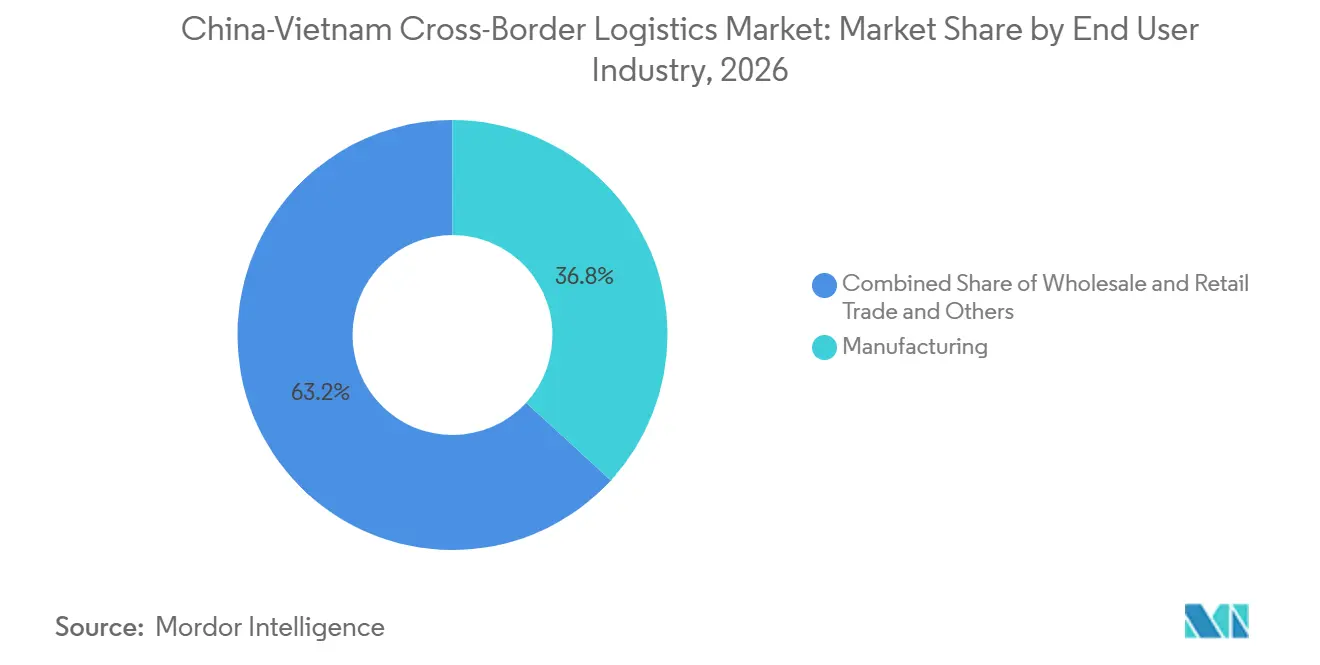
Manufacturing Anchors Volumes, While Retail Trade GrowsManufacturing accounts for 36.82% of the China-Vietnam cross-border logistics market share in 2026, while wholesale and retail trade is projected to register a CAGR of 8.33% through 2032. Vietnamese factories depend on cross-border movements of machinery, components, intermediate goods, and raw materials from Chinese suppliers. These flows support demand for road freight, rail services, freight forwarding, customs brokerage, and scheduled deliveries aligned with production requirements.
Wholesale and retail trade is projected to register a CAGR of 8.33% through 2032 and be the fastest-growing end-user segment as retailers and digital platforms source more consumer goods across the border. These shipments involve many product categories, frequent orders, and requirements for parcel fulfillment, inventory management, returns, and last-mile delivery. Agricultural products, seafood, and other consumer goods add further variety to the corridor. This mix creates opportunities for logistics companies that combine cross-border movement with customs support, fulfillment, and specialized cargo handling.

By Logistics Function:
Freight Transport Leads, While Value-Added Services ExpandFreight transport mode accounts for 62.34% of the China-Vietnam cross-border logistics market share in 2026. Road transport remains important because it provides flexible connections between industrial areas, border crossings, and distribution centers. The direct-trucking routes inaugurated in May 2025 under the Greater Mekong Subregion agreement connect designated locations in China and Vietnam without requiring intermediate cargo transshipment. The framework can save approximately 1 day in transit time on eligible routes. Rail freight also supports the corridor. China-Vietnam freight trains originating in Guangxi transported 37,000 TEUs in 2025, an increase of 86% from 2024. Rail can complement road freight for suitable cargo, although its competitiveness depends on terminal access, schedules, cargo characteristics, and connections to final destinations.
Value-added services and others are projected to register a CAGR of 7.94% through 2032. Value-added services include customs brokerage, bonded warehousing, cargo consolidation, fulfillment, shipment visibility, and specialized handling. These services help shippers manage documentation and reduce the number of separate providers involved in a shipment. Their importance increases as e-commerce volumes grow and manufacturers seek greater control over inventory and delivery schedules. Providers that combine transport with warehousing and customs coordination can compete on service integration rather than transport price alone.
By Shipment Type:
Business-to-Consumer Leads and Continues to GrowBusiness-to-consumer shipments account for 61.41% of the China-Vietnam cross-border logistics market share in 2026 and are projected to register a CAGR of 7.37% through 2032. Cross-border e-commerce creates demand for high-volume parcel processing, cost-efficient fulfillment, reliable customs documentation, and delivery networks that reach consumers across Vietnam. The operational requirements differ from conventional bulk freight because orders are smaller, more frequent, and spread across many product categories and delivery destinations. E-commerce operators and logistics providers must coordinate seller data, customs declarations, parcel sorting, and last-mile delivery. Bonded warehousing and border-adjacent fulfillment can support inventory positioning, while automated sorting can improve parcel-handling capacity. However, service economics remain sensitive to parcel density, customs processing time, returns, and delivery costs in less densely populated locations.
Business-to-business shipments continue to serve manufacturing and wholesale supply chains, including machinery, components, and industrial inputs. These movements often depend on recurring supplier relationships and coordinated freight-forwarding services. Consumer-to-consumer shipments form another part of the market but have different requirements related to personal purchases, declarations, and returns. Providers need service models suited to the shipment size, documentation, and delivery expectations of each customer group.
By Trade Direction:
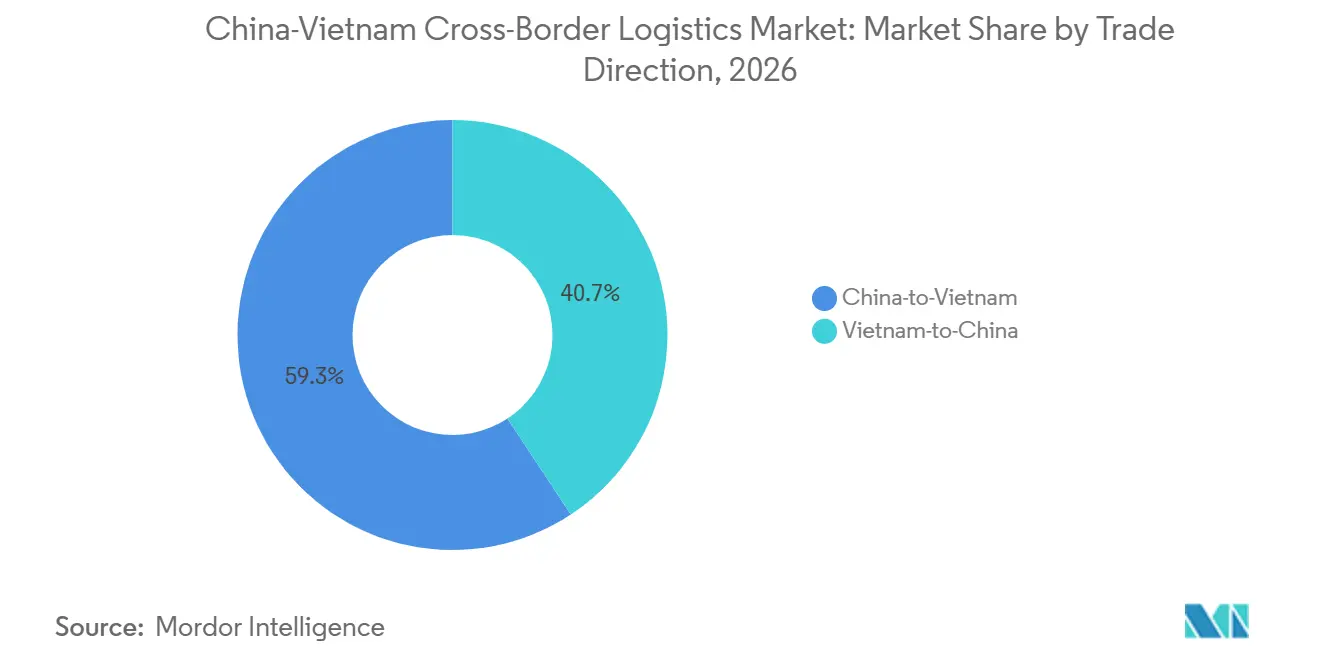
China-to-Vietnam Leads, While Vietnam-to-China Grows FasterChina-to-Vietnam accounts for 59.26% of the China-Vietnam cross-border logistics market share in 2026. The leading direction reflects Vietnam’s demand for Chinese machinery, industrial components, intermediate goods, and consumer products. These flows support services ranging from full-truckload transport and rail freight to express parcels and customs brokerage. Manufacturing procurement and consumer-goods distribution both contribute to demand, although the shipment mix varies by industry and season.
Vietnam-to-China is projected to register a CAGR of 8.24% through 2032. Agricultural products, seafood, and other exports contribute to this direction. Vietnam’s seafood exports to China exceeded USD 2.2 billion in 2025, increasing by approximately 33% from 2024. Direct trucking can support northbound movements by reducing intermediate handling on designated routes, while improved customs coordination can help exporters manage time-sensitive cargo. Faster growth in the Vietnam-to-China direction may improve transport-asset utilization where export cargo can be matched with available equipment. However, trade balancing remains dependent on the timing, volume, and handling requirements of northbound shipments. Seasonal exports and differences in container availability can still create repositioning costs.
Geography Analysis
Guangxi and Yunnan provide important overland links between China and Vietnam. Friendship Pass and Hekou connect Chinese logistics networks with the Huu Nghi and Lao Cai crossings, respectively, while Dongxing supports trade with Vietnam’s Quang Ninh province. These gateways connect inland production centers with Vietnamese manufacturing and distribution markets and support road freight, rail freight, and cross-border e-commerce flows. Rail services originating in Guangxi recorded higher China-Vietnam freight volumes in 2025. The corridor carried 37,000 TEUs during the year, up 86% from 2024[4]. This development highlights the role of rail as a complement to road freight, particularly for suitable cargo moving between inland Chinese production areas and Vietnamese destinations.
Guangxi’s border crossings also support cross-border e-commerce and regional distribution. Their effectiveness depends on customs processing, available transport capacity, and connections to inland production centers. Improvements in border infrastructure and data exchange can support more predictable movement, but actual gains depend on implementation and operating conditions at each crossing. Lang Son, Lao Cai, and Quang Ninh are important northern Vietnamese gateways for cross-border freight. Huu Nghi and Lao Cai handle overland movements from China, while Mong Cai serves the connection with Dongxing. Logistics performance in these provinces depends on truck availability, customs coordination, inspection facilities, and the ability to manage peak agricultural and e-commerce volumes.
Hai Phong and Ho Chi Minh City serve as important distribution and maritime logistics centers for Vietnam. Their connections to ports, industrial zones, warehouses, and domestic transport networks allow cross-border cargo to move beyond land gateways into wider supply chains. The Lao Cai–Hanoi-Hai Phong railway is another planned component of Vietnam’s multimodal network. The first component’s groundbreaking took place on 19 December 2025. The line is intended to strengthen connections between the Chinese border, northern Vietnamese industrial areas, and Hai Phong’s port facilities. Its contribution will depend on project delivery, rail operations, terminal connectivity, and integration with existing road and port networks.
Competitive Landscape
The China-Vietnam cross-border logistics market is fragmented and includes international freight forwarders, express operators, Chinese e-commerce logistics providers, Vietnamese logistics companies, and local trucking and customs-brokerage businesses. SF Express, Cainiao, JD Logistics, J&T Global Express, and 4PX focus on parcel delivery, e-commerce fulfillment, and technology-enabled logistics. DHL, Maersk, Kuehne+Nagel, and DSV compete across freight forwarding, contract logistics, warehousing, and multimodal transport. Vietnamese operators, including Viettel Post, Gemadept, ITL, and Transimex, contribute domestic distribution, transport, port, and logistics capabilities. Competition is shaped by the ability to coordinate cross-border transport with customs processes, storage, shipment tracking, and final delivery.
Larger integrated providers can use established networks and digital systems to manage complex shipments, while local operators offer domestic reach and familiarity with local procedures. Smaller trucking and brokerage companies remain relevant where customers require flexible capacity or services on specific routes. Investment in logistics infrastructure continues to influence competition. In September 2025, Kuehne+Nagel and the LEGO Group opened a regional distribution centre in Dong Nai to support the LEGO Group’s Asia-Pacific distribution network. In November 2025, DHL Global Forwarding expanded its CFS network in Ho Chi Minh City and Hai Phong and added an integrated warehouse in Bac Ninh. These investments extend providers’ capabilities beyond transport to storage, consolidation, and distribution.
Partnerships are also shaping service coverage. In April 2026, FedEx announced a strategic collaboration with Viettel Post, which became FedEx’s National Network Provider for nationwide pickup and delivery in Vietnam from 26 April 2026. In May 2026, Vietnam Post, SF Technology, and SF Express Vietnam signed a memorandum of understanding to explore smart cross-border logistics and technology-enabled services. As customs procedures become more digitized and customers seek greater shipment visibility, providers with established compliance processes and integrated networks may gain an advantage.
China-Vietnam Cross-Border Logistics Industry Leaders
-
DHL Group
-
Bee Logistics Corporation
-
Sinotrans
-
SF Express
-
Cainiao Network
- *Disclaimer: Major Players sorted in no particular order
China-Vietnam Cross-Border Logistics Market Companies Covered in this Report
- Cainiao Network
- SF Express
- Sinotrans
- JD Logistics
- J&T Global Express
- 4PX Express
- DHL Group
- FedEx Corporation
- United Parcel Service (UPS)
- A.P. Moller - Maersk
- Kuehne+Nagel
- DSV
- CEVA Logistics
- CJ Logistics
- Viettel Post
- Indo Trans Logistics Corporation (ITL)
- Bee Logistics Corporation
- Transimex Corporation
- THILOGI
- EMS Corporation
- Boxme Global
Recent Industry Developments in China-Vietnam Cross-Border Logistics Market
- April 2026: Gemadept and CMA CGM held the groundbreaking ceremony for Phase 2 of Gemalink Deep-Sea Port on 17 April. Upon completion, the project is expected to increase the port’s annual capacity to more than 3 million TEUs.
- April 2026: FedEx and Viettel Post announced a strategic collaboration covering nationwide pickup and delivery operations in Vietnam.
- April 2026: Vietnam and China signed a new customs cooperation agreement. The agreement establishes a framework for administrative assistance, customs information exchange, and improved coordination.
- November 2025: DHL Global Forwarding expanded its Vietnam CFS network. The Ho Chi Minh City CFS increased to 6,800 m², the Hai Phong CFS covered 4,000 m², and the company added a 3,000 m² integrated warehouse in Bac Ninh.
China-Vietnam Cross-Border Logistics Market Report Scope
Segmentation Overview
| Agriculture, Fishing and Forestry |
| Construction |
| Manufacturing |
| Oil and Gas, Mining and Quarrying |
| Wholesale and Retail Trade |
| Healthcare and Pharmaceuticals |
| Electronics and Electrical |
| Other End-User Industries |
| By Courier, Express and Parcel | Express |
| Non-Express | |
| By Freight Forwarding Mode | Air Freight Forwarding |
| Rail Freight Forwarding | |
| Road Freight Forwarding | |
| Sea and Inland Waterway Freight Forwarding | |
| By Freight Transport Mode | Air Freight Transport |
| Rail Freight Transport | |
| Road Freight Transport | |
| Sea and Inland Waterway Freight Transport | |
| By Warehousing and Storage Temperature Control | Non-Temperature-Controlled |
| Temperature-Controlled | |
| Other Logistics Services (Customs Brokerage, Border Handling, Value-Added Services) |
| Business-to-Business |
| Business-to-Consumer |
| Consumer-to-Consumer |
| China-to-Vietnam |
| Vietnam-to-China |
| By End-User Industry | Agriculture, Fishing and Forestry | |
| Construction | ||
| Manufacturing | ||
| Oil and Gas, Mining and Quarrying | ||
| Wholesale and Retail Trade | ||
| Healthcare and Pharmaceuticals | ||
| Electronics and Electrical | ||
| Other End-User Industries | ||
| By Logistics Function | By Courier, Express and Parcel | Express |
| Non-Express | ||
| By Freight Forwarding Mode | Air Freight Forwarding | |
| Rail Freight Forwarding | ||
| Road Freight Forwarding | ||
| Sea and Inland Waterway Freight Forwarding | ||
| By Freight Transport Mode | Air Freight Transport | |
| Rail Freight Transport | ||
| Road Freight Transport | ||
| Sea and Inland Waterway Freight Transport | ||
| By Warehousing and Storage Temperature Control | Non-Temperature-Controlled | |
| Temperature-Controlled | ||
| Other Logistics Services (Customs Brokerage, Border Handling, Value-Added Services) | ||
| By Shipment Type | Business-to-Business | |
| Business-to-Consumer | ||
| Consumer-to-Consumer | ||
| By Trade Direction | China-to-Vietnam | |
| Vietnam-to-China | ||
Key Questions Answered in the Report
What is the projected value of the China-Vietnam cross-border logistics market in 2032?
The market is projected to reach USD 6.90 billion by 2032, increasing from USD 5.00 billion in 2027 at a CAGR of 6.64%.
Which end-user segment leads China-Vietnam cross-border logistics demand?
Manufacturing leads the market in 2026, accounting for 36.82% of total market value. Demand is supported by cross-border movements of machinery, components, intermediate goods, and raw materials used by Vietnamese factories.
Why are business-to-consumer shipments important in the China-Vietnam corridor?
Business-to-consumer shipments account for 61.41% of the market in 2026 and are projected to grow at a CAGR of 7.37% through 2032. Cross-border e-commerce increases demand for parcel sorting, fulfillment, customs documentation, and last-mile delivery.
Which trade direction is expected to grow fastest?
Vietnam-to-China is projected to register at a CAGR of 8.24% through 2032, supported in part by demand for Vietnamese seafood, agricultural products, and other exports.
How are smart-border initiatives changing China-Vietnam freight transport?
Smart-border initiatives and customs digitization are intended to improve electronic information exchange, inspection coordination, and cargo processing. Their benefits depend on implementation and operational capacity at individual crossings.
Which transport development improves overland shipping between China and Vietnam?
The direct-trucking routes inaugurated in May 2025 under the Greater Mekong Subregion Cross-Border Transport Facilitation Agreement allow eligible vehicles to travel between designated Chinese and Vietnamese locations without intermediate cargo transshipment. The framework can save approximately 1 day in transit time on eligible routes.