
China OTT Market Size and Share
Market Overview
| Study Period | 2020 - 2031 |
|---|---|
| Forecast Data Period | 2026 - 2031 |
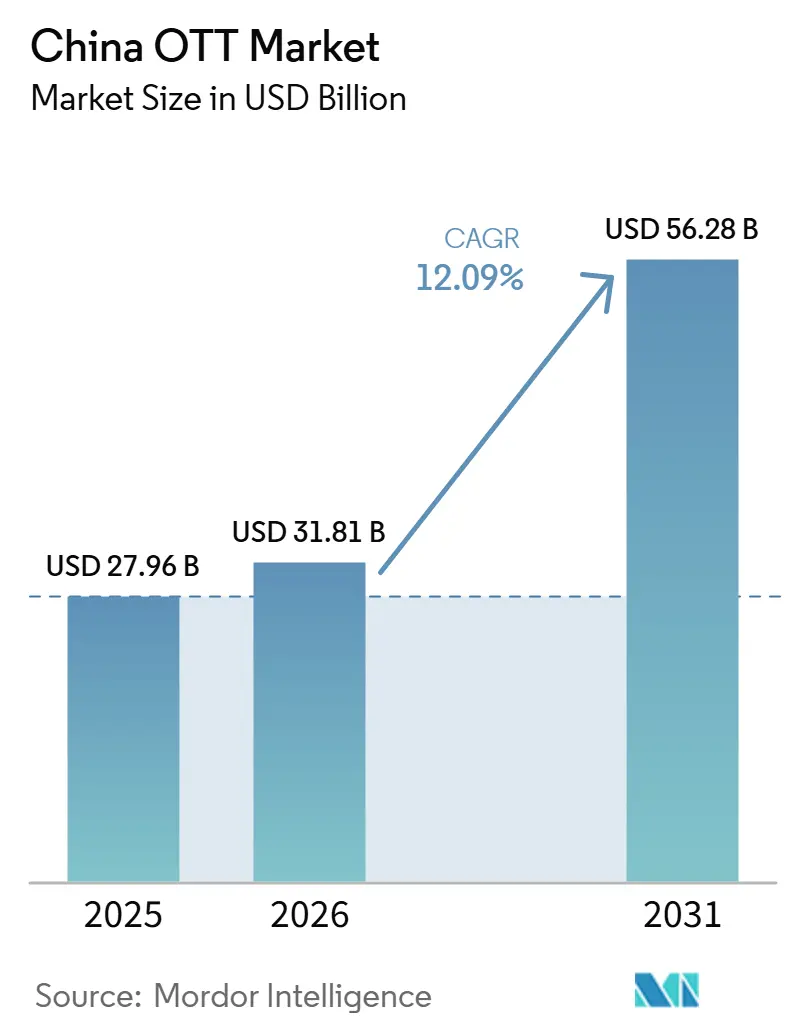
| Base Year Market Size (2025) | USD 27.96 Billion |
| Market Size (2026) | USD 31.81 Billion |
| Market Size (2031) | USD 56.28 Billion |
| Growth Rate (2026 - 2031) | 12.09% CAGR |
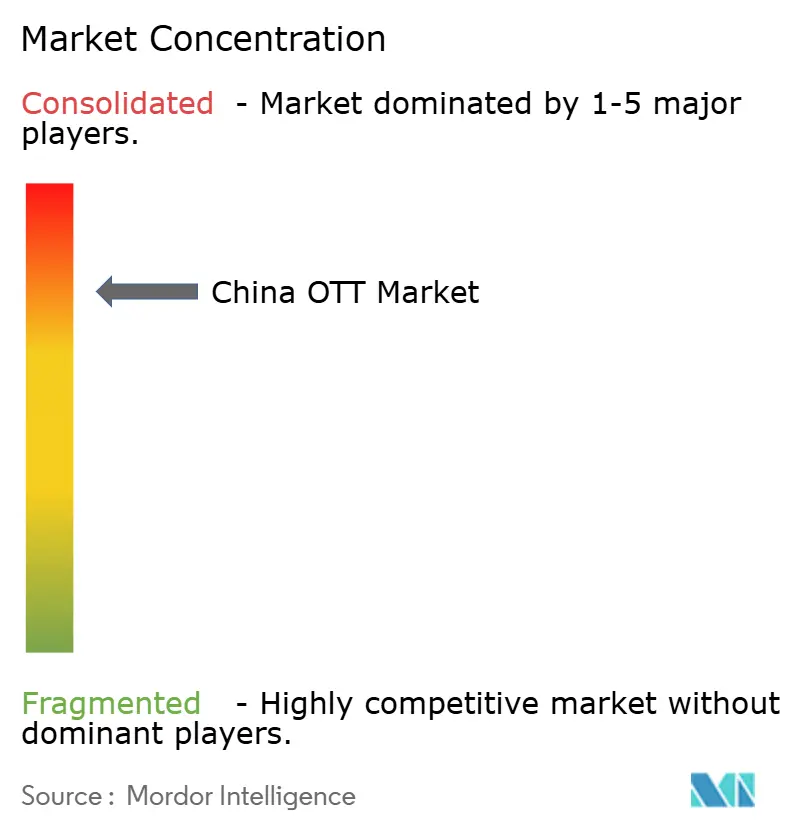
| Market Concentration | High |
Major Players *Disclaimer: Major Players sorted in no particular order Image © Mordor Intelligence. Reuse requires attribution under CC BY 4.0. | |
China OTT Market Analysis by Mordor Intelligence
The China OTT market size is projected to be USD 27.96 billion in 2025, USD 31.81 billion in 2026, and reach USD 56.28 billion by 2031, growing at a CAGR of 12.09% from 2026 to 2031. The China OTT market is moving beyond subscriber additions as platforms place more weight on subscription renewal, advertising, and paid content conversion across mobile and connected television screens. Large local libraries remain important, but discovery tools and tailored recommendations increasingly shape what audiences watch, how long they stay, and whether they renew a paid plan. Short-form viewing is putting pressure on long-form services by competing for attention, advertising spending, and the limited time viewers allocate to paid entertainment. This makes content quality, audience retention, consistent device access, and a balanced revenue model central to the China OTT market.
Key Report Takeaways
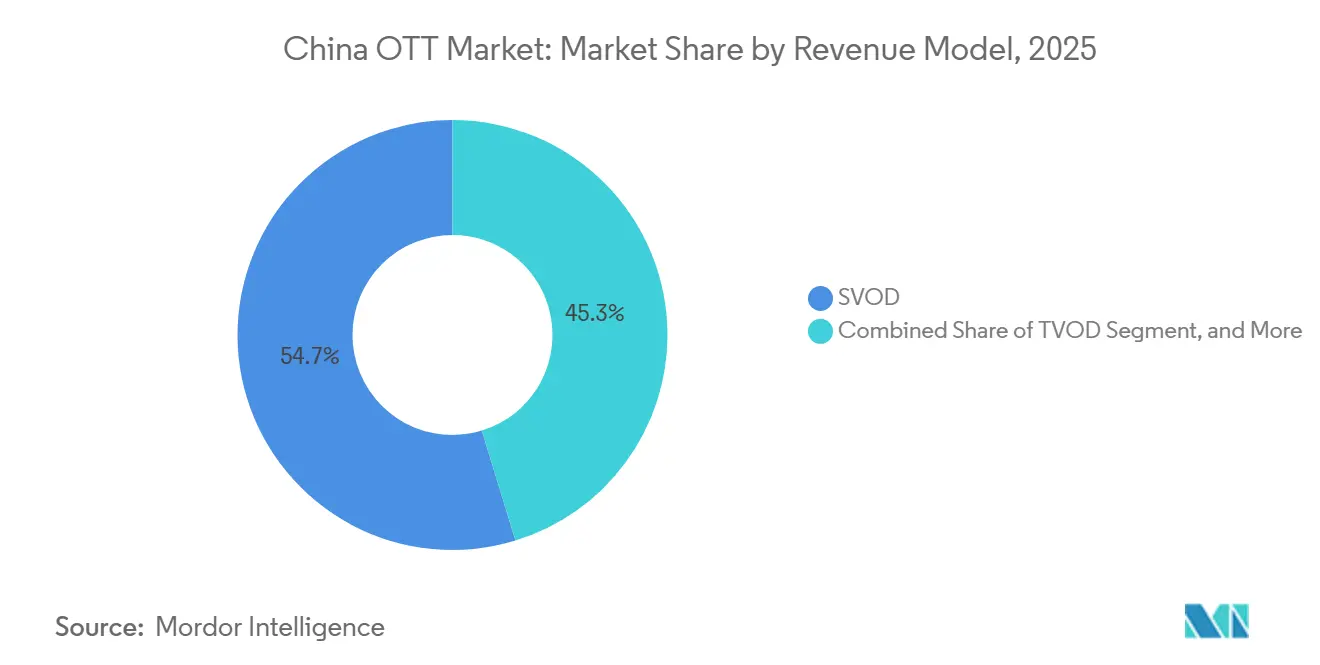
- By revenue model, SVOD held 54.73% of the China OTT market share in 2025, while AVOD is projected to expand at a 13.20% CAGR through 2031.
- By device type, smartphones and tablets held 68.19% of the China over-the-top (OTT) market share in 2025, while smart TVs are projected to expand at a 12.71% CAGR through 2031.
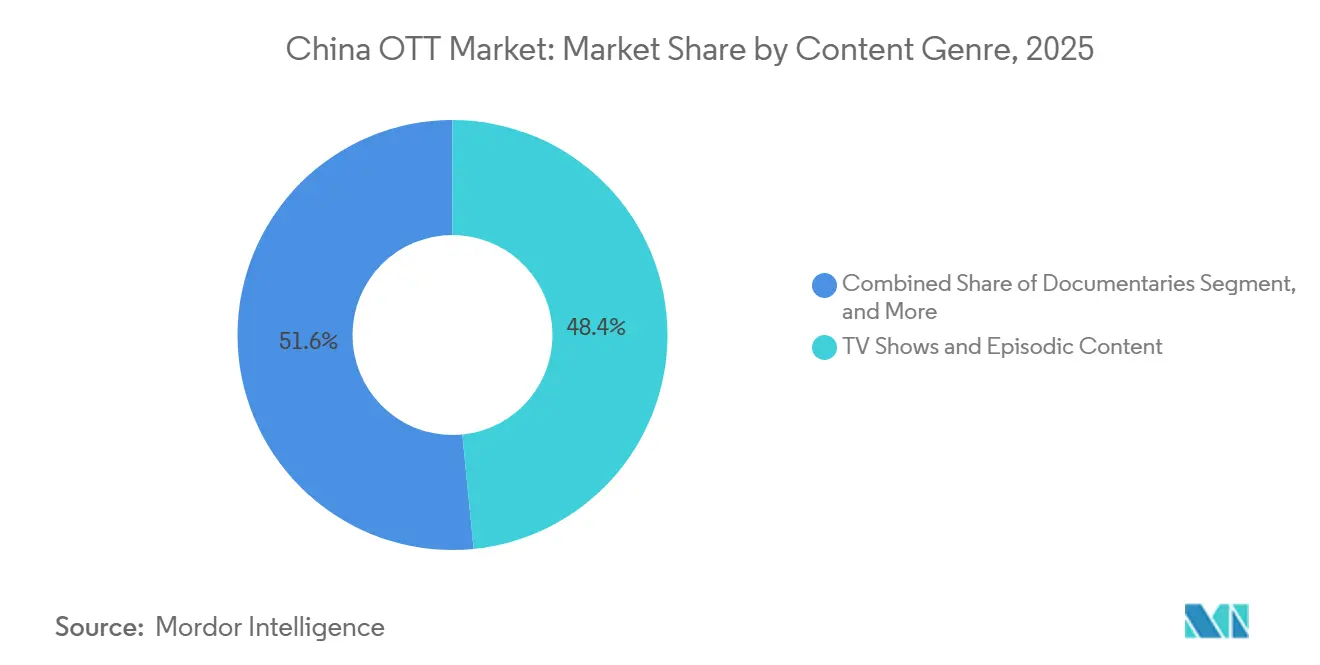
- By content genre, TV shows and episodic content held 48.43% of revenue in 2025, while documentaries are projected to expand at a 12.63% CAGR through 2031.
Note: Market size and forecast figures in this report are generated using Mordor Intelligence’s proprietary estimation framework, updated with the latest available data and insights as of January 2026.
China OTT Market Trends and Insights
Drivers Impact Analysis*
| Driver | (~) % Impact on CAGR Forecast | Geographic Relevance | Impact Timeline |
|---|---|---|---|
| Premium Local Content Upsell | +2.8% | National, concentrated in Tier-1 and Tier-2 cities with higher revenue per user | Medium term (2-4 years) |
| Hybrid Video Bundle Advertising | +2.3% | National, with early traction where smart TV and mobile use overlap | Short term (≤ 2 years) |
| Sports Rights Differentiation | +1.9% | National, concentrated in Tier-1 sports viewing clusters | Short term (≤ 2 years) |
| AI-Driven Personalization | +1.6% | National, with early deployment in Tier-1 cities and expansion to lower-tier cities | Medium term (2-4 years) |
| Smart TV and Connected-Screen Expansion | +1.3% | National, strongest in Tier-3 and lower-tier cities | Long term (≥ 4 years) |
| Short-Form Discovery Conversion | +0.9% | National, with growing relevance in Tier-3 and lower-tier cities | Medium term (2-4 years) |
| Source: Mordor Intelligence | |||
Rising Subscription Upsell From Premium Local Content
Premium local programming remains a key reason viewers join and renew subscriptions in the China OTT market. First-run dramas and variety programs can create recurring renewal periods when platforms secure exclusive rights. iQIYI reported membership-service revenue of CNY 16.81 billion (USD 2.4 billion) in 2025, making it the company’s largest revenue line despite weaker overall revenue. The result indicates that established content libraries can retain paying users when a service faces a weaker release schedule. iQIYI introduced Nadou Pro in 2026 to support professional film and television production through its Qizhi model and third-party generation tools. Lower production costs could allow major platforms to fund more original programming while protecting the exclusive titles that support higher subscription tiers, thereby reducing the pressure to choose only a few costly releases.
Accelerating Ad Monetization From Hybrid Video Bundles
Subscription and advertising are becoming increasingly intertwined across the China OTT market. iQIYI’s advertising revenue declined 9% to CNY 5.19 billion (USD 0.7 billion) in 2025, which shows the difficulty of relying only on advertising revenue in long-form video.[1]iQIYI, Inc., “iQIYI Announces Fourth Quarter and Fiscal Year 2025 Financial Results,” iQIYI Investor Relations, ir.iqiyi.com The supplied company results showed that Bilibili’s advertising revenue exceeded CNY 10 billion (USD 1.4 billion) in 2025, up 22.8% from the prior year. They also reported 180% growth in AI-related advertising revenue, suggesting demand for advertising tools that match messages to audience interests. Hybrid offers can give platforms a subscription base while retaining advertising income from viewers who accept lower-priced access, thereby reducing reliance on any one source of revenue amid changing advertising conditions. This approach may be especially useful as platforms seek to serve audiences with different spending preferences without sacrificing access to premium content or creating confusing choices among service tiers.
Sports Rights Differentiation Across Major Platforms
Sports rights have become an important way for platforms to stand apart in the China over-the-top (OTT) market. China Media Group secured broadcast rights covering major tournaments from 2026 through 2031, and streaming rights for the 2026 FIFA World Cup were sublicensed to Xiaohongshu. The arrangement placed live sports alongside social interaction and commerce features. Migu retained mobile streaming rights tied to its telecom parent, while Douyin did not continue its earlier World Cup distribution role. Premium sports can attract viewers during fixed event periods and provide platforms with useful audience behavior data that can inform future programming, advertising packages, and recommendations for viewers with recurring interests. Multi-year rights for football, basketball, and eSports can also help reduce churn because viewers return for scheduled events rather than only new entertainment releases, giving platforms a predictable reason to maintain regular audience contact.
AI-Driven Personalization Improving Retention and Watch Time
Recommendation quality is becoming a stronger competitive factor in the China OTT market because it affects watch time and renewal decisions. Kuaishou stated that OneRec, its generative recommendation system, was deployed across 25% of traffic on its main app and Lite version by the third quarter of 2025. The company planned a wider rollout after the system supported growth in local services activity. iQIYI has also described work on AI-supported recommendation, interactive viewing, and micro-drama production. Better recommendations can make a smaller library more useful by bringing relevant titles to viewers more quickly. This favors larger companies that can invest in technology and content simultaneously, while smaller platforms may find it harder to fund dedicated recommendation development, model training, and the data resources needed to continually improve recommendations.
Restraints Impact Analysis*
| Restraint | (~) % Impact on CAGR Forecast | Geographic Relevance | Impact Timeline |
|---|---|---|---|
| Premium Content and Sports Cost Inflation | -2.1% | Global content markets, with the highest effect on long-form premium platforms | Long term (≥ 4 years) |
| Platform Oversight and Compliance Requirements | -1.5% | National, with a higher burden on Tier-1 city headquartered platforms | Medium term (2-4 years) |
| Multi-Platform Subscription Fatigue | -0.9% | Tier-1 and Tier-2 cities where multiple subscriptions are common | Short term (≤ 2 years) |
| Bandwidth and Cloud Delivery Costs | -0.7% | National, with higher severity for high-definition services in rural and western areas | Long term (≥ 4 years) |
| Source: Mordor Intelligence | |||
Content Licensing Cost Inflation for Premium Originals and Sports
Content costs remain a persistent constraint for the China OTT market. iQIYI reported content costs of CNY 15.45 billion (USD 2.2 billion) for 2025, while total revenue declined 7% to CNY 27.29 billion (USD 3.8 billion). The difference between large content investments and slower revenue growth puts pressure on margins, especially when platforms must continue funding future releases to retain their existing subscriber base. Sports rights can add to this pressure because services must pay for licenses before they know how many viewers will convert to paid users. Large platforms can spread these costs across memberships, advertising, and related businesses. Smaller services have less room to absorb a costly season, which can widen the gap between leading services and independent operators and reduce the number of credible long-form competitors.
Tight Platform Oversight on Content, Recommendation, and Monetization Practices
Rules for online video now cover more than content review in the China OTT market. The CAC and other agencies issued regulations on internet content multi-channel network distribution services on May 29, 2026, with effect from September 1, 2026.[2]Cyberspace Administration of China, “Regulations on Internet Content Multi-Channel Network Distribution Services,” Cyberspace Administration of China, cac.gov.cn The rules require content-management leads, creator agreements that define information security duties, and controls for minors and livestream marketing across the networks that distribute content and work with online creators. The NRTA also introduced classification and tiering standards for AI-produced short dramas from July 1, 2026. By March 31, 2026, an NRTA monitoring system had removed nearly 29,000 AI-modified videos.[3]National Radio and Television Administration, “AI-Altered Video Governance Results,” National Radio and Television Administration, nrta.gov.cn Ongoing compliance work can add costs for platforms with large creator networks and may be harder for smaller companies to manage because monitoring and contract processes must operate continuously.
*Our forecasts treat driver/restraint impacts as directional, not additive. The impact forecasts reflect baseline growth, mix effects, and variable interactions.
Segment Analysis
By Revenue Model: SVOD Retains the Largest Position While AVOD Gains Ground
SVOD held 54.73% of the China OTT market share in 2025, supported by the renewal value of first-run dramas and variety programs that viewers can follow over several weeks or an entire season. The China OTT market size for SVOD benefits when exclusive releases give members a reason to maintain paid access. AVOD is projected to grow at a 13.20% CAGR through 2031, which is faster than the mature subscription model. Advertising-supported access can reach viewers who do not want another recurring payment. It can also give brands access to video audiences without requiring a direct subscription conversion. TVOD continues to serve selected film releases where a one-time payment can preserve the value of a premium title. Hybrid subscription and advertising plans combine a recurring payment floor with additional advertising income. This model gives platforms another way to protect revenue when subscription growth slows. The China OTT market, therefore, has room for several revenue models, although SVOD remains the main source of revenue. Services will need to decide which titles justify a paid window and which titles can support broader advertising reach.
Mango TV showed the value of a focused dual-revenue model in 2025, particularly for a service that connects a recognizable programming identity with membership and advertising income. Mango Excellent Media reported membership revenue of CNY 4.646 billion (USD 0.7 billion), advertising revenue of CNY 3.831 billion (USD 0.5 billion), and an effective membership base of 75.6 million. Its variety and lifestyle focus helped it build memberships without directly matching every premium drama acquisition by the largest services. The CAC rules issued in 2026 apply across revenue models when platforms work with creator networks. Platforms need content-management processes and clear creator agreements as they expand advertising, subscriptions, or sales-linked content. These requirements may make established services more reliable partners for advertisers and creators. They also raise the cost of building a new revenue model at scale. The China OTT industry is likely to favor platforms that can manage content, advertising, and compliance within the same operating system. This structure can make it easier to respond when advertising demand, viewer preferences, or regulatory duties change.



By Device Type: Mobile Viewing Leads While Smart TVs Extend Household Use
Smartphones and tablets accounted for 68.19% of the China OTT market share in 2025, confirming that portable screens remain the main entry point for daily video use and content discovery. Mobile screens remain central because viewers often move between short-form clips and longer programs on the same device. Smart TVs are projected to grow at a 12.71% CAGR through 2031. The faster growth reflects their role as a shared household screen for long viewing sessions. Smart TV viewing can create advertising space that differs from mobile formats because several people may watch together. It can also support premium subscription packages that include access to larger screens. Laptops and desktops retain a smaller role for viewing during work and study routines. Other devices include gaming consoles, set-top boxes, and connected projectors. The China over-the-top (OTT) market for smart TVs may gain momentum as household viewers increasingly use connected screens.
The supplied data placed China’s smart TV installed base at 439 million units in 2025, up 4% year over year, strengthening the base for household advertising and premium video consumption. The same data stated that smart TV use had a 52% daily opening rate and more than 5.6 hours of daily viewing. These figures point to sustained household engagement rather than occasional use. The supplied NRTA statistical information reported progress toward simpler television use, with more than 10.66 million universal remote systems by the end of 2025. This work addressed complex interfaces and nested billing concerns. Easier access can reduce friction for viewers moving from cable television to connected services. Smart TV growth is also relevant in lower-tier cities, where connected screens can become a primary home entertainment device. The China OTT market will continue to require services that work across mobile and household viewing contexts. A platform that treats each screen as part of a single service can keep its audience engaged throughout the day.
By Content Genre: Episodic Programs Lead Revenue While Documentaries Grow Faster
TV shows and episodic content accounted for 48.43% of revenue in 2025, underscoring the ongoing commercial importance of regular episodes that build viewing routines and drive membership renewal. Serialized programming supports regular viewing and provides a clear reason for viewers to keep subscriptions active. The China OTT market size for this genre reflects the importance of drama and variety programming at the leading long-form platforms. Documentaries are projected to grow at a 12.63% CAGR through 2031. The genre can appeal to urban viewers who value factual content and specialized programming. Movies and films remain important but face a more contested role between theaters, premium on-demand releases, and platform exclusivity. Other genres include live sports, eSports, animation, and reality programs. These formats help services reduce their reliance on drama alone. The China OTT market benefits from this broader mix, as different audiences respond to different content schedules and pricing offers. Genre variety can also help platforms maintain viewing between major drama releases and live events.
China produced 2,652 long-form titles in 2025, a nearly 19% increase from the prior year, according to the supplied association data, showing continued investment in the supply of professionally produced programming. The same data showed 625 key online micro-short dramas, representing 30% growth. The combined output shows continuing investment in both higher-budget long-form programs and shorter formats. Short dramas can provide rapid discovery and help services test new themes or target audiences. Premium documentaries can provide a contrasting format that supports deeper viewing and targeted bundles. The NRTA’s 2026 standards for AI-produced short dramas introduced different review expectations based on investment scale and subject matter. Platforms will need to consider these rules when they add AI-supported programs to their content plans. Content planning in the China OTT market will continue to be shaped by both viewer preferences and compliance requirements. Services must balance creative flexibility with the review processes that apply to new program types.
Geography Analysis
Coastal and eastern China remain the main revenue base for the China OTT market because of higher household incomes, stronger digital payment habits, wider smart TV adoption, and a larger base of premium content consumers. Guangdong, Zhejiang, Jiangsu, Beijing, and Shanghai have large concentrations of viewers who can support premium subscriptions and advertising. This suggests that connected-screen viewing can add to mobile use even in cities with mature digital services, rather than simply replacing established smartphone viewing habits.
Central and western China offer the largest incremental opportunity for the China over-the-top (OTT) market over the forecast period because new connected households can add viewing volume beyond the more mature coastal markets. Henan and Sichuan were identified in the supplied material as important contributors to the deployment of new OTT terminals. Rural broadband expansion and support programs can bring smart TVs to more first-time connected households. Lower-tier audiences have shown stronger use of locally produced drama, variety programming, and micro-dramas. AVOD and free-access options may be more suitable for many of these households than SVOD. Services will need local content and flexible pricing to move free viewers toward paid tiers while recognizing different household budgets and preferences across lower-tier cities. NRTA's work on set-top box interfaces and nested billing can help reduce barriers as legacy cable users move to online video.
Northern China has a distinct position because Beijing is home to major media groups, streaming operations, and regulatory bodies that influence both platform investment and compliance practices. Beijing hosts the China Media Group, iQIYI, Tencent Video, the NRTA, and the CAC. This concentration supports premium content spending but also makes the region highly sensitive to changes in enforcement and the content decisions platforms make in response. State-backed 5G and ultra-high-definition development can support delivery of 4K and 8K programming to a well-connected urban population.
Competitive Landscape
Tencent Video, iQIYI, and Youku are the leading long-form services in the Chinese OTT market, with the resources to maintain broad catalogs and compete for important original releases. Their parent groups provide wider resources that support content investment and platform distribution. This backing makes it difficult for independent services to match their content budgets, particularly when the largest services acquire high-demand drama, variety, or sports rights. Mango TV, Bilibili, Kuaishou, and ByteDance-operated platforms occupy specialized viewing niches.
Bilibili reported its first annual profit in 2025 and total revenue of CNY 30.35 billion (USD 4.3 billion), reinforcing the commercial value of its differentiated youth-oriented and animation-adjacent audience position. The company also reported advertising revenue above CNY 10 billion (USD 1.4 billion) for 2025. iQIYI’s introduction of Nadou Pro is an example of a major platform using AI tools to improve professional content production. Kuaishou’s OneRec rollout is another example, focused on improving recommendations and reducing time spent on irrelevant videos. Technology spending can improve the value of existing catalogs, but it also raises investment requirements.
Sports rights remain an area where no single service holds a clear lead, even though major live events can attract valuable audiences and drive intense competition for distribution rights. The distribution of the 2026 FIFA World Cup was shared among China Media Group, Xiaohongshu, and Migu rather than concentrated in a single destination. This leaves room for a service to build a more complete multi-sport subscription offer with dependable access across multiple events and devices. Compliance capacity is also becoming a competitive advantage as AI content and creator monetization rules expand. The China OTT market is concentrated among a small number of well-funded platforms, while specialist services compete through audience focus, technology, and selected content rights that give viewers a reason to choose them alongside the major general-entertainment services. This competitive structure keeps pressure on leaders to improve both content quality and service design.
China OTT Industry Leaders
Tencent Holdings Limited
iQIYI, Inc.
Youku Tudou Inc.
Mango Excellent Media Co., Ltd.
Bilibili Inc.
- *Disclaimer: Major Players sorted in no particular order

Recent Industry Developments
- July 2026: Xiaohongshu, Red Note, concluded its 39-day, 104-match FIFA World Cup livestreaming experiment, marking the platform’s first full-scale OTT sports broadcast deployment in China. The event tested its long-form content and audience retention capabilities while connecting sports livestreaming with community commerce.
- May 2026: The Cyberspace Administration of China, jointly with the Ministry of Public Security, Ministry of Culture and Tourism, SAMR, and NRTA, issued the Regulations on Internet Content Multi-Channel Network Distribution Services. The regulations take effect on September 1, 2026, and require content team structures, creator agreements specifying information security responsibilities, and new minor-protection and livestream-marketing compliance obligations for MCN operators and hosting platforms.
- April 2026: iQIYI launched Nadou Pro, described as China’s first AI agent designed for professional film and television production. The system integrates iQIYI’s Qizhi large model with third-party generation platforms for professional creators making long-form and mid-length drama content.
- February 2026: iQIYI reported FY2025 revenue of CNY 27.29 billion (USD 3.79 billion), content costs of CNY 15.45 billion (USD 2.15 billion), and operating income of CNY 229.3 million (USD 31.9 million). Fourth-quarter 2025 revenue increased 3% year over year, with content distribution revenue increasing 94%.


China OTT Market Report Scope
The China OTT (Over-the-Top) Market comprises digital content platforms and service providers that deliver video and entertainment content directly to consumers through internet-connected devices, bypassing traditional cable, satellite, and broadcast distribution networks. The market includes streaming platforms that provide on-demand access to movies, television programs, original productions, documentaries, and other digital media content via internet-based delivery.
The China OTT Market Report is Segmented by Revenue Model (SVOD, AVOD, TVOD, and Hybrid Subscription and Ads), Device Type (Smartphones and Tablets, Smart TVs, Laptops and Desktops, and Other Device Types), and Content Genre (Movies and Films, TV Shows and Episodic Content, Documentaries, and Other Content Genres). The Market Forecasts are Provided in Terms of Value (USD).
| SVOD |
| AVOD |
| TVOD |
| Hybrid Subscription and Ads |
| Smartphones and Tablets |
| Smart TVs |
| Laptops and Desktops |
| Other Device Types |
| Movies and Films |
| TV Shows and Episodic Content |
| Documentaries |
| Other Content Genres |
| By Revenue Model | SVOD |
| AVOD | |
| TVOD | |
| Hybrid Subscription and Ads | |
| By Device Type | Smartphones and Tablets |
| Smart TVs | |
| Laptops and Desktops | |
| Other Device Types | |
| By Content Genre | Movies and Films |
| TV Shows and Episodic Content | |
| Documentaries | |
| Other Content Genres |


Key Questions Answered in the Report
What is the China OTT market size?
The China OTT market size is projected to be USD 31.81 billion in 2026 and USD 56.28 billion by 2031, at a 12.09% CAGR. Growth reflects broader revenue options, connected-screen viewing, and ongoing demand for distinctive local programming.
Which revenue model leads China’s online video services?
SVOD led with a 54.73% share in 2025, while AVOD is projected to grow faster at a 13.20% CAGR through 2031. Hybrid offers can combine memberships with advertising for viewers with different payment preferences.
Why are smart TVs important for China’s OTT services?
Smart TVs are projected to expand at a 12.71% CAGR through 2031 and provide a household screen for longer viewing and advertising. They complement mobile viewing and can support shared access to premium entertainment.
Which content format generates the most revenue?
TV shows and episodic content held 48.43% of revenue in 2025 because serialized programs support subscriber acquisition and renewal. Documentaries are projected to grow faster than other genres at a 12.63% CAGR.
How do regulations affect online video platforms in China?
Platforms must manage requirements covering creator agreements, content controls, minors, livestream marketing, and AI-produced short dramas. These duties create an ongoing need for internal review and compliance processes.
Which companies lead China’s long-form streaming sector?
Tencent Video, iQIYI, and Youku lead the long-form sector, while Mango TV and Bilibili compete through more specialized content positions. Sports, youth programming, and technology capabilities remain important ways to differentiate services.
Page last updated on:






