
China Modern Methods Of Construction Market Size and Share
Market Overview
| Study Period | 2021 - 2032 |
|---|---|
| Forecast Data Period | 2027 - 2032 |
| Base Year Market Size (2026) | USD 69.74 Billion |
| Market Size (2027) | USD 74.61 Billion |
| Market Size (2032) | USD 104.70 Billion |
| Growth Rate (2027 - 2032) | 7.01 % |
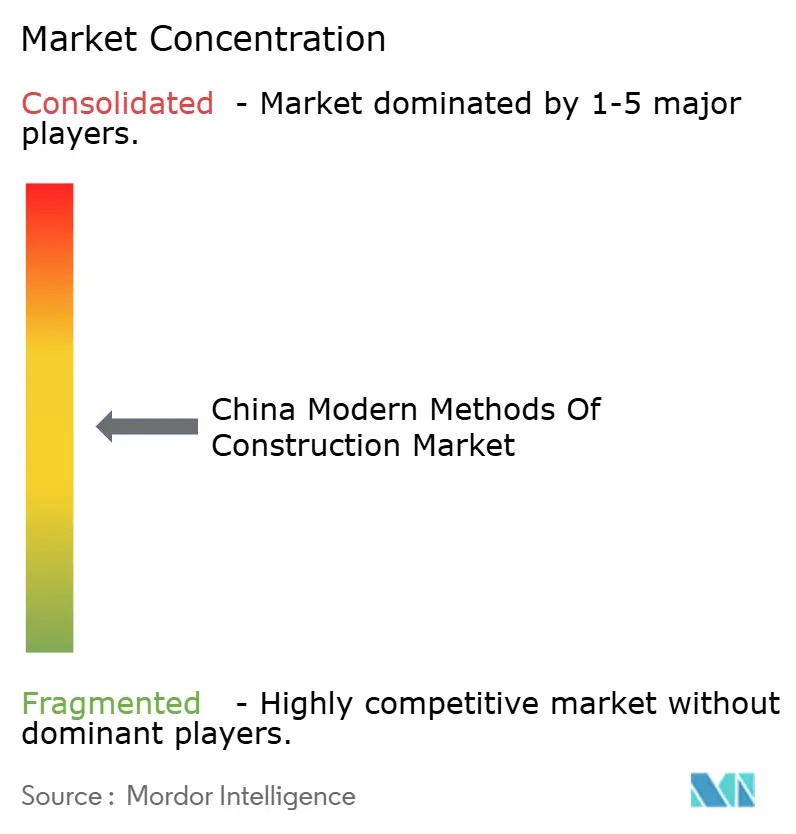
| Market Concentration | Medium |
Major Players *Disclaimer: Major Players sorted in no particular order Image © Mordor Intelligence. Reuse requires attribution under CC BY 4.0. | |
China Modern Methods Of Construction Market Analysis by Mordor Intelligence
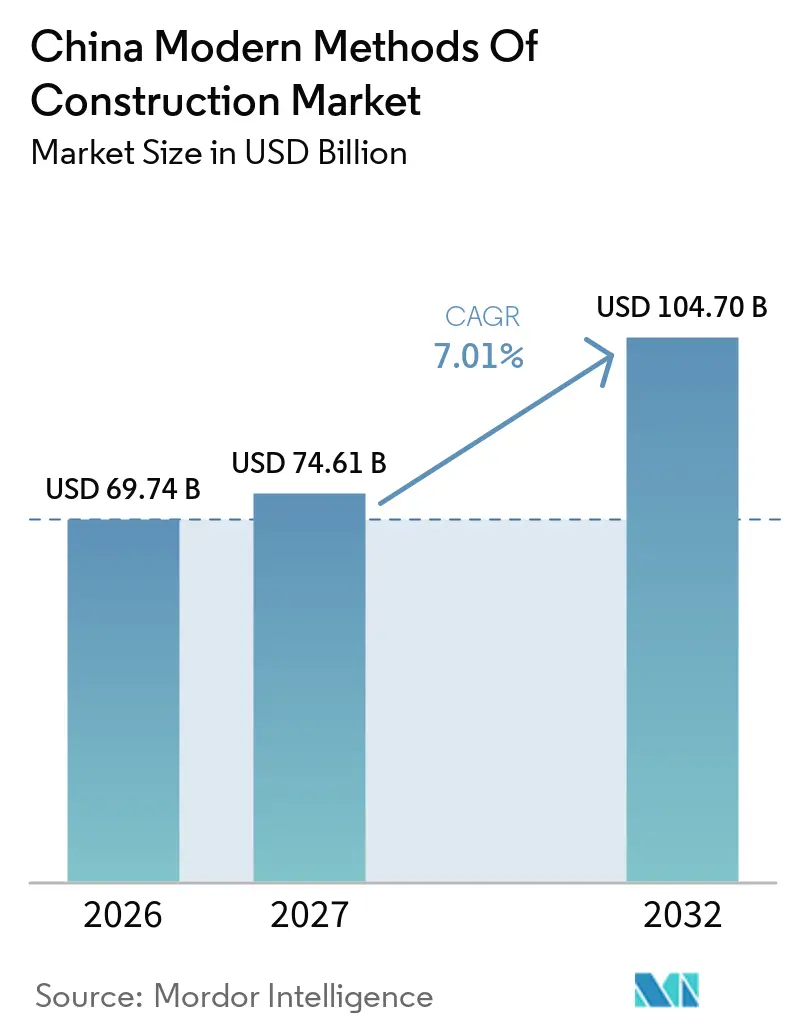
The China Modern Methods Of Construction Market size is projected to expand from USD 69.74 billion in 2026 and USD 74.61 billion in 2027 to USD 104.70 billion by 2032, registering a CAGR of 7.01% between 2027 and 2032.
The China modern methods of construction market is moving from site-based building toward factory-made components, modular assemblies, and digitally managed delivery. National policy, urban renewal, and demand for faster project completion are supporting this transition. The completed-home sales approach increases the value of shorter build times because developers need to bring projects to a more advanced stage before sales approval. Public construction, affordable housing, infrastructure, and industrial facilities provide a more stable source of demand while private housing investment remains under pressure. Manufacturers that combine design, production, logistics, and installation are better positioned to respond to these requirements.
Key Report Takeaways
- By construction type, prefabricated & modular construction held 98.4% of the China modern methods of construction market share in 2026, while 3D construction is forecast to grow at a 42.4% CAGR through 2032.
- By material type, concrete accounted for 58.4% of the China modern methods of construction market size in 2026, while timber is projected to expand at a 7.5% CAGR through 2032.
- By application, residential construction held 53.7% of the China modern methods of construction market share in 2026, while other applications are forecast to grow at a 7.2% CAGR through 2032.
- By geography, Shanghai accounted for 18.6% of the China modern methods of construction market size in 2026, while Shenzhen is projected to grow at a 7.6% CAGR through 2032.
Note: Market numbers in this report are based on Mordor Intelligence's proprietary estimation framework, which combines nine months of actuals with Q4 projections for base year 2026.
China Modern Methods Of Construction Market Trends and Insights
Drivers Impact Analysis*
| Drivers | (~) % Impact on CAGR Forecast | Geographic Relevance | Impact Timeline |
|---|---|---|---|
| Government-Led Promotion of Prefabricated Buildings | +1.8% | National, with concentration in Beijing, Shanghai, Shenzhen, Hainan, and Sichuan | Short term (≤ 2 years) |
| Urban Renewal and High-Density Residential Development | +1.5% | Shanghai, Beijing, Guangzhou, and cities with pre-1990 housing stock | Medium term (2-4 years) |
| Large-Scale Infrastructure and New Urbanization Projects | +1.2% | National, with spillover into Central and Western China | Long term (≥ 4 years) |
| Industrialized Construction for Schedule and Quality Control | +1.0% | National, led by the Yangtze River Delta and Pearl River Delta | Medium term (2-4 years) |
| Domestic Manufacturing Scale in Steel, Concrete, and Building Components | +0.7% | National, with strength in Guangdong, Zhejiang, Jiangsu, and Hebei | Medium term (2-4 years) |
| Demand for Green Buildings and Construction-Waste Reduction | +0.5% | National, with early effects in 101 cities under green procurement policy | Long term (≥ 4 years) |
| Source: Mordor Intelligence | |||
Government-Led Promotion of Prefabricated Buildings
The China modern methods of construction market benefits from a policy framework that gives public projects a predictable path to adopt industrialized building methods. The Ministry of Housing and Urban-Rural Development issued its Intelligent Construction Technology Guidelines in March 2025, setting out a national framework for digital construction from design through operations. Sichuan also released joint guidance in September 2025 that calls for prefabricated buildings to exceed 50% of new construction starts in the province. These measures create a clearer order base for producers of steel structures, precast components, and digital construction systems. The policy setting also makes it easier for project owners to compare certified solutions across public housing, schools, hospitals, and other public assets. As a result, firms with established production capacity and compliance capabilities can convert government-backed demand into longer project pipelines.
Urban Renewal and High-Density Residential Development
Urban renewal is creating suitable conditions for modular systems because dense neighborhoods leave little room for conventional site operations. The State Council's June 2025 notice calls for wider use of new construction methods and aims for a 50% resource utilization rate for construction waste in prefecture-level and larger cities by 2027[1]. Factory-made components can reduce on-site material handling and limit disruption around occupied urban areas. Shanghai's Tianlin Road project demonstrates this approach, using Concrete Modular Integrated Construction for 1,114 units across 9 buildings. The China modern methods of construction market therefore has an opening in redevelopment projects that require compact work sites, tighter schedules, and stronger waste controls. Completed projects can also provide templates that other cities can adapt for their own renewal programs.
Large-Scale Infrastructure and New Urbanization Projects
Infrastructure projects support the China modern methods of construction market when developers reduce private residential spending. Precast bridge girders, tunnel segments, and modular station structures give contractors more control over sequencing and quality. This matters in inland and western corridors, where labor availability and weather can interrupt field work. Steel structure systems have shown a 30% to 40% reduction in primary structural cycle times in company disclosures. The benefit is strongest where contractual deadlines can create substantial costs for late delivery. The result is a broader demand base that is less dependent on the pace of apartment construction.
Industrialized Construction for Schedule and Quality Control
The shift toward completed home sales increases the financial importance of fast and reliable construction. China State Construction International states that modular integrated construction moves more than 70% of construction work to factories and can reduce total construction time by 60% compared with conventional methods. This approach allows several modules to be produced at the same time while on-site work focuses on lifting and connecting them. Factory production can also reduce tolerance variation and make quality control more consistent. The China modern methods of construction industry is therefore becoming more relevant to developers that need to reach construction milestones sooner without weakening building quality. The Ministry's pilot program has also given cities practical examples for evaluating intelligent construction methods.
Restraints Impact Analysis*
| Restraints | (~) % Impact on CAGR Forecast | Geographic Relevance | Impact Timeline |
|---|---|---|---|
| Regional Differences in Prefabrication Standards and Adoption | -1.0% | Interior provinces, Northeast China, and tier-3 and tier-4 cities | Medium term (2-4 years) |
| Property-Market Weakness and Developer Liquidity Pressure | -0.9% | National, with a greater effect on private developers in tier-1 and tier-2 cities | Short term (≤ 2 years) |
| Low-Margin Competition in Standardized Components | -0.5% | National, especially among precast concrete panel producers | Medium term (2-4 years) |
| Complex Long-Distance Logistics Between Manufacturing and Sites | -0.4% | Western and Northeast China, especially sites far from manufacturing bases | Long term (≥ 4 years) |
| Source: Mordor Intelligence | |||
Regional Differences in Prefabrication Standards and Adoption
Regional variation limits how quickly the China modern methods of construction market can scale beyond its established coastal centers. Beijing and Shanghai have stronger implementation rules, project registration processes, and production ecosystems than many interior provinces. A 2025 study in Buildings identified fragmented supply chains, limited standards, and shortages of skilled workers as major barriers to modular construction scale-up[2]. The National Assembly Rate Evaluation Standard provides a common definition, but local technical rules and certification processes can still differ. Producers serving several provinces may need to adapt component designs and approval documentation for each location. Greater alignment between local rules and manufacturing capacity would lower this friction over time.
Property-Market Weakness and Developer Liquidity Pressure
Weak private residential demand remains a near-term restraint for the China modern methods of construction market. Nikkei Asia reported that residential new starts fell 24.6% year over year from January through July 2026. Developers facing delayed sales and tighter liquidity are more likely to defer capital-intensive building investments. This weakness affects suppliers that depend on private residential orders for high-volume components. Affordable housing, state-linked developers, urban renewal, and infrastructure projects partly offset this weakness. Consequently, the demand mix is shifting toward projects where public funding, long-term ownership, or operational requirements provide stronger support.
*Our forecasts treat driver/restraint impacts as directional, not additive. The impact forecasts reflect baseline growth, mix effects, and variable interactions.
Segment Analysis
By Construction Type: Prefabrication Holds the Installed Base While 3D Construction Advances
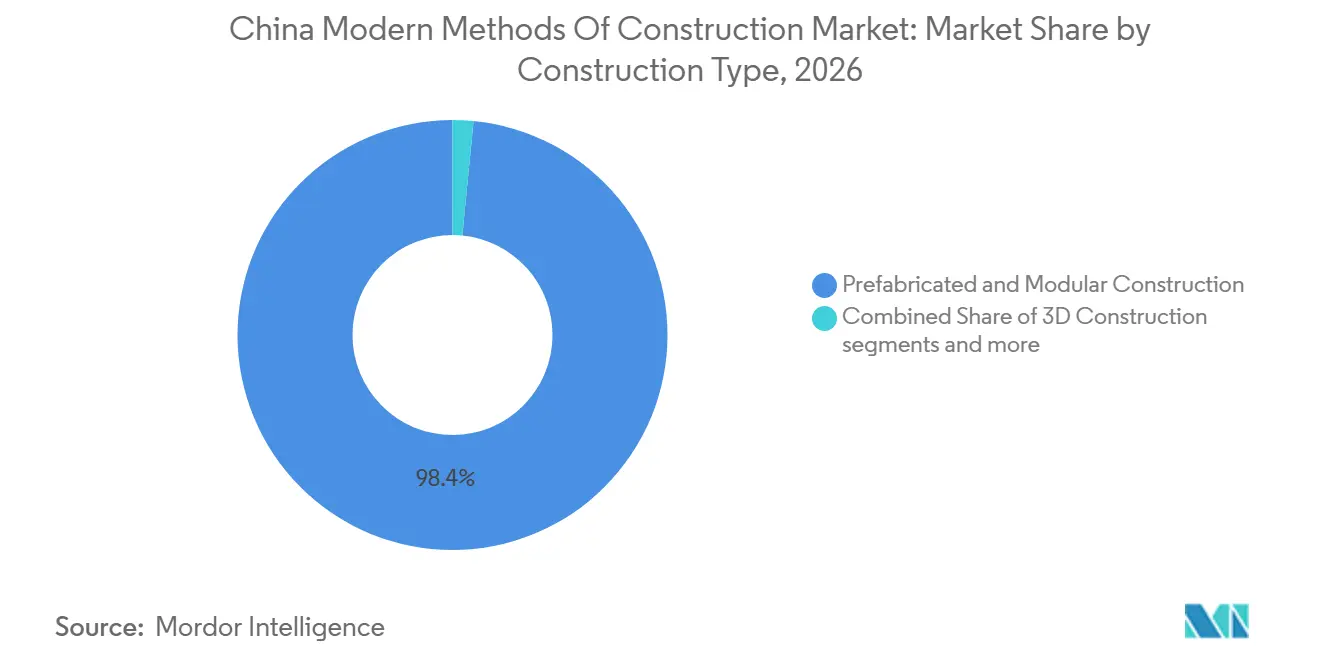
Prefabricated and modular construction held 98.4% of the China modern methods of construction market share in 2026. The segment includes precast concrete floor slabs, wall panels, facades, steel-frame modules, and hybrid structural assemblies across residential and nonresidential construction. Its position reflects the wide availability of precast plants, contractor experience, and building practices suited to dense urban development. China State Construction International operates 12 prefabrication manufacturing bases and 85 intelligent production lines, with an annual capacity of 130,000 modules. Panelized systems fit high-volume work, while hybrid designs address high-rise structural and transport requirements.
3D construction is forecast to grow at a 42.4% CAGR through 2032, the fastest rate among construction types. The technology is moving from pilots toward interior walls, smaller buildings, and specialized public projects. A 2026 scientific article explains how artificial intelligence can improve mix design and process control for 3D-printed concrete. Wuhan has demonstrated 3D-printed wall systems through its intelligent construction program. Wider adoption will depend on codes, structural validation, equipment reliability, material cost, and repeatable project designs.

By Material Type: Concrete Retains Its Lead While Timber Builds a Policy-Led Niche
Concrete held 58.4% of the China modern methods of construction market size in 2026. Precast panels, floor slabs, load-bearing frames, and facade systems serve residential, commercial, institutional, and infrastructure projects. The material fits established practice for mid-rise and high-rise structures and has an extensive domestic manufacturing base. Cement suppliers, component plants, and engineering contractors also have established working relationships. Glass, metal, and other materials retain important roles in facades, industrial structures, and selected infrastructure applications.
Timber is forecast to grow at a 7.5% CAGR through 2032, supported by low- and mid-rise opportunities and a wider focus on lower-carbon materials. Cross-laminated timber and laminated veneer lumber can be used where structural requirements allow wood-based systems. The United States Department of Agriculture reported China’s 2025 timber production at 144 million cubic meters, supported by maturing plantations. Technical specifications can help developers assess timber and bamboo systems under local approval frameworks. Timber is more likely to complement concrete than displace it in large structural projects.
By Application: Residential Leads Demand While Other Applications Gain Speed
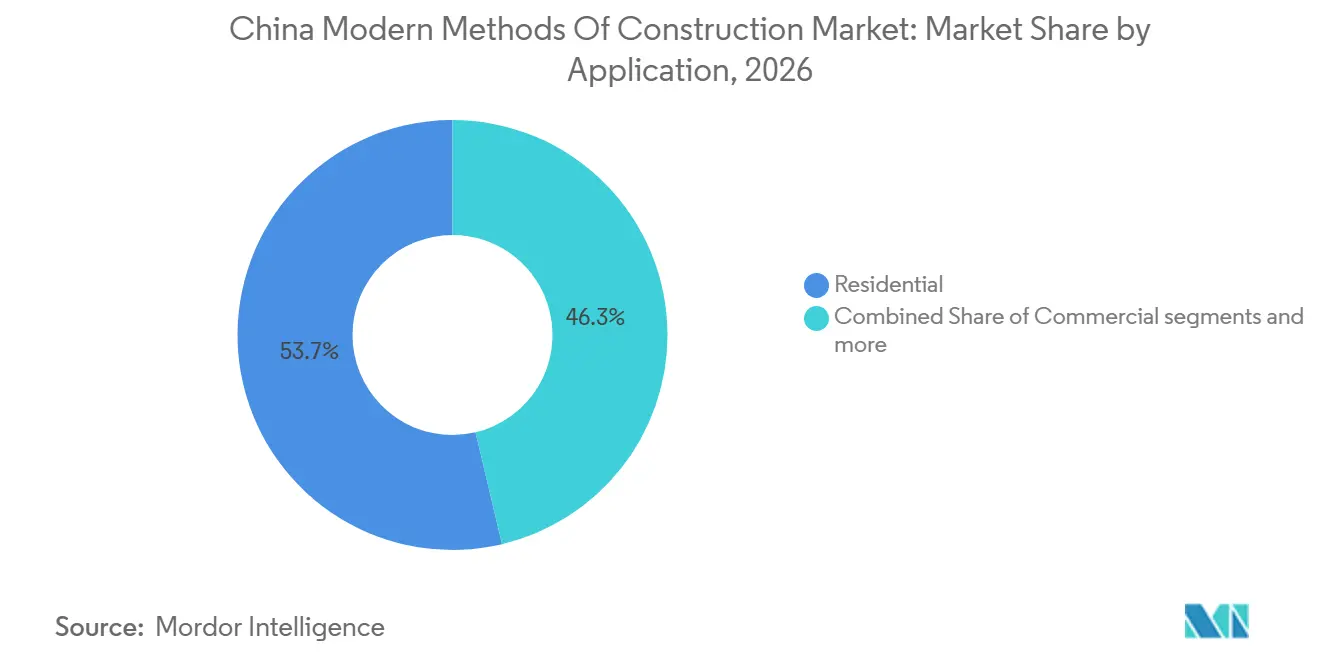
Residential construction held 53.7% of the China modern methods of construction market share in 2026. Affordable housing and city renewal projects support demand because they are less exposed to the financial pressure affecting some private developers. Factory-made construction can shorten the route to structural milestones required under completed-home sales policies. The Residential Project Code GB 55038-2025 took effect in May 2025 and sets mandatory national requirements for residential projects[3]. Residential demand will remain uneven because private housing conditions differ markedly by city.
Other applications are forecast to grow at a 7.2% CAGR through 2032. This group includes industrial facilities, institutional buildings, energy and utility assets, and infrastructure. Modular data centers are an important opportunity because projects need fast deployment and repeatable technical designs. CIMC Group reported contracts for 200 megawatts of cloud and artificial intelligence computing data center projects in the first half of 2026. Factory-controlled assembly can also improve speed and reduce coordination demands at industrial sites.
Geography Analysis
Shanghai held 18.6% of the China modern methods of construction market share among profiled cities in 2026. Its lead reflects early modular integrated construction adoption in urban renewal, a concentration of integrated engineering procurement and construction contractors, and a large redevelopment pipeline. The Tianlin Road project in Xuhui District used Concrete Modular Integrated Construction across 78,900 square meters and delivered 1,114 homes. The project provides a reference for redevelopment where temporary works and site space are limited. Shanghai’s experience with steel-structure assembled renovation gives contractors evidence for proposals in other cities.
Shenzhen is projected to grow at a 7.6% CAGR through 2032, the fastest pace among profiled cities. Its high-density sites, affordable housing programs, and production base provide favorable conditions for modular building. China State Construction International cites the Huazhang affordable housing project as a case involving 6,028 concrete modules and 2,740 rental units. Shenzhen’s supply chain can also support production for other markets. Overseas recognition of Chinese modular systems can reinforce investment in local capacity.
Beijing contributes through public-sector buildings, education facilities, and intelligent construction trials. China State Construction International secured rapid classroom projects in the Fengtai District during the first half of 2026. Hangzhou supports the Yangtze River Delta through steel-structure manufacturing, while Guangzhou’s industrial, logistics, and affordable housing work support the Pearl River Delta. Geographic expansion will depend on local procurement rules, transport distances, factory density, and skilled installation teams.
Competitive Landscape
The China modern methods of construction market is moderately concentrated among integrated platforms and fragmented among standardized component suppliers. State-owned construction groups can combine design, manufacturing, logistics, financing, and on-site assembly within a single delivery model. This structure gives them an advantage in public contracts and large urban renewal programs. Private producers compete more directly on component cost, creating pressure on margins in high-volume categories. Competitive performance increasingly depends on design capability, factory automation, schedule reliability, and project-specific execution.
China State Construction International has expanded its modular footprint through production bases, intelligent lines, and project delivery in Beijing, Shanghai, Guangzhou, Shenzhen, and Suzhou. CIMC Modular Building Systems shipped modules for its first Middle East hospitality project from Jiangmen in August 2026. Hangxiao Steel Structure secured an overseas public-building contract in Angola in 2025. These moves pair domestic production capabilities with export, hospitality, industrial, and public-project opportunities. Approvals in new locations can also reduce commercial risk when entering unfamiliar regulatory systems.
Technology is becoming a clearer point of separation in China's modern methods of construction industry. Digital design, robotics-enabled production, and design for manufacture and assembly can reduce rework and improve repeatability. China State Construction International has reported a focus on low-carbon construction and modular systems. Strategic opportunities lie in modular data centers, steel systems linked to building-integrated photovoltaics, and export markets.
China Modern Methods Of Construction Industry Leaders
-
China State Construction Engineering Corporation Limited
-
China National Building Material Group Corporation
-
CIMC Modular Building Systems
-
Broad Sustainable Building Co., Ltd.
-
China Railway Construction Corporation Limited
- *Disclaimer: Major Players sorted in no particular order
Recent Industry Developments
- September 2026: China State Construction International Holdings Limited announced that its Modular Integrated Construction newly signed contracts in the Chinese Mainland grew by more than 70% in H1 2026, with the Tongzhou Jiukeshu project identified as China's first MiC commercial residential development. The company operates 12 prefabrication manufacturing bases, 85 intelligent production lines, and an annual production capacity of 130,000 modules, with active projects in Beijing, Shanghai, Guangzhou, Shenzhen, and Suzhou.
- August 2026: CIMC Modular Building Systems officially shipped modular units for Earth Hotels Riyadh from its Jiangmen, Guangdong facility, marking the company's first hospitality project in the Middle East.
- July 2026: CIMC Group shipped 63 integrated modules for a senior apartment project in central England and 78 modules for an office project in Yaoundé, Cameroon.
- June 2026: China State Construction International delivered the Shanghai Tianlin Road project in Xuhui District, which covers 78,900 square meters and includes 1,114 homes across 9 buildings.
China Modern Methods Of Construction Market Report Scope
| Prefabricated & Modular Construction | Panelized Systems | Structural Insulated Panels (SIPs) |
| Timber/Wood Frame Panels | ||
| Light Gauge Steel (LGS) Panels | ||
| Others | ||
| Volumetric Modules | Steel-Framed Volumetric Modules | |
| Timber-Framed Volumetric Modules | ||
| Concrete (Precast/Monolithic) Volumetric Modules | ||
| Others | ||
| Hybrid Modular Construction | ||
| 3D Construction | Extrusion Method | |
| Power Bonding Method | ||
| Others | ||
| Other Construction Methods | ||
| Concrete |
| Glass |
| Metal |
| Timber |
| Other Material Types |
| Residential |
| Commercial |
| Other Applications (Industrial, Institutional, Energy and Utilities, Infrastructure) |
| Shenzhen |
| Beijing |
| Shanghai |
| Hangzhou |
| Guangzhou |
| Other Key Cities |
| By Construction Type | Prefabricated & Modular Construction | Panelized Systems | Structural Insulated Panels (SIPs) |
| Timber/Wood Frame Panels | |||
| Light Gauge Steel (LGS) Panels | |||
| Others | |||
| Volumetric Modules | Steel-Framed Volumetric Modules | ||
| Timber-Framed Volumetric Modules | |||
| Concrete (Precast/Monolithic) Volumetric Modules | |||
| Others | |||
| Hybrid Modular Construction | |||
| 3D Construction | Extrusion Method | ||
| Power Bonding Method | |||
| Others | |||
| Other Construction Methods | |||
| By Material Type | Concrete | ||
| Glass | |||
| Metal | |||
| Timber | |||
| Other Material Types | |||
| By Application | Residential | ||
| Commercial | |||
| Other Applications (Industrial, Institutional, Energy and Utilities, Infrastructure) | |||
| By Cities | Shenzhen | ||
| Beijing | |||
| Shanghai | |||
| Hangzhou | |||
| Guangzhou | |||
| Other Key Cities | |||
Key Questions Answered in the Report
What is the forecast growth rate for modern methods of construction in China?
The China modern methods of construction market is forecast to grow at a 7.01% CAGR from 2027 to 2032, reaching USD 104.7 billion by 2032.
Which construction type has the largest share in China?
Prefabricated & modular construction leads with 98.4% share in 2026, supported by established precast and modular production.
Why are modular methods gaining interest in Chinese housing projects?
They can move more work to factories, improve quality control, and reduce project time when developers need to meet completed-home sales milestones.
Which material is most widely used for modern construction methods in China?
Concrete leads with 58.4% share in 2026 because it fits existing high-rise codes, production infrastructure, and supply chains.
Which city is growing fastest for modern construction methods?
Shenzhen is forecast to grow at a 7.6% CAGR through 2032, supported by high-density development and affordable housing programs.
What applications are creating new demand beyond housing?
The China modern methods of construction market is expanding through industrial facilities, infrastructure, utilities, and modular data centers that require faster and repeatable delivery.